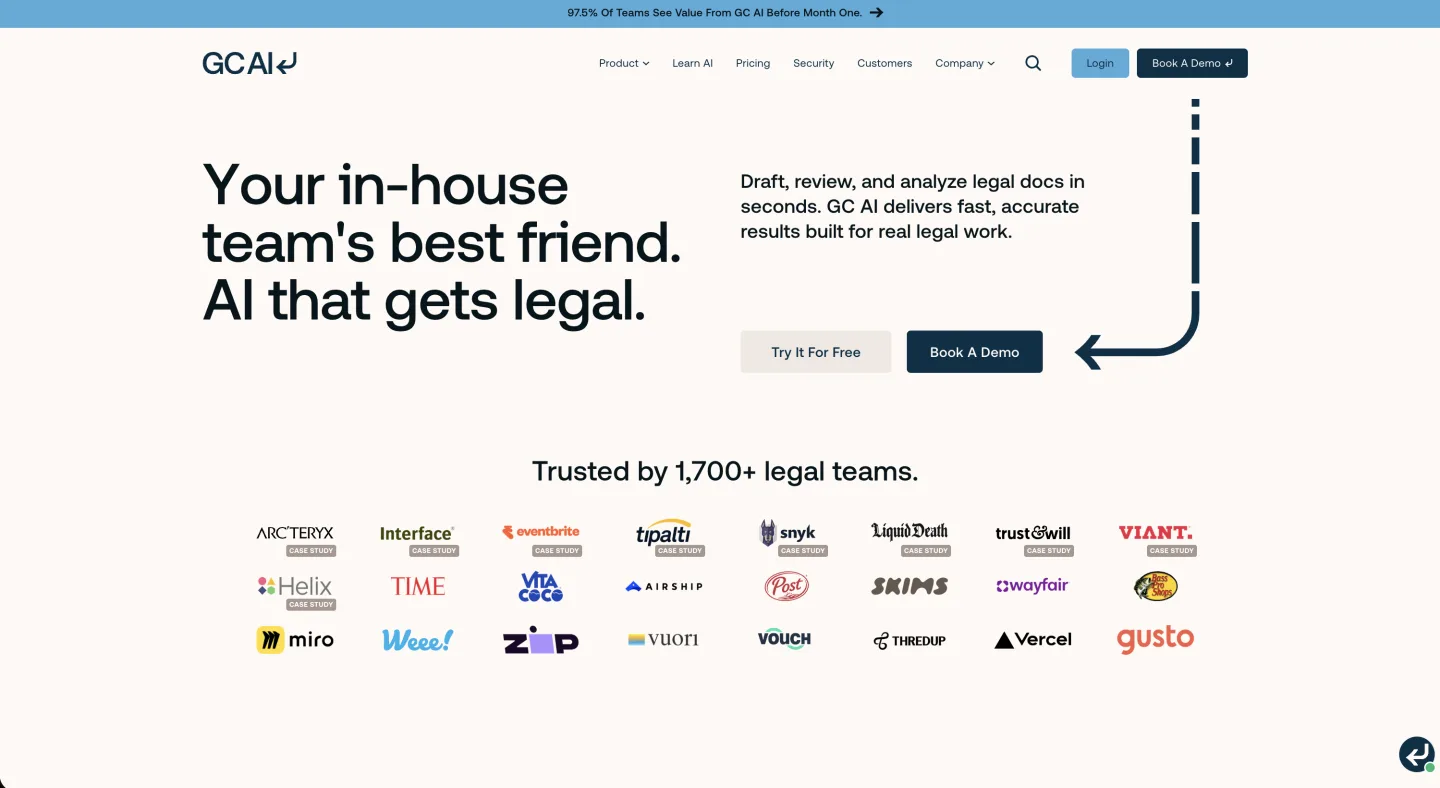
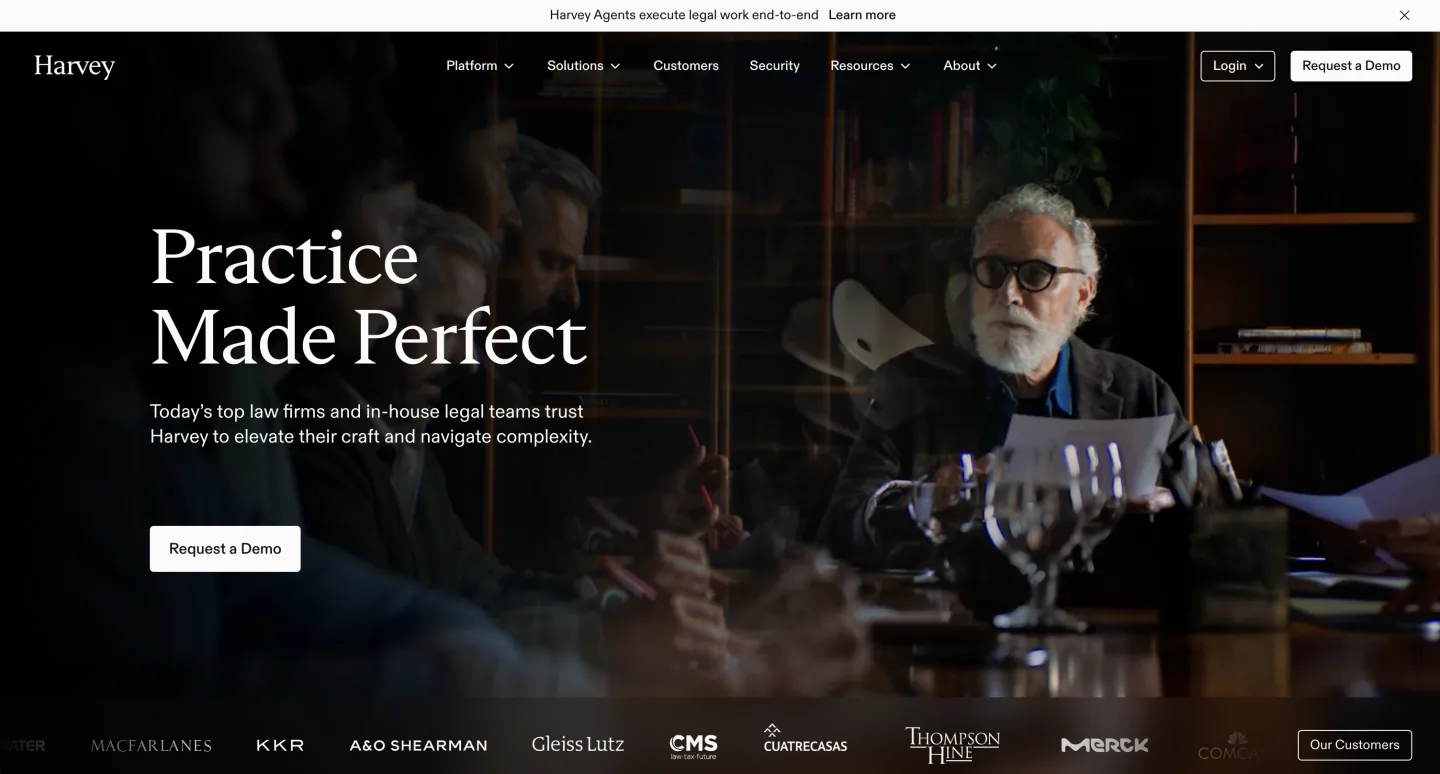
Pick GC AI if you run an in-house legal department and want a seat at a published price. Pick Harvey if you are a large firm or big enterprise rolling out AI across many users with procurement behind you.
That is the whole decision in one line. GC AI vs Harvey is less a quality contest than a buyer-fit question. The two tools aim at different rooms.
GC AI is built for in-house counsel, with an Individual seat at $500 per month and a self-serve trial (gc.ai/pricing, checked June 2026). Harvey is a frontier platform sold to AmLaw firms and Fortune 500 legal departments, quote-based, often with a multi-week buying cycle (harvey.ai, checked June 2026). The rest of this post shows where each one fits.
TL;DR
- GC AI targets in-house legal departments. Solo GCs, fractional GCs, and small in-house teams. It publishes a $500 per seat per month Individual plan with a free trial and no seat minimum (gc.ai/pricing, checked June 2026).
- Harvey targets large firms and big enterprises. AmLaw 100 firms, mid-sized firms, and Fortune 500 in-house teams. Pricing is quote-based, with no public number (harvey.ai, checked June 2026). Third-party reports put it near $1,200 to $2,000+ per user per month.
- The split is buyer fit, not winner versus loser. GC AI is self-serve and built around the in-house contract week. Harvey is a wide platform built for firm-wide and enterprise-wide transformation.
- Both are well funded. GC AI raised a $60M Series B in November 2025 (gc.ai, Nov 2025). Harvey raised $200M at an $11B valuation in March 2026 (CNBC, Mar 2026).
- Pricing notes are hedged. GC AI's Individual seat is published. Harvey's number is not, so treat any quoted Harvey figure as third-party and confirm it in your own quote.
What is GC AI's published Individual seat price?
For depth on each tool on its own, see our GC AI review and Harvey review. This post is the head-to-head.
How we compared them
We checked both vendors' live sites in June 2026 for capabilities, target buyer, and pricing posture. GC AI's seat price is published, so we state it as fact. Harvey publishes no price, so we mark its numbers as third-party and hedged.
Funding figures carry named, dated sources you can open. Where a claim comes from a vendor's own page, we say so. Anything we could not verify, we left out.
The core difference: who each one is built for
GC AI was built for the person who is the legal department. A three-time general counsel, Cecilia Ziniti, started it, and the product reflects that chair.
Its home is the in-house week: review an NDA, mark up a vendor MSA against your playbook, answer a product manager's question, draft a clause. The Individual plan even says "For solo or fractional GCs" on the pricing page (gc.ai/pricing, checked June 2026).
Harvey was built for the large firm and the big enterprise. It calls itself AI software for legal and professional services, and its customer wall leans on AmLaw 100 firms and large in-house teams (harvey.ai, checked June 2026).
The product spread shows it. Harvey lists Assistant, Vault, Knowledge, Agents, Contract Intelligence, and a Command Center for analytics. That breadth fits an organization deploying AI across many practice groups, not one lawyer buying a seat on a Tuesday.
Head-to-head comparison
| Dimension | GC AI | Harvey |
|---|---|---|
| Target buyer | In-house GCs and legal departments | Large firms (AmLaw) and big enterprise legal teams |
| Buying motion | Self-serve trial, then sales for Team/Enterprise | Sales-led, demo first, often multi-week |
| Published price | $500 per seat/mo, Individual (gc.ai/pricing, Jun 2026) | None published; quote-based (harvey.ai, Jun 2026) |
| Reported price | n/a (published) | ~$1,200 to $2,000+ per user/mo (third-party reports, hedge) |
| Seat minimum | No minimum on Individual | Not published; ~25-seat enterprise floor reported |
| Free trial | Yes, self-serve | Pilot via sales, no public self-serve trial |
| Core strength | In-house contract review and Q&A | Broad platform: research, diligence, agents, analytics |
| Word-native | Yes (Word add-in) | Yes (Harvey for Word) |
| Best fit | In-house teams that want to start fast | Firm-wide or enterprise-wide rollouts |
Pricing in this table is dated June 2026. Verify before you buy, because legal AI pricing moves.
If you want the decision as a flowchart, this is the fork most teams land on:
In-house workflows
GC AI is shaped around the jobs that fill an in-house day. Playbooks encode your clause standards and run agentic review on incoming contracts. Projects hold matter context across sessions, so you do not re-upload deal files every week.
That design matches how a small legal team actually works. One person, many matters, repeating contract types. For a deeper teardown of those features, see our GC AI review.
Harvey serves in-house teams too, but at a different scale. Its in-house pitch is for large departments with many users and complex matters across regions.
If your "department" is two lawyers holding up a 600-person company, Harvey's motion can feel oversized. The buying cycle and seat economics assume a bigger room.
Drafting and review
Both tools draft and review contracts, and both live inside Microsoft Word. GC AI runs a Word add-in. Harvey ships Harvey for Word.
GC AI's review centers on its four pre-built playbooks: NDAs, DPAs, MSAs (SaaS), and MSAs (commercial). Those are the documents that eat most of an in-house contract week. For an odd one-off agreement, the first pass needs more cleanup.
Harvey's Contract Intelligence and Vault target review at volume across many documents. Vault is built to hold and analyze large repositories, with third-party reviews describing capacity into the tens of thousands of documents per project (Spellbook, checked July 2026). That suits diligence on a deal with hundreds of agreements, or an M&A data room. For one NDA at a time, that depth is more than a in-house team needs. If bulk review is your actual bottleneck, our bulk contract review matrix walks through how to score a tool on volume.
Research
Harvey is the deeper research surface. Its Knowledge and Assistant products are built for cross-border regulatory work and complex memos, the kind a large firm runs daily.
GC AI's research is solid on bounded questions inside the contract workflow. Ask a focused question while you mark up a clause and the answer comes back with sources. Push it into wide multi-state regulatory analysis and it feels lighter than a dedicated research platform.
So if your week is mostly contracts with some research, GC AI carries the load. If deep research is the main job, Harvey has more under the hood.
Capabilities and specs, side by side
The buyer split is the headline. The platform detail is where a procurement checklist lives. Here is how the two line up on the specs teams actually ask about, drawn from each vendor's own pages and marked where a figure is vendor-reported.
| Capability | GC AI | Harvey |
|---|---|---|
| Model providers | OpenAI, Anthropic, Cohere, Reducto, Google (gc.ai, checked Jul 2026) | Custom models built with OpenAI, plus Anthropic and Google (gc.ai/harvey.ai, checked Jul 2026) |
| Contract review | Playbooks for NDAs, DPAs, SaaS MSAs, commercial MSAs | Contract Intelligence + Workflow Agents (vendor claims 25,000+ workflows) |
| Citations | Exact Quote, character-level from the source doc | Grounded in indexed firm documents |
| Document handling | Files feature for matter context | Vault for large-scale, multi-thousand-document review |
| DMS integrations | Word add-in via Microsoft AppSource | iManage, SharePoint, Outlook, Google Drive, Box (2026) |
| Security posture | SOC 2 Type II, GDPR, no training on your data (gc.ai) | SOC 2 Type II, ISO 27001, GDPR, CCPA (harvey.ai) |
| Mobile | Not published | Mobile app (shipped Sep 2025) |
Vendor-reported figures (workflow counts, adoption stats) are marketing claims, not audited numbers. Treat them as directional and confirm anything load-bearing in your own evaluation. GC AI's own site claims 1,800+ in-house teams use it daily and an NPS of 77 (gc.ai, checked Jul 2026); Harvey does not publish an equivalent NPS.
What actually differs in a pilot
The brochure split is obvious. The pilot is where the real gaps show. Below is what surfaces once a tool meets live work, lever by lever.
Setup effort. GC AI's playbooks are quick to stand up. You take its NDA or MSA template, paste in your three or four hard positions, and run. A junior lawyer can configure it in an afternoon. Harvey's value comes from grounding on your firm or department files, so the setup is heavier. You index documents into Vault and Knowledge first, and that step usually pulls in IT.
Word redline quality. Both edit in Word. GC AI's markup reads like an in-house lawyer working a known contract type, clean on its four standard documents. On a non-standard agreement it drifts toward generic. Harvey's redlines hold up better on unusual or bespoke documents, because it leans on grounded firm precedent rather than fixed playbooks.
Source grounding and citations. GC AI cites the source for a research answer and pulls verbatim quotes you can check. Harvey grounds answers in the documents you indexed, so a diligence answer points back to the exact contract and page. Test both on a question where the answer must trace to a specific clause, and watch whether the citation lands on the right line.
DMS and integrations. This is a real gap in a pilot. Harvey connects to iManage, SharePoint, Outlook, Google Drive, and added Box in 2026, the systems a firm already runs on (harvey.ai, checked July 2026). GC AI is lighter here, mainly the Word add-in through Microsoft AppSource, so a department living inside a document management system should ask exactly what it connects to before signing.
Permissioning. Harvey assumes many users and matter-level access controls, so admins scope who sees what. GC AI's Individual plan is one seat, so permissioning only matters once you move to Team or Enterprise. A regulated department should test this early, not after rollout.
Review latency. On a single NDA, GC AI feels fast, because the job is small and the playbook is tight. On a 200-contract diligence run, Harvey is built to chew through volume, where a per-contract tool would stall. Match the test to the real load, not a one-document demo.
Who owns the rollout. This decides adoption more than any feature. GC AI can be owned by a single GC who pilots it alone. Harvey needs an internal owner with budget, an IT partner, and a change-management plan. If nobody owns the Harvey rollout, seats go unused and the contract becomes shelfware.
How to run the pilot
Do not judge either tool on a demo. Run a real test that matches its job, score it, and decide on the numbers.
The GC AI test: 10 contracts. Pull 10 real agreements your team sees often: a mix of NDAs, DPAs, and vendor MSAs. Build a playbook with your five hardest positions, like a liability cap at fees paid in the prior 12 months. Run all 10 through Playbooks and time the markup against your manual baseline.
Score each contract on three things. One, did it flag every position that breaks your standard? Two, were the redlines usable as a first pass, or did you rewrite them? Three, how long did the markup take versus doing it by hand?
A pass looks like this. It catches at least 8 of 10 deviations, the redlines need light edits, and it saves real time across the set. A fail is missed deviations on standard contract types, or markups so generic you redo them.
The Harvey test: 50 documents. Pick a real diligence set of 50-plus agreements, or a research memo on an unsettled question your team actually faces. Index the documents first, then run the diligence or research workflow end to end. This tests grounding and volume, which is Harvey's job.
Score it on coverage, citation accuracy, and trust. Did it surface the key issues across all 50 documents? Does every claim cite back to the right document and clause? Could a senior lawyer sign off on the output with a normal review, or did it need a full rebuild?
A pass looks like this. It covers the set without missing a material issue. Citations trace cleanly, and a partner trusts the first draft after a normal check. A fail is missed issues at volume, citations pointing to the wrong place, or output that needs a rewrite.
Run each test on the tool built for that job. A 10-NDA test on Harvey understates it. A 50-document diligence run on GC AI overloads it. The point is fit, so test for fit.
Pricing and seat minimums
This is where the buyer split is clearest. GC AI publishes its price. Harvey does not.
GC AI's Individual plan is $500 per seat per month, with a free trial and no seat minimum (gc.ai/pricing, checked June 2026). Team and Enterprise are quote-based. A solo GC can read the number and start the same day.
Harvey shows no price and routes you to "Request a Demo" (harvey.ai, checked June 2026). One third-party breakdown puts its seats near $1,200 to $2,000+ per user per month (The Crossing, May 2026). Reporting also points to a floor on deal size: 2026 pricing roundups cite a base seat near $1,200 per lawyer per month against a 25-seat minimum on a 12-month term, which works out near $360,000 a year at the low end (The Legal Prompts, 2026). With no published number, any Harvey figure is reported, not official. Confirm the price and the seat minimum in your own quote. For more, see our legal AI pricing benchmark, the Harvey per-seat price increase, and the dedicated GC AI pricing post.
Deployment and onboarding
GC AI is the faster start. Self-serve trial, no credit card on the Individual plan, no procurement gate. A GC can pilot it alone and expand later.
Harvey is a deployment, not a download. The motion is sales-led: demo, scoping, often a security review, then a rollout. For a large firm with change-management support, that is appropriate. For one lawyer who wants to try a tool this afternoon, it is a wall.
The Enterprise side of GC AI carries managed procurement and onboarding too. So if you grow into a large in-house team, GC AI has a heavier path. Most buyers reading this comparison start on the lighter one.
Security
Both clear the security bar that in-house procurement asks for. GC AI states it is SOC 2 Type II certified, is GDPR-compliant, and does not train on your data (gc.ai, checked June 2026).
Harvey is built for enterprise and BigLaw, where security review is the default step before any deal. It indexes firm files in Vault and Knowledge for grounded answers.
Either way, run your own vendor security questionnaire before you sign. The vendor's stated posture is the starting point, not the finish line.
Honest pros and cons
GC AI, where it wins. It is built for the in-house chair, top to bottom. The price is published, the trial is self-serve, and the playbooks match the real contract week. Vendor risk is lower than most startups after a $60M Series B (gc.ai, Nov 2025).
GC AI, where it falls short. Research depth past contract review is lighter than a dedicated platform, and US Case Law is a paid add-on on the Individual plan. At $500 a seat it is in-house money, which suits a solo or fractional GC but sits awkwardly against hourly law-firm economics. The API is no longer a gap: it went publicly available on July 29, 2026 with multi-turn support (gc.ai).
Harvey, where it wins. It is the broadest platform here: research, diligence, agents, analytics, and firm-specific grounding. It is the strongest fit for AmLaw firms and large enterprise legal teams. Funding is deep, with $200M raised at an $11B valuation in March 2026 (CNBC, Mar 2026).
Harvey, where it falls short. No published price, a sales-led cycle, and economics that assume a big deployment. For a in-house team, the motion and the cost are heavy. There is no public self-serve trial.
Who should pick GC AI
Pick GC AI if you are an in-house legal department that wants to start fast. The clean fit is a solo GC, a fractional GC, or a small in-house team whose week is mostly NDAs, DPAs, and vendor MSAs.
You want a price you can read, a trial you can run alone, and playbooks that match your contracts. You do not want a procurement project to test a tool.
Run the free trial, load three real contracts into Playbooks, and time the markup. If it saves real hours, expand from there.
Who should pick Harvey
Pick Harvey if you are a large firm or a big enterprise legal team running AI across many users. The clean fit is an AmLaw firm with deep diligence work, or a Fortune 500 legal department with procurement and change management.
You need broad coverage across research, drafting, diligence, and analytics. You can absorb a sales cycle and a multi-week rollout, and you want firm-specific grounding across many practice groups.
If that is your room, Harvey's breadth and enterprise tooling are built for it. Get the price in writing and run a gold-set pilot before you commit.
A third option
If neither fits, the gap is usually price and scope. GC AI's $500 seat is built for in-house budgets, with no seat minimum, so a solo or fractional GC can buy it alone. Harvey's enterprise motion is built for large rooms with a seat floor to match. An hourly-billing firm of 2 to 15 lawyers can fall between them.
Evaluate whatever you shortlist the way you would evaluate these two: run a trial, test your own contracts, and check the fit before you decide. For the ranked field at this buyer, see the best legal AI tools for in-house counsel.
FAQ
GC AI vs Harvey: which is better for in-house counsel?
For most in-house teams, GC AI is the easier fit. It is built for the in-house contract week and publishes a $500 per seat per month Individual plan with a free trial (gc.ai/pricing, checked June 2026). Harvey suits large enterprise legal departments with procurement, not in-house teams.
How much do GC AI and Harvey cost?
GC AI's Individual plan is $500 per seat per month, published openly, with Team and Enterprise quote-based. Harvey publishes no price and routes you to a demo. Third-party reports put Harvey near $1,200 to $2,000+ per user per month, but treat that as reported and confirm your own quote.
Does either tool have a free trial?
GC AI offers a self-serve free trial with no seat minimum on the Individual plan. Harvey does not list a public self-serve trial; you pilot it through sales after a demo.
Which has better legal research?
Harvey has the deeper research surface, built for cross-border regulatory work and complex memos at firm scale. GC AI's research is strong on bounded questions inside the contract workflow and lighter on wide multi-state analysis.
Do GC AI and Harvey work inside Microsoft Word?
Yes, both do. GC AI ships a Word add-in, and Harvey ships Harvey for Word. So you can draft and review without leaving the document in either tool.
Is Harvey overkill for a small in-house team?
Often, yes. Harvey's breadth and enterprise motion assume a large deployment with procurement. A two-lawyer team usually gets more daily value from a tool built for the in-house week, like GC AI, or a lower-cost suite.
Are GC AI and Harvey financially stable vendors?
Both are well funded. GC AI raised a $60M Series B in November 2025 (gc.ai, Nov 2025). Harvey raised $200M at an $11B valuation in March 2026 (CNBC, Mar 2026), after an earlier round reported at an $8B valuation.
Does Harvey have a seat minimum?
Harvey does not publish one, but multiple third-party pricing writeups describe an enterprise motion with a multi-seat floor and an annual term. Reports cite roughly a 25-seat, 12-month minimum (The Legal Prompts, 2026). Read that as reported, not official, and pin down the exact minimum in your quote. GC AI's Individual plan has no seat minimum (gc.ai/pricing, checked June 2026).
Can I use GC AI and Harvey together?
Yes, and some organizations do. A firm can run Harvey for firm-wide diligence and research while a lean in-house team, or a specific department, uses GC AI for the daily contract week. The tools do not conflict, so the real question is whether two budgets and two rollouts are worth it for your headcount.
What if neither GC AI nor Harvey fits my budget?
Start with what each one charges you to find out. GC AI publishes $500 a seat monthly, $5,000 annually, with no seat minimum and a 14-day trial, so a single lawyer can test it without a sales call. Harvey's seat floor means the smallest realistic contract is a procurement exercise. If neither shape works, the best legal AI tools for in-house counsel covers the ranked field, and you can compare standard clause libraries while you evaluate.
Last updated: September 2026.
New legal AI guides, weekly.
Further Reading
The Legal AI Funding Arms Race: What $11B Harvey Means for In-House Buyers
Read postCoCounsel vs Harvey: Which Legal AI Fits Your Team?
Read postHarvey vs Legora: Which Legal AI Should You Choose?
Read postWhat Lawyers Want From Legal AI in 2026: A 534-Lawyer Study
Read postAI Medical Record Review for Lawyers: How It Works, What It Costs, and Where It Breaks
Read postIs Legal AI a Bubble? What the 2026 Market Data Says
Read post
Co-Founder & CEO · Attorney
Arshita leads product and strategy at Vaquill, building the legal AI suite that solo, small-firm, and in-house US lawyers use to run a matter end to end.