Ironclad beats Icertis when contract intake starts in Salesforce, legal-ops (not IT) owns the workflow build, and the team can live with twelve weeks to production rather than twelve months. Ironclad beats cheaper CLMs (Concord, Linksquares, Spotdraft) when contract volume exceeds 1,500 a year, workflow branching nests beyond two layers, or AI redline volume is meaningful.
Outside those bands, the cheaper CLMs are usually right; Icertis wins only on enterprise-scale governance. Most Ironclad RFPs that go sideways do so because the buyer paid for Ironclad without confirming legal-ops actually had the Salesforce admin time to own the integration.
Is Ironclad worth it? Yes for a Salesforce-centric mid-market or enterprise in-house team running 500+ contracts a year, no for solos, small firms, and in-house teams the $50K to $200K+ price tag prices out. Reviewers rate it 4.5/5 on G2 and 4.4/5 on Capterra (June 2026), and it sits among the leaders on Gartner Peer Insights, so the product quality is not the question. Fit and budget are.
GC at a Series D software company, three direct reports, sales closing forty deals a quarter. Legal is the revenue-recognition bottleneck because every custom NDA and order form sits in someone's email. Salesforce is already the source of truth, finance wants a renewal obligation tracker.
Shortlist: Ironclad, Icertis, and cheaper options no one believes will scale. Four tests separate right-shape from wrong-shape: workflow shape, volume and complexity, integration surface, segment fit. Ironclad scores high on workflow and integration, strong on volume for the right profile, miscast on segment outside a narrow band.
TL;DR
- Ironclad sits firmly in the top two of any serious CLM RFP in 2026: San Francisco-based, founded 2014 by Jason Boehmig (ex-Fenwick & West) and Cai GoGwilt (ex-Palantir), customer book includes L'Oreal, Salesforce, OpenAI, Mastercard, Cisco, and Shell. Reviewers rate it 4.5/5 on G2 and 4.4/5 on Capterra, and it ranks among the leaders on Gartner Peer Insights (all June 2026).
- Capitalization signals durability: roughly $333M raised cumulatively, with the January 2022 Series E adding $150M at a $3.2B valuation (Franklin Templeton's venture arm leading, with Accel, Sequoia, and Bain Capital Ventures participating). Industry reporting put ARR around $200M heading into 2025.
- Where it wins: the Workflow Designer is the most flexible no-code contract builder in the category, Salesforce integration is best-in-class, and Jurist (launched November 2024) ships AI clause work inside a fully editable .docx workspace rather than as a bolt-on chat tab.
- Where it has real gaps: primary-law research is explicitly not the product, outside-counsel coordination workflows are shallow, the public API surface is enterprise-gated, and pricing (typically $50K to $200K+ annually) prices out solo practitioners and 2-15 lawyer firms entirely.
- Watch the fine print. Independent pricing trackers report the AI (Jurist) tier commonly quoted as a separate line item near $50K to $200K per year, overage fees around $5 to $10 per contract over plan, and renewal rates rising materially without a negotiated cap (Spellbook, 2026; Bind, 2026).
Per this review, which buyers does Ironclad's typical $50K to $200K+ pricing price out entirely?
For more on legal AI vendor comparisons, see /topics/vendor-comparisons.
At a glance
| Ironclad | |
|---|---|
| Price | Quote-based, roughly $50K to $200K+ per year (triangulated from Vendr and Spendflo reported deals) |
| Access | Sales-negotiated contract, 6 to 12 week implementation |
| User ratings | 4.5/5 G2, 4.4/5 Capterra, leader on Gartner Peer Insights (June 2026) |
| Best for | Mid-market and enterprise in-house contract teams on Salesforce |
| Free trial | No self-serve trial; access arranged through a rep |
| Word-native drafting | Editable .docx Editor; Jurist AI runs on that surface |
| AI tier | Reported as a separately quoted line item, ~$50K to $200K/yr (Spellbook, Bind, 2026) |
| Trains on your data | No retention or training by the underlying model providers, per Ironclad (SOC 2 Type II, GDPR, HIPAA) |
| Public API | Enterprise-gated, no self-serve tier |
Read that table as a description of one product rather than a scorecard. Ironclad is a full CLM: post-signature obligation tracking, renewal automation, and a Salesforce-driven approval pipeline. Lighter contract workbenches do not do those things, so the comparison only makes sense once you know whether you need a governed contract pipeline at all.
What Ironclad actually is
Boehmig and GoGwilt founded Ironclad in 2014; Boehmig had quit Fenwick & West the same day GoGwilt walked out of Palantir. The product carried the original "self-serve CLM" thesis: contracts as data, workflows as configurable graphs, in-house counsel (not a vendor consultant) assembling the pipes.
The bet is still visible in the product. A lawyer who can describe a contract intake on a whiteboard can mostly build it in the software the same week.
Capital backed the thesis: Y Combinator in 2015, then Accel, Sequoia, and Bain Capital Ventures across Series A through D, and a January 2022 Series E adding $150M at a $3.2B valuation. Roughly $333M raised cumulatively. Ironclad consistently survives to the final two in any CLM RFP that does not start and end with Icertis.
What each product surface actually does on the third Tuesday of the month
Five surfaces carry the weight, and the right way to evaluate them is to ask what each one would do for the third Tuesday of a real in-house lawyer's month, not what the demo shows.
Workflow Designer. Drag-and-drop, no-code builder for contract intake, approval, and execution. The lawyer maps "sales rep submits a custom NDA" through "deal desk reviews," "legal approves anything with mutual indemnification," "DocuSign sends for signature," "Salesforce updates the opportunity."
Each node is configurable. Scales from a five-step NDA flow to a twenty-something-step diligence intake without forcing the team off the platform. Competitors with rigid template flows tend to hit a wall when conditional branching gets nested two layers deep; Ironclad does not.
Editor. Collaborative drafting in an editable .docx workspace: track changes, comments, versioning, redline reconciliation. Close enough to Word that lawyers can use it without retraining. The Editor is what makes Jurist viable; the AI runs on the same surface the lawyer is editing.
Jurist (the AI assistant, launched November 14, 2024). Conversational AI for drafting, editing, reviewing, summarizing, translating, and answering contracting questions. Built on Ironclad's open-source Rivet platform.
Two things separate it from bolt-on AI tabs shipped by other CLM vendors in 2024: agent actions and reasoning are surfaced inline with citations, and Jurist iterates on company precedent inside the .docx environment, not a sidebar the lawyer copy-pastes from. Sold with CLM, not as a standalone seat. SOC 2 Type II, GDPR, HIPAA compliant; no retention or training on customer data by the underlying model providers.
Repository. Post-execution storage, metadata extraction, search, renewals, obligation management. Standard CLM table stakes, executed cleanly. The "billions of contracts processed" figure earns its keep: the extraction model has seen more variants than any internal tool will encounter.
Integrations. Salesforce has been the depth play since 2018: bidirectional, opportunity-aware. Slack, a Word add-in for holdouts, Google Drive, Workday for vendor and employee flows, DocuSign and Adobe Sign. Salesforce is the integration most often cited in revenue-ops-led RFPs as why Ironclad wins over Icertis or Conga.
A live trial surfaces things the demo hides. Workflow Designer is flexible but slow: a non-trivial flow takes a half-day, not fifteen minutes. Jurist is strongest on the four standard types and noticeably generic on bespoke commercial agreements with novel clauses.
The Editor handles Ironclad-originated documents cleanly and is middling on heavily-tracked Word files from outside counsel. The SOW typically understates Salesforce configuration; ask explicitly which workflows are in scope before signing.
Ironclad pricing: what buyers actually pay
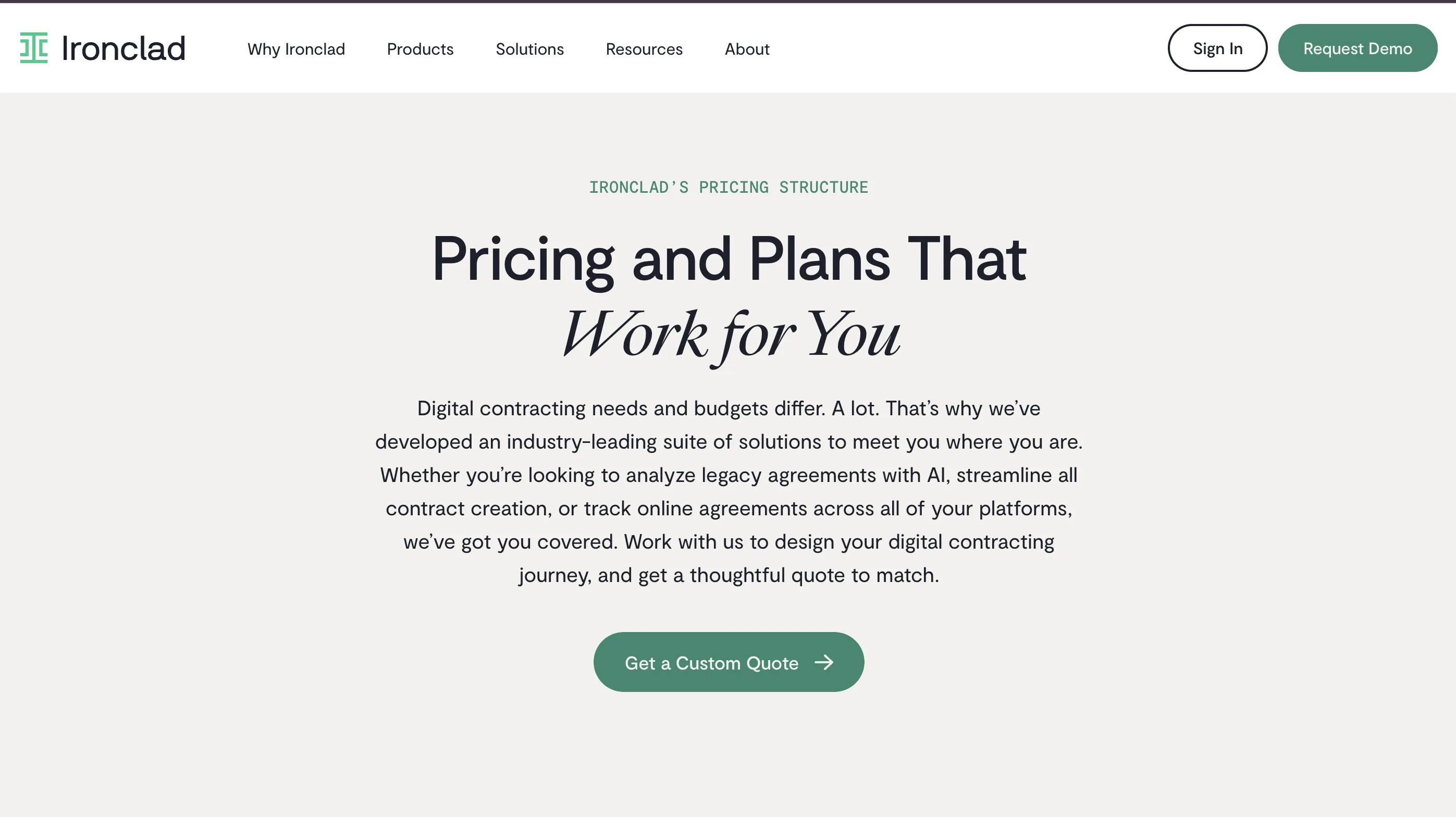
Ironclad does not publish pricing. The one hard, sourced anchor available is the Vendr marketplace figure: the median Ironclad buyer pays about $39,995 per year across 354 tracked purchases, negotiating roughly 20.6% off on average, with tracked deals landing anywhere from $13,740 to $99,630 (Vendr, June 2026). Read the median as the middle of the curve, not your number. Seat count, contract volume, and the AI tier swing the total hard.
The bands below are estimates triangulated across Vendr, Spendflo, and reported deals; treat them as starting points for a sales conversation, not as quotes:
- Small in-house (10-20 seats, low volume): roughly $30K-$60K per year.
- Mid-market (500-2,000 contracts annually, 10-30 users): commonly $50K-$120K per year.
- Enterprise (1,000+ employees, 5,000+ contracts annually, 50+ users, advanced AI and analytics): $150K-$250K+ per year, with implementation services often adding $50K-$100K in year one.
Three line items catch buyers who read only the platform quote. First, the AI tier. Ironclad positions Jurist as part of CLM rather than a standalone seat, but that does not make it free: independent pricing trackers report the AI Assist / Jurist tier commonly quoted as a separate line item at roughly $50K to $200K per year on top of the core platform (Spellbook, 2026; Bind, 2026). Ask whether AI is bundled or surcharged in your quote. Second, overage fees: buyers who exceed plan contract volume can face charges near $5 to $10 per contract (Spellbook, 2026; Bind, 2026). Third, renewal escalation, covered in the warning below.
Multi-year commitments trim 15% to 25% off annual pricing, and a competitive evaluation on the table is worth another 20% to 30% off the initial quote (Oneflow, 2026). Implementation runs six to twelve weeks, longer for custom Salesforce orchestration.
For a 15-lawyer team at a mid-market software company processing 1,500 contracts a year through Salesforce, the all-in first-year number commonly lands between $80K and $150K. Ask which workflows ship in implementation, whether Jurist is bundled or surcharged, and which integrations are scoped versus billable. Our Ironclad pricing breakdown walks the line items in more detail.
Where Ironclad clearly wins
Workflow flexibility. The Designer is the no-code builder most often cited by legal-ops practitioners as the reason they stayed off the professional services treadmill. A fifteen-step intake with conditional branching, parallel approvals, and Salesforce round-trip can usually be built without paying consultancy hours.
Salesforce integration depth. Bidirectional and opportunity-aware. If your contract intake starts in Salesforce ("Sales rep closes an opportunity, the MSA needs to be generated and routed"), Ironclad commonly has the shortest path to a working pipe of any CLM in the RFP.
Customer proof. Customer list includes L'Oreal, Salesforce, OpenAI, Mastercard, Cisco, Shell. Salesforce itself selected Ironclad for its own CLM in 2024, the kind of dogfood signal procurement teams overweight correctly when the vendor is also the customer's largest integration partner.
Support that scores. Ironclad rates 9.2/10 for customer support on G2 (June 2026), above the CLM category average. For a platform that needs an admin to run well, responsive support is not a footnote.
Jurist bundled, not bolted. Most CLM vendors shipped AI in 2024 as a separate tab or SKU. Jurist runs inside the .docx workspace where lawyers are already editing, with reasoning and citations inline (launch reporting).
Lawyers who do not trust a black-box AI redline can read the agent's reasoning trace, see which prior contract the suggestion was anchored to, and approve or reject without leaving the document. Multiplied by a hundred contracts a week, that pattern is the difference between the AI tier paying for itself and not.
Self-serve speed-to-deploy. Icertis deployments commonly run nine to fifteen months to production; Ironclad stands up a working contract flow in six to twelve weeks. That time-to-value gap is where Ironclad wins most head-to-head RFPs in the upper mid-market.
The time-to-value gap is where Ironclad wins most head-to-head RFPs in the upper mid-market.
Where Ironclad has gaps
Primary-law research is not the product. Ironclad is a contract operating system, not a research tool. If your bottleneck is "we need the indemnification carve-out standard in Delaware versus California versus New York before drafting," Jurist is not built for that.
The platform assumes the lawyer brings the legal standard. For an in-house team where 30% of the week is regulatory research, pair Ironclad with a research workbench; do not ask Jurist to replace one.
Outside-counsel coordination is shallow. Ironclad assumes in-house teams own the intake, drafting, and execution loop end to end. Outside-counsel workflows (matter assignment, billing rate negotiation, work-product return, conflict checks) live outside the product. Teams that route a meaningful percentage of contract work through outside firms will find the seam between Ironclad and their e-billing or matter management stack uncomfortably wide.
Public API access is enterprise-gated. Ironclad has an API, but accessing it productively requires an enterprise contract and an account rep. For a legal-ops team plugging into Zapier, Make, or n8n, that is real friction.
For a developer building a custom tool on top of contract metadata, the absence of a self-serve, well-documented public tier is a hard constraint. (See why MCP is the 2026 integration plane.)
Pricing pushes out smaller buyers. $50K-$200K+ fits mid-market and enterprise in-house teams. Solos and 2-15 lawyer firms looking for contract automation will find Ironclad priced for a different buyer. Worth naming because buyers landing here from "best CLM" lists without checking segment will bounce.
The AI tier is priced like an add-on. Even though Ironclad markets Jurist as part of CLM, third-party trackers report it quoted as a separate line item at roughly $50K to $200K per year (Spellbook, 2026; Bind, 2026). Budget for it as a real cost, and confirm in writing whether your quote bundles or surcharges the AI.
OpenAI dependency in the AI stack. Industry analyses through late 2025 noted Ironclad's reliance on OpenAI for Jurist. Rivet is the abstraction layer, but a serious procurement question is whether multi-model fallback is in place. Ask in the demo. (AI-native review tools like Spellbook face the same question; see our Spellbook review.)
Search, reporting, and mobile trail the rest of the product. Public reviews complain about this more than they complain about the AI. Reviewers on G2, Capterra, and Software Advice report that finding an older contract breaks down when metadata or tags were entered inconsistently, that the built-in reporting and analytics feel underbuilt next to the polish of the Workflow Designer, and that the desktop experience is strong while mobile redlining on complex documents is thin (SoftwareReviews / G2, 2026). One Software Advice reviewer called the setup "choose your own adventure" and warned it is hard to run without a full-time admin. Budget for metadata hygiene and a named owner, or search degrades as the repository grows.
What users say. Ratings stay high (4.5/5 on G2, 4.4/5 on Capterra, June 2026) and the workflow builder draws genuine praise, but the recurring gripes cluster on search findability, clunky PDF-to-Word editing on large files, thin mobile redlining, and a learning curve that needs admin time. Strong product, real operating overhead.
What buyers misprice in the SOW (the Ironclad CLM review the sales deck won't give you)
Three patterns derail Ironclad deployments more often than vendors disclose, and each maps to a hidden integration cost the SOW does not surface.
The first is split ownership. Legal-ops owns the workflow build; RevOps or IT owns the integration. Common failure: the legal-ops lead signs the SOW, the Salesforce custom object mapping for the order form is never in scope, week eight arrives and production slips a quarter. Hidden cost: $15K to $40K in change-order integration work. Fix: put the Salesforce admin in the room before signing.
The second is sales-team change management. If reps are used to emailing custom NDAs to legal, the new front door fails until enablement happens. Hidden cost: two to three weeks of change management not in the SOW, plus every deal slowing while reps learn the flow. Fix: budget enablement explicitly, run it before go-live.
The third is contract migration. Loading a backlog of 5,000 historical PDFs into a searchable Repository state is a separate project that almost never falls inside the standard SOW. Hidden cost: a six to twelve week migration engagement that runs $30,000 to $80,000. Fix: scope it as a separate workstream, or accept that legacy search is not usable at go-live. (For adjacent vendor stack considerations, see the small-firm legal tech stack.)
Who should buy Ironclad
The clean buy: in-house contract team at a mid-market or enterprise company with Salesforce as the system of record, 500+ contracts a year across NDAs, DPAs, MSAs, and vendor agreements, a real no-code workflow appetite, and a budget that absorbs $80K to $200K all-in for year one.
Public-company in-house teams with mid-volume contract review are in the sweet spot. Late-stage startup GCs with a legal-ops counterpart are too.
Who should look elsewhere
Litigation-first firms. Not built for matter intake, discovery, or pleadings; a litigation practice management tool is the right shape.
Primary-law researchers. In-house teams dominated by multi-jurisdictional regulatory analysis will find a dedicated research workbench far deeper. Pair tools; do not expect Jurist to do the research job.
Developer shops needing an API. The enterprise-gated API is a constraint for programmatic workflows (the developer-friendly stack).
Solo and 2-15 lawyer firms. The price is built for in-house budgets, not small-firm economics.
Deal counsel doing M&A. Ironclad handles recurring commercial contracts at scale. For ten-figure M&A diligence with bespoke transaction documents, the workflow assumptions don't carry; the value is in repetition, and M&A deals don't repeat the same way an NDA pipeline does.
Regulated industries facing novel rules. Healthcare, financial services, and defense buyers with thousands of bespoke clause variants find Jurist works best on contracts the company has signed before. For genuinely novel regulatory clauses (a new state privacy regime, a fresh export-control rule), Jurist hedges and the team does the analysis by hand. A ceiling on automation rate most procurement teams do not test for in trial.
What to actually do, by segment
For a Salesforce-centric mid-market or enterprise in-house team with contract volume that justifies workflow automation, Ironclad is often the right answer. Jurist closes a real gap that CLM platforms with bolted-on AI tabs left open.
The remaining gaps (primary-law research, outside-counsel coordination, API access, smaller-buyer pricing, OpenAI dependency) are real but knowable, and most are addressable by pairing Ironclad with the right adjacent tool.
Three demo questions before anything else: (1) "Show me a Workflow Designer build of our actual intake flow, end to end, with our Salesforce custom objects, in this session." (2) "Run Jurist on a contract outside the four standard types and show me the reasoning trace." (3) "What is the API access tier, rate limits, and contract for a legal-ops team plugging into Zapier or Make this quarter?"
Any vendor reluctance is a procurement signal.
What to do next, this week, not next quarter:
- Mid-market or enterprise in-house team, Salesforce-centric, contract-heavy. Open the trial, pick the single most painful current intake flow, and build it in Workflow Designer end-to-end. If you cannot get to a working version in one half-day, that is your answer. If you can, the rest of the procurement is paperwork.
- In-house team where research is the bottleneck, not contracts. Buy the research workbench first; revisit Ironclad when contract volume justifies the seat.
- Solo or 2-15 lawyer firm. Skip. Look at workbenches priced for small-firm economics (the small-firm stack).
- Developer or legal-ops engineer needing an API. Press hard on API access terms before signing, and have a fallback platform in mind.
FAQ
How much does Ironclad cost? Ironclad does not publish pricing. The Vendr marketplace puts the median buyer at about $39,995 per year across 354 tracked deals, ranging $13,740 to $99,630 (Vendr, June 2026). Triangulated bands run around $30K to $60K for small in-house deployments, $50K to $120K for mid-market, and $150K to $250K+ for enterprise, with implementation often adding $50K to $100K in year one. Two extras to budget: the AI (Jurist) tier is commonly quoted as a separate $50K to $200K per year line item, and overages run about $5 to $10 per contract over plan (Spellbook, 2026; Bind, 2026). For a 15-lawyer team processing 1,500 contracts through Salesforce, the all-in first year commonly lands between $80K and $150K.
Are Ironclad's AI features included in the base price? Ironclad markets Jurist as part of the CLM experience rather than a standalone seat, but that does not mean it is free. Independent pricing trackers report the AI Assist / Jurist tier quoted as a separate line item at roughly $50K to $200K per year on top of the core platform (Spellbook, 2026; Bind, 2026). Get it in writing whether your quote bundles or surcharges the AI tier.
Does Ironclad raise prices at renewal? Third-party pricing trackers report Ironclad raising renewal rates materially. Without a negotiated cap, a roughly $50K per year contract can reach $65K or more by year three (Spellbook, 2026). Negotiate a renewal escalator cap into the initial contract; it is far cheaper to secure before signing than to claw back at renewal.
How long does Ironclad take to implement? Six to twelve weeks for a standard deployment, longer when Salesforce orchestration is custom. That compares with nine to fifteen months for Icertis, which is the time-to-value gap Ironclad wins most upper-mid-market RFPs on. Historical contract migration (loading a backlog of thousands of PDFs into a searchable Repository) is a separate workstream that usually runs six to twelve weeks on its own.
Is Ironclad worth it? For a Salesforce-centric mid-market or enterprise in-house team with 500+ contracts a year and a real no-code workflow appetite, yes. The Workflow Designer and Salesforce depth stand a working pipe up in 6 to 12 weeks, versus 9 to 15 months for Icertis. Outside that band, a cheaper CLM is usually the right call, and small firms are priced out entirely.
How accurate is Ironclad's Jurist AI? Jurist runs inside the editable .docx workspace with reasoning and citations surfaced inline (Law.com launch coverage, Nov 14 2024). It is strongest on the four standard contract types and noticeably more generic on bespoke commercial agreements with novel clauses. Industry analysis through late 2025 flagged its reliance on OpenAI, so ask about multi-model fallback in the demo.
Ironclad vs Icertis: which should I buy? Ironclad wins when legal-ops (not IT) owns the workflow build, intake starts in Salesforce, and you can deploy in weeks. Icertis wins on enterprise-scale governance and the largest, most complex contract estates. Most Ironclad RFPs that go sideways do so because the buyer never confirmed legal-ops had the Salesforce admin time to own the integration.
Does Ironclad have a free trial? Not a self-serve one. Several third-party blogs claim a "14-day free trial," but Ironclad's own pricing page shows no trial and routes everyone to "Get a Custom Quote" through a demo. Any hands-on access is arranged with a rep. The best test once you have it: pick your single most painful intake flow and try to build it end-to-end in Workflow Designer in one half-day. If you cannot, that is your answer.
What are the main complaints about Ironclad? The most consistent ones in public reviews are search and findability when contract metadata is inconsistent, underbuilt reporting and analytics, clunky PDF-to-Word editing on large files, thin mobile redlining, and a setup that needs a full-time admin to run well. The AI assistant Jurist reviews better than the search experience. None of these are dealbreakers for a resourced legal-ops team, but they are real operating overhead.
Ironclad vs DocuSign CLM: which is better? Ironclad wins on workflow flexibility and Salesforce depth; legal-ops can build and change intake flows without consultants. DocuSign CLM tends to fit teams already standardized on DocuSign for signature and document generation who want CLM in the same stack. If your contracts originate in Salesforce, Ironclad usually has the shorter path; if signature volume drives the decision, weigh DocuSign. Our full CLM comparison walks the tradeoffs.
Does Ironclad fit solos, small firms, or in-house teams? Not at that price. A $50K to $200K+ band is built for in-house and enterprise budgets rather than small-firm economics, and the implementation timeline assumes a legal-ops function to run it. Teams at that size shop the lighter contract-workbench tier.
Does Ironclad replace legal research? No. Primary-law research is explicitly not the product; Jurist assumes the lawyer brings the legal standard. Teams where a meaningful share of the week is regulatory research should pair Ironclad with a dedicated research workbench rather than ask Jurist to do that job.
If Ironclad's $50K to $200K band is built for a larger team than yours, that is worth establishing before the demo rather than after: the implementation cost and the legal-ops overhead scale with it.
For more on legal AI vendor comparisons, see /topics/vendor-comparisons.
New legal AI guides, weekly.
Further Reading
LinkSquares Review 2026: An Honest Assessment for In-House Contract Teams
Read postLuminance Review 2026: An Honest Assessment for In-House Counsel
Read postIronclad Pricing 2026: CLM Cost Ranges and the AI Add-On
Read postCoCounsel Review 2026: An Honest Assessment for In-House Counsel
Read postLegora Review: Who It's For, What It Costs, and Where It Falls Short
Read postBloomberg Law AI Review 2026: An Honest Assessment for Transactional and Litigation Teams
Read post
Co-Founder & CEO · Attorney
Arshita leads product and strategy at Vaquill, building the legal AI suite that solo, small-firm, and in-house US lawyers use to run a matter end to end.