Short answer: pick Ironclad if you have legal ops headcount and want the strongest pre-signature workflow and AI redlining; pick DocuSign CLM if you are already standardized on DocuSign e-signature and want one vendor; pick ContractWorks if you want published pricing, a free trial, and a repository you can stand up in days. Under 200 contracts a year of mostly NDAs and vendor paper? You probably do not need any of them.
The CLM market in 2026 is in the middle of two simultaneous shifts. The first is consolidation at the top: Ironclad keeps absorbing functionality from the AI startups (negotiation, redlining, post-signature analytics), Workday folded Evisort into its suite, and DocuSign CLM keeps cross-selling on top of the e-signature footprint that 90% of US in-house teams already have.
The second is pressure at the bottom: AI-native contract review tools like Spellbook, lightweight NDA triage tools, and Claude Cowork plugins are pulling the simpler workflows out of CLM platforms entirely. If your team only buys a CLM to handle NDAs and vendor agreements, you might not need a CLM at all in 2026.
This post is for in-house counsel and legal ops teams evaluating CLM in 2026. We will walk through what each major platform actually costs, where each one wins, and the under-discussed question of whether you should be running a CLM at all.
TL;DR
- Skip CLM entirely if you run under 200 contracts/year of mostly NDAs and vendor agreements; a DMS plus an AI review layer plus e-signature is cheaper and faster.
- Ironclad or DocuSign CLM only pays back if you have dedicated legal ops headcount or an active Customer Success engagement. Without one, you will use 20% of the platform you paid for.
- ContractWorks, Juro, or SpotDraft is the right buy for 200-1,000 contracts/year with at least one ops admin; Evisort now ships as Workday CLM; Icertis remains Fortune-1000-only.
- Watch the price labels: published "$10 to $40 per user" figures floating around for "DocuSign CLM" are e-signature plans, not the CLM platform, which is quote-based in the tens of thousands.
- The real story in 2026 is the AI-native bottom: Spellbook, Claude Cowork Legal, and review skills are taking the NDA and vendor-triage workload out of CLM platforms at a tenth of the price.
Which of the three head-to-head tools has no native e-signature?
Part of our document tools, redline, and matrix guide series.
For related document-tools coverage, see Cost-Effective CLM Platforms Compared: What Small and Mid Firms Pay in 2026 and Top Contract Management Vendors for Fortune 500 Legal Teams.
A thread on r/legaltech ("Which legal doc automation tools are actually working in 2025?") comparing Ironclad, DocuSign CLM, and ContractWorks has aged well; the conclusions track what we see at customers in 2026.
How we compared these tools
We looked at eight CLM and AI-review platforms in-house counsel actually shortlist, scored on the seven axes buyers decide on: price, AI features, workflow depth, native e-signature, integrations, implementation time, and best-fit team. Prices are quote-based at the top of the market, so we cite third-party negotiation data (Vendr medians, surfaced via Bind Legal, Feb 2026) and label every figure. Sentiment lines come from named forums and review sites, linked where they return live. We build legal AI (Vaquill AI), so the methodology and sources are here for you to check the math.
Ironclad vs DocuSign CLM vs ContractWorks: the head-to-head
| Axis | Ironclad | DocuSign CLM | ContractWorks |
|---|---|---|---|
| Annual cost (8-30 seats) | $30K-$100K+ (Vendr via Bind Legal, Feb 2026) | $25K-$100K+ (Vendr via Bind Legal, Feb 2026) | $700-$2,000/mo published; ~$20K-$30K typical |
| Pricing model | Quote-based, per workflow | Quote-based, often bundled with e-sign seats | Published tiers, free trial |
| AI features | Jurist AI: clause redlining, risk scoring, 190+ auto-extracted properties | DocuSign Insight: post-sign extraction, obligation and renewal tracking | Competent clause extraction on standard contracts |
| Workflow depth | Strongest visual builder (Workflow Designer) | Simpler, fine for straightforward flows | Thin negotiation and redlining |
| Native e-signature | No (integrates DocuSign or Adobe Sign) | Yes (its core product) | Yes, built in |
| Integrations | Salesforce, Slack, Coupa, Teams, Zapier, Box | 1,000+ via DocuSign ecosystem | Salesforce, DocuSign, Office 365 (ERP needs connectors) |
| Implementation | ~2+ months (4-6 weeks advertised) | 3-12 months (often overruns) | Days to ~2 weeks |
| G2 / Capterra | 4.4 G2, 4.6 Capterra value | 4.1 G2, 4.3 Capterra value | Strong on ease and setup speed |
| Best for | Mid-market and enterprise with legal ops | DocuSign-standardized, regulated buyers | Small in-house teams wanting simple, cheap, fast |
Ratings: G2 and Capterra category listings via Juro's DocuSign CLM vs Ironclad comparison, Oct 2025. Implementation and feature axes: HyperStart's Ironclad vs DocuSign guide (Apr 2026) and Juro (Oct 2025).
IntelAgree vs DocuSign CLM
IntelAgree is an AI-native CLM aimed at mid-market legal teams, built around Saige Assist, its generative AI layer for clause extraction, redlining, and search (IntelAgree, 2026). It competes with DocuSign CLM less on e-signature footprint and more on AI depth. If you are weighing the two head to head, the split is straightforward: IntelAgree leads on AI-native contract intelligence, while DocuSign CLM leads on native e-signature and single-vendor consolidation for teams already standardized on DocuSign.
| Axis | IntelAgree | DocuSign CLM |
|---|---|---|
| AI clause extraction | Saige Assist auto-identifies and extracts key clauses and terms for review (IntelAgree, 2026) | DocuSign Insight extracts clauses and key terms post-signature (via Juro, Oct 2025) |
| Renewal alerts | Automated renewal and expiration alerts with obligation monitoring (IntelAgree, 2026) | Obligation tracking and renewal alerts via Insight (via Juro, Oct 2025) |
| Semantic search | Plain-language semantic search across the full contract portfolio (IntelAgree, 2026) | Search across the executed-contract repository, with Insight surfacing extracted key terms |
| Best for | Mid-market legal teams wanting AI-native contract intelligence | Teams standardized on DocuSign e-signature wanting a single-vendor stack |
| G2 rating | 4.6 across ~60 reviews (G2, 2026) | 4.1 (via Juro, Oct 2025) |
IntelAgree does not publish pricing and routes you to a demo, so budget it in line with the other AI-native mid-market platforms in this post. Like the rest of these platforms, it is a full CLM. If your team mostly runs NDA and vendor triage, the AI-native review layer covered further down may handle the actual work at a fraction of the cost.
What a CLM actually is in 2026
Contracts govern roughly 80% of B2B revenue (World Commerce & Contracting, via Summize's CLM guide, 2026), yet a large share of legal teams still track them in inboxes and shared drives rather than a system of record. That gap is what CLM software sells against.
A CLM platform handles five workflows that, until roughly 2020, lived in five different tools:
- Template management and self-serve generation. Marketing wants to send an NDA to a prospect; instead of emailing legal, they generate one from a managed template.
- Negotiation and redlining. The CLM tracks versions, suggests edits against your playbook, and routes approvals.
- E-signature. DocuSign, Adobe Sign, or a native equivalent.
- Repository and search. Every executed contract goes into a searchable archive with extracted key terms (parties, term, value, governing law, etc.).
- Post-signature analytics and obligations management. Renewal dates, auto-renewal alerts, compliance with negotiated terms.
A "real" CLM does all five with deep integrations into Salesforce, Slack, Microsoft 365, and your DMS. The cheap end of the market does two or three with looser integrations.
The AI-native end of the market does one or two with no integrations but at a fraction of the price.
The real options at full-CLM scale
Ironclad
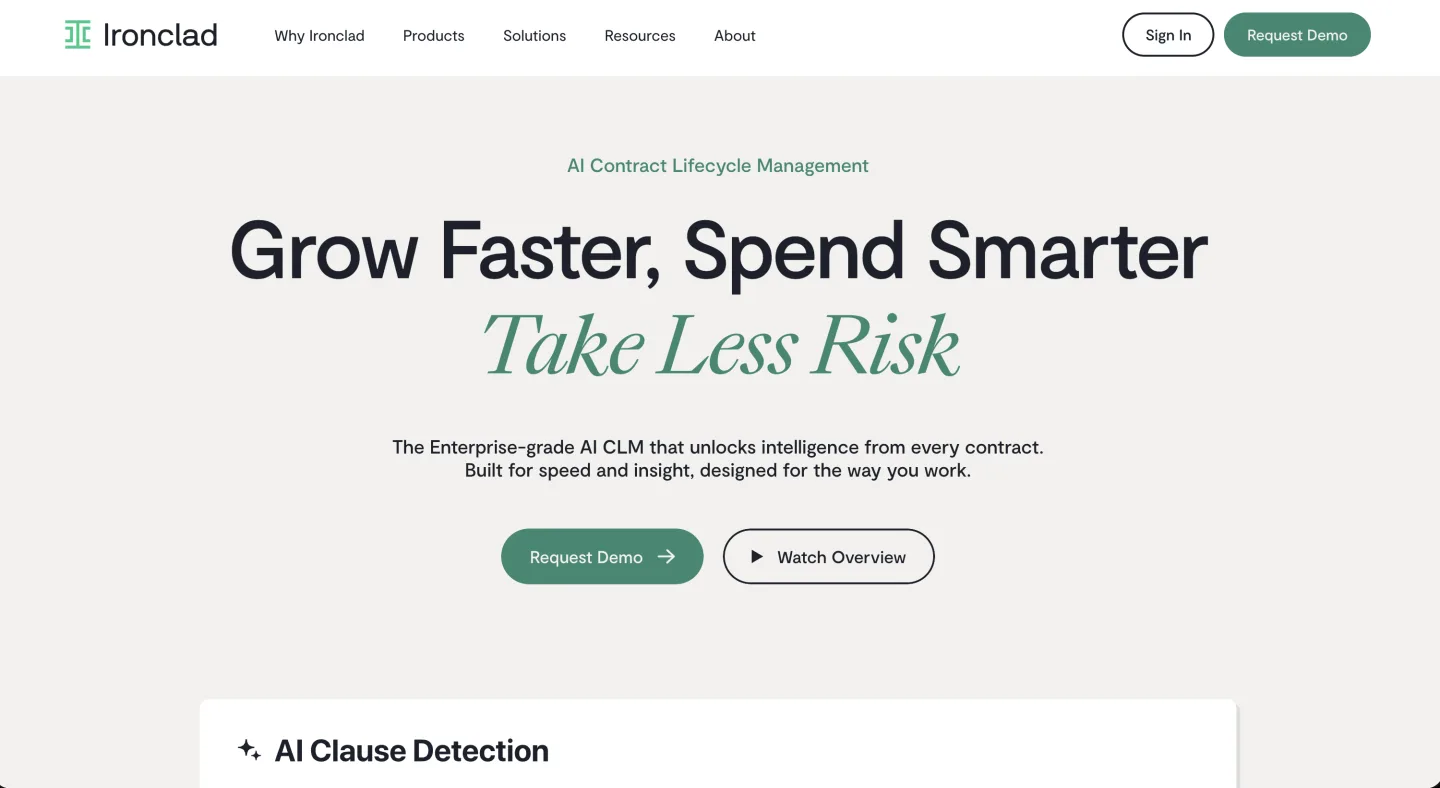
Pricing: Quote-based, no public list. Third-party negotiation data puts the Standard tier around $30,000 to $50,000 per year and Professional around $50,000 to $100,000, with a $15,000 minimum annual contract (Bind Legal, citing Vendr marketplace data, Feb 2026). Enterprise deployments run $100,000 and up.
Best for: Mid-market and enterprise legal ops teams. Strong adoption at sub-AmLaw and AmLaw 200 firms with internal legal ops headcount.
What it does well: End-to-end CLM with deep Salesforce, Slack, and Microsoft 365 integrations. Jurist AI handles clause-level redlining and risk scoring against 190+ auto-detected contract properties, and Workflow Designer is the strongest visual workflow builder in the category. The repository search is mature and the post-signature analytics actually surface useful renewal-management signals.
What it does poorly: No native e-signature, so you sign through DocuSign or Adobe Sign and carry a second bill. Setup runs ~2 months or more (4 to 6 weeks advertised) with a paid Customer Success engagement, and Workflow Designer needs legal ops engineering hours to configure.
The per-seat pricing penalizes high-employee, low-legal-team companies (e.g., a 500-employee startup with 3 lawyers may end up paying for 50+ seats because the platform is used outside legal).
What users say: Ironclad rates 4.4 on G2 and 4.6 on Capterra for value, ahead of DocuSign CLM on both (via Juro's comparison, Oct 2025). The recurring complaint is workflow setup that non-legal users struggle to maintain.
ironcladapp.com is the canonical landing page.
DocuSign CLM
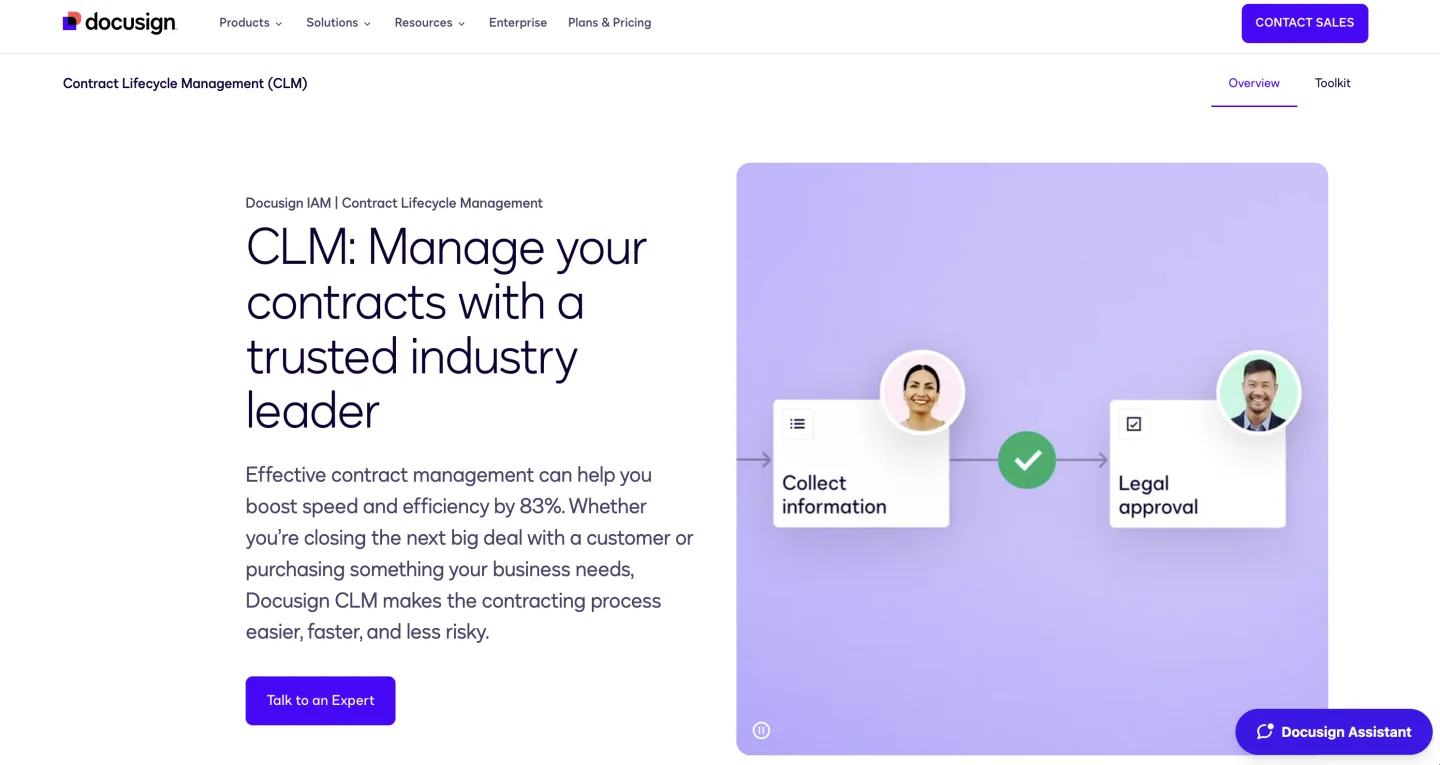
Pricing: Quote-based. Third-party negotiation data puts CLM Essentials around $25,000 to $50,000 per year and full CLM at $50,000 to $100,000 and up, often bundled with DocuSign e-signature seats that complicate the per-seat math (Bind Legal, citing Vendr marketplace data, Feb 2026).
Best for: Companies that are already deep on DocuSign e-signature and want a single-vendor stack. Strong adoption at Fortune 1000 and regulated industries.
What it does well: Native e-signature is built in, the only one in this trio that signs without a third-party connector. DocuSign Insight handles post-signature clause extraction, obligation tracking, and renewal alerts well.
The product had a difficult 2022-2024 period during a major platform rewrite, but the current generation (post-2025) is stable.
What it does poorly: The pricing structure incentivizes you to keep adding modules; the "all-in" cost typically lands 50% to 80% higher than the initial quote once you have actually deployed what your team uses. Implementation runs 3 to 12 months and frequently overruns.
The negotiation layer is less polished than Ironclad's for redlining workflows. Customer Success is uneven; some teams report excellent support, others a struggle.
What users say: DocuSign CLM sits at 4.1 on G2 and 4.3 on Capterra for value, with the dated interface and long implementation as the common gripes (via Juro's comparison, Oct 2025).
docusign.com/products/clm is the product page.
Evisort (now Workday CLM)
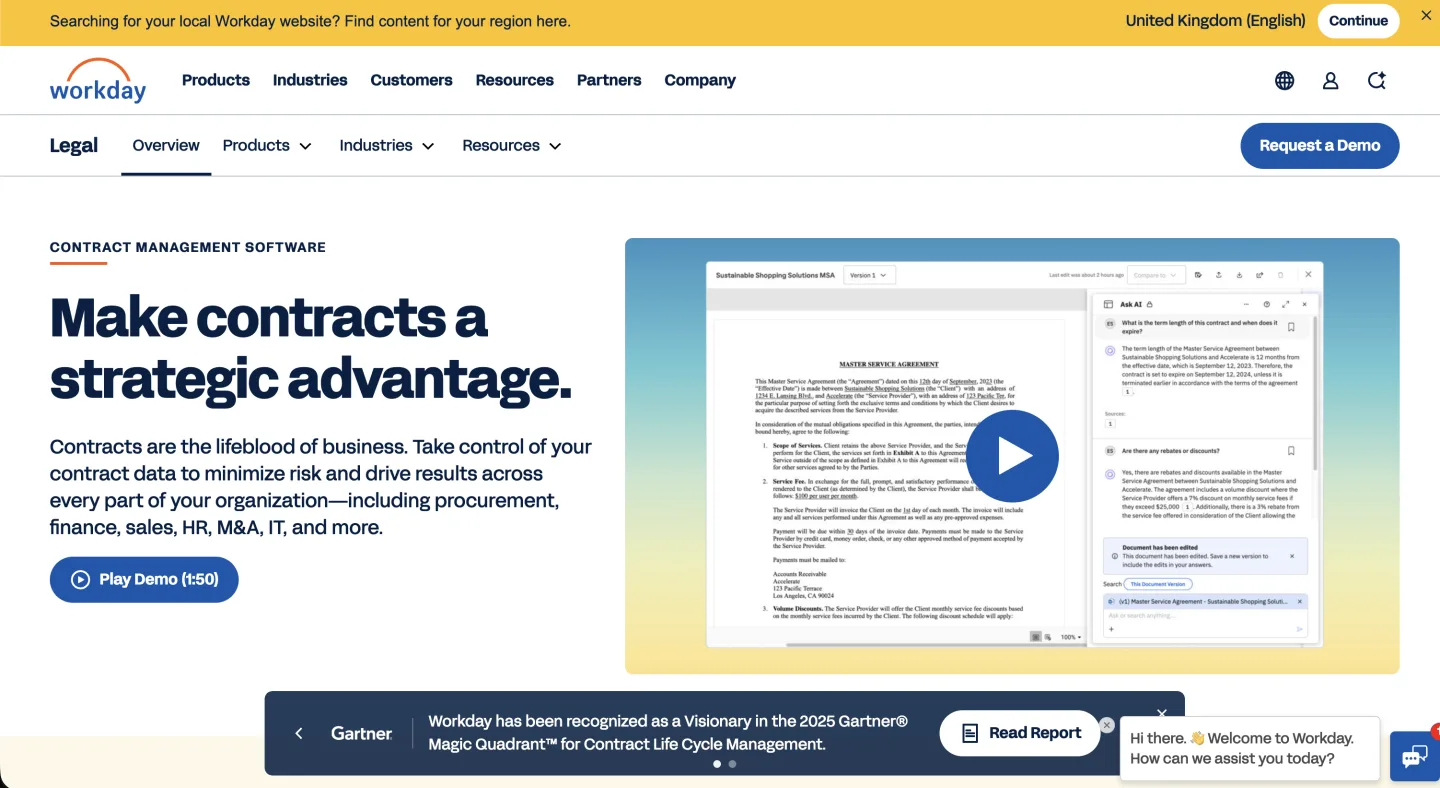
Pricing: Quote-based, enterprise. No public list; budget in line with the other enterprise-grade platforms once you add the Workday tie-in.
Best for: Mid-market and enterprise teams that want AI-first contract analytics and are already in, or moving toward, the Workday ecosystem. Workday acquired Evisort and now sells it as Workday Contract Lifecycle Management, powered by Evisort AI (Workday product page, 2026).
What it does well: AI extraction and analytics were the original product, so clause detection, obligation tracking, and reporting across large contract sets feel native rather than bolted on. The Workday connection is a genuine advantage if your finance and HR data already live there.
What it does poorly: The acquisition is still bedding in, and standalone Evisort buyers report roadmap uncertainty as features fold into the broader Workday suite. Integration and implementation outside the Workday stack are less mature than Ironclad's, and the enterprise sales motion prices it out of small teams.
workday.com contract-lifecycle-management is the product page.
Agiloft

Pricing: Custom. Mid-market entry around $40,000 to $60,000 per year. Enterprise contracts six figures.
Best for: Highly customized enterprise legal ops setups where the standard CLM workflows do not fit the company's procurement or vendor management processes. Government, defense, and regulated industries are the strong customer base.
What it does well: Configurable to a degree no other CLM matches. Strong custom workflow capability, integration with ERP and procurement systems (SAP, Oracle), and the most mature contract analytics suite for compliance-heavy industries.
What it does poorly: The flexibility comes at the cost of out-of-the-box usability. Agiloft implementations are typically 4 to 8 months and require dedicated administrator headcount.
For mid-market teams without a legal ops engineer or a Salesforce-style admin, Agiloft tends to ship a sub-optimal initial configuration that takes a year to refine.
agiloft.com is the product site.
Conga CLM
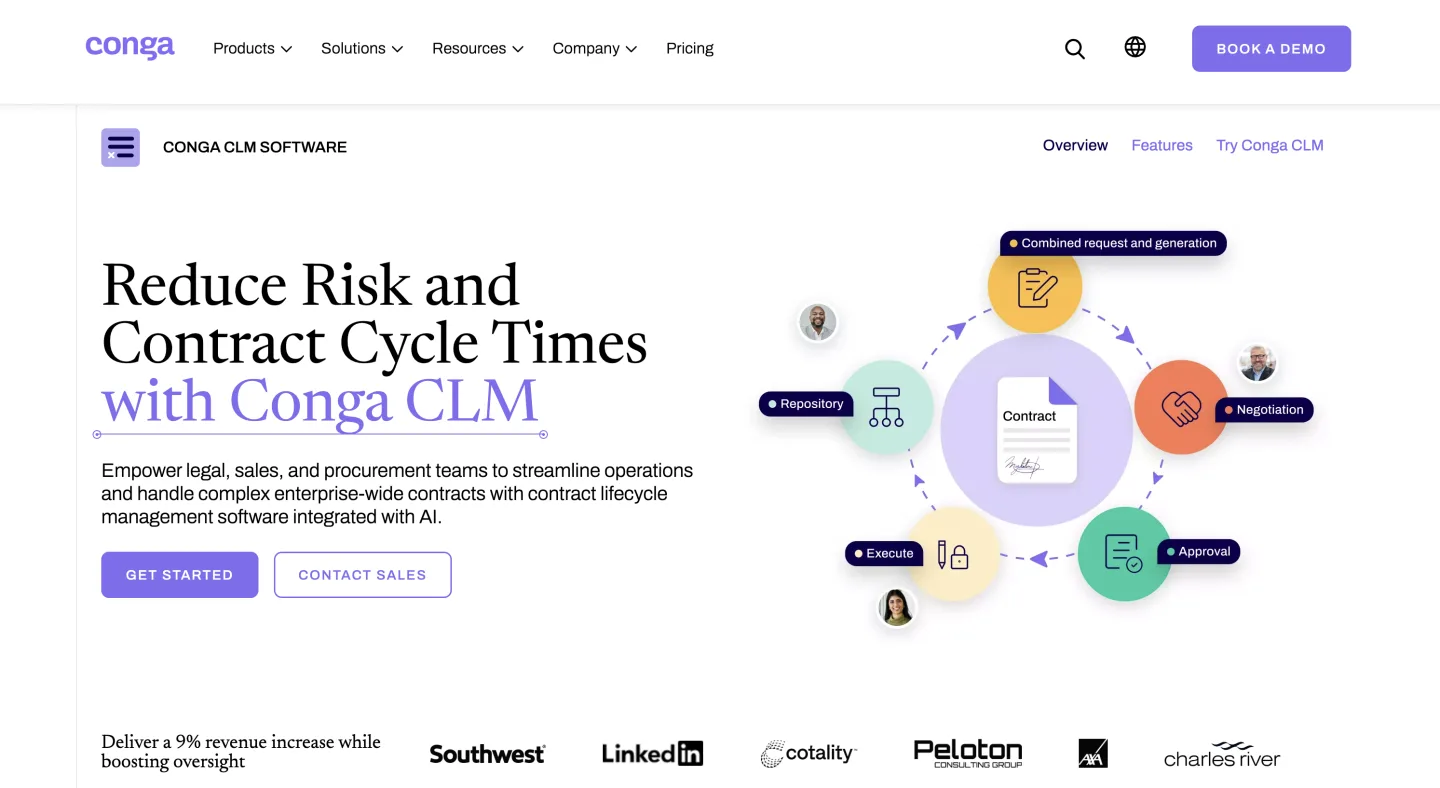
Pricing: Custom. Mid-market entry around $20,000 to $35,000 per year.
Best for: Salesforce-centric companies that want CLM living inside their Salesforce instance. Conga (formerly Apttus) was built Salesforce-native and that lineage shows.
What it does well: Salesforce integration is the deepest in the market. Document generation from Salesforce records (proposal, MSA, SOW) is fluid. Negotiation and approval workflows route through Salesforce-native UX.
What it does poorly: If you are not on Salesforce, Conga makes less sense. The standalone product (Conga CLM) is credible but lacks the polish of Ironclad or DocuSign CLM at comparable price points.
AI features have been added but feel layered-on rather than native.
conga.com/products/conga-clm is the product page.
Icertis
Pricing: Enterprise-only, typically $200,000+ per year.
Best for: Fortune 500 companies with very high contract volume and regulatory complexity. Pharma, banking, defense, large industrials.
What it does well: The highest-volume CLM platform in production at Fortune 500 scale. Strong AI extraction across millions of contracts, configurable to any compliance framework, deep integration with SAP and Oracle.
What it does poorly: Mismatched for any company below the Fortune 1000 line. The implementation cost alone (often six figures before software) prices it out of mid-market entirely.
icertis.com is the product site.
The mid-market alternatives
For teams that do not need (or cannot afford) Ironclad-class platforms:
ContractWorks
Pricing: Published at $700/month base (3 users, 100 contracts) up to $2,000/month for unlimited. Mid-market customers typically land in the $20,000 to $30,000 per year range.
Best for: Small in-house teams (2 to 10 lawyers) at sub-$100M revenue companies. Real estate, healthcare, professional services where the contract volume is meaningful but not massive.
What it does well: Published pricing. Real free trial. Setup typically completes in 1 to 2 weeks. AI clause extraction is competent on standard contract types. The repository search and reporting are sufficient for compliance and audit needs at this scale.
What it does poorly: The negotiation and redlining layer is thin. If your team handles complex bilateral negotiations (M&A NDAs, MSA negotiations with enterprise customers), ContractWorks will not be enough.
Integrations are functional but not deep (Salesforce, DocuSign, Office 365 are supported; ERP integrations require third-party connectors).
contractworks.com is the canonical site.
Juro
Pricing: Published entry point at $463/month for the Essentials plan, scaling to custom Scale and Enterprise tiers (Guideflow CLM roundup, 2026). A rare published starting price in a market that hides behind demos.
Best for: Growing in-house and operations teams that want an AI-native CLM in a browser-native editor, at a lower entry point than the enterprise platforms.
What it does well: Contract creation, negotiation, e-signature, and repository in one browser-native workspace, with AI drafting and summarization built in. The published Essentials price makes budgeting straightforward, which is unusual at this end of the market.
What it does poorly: Depth of workflow configuration and integration breadth trail Ironclad and DocuSign CLM at the top. Very high-volume or heavily customized procurement processes can outgrow it.
juro.com is the canonical site.
SpotDraft
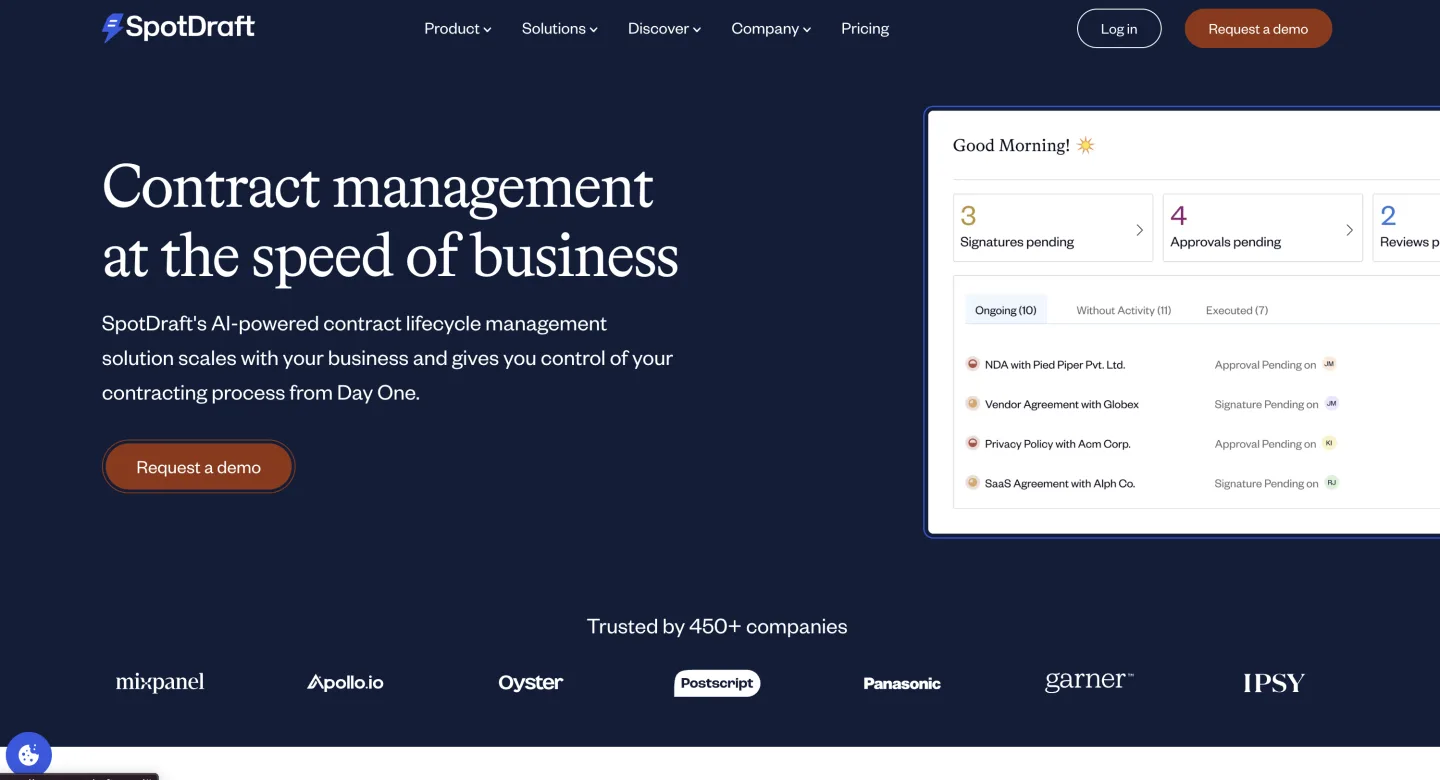
Pricing: Custom. Mid-market entry around $15,000 to $25,000 per year.
Best for: Growing mid-market in-house teams (5 to 20 lawyers) that want CLM functionality without enterprise pricing.
What it does well: AI-first design with negotiation, redlining, and clause extraction built in rather than bolted on. Customer-friendly contract structure with shorter terms and clearer upgrade paths than Ironclad or DocuSign CLM. The product roadmap has been moving fast.
What it does poorly: Smaller customer base means thinner third-party integration ecosystem. If your stack relies on niche tools, you may find integrations missing.
spotdraft.com is the canonical site.
The AI-native disruptors
This is where the market is being reshaped in 2026. A new class of tools handles contract review and triage without being a full CLM, at 5% to 10% of the cost.
Spellbook is the most established. AI clause-level review, redlining against a playbook, and Word-native track-changes output. Spellbook does not list pricing publicly and routes you to a demo; the base plan is $500 per seat, with team and enterprise tiers up.
It is not a CLM (no e-signature, no repository, no post-signature analytics), but for in-house teams whose CLM is mostly used for NDA and vendor-agreement review, it does the actual work for a fraction of the CLM price. Transactional lawyers like the Word add-in; the standing gripes are occasional wrong citations and a transactional-only focus that leaves litigation thin (Lawyerist review, ~4.1/5).
Gavel is worth a look for the same NDA-and-vendor triage job. Gavel Exec (its contract-review product) is quote-based with no public price, but it earns genuine Reddit praise for surgical redlines that do not turn the whole document red, and for Projects that train on your own clause library (r/legaltechAI, Oct 2025).
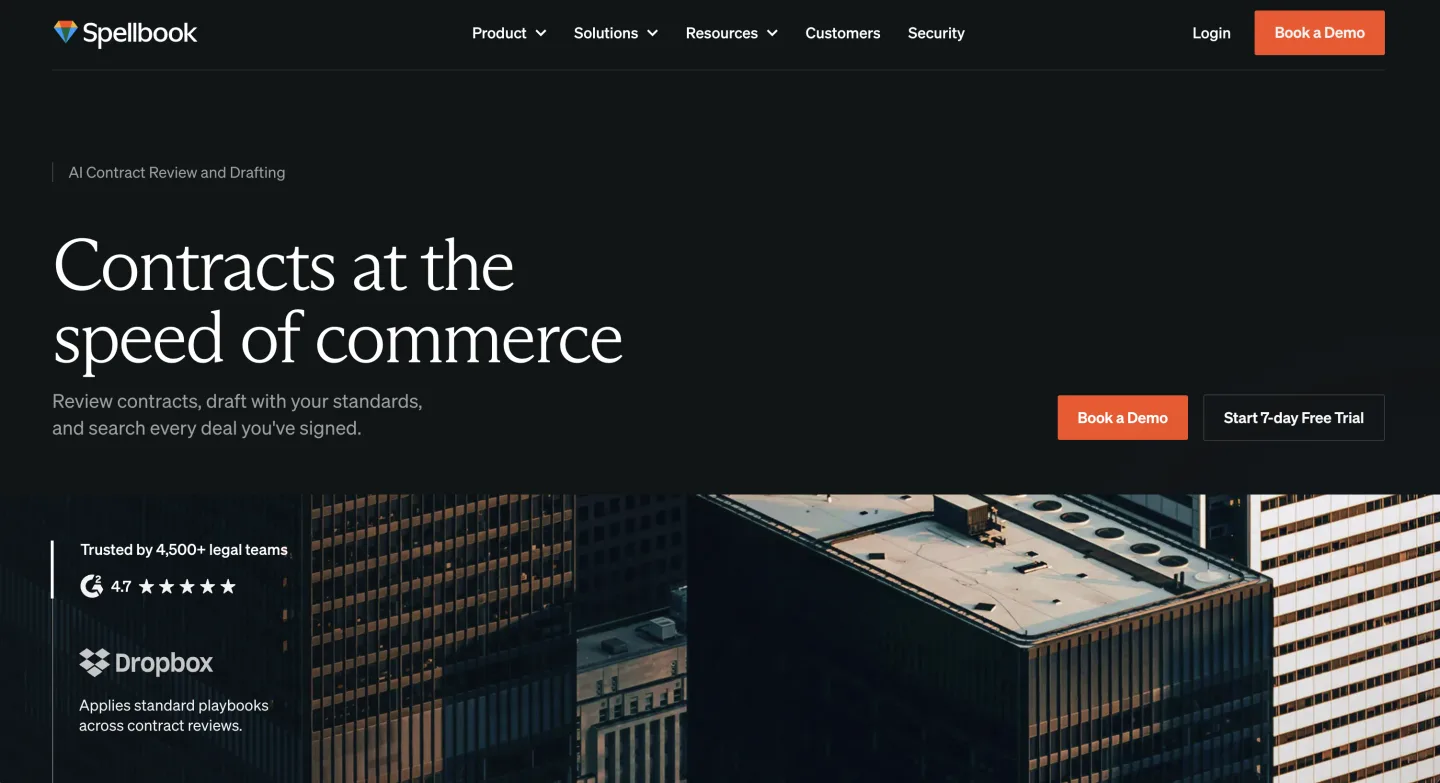 Spellbook does Word-native clause review and redlining without the full CLM stack.
Lightweight AI CLMs sit between review tools and full platforms. Concord starts around $17 per user per month with a free tier, and PandaDoc's Business plan starts around $35 per user per month (Guideflow CLM roundup, 2026). Both are cheaper than enterprise CLM but lighter on legal-grade negotiation and analytics.
Skill-based review stacks (NDA triage, contract review) sit inside per-seat legal AI suites with self-serve, published pricing and handle the same workflow for teams that want AI legal research and contract review on one stack. See our NDA triage evaluation post for the longer analysis.
Claude Cowork Plugins with the official Legal plugin (free with Claude Pro/Team/Enterprise) handle a similar workflow at the foundation-model layer, without a workflow-specific tool. This is the bottom of the market, and it is moving up fast.
ChatGPT custom GPTs with playbook-aware prompting can replicate Level 1 to 1.5 NDA triage entirely. Not a recommended primary workflow tool, but a credible last-resort for teams with no CLM budget at all.
Pricing reality check
Here is what 8 lawyers at a mid-market company actually spend per year for the same CLM workflow at each tier:
| Stack | Annual all-in (8 lawyers) | What you get |
|---|---|---|
| Icertis | $200,000+ | Enterprise CLM, Fortune 500-grade |
| Ironclad mid-market | $80,000 to $150,000 | Full CLM, deep integrations |
| DocuSign CLM mid-market | $60,000 to $120,000 | Full CLM, native e-sig integration |
| Agiloft mid-market | $50,000 to $100,000 | Customizable enterprise CLM |
| Evisort / Workday CLM | Quote-based (enterprise) | AI-native CLM, Workday-integrated |
| Conga CLM | $40,000 to $80,000 | Salesforce-native CLM |
| ContractWorks | $20,000 to $30,000 | Mid-market CLM, lighter negotiation |
| SpotDraft | $15,000 to $25,000 | AI-first mid-market CLM |
| Juro (Essentials, published) | $5,500/year+ | AI-native CLM, published entry price |
| Spellbook (review only) | $6,000/seat/year (base) | AI review and redlining, no repository or e-sig |
| Per-seat AI suite (review + research) | $9,500 | AI review skill plus in-product case law and statute research |
| Claude Cowork + DIY repository | $3,000 to $5,000 | AI review only, no workflow tooling |
Juro's figure is the published Essentials entry plan, not an 8-seat quote; an 8-lawyer deployment lands on a higher custom tier.
The 50x gap between Icertis and "Claude plus a folder structure" is real, and it is the spread that legal ops teams are now sorting through.
The big question: do you need a CLM at all?
For an in-house team handling fewer than 200 contracts per year that are mostly NDAs, vendor agreements, and standard customer contracts, the honest answer is probably no. What you actually need is:
- A document store with search (your DMS, Google Drive, SharePoint, or NetDocs all qualify)
- An AI review layer for incoming contracts (Spellbook, a per-seat review suite, or Claude with the Cowork Legal plugin)
- An e-signature tool (DocuSign or Adobe Sign, which you probably already have)
- A spreadsheet (or a Notion, Airtable, or Linear setup) for tracking renewals and obligations
Total cost: $20 to $200 per month per user, depending on which AI review layer you pick. Compare that against $5,000 to $20,000 per user per year for any of the CLM platforms above.
For teams handling 1,000+ contracts per year with complex negotiations, renewals, and multi-party workflows, you need a real CLM. The economics flip; the per-contract cost on a CLM platform becomes lower than the per-contract cost of human and AI review without workflow automation. Ironclad or DocuSign CLM is where you land.
For teams in the middle (200 to 1,000 contracts per year), the answer depends on whether you have a legal ops headcount to configure and maintain the CLM. If yes, ContractWorks, Juro, or SpotDraft pay for themselves within 12 months.
If no, you will get more value from the AI-native stack and a tighter workflow discipline than from a CLM that is poorly maintained.
What we are seeing at customers
The pattern we see most often at small in-house teams (5 to 20 lawyers at mid-market companies): they tried Ironclad or DocuSign CLM, found it overengineered for their volume, did not have the legal ops headcount to configure it well, and ended up using maybe 20% of the platform they paid for.
The conversion is then either dropping to ContractWorks, Juro, or SpotDraft (and using more of a cheaper tool) or assembling an AI-native stack (a contract review skill plus DocuSign e-signature plus SharePoint repository plus a renewals tracker).
The companies that stay on Ironclad or DocuSign CLM and get full value tend to have legal ops headcount on staff or a Customer Success engagement they actively use. The companies that drop down save 60% to 80% on annual cost and recover meaningful Counsel time previously spent administering the CLM.
The right CLM is the one you will actually use 80% of, not the one with the longest feature list.
Picks for 2026
For solo / small firms (1 to 4 lawyers): No CLM. Use Spellbook ($500/seat base) or a per-seat review skill (self-serve, published pricing, all-in) plus your existing e-signature plus a Drive folder. Save the CLM money for marketing.
For small in-house teams (5 to 10 lawyers, under $200M revenue): ContractWorks or Juro, plus an AI review layer (Spellbook or a review skill) for incoming contract triage. Annual all-in $25,000 to $40,000.
For mid-market in-house teams (10 to 30 lawyers, $200M to $1B revenue): Ironclad or DocuSign CLM if you have legal ops headcount; SpotDraft or Evisort/Workday CLM if you want AI-native depth. Annual all-in $80,000 to $200,000.
For enterprise (Fortune 1000): Icertis if your contract volume is in the hundreds of thousands per year; Ironclad, DocuSign CLM, or Evisort/Workday CLM otherwise. Plus an AI review layer on top.
FAQ
Is Ironclad cheaper than DocuSign CLM? They overlap. Both are quote-based, and negotiation data puts each in the $25,000 to $100,000+ per year band depending on seats and modules (Bind Legal citing Vendr, Feb 2026). Ironclad's published Standard tier starts a little higher (~$30K) but its implementation tends to be shorter. The real cost driver is which modules and how many non-legal seats you end up paying for, not the headline number.
Does Ironclad have native e-signature? No. Ironclad does not include its own e-signature and integrates with DocuSign or Adobe Sign instead. DocuSign CLM and ContractWorks both sign in-product. If you do not already pay for e-signature, add that line to your Ironclad budget.
Is DocuSign CLM the same as DocuSign e-signature? No. DocuSign e-signature is the signing product most teams already have (published at roughly $10 to $40 per user per month). DocuSign CLM is a separate, quote-based platform for the full contract lifecycle (templates, workflow, repository, analytics) in the tens of thousands per year that sits on top of it.
What is the difference between CLM and contract management software? In practice they are used interchangeably, but "contract management" often means repository plus search plus reminders (the storage half), while "contract lifecycle management" adds the pre-signature half: template generation, negotiation, redlining, and approval workflow. A repository-first tool like ContractWorks leans contract management; Ironclad and DocuSign CLM cover the full lifecycle.
How much does CLM software cost? Full CLM platforms run $20,000 to $200,000+ per year and are mostly quote-based. Repository-first and AI-native tools publish more: ContractWorks starts at $700/month, Juro's Essentials plan starts around $463/month (Guideflow, 2026). AI review tools that are not full CLMs run $20 to $200 per user per month.
Is Evisort the same as Workday CLM? Effectively yes now. Workday acquired Evisort and sells it as Workday Contract Lifecycle Management, powered by Evisort AI (Workday product page, 2026). If a vendor pitches you "Evisort," you are evaluating what is now part of the Workday suite.
How long does CLM implementation take? ContractWorks stands up in days to about two weeks. Ironclad advertises 4 to 6 weeks but commonly runs 2 months or more. DocuSign CLM runs 3 to 12 months and often overruns (HyperStart, Apr 2026; Juro, Oct 2025).
Which CLM is best for a small in-house team? For 5 to 10 lawyers under $200M revenue, ContractWorks, Juro, or SpotDraft plus an AI review layer is the usual fit. Ironclad and DocuSign CLM only pay back with dedicated legal ops headcount to configure and maintain them.
Do I need a CLM if I mostly handle NDAs and vendor agreements? Probably not. Under roughly 200 contracts a year of standard paper, a document store plus an AI review layer plus the e-signature you already own does the job at $20 to $200 per user per month, far below any full CLM.
What is the best AI contract review tool that is not a full CLM? Spellbook and Gavel Exec are the most cited for clause-level review and playbook redlining; per-seat legal AI suites fold the same review into a research and drafting stack. None of these is a CLM (no repository or post-signature analytics), but for triage they handle the work the CLM is usually bought for.
Where Vaquill AI fits
Vaquill AI is not a full CLM. There is no e-signature engine, no procurement-grade obligations workflow, and no Salesforce-native CPQ. What it does is the AI-native layer this post keeps pointing at: contract drafting, clause-level review against your playbook, and in-product US case law and statute research on one per-seat stack, self-serve. If your CLM is mostly used for NDA and vendor triage, that is the part you can pull out and pair with the e-signature and repository you already run.
Related reading
- What an NDA Triage AI Is Actually Doing (2026): the workflow that's pulling away from CLM
- The Small-Firm Legal Tech Stack That Actually Works in 2026
- Where Your Legal AI Data Actually Goes (2026)
- Best AI Legal Research for Solo Attorneys on a Budget (2026)
Sources
- r/legaltech: Which legal doc automation tools are actually working in 2025?
- Ironclad product site
- DocuSign CLM product page
- Workday Contract Lifecycle Management, powered by Evisort
- Summize: Best CLM software (World Commerce & Contracting stat)
- Guideflow: Best contract lifecycle management software (Juro, Concord, PandaDoc pricing)
- Spellbook product site
New legal AI guides, weekly.
Further Reading
NDA Triage AI: How AI NDA Review Works and How to Evaluate a Tool (2026)
Read postWhat Is NDA Triage? How Lawyers Sort Inbound NDAs in Minutes With AI
Read postLegal AI Tools for Solo Practitioners: 7 Picks That Fit a One-Person Firm
Read postPersonal Injury AI in 2026: What It Actually Does for Plaintiff Lawyers
Read post7 Ways AI Helps Personal Injury Lawyers Win Cases Faster
Read postAI Law Search Engine vs Keyword Search: Find Case Law Faster
Read post
Product & Content
Legal AI suite for US working lawyers: research, drafting, document comparison, document matrix, matters, and citation-verified answers, in one tool.