A litigator I know spent an afternoon last winter deciding whether to file a motion for summary judgment in front of a judge she had never appeared before. She did not pull a single case first. She pulled the judge's numbers: how often this judge grants MSJs in employment matters, the median time from filing to ruling, which way the appellate panel above had been trending.
The case law came later. The strategy came from analytics.
That is the part of litigation research the marketing rarely talks about, and it is exactly where the Lexis+ vs Westlaw litigation question gets interesting. The short version: for the best legal research for litigation, Westlaw wins on integrated, court-coverage-deep predictive analytics, and Lexis+ wins on high-volume case-file handling plus the Lex Machina analytics line. If you are a litigator, the honest comparison is not a citation bake-off. It is a question about which platform's litigation-native muscle matches the way you actually fight cases.
We already published a general head-to-head on Lexis+ AI vs Westlaw AI, covering hallucination rates, pricing, citators, and API access.
This piece is narrower and, for trial lawyers, more useful: it looks at the two platforms through the lens of motion practice, discovery, depositions, judge analytics, and the KeyCite vs Shepard's citator question. No pricing tables. Just where each one earns its keep when you are the one carrying the file.
TL;DR
- For litigators, the decisive axes are not "which AI hallucinates less." They are predictive analytics, high-volume case-file handling, and the citator you trust.
- Westlaw wins integrated litigation strategy: Litigation Analytics on judges, courts, motion grant rates, and damages sits inside the same workspace as research, plus a Litigation Document Analyzer that flags mischaracterizations of law in bulk filings.
- Lexis+ with Protege wins volume and owns the deeper analytics bench: Vaults hold up to 100,000 documents with multimodal ingestion (audio, video, images, spreadsheets) and passage-level citing, and LexisNexis owns Lex Machina, the litigation analytics line built at Stanford.
- Citator: KeyCite (Westlaw) leans on color-flag speed and Overruling Risk; Shepard's (Lexis) leans on exhaustive treatment depth. Both verify a citation exists. Neither confirms it supports your proposition. Post-Mata, that duty is still yours under ABA Formal Opinion 512.
- For the grounded, verifiable slice of litigation research (statutes and case law you can open and check), you do not need a $500-plus per-seat enterprise contract to de-risk your own work.
How many documents can Protege's Vaults hold?
Part of our legal AI vendor comparison and pricing series.
Stop treating this as an accuracy contest
Most comparison pieces lead with the Stanford HAI study, and for good reason. That peer-reviewed work (arxiv.org/html/2405.20362v1) found Westlaw's AI-Assisted Research at roughly 42% accurate with about 33% hallucination, while Lexis+ AI came in at roughly 65% accurate with about 17% hallucination.
We covered those numbers in detail in the general comparison, and they matter. But for a litigator deciding between the two, leading with hallucination rates is like choosing a trial strategy based on the courthouse parking situation. Real, occasionally decisive, almost never the point.
Here is the thing about a 33% versus 17% hallucination gap: you should be manually verifying every citation either way. The duty does not flex based on which vendor you bought.
So once you accept that verification is non-negotiable, the accuracy delta stops being a tiebreaker and the question becomes: what does this platform do for me that a careful associate with a free PACER login cannot?
For litigators, that answer splits cleanly down two lines.
Where Westlaw actually wins: predictive litigation strategy
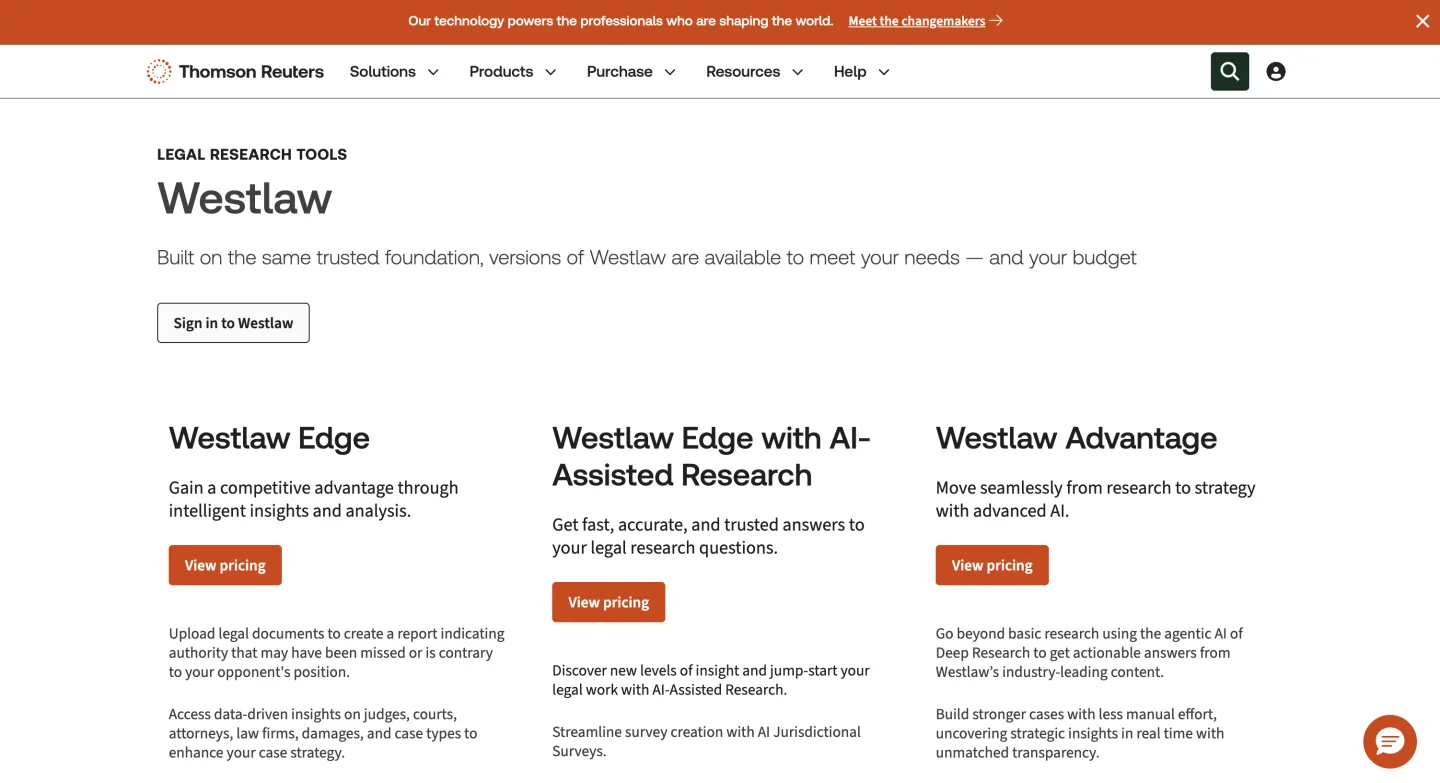
Westlaw's strongest litigation play has very little to do with finding cases. It is Litigation Analytics, the structured data layer that lets you scout the field before you commit to a position.
This is the tool that powers the scene I opened with. You can look up a federal judge and see how they rule on specific motion types, how long their dockets run, which firms and lawyers appear before them most, and historical damages awards in comparable matters.
For a litigator weighing whether to move, settle, or push to trial, that is genuine signal. It turns "I think this judge is tough on Daubert" into a number.
The second piece is the Litigation Document Analyzer, part of the CoCounsel toolset. Point it at a stack of opposing-counsel filings and it reads them in bulk, surfacing where the other side has mischaracterized the law, cited a case for a proposition it does not stand for, or quietly relied on something that has been distinguished.
Independent reviews, including Spellbook's breakdown of Westlaw versus LexisNexis, consistently flag this bulk-review-against-authority capability as a Westlaw strength. When you are staring down a 60-page response brief with 90 citations and a Friday deadline, a tool that triages which of those 90 are soft is worth real money.
Notice what both of these have in common: they are about what to do, not what to read. That is litigation-native. A general legal research engine, no matter how good its retrieval, does not tell you that this particular judge denies 70% of the motions you are about to file.
Westlaw's real edge here is integration. The judge data, the motion grant rates, and the damages tables live in the same workspace as your case-law search, so the scouting and the reading happen without a context switch. Thomson Reuters describes the module on its Westlaw Edge Litigation Analytics page. Lexis has comparable raw analytics (more on that below); what it does not have is this tight a weld between the analytics and the research surface.
The caveat on analytics
Litigation Analytics is descriptive, not prophetic. A judge's historical MSJ grant rate is a base rate, not a prediction about your facts.
Litigators who lean on it as destiny rather than as one input get burned the same way poker players who only count the pot get burned. Use it to calibrate, not to decide.
For related vendor / pricing / buyer-guide coverage, see Lexis+ AI Pricing 2026: Per-Seat Costs, Hidden Add-Ons, Cheaper Suite Alternatives and Lexis+ AI vs Westlaw AI (2026): Pricing, Accuracy, and Which One Hallucinates Less.
Where Lexis+ actually wins: volume and the integrated case file

LexisNexis spent 2026 leaning hard into the other half of litigation: the sheer mass of documents a real case generates.
In February the company replaced Lexis+ AI with "Lexis+ with Protege," an end-to-end workflow platform. Then in May it expanded Protege in ways that matter specifically to litigators drowning in discovery.
The headline: Protege's Vaults now hold up to 100,000 documents, and they ingest multimodal material, audio, video, images, and spreadsheets, with citing down to the passage or timestamp.
Sit with that for a second. A litigator's case file is not a tidy set of published opinions. It is deposition transcripts, exhibit dumps, recorded interviews, email exports, and a spreadsheet someone produced in native format two days before the deadline.
A research tool that can take all of it in, then let you ask a question and get an answer that cites a specific transcript page or a specific timestamp in a recorded call, is solving the discovery problem, not the precedent problem. That is the daily grind of litigation, and it is where Lexis has planted its flag.
The same expansion added Shepard's Verify, a trust marker that flags citations the system cannot confirm exist, and customer-held encryption keys (BYOK) that LexisNexis says are deployed in AmLaw 100 firms. The encryption story is real and matters for firms with strict client-confidentiality postures. The Verify story needs an asterisk, which we will get to.
The other half of the Lexis pitch is drafting integration. Protege does not just retrieve; it carries the work into a motion or a memo through its agentic workflows.
For a solo or small-firm litigator who is researcher, drafter, and proofreader all at once, keeping the retrieval and the draft in one place removes a real friction point.
Lexis is not empty on analytics: Lex Machina
A common mistake in these comparisons (one our own earlier draft made) is treating judge and motion analytics as a Westlaw-only feature. It is not. LexisNexis owns Lex Machina, the legal analytics line that started at Stanford and now sits inside the Lexis stack. Per the LexisNexis Lex Machina product page, it covers all 94 federal district courts, the appeals courts, the PTAB, and a growing set of state courts, with motion-outcome metrics, judge tendencies, timing data, and damages.
So the honest framing is not "Westlaw has analytics, Lexis does not." It is that Westlaw bundles its Litigation Analytics into the core research seat, while Lexis's deepest analytics live in Lex Machina, often a separate product line. If your firm already buys Lex Machina, Lexis's analytics bench is arguably the wider one. If you want analytics inside the same seat as your research and AI, Westlaw's integration is cleaner.
KeyCite vs Shepard's: the citator question for litigators
Before the trap, the practical split. Both KeyCite (Westlaw) and Shepard's (Lexis) do the same core job: tell you whether a case is still good law. They differ in style. KeyCite leans on speed and signaling, with color flags and a machine-learning Overruling Risk indicator that surfaces decisions weakened by later, indirectly related rulings. Shepard's leans on depth, with granular treatment categories (followed, distinguished, criticized, questioned) that many litigators find better for a full history of how a case has been handled.
Neither is objectively better for litigation. If you want a fast read on whether to cite something, KeyCite's flags are quicker. If you are writing the brief section that has to survive a motion to strike and you need every wrinkle of treatment, Shepard's depth tends to win. Most litigators pick the one they trained on and stop arguing about it.
The misconception that gets litigators in trouble
There is a comfortable belief floating around: "I use Westlaw with KeyCite" or "Lexis just shipped Shepard's Verify, so my citations are safe."
They are not. Not in the way litigators tend to assume.
KeyCite and Shepard's tell you the treatment history of a case: whether it has been overruled, distinguished, criticized, or is still good law. Shepard's Verify, the new Protege trust marker, confirms that a citation corresponds to a real case that exists.
That is a genuinely useful guardrail against the failure mode that sank the lawyers in the 2023 Mata v. Avianca sanctions, where ChatGPT invented cases out of whole cloth and counsel filed them.
But "this case exists" and "this case supports the proposition I cited it for" are different claims. A citator can tell you Carpenter v. United States, 585 U.S. 296 (2018), is real and still good law. It cannot tell you that the sentence you wrote about Carpenter actually reflects what the Court held.
That second step, the match between the authority and your argument, is human work. It always has been.
This is not pedantry. It is the exact gap that ABA Formal Opinion 512 addresses. The opinion is clear that the duty of competence with generative AI includes verifying outputs, and a "verify exists" checkmark does not discharge it.
A litigator who reads a green trust marker as permission to stop reading the case is making the same category error that Mata made, just one rung up the ladder.
So which one wins for litigation?
The disappointing-but-correct answer: it depends on what kind of litigator you are.
| Litigation job | Westlaw strength | Lexis+ with Protege strength |
|---|---|---|
| Judge and motion analytics | Litigation Analytics built into the research seat | Lex Machina line (often a separate product), plus Lexis Litigation Analytics |
| Bulk attack on opposing authority | Litigation Document Analyzer flags mischaracterizations | Document analysis inside Vaults, more manual |
| Multimodal case file ingestion | More limited | Vaults up to 100,000 docs, audio/video/image/spreadsheet |
| Passage and timestamp citing | Document-level | Passage and timestamp level |
| Drafting integration | CoCounsel workflows | Protege agentic skills, end-to-end |
| Citator style | KeyCite: color flags, Overruling Risk (speed) | Shepard's: granular treatment depth |
| Citation existence trust marker | KeyCite | Shepard's Verify (existence only) |
| Customer-held encryption keys | Limited reporting | BYOK, reported in AmLaw 100 |
Lean Westlaw if your edge is strategic. You live in motion practice, you appear before the same judges repeatedly, you want your odds before you file, and you regularly need to dismantle the other side's authority at scale.
Litigation Analytics and the Document Analyzer are built for that work, and the win is having them inside the same seat as your research. Lexis can match the raw analytics through Lex Machina, but usually as a separate buy rather than one integrated surface.
Lean Lexis+ with Protege if your edge is throughput. Your cases generate mountains of discovery, you need multimodal ingestion of transcripts and recordings, you want passage-level citing across a 100,000-document Vault, and you want research and drafting in one continuous workflow.
That is the heavy-case-file profile, and Lexis built directly for it this year.
Most litigators are some blend, which is why the platforms keep racing to copy each other.
The blend is the point: choose based on where your specific practice spends its hours, not on whose hallucination number is lower.
The part nobody sells you
Here is what neither vendor will lead with. A large share of the litigation research you actually need to de-risk is the grounded, checkable kind: pulling the exact text of the statute you are suing under, confirming a regulation, reading a real opinion with a citation you can open.
That work does not require predictive analytics or a six-figure enterprise contract. It requires accurate retrieval and a citation you can verify with your own eyes.
Take the workhorse of civil-rights litigation, 42 U.S.C. § 1983. A litigator building a Section 1983 claim needs the precise statutory text, its place in the Title 42 hierarchy, and a clean link to the official source, not a paraphrase an AI is "pretty confident" about.
Statutory and regulatory retrieval is mechanical, verifiable, and increasingly commoditized. There are now self-serve statutes APIs that expose exactly this: search and fetch across the full U.S. Code, the CFR, and 50-state codes, returning the citation, the hierarchy, and the source document. (For clarity: the public API is statutes and legislation only; case-law research happens in the in-app workbench, not over a public endpoint.)
The strategic point for a litigator on a budget is this: the layer of litigation research you can fully verify yourself is the layer that has gotten cheap. The expensive layer, predictive analytics and bulk authority-checking, is where Westlaw and Lexis still command a premium, and it is genuinely premium work.
Pay for what is hard. Do not overpay for what has become a commodity.
The buyer profile that should not be paying enterprise-litigation-platform prices is the solo or 2-to-5-lawyer shop whose case mix is transactional with occasional litigation; the analytics never get exercised, the discovery never hits a Vault threshold, and the cost lands on every matter regardless of whether it earns its keep.
The shops that should be paying are the ones running motion practice every week before the same handful of judges, where Litigation Analytics is the difference between a settle call and a try call.
If you want the fuller pricing and accuracy treatment, the general Lexis vs Westlaw comparison goes deeper than this piece intends to.
Where this leaves the solo and small-firm litigator
If you are a litigator at a solo or small firm, the two-platform framing can feel like being asked to pick a yacht. Both Westlaw and Lexis are built and priced for shops that staff cases with teams.
That does not mean the analytics and volume capabilities are useless to you; it means you should be honest about whether your matter volume justifies the contract.
A practical middle path that more small litigation shops are running in 2026: pair a grounded research-and-drafting suite for the bulk of the work (the statute pulls, the opinion reading, the first-draft memos, the timelines) with a targeted Westlaw or Lexis subscription, or even a la carte access, for the specific moments you need judge analytics or deep treatment history.
You are not obligated to put everything in one vendor's basket. Building a defensible case chronology, comparing the exhibit versions in a redline, and organizing each matter is increasingly handled by AI-native suites that cost a fraction of the incumbents.
We have written before about what a sensible small-firm legal-tech stack looks like if you want to see how the pieces fit.
The trap is treating Westlaw or Lexis as an all-or-nothing identity decision. It is not. It is a buying decision, and litigators are supposed to be good at those.
FAQ
Which is better for litigation, Lexis+ or Westlaw?
It depends on your edge. Lean Westlaw if your work is strategic: motion practice before repeat judges, where Litigation Analytics (judge grant rates, durations, damages) sits in the same seat as research and the Litigation Document Analyzer carries real weight. Lean Lexis+ with Protégé if your edge is throughput: heavy discovery, multimodal ingestion, and passage-level citing across a Vault of up to 100,000 documents, plus the Lex Machina analytics line. Most litigators are a blend.
Which one hallucinates less?
In the 2024 Stanford/Yale study (arxiv.org/html/2405.20362v1), Lexis+ AI was the more reliable, at roughly 65% accurate with about 17% hallucination, versus Westlaw AI-Assisted Research at roughly 42% accurate with about 33% hallucination. For a litigator the gap is close to moot, because you should be verifying every citation manually either way.
Does Shepard's Verify or KeyCite mean my citations are safe?
No. KeyCite and Shepard's report treatment history (overruled, distinguished, still good law), and Shepard's Verify confirms a cited case actually exists. Neither confirms the case supports the proposition you cited it for. That match between authority and argument is human work, every time, under ABA Formal Opinion 512.
KeyCite or Shepard's: which citator is better for litigation?
Neither is objectively better; they trade speed for depth. KeyCite (Westlaw) leans on color flags and a machine-learning Overruling Risk signal, so you get a fast read on whether a case is safe to cite. Shepard's (Lexis) leans on granular treatment categories (followed, distinguished, criticized), so it tends to win when you need the full history behind a case you are leaning on. Most litigators use whichever they trained on.
Does Lexis have a Westlaw Litigation Analytics equivalent?
Yes. LexisNexis owns Lex Machina, the legal analytics line built at Stanford, which covers the federal district and appeals courts, the PTAB, and a growing set of state courts with motion-outcome metrics, judge tendencies, and damages. The practical difference is integration: Westlaw bundles Litigation Analytics into the core research seat, while Lex Machina is often a separate product line on the Lexis side.
Is Westlaw or Lexis worth it for a solo or small-firm litigator?
It is worth it when your matter volume actually exercises the premium features. If you run motion practice weekly before the same judges, Westlaw's analytics earn their keep; if your cases generate huge discovery sets, Lexis's Vault and multimodal ingestion do. If your mix is mostly transactional with occasional litigation, the enterprise contract usually costs more than it returns.
How much do Lexis+ and Westlaw cost for litigation?
Both are quote-based and built for team-staffed shops; a comparable AI tier puts a small-firm seat in roughly the $300 to $500 range before per-document overages, on annual contracts. This post avoids a pricing table on purpose; the general Lexis vs Westlaw comparison goes deeper on the numbers.
Can I avoid paying enterprise prices and still de-risk my litigation research?
For the grounded, checkable layer, yes. Pulling exact statutory text, confirming a regulation, and reading a real opinion with a citation you can open is mechanical and has gotten cheap; self-serve statutes access and AI-native suites cover it at a fraction of incumbent pricing. A common 2026 setup pairs that suite for the bulk of the work with targeted Westlaw or Lexis access for the analytics and treatment-history moments.
Does Lexis Protégé replace a careful associate?
No. Protégé and Westlaw's CoCounsel toolset speed up retrieval, drafting, and bulk review, but the analytics are descriptive base rates, not predictions about your facts, and the citation-to-argument match still needs human judgment. Use the tools to calibrate and triage, not to decide.
New legal AI guides, weekly.
Further Reading
Harvey AI Pricing 2026: Per-Seat Cost and the Renewal Increase
Read postHarvey AI Pricing: $1,200-$2,000/Seat vs Legora & CoCounsel
Read postLexis+ AI vs Westlaw AI 2026: Pricing + Which Hallucinates Less
Read postWhere Your Data Actually Goes When You Use Legal AI (2026)
Read postLexis+ AI vs Westlaw AI vs Vaquill AI: The Honest AI Legal Research Comparison
Read postTop AI Legal Research for Solo Attorneys on a Budget
Read post
Co-Founder & CEO · Attorney
Arshita leads product and strategy at Vaquill, building the legal AI suite that solo, small-firm, and in-house US lawyers use to run a matter end to end.