Short answer: LexisNexis publishes no public per-seat rate card for the AI layer. The closest published numbers are reseller tier listings (Essential $128, Enhanced $314, Professional $494 per month, per Software Finder, Dec 2025). Most firms negotiate a quote instead, and all-in Lexis+ with Protege seats reported to buyers land roughly $250 to $500 per seat per month depending on firm size and content packages (AI Vortex, Apr 2026). The base non-AI research seat is reported around $171/user/month on store.lexisnexis.com.
A Lexis+ AI seat does not come with one sticker price you can read off a webpage. The base research license is roughly published, the AI layer is usually a quote, and the agentic tier is "let's set up a call."
This is a line-by-line teardown of what a Lexis+ AI or Protege seat actually costs a 1-15 lawyer firm in 2026, including the add-ons that do not show up until the contract does. Every Lexis figure here is either a named, dated third-party source or labeled "reported, varies by quote," because LexisNexis does not publish an AI rate card.
TL;DR
- Base Lexis+ (non-AI) is reported around $171/user/month on the public store. The AI layer sits on top of that as a separate premium, usually quoted, not listed.
- Reseller listings put published Lexis+ AI tiers at Essential $128, Enhanced $314, Professional $494 per month (Software Finder, Dec 2025), with full enterprise access custom-quoted. Treat these as reseller tiers, not a LexisNexis rate card.
- Lexis+ with Protege (the agentic tier, rebranded from Lexis+ AI in February 2026, 300+ pre-built workflows plus a no-code builder, model routing across Anthropic, Google, and OpenAI per LawSites, May 2026) is custom-quote at the firm level. All-in figures reported to buyers land roughly $250 to $500 per seat per month (AI Vortex, Apr 2026).
- When a third-party tool like Harvey bundles Lexis content, the Lexis license rides along as a pass-through cost. If you already pay for Lexis+ AI separately, you can end up paying for the same content twice.
- Four cost drivers rarely surface in the demo: multi-jurisdiction content unlocks, annual auto-renew lock-in, integration pass-through, and cancellation friction (BBB has documented contract complaints).
- A self-serve suite with published, transparent pricing ships full statutory research (U.S. Code, CFR, all 52 state and territory codes) plus in-app case-law research, no quote call required.
What is the reported base Lexis+ (non-AI) research seat cost?
For the accuracy and citator side of the question (hallucination rates, Shepard's versus KeyCite), see Lexis+ AI vs Westlaw AI (2026). This post stays on price.
Part of our legal AI vendor comparison and pricing series.
The base layer: what a Lexis+ seat costs before AI

Start with the thing you can actually look up. The base Lexis+ research subscription is reported around $171 per user per month on store.lexisnexis.com for a single-user plan. That number is the floor, and it buys you the traditional research platform: case law, statutes, Shepard's, secondary sources scoped to whatever content packages your plan includes.
The AI does not live in that $171. Lexis+ AI is a premium layer billed on top, and LexisNexis does not publish a per-seat AI rate card on its own site. The numbers that do circulate come from third parties. Reseller listings show packaged tiers of Essential $128, Enhanced $314, and Professional $494 per month (Software Finder, updated Dec 2025), with full enterprise access marked custom. Read those as reseller-tier pricing, not a LexisNexis-published rate, because when firms ask LexisNexis directly they get a quote that depends on firm size, practice areas, and which content libraries they already license.
So the honest answer to "what does Lexis+ cost" is: $171 is the visible base, the reseller tiers above are the closest thing to a published AI price, and a firm-level AI quote is a separate negotiated line you will not see until you talk to sales.
This matters for budgeting because the published number anchors expectations low. A solo who sees $171 and a small-firm partner who ends up at a multiple of that are looking at the same product family with very different invoices.
The AI layer: Lexis+ AI and the Protege tier
Lexis+ AI is the conversational research, drafting, and summarization layer. Lexis+ with Protege, which rebranded from Lexis+ AI in February 2026, is the agentic tier: it adds 300+ pre-built legal workflows plus a no-code workflow builder, and an orchestration layer that routes a request across models from Anthropic, Google, and OpenAI depending on the task (LawSites, May 2026).
Neither has a LexisNexis-published per-seat price. One third-party breakdown puts the AI add-on at $50 to $125 per user per month on top of the base research seat, with the Protege premium adding a further $75 to $150 per user per month (AI Vortex, Apr 2026). Stack those and an all-in Lexis+ AI or Protege seat lands roughly in the $250 to $500 per seat per month range, depending on content and firm size. Treat that band as reported, not quoted-to-you, because your number depends on the variables below.
The point is the gap: the visible $171 base and the all-in AI seat are not the same conversation, and the difference is where the budget surprise lives.
| Tier | Per seat / month | How the price is set | What you get |
|---|---|---|---|
| Lexis+ base (non-AI) | ~$171 reported (store.lexisnexis.com, single-user) | Published store price, content packages scoped to plan | Traditional research: case law, statutes, Shepard's, secondary sources |
| Lexis+ AI reseller tiers | $128 / $314 / $494 (Essential / Enhanced / Professional, Software Finder, Dec 2025) | Packaged reseller listings, not a LexisNexis rate card | Conversational research, drafting, summarization on top of the base |
| Lexis+ AI (firm quote) | ~$250 to $500 reported, quote-based (AI Vortex, Apr 2026) | Custom quote by firm size, practice area, content licensed | Conversational research, drafting, summarization on top of the base |
| Lexis+ with Protege (agentic) | ~$250 to $500 reported, quote-based; content add-ons push toward the top | Custom quote, no LexisNexis-published price | 300+ workflows plus no-code builder, model routing across Anthropic, Google, OpenAI (LawSites, May 2026) |
| Vaquill AI suite | Self-serve, published | Published, self-serve, flat per seat | Statutory research (U.S. Code, CFR, all 52 state and territory codes) plus in-app case-law research, no quote call |
Lexis firm-quote figures are reported to buyers, not LexisNexis-published per-seat prices; the $128/$314/$494 tiers are reseller listings; the base ~$171 is the visible store number. Vaquill AI's pricing is published and self-serve, a flat per-seat number you can read off the pricing page without a quote call.
If you want the apples-to-apples competitive math against Westlaw's CoCounsel-era pricing, the companion piece Casetext vs Westlaw pricing (2026) and legal research costs 2026 both break down where the dollars go across vendors.
For related vendor / pricing / buyer-guide coverage, see Lexis+ AI vs Westlaw AI (2026): Pricing, Accuracy, and Which One Hallucinates Less and Lexis+ vs Westlaw for Litigation Research: Which Wins in 2026.
The four hidden add-ons
The quote you get is rarely the spend you incur. Four line items tend to surface after the demo.
1. Multi-jurisdiction content unlocks
The statutory and case-law content in a Lexis plan is packaged. A seat priced for one practice area or one state's materials does not automatically cover the rest. Add a second jurisdiction, a specialized treatise library, or analytics, and the per-seat figure moves.
For a firm that practices across state lines, the "base" AI seat can need several content add-ons before it covers the research the lawyers actually do.
This is the single biggest reason two firms quote the same product and report different numbers. One is buying a slice; the other is buying coverage.
2. Annual auto-renew lock-in
Lexis contracts are typically annual and frequently auto-renew. That structure means the price you negotiate is the price for at least a year, and the renewal can roll forward unless you give notice inside a specific window.
Auto-renew is not unique to Lexis, but it changes how you should read the per-seat number: it is an annual commitment, not a month-you-can-leave subscription.
3. Integration and bundle pass-through
When Lexis content ships inside a third-party tool, the Lexis license rides along as a pass-through cost. Harvey, for one, can bundle Lexis primary-law content into the seat. When it does, the Lexis license is traveling inside that price, not a separate Harvey capability you are buying twice.
We dug into how that pricing shakes out in Harvey, Legora, and CoCounsel pricing reality (2026). The lesson for a Lexis buyer: if you are evaluating an integrated AI product that includes Lexis data, you are paying the Lexis seat inside that price, and stacking a separate Lexis+ AI subscription on top can mean paying for the same content twice.
4. Cancellation friction
The Better Business Bureau has documented complaints about LexisNexis contract terms and cancellation. Whatever the merits of any individual complaint, the practical takeaway for a small firm is to read the exit terms before the entry terms: know the notice window, get the renewal date in writing, and confirm what happens to your saved work and history if you leave.
A seat that is easy to start and hard to stop has a real cost that does not appear in the per-seat quote.
Per-seat math for a 1-15 lawyer firm
Put it together for a small firm. Say a 6-lawyer firm wants AI-assisted research and drafting on every desk.
- At the reported $250 to $500 all-in band, six Protege-class seats run roughly $1,500 to $3,000 per month, or about $18,000 to $36,000 per year, before any content add-ons.
- Add a second jurisdiction or a specialized library and the per-seat number climbs from the bottom of that band toward the top.
- Lock that into an annual auto-renew, and the firm has committed five figures for at least a year on a tool whose all-in price it could not see on a webpage.
For a solo or a 2-3 lawyer shop, the same per-seat economics scale down in headcount but not in friction: you still negotiate, you still sign annual, and you still buy content in packages.
This is the structural reason small firms keep asking whether the AmLaw-priced platforms fit a small-firm budget. We laid out the alternatives in best Westlaw alternatives for solo and small firms (2026) and best AI legal research for solo attorneys on a budget (2026).
The feature that should not be a $400 line item: statutory research
Here is where the packaging math gets hard to justify. Statutory and regulatory research is core to almost every matter, and on a Lexis seat that capability is bundled inside the $250 to $500 tier alongside everything else. You cannot easily buy "statutes with current court treatment" as a cheap standalone; it comes with the whole platform.
Statutes-with-treatment is not a nice-to-have. Read 5 U.S.C. 706, the Administrative Procedure Act's scope-of-review provision, on its own and you get the text. Read it against Loper Bright Enterprises v. Raimondo, 603 U.S. 369 (2024), which overruled Chevron U.S.A. Inc. v. Natural Resources Defense Council, Inc., 467 U.S. 837 (1984), and the practical meaning of 706 changed for every agency-deference question.
A statute pulled without its current judicial treatment is a trap, because the controlling interpretation can be newer than the code text in front of you. That is the entire value of statutory research with live court interpretation, and post-2024 Loper Bright is the canonical proof.
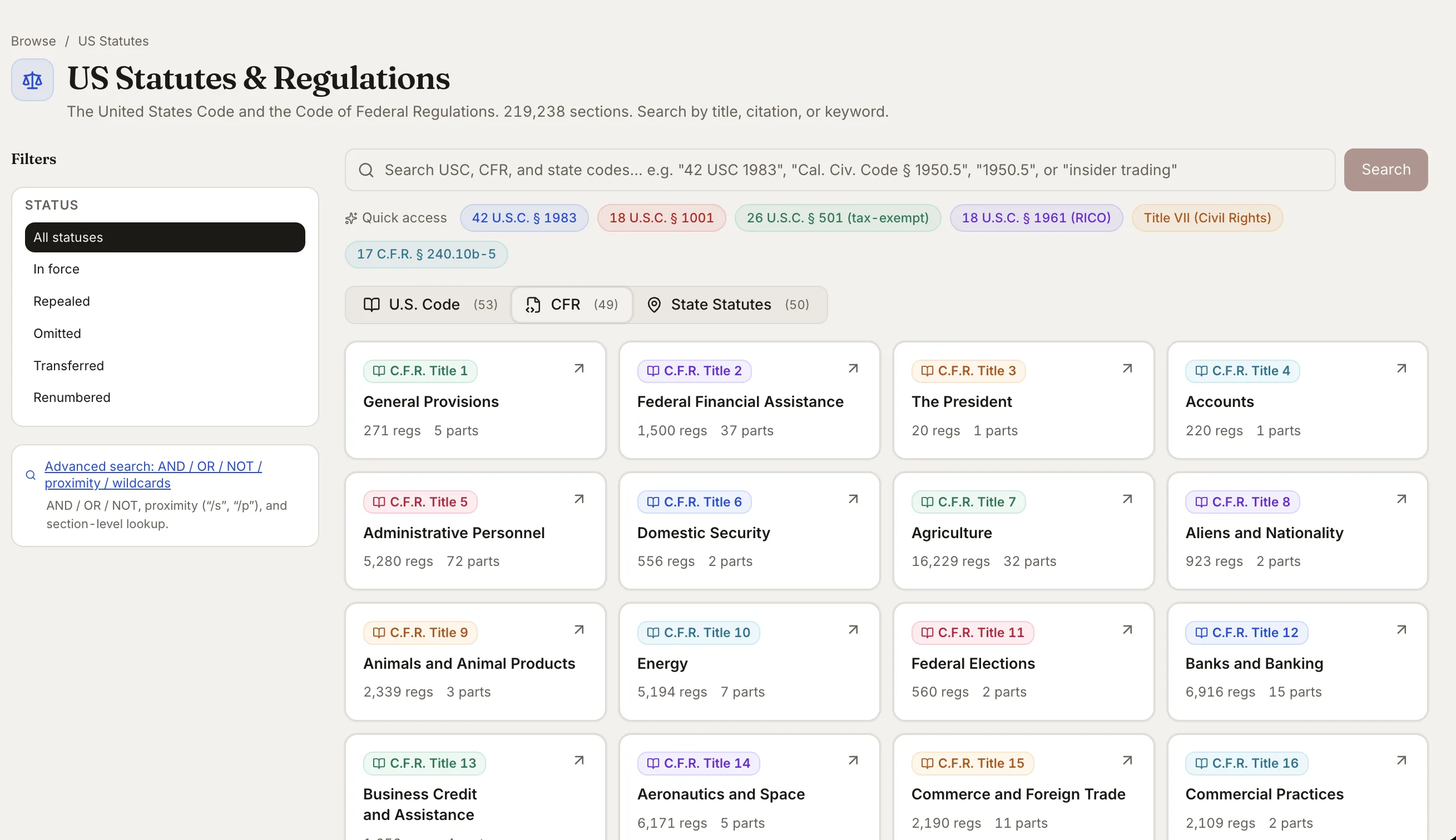
A self-serve statutes and regulations layer ships that capability without a quote call. The reported corpus: the full U.S. Code (60,170 sections), the Code of Federal Regulations (222,251 sections), over 4 million sections of US primary law in total, and all 52 state and territory codes ingested, each read alongside the federal and state court opinions that interpret them inside the workbench.
The public API is statutes and legislation only, billed per credit; case-law research lives in the in-app workbench, with 8M+ US court opinions read alongside the statutes that they interpret.
The point is not that one suite replaces a full Lexis content library for every practice. It is that the specific job of "give me the statute and what the courts have done with it" does not need to be a $400 bundled line item.
A note that applies at any price
Whatever you pay, the duty to verify the output is yours. ABA Formal Opinion 512 (July 2024) is explicit that a lawyer's obligations around competence, confidentiality, communication, candor, and fees do not change because a generative AI tool produced the draft; you still have to check the work and protect client confidences.
A $500 seat and a self-serve seat carry the same professional-responsibility floor.
For why that matters in practice, see AI hallucinations and legal research sanctions and where your legal AI data actually goes (2026).
How to read any Lexis quote you get
Three questions turn a vague quote into a real number:
- What is the all-in per-seat price including every content package my practice needs, not the base research seat? Get the add-ons named.
- What is the contract term, the auto-renew date, and the cancellation notice window? Get it in writing.
- If I am evaluating an integrated tool (Harvey, a CLM, anything bundling Lexis content), is a Lexis license already inside that price? Do not buy it twice.
FAQ
How much does Lexis+ AI cost per seat? LexisNexis publishes no per-seat rate card for the AI layer. The base Lexis+ research subscription is reported around $171 per user per month on store.lexisnexis.com for a single-user plan. Reseller listings show packaged tiers of $128, $314, and $494 per month (Software Finder, Dec 2025), and all-in firm quotes reported to buyers land roughly $250 to $500 per seat per month depending on content and firm size (AI Vortex, Apr 2026). Treat the firm band as reported, not quoted-to-you, because your number depends on the variables in this post.
Does Lexis+ AI have hidden fees? Four cost drivers rarely surface in the demo: multi-jurisdiction content unlocks, annual auto-renew lock-in, integration and bundle pass-through (paying for Lexis content twice if it rides inside a tool like Harvey), and cancellation friction. The Better Business Bureau has documented complaints about LexisNexis contract terms and cancellation, so read the exit terms before the entry terms.
Is there a minimum seat count or contract term? Lexis contracts are typically annual and frequently auto-renew, with a cancellation notice window you have to hit to avoid rolling forward. There is no published self-serve checkout, so seat count and term are set in the negotiated quote. The practical floor for a small firm is an annual commitment, not a month-you-can-leave subscription.
Is Protege the same as Lexis+ AI? Protege is the next generation of it. LexisNexis rebranded Lexis+ AI to Lexis+ with Protege in February 2026 and expanded it again in May 2026 with agentic skills, collaboration workrooms, and customer-held encryption keys (LawSites, May 2026). Protege adds 300+ pre-built workflows, a no-code builder, and model routing across Anthropic, Google, and OpenAI on top of the conversational research and drafting that Lexis+ AI already did. Pricing is still custom-quote, not published.
Is Lexis+ AI worth it? For a firm that uses the deep editorial content and 300+ Protege workflows every week, the platform earns its keep. For a 1 to 15 lawyer firm that mainly needs statutory and case-law research, the packaging is hard to justify: statutory research with current court treatment is bundled inside the $250 to $500 tier when it does not need to be a $400 line item. Whatever you pay, the duty to verify the output is yours under ABA Formal Opinion 512 (July 2024).
Can I negotiate a Lexis+ AI quote? Yes. Because the AI seat is custom-quoted, the negotiable levers are which content packages are bundled, the term length, the auto-renew notice window, and the escalation rate. Ask three questions in writing before the demo: the all-in per-seat price with every content package named, the contract term and cancellation window, and whether a Lexis license is already inside any integrated tool you are also evaluating.
Will I pay for Lexis content twice? You can. When a third-party tool like Harvey bundles Lexis primary-law content into its seat, the Lexis license rides along as a pass-through cost. If you also keep a separate Lexis+ AI subscription, you are paying for the same data once on your Lexis invoice and a second time inside the integrated tool's per-seat number. Confirm the bundle before you stack subscriptions.
Is there a free trial of Lexis+ AI? Lexis+ AI access runs through a sales conversation and a negotiated annual contract rather than a self-serve free trial. If you want to test statutory and case-law research without a quote call, a self-serve statutes and regulations layer ships at published, self-serve pricing with no demo gate.
Is Lexis+ AI cheaper than Westlaw with CoCounsel? One third-party comparison puts Lexis+ with AI at $250 to $475 per user per month against Westlaw Edge with CoCounsel at $300 to $550, calling Lexis roughly 15 to 25 percent cheaper at the mid-size tier (AI Vortex, Apr 2026). Both are quote-based, so your real delta depends on content packages and term length. For the accuracy and citator side of that choice, see Lexis+ AI vs Westlaw AI (2026).
What is a cheaper Lexis+ AI alternative for a small firm? A self-serve suite ships the core "statute plus current court treatment" job at published, self-serve pricing, with no quote call: the full U.S. Code, the CFR, and all 52 state and territory codes, each read alongside the court opinions that interpret them. For the broader comparison, see best AI legal research for solo attorneys on a budget (2026).
Where to go from here
For more on small-firm research pricing, see the small-firm legal-tech stack guide.
New legal AI guides, weekly.
Further Reading
Harvey AI Pricing 2026: Per-Seat Cost and the Renewal Increase
Read postHow Much Does Westlaw Cost in 2026? Solo, Small-Firm, Westlaw Plus Pricing
Read postTop Legal Research Tools for Solo Family Law Attorneys
Read postHarvey AI Pricing: $1,200-$2,000/Seat vs Legora & CoCounsel
Read postLexis+ AI vs Westlaw AI 2026: Pricing + Which Hallucinates Less
Read postCasetext Acquisition and Pricing: What Happened After Thomson Reuters Bought It
Read post
Co-Founder & CEO · Attorney
Arshita leads product and strategy at Vaquill, building the legal AI suite that solo, small-firm, and in-house US lawyers use to run a matter end to end.