Harvey AI pricing runs $1,200 to $2,000+ per user per month for unlimited AI usage. That is what Harvey AI costs per seat in 2026, and the range exists because Harvey is a bundled product with per-feature add-ons: your tier plus your add-on mix sets the per-user price. Harvey does not publish a price, so every figure here is attributed to dated reporting you can check.
The tier detail sits inside that band. Practitioners and analysts report a base seat near $1,200 per user per month and a LexisNexis-bundled seat near $2,400 (eesel AI's leaked-tier roundup, citing r/legaltech, Sacra, and Artificial Lawyer, 2025-2026). Reported deals carry a 25-seat minimum on a 12-month term, which puts a small Harvey contract near $360,000 a year before add-ons.
When a renewal quote lands, the number on it is rarely the number from last cycle, and the per-seat increase is the line item firms keep flagging. Harvey now also offers a pay-as-you-go, credit-metered plan.
This post is about that spread: where the per-seat number moved, who actually pays it, and what you stop paying for if the tabular due-diligence work is the only reason you signed.
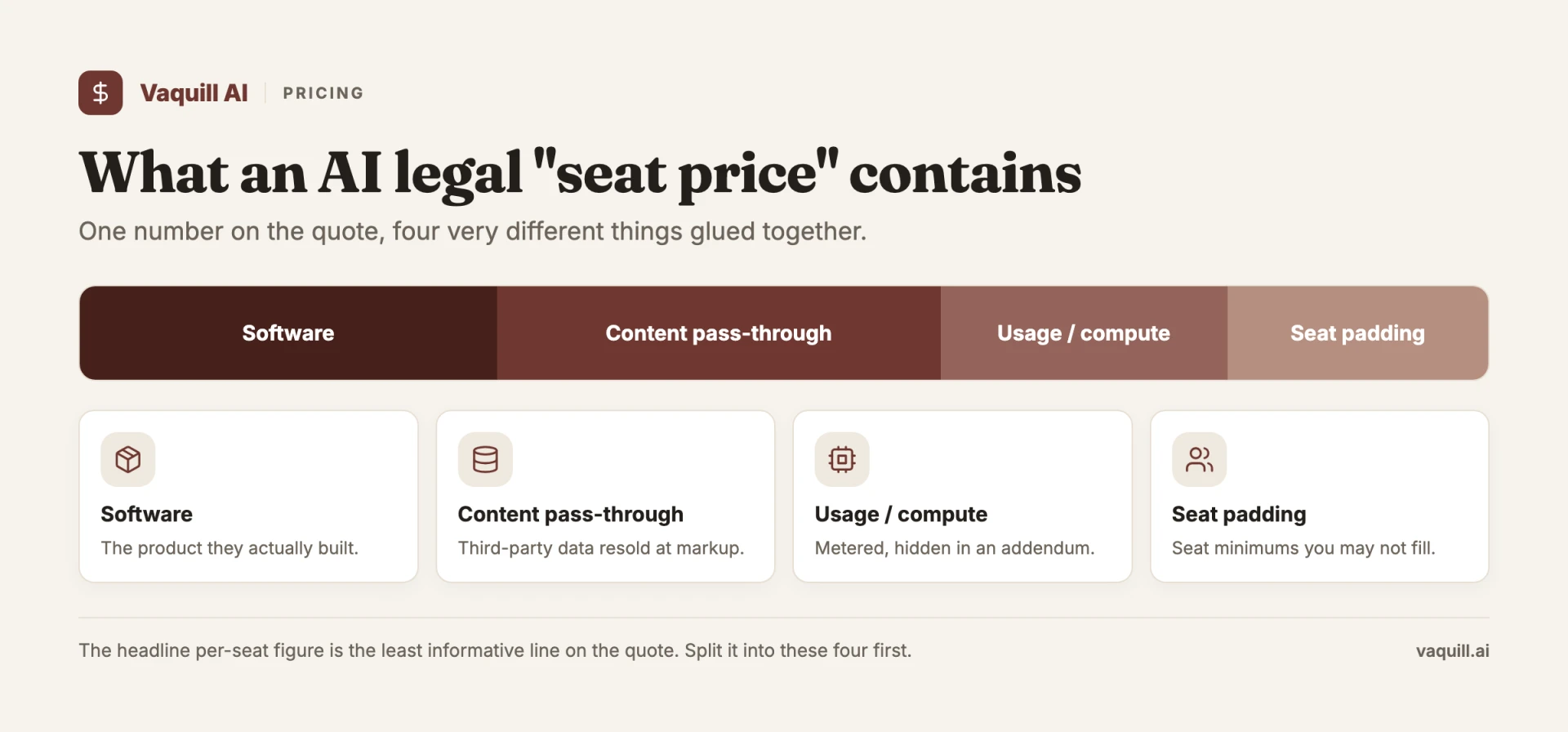
One per-seat number, four very different things glued together.
TL;DR
- Harvey is $1,200 to $2,000+ per user per month for unlimited AI usage (reported). The range is the bundle plus per-feature add-ons: your tier and add-on mix set the per-user price. Harvey also offers a pay-as-you-go, credit-metered plan. The "increase" is the tier-and-add-on spread plus valuation-driven upward pressure.
- Tier detail: a base seat near $1,200 at the floor and a LexisNexis-bundled seat near $2,400 at the top, per user per month, with a reported 25-seat, 12-month minimum (~$360K/year floor) per eesel AI citing r/legaltech, Sacra, and Artificial Lawyer (2025-2026).
- Funding context: Harvey hit an $8B valuation in December 2025 ($160M Series F led by Andreessen Horowitz, Yahoo Finance, Dec 2025) and a $11B valuation in March 2026 ($200M round co-led by GIC and Sequoia, CNBC, Mar 25 2026). Four-figure ACVs are how those multiples get justified.
- AmLaw firms absorb the increase because they run the heavy agentic workflows. Solo and 2-15 lawyer firms pay AmLaw rates for M&A agents they never open.
- ABA Formal Opinion 512 (July 2024) means a four-figure seat is now a billing conversation: you have to justify the cost and verify the output.
- Document Matrix is the concrete substitute for the high-volume diligence that justifies a Harvey or Legora seat: up to 200 docs per matrix, every cell grounded in a source quote with page and paragraph citations.
- For the full multi-vendor comparison, see the Harvey vs Legora vs CoCounsel pricing roundup. This post stays narrow on Harvey.
What is Harvey AI's reported per-seat range?
Part of our legal AI vendor comparison and pricing series.
The number, and what "increase" actually means
Harvey is $1,200 to $2,000+ per user per month for unlimited AI usage. The range is not noise; it is structural. Harvey is a bundled product, and per-feature add-ons set where in that band a given seat lands.
A seat with the base feature set sits near the bottom; a seat loaded with the deep agentic workflows, content integrations, and custom-model work sits near the top. The tier you pick plus the add-ons you bolt on is the per-user price.
Harvey now also offers a pay-as-you-go, credit-metered plan for firms that would rather meter usage than commit to an unlimited per-seat rate.
| Tier | Per user / month | Annualized per seat | Fits | What sets the price |
|---|---|---|---|---|
| Lower band | $1,200 | $14,400 | Smaller teams on the base feature set | Fewer add-ons, lighter agent mix |
| Upper band | $2,000+ | $24,000+ | Firms running the full add-on stack | Full agentic workflows, content integrations, custom-model work |
| Pay-as-you-go | Credit-metered | Varies with usage | Firms metering instead of committing | Consumption, not a fixed per-seat rate |
Reported deal numbers span the band and above. Reporting aggregated by eesel AI (citing r/legaltech, Sacra, and Artificial Lawyer, 2025-2026) describes a base seat near $1,200 per user per month at the floor and a LexisNexis-bundled seat near $2,400 above the standard top, on a reported 25-seat, 12-month minimum. Treat those as leaked data points, not a published rate card, but they line up with the reported range once the heavier add-ons attach.
The honest read is that "the Harvey price increase per seat" is less a single jump from one list price to another and more the bundle-and-add-on spread itself: firms that started on a lower tier or an early pilot rate find the renewal lands higher up the ladder as more add-ons get attached.
The upward pressure has a cause. Harvey's valuation moved fast: a $5B Series E in mid-2025, then an $8B valuation in December 2025 on a $160M Series F led by Andreessen Horowitz (Yahoo Finance, Dec 2025), then an $11B valuation in March 2026 on a $200M round co-led by GIC and Sequoia (CNBC, Mar 25 2026). That is a 3.5x jump in roughly a year.
A company carrying that multiple has to land and expand four-figure per-seat contracts to grow into it. The pricing is not arbitrary. It reflects the investor math, and the investor math points up.
There is a second escalator inside the contract. Enterprise SaaS deals commonly bake in a 3 to 8 percent annual uplift, so even a flat tier compounds at renewal before a single add-on is attached. Stack that on top of the bundle-and-add-on spread and the "Harvey price increase per seat" is two forces at once: the seat climbing the $1,200 to $2,000+ ladder as add-ons attach, and the contracted annual uplift on whatever rate you started at.
That is the part renewal shock misses. The seat did not get more expensive because the product got proportionally better in your specific practice. It got more expensive because the business model requires it to.
Who actually absorbs the increase
The per-seat number is the same regardless of firm size, but the value delivered is not. This is where the increase bites unevenly.
AmLaw and large firms absorb it. A 200-lawyer firm with an existing Lexis license and a real M&A practice uses the agentic due-diligence workflows, the litigation drafting agents, and the deep iManage integration at full intensity. At that use density, a top-of-band seat near $2,000 per user per month plus the add-on stack buys an integrated product no DIY assembly replicates today.
The increase is annoying, not disqualifying. It gets signed because the partners signing it are also the ones running the matters that consume the depth.
Solo and 2-15 lawyer firms pay it for features they never open. A five-lawyer firm does not do M&A. The M&A due-diligence agent is dead weight on their seat. They use the contract-review agent and maybe the litigation-drafting agent.
The full-stack seats toward $2,000 are priced for AmLaw use intensity, not solo-and-small-firm use intensity, so a small firm paying the increase is buying capacity it structurally cannot consume.
This is the friction the Reddit thread keeps venting about, and it maps cleanly onto how we think about the market: small and mid firms are the people who get the worst deal on a per-seat hike, because the seat is sized for someone else.
If you are in that small-and-mid bracket, the renewal-shock question is not "can we afford the increase," it is "are we paying AmLaw rates for an AmLaw feature set we will never use." For most firms under 15 lawyers, the answer is yes, and that is the wrong trade. We unpack the alternatives in the Harvey alternative breakdown.
For related vendor / pricing / buyer-guide coverage, see Why Harvey Costs $2,400 a Seat in 2026 (and Whether It's Worth Anywhere Near That) and How Much Does Legora Cost? 2026 Pricing Breakdown vs Harvey. For the standalone product take and the in-house shortlist, see our honest Harvey AI review and the best Harvey alternatives for in-house counsel.
A four-figure seat is now a billing conversation
The increase is not only a budget question. It is an ethics question, because the cost of legal AI is something you may need to justify to clients.
ABA Formal Opinion 512 (July 2024) is the first formal ABA guidance on generative AI in practice. It covers competence, confidentiality, communication, candor, supervision, and fees.
Two threads matter directly for a per-seat increase:
- Fees must be reasonable. If a tool's cost is passed through to clients, or shapes how you bill, you have to be able to defend that cost as reasonable for the work. A $2,000 seat that a partner uses for one contract review a month is hard to defend on that basis.
- You must verify the output. Opinion 512 is explicit that lawyers remain responsible for the accuracy of AI-assisted work and for protecting client confidences. The seat price buys you nothing on the verification obligation. You own that regardless of what you paid.
Put those together and the increase stops being a procurement footnote. A higher per-seat cost raises the bar on what you have to show for it, both to the client whose matter it touches and to your own competence and supervision duties.
If the seat is mostly idle capacity priced for a firm ten times your size, that is a weak position to be in when a client asks what the line item bought them.
Document Matrix: what you stop paying Harvey for
Strip a Harvey or Legora seat down to the one feature most small and mid firms actually justify it with, and it is usually tabular due diligence: pull the same fields across dozens or hundreds of documents into one comparison view.
That is the workflow that beats chatting with one document at a time, and it is the workflow firms cite when they defend the price.
Document Matrix is the direct substitute for that specific job:
- Up to 200 documents per matrix. Rows are your documents, columns are the questions you want answered from each. Drag in PDFs, DOCX, TXT, or XLSX; scanned PDFs auto-route through OCR. Files populate as rows complete.
- Every cell is grounded in a source quote. Each answer links to the exact passage with page and paragraph citations. Click a cell, see the supporting text in context. Where a document does not address a column, the cell returns "Not found" instead of guessing. That last part matters more than it sounds, because a confident wrong answer in a diligence grid is exactly the failure mode Opinion 512 makes you liable for.
- Prebuilt column templates. NDA, SaaS MSA, commercial lease, employment agreement, and IP license templates ship as starting points. Customize columns per matter without retraining anything.
- Pre-run cost estimation. Pricing is credit-based, each cell costs a small number of credits, and you see the estimate before you commit, so a 200-document run cannot quietly blow your budget.
The framing against single-document chat is the whole point. Chat answers one question about one document well. Document Matrix answers the same set of questions across 200 documents at once and shows its work in every cell.
For a lease-abstraction job (say 20 to 50 data points across 200 leases), that is the difference between two days of paralegal time and two weeks. That is also precisely the capability a small firm was renting a four-figure Harvey or Legora seat to get.
The grounding underneath it
A diligence grid is only as trustworthy as the law it can check against. Document Matrix shares the same retrieval pipeline as the rest of the suite, and that pipeline runs on real US primary sources, not a model's training memory.
A grounded suite runs legal research as RAG over 8M+ US federal and state opinions plus the full U.S. Code and CFR. The US case-law corpus is anchored to real primary sources, so every answer traces back to law you can open and read.
The practical effect is that when you ask a research question, you get an answer anchored to citations you can open and read.
To make that concrete: ask about the current status of agency deference and a grounded system points you to Loper Bright Enterprises v. Raimondo, 603 U.S. 369 (2024), which overruled Chevron U.S.A. v. Natural Resources Defense Council, 467 U.S. 837 (1984). Those are real, verifiable citations you can pull up yourself.
A model running on training data alone will too often produce a citation that looks right and is not, which is the exact problem that has produced sanctions in real cases. The difference between "looks right" and "is right" is the difference between a tool you can bill against and one you cannot.
FAQ
How much does Harvey AI cost per seat? Harvey runs $1,200 to $2,000+ per user per month for unlimited AI usage. The range is structural: Harvey is a bundled product, and the tier plus the per-feature add-ons you attach set where a seat lands. A base feature set sits near the bottom, and the full agentic-workflow and custom-model stack sits near the top. The range is reported from dated third-party pricing coverage.
Why did the Harvey price per seat increase? Three forces. The bundle-and-add-on spread (renewals land higher as add-ons attach), a contracted annual uplift (enterprise SaaS commonly runs 3 to 8 percent a year), and business-model pressure. Harvey hit an $8B valuation in December 2025 (Yahoo Finance) and a $11B valuation in March 2026 (CNBC), and a company carrying that multiple has to land and expand four-figure per-seat contracts to grow into it.
Does Harvey have hidden fees? The per-seat number is the headline, but the add-ons are where the real cost lives, and they are not itemized until the contract is. Deep agentic workflows, content integrations, and custom-model work each push the seat up the $1,200 to $2,000+ band. There is also a newer pay-as-you-go credit-metered plan, so usage-based charges can sit on top of or instead of a flat seat.
Is there a minimum seat count or commitment? Harvey is quote-based and enterprise-oriented, sold through a sales motion rather than self-serve, and contracts typically run annual. Reported deals describe a 25-seat minimum on a 12-month term, which lands a small contract near $360,000 a year before add-ons (eesel AI, citing r/legaltech and Sacra). There is no published per-seat sticker or self-serve checkout, so the exact commitment terms are set in the quote.
Is Harvey overpriced for a small or mid-size firm? For most firms under 15 lawyers, yes. Leaked tiers near $1,200 to $2,400 per seat and a 25-seat floor are sized for AmLaw use intensity, and a small firm rarely runs the M&A diligence agents that justify the top of the band. The cheaper path is to buy only the high-volume diligence workflow standalone rather than a full four-figure seat. See the Harvey alternative breakdown.
Is Harvey worth it? For an AmLaw or large firm running the heavy agentic due-diligence and litigation-drafting workflows at full intensity, a top-of-band seat buys an integrated product that DIY assembly does not yet replace. For a firm under 15 lawyers, you are usually paying AmLaw rates for M&A agents you never open. Practitioner sentiment is mixed: partners often love it while associates question the value (see this r/legaltech thread, Dec 2025).
Can I negotiate Harvey pricing? Since the price is a quote built from tier and add-ons, the levers are the add-on mix, the term, and whether the credit-metered plan fits your usage better than a flat unlimited seat. Walk into the renewal with last quarter's usage logs (which seats logged in weekly, which agents got used) so you negotiate against data rather than a quote.
Is there a free trial of Harvey? Harvey does not publish a self-serve free trial; access runs through a demo and sales conversation. If you want to test the specific high-volume diligence workflow that justifies most Harvey seats without a quote call, a self-serve document matrix runs up to 200 documents with every cell grounded in a source quote.
What is a cheaper alternative to Harvey? The diligence workflow that justifies most small and mid-firm Harvey seats is available standalone as Document Matrix, paired with grounded legal research, without a four-figure per-seat contract or annual lock-in. A self-serve suite runs on published pricing well below a four-figure seat. See the Harvey alternative breakdown for the side-by-side.
So what should you do at renewal
Three positions, depending on where your firm sits:
Solo or 2-15 lawyers. Do not absorb the increase on a tier sized for AmLaw. The diligence workflow that justified the seat is available as a standalone capability (Document Matrix) without a four-figure per-seat contract or annual lock-in. Pair it with grounded research and you have replaced the part of Harvey you actually used. See the Harvey alternative page for the side-by-side.
Sub-AmLaw (50 to 300 lawyers). Run the renewal as a real bake-off, not an auto-sign. Measure cost per matter, not cost per seat, across 90 days on live work.
The deep agentic workflows win on the 20% of matters that need them. For the other 80%, a leaner stack matches the output at a fraction of the per-seat cost. Whether the 20% justifies the increase is a firm-specific call, but it is a call you should make with data, not at the mercy of a renewal quote.
AmLaw 100. The increase is largely price-insensitive at your scale. The real question is integration depth and contract term, not the per-seat number. You are the firm the pricing was designed for.
For the broader multi-vendor view, including how Legora and CoCounsel Legal compare and what the underlying wrapper debate gets right and wrong, read the full pricing roundup.
If you want the build-it-yourself route, the Claude plus MCP stack lays out the assembly. And if you are integrating statutes into your own product, a statutes-only legal API is self-serve and avoids per-seat licensing entirely.
New legal AI guides, weekly.
Further Reading
Harvey AI Pricing: $1,200-$2,000/Seat vs Legora & CoCounsel
Read postLexis+ AI vs Westlaw AI 2026: Pricing + Which Hallucinates Less
Read postLexis+ AI vs Westlaw AI vs Vaquill AI: The Honest AI Legal Research Comparison
Read postTop AI Legal Research for Solo Attorneys on a Budget
Read postBest AI Software for Plaintiff Law Firms (2026): 11 Tools Compared
Read postLegora Pricing: What a Seat Actually Costs (2026) vs Harvey
Read post
Co-Founder & CEO · Attorney
Arshita leads product and strategy at Vaquill, building the legal AI suite that solo, small-firm, and in-house US lawyers use to run a matter end to end.