Short answer for the lexis ai vs westlaw ai vs vaquill question: in the only peer-reviewed test, Lexis+ AI was the most accurate of the incumbents (about 65% accurate, 17% hallucination) and Westlaw AI scored worst (about 42% accurate, 33% hallucination); Vaquill AI is the lowest-cost, self-serve, with every citation grounded in a clickable source. Pick Lexis+ AI or Westlaw AI if you need KeyCite or Shepard's for malpractice-grade negative-treatment work, and pick Vaquill AI if you are an in-house team or small firm that wants verifiable answers at a fraction of incumbent pricing.
These three are not really competing for the same buyer. Lexis+ AI and Westlaw AI are incumbent, citator-anchored research platforms at roughly $300 to $500 a seat, and both declined to be independently benchmarked.
Vaquill AI is an AI-native US suite that verifies every citation in four layers. The evidence behind that split is below.
In October 2025, the independent benchmarking firm Vals AI published the results of its second round of legal AI testing. The headline most people caught was that several legal AI tools, and even general-purpose ChatGPT, now score above a baseline of practicing lawyers on a battery of real legal tasks.
The detail most people skipped is the one that actually matters for anyone shopping for a tool right now: when Vals invited the two biggest names in legal research to participate, Thomson Reuters (Westlaw) and LexisNexis both declined, and vLex withdrew before publication. No public explanation.
Sit with that for a second. The two vendors charging the most for "trustworthy, hallucination-free" legal AI are also the two that said no to an independent, apples-to-apples accuracy test.
That single fact reframes the entire lexis+ ai vs westlaw ai debate. The question is not really which incumbent hallucinates less. It is whether you want to keep paying incumbent prices for a tool that will not show its work.
This post is the three-way version of that question: Lexis+ AI, Westlaw AI, and the AI-native field that has quietly caught up. If you want the deep, feature-by-feature head-to-head on the two incumbents (KeyCite vs Shepard's, CoCounsel Legal vs Protege, the Stanford hallucination numbers), the dedicated piece is here: Lexis+ AI vs Westlaw AI (2026).
This one is the meta layer on top of it. We will not re-litigate the citators here.
TL;DR
- The
lexis+ ai vs westlaw aiframing is a 2019 question. In 2026 the real axis is incumbent editorial moat plus opaque procurement versus AI-native transparency plus verifiable grounding. - Vals AI's October 2025 benchmark found legal and general AI tools clustered within about 4 points of each other and roughly 7 points above a lawyer baseline. Both Westlaw and Lexis declined to participate.
- The strongest signal of 2026 is not a marketing claim. It is the refusal to be benchmarked. A vendor confident in its accuracy submits to an independent test.
- Stanford HAI's peer-reviewed numbers (Westlaw AI around 42% accurate / 33% hallucination, Lexis+ AI around 65% accurate / 17% hallucination, arxiv.org/html/2405.20362v1) remain the only independent figures, and neither vendor has re-benchmarked since.
- Your malpractice exposure under ABA Formal Opinion 512 is identical whether you spent little or $499 a seat. Price does not buy you out of the verification step.
- For a solo or 2-15-lawyer firm, paying $300 to $500 a seat for an un-benchmarked tool is the actual risk, not the tool you pick.
Part of our legal AI vendor comparison and pricing series.
In the only peer-reviewed test (Stanford, 2024), which incumbent was more accurate?
How we compared these three
We scored each tool on six axes a buyer actually decides on: published price, US legal coverage, independently measured citation accuracy and hallucination rate, drafting support, integrations, and self-serve access. Prices are stated only where the vendor publishes them or a named third party documents them; the incumbents publish neither, so their figures are reported ranges with sources. Accuracy figures come from the one peer-reviewed study (Stanford HAI, 2024) and the one independent capability benchmark (Vals AI, 2025), not vendor marketing. Disclosure again: we build Vaquill AI, so the prices and benchmarks here all carry sources you can open and check.
The three-way comparison at a glance
| Axis | Westlaw AI | Lexis+ AI (Protege) | Vaquill AI |
|---|---|---|---|
| Published price | None (quote-based; ~$133/mo base before AI, reported) | None (quote-based; ~$171/mo base before AI, reported) | Self-serve, published |
| Comparable AI tier, small firm | ~$300 to $500/seat/mo (reported) | ~$300 to $500/seat/mo (reported) | Self-serve, a fraction of that |
| US coverage | Deep case law, statutes, KeyCite, West editorial | Deep case law, statutes, Shepard's, Practical Guidance | US federal and state opinions, US Code, CFR, 50-state codes |
| Accuracy (Stanford HAI 2024) | ~42% accurate | ~65% accurate | Not in the Stanford study; publishes own benchmarks |
| Hallucination (Stanford HAI 2024) | ~33% | ~17% | Grounded in retrieved opinions; cites are clickable |
| Independent benchmark (Vals AI 2025) | Declined | Withdrew | Not tested by Vals |
| Drafting | CoCounsel drafting add-on | AI Assistant drafting, Protege workflows | Drafting in the suite |
| Self-serve signup | No (procurement) | No (procurement) | Yes (month-to-month) |
Prices: Westlaw and Lexis base figures are reported from public reseller and pricing coverage and carry no clean vendor sticker; see Legal Research Costs in 2026 for the sourcing. Vaquill AI's price is its own published, self-serve seat. Accuracy and hallucination figures are from Stanford HAI (2024), cited in full below.
Why "Lexis vs Westlaw" is the wrong fight
For thirty years, choosing a legal research platform meant choosing a tribe. You shepardized or you KeyCited, based mostly on where you summered. That muscle memory is exactly what both incumbents are counting on as they sell you AI.
Here is what changed. In 2023, Thomson Reuters bought Casetext for $650 million and absorbed its CoCounsel assistant into the Westlaw line. LexisNexis shipped Lexis+ AI, then replaced it in early 2026 with Protege and its catalog of agentic workflows.
Both spent the last three years rebuilding their AI stories. And both, when offered a neutral stage to prove the accuracy those stories depend on, walked off it.
That is not a small thing. The entire premium of an incumbent legal research subscription rests on one promise: trust the editorial layer, trust the citator, trust the brand.
When the brand will not validate its AI accuracy against a third party, the premium is buying you reputation, not measured performance. For a BigLaw firm with a procurement department and malpractice carriers who like a recognizable logo on the invoice, that reputation may still be worth it. For a five-person plaintiff's shop, it is a tax on familiarity.
The 2-way piece settles the incumbent-vs-incumbent question on the merits. If you have already decided you are buying an incumbent, go read it and pick. This piece is for the larger group of readers who have not actually decided that, and have been told there are only two doors.
What the benchmarks actually say
There are two independent sources worth your attention. Everything else is vendor copy.
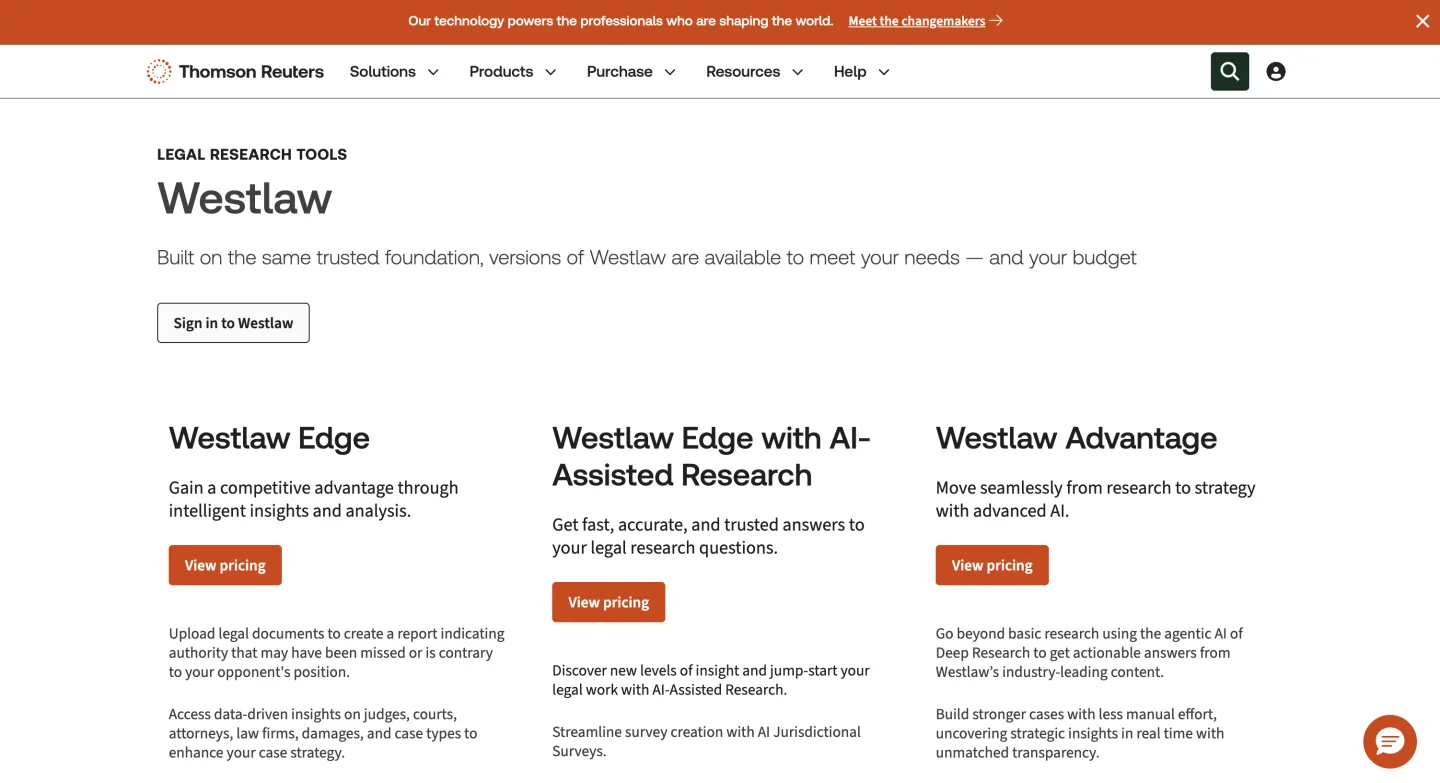

Stanford HAI (2024). A peer-reviewed study (arxiv.org/html/2405.20362v1) tested the major AI legal research tools across more than 200 queries and found Westlaw's AI-Assisted Research at roughly 42% accurate with about 33% hallucination, while Lexis+ AI came in at roughly 65% accurate with about 17% hallucination.
That is the only peer-reviewed, independent hallucination figure in the market, and the uncomfortable part for buyers is that the more expensive, more editorially deep platform scored worse. Neither vendor has commissioned a public re-benchmark since. The numbers are aging, but they are still the only numbers, which is itself the point.
Vals AI (2025). Vals ran two rounds of broader capability benchmarking. The February 2025 round had CoCounsel posting strong document-summarization scores and Harvey emerging as a top performer, while Lexis+ AI withdrew from sections of the test.
The October 2025 round (VLAIR) is the more telling one. Across the tested tools, the spread was startlingly tight: legal-specialist AIs and general ChatGPT all landed within about 4 points of each other, and roughly 7 points above a baseline of practicing lawyers.
The tools also dropped around 11 points on multi-jurisdictional questions, a useful reminder that "above the lawyer baseline" is an average, not a guarantee on your hardest matter.
The two incumbents declined to participate in the round that mattered most. Read the Vals AI VLAIR report and the LawNext coverage yourself; both are worth twenty minutes. Legal IT Insider's writeup, headlined that "the market leaders are absent" (Legal IT Insider, Oct 2025), is the blunt version of the same finding.
Put the two sources together and a thesis falls out. The AI-native field has closed the accuracy gap. The incumbents have stopped letting anyone measure it. And the price gap between the two camps has, if anything, widened.
For related vendor / pricing / buyer-guide coverage, see Lexis+ AI vs Westlaw AI (2026): Pricing, Accuracy, and Which One Hallucinates Less and Westlaw vs LexisNexis vs Vaquill AI: A 2026 Pricing and AI Research Comparison.
What most people get wrong
Mistake one: treating it as a binary. "Lexis or Westlaw" was a real choice when they were the only two corpora that mattered. In 2026 the field includes Harvey, Legora, CoCounsel as a standalone capability, and a tier of AI-native tools that benchmark at parity.
Vals tested several of them. The two-door framing survives because the incumbents benefit from it, not because it is true.
Mistake two: reading "hallucination-free" as a fact. LexisNexis marketed Lexis+ AI with "hallucination-free linked legal citations" language, and then Stanford measured a 17% hallucination rate on it. The lesson is not that Lexis is uniquely dishonest. The lesson is that "hallucination-free" is a marketing register, not a measured claim, across the whole category.
The honest version of that claim is a benchmark score with a methodology attached. The vendors that publish one are telling you something. The vendors that decline are also telling you something.
Mistake three: assuming a higher price buys a lower error rate. Stanford showed the opposite can hold. And the downstream risk is flat regardless of price.
The 2023 Mata v. Avianca sanctions, where lawyers filed a brief full of ChatGPT-invented cases, did not happen because the lawyers used a cheap tool. They happened because nobody opened the citations.
ABA Formal Opinion 512 (July 2024) makes the duty of competent verification explicit, and it does not scale with your subscription tier. If you paste an un-checked citation into a filing, the sanction is the same whether the tool cost a little or $1,460 a month.
Pricing: where the third path earns its keep
None of the incumbents publish a clean price sheet. The figures below are reported from public sources and reseller listings, consistent with what we documented in Legal Research Costs in 2026 and Best Westlaw Alternatives for Solo and Small Firms.
| Platform | Reported entry point | AI tier reality |
|---|---|---|
| Westlaw | ~$133/mo single state | CoCounsel pushes total past $300-$400/seat |
| Lexis+ | ~$171/mo base | Lexis+ AI reported near enterprise; custom quotes |
| AI-native (Harvey/Legora/CoCounsel class) | bundle + add-ons | Harvey $1,200-$2,000+, Legora $300-$800/user/mo, unlimited; PAYG credits |
Two things hide inside these numbers. First, the comparable AI tier on either incumbent lands a typical small firm in the $300 to $500 per seat per month range, on annual contracts with auto-renewal and documented cancellation friction (Westlaw's mailed-letter cancellation window is its own genre of complaint).
Second, the per-document and per-search overages that nobody budgets for stack on top of the headline number. A three-lawyer firm on a comparable AI tier clears $900 to $1,500 a month before billing an hour.
The AI-native peer set does not automatically solve this. Harvey, Legora, and the standalone CoCounsel capability are themselves priced for firms with budget, and we have written separately about how that pricing actually shakes out.
The structural difference is transparency: self-serve pricing, monthly billing, no mailed-letter cancellation ritual. That is the lever a small firm actually has.
The third path: transparency plus verifiable grounding
If the incumbents will not be benchmarked and the premium AI-natives are priced for AmLaw, what is left for the firm that bills $250 an hour and cannot stomach a $400 seat?
The answer is the category of AI-native tools built around two design choices the incumbents bolt on after the fact: verifiable grounding and published methodology.
Grounding means the answer is generated from retrieved source opinions (RAG), with citations you can click and read, rather than from a model's training-time memory of what a case probably said. That distinction is the difference between a citation you can open and a citation you have to pray about.
A representative example of this third-path posture: every answer is grounded in real US federal and state opinions with citations you can open and verify, and the vendor publishes what it measures rather than asking you to trust a "hallucination-free" label.
A public benchmarks page and a shipping Agent Mode for autonomous multi-step research are signals of that posture, but the load-bearing claim is the boring one: the citation goes to a real document you can read.
That is not a knock that lands only on incumbents. It is the standard the whole field should be held to.
So which one should you pick?
Here is the honest decision tree, with no thumb on the scale.
Pick Westlaw AI (CoCounsel Legal) if you are at a firm with procurement budget, your associates already trust KeyCite and the West editorial layer, and a recognizable incumbent logo carries weight with your malpractice carrier or clients. You are paying for depth and reputation. Know that you are also paying for a tool the vendor declined to benchmark.
Pick Lexis+ AI (Protege) if your firm runs on the Microsoft stack, you want the 300-plus agentic workflows and multi-model routing, and Shepard's matches how you already think about citation history. Same caveat applies on the benchmark refusal.
Pick an AI-native tool if you are a solo or 2-15-lawyer firm, the incumbent economics do not fit, and you want self-serve pricing plus citations you can verify on demand. Test it on three matters where you already know the right answer, the way you would test any tool, and compare what comes back.
The AI-native field benchmarks at parity on average; your job is to confirm it holds on your jurisdiction and your hardest questions.
For builders rather than practitioners, there is a fourth note. If you need programmatic access to statutes, neither incumbent will hand you a self-serve API key without a procurement cycle.
A credible public statutes API in this category exposes the US Code, the CFR, and all 52 state and territory codes for exactly that use case (scoped to legislation, not case-law search), and that kind of self-serve access is what the incumbents do not offer.
Whatever you choose, the verification step does not move. It is yours, on every citation, every time.
The most expensive tool on this list does not change that, and the cheapest one does not excuse you from it. That is the real lesson of Mata v. Avianca, and it is the one piece of advice in this post that costs nothing.
FAQ
Which is cheaper, Lexis+ AI, Westlaw AI, or Vaquill AI?
Vaquill AI, on a published, self-serve basis. Lexis+ AI and Westlaw AI are quote-based; a comparable AI tier puts a small-firm seat in roughly the $300 to $500 range, on annual contracts with auto-renewal, and per-document overages stack on top.
Which one hallucinates less, Lexis+ AI or Westlaw AI?
In the 2024 Stanford/Yale study (arxiv.org/html/2405.20362v1), Lexis+ AI was more reliable at roughly 65% accurate with about 17% hallucination, versus Westlaw AI-Assisted Research at roughly 42% accurate with about 33% hallucination. Both numbers are from then-current versions, and both vendors declined the independent 2025 Vals AI round, so treat the figures as the floor of what is publicly measured and verify every citation.
Which is better for a small firm versus litigation?
For a solo or 2-to-15-lawyer firm the incumbent economics rarely pencil out, so an AI-native tool with self-serve pricing and verifiable grounding usually fits the daily research better. For heavy litigation, Westlaw's Litigation Analytics and Lexis's volume and analytics tooling earn their premium; a common setup is an AI-native suite for the bulk of the work plus a targeted incumbent seat for those moments.
Does CoCounsel cost extra on Westlaw?
Yes. CoCounsel (now folded into the Westlaw AI line as Westlaw Precision AI) is an add-on layered on the base research subscription, and turning it on is what pushes a typical small-firm seat past roughly $400 a month. The exact figure is quote-based.
Is Vaquill AI worth it over an incumbent's AI?
It depends on what you need. If you require KeyCite or Shepard's for malpractice-grade negative-treatment analysis, an incumbent is hard to replace. If you want clickable, source-grounded answers at a published, self-serve price with month-to-month terms, the AI-native option is the lower-friction buy. Test all three on matters where you already know the answer.
Why does it matter that Westlaw and Lexis declined to be benchmarked?
The premium of an incumbent subscription rests on a trust claim. When both vendors decline an independent, apples-to-apples accuracy test (the 2025 Vals AI round) and have not re-benchmarked since 2024, the refusal itself is a signal: you are paying for reputation rather than recently measured performance.
Does any tool remove the duty to verify citations?
No. Under ABA Formal Opinion 512 the verification duty is yours on every citation, and it does not scale with the price of the tool. A self-serve seat and a $1,460 seat carry the same obligation; the only thing a good tool changes is how fast verification goes.
What is the best legal research AI in 2026?
There is no single winner for everyone. On measured accuracy, Lexis+ AI leads the incumbents (about 65% accurate in the 2024 Stanford study). On price and citation transparency, an AI-native tool with verifiable grounding wins for solo, small-firm, and in-house buyers. On litigation analytics and citator depth, Westlaw and Lexis still earn their premium. Match the tool to your matter type and budget, then test it on questions where you already know the answer.
Is AI reliable enough for legal research?
It is reliable enough to draft and accelerate, not to file unverified. Even the best-measured tool hallucinated on about 1 in 6 queries in the 2024 Stanford study, and general models scored worse. The reliable workflow is a grounded tool whose citations you can click and confirm, with a human verifying every cite before it goes in a filing. AI does not replace the legal researcher; it shortens the search and leaves the judgment with you.
Can these tools draft legal documents, not just research?
Yes. Westlaw layers drafting through its CoCounsel add-on, Lexis+ AI drafts through its AI Assistant and Protege workflows, and Vaquill AI includes drafting in the suite alongside research and matter document management. Drafting quality still depends on the source grounding, so the same verify-every-cite rule applies to anything the tool writes.
Which is best for a small or personal injury firm?
For a solo, small, or personal injury practice that bills by the hour and cannot absorb a $400-plus seat, an AI-native tool with self-serve pricing and clickable citations usually fits the daily research better than an incumbent contract. Keep a targeted Westlaw or Lexis seat only if your caseload leans on litigation analytics or 50-state Shepardizing. For the budget angle, see Best AI Legal Research for Solo Attorneys on a Budget.
For more on what verifiable-grounding looks like as a product surface, see our take on whether LexisNexis is worth it in 2026.
New legal AI guides, weekly.
Further Reading
Harvey AI Pricing 2026: Per-Seat Cost and the Renewal Increase
Read postHarvey AI Pricing: $1,200-$2,000/Seat vs Legora & CoCounsel
Read postLexis+ AI vs Westlaw AI 2026: Pricing + Which Hallucinates Less
Read postTop AI Legal Research for Solo Attorneys on a Budget
Read postBest AI Software for Plaintiff Law Firms (2026): 11 Tools Compared
Read postLegora Pricing: What a Seat Actually Costs (2026) vs Harvey
Read post
Co-Founder & CEO · Attorney
Arshita leads product and strategy at Vaquill, building the legal AI suite that solo, small-firm, and in-house US lawyers use to run a matter end to end.