On the only independent numbers that exist, Lexis+ AI is the safer bet on accuracy: the peer-reviewed Stanford and Yale study (Magesh et al., now in the Journal of Empirical Legal Studies, 2025) found Lexis+ AI answered 65% of queries accurately while hallucinating on about 17%, against Westlaw at 42% accurate and roughly 33% hallucinations. Neither vendor has commissioned an independent re-benchmark since.
On price the two are close, both landing around $300 to $500 per seat per month once the AI layer is added. Whichever you pick, ABA Opinion 512 still makes you verify every cite. The full comparison, including Shepard's versus KeyCite and where each actually wins, is below.
For thirty years, the legal research conversation in the United States was a two-name affair. Westlaw or Lexis. Pick one, sign the contract, train the associates, move on.
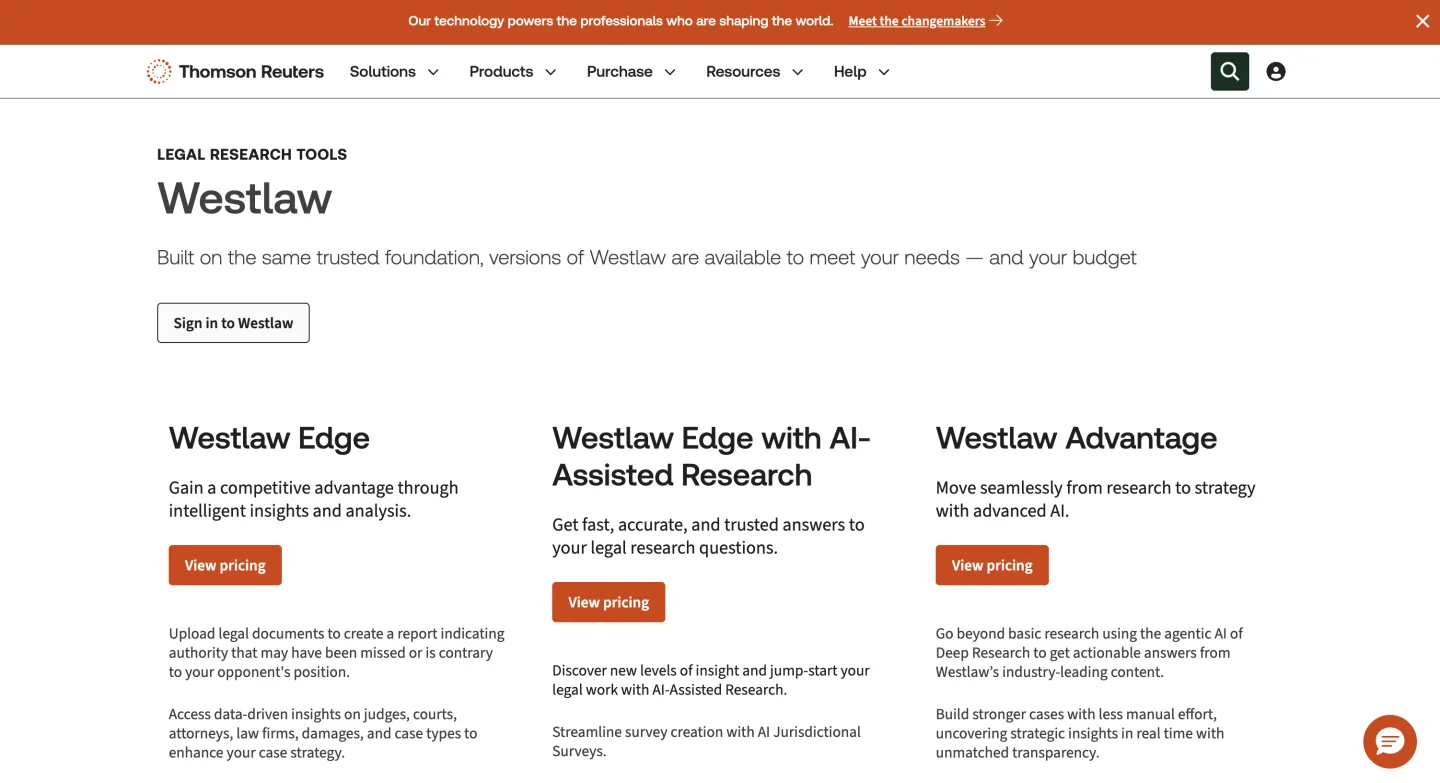
In 2026, the conversation has shifted: it is now Westlaw AI or Lexis+ AI, and the answer is less obvious than the marketing implies. The product names have moved too. What people search as "Westlaw Precision AI" now ships as Westlaw AI-Assisted Research plus CoCounsel Legal, and "Lexis+ AI" is now Lexis+ with Protege. The Westlaw vs Lexis AI question is the same question; the labels changed.
Both platforms have undergone a generational rewrite in the last three years. Thomson Reuters bought Casetext for $650 million in June 2023 and folded its CoCounsel AI assistant into a new product line, currently shipping as CoCounsel Legal with agentic Deep Research, grounded in Westlaw Advantage content.
LexisNexis launched Lexis+ AI in 2023, then in February 2026 replaced it with Lexis+ with Protege, an end-to-end workflow platform with 300+ agentic workflows and multi-model "Best Fit" selection across Claude Sonnet 4.5 and GPT-5.1.
This article compares the two on the things that actually matter: accuracy and hallucination rates, real pricing, citation systems, AI workflows, API access, and training data positions. If you are evaluating which one to subscribe to, or considering whether either is worth the cost at all, read on.
This comparison is written from a working-lawyer point of view. Our team evaluates these platforms the way a buyer does: against the one peer-reviewed accuracy benchmark that exists, against quote-based pricing as it actually lands on a small-firm invoice, and against the citation and verification workflow you are still on the hook for under ABA Opinion 512.
TL;DR
- The peer-reviewed Stanford and Yale study (Magesh et al.) found Lexis+ AI answers 65% of queries accurately and hallucinates on about 17%. Westlaw AI-Assisted Research is accurate 42% of the time and hallucinates on roughly 33%, nearly double the Lexis rate. The "purpose-built for lawyers" pitch does not buy you out of the verification step.
- Reported all-in seat pricing for a comparable Westlaw + CoCounsel Legal or Lexis+ with Protege seat lands around $300 to $500 per user per month, with auto-renewing annual contracts and documented cancellation friction.
- The sticker is not the total. Ramp time, training, and switching between citators are real line items the quote never shows.
- CoCounsel Legal is the more focused Deep Research play grounded in Westlaw Advantage. Protege is the deeper Microsoft-stack workflow play with multi-model "Best Fit" routing.
- Neither incumbent offers a self-serve API key. Both gate developer access behind enterprise procurement.
- For a 1 to 15 lawyer firm, neither AmLaw-priced tier pencils out. The third option is a self-serve, per-seat AI suite with published pricing and a built-in verification stack.
Per the peer-reviewed Stanford and Yale study, which tool hallucinated less?
| Axis | Westlaw + CoCounsel Legal | Lexis+ with Protege |
|---|---|---|
| Accuracy (Magesh et al.) | 42% accurate | 65% accurate |
| Hallucination rate (Magesh et al.) | ~33% | ~17% |
| Citator | KeyCite, with AI Overruling Risk on Edge | Shepard's, with a dedicated Shepard's Citation Agent |
| AI architecture | Single integrated surface, mostly OpenAI under the hood | Multi-model "Best Fit" routing (Claude + GPT via Bedrock) |
| Reported all-in seat price | ~$300-500/user/mo with CoCounsel | ~$300-500/user/mo with Protege |
| Public API | 137 APIs, enterprise-only, no self-serve key | Developer portal, enterprise-only, no self-serve key |
| Microsoft stack integration | Lighter | iManage, NetDocuments, SharePoint, Office, deeper |
Part of our legal AI vendor comparison and pricing series.
The accuracy and hallucination study: 65% vs 42% accurate, 17% vs 33% hallucinations
The most important data point in this comparison is not from a vendor. It is from a peer-reviewed study by Varun Magesh, Faiz Surani, Matthew Dahl, Mirac Suzgun, Christopher D. Manning, and Daniel E. Ho of Stanford and Yale, titled "Hallucination-Free? Assessing the Reliability of Leading AI Legal Research Tools."
The pre-print is on arXiv, and the work is now peer-reviewed and published in the Journal of Empirical Legal Studies (2025). Stanford HAI summarized it as "AI on Trial: Legal Models Hallucinate in 1 out of 6 (or More) Benchmarking Queries."
The headline findings, in the authors' own words:
- Lexis+ AI is the highest-performing system tested. It answers 65% of queries accurately and hallucinates on about 17%.
- Westlaw AI-Assisted Research is accurate 42% of the time and hallucinates on roughly 33% of queries, nearly twice as often as Lexis+ AI.
- Thomson Reuters's Ask Practical Law AI was the most conservative: it refuses or gives ungrounded answers on more than 60% of queries, the highest incompleteness rate among the tools tested.
- Against a general-purpose chatbot baseline (GPT-4), the legal tools do reduce hallucinations, but they do not eliminate them. The authors conclude that vendor claims of "hallucination-free" AI are "overstated."
The accuracy half of this matters as much as the hallucination half. A low hallucination rate alone can hide a tool that simply refuses to answer. Lexis+ AI is the better pick here not only because it hallucinates less, but because it actually answers correctly more often: 65% accurate versus 42%.
Follow-up LawNext analysis reported that the gap held up under retesting, and a separate independent review by a Canadian law professor gave Lexis+ AI a failing grade for reproducing headnotes verbatim as summaries and citing non-existent legislation. The Yale ISPS summary of the same research is here.
Thomson Reuters has since shipped CoCounsel Legal with stated accuracy improvements, and LexisNexis has shipped Protege with multi-model "Best Fit" routing. Neither company has commissioned an independent re-benchmark that we can find. Until they do, the 42%/65% accuracy and 33%/17% hallucination numbers are the most credible data points available.
How the study measured this
The methodology is what makes these numbers trustworthy. The authors built the first preregistered empirical evaluation of AI legal research tools: a hand-constructed dataset of over 200 legal queries, with the scoring criteria registered before the tests ran, so the bar could not be moved after seeing the results.
They scored each answer on two dimensions. A response is correct if its factual claims are right, and grounded if those claims are properly supported by the cited sources.
The key concept is the misgrounded answer: one that cites a real, existing source that does not actually support the claim being made. That is more dangerous than an obviously fake citation, because it looks legitimate until you pull the case and read it. A hallucination, in this study, is a response that is either incorrect or misgrounded.
Answer length turns out to matter. Excluding refusals, Westlaw produced the longest answers, averaging about 350 words (SD 120), against 219 words for Lexis+ AI (SD 114) and 175 words for Ask Practical Law AI (SD 67).
Longer answers make more falsifiable claims, which gives more surface area for a citation to be wrong. That partly explains why Westlaw, the most verbose tool, also hallucinated the most.
The other lesson is that no tool was close to complete. None of the systems answered the full set reliably, and the most cautious tool (Ask Practical Law AI) bought its low error rate by refusing or under-answering more than 60% of the time.
There is no system in this study you can treat as a finished answer. Every one of them is a first draft you have to check.
Practical takeaway: If you are a litigator pasting AI output into a brief, you cannot trust either platform's citations without manual verification. The post-Mata v. Avianca duty of candor and ABA Formal Opinion 512 on the duty of competence with generative AI both require it. Whatever AI tool you use, the verification step is on you.
A note on the unverified "under 3%" and "78% vs 61%" claims
You will see vendor-adjacent posts and roundups circulating numbers like "under 3%" or "5 to 6%" citation hallucination, "78% vs 61%" relevance ranking, or "94%+ citation accuracy," often credited to a "Stanford 2025 Legal AI Benchmark." We could not find a named, dated, reproducible third-party source behind those specific figures. The closest real artifact is Paxton AI's own 94%+ on the Stanford hallucination benchmark, which is a vendor self-report on a different task, not an independent head-to-head of Lexis vs Westlaw.
The only peer-reviewed, preregistered, independent measurement of Lexis+ AI against Westlaw in the public record is Magesh et al. It puts Lexis+ AI at about 17% hallucination and 65% accuracy, and Westlaw at about 33% and 42%. It does not report a "78% vs 61%" relevance figure or a "sub-3%" citation rate. Until a vendor funds and publishes an independent re-benchmark with disclosed methodology, treat single-digit hallucination claims and unsourced relevance percentages as marketing, not measurement.
Feature comparison matrix
The TL;DR table above is the quick decision axis. This one is the full spec sheet for a side-by-side buyer evaluation.
| Feature | Westlaw + CoCounsel Legal | Lexis+ with Protege |
|---|---|---|
| Grounding source | Westlaw Advantage editorial corpus | LexisNexis corpus + Shepard's |
| Underlying models | Mostly OpenAI (GPT family) with TR fine-tuning | "Best Fit" routing across Claude Sonnet 4.5 and GPT-5.1 via AWS Bedrock |
| Citator | KeyCite, AI Overruling Risk (Edge) | Shepard's, dedicated Shepard's Citation Agent |
| Workflow integration | CoCounsel guided workflows, Litigation Document Analyzer, Claims Explorer | 300+ agentic workflows, persona-based task execution, Legal Research Agent |
| Microsoft / DMS stack | Lighter integration | iManage, NetDocuments, SharePoint, Office, deeper |
| API access | 137 APIs, enterprise-only, no self-serve key | Developer portal, enterprise-only, no self-serve key |
| Document analysis caps | Litigation Document Analyzer handles up to ~10,000 documents in bulk | Document-set workflows, enterprise-gated limits |
| Independent accuracy | 42% accurate, ~33% hallucination (Magesh et al.) | 65% accurate, ~17% hallucination (Magesh et al.) |
| Best for | Federal litigation depth, West editorial layer, KeyCite shops | Microsoft-stack firms, multi-model routing, Shepard's shops |
Where each tool landed in the same study
For the long-tail "vs vLex" and "vs Harvey" questions: the Magesh et al. study scored four systems. vLex Vincent and Harvey were not independently benchmarked in this study (the authors note their access is even more restricted than the incumbents'), so we do not assign them a score.
Anyone quoting a Vincent or Harvey hallucination rate "from the Stanford study" is citing something that is not in the paper.
| System | Accurate | Hallucinates | Note |
|---|---|---|---|
| Lexis+ AI | 65% | ~17% | Highest-performing system tested |
| Westlaw AI-Assisted Research | 42% | ~33% | Longest answers, highest hallucination of the paid tools |
| Ask Practical Law AI (Thomson Reuters) | lower | lower error, but incomplete | Refuses or under-answers 60%+ of queries |
| GPT-4 (general-purpose baseline) | n/a | highest | Baseline; legal tools beat it but do not eliminate hallucination |
| vLex Vincent | not tested | not tested | Not in the study |
| Harvey | not tested | not tested | Not in the study |
Pricing reality: quote-based, and what it actually costs all-in
Neither platform publishes prices openly. Both require a sales call. The figures below come from published third-party estimates and reseller listings, not official price sheets, and are attributed inline. There is no public vendor sticker price for the AI tiers.
Westlaw pricing (per user, per month, third-party estimates):
- Westlaw Classic, single state: ~$133
- Westlaw Classic, all states: ~$200
- Westlaw Classic, all states + federal: ~$266
- Westlaw Edge: $169 to $194 (includes KeyCite Overruling Risk)
- Westlaw Precision and Westlaw Advantage: custom quotes (sales engagement required)
- CoCounsel Legal: additional premium on top, typically pushing the total well past $300 to $400 per user per month
Lexis+ AI pricing (per user, per month, third-party estimates):
- Base Lexis+ (non-AI): ~$171
- Lexis+ AI: additional premium on top of base
- Lexis+ with Protege (agentic workflows): premium tier, custom quote
A separate third-party guide (AI Vortex, 2026) lists base Westlaw at ~$150 to $400 per user per month with the CoCounsel add-on at ~$100 to $200 on top, and base Lexis+ at ~$130 to $350. Those ranges overlap the reseller figures above and land in the same all-in zone once AI is bundled.
For a fair side-by-side, an "all-in" comparable Westlaw setup (all states + federal + Edge + CoCounsel) and a Lexis+ AI with Protege seat both land roughly in the $300 to $500 per user per month range for a typical small-firm subscription.
Both have annual contracts with auto-renewal clauses, and both carry documented complaints about cancellation friction: BBB filings catalog multiple LexisNexis contract-lock-in cases, and Westlaw's cancellation process is documented as requiring a physical letter within a narrow pre-renewal window.
Annualized firm-cost estimates
The table below annualizes the all-in $300 to $500 per-seat range for a 3-seat and a 10-seat firm. These are third-party estimates based on the reseller and analyst figures above, not vendor sticker prices, and the incumbent figures stay a range precisely because the AI tiers are quote-based. Vaquill AI's prices are listed as published fact for contrast.
| Firm size | Westlaw + CoCounsel (est.) | Lexis+ with Protege (est.) | Vaquill AI (published) |
|---|---|---|---|
| 3 seats / year | ~$10,800 to $18,000 | ~$10,800 to $18,000 | Self-serve, published, a fraction of the incumbent figure |
| 10 seats / year | ~$36,000 to $60,000 | ~$36,000 to $60,000 | Self-serve, published, a fraction of the incumbent figure |
Incumbent estimates derived from the per-seat ranges above (third-party reseller and analyst listings); Westlaw and Lexis remain quote-based and will vary by contract. Vaquill AI is published and self-serve.
Beyond the sticker: ramp time, training, and switching costs
The per-seat number is not the total cost of ownership. Three line items that never show up in the quote:
- Ramp and training. Protege ships 300+ workflows and CoCounsel adds agentic Deep Research. Nobody learns either in an afternoon. Budget real onboarding hours per lawyer before the tool starts paying for itself.
- Contract lock-in. Both platforms auto-renew on annual terms. LexisNexis carries BBB-documented contract-lock-in complaints, and Westlaw's cancellation is documented as requiring a physical letter inside a narrow pre-renewal window. Put the cancellation date in your calendar the day you sign.
- Switching cost. Moving off one incumbent onto the other, or onto a lighter tool, means re-training on a different citator (KeyCite versus Shepard's), rebuilding saved searches, and re-integrating your document management system. Run any new tool in parallel on live matters before you cut over.
For related vendor, pricing, and buyer-guide coverage, see Lexis+ AI Pricing 2026: Per-Seat Costs, Hidden Add-Ons, Cheaper Suite Alternatives and Lexis+ AI vs Westlaw AI vs Vaquill AI: The Honest AI Legal Research Comparison.
Citation systems: KeyCite vs Shepard's
Both citators are credible, lawyer-edited, and have decades of editorial investment. They are also the two best citators on the US market.
If your only criterion were citation reliability, this is roughly a tie. This is the layer the AI study above does not touch, and it is still the backbone of malpractice-grade citation checking.
KeyCite (Westlaw):
- Red flag (reversed, overruled, abrogated) and yellow flag (negative treatment but not overturned)
- Depth-of-treatment bars (one to four bars indicating how thoroughly the citing case discusses the cited case)
- AI-powered Overruling Risk prediction (Westlaw Edge feature)
- Coverage of every case in West's National Reporter System plus over 1 million unpublished cases
- 150+ years of editorial classification via the West Key Number System
Shepard's (Lexis+):
- Red stop sign (negative treatment), orange Q (questioned), yellow triangle (caution), and green diamond (positive)
- Appellate history, citing decisions, table of authorities
- Origin in the 19th century (the verb "shepardize" is still in the federal rules of practice)
- Tighter integration with the broader LexisNexis corpus and Protege workflows

The honest answer: most US litigators have a strong opinion about which one they trust, and that opinion usually correlates with where they trained as a summer associate. Both are sufficient for malpractice-grade citation checking.
If you have no prior preference and you primarily practice in state court, Shepard's signals tend to be marginally more granular for state appellate histories. If you primarily practice in federal court, KeyCite's depth-of-treatment bars are the more useful at-a-glance signal.
AI workflows: CoCounsel Legal vs Protege
This is where the two platforms have diverged most sharply. One way to frame the split, per a May 2026 Advocate Magazine analysis: LexisNexis optimizes for customization and prediction, while Westlaw optimizes for citation integrity and editorially reviewed content. That philosophy shows up in the products.
CoCounsel Legal (Thomson Reuters) focuses on agentic Deep Research grounded in Westlaw Advantage content. The August 2025 launch highlighted guided workflows for drafting privacy policies, employee handbooks, complaints, and discovery requests; a Litigation Document Analyzer that handles up to 10,000 documents in bulk; and a Claims Explorer that maps litigation theories.
The architecture is single-product: Westlaw Advantage plus CoCounsel as one integrated surface.
Lexis+ with Protege (LexisNexis) went a different direction. The February 2026 launch is positioned as an end-to-end workflow platform with 300+ agentic workflows, persona-based task execution, and a "Best Fit" multi-model layer that routes queries across Claude Sonnet 4.5 and GPT-5.1.
Specialized sub-agents include a Shepard's Citation Agent and a Legal Research Agent. Integration with iManage, NetDocuments, SharePoint, and Office is deeper than what Thomson Reuters has shipped on the CoCounsel side.
Practical takeaway:
- If your firm runs on the Microsoft stack and you want one tool to draft, review, and research without switching apps, Protege is the more integrated workflow play.
- If you want the deepest single-tool research depth and you trust the Westlaw editorial layer more, CoCounsel Legal Deep Research is the more focused research play.
Both are designed for AmLaw and BigLaw economics. Neither makes sense at solo or 2 to 15 lawyer scale without significant per-seat budget.
API access: both gated, neither self-serve
This is the most under-discussed difference between the two platforms and the broader market.
Westlaw / Thomson Reuters: The Thomson Reuters Developer Portal launched in April 2024 with 137 APIs covering Westlaw search, Litigation Analytics, Practical Law, Dockets, SEC Filings, and more.
Access requires an enterprise agreement and sales approval. There is no self-serve API key, no public pricing, and no documented free tier.
LexisNexis: A developer portal launched in 2022 with broadly similar economics. Enterprise agreement required, sales engagement, no self-serve key, no free tier.
If you are a legal tech builder trying to integrate US case law into your product, neither incumbent will give you an API key without a procurement process.
This has been a quiet driver of the post-2023 wave of new legal AI tools: the data is no longer the moat it once was, and developer-facing alternatives have shipped. We cover the self-serve options in Westlaw and LexisNexis API alternatives for developers.
Training data: "we do not train" positions
A query that has been showing up in legal-research search logs throughout 2026 is variations on "we do not train" "westlaw" "openai". Lawyers want to know whether their queries and uploaded documents are used to train the underlying foundation models. Here is where each platform stands as of mid-2026, based on their public documentation.
Thomson Reuters / Westlaw: The CoCounsel Legal documentation states that customer queries and uploaded documents are not used to train the underlying foundation models.
Inputs are processed for the response and discarded per the contractual data handling terms. CoCounsel's foundation models are largely OpenAI-based with Thomson Reuters's own fine-tuning and grounding pipeline on top.
LexisNexis / Protege: Similar position: customer data is not used to train foundation models. The multi-model layer routes across Claude (Anthropic) and GPT (OpenAI) via AWS Bedrock, with the same no-training-on-customer-data guarantee in the enterprise terms.
For solo and small-firm lawyers, the more meaningful question is whether your client confidences pass through an upstream provider's infrastructure at all. Both platforms route customer queries through OpenAI or Anthropic APIs (Bedrock in the Lexis case).
If you have a client who is sensitive to inputs touching any third-party LLM API, that is a question you need to ask in writing before signing the contract, regardless of which platform you pick. For the full contractual breakdown, see how Westlaw and Lexis handle OpenAI training data.
Which one should you pick?
The fastest way to route the decision is by firm size first, then by priority.
Pick Westlaw with CoCounsel Legal if:
- You are at an AmLaw or BigLaw firm with procurement budget
- You need the depth of West's editorial layer (Key Number System, treatises, secondary sources)
- KeyCite is part of your existing workflow and your associates trust it
- Your firm bills primarily federal litigation where the National Reporter coverage matters most
Pick Lexis+ with Protege if:
- Your firm runs on the Microsoft stack and you want one workflow tool
- You want 300+ agentic workflows for drafting and document analysis
- You value the multi-model "Best Fit" routing (Claude plus GPT)
- Shepard's signals match how you already think about citation history
- Accuracy is the deciding factor: it scored 65% accurate against Westlaw's 42% in the only peer-reviewed test
By practice area: For federal litigation, Westlaw's National Reporter coverage and KeyCite depth-of-treatment bars are the stronger at-a-glance signal. For high-volume case-file work and litigation analytics, Lexis+ pairs with the Lex Machina line and handles large document sets well. For transactional and drafting-heavy teams, Protege's workflow library does more of the first draft. The deeper Lexis+ vs Westlaw litigation research breakdown has the court-by-court view.
Pick neither incumbent if you are a solo lawyer or 1 to 15 lawyer firm. The economics do not work. A comparable AI tier on either platform clears $300+ per user per month with annual contracts and BBB-documented cancellation friction.
The Magesh et al. study still shows 17% to 33% hallucination rates and 42% to 65% accuracy on the AI layer, and your malpractice exposure is the same whether you spent a little or $499 per month on the tool that hallucinated.
Look at vLex Vincent if you want incumbent-class case-law depth at a lower price. vLex publishes a Professional tier around $69 per user per month and Enterprise around $99 to $150 (third-party listing, AI Vortex, April 2026; vLex itself is quote-based for full AI access). It was not in the Magesh et al. benchmark, so there is no independent accuracy score for it, but it is the option most buyers compare against Lexis and Westlaw on cost.
The third option: per-seat AI legal research for small firms
If you are running a 1 to 15 lawyer US firm and the Westlaw or Lexis economics do not fit, the alternative class is per-seat AI legal research platforms with self-serve onboarding, transparent published pricing, no annual contracts, and millions of US federal and state opinions. Vaquill AI sits in this tier, published and self-serve.
The credible ones publish a verification stack with per-claim confidence scores, and an open accuracy benchmark on recently changed law, rather than a single-shot answer, because the Magesh et al. numbers (17% to 33% hallucination, 42% to 65% accuracy on the incumbents) are now the default buyer expectation, not a worst case.
If you cannot afford a tool that is only accurate 42% of the time and you cannot afford a $400-per-seat AI subscription, those two facts are connected.
FAQ
Is Lexis+ AI more accurate than Westlaw?
Yes, on the only independent measurement available. The peer-reviewed Magesh et al. study (Stanford and Yale, JELS 2025) found Lexis+ AI answered 65% of queries accurately versus 42% for Westlaw AI-Assisted Research, and Lexis+ AI hallucinated on about 17% of queries versus roughly 33% for Westlaw.
How much does Westlaw AI cost per month?
There is no public sticker price. Westlaw and CoCounsel Legal are quote-based and require a sales call.
Third-party reseller and analyst estimates put base Westlaw tiers from ~$133 (single state) to ~$266 (all states plus federal), with Edge at $169 to $194, and an all-in seat with CoCounsel Legal typically landing in the $300 to $500 per user per month range.
Does CoCounsel cost extra?
Yes. CoCounsel Legal is an add-on premium on top of a Westlaw subscription, not included in the base research tiers. That add-on is what pushes a comparable AI-enabled seat past $300 to $400 per user per month.
Which hallucinates less, Lexis+ AI or Westlaw AI?
Lexis+ AI. In the Magesh et al. study it hallucinated on about 17% of queries, roughly half of Westlaw's ~33%. Part of the gap is answer length: Westlaw produced the longest answers (about 350 words on average versus 219 for Lexis+ AI), and longer answers make more falsifiable claims.
Is Westlaw or Lexis+ AI better for litigation?
It depends on the litigation. For federal work, Westlaw's National Reporter coverage and KeyCite depth-of-treatment bars are the stronger citation signal. For high-volume case-file handling and litigation analytics, Lexis+ pairs with the Lex Machina line. On the one peer-reviewed accuracy test, Lexis+ scored higher (65% vs 42%), and you have to verify every cite either way.
Can I switch from Westlaw to Lexis+ AI without losing capability?
Mostly, but budget for the switch. The case-law depth is comparable, but you re-train associates on Shepard's instead of KeyCite, rebuild saved searches and alerts, and re-integrate your document management system. Run the new platform in parallel on live matters for a few weeks before you cut the old contract, and watch the auto-renewal date so you are not double-paying.
How do I negotiate a lower price on Westlaw or Lexis+ AI?
Both list-price quotes are negotiable, and the leverage is highest near a renewal. Get a written proposal from the competitor and put it on the table. Ask for the AI tier bundled into the seat price rather than billed as a separate add-on, and negotiate the auto-renewal and cancellation terms before you sign, not after.
Is Lexis+ AI worth it for a small firm?
For most solo and 2 to 15 lawyer firms, the all-in cost is hard to justify, which is the whole question behind whether LexisNexis is worth it and the better alternatives. Even the more accurate incumbent runs $300 to $500 per seat per month on annual contracts, and you still have to manually verify every citation.
A self-serve per-seat suite with a built-in verification stack, such as Vaquill AI, is usually the better fit at that scale.
What did the Stanford study find?
The Stanford and Yale study (Magesh, Surani, Dahl, Suzgun, Manning, and Ho), "Hallucination-Free? Assessing the Reliability of Leading AI Legal Research Tools," ran over 200 preregistered queries against the major legal AI tools.
It found Lexis+ AI accurate 65% of the time (hallucinating ~17%), Westlaw accurate 42% (hallucinating ~33%), and Ask Practical Law AI incomplete on more than 60% of queries. The authors concluded that "hallucination-free" vendor claims are overstated.
Does either tool offer a self-serve API?
No. Both Thomson Reuters (137 APIs) and LexisNexis run enterprise-only developer portals. Neither offers a self-serve API key, public pricing, or a documented free tier; access requires a procurement process.
Are the "under 3%" hallucination numbers real?
We could not find a named, dated, reproducible third-party source for single-digit hallucination claims. The only peer-reviewed, preregistered measurement is Magesh et al., which puts Lexis+ AI at about 17% and Westlaw at about 33%. Treat sub-3% claims as marketing until a vendor publishes an independent re-benchmark with disclosed methodology.
Is Westlaw Precision AI the same as Westlaw AI-Assisted Research?
They are part of the same product family. Westlaw Precision is the research platform, AI-Assisted Research is the generative answer layer that the Magesh et al. study tested, and CoCounsel Legal is the agentic add-on Thomson Reuters now leads with. When people search "Westlaw Precision AI vs Lexis+ AI," they are comparing the same two stacks covered here.
How does vLex compare to Lexis+ AI and Westlaw?
vLex Vincent is the main lower-cost alternative buyers weigh against the two incumbents, with third-party listings around $69 to $150 per user per month (AI Vortex, April 2026). It was not included in the Magesh et al. benchmark, so there is no independent accuracy or hallucination score for it. On price it undercuts both incumbents; on independent accuracy data it is untested.
Sources
- Magesh et al., "Hallucination-Free? Assessing the Reliability of Leading AI Legal Research Tools" (arXiv pre-print): curl 200 (browser UA)
- Journal of Empirical Legal Studies (2025): peer-reviewed version, DOI 10.1111/jels.12413: DOI valid; Wiley returns 403 to non-browser clients (bot block), resolves in-browser
- Stanford HAI: AI on Trial (Legal Models Hallucinate): curl 200
- Yale ISPS summary of the study: curl 200
- LawNext: In a redo of its study, Stanford finds Westlaw's AI hallucinates at double the rate of LexisNexis (June 2024): curl 200
- Paxton AI: 94%+ on the Stanford hallucination benchmark (vendor self-report, used here only to show "94%" is a single-vendor claim, not an independent head-to-head): curl 200
- Advocate Magazine: LexisNexis AI vs Westlaw AI, design-philosophy framing (May 2026): fetched 200; cited for the prediction-vs-accuracy framing only
- AI Vortex: Westlaw vs Lexis+ vs vLex 2026 (April 2026): third-party price listing cited for the vLex ~$69 to $150 range and the base Westlaw / Lexis+ estimate ranges
- LawNext: Thomson Reuters launches CoCounsel Legal (August 2025)
- LawNext: LexisNexis launches Lexis+ with Protege (February 2026)
New legal AI guides, weekly.
Further Reading
Harvey AI Pricing 2026: Per-Seat Cost and the Renewal Increase
Read postHarvey AI Pricing: $1,200-$2,000/Seat vs Legora & CoCounsel
Read postLexis+ AI vs Westlaw AI vs Vaquill AI: The Honest AI Legal Research Comparison
Read postTop AI Legal Research for Solo Attorneys on a Budget
Read postBest AI Software for Plaintiff Law Firms (2026): 11 Tools Compared
Read postLegora Pricing: What a Seat Actually Costs (2026) vs Harvey
Read post
Co-Founder & CEO · Attorney
Arshita leads product and strategy at Vaquill, building the legal AI suite that solo, small-firm, and in-house US lawyers use to run a matter end to end.