For the work a solo or 2 to 15 lawyer firm actually does, Westlaw and LexisNexis are close to interchangeable on everything they market: case law, statutes, and now AI. They differ on one real axis, exclusive treatises (Wright & Miller on Westlaw, Moore's on Lexis), and most small firms never touch it.
So choose on price and whether a named treatise is load-bearing for you, not the sales demo. On price, a solo Westlaw Essentials plan starts around $96 a month and Lexis solo plans start around $108 to $175 a month (LawSites, Bob Ambrogi, May 2019), with the AI layer on either side pushing a seat past $400. Both also cost well above AI-native tools that cover the same daily research. The plain-English breakdown is below.
A solo lawyer I know spent three weeks agonizing over Westlaw vs LexisNexis. She built a spreadsheet. She sat through two sales demos. She asked her old firm's librarian which one was "better."
Then she signed a Westlaw contract, used it for case law and a citator, and never once touched the thing that actually distinguishes the two platforms.
That is the whole story of this decision, compressed. Most small firms treat Westlaw vs LexisNexis as a quality contest, like choosing between two cars. It is not.
For the work a solo or 2-to-15-lawyer firm actually does, the two are close to interchangeable on everything they market at you. They genuinely differ on exactly one axis, and almost nobody chooses on that axis. They choose on the demo, the rep, or the brand they remember from law school.
So let me reframe the question. The useful version is not "which is better." It is "which lock-in can I live with, and do I need to be locked in at all?"
TL;DR
- On primary law (the U.S. Code, the CFR, all 52 state and territory codes, federal and state opinions), Westlaw and LexisNexis cover the same public corpus. The marketed differences there are thin.
- The one real differentiator is exclusive editorial content. Wright & Miller's Federal Practice and Procedure lives only on Westlaw. Moore's Federal Practice lives only on Lexis. If your practice leans on a named treatise, that decides it. If it does not, the choice barely matters.
- KeyCite vs Shepard's is a tie for most small-firm work. Both flag bad law reliably. Neither is a reason to pick a platform.
- On solo and small-firm pricing, the two land in the same band: Westlaw Essentials from $96 a month, Lexis solo plans from $108 to $175 a month (LawSites, May 2019). Add AI on either side and a seat clears $400. The pain (annual contracts, auto-renewal, per-document surprise charges) is symmetric.
- Price is negotiable on both. The published or quoted rate is a starting point, and reps discount on multi-year deals.
- The honest takeaway: what you "give up" with either is mostly the same. The decision deserves an afternoon, not three weeks.
For a small firm, what is the single defensible reason to pick one platform over the other?
Part of our legal AI vendor comparison and pricing series.
The comparison at a glance
| Westlaw | LexisNexis | Vaquill AI | |
|---|---|---|---|
| Solo entry price | Essentials ~$96/mo, state cases and statutes (LawSites, 2019) | State Basic ~$108/mo (1-yr), state cases and statutes (LawSites, 2019) | Self-serve, published |
| All-states plus federal | ~$277/mo (1 attorney), custom plan (LawSites, 2019) | Premium ~$246/mo (1-yr) (LawSites, 2019) | Included at the single self-serve tier |
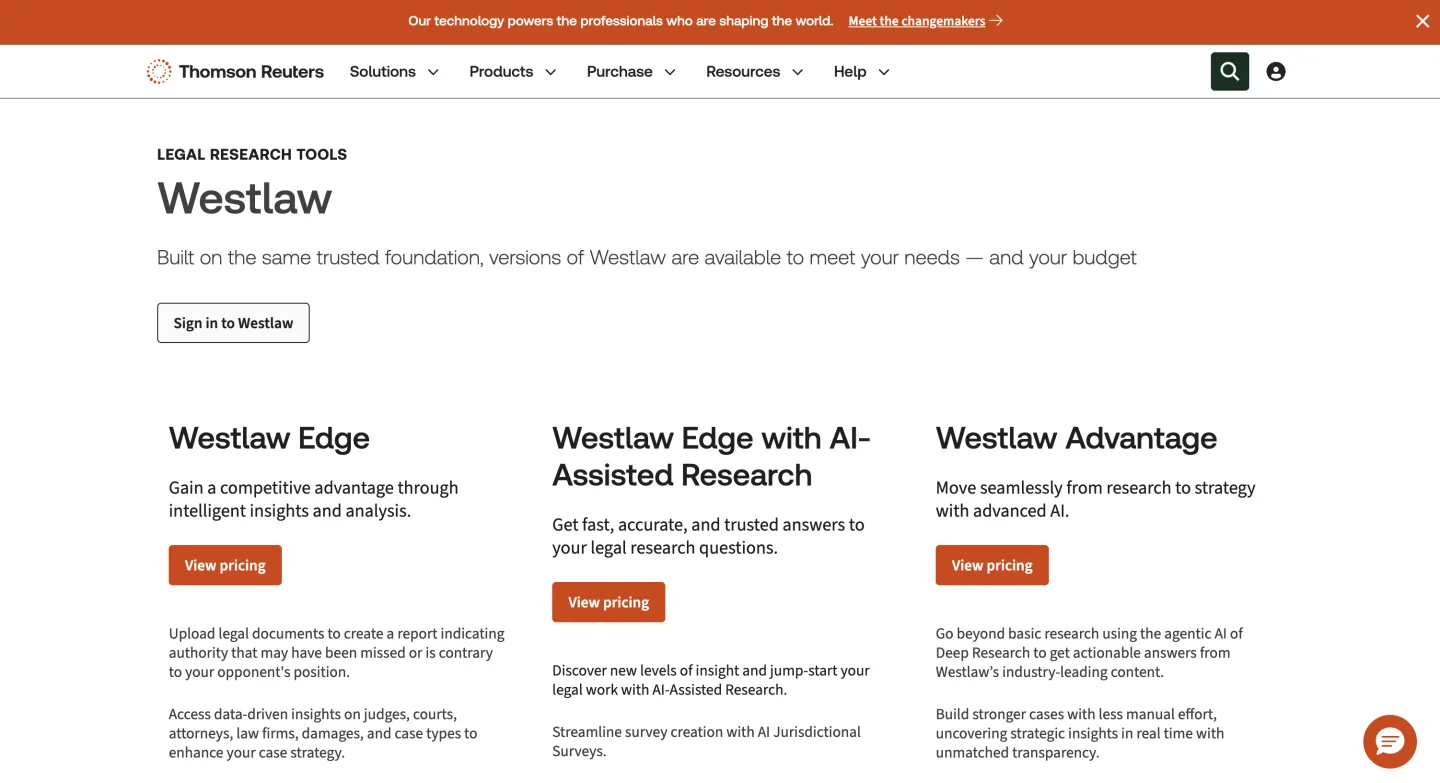
| With the AI layer | Precision AI / CoCounsel, quote-based, clears ~$400/seat | Lexis+ Protégé, quote-based, clears ~$400/seat | AI is included, no separate add-on |
| Access | Annual contract, demo required, auto-renewal | Annual contract, demo required, auto-renewal | Self-serve, 7-day trial, month-to-month at the published tier |
| Citator | KeyCite | Shepard's | Per-claim source verification, no 60-year treatment citator |
| AI accuracy | AI-Assisted Research ~42% accurate, ~33% hallucination (Stanford/Yale, arxiv.org/html/2405.20362v1) | Lexis+ AI ~65% accurate, ~17% hallucination (same study) | 4-layer verification with per-claim confidence tags; no third-party benchmark yet |
| Exclusive treatise | Wright & Miller, Federal Practice and Procedure | Moore's Federal Practice, plus Lex Machina analytics | None; relies on public primary law |
| Best for | Firms tied to a Westlaw-exclusive treatise (Wright & Miller) | Firms tied to a Lexis-exclusive treatise (Moore's) or Lex Machina analytics | Solo and small firms wanting an AI-native suite at a published price |
Prices for Westlaw and Lexis come from Bob Ambrogi's solo and small-firm cost comparison (LawSites, May 2019), the most detailed public plan-by-plan breakdown for small firms. They are dated and a starting point for negotiation, not a live quote. The Stanford/Yale accuracy figures come from the 2024 study later published in the Journal of Empirical Legal Studies; they tested then-current versions, and neither incumbent has re-benchmarked since.
The thirty-year duopoly, and why it feels permanent
Westlaw and LexisNexis have split the American legal research market for roughly three decades. That longevity is not an accident of quality. It is the compounding of a head start.
Both companies spent the 1970s and 1980s digitizing case law and building editorial layers (headnotes, key numbers, annotations) on top of public-domain primary law. Once a generation of lawyers learned to research inside those systems, switching costs became the moat. You do not just buy a database. You buy back the muscle memory of everyone you hire.
That is why the duopoly feels permanent even though the underlying material, the law itself, is free. Every published opinion is public record. The U.S. Code is public. The CFR is public. All fifty state codes are public.
What you are paying Thomson Reuters or RELX for is not the law. It is the organization of the law, plus a citator, plus a handful of treatises you cannot get anywhere else.
For a big firm running fifty associates, that organization is worth a lot. For a three-person shop, the value proposition gets murky fast, which is the part the sales decks never show you.
You do not just buy a database. You buy back the muscle memory of everyone you hire.
Where they are genuinely identical
Start with the things both platforms put on the first slide.
Primary law coverage. Federal appellate and district opinions, state supreme and appellate decisions, statutes, regulations, court rules. Both have all of it.
If you are looking up Carpenter v. United States, 585 U.S. 296 (2018), or pulling the text of 42 U.S.C. 1983, it does not matter which subscription you hold. The opinion and the statute are the same document on both. Coverage gaps that mattered in the 1990s have closed.

Annotated statutes. Both sell heavily annotated versions of the U.S. Code (USCA on Westlaw, USCS on Lexis) and state codes, with notes of decisions, cross-references, and historical amendments. The annotations differ in editorial flavor, not in whether they exist. A litigator researching the scope of 5 U.S.C. 706 after Loper Bright v. Raimondo, 603 U.S. 369 (2024), will find detailed treatment on either.
Search and AI surface. Both have natural-language search, Boolean operators, and a generative-AI assistant bolted on top. The AI layers do differ, and they differ enough to deserve their own comparison, but that is a separate question from the platforms underneath. I will point you to it below rather than relitigate it here.
If you stopped reading at this section, you would already know more than most buyers: on the marketed features, this is close to a coin flip.
For related vendor / pricing / buyer-guide coverage, see Westlaw vs LexisNexis vs Vaquill AI: A 2026 Pricing and AI Research Comparison and Best Westlaw Alternatives for Solo & Small Firms (2026).
The one thing that actually forces a choice
Here is the part worth slowing down for. The single defensible reason to pick one platform over the other is exclusive secondary content.
Two treatises make the point cleanly:
- Wright & Miller, Federal Practice and Procedure is exclusive to Westlaw. It is the most-cited treatise in federal civil procedure, full stop. If you litigate in federal court and you rely on Wright & Miller, Westlaw is not a preference. It is a requirement.
- Moore's Federal Practice is exclusive to LexisNexis. It is the principal rival to Wright & Miller, and plenty of federal practitioners swear by it instead.
This pattern repeats across practice areas. Particular treatises, form books, and practice guides are tied to one platform by publishing rights, and you cannot buy them à la carte from the other. Law librarians document this constantly; the treatise-availability charts in university library research guides exist precisely because the exclusivity is real and confusing.
So the honest test for a small firm is narrow and specific: Is there a named treatise your practice genuinely depends on, and does it live on only one platform? If yes, the question answers itself, and you should ignore everything else.
If no, and for many small firms the honest answer is no, then you are choosing between two products that do the same job at the same price with the same contract friction. The brand on the login screen is the least important variable in the entire decision.
This is the inversion most buyers miss. They treat the exclusive content as a tiebreaker after they have weighed price, interface, and AI. It is the opposite. The exclusive content is the only thing that should ever break a tie, because it is the only thing one platform has that the other cannot get.
Citators: KeyCite vs Shepard's
Citation checking is the function lawyers are most nervous about getting wrong, and rightly so. Citing overruled law is not a typo. It is a malpractice exposure.
So which citator wins, KeyCite (Westlaw) or Shepard's (Lexis)? For small-firm work, neither. Both are mature, both have decades of editorial labor behind them, and both reliably flag when a case has been overruled, questioned, or distinguished.
Studies over the years have found edge cases where one catches a negative treatment the other missed, in both directions, which tells you the practical answer: at the level a small firm operates, they are a wash.
The real citator risk in 2026 is not KeyCite vs Shepard's. It is trusting an AI summary that did not actually run a citator at all. After the Mata v. Avianca sanctions in 2023, where lawyers filed a brief citing cases ChatGPT invented, the profession learned the hard way that a confident citation is not a verified one.
Whatever platform you choose, the citator is the safety check, and it has to be a real one. ABA Formal Opinion 512 (July 2024) made the duty to verify AI output explicit. Pick the platform for its treatises. Trust the citator because you actually clicked through it, not because a chatbot told you the case was good law.
The economics nobody puts on the slide
Now the part that hits a small firm hardest, and where the two are most identical: the money and the contract.
The most detailed public plan-by-plan numbers for small firms come from Bob Ambrogi's cost comparison (LawSites, May 2019). They are dated, so treat them as a band and a negotiating baseline, not a 2026 quote. They still show the shape of it:
| Plan | Coverage | Monthly (1 attorney) |
|---|---|---|
| Westlaw Essentials | State cases and statutes | ~$96 |
| Westlaw Plus (Massachusetts example) | State plus federal circuit materials | ~$292 |
| Westlaw Custom | All federal and state cases | ~$277 |
| Lexis State Basic (1-yr) | State cases and statutes | ~$108 |
| Lexis Enhanced (1-yr) | State plus federal, $25 admin fee | ~$149 |
| Lexis Premium (1-yr) | Adds law reviews and journals | ~$246 |
Source: LawSites, May 2019. Westlaw Plus pricing varies by state; California ran ~$356 for one attorney.
Once you add CoCounsel AI features (absorbed from the Casetext acquisition, which Thomson Reuters bought for $650M in 2023) on the Westlaw side, or Lexis+ Protégé on the Lexis side, you are into custom quotes that, by most accounts, clear $400 a month per seat.
Both quote you, rather than publish, the moment AI enters the conversation. And on both sides the published or quoted rate is a starting point: reps discount, especially on multi-year deals, so always ask.
The structural pain is the same on both sides:
- Annual contracts with auto-renewal. You are committing for a year, and the renewal often arrives at a higher rate unless you act inside a narrow window.
- Cancellation friction. Getting out is deliberately harder than getting in. Lawyers have described cancellation processes that require a mailed physical letter inside a tight window. That is not a Westlaw quirk or a Lexis quirk. It is duopoly behavior.
- Per-document surprises. Viewing material outside your plan can trigger charges you did not see coming, sometimes over a hundred dollars for a single document.
For a three-person litigation shop on a full-coverage plan with the AI layer, that can mean spending well over $1,000 a month on research before billing a single hour. The point here is not that one platform is cheaper. It is that the cost structure was built for AmLaw economics, and it does not flex for you.
When people ask what they "give up" by choosing Westlaw over Lexis or the reverse, the honest answer is: nothing, on the dimensions that hurt. The price and the contract are symmetric pain.
So how should a small firm actually decide?
Strip it down to a short sequence.
- Do you depend on a named exclusive treatise? If Wright & Miller is load-bearing for your federal practice, it is Westlaw. If Moore's is, it is Lexis. Stop here; you are done.
- If not, is one platform free or subsidized for you? Many state bars bundle a research platform as a member benefit. Free coverage you already have beats a contract you are evaluating.
- If still tied, what does your team already know? Switching costs are real and they live in your people's hands. If your paralegal is fluent in one, that fluency has dollar value.
- Then, and only then, weigh price and AI. And at that point, ask the bigger question: do you need the duopoly at all?
That last question is the one the spreadsheet never includes. Because the public corpus, the actual law, no longer requires a duopoly contract to reach.
The U.S. Code, the CFR, and all fifty state codes are available through self-serve options and through neutral statutes APIs, which is to say the primary-law layer that justified the duopoly's pricing in 1990 is now a commodity. What you are really paying the incumbents for, in 2026, is the citator, the exclusive treatises, and the brand comfort. Two of those three are gettable elsewhere, and the third only matters if you actually use it.
A new generation of AI-native tools (Harvey, Legora, CoCounsel, and a handful of newer US-focused suites) is built on exactly that premise: the law is free, the value is in how fast you can reason over it, and the contract should not feel like a hostage negotiation.
Whether one of those fits your practice is its own evaluation. But it belongs in the decision, because "Westlaw or Lexis" quietly assumes the answer has to be one of two companies, and in 2026 that assumption is the thing most worth questioning.
Where to go deeper
- If you want the AI-layer comparison specifically (CoCounsel Legal vs Protégé, hallucination rates, multi-model routing), read Lexis AI vs Westlaw AI in 2026. That post is about the assistants. This one is about the platforms underneath.
- For the wider set of options, the best Westlaw alternatives for solo and small firms walks through free and paid options, and what firms actually pay for legal research in 2026 breaks down the real numbers.
FAQ
Is Westlaw or LexisNexis cheaper for a solo or small firm?
They land in roughly the same band. Bob Ambrogi's solo and small-firm comparison (LawSites, May 2019) put Westlaw Essentials around $96 a month and Lexis State Basic around $108 a month for state-only coverage, rising to roughly $246 to $277 a month for all-states-plus-federal on either side. Add the AI layer and a seat clears $400. Those figures are dated, so use them as a band and a negotiating baseline, not a live quote.
Which one hallucinates less, Westlaw AI or Lexis+ AI?
In the 2024 Stanford/Yale study (arxiv.org/html/2405.20362v1), Lexis+ AI was the more reliable of the two, at roughly 65% accurate with about 17% hallucination, versus Westlaw AI-Assisted Research at roughly 42% accurate with about 33% hallucination. Both numbers are from then-current versions, and neither vendor has published a re-benchmark, so verify every citation regardless of which you pick.
Which is better for a small firm versus litigation?
For general small-firm work the two are close to interchangeable, so the named-treatise question and price usually decide it. For litigation specifically, Westlaw's Litigation Analytics (judge and motion data) and Lexis's Lex Machina pull ahead in different directions; that is its own comparison.
Does the AI layer (CoCounsel or Protégé) cost extra?
Yes. The base research subscription does not include the generative AI assistant. Adding Westlaw Precision AI (CoCounsel lineage) or Lexis+ with Protégé pushes a small-firm seat past roughly $400 a month, and the exact figure is quote-based.
Is KeyCite or Shepard's the better citator?
For small-firm work they are a wash. Both are mature, both reliably flag overruled or questioned law, and studies over the years find edge cases in both directions. Neither is a strong enough reason to pick a platform on its own.
Do I have to choose one of the two at all?
No. The primary law (the U.S. Code, the CFR, all 52 state and territory codes, federal and state opinions) is public, and AI-native suites now cover the same daily research at a published price. Vaquill AI, for example, is self-serve and published. The incumbents still win on exclusive treatises and the long-standing citators, so the honest question is whether your practice actually needs those.
Is Westlaw or LexisNexis worth it for a 2-to-15-lawyer firm?
It is worth it when a named treatise or analytics product your practice depends on lives only on that platform. If no such dependency exists, you are paying enterprise-shaped pricing for a corpus that is largely public, and a lower-cost AI-native suite may cover the daily work for less.
Is Westlaw easier to use than LexisNexis for a solo?
For most solos, Westlaw is the gentler on-ramp because its natural-language search behaves like a plain Google query, which matters when you are doing every job in the firm yourself. Lexis rewards lawyers who configure their own workflows and lean on analytics. Neither gap is large enough to override price or the named-treatise question.
Can I get Westlaw or LexisNexis free through my state bar?
Sometimes. A number of state bars bundle Fastcase, vLex, or a research platform as a member benefit, and that free coverage can handle a real share of small-firm research. Check your bar's member portal before you sign any contract, because coverage you already have beats a subscription you are evaluating.
Can you negotiate Westlaw or LexisNexis pricing?
Yes. The published or quoted rate is a starting point, not a fixed price. Reps have discretion to discount, especially on multi-year contracts, and Lexis in particular has a reputation for flexibility at the table. Get quotes from both and use each against the other.
New legal AI guides, weekly.
Further Reading
Harvey AI Pricing 2026: Per-Seat Cost and the Renewal Increase
Read postLexis+ AI Pricing 2026: Per-Seat Costs, Hidden Add-Ons, Cheaper Suite Alternatives
Read postHow Much Does Westlaw Cost in 2026? Solo, Small-Firm, Westlaw Plus Pricing
Read postTop Legal Research Tools for Solo Family Law Attorneys
Read postHarvey AI Pricing: $1,200-$2,000/Seat vs Legora & CoCounsel
Read postLexis+ AI vs Westlaw AI 2026: Pricing + Which Hallucinates Less
Read post
Co-Founder & CEO · Attorney
Arshita leads product and strategy at Vaquill, building the legal AI suite that solo, small-firm, and in-house US lawyers use to run a matter end to end.