Short answer: Westlaw wins on the Key Number System and KeyCite, LexisNexis wins on Lex Machina analytics and Shepard's, and Vaquill AI wins on price (published, self-serve pricing) plus a month-to-month motion for solo and small firms. Westlaw Classic starts at $132.80 per month and Lexis+ Enhanced at $148.84 per month before any AI add-on; both clear $400 once AI is on. Coverage on primary law is close across all three.
The honest framing of "Westlaw vs LexisNexis vs Vaquill AI" is not three products competing for the same buyer. It is three product shapes built for three different decades of legal work, sold through three different motions, priced for three different P&Ls.
Treating it as a single bake-off is how firms end up paying enterprise rates for features a solo will never use. This is an analyst-style breakdown, not a sales deck. Price comes up once, near the end.
TL;DR
- Price, sourced: Westlaw Classic starts at $132.80 per month for one state, $266.40 for all states plus federal (Lawyerist, 2026); a comparable Lexis+ Enhanced seat runs $148.84 per month plus a $25 admin fee (Clio, 2026). Adding the AI layer (Precision AI or Lexis+ Protégé) pushes a seat past $400. Vaquill AI is published, self-serve pricing you can read off the pricing page.
- Westlaw and LexisNexis are the incumbents, with the deepest editorial layers, the broadest secondary sources, and decades of muscle memory built into the profession. They are not going away.
- Citator is the real fork: KeyCite (Westlaw) and Shepard's (Lexis) are decades-deep negative-treatment systems. Vaquill AI verifies each AI claim against its source but does not replace a citator. If your workflow starts every case with a treatment flag, keep an incumbent for that step.
- Vaquill AI is an upstart full suite (research, drafting, document comparison, matrices, matters, agent mode) priced and packaged for solo and small-firm buyers, with a self-serve motion and a 4-layer verification approach on AI answers.
- Coverage on primary law is comparable across all three. Secondary sources (treatises like Wright & Miller, Moore's, ALR, AmJur) remain a Westlaw/Lexis moat. Vaquill AI does not claim parity there.
- The right pick depends on what you do every day, not on which tool wins a feature checklist. The buyer-profile section near the end is the part most people should skim to first.
What does Westlaw Classic start at per month for one state?
Part of our legal AI vendor comparison and pricing series.
The three tools, drawn honestly
Westlaw (Thomson Reuters)
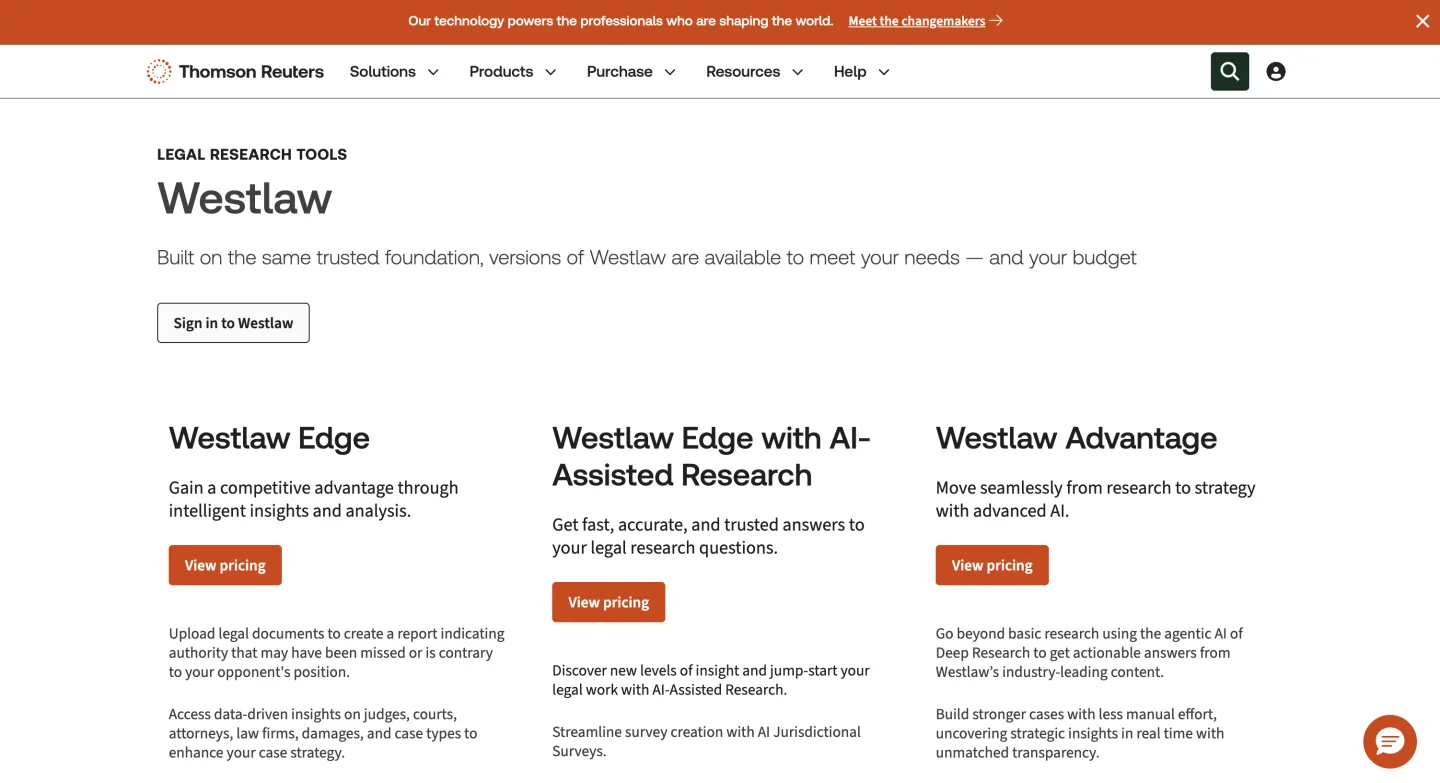
At a glance: Westlaw Classic from $132.80/mo (one state) to $266.40/mo (all states plus federal) per Lawyerist (2026); $400-plus once Precision AI is added · Annual contract, demo required · Best for firms whose method leans on the Key Number System and exclusive treatises.
Westlaw's real moat is editorial: the Key Number System, the headnotes, KeyCite, and a long shelf of exclusive treatises (Wright & Miller's Federal Practice and Procedure, Corbin on Contracts, the Restatements). The AI layer, now Westlaw Precision AI after Thomson Reuters absorbed Casetext (acquired for $650M in June 2023 and folded into the CoCounsel product line), sits on top of that corpus and reuses its enhancements.
Sales motion is enterprise-classic: a rep, a demo, an annual contract, a security questionnaire, a negotiated price. Westlaw assumes a firm administrator is buying, not a lawyer at midnight.
What's good
- The deepest editorial layer in the market: Key Number System, headnotes, KeyCite treatment flags
- Exclusive treatises that are load-bearing for many practices (Wright & Miller, Corbin, the Restatements)
- Westlaw Precision analytics for litigation research
- Decades of profession-wide muscle memory, training material, and law-school onboarding
Where it falls short
- Opaque, sales-quoted pricing that typically clears $400 a seat once Precision AI is on
- Annual contracts with documented auto-renewal and narrow cancellation windows
- The AI layer sits on a legacy database rather than being AI-native
- The cost structure is overkill for a solo who never touches the secondary layer
LexisNexis (Lexis+ / Lexis+ Protégé)

At a glance: Lexis+ Enhanced from $148.84/mo plus a $25 admin fee for one attorney per Clio (2026); $400 to $1,500 per seat once the Protégé AI add-on is on · Annual contract, demo required · Best for litigation-analytics-heavy and regulatory practices.
The mirror image. The citator is Shepard's. The exclusive treatise shelf includes Moore's Federal Practice, Collier on Bankruptcy, Nimmer on Copyright. Lex Machina, the analytics product RELX acquired in 2015, gives Lexis a distinct edge on litigation analytics.
The AI layer is Lexis+ AI, with the assistant branded Protégé. Same enterprise motion: SE-led pilots, security review, multi-year commitments, list prices that essentially nobody pays.
What's good
- Mirror-image editorial depth: the Shepard's citator and exclusive treatises (Moore's, Collier, Nimmer)
- Lex Machina litigation analytics, a genuine edge on judge behavior and outcome data
- The Lexis+ Protégé assistant integrated with Shepard's treatment
- Strong on regulatory and transactional research
Where it falls short
- The same sales-quoted opacity; the Protégé add-on pushes seats into the $400 to $1,500 band
- Multi-year commitments and the same exit friction as Westlaw
- Measured at roughly 17% hallucination (about 65% accurate) in the 2024 Stanford/Yale study (arxiv.org/html/2405.20362v1), since iterated, but no ongoing benchmark is published
- The same legacy-database-plus-AI shape; the per-seat math rarely pencils for a solo
Vaquill AI
At a glance: Published, self-serve pricing (sign up to see the latest) · 7-day free trial, no demo · Best for solo and small-firm lawyers who want an AI-native suite with source verification.
A different product shape. AI-native suite rather than a research database with AI bolted on. Pieces that ship together: an AI legal research surface grounded in U.S. case law (roughly 8M+ opinions), a drafting workspace, document comparison and matrix tools, a matters workspace, and an agent mode for multi-step tasks.
The public statutes and legislation API covers the U.S. Code, the CFR, all 52 state and territory codes, state constitutions, court rules, and Executive Orders back to 2015. Self-serve motion: public pricing, 7-day free trial, no demo required. The natural peer set is Harvey, Legora, and CoCounsel, not Westlaw or Lexis.
What's good
- Published, self-serve per-seat price with a 7-day trial and no sales call
- One workspace for research, drafting, document comparison, matrices, and matters, instead of separately licensed add-ons
- Every AI answer runs through a 4-layer verification pass with per-claim confidence tags (Verified, Partially Verified, Unverified)
- Direct links to source text, plus multi-document chat across up to 100 documents per matter
- Month-to-month at the self-serve tier, no auto-renewal lock-in
Where it falls short
- No editorial layer on the order of the Key Number System or Shepard's headnotes
- No 60-year negative-treatment citator like KeyCite or Shepard's
- No named treatises (Wright & Miller, Moore's, Restatements) and no Lex Machina-style litigation analytics
- Thinner on niche state trial court coverage, and the public API is statutes-only, not case law
- Younger than the incumbents, with a shorter independent track record
Each of those weaknesses gets a fuller, candid treatment in the "Where the upstart does not lead" section further down.
Coverage: what is actually in the box
| Coverage area | Westlaw | LexisNexis | Vaquill AI |
|---|---|---|---|
| Federal case law | Comprehensive, with editorial enhancement | Comprehensive, with editorial enhancement | 8M+ U.S. opinions; narrower on some niche state trial dockets |
| State case law (all 50) | Comprehensive | Comprehensive | Comprehensive appellate coverage; thinner on some state trial courts |
| U.S. Code and CFR | Annotated (USCA) | Annotated (USCS) | Full text via statutes API; not deeply annotated |
| State codes and constitutions | All 50 states, annotated | All 50 states, annotated | All 50 states, full text, structured |
| Court rules | Federal and state | Federal and state | Federal and state |
| Executive Orders | Yes | Yes | Yes, EOs since 2015 |
| Secondary sources (treatises, ALR, AmJur) | Deep; many exclusives (Wright & Miller, Restatements, etc.) | Deep; many exclusives (Moore's, Collier, Nimmer) | Not a focus; no treatise library |
| Forms and practice templates | Broad | Broad | Drafting tools rather than form library |
| Litigation analytics | Westlaw Precision analytics | Lex Machina | None comparable |
The truthful summary: on raw primary law, the three are close enough that no working lawyer should choose on coverage alone. Where Westlaw and Lexis pull genuinely ahead is the secondary layer (editorially enhanced headnotes, the named treatises, the analytics products). That is the real $500-a-seat justification, not the access to opinions.
Vaquill AI explicitly does not claim parity on secondary sources. There is no Vaquill AI equivalent of Wright & Miller, and there will not be one any time soon, because that moat took decades and a publishing arm to build.
For related vendor / pricing / buyer-guide coverage, see Westlaw vs LexisNexis: A Plain-English 2026 Breakdown for Solo and Small Firms and Lexis+ AI vs Westlaw AI vs Vaquill AI: The Honest AI Legal Research Comparison.
AI features: comparing what is actually shipping
| AI capability | Westlaw Precision AI | Lexis+ Protégé | Vaquill AI |
|---|---|---|---|
| Natural-language case-law research | Yes | Yes | Yes |
| Drafting assistance | Yes (CoCounsel lineage) | Yes | Yes (drafting workspace) |
| Document summarization | Yes | Yes | Yes |
| Multi-document chat | Limited | Limited | Yes, up to 100 documents per matter |
| Citation verification surface | KeyCite integration | Shepard's integration | 4-layer verification with per-claim confidence |
| Document comparison | Available, separate workflow | Available, separate workflow | Built into suite |
| Matrix / chronology tools | Add-on / separate | Add-on / separate | Built into suite |
| Agent mode for multi-step tasks | Emerging | Emerging | Yes |
| Microsoft Word integration | Yes, separate plug-in | Yes, separate add-on (priced extra per Spellbook, 2026) | Web app, export to Word |
| Practice-management integration | Via TR ecosystem | Via LexisNexis ecosystem | Matters workspace built in |
| Underlying model | Vendor undisclosed mix | Vendor undisclosed mix | Multi-model, vendor-disclosed on request |
All three vendors are iterating fast. The honest read of the AI feature checklist in mid-2026 is that no one has a permanent lead. Westlaw and Lexis have the corpus advantage, especially on annotated material.
Vaquill AI's leverage is workflow shape: the research, drafting, and matter management surfaces share one UI, which matters more for a solo PI lawyer than for a litigation partner with a librarian on call.
KeyCite vs Shepard's: the citator question buyers actually ask
For most lawyers the citator is the deciding feature, not the AI. KeyCite (Westlaw) and Shepard's (Lexis) both answer the core question, "is this case still good law," and both flag negative treatment. The differences are real but narrow.
| Citator axis | KeyCite (Westlaw) | Shepard's (LexisNexis) | Vaquill AI |
|---|---|---|---|
| Core function | Negative-treatment flags, citing references | Negative-treatment flags, citing references | Per-claim source verification, not a citator |
| Signal style | Color flags, depth-of-treatment bars | Color signals, granular treatment history | Confidence tags (Verified, Partially Verified, Unverified) |
| Practitioner read | Clean at-a-glance triage, strong on federal | Deeper treatment history, strong on state appellate | Surfaces where an AI answer is reaching |
| Coverage depth | Decades deep across the corpus | Decades deep, the original citator | Checks the claims in your answer, not every cite in a corpus |
KeyCite gives faster at-a-glance triage; Shepard's gives a deeper treatment trail that suits training and supervision. Both are mature. Neither is a reason to switch off the incumbent you already know.
Vaquill AI does not replace a citator. Its 4-layer verification checks each AI-generated claim against the source it cites, which is a different job from maintaining a 60-year negative-treatment history on every published opinion. If treatment-flag checking is the first move on every case, keep an incumbent seat for that step. The honest split: use the AI-native suite for research, drafting, and document work, and the incumbent for the citator moment.
Verification posture: the section worth slowing down for
This is the area where the comparison stops being symmetric.
Stanford's HAI study "Hallucination-Free? Assessing the Reliability of Leading AI Legal Research Tools" (arxiv.org/html/2405.20362v1), published in 2024 and later in the Journal of Empirical Legal Studies, tested then-current versions of the major legal AI products.
Lexis+ AI came out the more reliable of the two incumbents, at roughly 65% accurate with about 17% hallucination. Westlaw AI-Assisted Research landed at roughly 42% accurate with about 33% hallucination. GPT-4 with no legal retrieval came in at 43% accurate.
Even the best-performing legal-RAG tools were producing materially wrong answers about once every six queries.
Both incumbents have since iterated. Neither publishes ongoing hallucination benchmarks. Both rely heavily on their citators (KeyCite, Shepard's) as the safety net, which is a strong safety net for the binary "is this case still good law" question but does not catch synthesis errors, where a real case is paired with a fabricated holding or an inverted rule.
Vaquill AI takes a different shape. Every AI answer runs through a 4-layer verification process: exact text matching against the retrieved source, citation existence checking, semantic alignment between the claim and the source, and an LLM cross-check that re-reads the source against the generated text.
Each claim emerges with a confidence tag (Verified, Partially Verified, or Unverified). The intent is to surface the spots where the model is reaching, not to claim zero hallucinations. Anyone claiming zero hallucinations in 2026 is selling, not testing.
The reason this matters is not theoretical. The Mata v. Avianca sanctions in June 2023, the Wadsworth v. Walmart sanctions in February 2025, the California $10,000 fine in October 2025 for a brief in which 21 of 23 quotations were fabricated, are not freak incidents.
Damien Charlotin's tracker now logs hundreds of AI-hallucination sanctions cases worldwide. ABA Formal Opinion 512 (July 2024) made the verification duty explicit: lawyers cannot outsource the candor obligation to a vendor. The platform you pick should make verification fast, because you will be doing it on every filing whether you want to or not.
For a deeper read on the sanctions trend and how to build a verification protocol that survives a Rule 11 challenge, the AI hallucinations in legal research post walks through it.
Pricing: one section, not the headline
Westlaw and Lexis are sales-quoted. The reported ranges in the wild for 2026:
- Westlaw: Westlaw Classic runs $132.80 per month for one state, $200 for all states, and $266.40 for all states plus federal, on a one-year commitment (Lawyerist, 2026). Westlaw Edge with analytics starts around $194.40 per month for single-state coverage (same source). Once Westlaw Precision AI is added, the seat price typically clears $400 and can run to $1,000-plus for full-suite enterprise configurations.
- LexisNexis: Lexis+ Enhanced (federal and state access) has a minimum one-year contract of $148.84 per month for one attorney plus a $25 monthly admin fee (Clio, 2026). Comparable opacity above that line: Lexis+ with the Protégé AI add-on lands in the same $400 to $1,500 per-seat-per-month band, depending on coverage and add-ons.
- Vaquill AI: published, self-serve pricing. A 7-day free trial. An Enterprise tier exists for firms that need SSO, custom retention, and procurement-friendly contracting; that is custom-quoted.
A lawyer billing $400 an hour is not actually optimizing for a difference of a few hundred dollars a month in software spend. The structural delta that matters more is the contract shape: Westlaw and Lexis are annual commitments with auto-renewal and exit friction that has been documented for years (some lawyers report having to send physical cancellation letters inside narrow windows).
Vaquill AI is month-to-month at the self-serve tier. For a solo who hates being locked in, that is the larger savings, not the dollar figure.
For the standalone breakdown of why Westlaw and Lexis pricing is structured the way it is, the solo and small-firm Westlaw vs LexisNexis breakdown goes deeper.
Sales motion: the part nobody talks about
Westlaw and LexisNexis run a classic enterprise motion. Rep assigned, discovery call, tailored demo, security questionnaire, 30 to 90 day evaluation, contract. Published price is rarely the price you pay. The motion assumes a firm administrator or managing partner is buying with time to leverage a competing quote.
Vaquill AI runs a self-serve motion. Sign up, run real queries on real matters during the trial, decide. No SE on the call, because there is no call.
For a firm administrator who needs SOC 2 attestation, an MSA negotiated by general counsel, and a contractual carve-out on data residency, the self-serve tier is the wrong shape; the Enterprise tier exists for that. Neither motion is "better." They serve different buyers.
Five honest buyer profiles
This is the section to skim if you only have two minutes.
BigLaw partner with an established Westlaw or Lexis seat. Stay. The switching cost (retraining associates, rebuilding research workflows, losing access to the named treatises you actually cite) outweighs any AI feature in the market today. Consider adding an AI-native tool alongside your incumbent if your firm is piloting one, but do not rip out the citator.
Solo plaintiff PI lawyer. A modern AI-native suite is likely the better fit. The work is repetitive (demand letters, medical chronologies, motion practice), the budget is real, and the named-treatise dependency is usually low.
Vaquill AI or vLex sit in this slot. Westlaw and Lexis will quote you, but the per-seat math rarely pencils out for a single-lawyer shop.
Three-person estate planning firm. Similar profile. Heavy drafting, moderate research, low secondary-source dependency. AI-native suites win on workflow and price. The incumbent rationale weakens further when no one on the team is doing federal litigation.
In-house counsel at a 50-person company. Mixed. If the work is heavy regulatory (FDA, FCC, securities), Lexis (especially with Lex Machina) earns its keep.
If it is mostly contract review, vendor diligence, employment matters, and matter management, a modern suite with strong drafting and document comparison is the lower-friction choice.
Academic legal researcher or law librarian. Westlaw or Lexis, almost always. The secondary-source depth (treatises, ALR, AmJur, historical state-bar journals) is the entire job. AI-native tools are not built for that workload and do not pretend to be.
Where the upstart does not lead, candidly
A comparison that omits this section is a brochure.
Editorial enhancement. No headnote system on the order of Westlaw's Key Number System. The research workflow is grounded in retrieval plus verification, not editorially enriched metadata. For practitioners whose method depends on browsing key numbers, that is a real gap.
Niche state trial court coverage. Vaquill AI's appellate and federal coverage is excellent. State trial court coverage is genuinely thinner on the long tail compared to what the incumbents have built over decades. Worth testing during a trial if your practice lives in a specific state's trial courts.
No Lex Machina equivalent. Litigation analytics (judge behavior modeling, motion outcome statistics, win rates by counsel) is not yet on offer. Lexis owns that surface for now.
No KeyCite-equivalent on every citation. The 4-layer verification is a different shape: per-claim against retrieved sources, not a treatment flag for every citation in a corpus. For a litigator whose first instinct on any case is "what does KeyCite say," that is a workflow change.
Named treatises. No Wright & Miller. No Moore's. No Restatements as a licensed product. If a treatise is load-bearing in your practice, the incumbent owning it is the platform you need, full stop.
How to actually decide
A useful order of operations:
- Is a named treatise load-bearing for your practice? If yes, pick the incumbent that owns it. Skip the rest.
- Is your work heavy on Lex Machina-style analytics? Lexis is the cleanest answer.
- Is your buying authority a firm administrator running a formal vendor process? The incumbents are built for that motion.
- Are you the lawyer and the buyer, and do you want one workspace for research, drafting, comparison, and matter management? An AI-native suite is the right shape; the short list is Harvey, Legora, CoCounsel, and the upstart covered here.
The decision is rarely binary. Plenty of firms will sensibly run Westlaw or Lexis alongside an AI-native suite, using the incumbent for citator and treatise work and the suite for drafting, comparison, and day-to-day research.
That stack is not a contradiction. It is what a 2026 small-firm research desk often looks like.
A short note on benchmarks
Evaluate any of these tools against your own work, not against a vendor's demo script. Take five real questions from cases you have closed, where you already know the right answer, and ask each tool. Read the citations. Click through to the sources. Time how long verification takes.
The benchmarks page publishes internal numbers; the security page covers procurement-relevant details (SOC 2 status, data handling, model routing). The incumbents do not publish equivalent ongoing benchmarks.
A real-question evaluation beats a feature checklist
The fastest honest evaluation is bringing a real research question you already know the answer to and running it through whichever stack you are weighing. The point of this comparison was not to crown a winner. It was to make sure whichever tool you pay for is shaped for the work you actually do.
FAQ
Which is cheapest, Westlaw, LexisNexis, or Vaquill AI?
Vaquill AI, on a published basis: self-serve pricing you can read off the pricing page, no quote call. Westlaw and Lexis are quote-based; a small-firm research seat lands in roughly the same band before AI, and once Westlaw Precision AI or Lexis+ Protégé is added a seat typically clears $400 and can run to $1,500 depending on coverage and add-ons.
Which one hallucinates least?
In the 2024 Stanford/Yale study (arxiv.org/html/2405.20362v1), Lexis+ AI was the more reliable incumbent at about 17% hallucination (roughly 65% accurate), versus Westlaw AI-Assisted Research at about 33% hallucination (roughly 42% accurate).
Those figures are from then-current versions and neither vendor has published a re-benchmark. Vaquill AI runs a 4-layer per-claim verification pass but has no third-party benchmark yet, so verify citations on any of the three.
Does CoCounsel cost extra on top of Westlaw?
Yes. The CoCounsel-lineage AI (now Westlaw Precision AI) is an add-on, not part of the base research subscription, and turning it on is what pushes a seat past roughly $400 a month. The exact price is quote-based.
Which should a small firm pick versus a litigation shop?
For general small-firm research the three are close on primary law, so price, contract shape, and any named-treatise dependency decide it. For litigation, the incumbents pull ahead on analytics (Westlaw Litigation Analytics, Lexis Lex Machina), which Vaquill AI does not match. A common 2026 setup is an AI-native suite for daily work plus a targeted incumbent seat for the citator and analytics moments.
Is KeyCite better than Shepard's?
Neither is clearly better; they trade strengths. KeyCite (Westlaw) is read as cleaner for at-a-glance triage and strong on federal treatment, while Shepard's (LexisNexis) carries a deeper treatment history that suits state appellate work, training, and supervision. Both are mature, decades-deep citators, so the call usually follows whichever platform your firm already runs.
How much does Westlaw cost compared to LexisNexis?
Westlaw Classic starts at $132.80 per month for one state and $266.40 for all states plus federal (Lawyerist, 2026). A comparable Lexis+ Enhanced seat runs $148.84 per month plus a $25 admin fee for one attorney (Clio, 2026). Both clear $400 a seat once the AI layer (Westlaw Precision AI or Lexis+ Protégé) is added, and both are annual contracts.
Does Vaquill AI replace KeyCite or Shepard's?
No. Vaquill AI verifies each AI claim against the retrieved source and tags confidence, but it does not maintain a decades-deep negative-treatment citator like KeyCite or Shepard's. If your workflow starts every case by checking treatment flags, keep an incumbent for that step.
Is Vaquill AI worth it if I already have Westlaw or Lexis?
It can be, as a complement rather than a rip-and-replace. Many small firms keep the incumbent for citator and treatise work and use an AI-native suite for drafting, document comparison, matrices, and day-to-day research, where the published, self-serve price and month-to-month terms lower the friction.
Do Westlaw and Lexis publish ongoing accuracy benchmarks?
No. The 2024 Stanford/Yale figures remain the only independent numbers, and neither incumbent has commissioned a public re-benchmark since. Evaluate any of the three against your own closed matters rather than a vendor demo.
New legal AI guides, weekly.
Further Reading
Legal AI Word Add-Ins Compared: 14 Tools, Features, and Pricing (2026)
Read postAI Document Version Comparison Tools: 13 Compared With Pricing (2026)
Read postTop Westlaw Alternatives in 2026 (7 Tools Compared)
Read postCost-Effective CLM: 8 Affordable Contract Management Platforms (2026 Prices)
Read postTop Legal Data APIs for Developers in 2026
Read postLegal Document Version Control: Which Platforms Track Versions
Read post
Co-Founder & CEO · Attorney
Arshita leads product and strategy at Vaquill, building the legal AI suite that solo, small-firm, and in-house US lawyers use to run a matter end to end.