What firms actually pay for legal research in 2026 is far more than the subscription. The license is typically only 5 to 14 percent of the real cost; the rest is lawyer time, training on interface changes, untracked per-document overages, and billable hours lost reading irrelevant cases.
Westlaw, Lexis, and Bloomberg Law all bury 5 to 8 percent annual escalators. The number that matters is total cost of ownership per lawyer, not the line item. Here is the full breakdown across every tier.
Most managing partners know their Westlaw or Lexis line item to the dollar. Fewer can tell you the total cost of legal research at their firm.
That number includes the subscription, the per-document charges nobody tracks, the training hours every time Thomson Reuters rolls out a new interface, and the five hours a week each associate burns reading cases that turn out to be irrelevant.
This article breaks down what US law firms actually spend on legal research in 2026. Not list prices. Not marketing copy. The real numbers, from subscription fees to opportunity costs, across every tier of the market.
The short answer: a paid legal research subscription runs from about $80 to $400 per user per month ($960 to $4,800 a year) for a solo or small firm, depending on the platform and AI tier. A single-state Westlaw Classic seat is $132.80/month (Lawyerist Westlaw review, Dec 2024); Lexis+ entry plans start near $80/month and Bloomberg Law is reported around $350 to $500/month (G2/TrustRadius user reviews). Bar-member vLex Fastcase is free. But the subscription is only 5 to 14 percent of the true cost once you count lawyer time, training, overages, and lost billable hours, which is the part the rest of this guide prices out.
TL;DR
- The subscription is usually 5 to 14 percent of the real cost of legal research. The rest is lawyer time, training, overages, and lost billable hours.
- Westlaw, Lexis, and Bloomberg Law all price differently and all bury annual escalators of roughly 5 to 8 percent. Multi-year contracts compound silently.
- Free tools (Google Scholar, open case-law databases, bar-member Fastcase) are real but cost meaningful unbilled time on citation verification. They are best for flat-fee or low-stakes work.
- Per-billable-hour math beats per-month math. A research tool that saves 3 to 5 hours per lawyer per week recovers far more than any reasonable license fee.
- The right negotiation question is not "what does this cost," it is "what does my usage data show, and what would a credible alternative cost on paper at quarter-end."
What share of the real cost of legal research is the subscription itself?
Part of our legal AI vendor comparison and pricing series.
The true cost of legal research: beyond the subscription
Legal research costs split into five categories. Most firms only budget for the first one.
1. Subscription fees. The obvious line item. For a solo practitioner, this ranges from $79/month (single-state Fastcase plan) to $400+/month (Westlaw with CoCounsel). For a 50-lawyer firm, annual contracts routinely clear $200,000.
2. Per-search and document charges. For out-of-plan use, the Franklin County Law Library puts Westlaw at roughly $99 per search and Lexis at roughly $60 per search (updated Jun 16, 2026), plus per-document fees that vary by content category. If your associates are pulling 20 to 30 documents per research session, these charges accumulate quietly.
3. Training and onboarding. Every platform update requires retraining. Thomson Reuters rolled out Westlaw Precision, then CoCounsel, in rapid succession.
Each transition eats 8-16 hours of lawyer time per user in the first quarter. At a blended rate of $288/hour for solo practitioners (the national average per Clio's 2025 data), that training has a shadow cost of $2,300-$4,600 per lawyer.
4. Wasted research time. According to the 2025 Bloomberg Law Attorney Workload Survey, associates spend roughly 15 hours per week on legal research. The ABA's 2024 Legal Technology Survey found that solo practitioners spend 23% of their working hours on research, compared to 19% at larger firms.
Not all of that time is productive. When a research session returns irrelevant results or misses a key case, the lawyer starts over.
5. Opportunity cost. Clio's 2025 Legal Trends Report found that for every eight hours worked, only 2.9 are billed. Nearly half of lawyer time goes to administrative tasks.
Research that takes four hours instead of one doesn't just cost three extra hours of salary. It costs three hours of billable work that didn't happen.
For a solo billing at $288/hour, three lost billable hours equals $864 in forgone revenue. Multiply that by two or three extended research sessions per week and you're looking at $90,000-$135,000 per year in revenue that evaporates because research took longer than it should have.
This pattern hits small firms the hardest. The ABA's 2024 survey found that 67% of lawyers rely on fee-based online legal research services, while 55% also use free platforms like government websites and open legal databases.
Solo practitioners reported average annual technology spending under $3,000, while firms of 2-9 lawyers reported $10,000-$20,000. But those numbers capture only the direct cost. They miss the labor component entirely.
A simple TCO model
For a solo practitioner billing at $288/hour and spending 23% of a 40-hour week on research (roughly 9.2 hours):
| Cost component | Monthly estimate |
|---|---|
| Westlaw subscription (one state) | $133-$381 |
| Overage/document charges | $50-$200 |
| Training time (amortized) | $190-$380 |
| Non-productive research time (est. 30% waste) | $2,390 |
| Total cost of research | $2,763-$3,351 |
That last row is the number that matters. The subscription is 5-14% of the real cost. The rest is labor.
The subscription is the smallest part of the bill. The rest is labor.
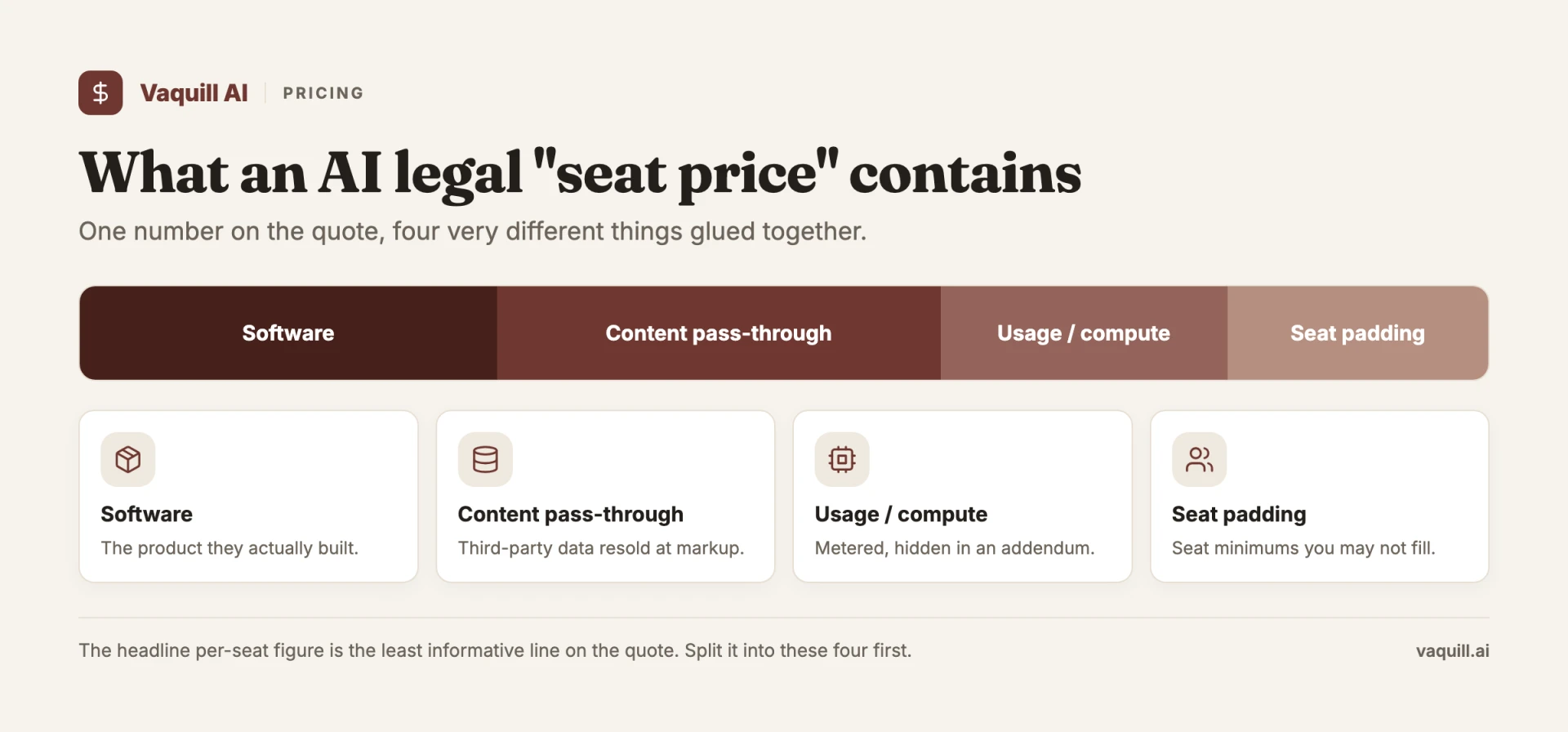
What Westlaw, LexisNexis, and Bloomberg Law actually charge
These three platforms dominate the US legal research market. None publishes a clean, public price sheet. Here's what we've been able to verify from public sources, library pricing guides, and review platforms.
Westlaw (Thomson Reuters)
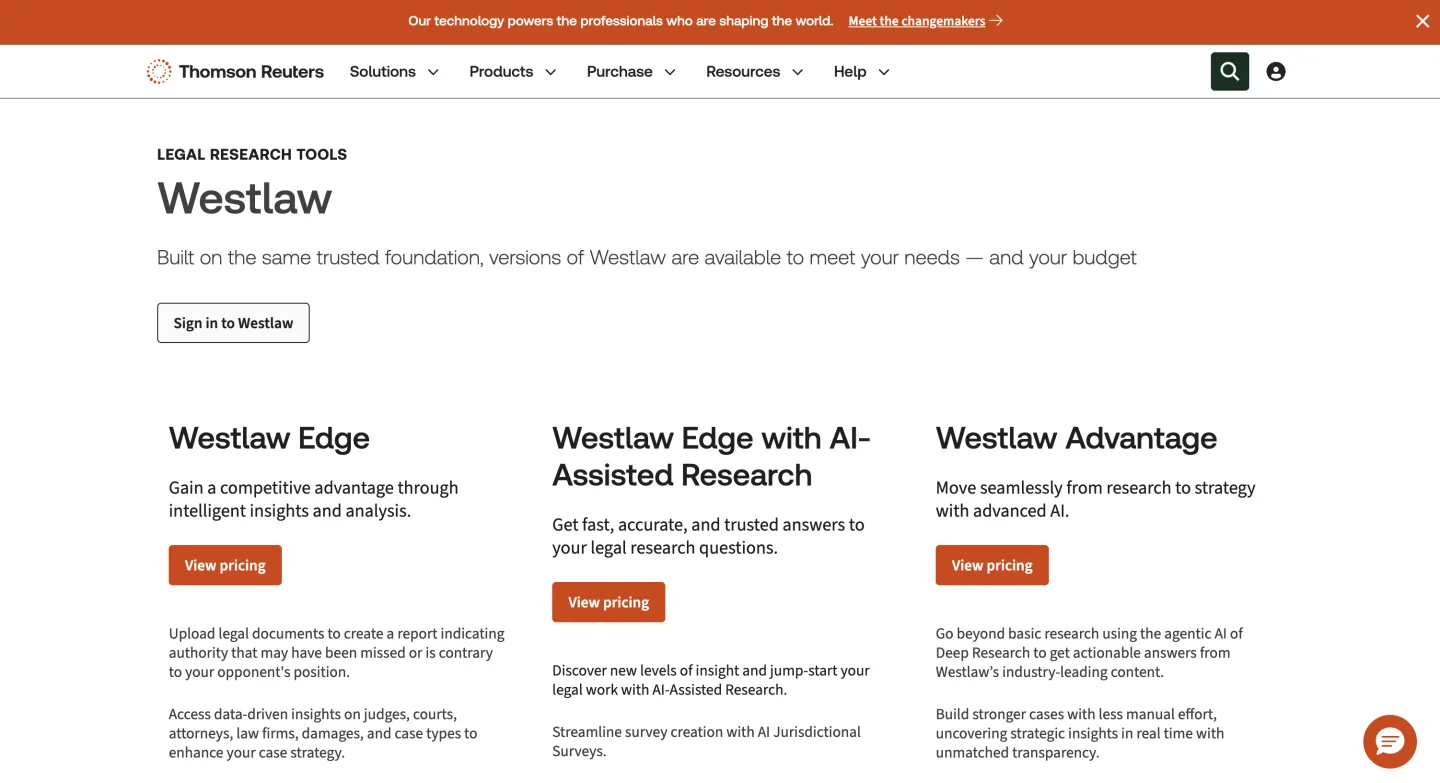
Westlaw's pricing model is tiered by coverage and firm size.
Published rates (Lawyerist Westlaw review, Dec 2024):
- Westlaw Classic, one state: $132.80/month on a one-year commitment
- Westlaw Classic, all states: $200/month; all states plus federal: $266.40/month
- Westlaw Edge (AI-enhanced), single state: starts at $194.40/month
- CoCounsel (the AI research assistant): quote-only, reported at roughly $400/month standalone or $500 to $700/month bundled with Westlaw (G2 and TrustRadius user reviews)
- Firms with 7+ lawyers: custom pricing only
What they don't advertise:
- Transactional document charges for content outside your plan
- Automatic price escalation clauses (typically 5-8% annually) baked into multi-year contracts
- After Thomson Reuters acquired Casetext for $650 million in 2023, the standalone Casetext product was shut down in April 2025 and absorbed into CoCounsel, with former Casetext users reporting 2-3x price increases
G2 and TrustRadius user-reported costs:
- Small firms typically report $150-$400/month per user
- Mid-size firms report $300-$600/month per user (including AI features)
LexisNexis (RELX)

LexisNexis pricing is similarly opaque.
What we know from public sources:
- Lexis+ core research plans are reported in the $80 to $135 per user per month range on review-platform listings (Capterra, G2); LexisNexis publishes no clean public rate card
- Lexis+ AI: quote-based, listed as "Contact Vendor" with no public per-seat rate (Lawyerist Lexis+ with Protege review)
- Per-search pricing exists for transactional plans (about $60 per search per the Franklin County Law Library, updated Jun 16, 2026)
Negotiation leverage:
- A sole practitioner's three-year Lexis Advance New York subscription was quoted at $271/month online, but negotiated down to $125/month for the first year through a sales representative (per Franklin County Law Library's cost-effective research guide)
- Volume discounts available at 20+ users
Hidden costs:
- Premium content modules (practice area add-ons, analytics tools) are priced separately
- Integration fees for connecting with practice management software
- Auto-renewal with price escalation is standard
Bloomberg Law
Bloomberg Law positions itself as the transparent alternative.
What's confirmed:
- Flat-fee, all-inclusive pricing (no per-search or per-document charges)
- 2-24 users can purchase directly through their website
- 25+ users get volume discounts
- AI-powered tools included in the subscription at no additional charge
What users report:
- TrustRadius and G2 reviews place Bloomberg Law at roughly $350-$500/month per user
- The flat-fee structure is consistently cited as a differentiator against Westlaw and Lexis
The trade-off:
- Bloomberg Law's case law coverage is younger and thinner than Westlaw or Lexis in some jurisdictions
- Strongest in transactional, regulatory, and business law
- Litigation-heavy firms may still need Westlaw or Lexis as a primary source
The price escalation problem
All three vendors embed annual price increases into multi-year contracts. Typical escalation clauses run 5-8% per year, compounding silently.
A $300/month contract with 7% annual escalation becomes $343/month by year three and $393/month by year five. Over a five-year span, you pay 16% more than you budgeted at signing.
This matters because law firms tend to auto-renew. According to ABA survey data, only 41% of solo practitioners actively budget for technology, compared to 90% of firms with 100+ lawyers. Firms that don't track their research spending are the ones most likely to absorb these increases without questioning them.
Clio's 2025 report found that law firms are increasing tech spending by 20% annually, with solo practitioners leading at a 56% increase. Some of that growth is intentional adoption of new tools. Some of it is vendors raising prices on existing contracts while firms look the other way.
Side-by-side comparison
| Feature | Westlaw | LexisNexis | Bloomberg Law |
|---|---|---|---|
| Solo monthly cost | $133-$381 | $80-$271 | ~$350-$500 |
| AI assistant | CoCounsel ($400+/mo) | Lexis+ AI (quote-based) | Included |
| Per-document fees | Yes (off-plan) | Yes (off-plan) | No |
| Price escalation | 5-8%/year typical | Similar | Lower |
| Contract length | 1-3 years | 1-3 years | 1 year+ |
Plenty of firms never actually choose between these platforms; they run two at once, keeping Westlaw for litigation and Lexis for a second citator, or the reverse. A Westlaw all-states-plus-federal seat ($266.40/month, Lawyerist) alongside a full-coverage Lexis+ plan lands near $500 to $550 per lawyer per month, roughly $6,000 to $6,600 a year, before a single AI add-on or document overage. That dual-subscription habit, more than any one sticker price, is what pushes real per-attorney research spend into five figures.
For related vendor / pricing / buyer-guide coverage, see How Much Does an AI Legal Seat Really Cost in 2026? Reading Quotes Like a Buyer and How Much Does Westlaw Cost in 2026? Solo, Small-Firm, Westlaw Plus Pricing.
The solo and small firm math
Let's work through a concrete scenario. You run a three-lawyer litigation firm in a mid-size metro. Your blended billable rate is $300/hour. Each lawyer bills roughly 1,500 hours per year.
Scenario A: Westlaw Edge for three users
- Subscription: $300/month x 3 = $900/month
- Document overages (conservative): $150/month
- CoCounsel add-on for one user: $400/month
- Annual total: $17,400
Scenario B: Lexis+ for three users
- Subscription: $125/month x 3 = $375/month (negotiated rate)
- Premium modules: $100/month
- Annual total: $5,700
Scenario C: Bloomberg Law for three users
- Subscription: $400/month x 3 = $1,200/month
- No overages
- Annual total: $14,400
Now translate these into per-billable-hour costs. With three lawyers billing 1,500 hours each (4,500 total billable hours per year):
| Platform | Annual cost | Cost per billable hour |
|---|---|---|
| Westlaw Edge + CoCounsel | $17,400 | $3.87 |
| Lexis+ (negotiated) | $5,700 | $1.27 |
| Bloomberg Law | $14,400 | $3.20 |
At $300/hour billing, the Westlaw setup costs your firm 1.3% of gross revenue from billable work. Lexis at a negotiated rate is 0.4%.
These numbers look manageable in isolation. The question is whether the platform actually saves enough research time to justify the spend, or whether a leaner stack produces the same outcomes.
Free vs. paid: the real cost of "free"
Two free legal research tools dominate the market: Google Scholar and bar-association-provided Fastcase (now vLex Fastcase).
Google Scholar
What you get: Federal and state case law, searchable by keyword. Free. No login required.
What you don't get:
- No citator. You cannot verify whether a case has been overruled, distinguished, or questioned. The "How Cited" feature is not a substitute for Shepard's or KeyCite.
- Unpublished and memorandum decisions are frequently missing
- New opinions can take up to a month to appear
- No headnotes, key numbers, or editorial enhancements
- Topic-based searching produces inconsistent results
- No statutes in many jurisdictions
The time cost: If you rely on Google Scholar, you must manually verify every citation through a separate source.
For a research memo citing 15 cases, add 30-60 minutes of verification work. At $288/hour, that is $144-$288 per memo in lawyer time.
vLex Fastcase (bar association benefit)
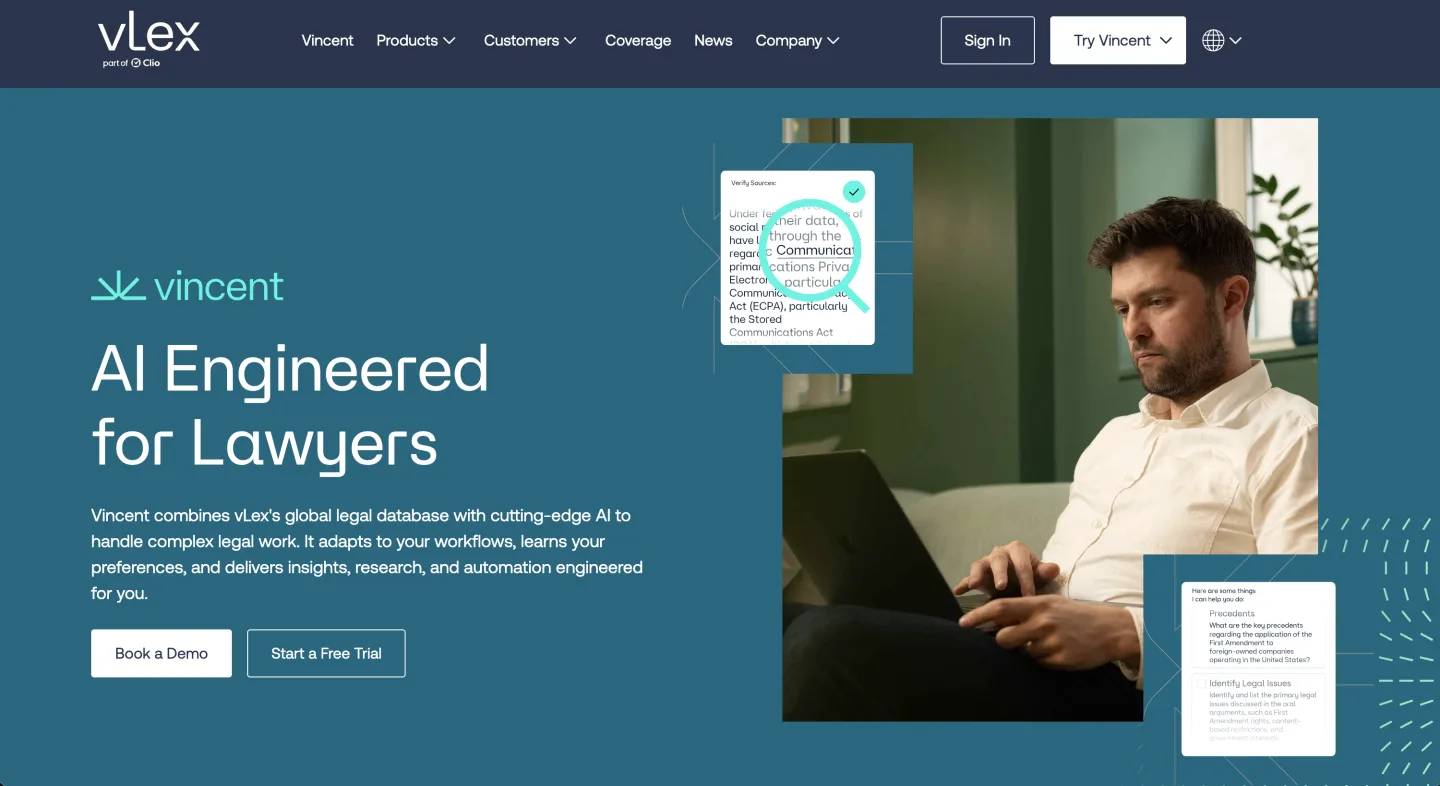
What you get: Case law, statutes, regulations, and some secondary sources. Available free to bar members in all 50 states plus DC.
After the vLex merger in 2023 and Clio's $1 billion acquisition of vLex in 2025, the platform has expanded significantly.
What you don't get:
- Secondary source coverage is thinner than Westlaw or Lexis
- AI features are limited in the free tier
- The paid premium plan (approximately $995/year) adds enhanced features
Best use case: Solo practitioners and small firms doing straightforward case law and statutory research. For many practice areas, this is genuinely sufficient.
Calculating the free-tool penalty
Assume a lawyer does four research memos per week using free tools instead of a paid platform. Each memo requires an extra 45 minutes for citation verification and gap-filling. That is three hours per week, or 144 hours per year.
At $288/hour, the "free tool penalty" costs $41,472/year in unbillable lawyer time.
Even if only half of that time would have been billable, you're looking at $20,736 in lost revenue, which dwarfs the cost of any paid platform.
The math is clear: free tools are not free for lawyers who bill by the hour.
What it costs to outsource the research entirely
Some firms don't buy a database at all for a given matter. They hand the question to a contract legal research service and pay by the hour. This is routine for overflow work, an unfamiliar jurisdiction, or a one-off appellate brief where a full-year subscription would sit idle the other 51 weeks.
The National Legal Research Group publishes its rates, which is itself rare in this market: $190/hour standard, $235/hour for a 3-to-5-day rush, and $285/hour for 1-to-2-day expedited turnaround, plus a 6% surcharge on every bill to cover the researcher's own Westlaw and Lexis access (National Legal Research Group fee schedule, 2026).
| Turnaround | Hourly rate | Effective rate with 6% surcharge |
|---|---|---|
| Standard | $190 | $201.40 |
| Rush (3-5 days) | $235 | $249.10 |
| Expedited (1-2 days) | $285 | $302.10 |
That surcharge line is the tell: even the outsourced provider passes its database cost straight through to you. A 10-hour memo at the standard rate runs about $2,014 all-in. Whether that beats doing the work in-house comes down to your own billable rate and whether those hours would have been collected in the first place.
AI tools and research speed
The 2025 wave of AI-native legal research tools has changed the calculus. The core claim: tasks that took 4-8 hours now take 30-90 minutes. Let's examine the evidence.
What the data shows
LawSikho's efficiency study found that comprehensive issue research spanning multiple jurisdictions dropped from 4-6 hours to 90 minutes with AI-assisted search.
Everlaw's 2025 survey reported that lawyers using generative AI saved up to 32.5 working days per year. That is roughly 6.5 weeks of recovered capacity.
Harvey AI reports that a typical lawyer saves 15-30 minutes per query, with litigation-heavy users reporting savings of 8+ hours per lawyer per week.
Broader industry data shows AI-powered platforms reduce case law research time by 60-75%, with citation verification and multi-jurisdiction surveys showing 70%+ time savings. Novel legal issue research shows more modest 30-40% improvements.
The ROI calculation
Take our three-lawyer firm from earlier. Each lawyer spends 9 hours per week on research (at the 23% rate from the ABA survey). AI tools reduce that by 60%, saving roughly 5.4 hours per lawyer per week.
- Weekly time saved: 5.4 hours x 3 lawyers = 16.2 hours
- Weekly revenue opportunity (at $300/hour): $4,860
- Annual revenue opportunity: $252,720
- Even at a 25% conversion rate (turning saved time into billed work): $63,180/year
Against that, the annual cost of an AI-native research tool runs $948-$4,800 per lawyer ($79-$400/month). The payback period is measured in days, not months. For a side-by-side on which AI seat fits a budget, see the best AI legal research for solo attorneys on a budget.
Current AI legal research pricing
Published or reported per-user monthly prices, newest first. Where a vendor sells by quote, the figure is what reviewers and directories report, not a sticker rate.
| Tool | Monthly cost (per user) | Source | Key strength |
|---|---|---|---|
| Paxton AI | $499/mo, or $2,999/yr | Published (paxton.ai) | Fast AI search, 7-day trial |
| CoCounsel (Westlaw) | $400-$700 bundled (reported) | G2 / TrustRadius reviews | Westlaw's editorial corpus |
| Lexis+ AI | Quote-based | Lawyerist (no public rate) | Shepard's integration |
| vLex Vincent AI | ~$399 (enterprise tier, reported) | LawNext Directory | Multi-jurisdiction (100+ countries) |
| AI legal tools (broad range) | $19 to $1,000+/mo | Elephas pricing comparison, Mar 2026 | Varies widely by tier |
| Vaquill AI | Self-serve, published | Vaquill AI (published) | Grounded US research, no seat minimum |
The spread is real: Elephas's March 2026 roundup puts legal AI from $19/month at the consumer end to $1,000+/month for enterprise tiers like Harvey, "a 100x difference." For solo and small-firm research, the useful band sits between the free bar-member tools and roughly $500/month for a full AI-plus-research seat.
How to negotiate your Westlaw or Lexis contract
Your Westlaw or Lexis rep has more pricing flexibility than they'll volunteer. Here is a practical playbook.
1. Pull your usage data first
Before any negotiation, request your firm's usage reports. Most firms pay for databases they rarely touch. Identify which content sets you actually use, how many searches each lawyer runs per month, and which features go untouched.
If your rep won't provide usage data, that itself is a negotiating signal. Push harder.
2. Time your negotiation
Westlaw and LexisNexis sales reps work on quarterly quotas. The last two weeks of a fiscal quarter (March, June, September, December for Thomson Reuters) are when reps are most flexible. Renewal negotiations that start 90 days before your contract expires give you the most leverage.
3. Get competing quotes
Bloomberg Law, vLex, and AI-native tools are your leverage. You don't need to switch. You need a credible alternative on paper. Request formal quotes from at least two competitors before sitting down with your current vendor.
4. Negotiate through a rep, not online
As documented in the Franklin County Law Library's pricing guide, a sole practitioner's Lexis Advance New York subscription was quoted at $271/month online but dropped to $125/month when negotiated through a sales representative. That is a 54% discount for making a phone call.
Online pricing is the ceiling, not the floor.
5. Resist multi-year lock-ins unless the discount is substantial
Vendors push three-year contracts because they include annual price escalation clauses of 5-8%.
A three-year deal at $300/month with 7% annual escalation costs $300, $321, and $343.50 per month in years one, two, and three. That is $11,574 over three years, not the $10,800 you calculated when you signed.
Above the Law documented one attorney who negotiated $600 for the first year, then found themselves locked into a $2,000+/year rate for two more years (Feb 2019). The Year 1 number is the bait; the term is where the money is.
Only accept a multi-year contract if the Year 1 discount exceeds the cumulative escalation over the term. Get the escalation cap in writing.
6. Unbundle aggressively
Sales reps default to all-inclusive packages because they generate higher commissions. Push for a la carte pricing on only the content sets you use. A firm that only practices in one state rarely needs 50-state coverage. A transactional practice doesn't need the full litigation analytics suite.
7. Ask about academic and government benchmarks
If you're a small firm or solo, ask what your vendor charges law school clinics or government legal departments for similar coverage. These rates are often 40-60% below standard commercial pricing. You may not get the same rate, but it establishes a floor for negotiation.
8. Use a contract negotiation consultant
Firms like Research Contract Consultants specialize in negotiating Westlaw and LexisNexis contracts. They typically work on a contingency or flat-fee basis and claim savings of 20-40% over self-negotiated deals.
For firms spending $50,000+/year on research tools, the ROI on hiring a negotiator is usually positive.
Building a modern research stack on a budget
Here are three tiers, with honest assessments of what each gets you and where you'll hit walls.
Tier 1: $0/month (free tools only)
Stack: Google Scholar + vLex Fastcase (bar membership) + state court websites
What works:
- Case law search for most jurisdictions (Fastcase covers all 50 states)
- Statutory research through Fastcase and state legislature sites
- Basic citator through Fastcase's Authority Check
What doesn't:
- No Shepard's or KeyCite equivalent for definitive citation verification
- Thin secondary source coverage (no treatises, no practice guides)
- No AI-assisted research
- Manual verification adds 30-60 minutes per research memo
Best for: Solo practitioners handling straightforward matters in a single jurisdiction, lawyers who bill flat fees (so research time doesn't directly eat revenue), and new solos building a practice on a tight budget.
Honest risk: You will miss cases. You will cite a case that's been narrowed or questioned without knowing it.
Google Scholar's coverage of unpublished decisions is inconsistent, and its "How Cited" feature does not tell you whether a citing case is positive, negative, or distinguishing. For low-stakes work, that risk is manageable. For appellate briefs or complex litigation, it is not.
Tier 2: $79-$149/month (AI-assisted research)
Stack: vLex Fastcase (free via bar) + one AI research tool (entry-tier AI suites start around $79/month) + Google Scholar as backup
What works:
- AI-powered search cuts research time by 60-75%
- Fastcase provides the primary case law and statutory database
- AI tool handles synthesis, memo drafting, and multi-source analysis
- Total annual cost: $948-$1,788
What doesn't:
- Still no Shepard's or KeyCite (must rely on Fastcase Authority Check and AI cross-referencing)
- Secondary sources remain limited
- Complex regulatory research may hit coverage gaps
Best for: Solo and small firm practitioners (1-5 lawyers) who want meaningful time savings without a five-figure annual commitment. Firms that handle litigation, family law, criminal defense, personal injury, or general practice.
The math: If the AI tool saves each lawyer 3 hours per week (conservative estimate), that is 144 hours per year.
At $288/hour, the tool generates $41,472 in recovered capacity for under $1,800 in cost. That is a 23:1 return.
Tier 3: $299-$500/month (full professional stack)
Stack: Bloomberg Law or negotiated Lexis+ ($125-$400/month) + AI research tool ($79-$299/month) + PACER for federal court filings
What works:
- Comprehensive case law, statutory, and secondary source coverage
- Professional citator (BCite or Shepard's)
- AI-assisted research for speed
- Total annual cost: $3,588-$6,000 per lawyer
What doesn't:
- This stack doesn't match the depth of a full Westlaw + CoCounsel setup at $700+/month
- You may need occasional a la carte access to Westlaw for niche editorial content
Best for: Firms handling complex litigation, regulatory work, or multi-jurisdictional matters. Practices where missing a case or citing bad law carries real malpractice risk. Firms billing $250+/hour where research efficiency directly impacts profitability.
The math: At $500/month total ($6,000/year) and 1,500 billable hours, your research cost is $4.00 per billable hour.
If the AI component saves 5 hours per week (260 hours per year at $300/hour), you recover $78,000 in capacity. Net return: $72,000 per lawyer per year.
The bottom line
Legal research costs in 2026 are defined less by subscription prices and more by lawyer time. The ABA survey shows solo practitioners spending 23% of their working hours on research. Clio's data shows only 2.9 hours of an 8-hour day get billed.
These two numbers, taken together, mean that research efficiency is the single largest lever most firms have for improving profitability.
The subscription is the smallest part of the bill. A $400/month Westlaw plan that saves each lawyer 5 hours per week pays for itself 15 times over. A $79/month AI tool that delivers 60% of those same time savings at one-fifth the price shifts the math even further.
The firms that will thrive in 2026 are the ones that stop asking "what does Westlaw cost?" and start asking "what does slow research cost?"
Consider the numbers one more time. The average solo practitioner bills at $288/hour and spends 23% of their working hours on research. If AI tools cut that research time by even 50%, each solo recovers roughly 4.6 hours per week.
Over a year, that is 239 hours. At the average billing rate, that recovered time is worth $68,832, enough to cover a full Westlaw subscription, an AI tool, and still net $45,000+ in additional revenue.
For a three-lawyer firm, triple those numbers. The research cost question is not about which platform has the lowest monthly fee. It is about which combination of tools produces the fastest path from question to answer, with the fewest dead ends, at a price that leaves room for profit.
FAQ
How much does legal research cost in 2026?
The subscription is usually 5 to 14 percent of the real cost. The rest is lawyer time, training, untracked overages, and lost billable hours. A solo's published seat runs from a single-state Westlaw Classic plan at $132.80/month (Lawyerist, Dec 2024) up past $400/month with the AI tier, but the total cost of ownership per lawyer, once you count research hours, is usually several times that figure.
What do small firms pay for legal research?
Per the ABA's 2024 Legal Technology Survey, solo practitioners report average annual technology spending under $3,000 and firms of 2 to 9 lawyers report $10,000 to $20,000. Those numbers capture the direct license cost only and miss the labor component, which is the larger line in practice.
What is a typical legal research subscription cost?
For a solo or small firm, a paid legal research subscription runs about $80 to $400 per user per month, which is $960 to $4,800 a year. Review-platform listings and library guides put the spread at roughly $1,200 to $14,000 per attorney per year across all platforms and tiers, with most small firms landing in the low thousands. AI-native research tools start lower, with self-serve, published pricing, while a full Westlaw-plus-CoCounsel seat sits at the top of the range.
How much does legal research cost per attorney per year?
Direct license cost per attorney typically lands between $1,200 and $14,000 a year depending on platform, coverage, and AI tier, based on review-platform and library-guide reporting. The ABA's 2024 Legal Technology Survey puts solo annual tech spend (all software, not just research) under $3,000 and 2-to-9-lawyer firms at $10,000 to $20,000. Once you add lawyer research time, the true per-attorney cost is usually several times the license.
What is the cheapest way to do legal research?
The cheapest direct-cost stack is free: Google Scholar and your bar's Fastcase or vLex benefit. The catch is that none includes a citator with good-law flags, so you pay in unbilled verification time instead. For lawyers who bill by the hour, a grounded, self-serve AI suite often costs less once you price the hours back in. See what a free AI legal research tool actually gets you in 2026.
How much does Westlaw cost for a solo?
Lawyerist reports a single-state Westlaw Classic seat at $132.80/month on a one-year commit (Dec 2024), all states at $200/month, and all states plus federal at $266.40/month. The current AI tier, Westlaw Precision with CoCounsel, is quote-only and reported at $400 to $700/month bundled.
Is Westlaw or Lexis cheaper?
On out-of-plan per-search cost, the Franklin County Law Library puts Lexis around $60 per search and Westlaw around $99 per search (updated Jun 16, 2026). On subscription entry, Capterra lists Lexis starting near $75/month against Westlaw's $132.80 single-state figure (Lawyerist). Neither publishes a clean public rate card, so the quoted number is a starting point, not a fixed price.
Are free legal research tools worth it?
For flat-fee or low-stakes work, yes. For appellate briefs or complex litigation, the missing citator is a real risk: free tools like Google Scholar tell you what an opinion says, not whether it is still good law. Budget 30 to 60 minutes of manual verification per memo, which at $288/hour is $144 to $288 in lawyer time.
What does it cost to outsource legal research?
Contract research services bill by the hour. The National Legal Research Group publishes $190/hour standard, $235/hour for a 3-to-5-day rush, and $285/hour for 1-to-2-day turnaround, plus a 6% surcharge that passes the researcher's own database cost through to you (National Legal Research Group, 2026). A typical 10-hour memo runs roughly $2,000 all-in, which makes outsourcing sensible for overflow or one-off matters and expensive as a standing habit.
Can I negotiate my Westlaw or Lexis price?
Yes. Because there is no public rate card, the quote is a ceiling. The Franklin County Law Library documents a sole practitioner's Lexis Advance New York subscription quoted at $271/month online but negotiated to $125/month through a sales rep. Pull your usage data, time the talk to the vendor's quarter-end, and bring a competing quote.
How much does Vaquill AI cost?
Vaquill AI uses published, self-serve pricing with no seat minimum (sign up to see the current rate). It includes grounded US legal research over an 8M+ opinion corpus plus the full U.S. Code, CFR, and 50-state codes, with clickable source citations you verify yourself.
New legal AI guides, weekly.
Further Reading
Top Legal Research Tools for Solo Family Law Attorneys
Read postTop AI Legal Research for Solo Attorneys on a Budget
Read postBest AI Software for Plaintiff Law Firms (2026): 11 Tools Compared
Read postLegal AI Tools for Solo Practitioners: 7 Picks That Fit a One-Person Firm
Read postPersonal Injury AI in 2026: What It Actually Does for Plaintiff Lawyers
Read post7 Ways AI Helps Personal Injury Lawyers Win Cases Faster
Read post
Co-Founder & CEO · Attorney
Arshita leads product and strategy at Vaquill, building the legal AI suite that solo, small-firm, and in-house US lawyers use to run a matter end to end.