

Every statute quote is verified against the cited section. Quotes that cannot be located are dropped before the memo reaches you.
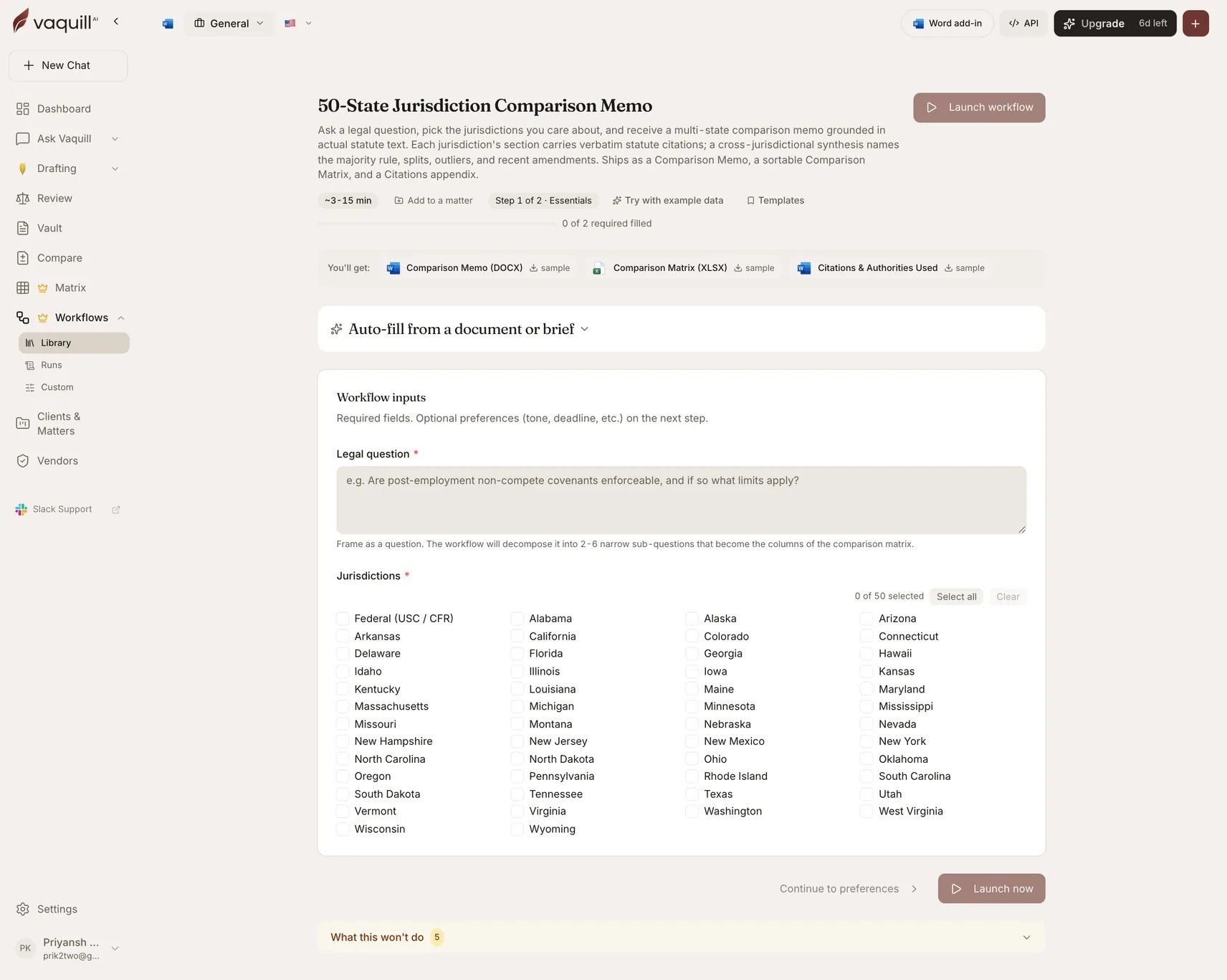
The 50-State Jurisdiction Comparison Memo launcher: document slots, inputs, and what you get
What you need
No documents. This workflow runs against Vaquill AI’s US statutes corpus, not against your uploads. It is the one built-in workflow with no document slots at all.Inputs
How it runs
1
Validate jurisdictions and coverage
Confirms every selected jurisdiction is supported and has corpus coverage for the question’s area, rejecting the run early rather than producing a thin section.
2
Decompose
Breaks the legal question into two to six narrow sub-questions, calibrated by the practice area. These become the matrix columns. Skipped if you supplied your own.
3
Per-jurisdiction statute analysis
Retrieves and analyses the governing statute text for each jurisdiction against each sub-question.
4
Cross-jurisdictional synthesis
Names the majority rule, the splits, the outliers, and any recent amendments visible in the statute text.
5
Render memo and matrix
Writes the memo, the sortable matrix, and the citation appendix, after verifying every quote against its cited section.
What you get
What this will not do
- Cite case law. The memo is built from statutes only. Where the statutory text is silent, the answer is honestly labeled “no on-point statute” rather than guessed at.
- Replace primary-source verification. Every citation is verified against its cited section, but pull the underlying section before you rely on it.
- Detect recent legislative changes that have not yet entered the research base. Recency flags surface only when the cited statute text itself mentions a recent enactment year.
- Resolve genuine splits with judgment. The memo names the majority rule and the outliers; you decide which authority controls in your venue.
Related
Statutes and regulations
The corpus this workflow reads, browsable directly.
Case law research
For the case law this workflow deliberately does not cite.