

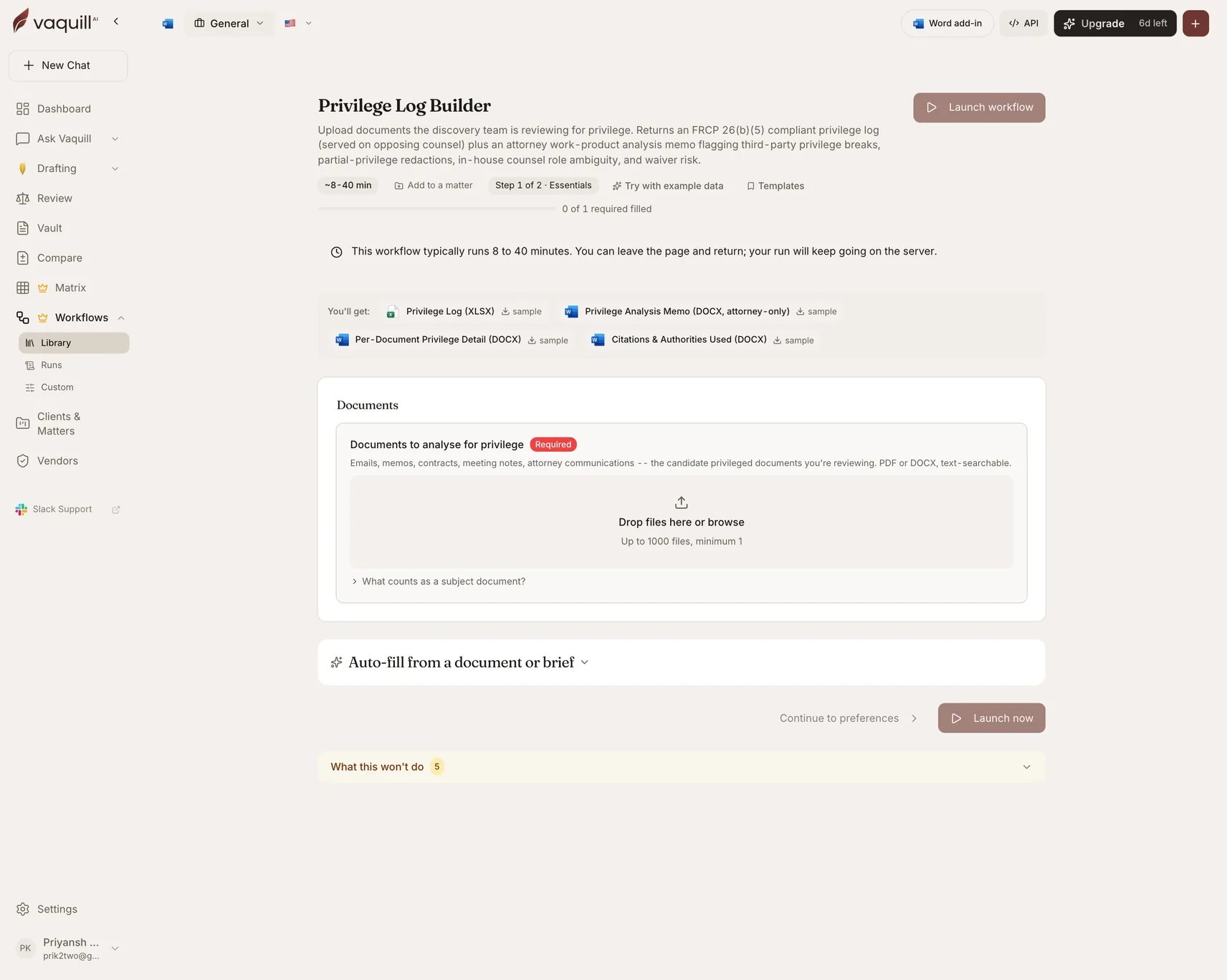
The Privilege Log Builder launcher: document slots, inputs, and what you get
What you need
Inputs
How it runs
A matrix-review pipeline:prepare → extract → wait for extraction → normalize and score → synthesize → render.
Each document is analysed for privilege type and basis, for third-party recipients that would break privilege, for whether the claim is fact or opinion work product, and for whether a partial redaction is the right call rather than a full withhold. The synthesis rolls those into portfolio-level risk patterns before the render stage writes the log and the memos.
What you get
What this will not do
- Serve the log on opposing counsel.
- Replace partner sign-off on any partial-privilege redaction call or third-party-break risk.
- Authenticate the documents. It analyses file metadata and text; it does not verify Bates ranges against the production set.
- Adjudicate the privilege call if challenged on motion. The log is your starting position, not a defense against in-camera review.
- Identify privileges peculiar to state or sector law: state attorney-client variations, deliberative-process scope, sectoral self-critical analysis.
Related
Discovery Response Pack
Produces a narrower privilege log scoped to one response set.
Document search
Finding the candidate documents in the first place.