

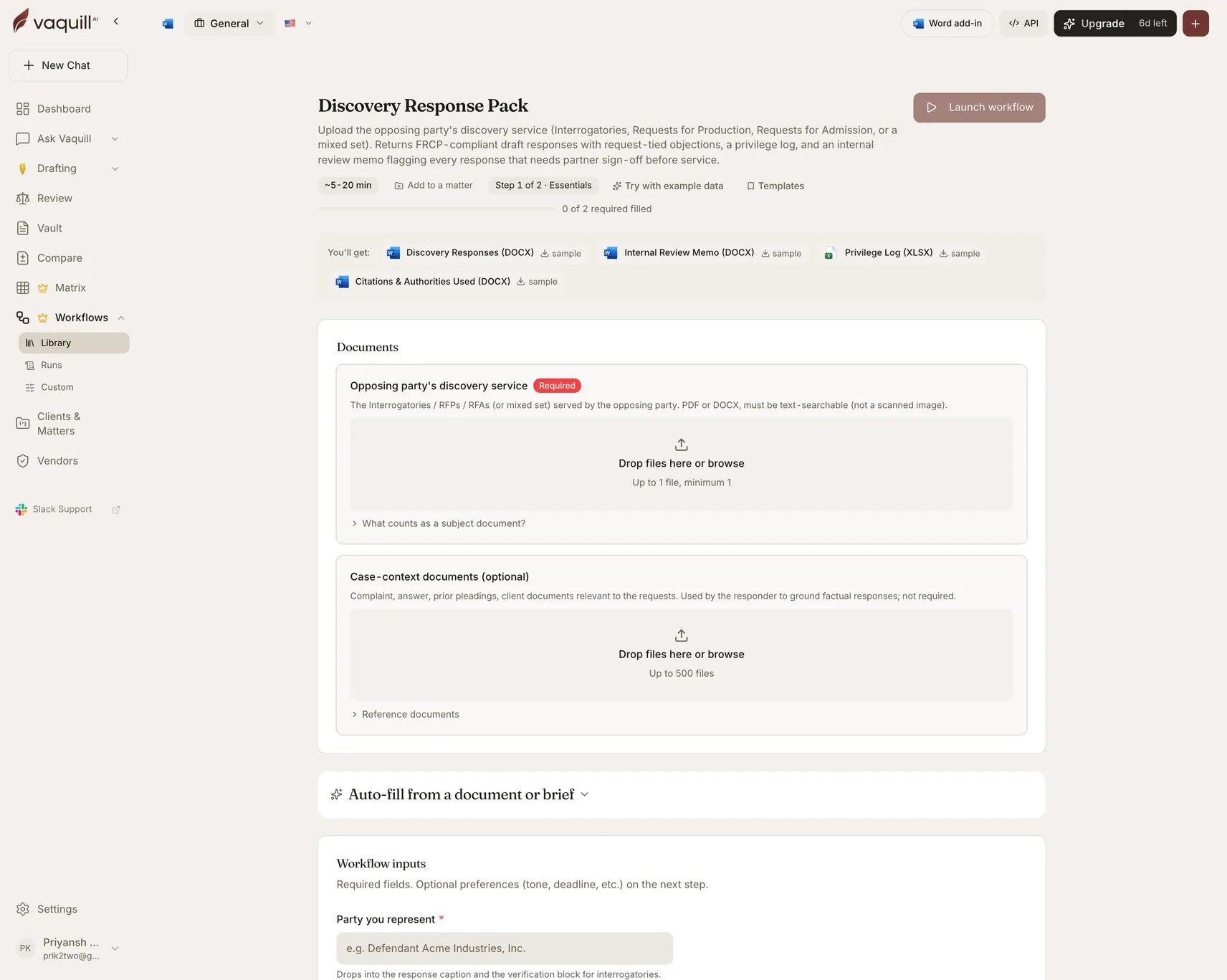
The Discovery Response Pack launcher: document slots, inputs, and what you get
What you need
Inputs
How it runs
1
Parse opposing discovery requests
Splits the served document into individual numbered requests and classifies each as an interrogatory, RFP, or RFA. Mixed sets are handled.
2
Draft responses
Produces a response per request, with objections tied to that specific request, post-2015 Rule 34(b)(2)(C) withholding statements where documents are withheld, and factual content grounded in the reference documents where you supplied them.
3
Render response package
Writes the served document, the privilege log, the internal memo, and the citations appendix.
What you get
What this will not do
- Serve the responses on opposing counsel or file with the court.
- Replace partner sign-off, particularly on any RFA denial with its FRCP 37(c)(2) cost-shift exposure, or on any privilege assertion.
- Identify and authenticate the actual documents to be produced. The workflow narrows scope; it does not search your client’s document collection.
- Verify under oath the truth of the substantive responses. It generates the verification block; the client signs it.
- Account for judge-specific orders that vary from the default FRCP scheme, such as SDNY individual practices.
Related
Privilege Log Builder
A full privilege review over a document population, rather than the log for one response set.
US Motion Drafter
For the motion to compel that follows a bad response.