Real estate legal AI comes down to one call. A dedicated lease and title abstraction tool does the heavy lifting. A generalist or workbench handles everything around it. The reason is the work itself. Real estate is a document-volume and abstraction-accuracy problem, the exact job a specialist wins.
Real estate legal work has a shape most generalist legal AI ignores. You read long leases with margin notes and strikeouts. You compare fifty agreements for one renewal clause. You chase easements through a chain of title. The tool that drafts a clean NDA may choke on a 90-page ground lease.
So this is not a one-winner list. It is eight tools sorted by the real estate job each does best. Each has hedged prices and an honest note on where it falls down. All prices and capabilities were checked June 2026. Confirm the current figure with the vendor before you buy.
TL;DR
- The heavy lifting is abstraction, so buy a specialist for it. Real estate is a document-volume and accuracy problem. A dedicated lease and title tool beats any generalist on that core job.
- Pick the category before the brand. Lease abstraction, title and due diligence, drafting and review, and large document sets are four jobs with four different winners.
- Real estate specialists exist now. Orbital handles property diligence and lease analysis. Visual Lease, Leverton, and Prophia focus on lease abstraction. They beat generalist tools on those exact tasks.
- Generalist legal AI still has a place. Harvey and CoCounsel do lease review and research inside a broader platform. Useful when real estate is one part of a mixed practice.
- An in-house workbench fits counsel who draft, review, and track matters in one place. Bolt a specialist on when abstraction volume demands it.
- Accuracy is not free. Even strong tools miss terms in dense leases and misread title language. A human check on every extracted figure stays non-negotiable.
- Prices run from about $20 a month for a general model up to enterprise quotes in the thousands per seat. More money does not mean a better fit.
Best tool for high-volume lease abstraction?
This guide pairs with our broader roundup of the best legal AI tools for in-house counsel and the deeper contract review tools comparison. Those cover the wider field. This one stays on the real estate desk.
What real estate counsel actually needs from AI
Three pressures shape the choice. Name yours before you shop.
Document volume and length. A single deal can carry a ground lease, three subleases, an SNDA, a loan agreement, and a title commitment. Abstraction and comparison at that volume is the job AI does best. It is also the one a chat box does worst.
Abstraction accuracy. Pulling rent escalations, renewal options, co-tenancy triggers, and exclusive-use clauses out of a messy PDF is exact work. A wrong commencement date or missed option window is a real liability. The tool's hit rate and your review step both matter.
Jurisdiction-specific rules. Recording requirements, transfer taxes, and title practice vary by state and county. A tool trained on the wrong market, or with no legal grounding, states confident answers that do not hold for your property.
How to choose: a four-step framework
You do not need a long pilot. Name your job and test two finalists on real paper.
- Name the job that owns your week. Lease abstraction, title and due diligence, drafting and review, or comparison across a stack. Buy the best tool in that one category first.
- Match the tool to your market. Confirm US commercial (or residential) coverage and your state's practice, rather than UK conveyancing or generic contracts.
- Test on a document you know cold. Drop in a lease or title commitment you have already abstracted and judge the output against your own answer.
- Check the contract terms. Ask whether it trains on your data, where files are stored, and whether you can export. Get the answers in the MSA.
The costliest mistake is buying a generalist drafting tool when your real job is abstracting two hundred leases. That is a comparison-grid job, and a chat tool cannot do it.
The 8 best AI tools for real estate lawyers
Each entry names the job it does best, its strengths, where it falls down, and a hedged price. No tool here is right for every desk.
1. Orbital: best for property due diligence and title review
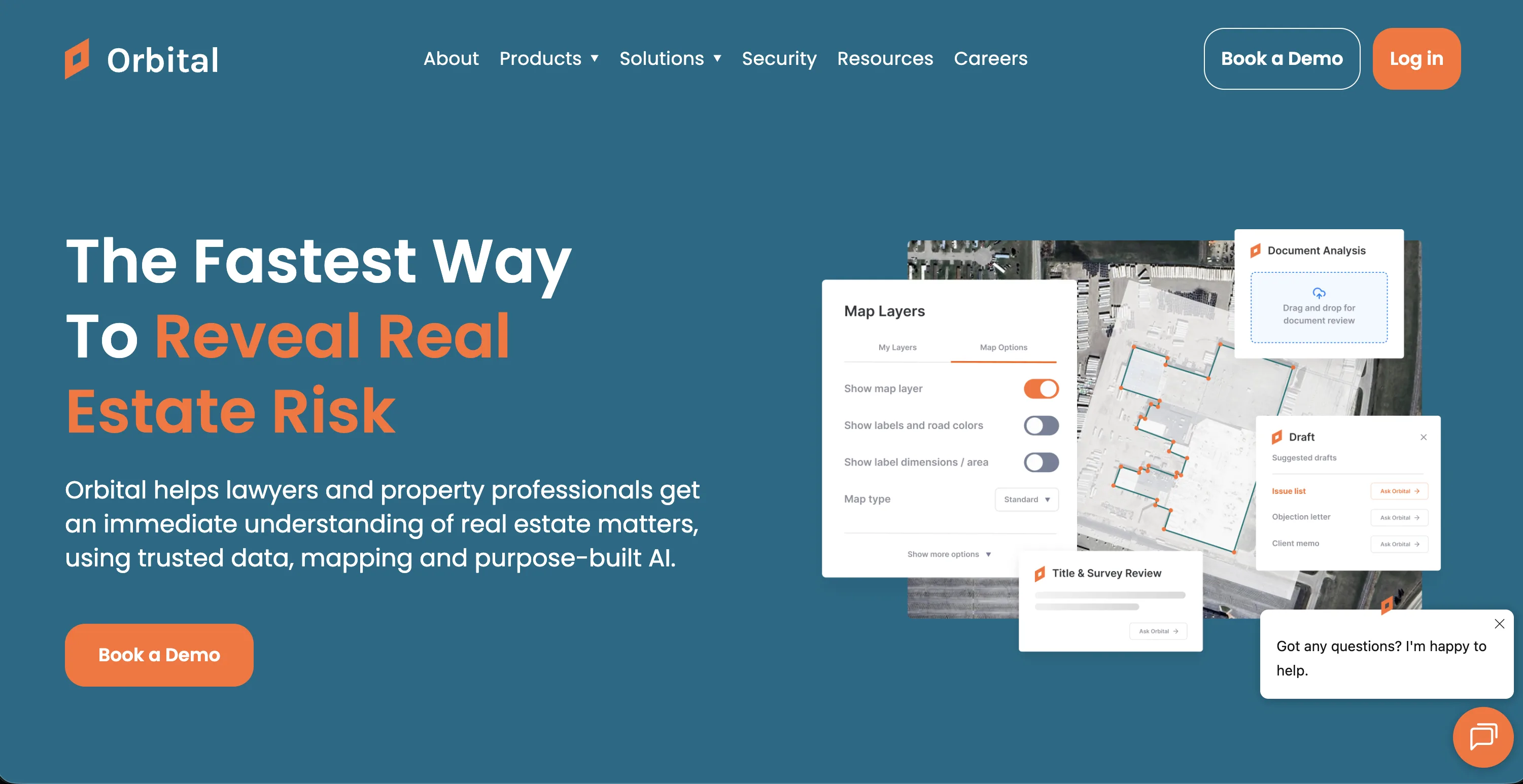
Category: Real estate legal AI (specialist). At a glance: Quote-based / on request · Sales-led, demo required · Best for property diligence teams.
Orbital is the closest thing to a purpose-built real estate AI on this list. Its flagship, Orbital Copilot, is pitched as an assistant for commercial real estate diligence. It covers US and UK markets (Orbital, checked June 2026).
What's good
- Built for the workflow: title and survey review, lease abstracts, legal-description plotting, and cross-document checks like tying lease terms to financing.
- Fine-tuned on property documents, not generic contracts, which shows on dense title work.
- Separate UK products (Orbital Witness, Orbital Residential) if you work across the Atlantic.
Where it falls short
- No public price, and access is sales-led, so factor in a procurement cycle.
- Specialized to real estate, so it is not your home for unrelated matters or general drafting.
What users say: Independent forum talk is thin, and most coverage is vendor or press. Treat the diligence-speedup claims as marketing until your own pilot confirms them.
Bottom line: Buy it if property diligence and title review own your week. Skip it if you need a general drafting home or a self-serve price up front.
2. Vaquill AI: best for in-house real estate counsel who draft, review, and track matters

Category: Purpose-built in-house suite (workbench). At a glance: Self-serve, published pricing (sign up to see the latest) · Self-serve, free trial · Best for in-house counsel handling property deals end to end.
Vaquill AI is a legal AI workbench for in-house teams, not a dedicated real estate tool. It fits counsel who draft purchase agreements, compare terms across a stack of leases, and keep each deal's documents together. It covers that connected week in one place.
What's good
- Drafts and redlines in real Microsoft Word track changes, each edit a discrete suggestion you accept or reject.
- Builds a document matrix across a stack of contracts for comparing terms across multiple leases at once (the document matrix workflow).
- Keeps matters and documents together, with US case law research and a clause library on the side.
- Self-serve, published pricing, no seat minimum, with a do-not-train-on-your-data policy.
Where it falls short
- Not a dedicated lease-abstraction engine: for abstracting hundreds of leases into structured records, a specialist like Visual Lease, Leverton, or Kira will beat it.
- No title or survey plotting, so dedicated property diligence lives elsewhere.
- Its public API is statutes-only, so it is not a programmatic case-law or abstraction pipe.
When NOT to choose it: If your biggest job is high-volume lease abstraction or title and survey diligence, buy the specialist for that task. The workbench is the home for drafting, review, and matters, not a replacement for an abstraction tool.
What users say: It is newer than the heavyweights, so there is little outside forum talk yet. We will not invent a verdict it has not earned.
Bottom line: Buy it if you run property deals from draft to renewal and want one workbench, not five tools. Skip it if abstraction or title diligence is your core job, where the specialists win.
3. Luminance: best for large document sets and data-room diligence
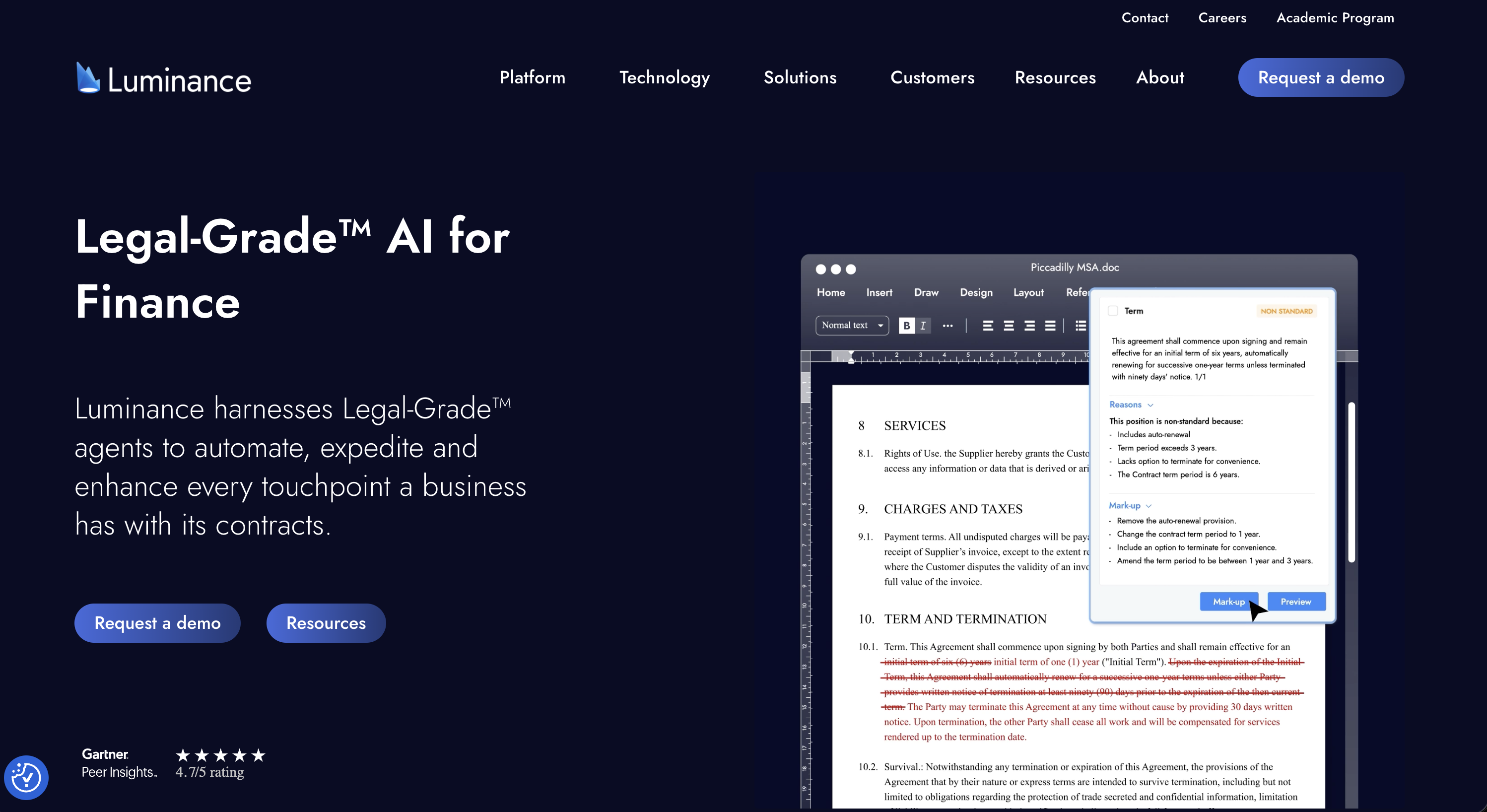
Category: Document analysis and review (enterprise). At a glance: Quote-based / on request · Sales-led, demo required · Best for portfolio and data-room scale.
Luminance is a mature document-analysis engine used heavily in diligence and large-portfolio review. For a data room full of leases, loans, and ancillary agreements, it surfaces patterns across the whole set (Luminance, checked June 2026).
What's good
- Strong at scale: it reads across an entire contract estate, not one document at a time.
- Handles multiple languages and jurisdictions, useful for cross-border property portfolios.
- Established vendor with a large customer base, so runway is not a worry.
Where it falls short
- General contract analysis, not a real estate specialist, so lease and title nuance needs your review.
- Enterprise-priced and sales-led, which is heavy for a solo or two-person team.
What users say: Reviewers credit it on large-scale review. They flag it as an enterprise buy with a setup curve, so budget onboarding time.
Bottom line: Buy it if your job is diligence across a big pile of agreements and you have the budget. Skip it if you mostly draft and negotiate single deals.
4. Kira (Litera): best for portfolio-scale lease and clause extraction
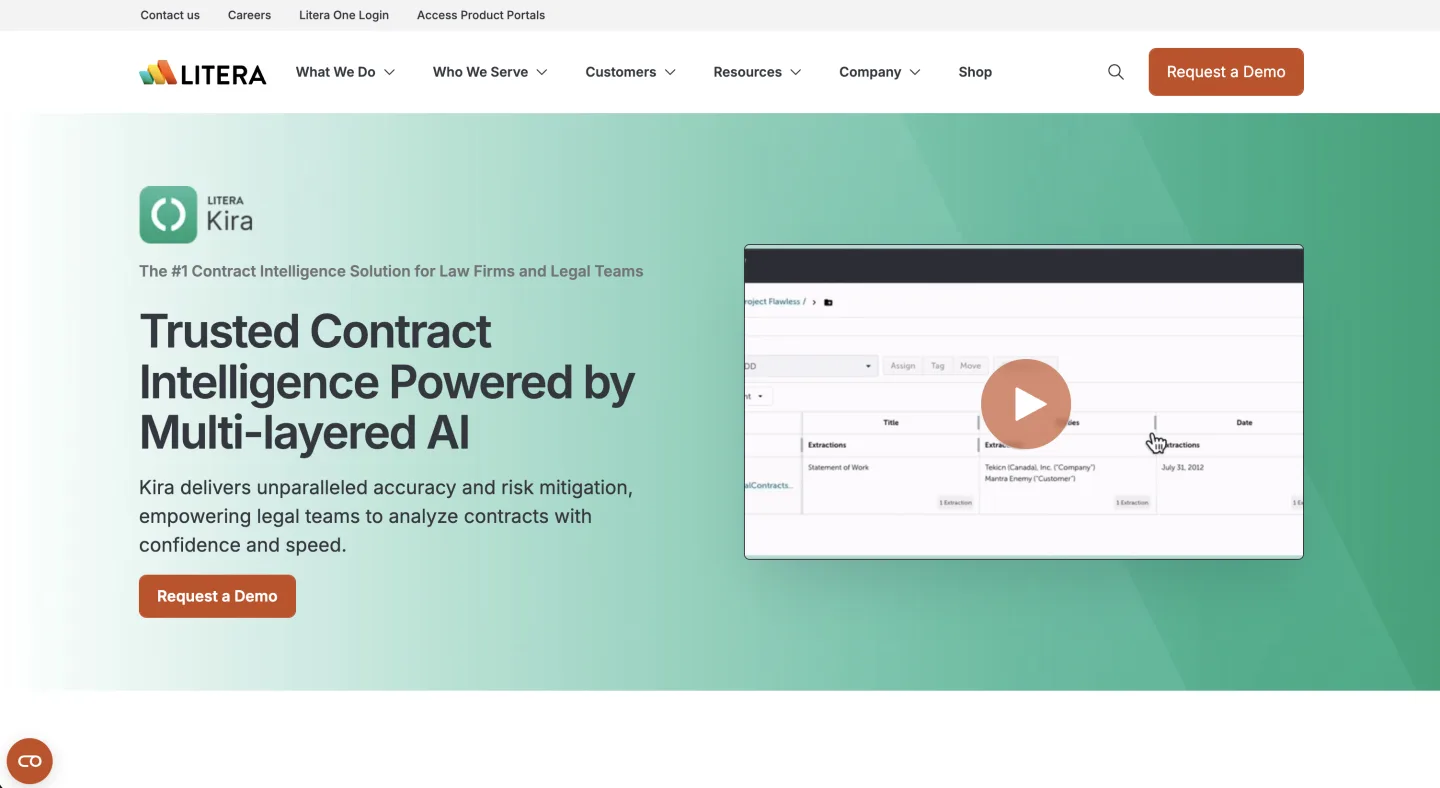
Category: Contract analysis and extraction (now part of Litera). At a glance: Quote-based / on request (enterprise) · Sales-led · Best for M&A-style portfolio review.
Kira pioneered machine-learning clause extraction and is now a Litera product. It pulls defined data points out of hundreds of leases or loan agreements at once (Litera Kira, checked June 2026).
What's good
- Deep, trainable extraction: teach it your own clause types for repeat portfolios.
- Built for diligence volume, so batch lease and loan review is its home turf.
- Long track record inside the AmLaw diligence stack.
Where it falls short
- Enterprise pricing and a sales-led path, not a quick self-serve start.
- It extracts and compares, it does not draft or run your matters.
What users say: Practitioners describe it as powerful but heavy, with real setup effort before it pays off. It suits teams with the volume to justify it.
Bottom line: Buy it if you abstract and compare leases at portfolio scale. Skip it if your volume is low or you need drafting and matters too.
5. Visual Lease, Leverton, and Prophia: best for dedicated lease abstraction
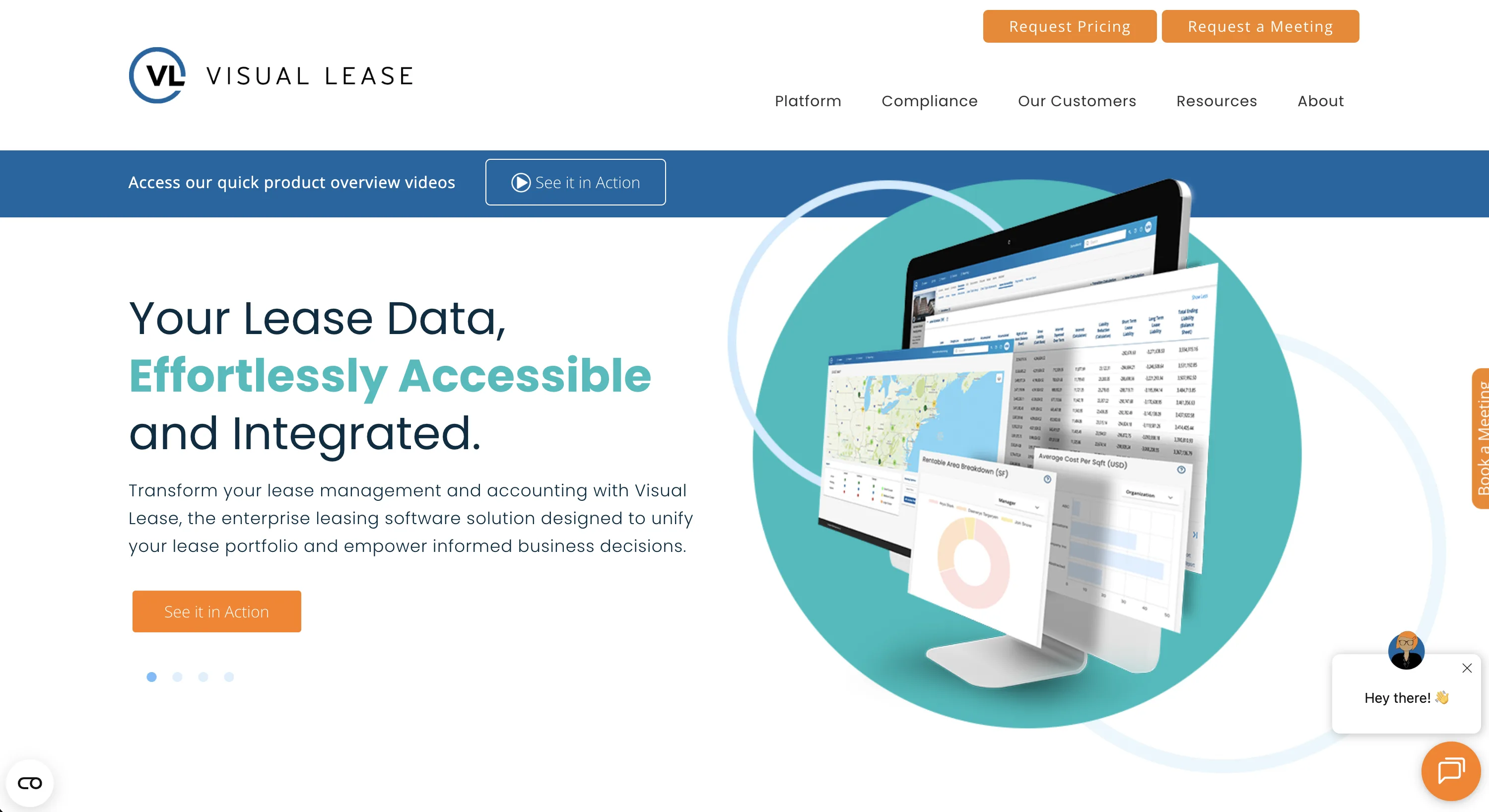
Category: Lease abstraction specialists. At a glance: Quote-based / on request · Sales-led, demo required · Best for high-volume lease abstraction.
If lease abstraction is the single job that fills your week, a dedicated tool beats any generalist. Visual Lease uses OCR plus lease-trained models to extract fields and build rent schedules. It runs validation checks against benchmark data (Visual Lease, checked June 2026). Leverton and Prophia compete in the same lane.
What's good
- Purpose-built for lease data: it reads tables, strikeouts, and margin notes, then populates structured records.
- Validation layers flag anomalies like rent irregularities and square-footage mismatches.
- Output is a usable abstract, not a chat summary.
Where it falls short
- Narrow by design: these are abstraction tools, not drafting, review, or matter platforms.
- Often aimed at corporate real estate teams, so confirm legal-grade fit for your use.
What users say: Buyers value abstraction speed and accuracy. No tool removes the final-record review, so keep a verification step.
Bottom line: Buy one if lease abstraction at volume is your core job. Skip them if the lease work needs to live alongside drafting, negotiation, and matters.
6. LegalOn: best for purchase agreements and loan-doc review

Category: Dedicated contract review. At a glance: reportedly ~$500 per user/mo (entry-level, checked June 2026; verify with the vendor) · Sales-led, demo required · Best for playbook review of deal docs.
LegalOn is a contract-review specialist that inserts redlines with attorney-authored reasoning behind each one. For purchase and sale agreements, loan documents, and the recurring clauses in deal paper, that reasoning layer is the draw.
What's good
- Real-time redline suggestions as you work through a purchase agreement or loan doc.
- Reasoning shown behind each edit, which review skeptics tend to come around on.
- Long track record at the review job specifically.
Where it falls short
- A review tool, not a real estate specialist, so title, survey, and abstraction live elsewhere.
- No self-serve path; team pricing is custom and gated behind a demo.
What users say: Buyers praise the attorney-authored guidance, while noting it is one tool in a stack, not a whole workbench.
Bottom line: Buy it if re-reading the same deal clauses against your positions is the grind. Skip it if you need abstraction, title work, or matters in the same place.
7. Ivo: best for fast, Word-native playbook review

Category: Dedicated contract review. At a glance: reportedly ~$500 per user/mo (checked June 2026; verify with the vendor) · Sales-led, demo required · Best for review at volume in Word.
Ivo is the leaner, faster name in the playbook-review camp, with a clean interface and a clear in-house focus. For checking incoming deal documents against your standard positions, it is quick to pick up.
What's good
- A genuine AI reviewer with playbook redlining, easy to learn.
- Word-native redlines you can accept or reject, which is the deliverable you send back.
- Teams that found the heavyweights heavy tend to land here.
Where it falls short
- Onboarding leans on Ivo's team rather than self-serve setup.
- A general reviewer, so real estate diligence and abstraction are not its job.
What users say: Reviewers describe an easy reviewer with solid playbook redlining, while flagging team-led onboarding and the odd inaccuracy.
Bottom line: Buy it if review volume on deal paper is your dominant job. Skip it if you want a self-serve trial or a single home for the whole practice.
8. Harvey and CoCounsel: best for real estate inside a mixed practice
Category: Generalist legal AI (firm-side platform and research assistant). At a glance: reportedly Harvey ~$1,200 to $2,000+ per user/mo and CoCounsel ~$225 to $400+ per user/mo (checked June 2026; both gate pricing behind sales, so verify) · Sales-led, demo required · Best for mixed practices.
Harvey and CoCounsel are generalist platforms, not real estate specialists, but both handle lease review and deal analysis inside a wider toolkit. If real estate is one slice of a mixed practice, the breadth can be worth it.
What's good
- Harvey does deep, agentic document work and lease-term extraction at scale.
- CoCounsel pairs review and drafting with Westlaw-grounded research, handy when a property question turns on case law or statute.
- Both are backed by deep-pocketed vendors, so staying power is not the concern.
Where it falls short
- Neither is fine-tuned on real estate documents, so a property specialist out-reads them on title and dense leases.
- Enterprise pricing and sales-led access make them heavy for a real-estate-only solo.
- Research assistants still fabricate citations, so verify every cite.
What users say: Buyers rate the breadth and depth highly. They warn that the price and the verification burden are both real for in-house teams.
Bottom line: Buy one if real estate is part of a broader legal load. Skip it if your week is purely property diligence, where a specialist earns its place.
Comparison table
| Tool | Real estate job | Price (per user/mo) | Access | Lease abstraction | Title / diligence | Best for |
|---|---|---|---|---|---|---|
| Orbital | Property diligence, title | Quote-based | Sales-led | Yes | Yes (specialist) | Property diligence teams |
| Vaquill AI | Drafting, review, matters | Published | Self-serve | No (matrix, not abstraction) | No | In-house property counsel |
| Luminance | Large document sets | Quote-based | Sales-led | Partial | Yes (general) | Data-room scale |
| Kira (Litera) | Portfolio extraction | Quote-based | Sales-led | Yes | Partial | M&A-style portfolio review |
| Visual Lease / Leverton / Prophia | Lease abstraction | Quote-based | Sales-led | Yes (specialist) | No | High-volume abstraction |
| LegalOn | Deal-doc review | ~$500 | Sales-led | No | No | Purchase / loan review |
| Ivo | Playbook review | ~$500 | Sales-led | No | No | Review at volume |
| Harvey / CoCounsel | Generalist review + research | ~$225 to $2,000+ | Sales-led | Partial | Partial | Mixed practices |
A note on the price column: where we write "quote-based," the vendor publishes nothing public. The binding number comes from your own demo. Treat any tool that will not put data-training and export terms in the contract as a no.
Why not ChatGPT or Claude for real estate work?
A general model drafts a readable clause and summarizes a short document well. For under $20 a month, that is real value for non-binding work. It is the wrong tool for the binding parts of real estate practice. Three gaps:
- It fabricates and misreads. A general model invents a statute cite or misstates a recording rule, with no grounding layer to catch itself. On a 90-page lease, it drops terms a trained abstraction tool would catch.
- No structured abstract or matrix. You get prose, not a field-by-field record or a comparison table across fifty leases. The structured output is the deliverable, and the chatbot does not produce it.
- No matter context or data terms. It does not keep a deal's documents together. Consumer terms are not built around privilege, US data residency, or a no-training guarantee.
Keep the general model for rough drafts you will check anyway. Move the abstraction, the diligence, and the binding deliverables onto a grounded tool.
How to decide
The single stance: real estate is a document-volume and abstraction problem, so a dedicated lease and title tool wins the heavy lifting. Everything else is a tool for the work around it.
If it is lease abstraction at volume, buy a specialist: Visual Lease, Leverton, Prophia, or Kira. If it is title and property diligence, buy Orbital or run a data-room engine like Luminance. If it is deal-doc drafting and review, a playbook reviewer (LegalOn, Ivo) or a workbench fits. If you are in-house counsel running deals end to end, a workbench keeps drafting, review, and matters in one place. Add a specialist for abstraction when volume demands it.
Then price to your real volume, not the brand. The vendors quoting enterprise prices know who they built for, and for a lean real estate desk, it is often not you.
Fit beats horsepower at small scale every time.
For the wider field, see our best legal AI tools for in-house counsel and the best AI tools for lawyers. For pricing math, read the legal AI pricing benchmark.
FAQ
What is the best AI tool for lease abstraction?
For dedicated, high-volume lease abstraction, a specialist beats any generalist. Visual Lease, Leverton, and Prophia extract lease fields into structured records. Kira does trainable clause extraction at portfolio scale. Test one on a lease you have already abstracted and check the output field by field.
Can AI handle title and due diligence for real estate?
Yes, but use a tool built for it. Orbital is designed for property diligence, including title and survey review and legal-description plotting. Data-room engines like Luminance read across large document sets. A general chatbot will misread title language, so keep a human review on every finding.
How accurate is AI lease abstraction?
Accuracy varies by tool and by how clean the document is. Even strong tools miss terms in dense or scanned leases. Treat any vendor accuracy claim as marketing until your own pilot confirms it. Keep a verification step on extracted dates, rents, and option windows, because a wrong commencement date is a real liability.
Should real estate lawyers use Harvey or a specialist tool?
It depends on the mix. Harvey and CoCounsel handle lease review and research inside a broader platform, which suits a mixed practice. If your week is purely property diligence, a specialist like Orbital or a lease tool out-reads them on those tasks.
How much does real estate legal AI cost?
It ranges widely. A general model runs about $20 a month. An in-house workbench publishes self-serve per-seat pricing, and dedicated reviewers sit around $500. The specialist diligence and abstraction platforms are usually quote-based and enterprise-priced, so budget for a demo.
Does real estate AI work for state-specific rules?
Only if it is built for your market. Recording rules, transfer taxes, and title practice vary by state and county. A tool trained on UK conveyancing or generic contracts will state confident answers that do not hold. Confirm US commercial or residential coverage and your state before you rely on it.
Can one AI tool cover the whole real estate workflow?
Not really, and any vendor claiming it can deserves a hard pilot. The workflow splits into abstraction, title and diligence, and drafting and review, and the best tools each own one lane. Most real estate teams pair a workbench for drafting and matters with a specialist for abstraction or diligence.
Will AI replace real estate paralegals or lawyers?
No, it shifts the work. AI speeds up abstraction, first-pass review, and document comparison, but it still misses terms and misreads dense documents. The judgment, the verification, and the client advice stay with people. The teams gaining the most use AI to clear volume, then spend the saved time on the harder calls.
Last updated: June 2026.
New legal AI guides, weekly.
Further Reading
Best AI Tools for Banking and Finance Lawyers
Read postBest AI Tools for Employment Lawyers
Read postBest AI Tools for M&A Lawyers
Read postBest AI Tools for Procurement Lawyers
Read postBest AI Tools for Startup and VC Lawyers
Read postWhat Lawyers Want From Legal AI in 2026: A 534-Lawyer Study
Read post
Co-Founder & CEO · Attorney
Arshita leads product and strategy at Vaquill, building the legal AI suite that solo, small-firm, and in-house US lawyers use to run a matter end to end.