The best AI tool for an M&A lawyer is usually a specialist, not a generalist. Diligence is a volume-and-accuracy problem. A tool that extracts the same provision across hundreds of contracts wins it. Pair that with a data room that answers buyer questions. Together they beat a do-everything assistant for the work that fills a deal.
M&A work is not one job. You read hundreds of target contracts under a deadline. You build disclosure schedules off what you find. You redline the purchase agreement and the ancillaries. You answer buyer questions in a data room. No single tool is best at all four. This guide sorts the field by the job. It names prices where vendors publish them, and says who each tool is wrong for.
TL;DR
- Sort by the job, not the brand. A diligence engine, a generalist deal assistant, and a contract-review tool solve different M&A problems. Name your bottleneck first.
- For diligence at volume, a specialist that extracts provisions across hundreds of contracts and plugs into a data room (Kira, Emma Legal) beats a general assistant.
- For a data room with AI built in, the platform itself now answers buyer questions and flags issues (Intralinks DealCentre AI).
- For the redline and the ancillaries, a Word-native playbook reviewer (Ivo, LegalOn) is faster than a generalist for repeat clause work.
- For an in-house deal team that also drafts, tracks matters, and reruns the same review across a contract stack, a workbench fits. It is not the pick for thousand-document, firm-side diligence.
- Two questions kill most vendors: does it train on your data, and does it fit the data security your deal counterparty expects? Get both in the contract.
Which tool does the post name best for high-volume contract diligence?
This is the M&A-practice roundup. For the broader buyer view, see our best legal AI tools for in-house counsel and best AI tools for lawyers. For the contract-review category in depth, see best AI contract review tools, compared.
What M&A actually needs from AI
Before any tool, name the four jobs that define a deal. Each rewards a different kind of software.
- Diligence review at volume. A data room holds hundreds or thousands of target contracts. You need change-of-control, assignment, exclusivity, and termination triggers across all of them, fast. This is an extraction-and-search job.
- Disclosure schedules. What diligence surfaces lands in the schedules of exceptions. The contracts that breach a representation become a disclosure. We cover the structure in drafting the schedule of exceptions in an M&A deal.
- Contract and clause review. The purchase agreement and the ancillaries get redlined against a position. This is playbook work, where Word-native review tools earn their keep.
- Data-room Q&A and deal drafting. Buyers ask questions; the sell side answers them in the room. Junior counsel draft the ancillaries. Both are now partly automatable.
A tool great at one job is often weak at another. The extraction engine does not draft your purchase agreement. The data room does not run your clause playbook. Match the tool to the bottleneck.
How to choose an AI tool for M&A
Four criteria decide the fit. Score each finalist against all four before the demo flatters you.
- Diligence volume. Can it ingest a full data room and extract the same provision across every contract at once? A tool built for one agreement at a time will not survive a 600-contract target.
- Accuracy and verification. Every output gets checked. Tools that cite the source clause and show their work cut the verification time. Tools that summarize without a pin cite add it back.
- Data security. M&A documents are confidential and often privileged. Ask where files sit, who can read them, whether the vendor trains on your data, and whether the posture matches what the counterparty expects in the room.
- Integration. Does it connect to the data room you are already using, export to Word and Excel, and fit the way your deal team works? A tool that makes you re-upload everything loses the time it saves.
The best AI tools for M&A lawyers
Eight tools across the four jobs. Each entry says what it does well, what it does not do, who it fits, and a hedged note on price. None is ranked best by default, because the right one depends on your bottleneck.
1. Kira (Litera): best for high-volume contract diligence
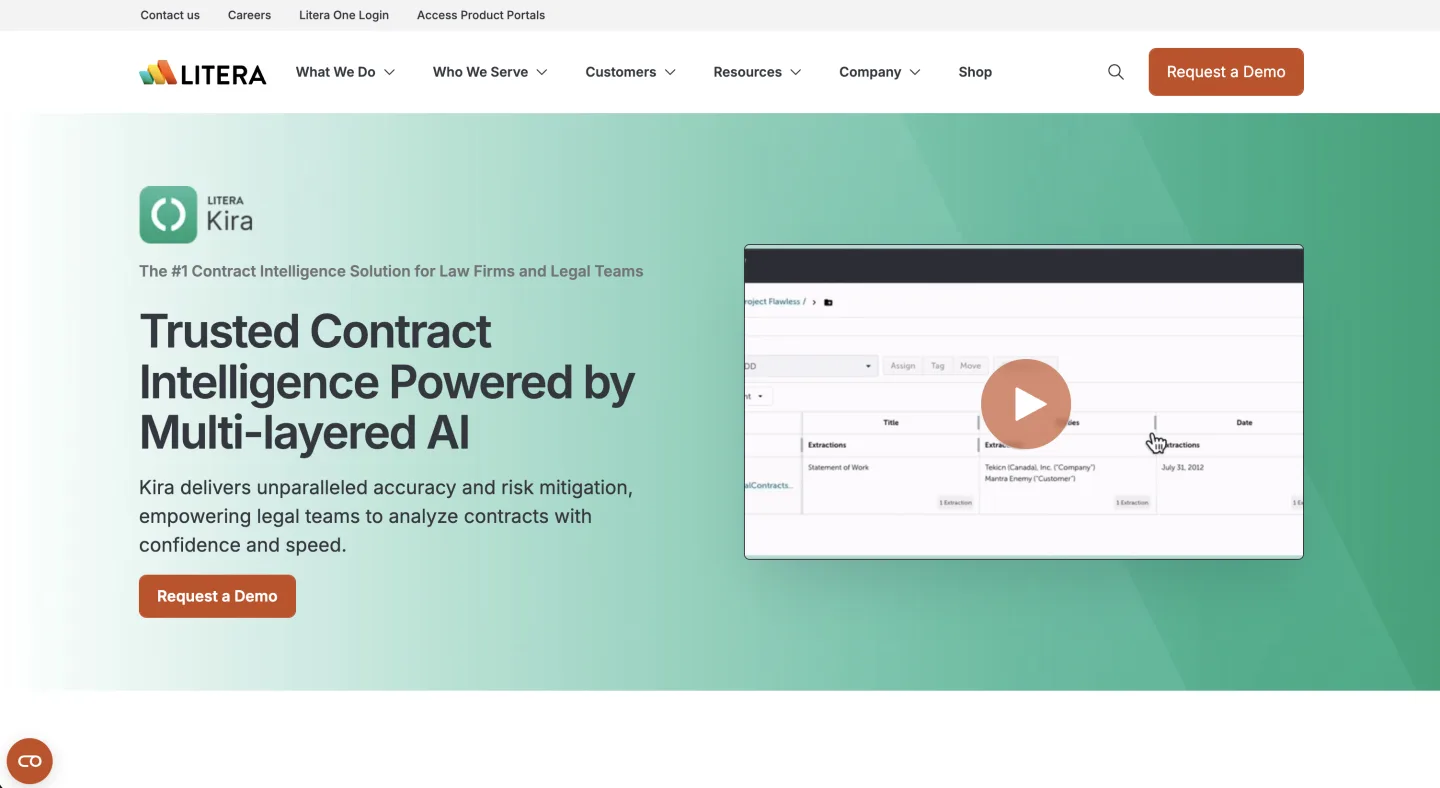
Category: Contract diligence and extraction. At a glance: Quote-based / on request · Sales-led, demo required · Best for high-volume M&A and real-estate diligence. Kira is the long-standing name for finding provisions across a large contract set. It pairs a model trained on lawyer-reviewed contracts with extraction across many documents at once.
What's good
- Extracts and tags provisions across hundreds of contracts, with bulk import, deduplication, and data-room integration (per Litera's Kira page, checked June 2026).
- Cites the source clause and exports structured results to Word, Excel, and PDF for the diligence report.
- Lets a team toggle generative AI on or off per project, which helps a deal that needs tighter governance.
Where it falls short
- It is a diligence and analysis engine, not a drafting tool. It does not write your purchase agreement or run a redline.
- Pricing is sales-led with no public number, and third-party estimates put it well into enterprise range.
What users say: Reviews describe a powerful, accurate extraction tool with a real setup cost. Treat third-party price estimates as estimates until your own quote lands.
Bottom line: Buy it if your week is reading hundreds of target contracts for the same set of provisions. Skip it if you need drafting or a place to run the rest of the deal.
2. Vaquill AI: best for an in-house deal team that also drafts and tracks matters
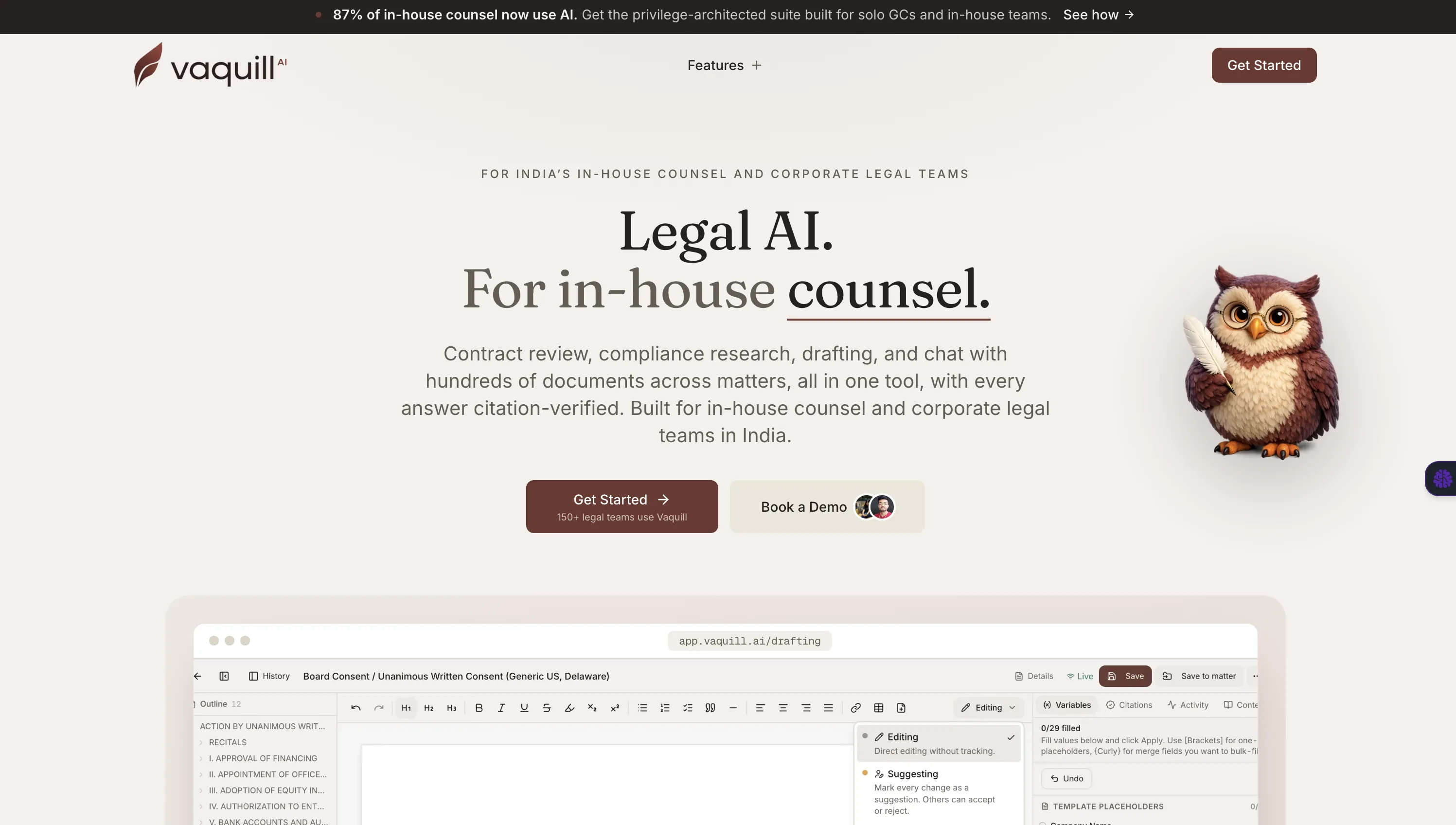
Category: In-house legal AI suite (workbench). At a glance: Self-serve, published pricing (sign up to see the latest) · Self-serve, 7-day trial · Best for in-house teams running the deal alongside the rest of the week. Vaquill AI is a workbench, not a dedicated diligence engine. For an in-house team that runs deals between everything else, it drafts, reviews, redlines, and keeps the deal documents in one place.
What's good
- A Document Matrix reruns the same review across a stack of contracts and lays the answers out side by side, which covers lighter diligence on a small or mid-size deal.
- Drafts and redlines ancillaries in real Microsoft Word track changes, and keeps each deal's documents together as a matter.
- Self-serve, published pricing, with a do-not-train-on-your-data policy. US case-law research is built in for the questions a deal raises (it is a feature, not an API).
Where it falls short
- It is not built for thousand-contract, firm-side diligence. For that volume, a specialist like Kira or a red-flag engine like Emma Legal beats it.
- It is not a virtual data room. If buyer Q&A inside a secure room is the job, a platform like Intralinks owns it.
What users say: It is newer than the diligence incumbents, so independent forum talk is thin, and we will not invent a verdict. Test the document matrix on a contract set you know.
Bottom line: Buy it if you are an in-house team running deals alongside the rest of the legal week and want one workbench. Do not choose it as your primary tool for high-volume, firm-side diligence or as a data room.
3. Emma Legal: best for fast red-flag diligence reports
Category: Legal due-diligence AI. At a glance: Per-file pricing (pay per document processed) · Sales-led · Best for funds and in-house teams wanting a quick go/no-go. Emma Legal reads a whole data room and produces a ranked risk report. It is built for the moment you need a fast read on a target before you commit deal hours.
What's good
- Processes an entire data room and returns a ranked red-flag report, connecting clauses across contracts (per Emma Legal's product page, checked June 2026).
- Flags missing documents against a requirement list, the gap diligence teams miss by hand.
- Per-file pricing scales with the data room, so a small deal does not carry an enterprise seat cost.
Where it falls short
- It surfaces risk; it does not draft the disclosure schedule or redline the agreement for you.
- It is newer than the incumbents, so independent benchmarks are thin.
What users say: Public discussion is mostly vendor and launch material, so we will not invent a verdict. Run a known data room through it before you trust the ranking.
Bottom line: Buy it if you want a fast, ranked first read on a target's contracts. Skip it if you need the tool to also draft, redline, or manage the deal end to end.
4. Intralinks DealCentre AI: best for a data room with AI built in
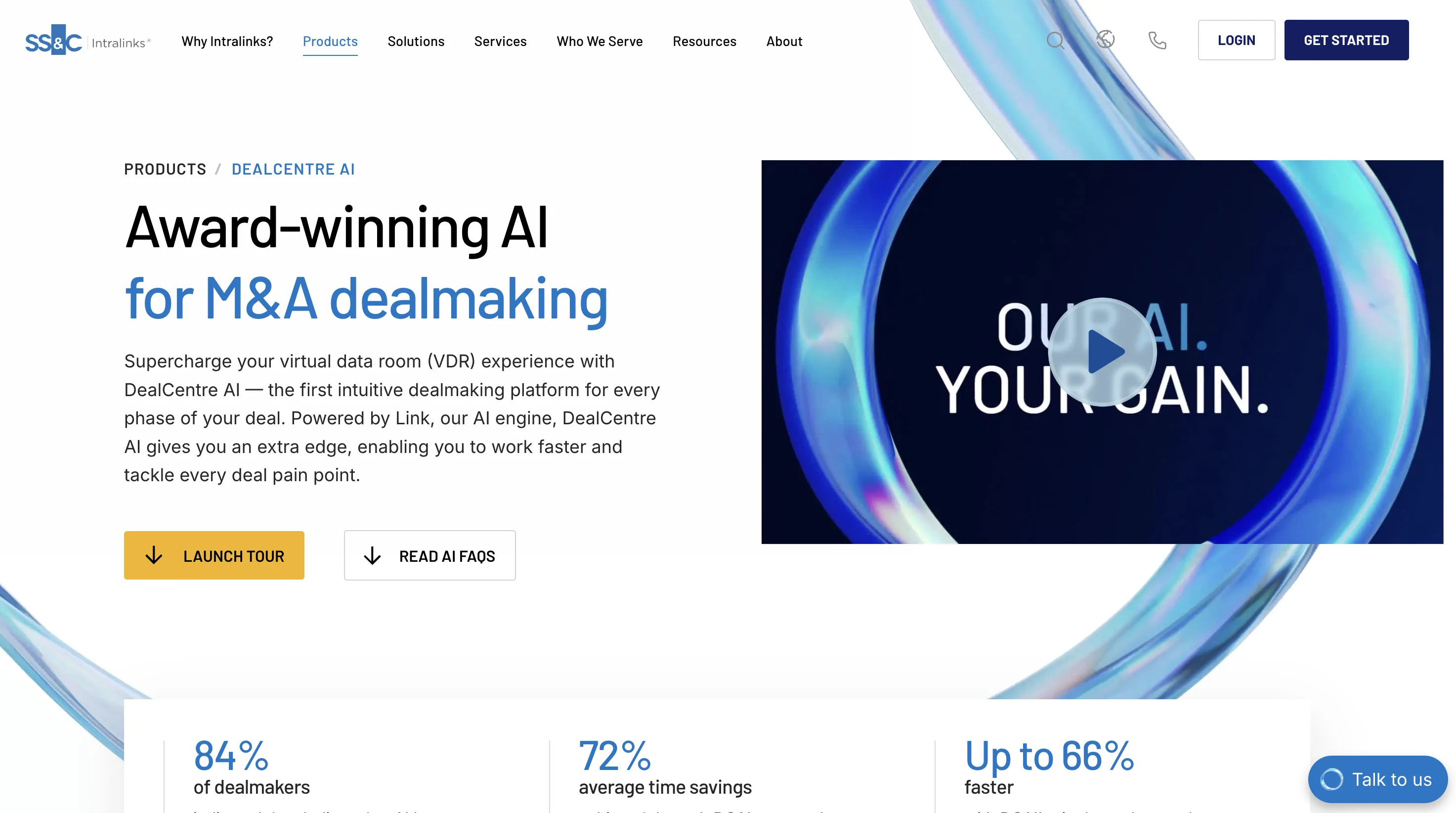
Category: Virtual data room with AI. At a glance: Quote-based / on request · Sales-led · Best for sell-side deal management and buyer Q&A. DealCentre AI is a data room first, with an AI layer for the diligence that happens inside it. The pitch is one place to prepare, run, and manage the deal rather than a separate review tool bolted on.
What's good
- Smart Q&A answers buyer questions with source citations and suggests responses, the data-room job nothing else here owns (per Intralinks' DealCentre AI page, checked June 2026).
- Summarizes documents, flags PII, and categorizes files as they land in the room.
Where it falls short
- The AI is tied to the data room. If you want the analysis without moving your deal into Intralinks, this is not it.
- It is sold to banks, corporates, and private equity, so pricing and onboarding assume an enterprise deal.
What users say: Buyers value the secure room and the Q&A workflow. The cited time-savings figures are vendor claims, so weigh them against your own deal volume.
Bottom line: Buy it if you run sell-side deals and want the data room and its AI in one platform. Skip it if you only need contract analysis and already have a room you like.
5. Harvey: best for firm-side, agentic deal work
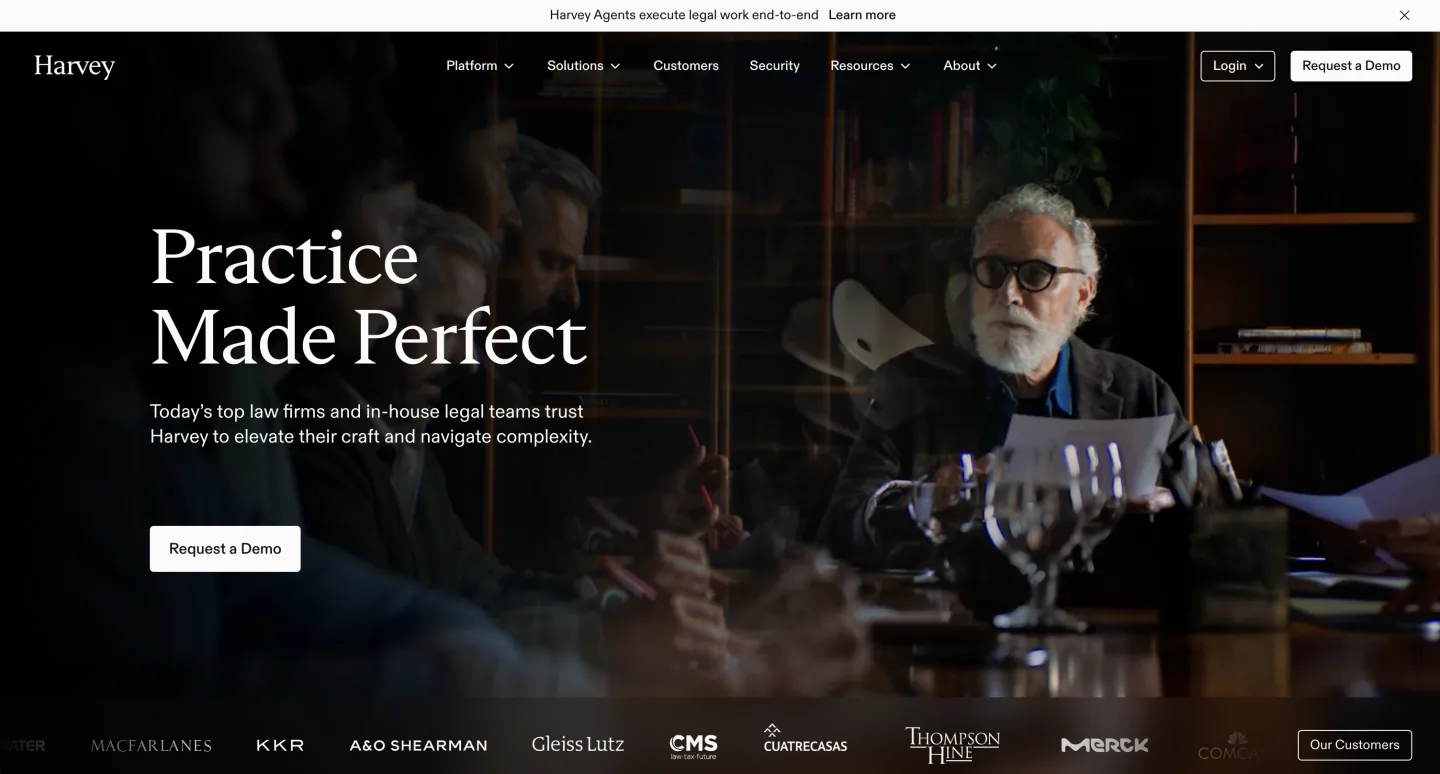
Category: Generalist firm-side legal AI. At a glance: $1,200 to $2,000+ per user/mo (bundle plus add-ons; sales-led) · Best for AmLaw firms and large deal teams. Harvey is the generalist deal assistant for large firms. It stores documents in a vault, analyzes them in bulk, and runs agentic workflows across a matter.
What's good
- Vault stores and bulk-analyzes deal documents, and Contract Intelligence surfaces review insights across a set (per Harvey's products page, checked June 2026).
- Agents handle multi-step deal tasks end to end, which suits a firm with the volume to justify it.
- Strong adoption among large firms, so the workflow is built for high-end transactional teams.
Where it falls short
- The value case is weak for a small in-house deal team paying enterprise prices for breadth it will not use.
- Pricing is sales-led and high, often gated behind an NDA, per the per-seat reporting in our legal AI pricing benchmark.
What users say: Buyers call it strong at deep document work and pricey, with sales friction. It is a firm-side tool, and the fit follows from that.
Bottom line: Buy it if you are a large firm or department running high deal volume. Skip it if you are a in-house team, where the price buys range you will not use.
6. CoCounsel (Thomson Reuters): best for deal teams already on Westlaw
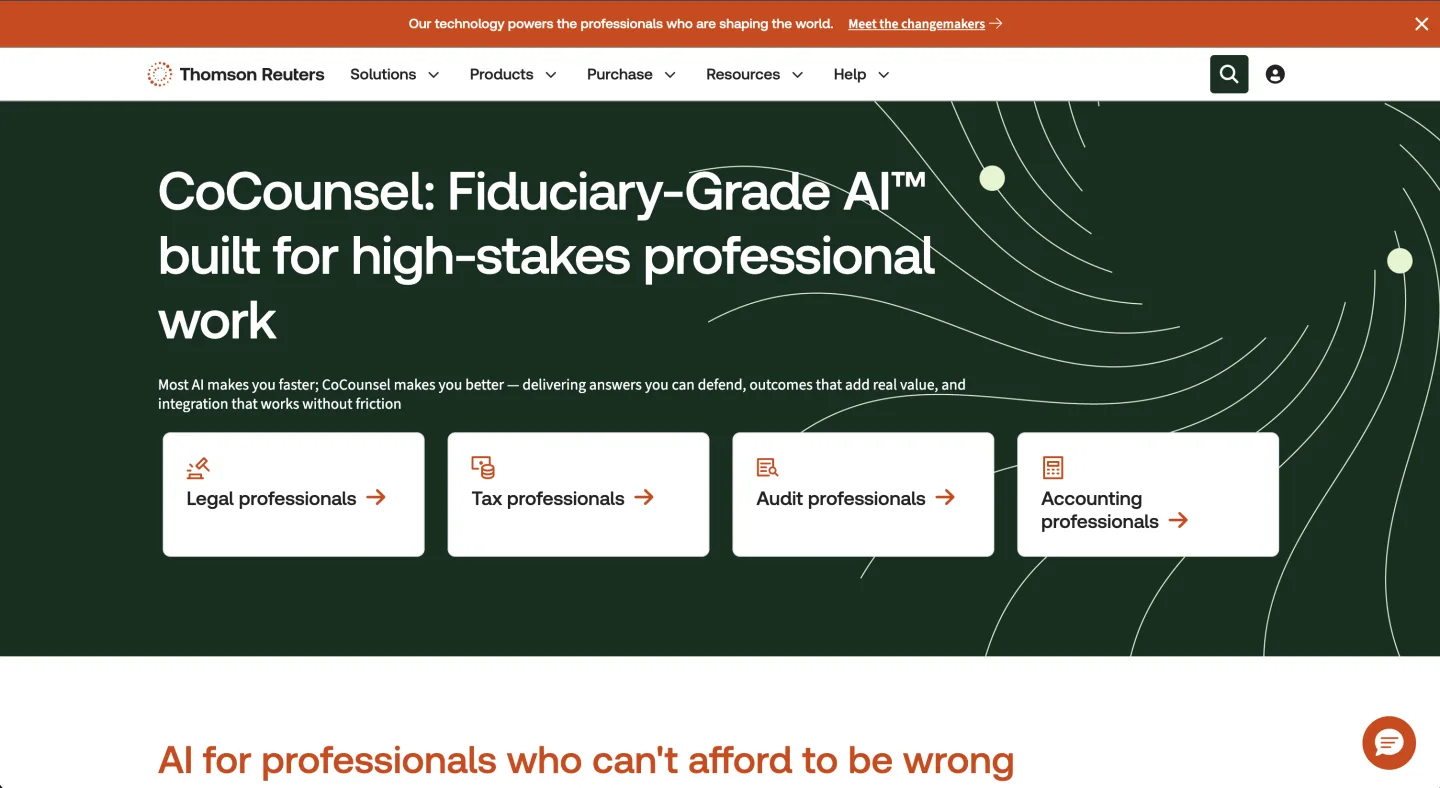
Category: Generalist legal AI with research. At a glance: $225 to $400+ per user/mo (more with Westlaw underneath; sales-led) · Best for teams already in the Thomson Reuters stack. CoCounsel is Thomson Reuters' assistant, with skills for document review, contract analysis, and summarizing a data set alongside legal research. In 2026 it tends to arrive bundled with Westlaw.
What's good
- Document-review and contract-analysis skills handle a first pass across a deal set.
- Backed by Thomson Reuters, so vendor durability is not the worry it is with smaller names.
Where it falls short
- It still fabricates citations on the research side, so verification stays non-negotiable.
- The all-in cost climbs once a Westlaw subscription sits underneath the assistant.
What users say: Users like the ease and time savings, and warn it still makes up citations, so check every output. The verdict tracks our in-house roundup.
Bottom line: Buy it if you already pay for Westlaw and want a deal assistant on top. Skip it if you do not, since you would buy a research platform just to get the assistant.
7. Ivo: best for Word-native redlining of deal documents

Category: Contract review. At a glance: Quote-based / on request · Sales-led, demo required · Best for redlining ancillaries against a playbook. Ivo redlines contracts against your playbook right inside Microsoft Word and Google Docs. For the ancillary documents and the repeat clause work in a deal, it is fast and clean.
What's good
- Surgical redlining in Word and Google Docs against your playbook and prior agreements (per Ivo's site, checked June 2026).
- Benchmarks a deal against your previously negotiated contracts.
- States it does not train on customer data, with SOC 2 and ISO 27001, which matters for deal files.
Where it falls short
- It is a review tool, not a diligence engine. It is not built to extract one provision across a 500-contract data room.
- Onboarding leans on Ivo's team rather than a self-serve setup.
What users say: In-house reviewers describe a clean, fast playbook reviewer with team-led onboarding. See our deeper take in best AI contract review tools, compared.
Bottom line: Buy it if redlining the ancillaries and repeat clauses is your bottleneck. Skip it if your job is mass diligence extraction, where a specialist wins.
8. LegalOn: best for review with the reasoning shown

Category: Contract review. At a glance: Quote-based / on request (Individual plans publish a price elsewhere; Teams custom) · Sales-led · Best for repeat clause review with attorney-built playbooks. LegalOn pairs AI review with attorney-built playbooks and shows the reasoning behind each redline. Its Vault also extracts intelligence across a contract set.
What's good
- 50-plus attorney-built playbooks kept current as laws change, with custom positions in plain English (per LegalOn's site, checked June 2026).
- The reasoning layer behind each redline is the part review skeptics tend to trust.
- A Vault that turns a contract set into extractable intelligence, useful on the lighter diligence end.
Where it falls short
- It is a review platform, not a deal workbench. Drafting the agreement and managing the matter live elsewhere.
- No clean self-serve path for teams, and Teams pricing is custom.
What users say: Buyers value the attorney-authored guidance and the shown reasoning. Treat marketing testimonials as marketing until your own pilot says otherwise.
Bottom line: Buy it if your recurring pain is re-reading the same clauses and you want the reasoning shown. Skip it if you need one place to draft, review, and run the deal.
Comparison table
| Tool | Price (per user/mo) | Job it owns | Access | Data-room link | Word redline | Trains on your data | Best for |
|---|---|---|---|---|---|---|---|
| Kira (Litera) | Quote-based | Diligence extraction | Sales-led | Yes | No | Confirm in MSA | High-volume contract diligence |
| Vaquill AI | Self-serve | In-house workbench | Self-serve | No | Yes | No (policy) | In-house team running deals |
| Emma Legal | Per-file | Red-flag diligence | Sales-led | Yes | No | Confirm in MSA | Fast go/no-go on a target |
| Intralinks DealCentre AI | Quote-based | Data room + Q&A | Sales-led | Native | No | Confirm in MSA | Sell-side deal management |
| Harvey | $1,200 to $2,000+ | Firm-side deal assistant | Sales-led | Vault | Yes | Confirm in MSA | Large firms, agentic work |
| CoCounsel | $225 to $400+ | Generalist + research | Sales-led | Limited | Limited | Confirm in MSA | Teams already on Westlaw |
| Ivo | Quote-based | Playbook redline | Sales-led | No | Yes | No (vendor states) | Redlining ancillaries |
| LegalOn | Quote-based | Playbook review | Sales-led | No | Yes | Confirm in MSA | Repeat clause review |
A note on the data columns. Where we write "confirm in MSA," the vendor's public posture is reasonable. The binding answer still belongs in your contract. For M&A files, a training-exclusion clause and a clear data-residency answer are table stakes, not extras.
How to pick, in one pass
Name the bottleneck, then buy the tool that owns it.
- Hundreds or thousands of target contracts to read? A diligence specialist (Kira) or a red-flag engine (Emma Legal) is the buy. A generalist assistant will be slower.
- Running the sell side and answering buyer questions? A data room with AI inside it (Intralinks DealCentre AI) owns that workflow.
- Redlining the purchase agreement and ancillaries against a position? A Word-native playbook reviewer (Ivo, LegalOn) is faster than a generalist for repeat clause work.
- A large firm with high deal volume? Harvey is built for that scale. CoCounsel fits if you already live in Westlaw.
- An in-house team running deals alongside the rest of the week? A workbench keeps drafting, review, and the deal's documents in one place, with lighter diligence covered by a document matrix.
The deal sets the tool, not the other way around.
If your week is mostly contract review rather than deals, start with best AI contract review tools, compared. To turn a redlined position into reusable language, see our clause library.
The fastest way past a feature grid is to run a workbench on a contract set you already know cold. Drop it in, rerun the same review across the stack, and check the redline in your own Word track changes.
FAQ
What is the best AI tool for M&A due diligence?
For high-volume diligence, a specialist that extracts provisions across hundreds of contracts wins. Kira does this with data-room integration, and Emma Legal produces a ranked red-flag report on a whole data room. A generalist assistant is slower at the same extraction job.
Can AI build my disclosure schedules?
AI speeds the input, not the judgment. A diligence tool finds the contracts that breach a representation, and you decide which become disclosures. The structure of the schedule itself is covered in drafting the schedule of exceptions in an M&A deal.
Is Harvey or CoCounsel better for M&A?
Harvey is built for large firms running high deal volume, with a vault and agentic workflows. CoCounsel fits teams already paying for Westlaw who want an assistant on top. Both are generalists, so for mass diligence extraction a specialist still beats them.
How accurate is AI for contract diligence?
It varies by tool, and every output needs a human check. Tools that cite the source clause cut verification time. Generalist assistants and research tools can still fabricate citations, so verify before you rely on any extraction or summary.
Is it safe to use AI on confidential M&A documents?
It can be, if the vendor is built for it. Look for no training on your data, clear data residency, and a posture the counterparty accepts in the room. Get the training-exclusion clause in the MSA. Treat any vendor that will not commit in writing as a no.
Do I need a separate tool for the data room?
Often, yes. Diligence engines and review tools analyze documents but are not secure data rooms. Some rooms now have AI inside them, like Intralinks DealCentre AI, which answers buyer questions with citations. Match the tool to whether your job is analysis or running the room.
What is the cheapest AI tool for an M&A lawyer?
Most M&A-grade tools are sales-led with quote-based pricing. A few self-serve workbenches publish a flat per-seat price well below the sales-led names. Emma Legal uses per-file pricing that scales with the data room. The diligence incumbents and firm-side platforms run higher and gate pricing behind a demo.
Should an in-house team buy a diligence specialist or a workbench?
If your deals are large and frequent enough to fill a specialist, buy one (Kira, Emma Legal). If you run occasional or mid-size deals beside the rest of the week, a workbench covers drafting and review in one place. Buy for the share of your year deals actually take.
Last updated: June 2026.
New legal AI guides, weekly.
Further Reading
Best AI Tools for Banking and Finance Lawyers
Read postBest AI Tools for Employment Lawyers
Read postBest AI Tools for Procurement Lawyers
Read postBest AI Tools for Real Estate Lawyers
Read postBest AI Tools for Startup and VC Lawyers
Read postWhat Lawyers Want From Legal AI in 2026: A 534-Lawyer Study
Read post
Co-Founder & CEO · Attorney
Arshita leads product and strategy at Vaquill, building the legal AI suite that solo, small-firm, and in-house US lawyers use to run a matter end to end.