Banking and finance legal work is a regulatory-accuracy problem before it is anything else. A tool that cannot cite primary regulation reliably is disqualified on the substance, however polished its drafting. So the first screen is not which interface feels nice. It is which tool grounds answers in current law and shows you the source.
That stance sorts the field fast. A wrong cross-default trigger, a missed UCC filing window, or a fabricated securities rule is not a typo. It moves money and risk. Pick for regulatory depth and verifiability, then weigh review speed and drafting polish second.
Past that, match the tool to the task. Credit and loan review needs a contract engine. Securities and Dodd-Frank questions need grounded research. Covenant tracking needs extraction. No single tool does all three at a level you can sign your name to.
TL;DR
- Regulatory accuracy is the gate, not a feature. Finance work runs on UCC filings, Dodd-Frank, securities rules, and ISDA terms. A tool that cannot cite primary regulation reliably is disqualified, however good its drafting. Pick for grounding and a checkable citation trail.
- Match the tool to the task, not the brand. Loan and credit review wants a contract engine. Securities and regulatory questions want grounded research. Covenant tracking wants extraction. Buying one for the others is the costly mistake.
- No single tool covers the whole banking week. Most in-house teams pair a research and statutes layer with a contract-review or drafting engine. Plan for two tools, not one.
- Deep specialized databases still matter. For securities-heavy desks, a regulatory research platform with current statutes and rules beats a generalist assistant. Know when the database earns its cost over a chat box.
- Self-serve is rare at this level. Most finance-grade tools are sales-led and gate pricing behind a demo, so factor procurement time into the cost.
What is the first screen when choosing a finance legal AI tool?
This is the practice-tools roundup. For the broader buyer's guide, see the best legal AI tools for in-house counsel. For the fintech regulatory map (SEC, FINRA, OFAC, 50-state), read legal AI for fintech in-house counsel, which covers a different angle than the tools below.
What banking and finance counsel actually need from AI
Strip the marketing and the job has four parts. Get clear on which one owns your week before you shop.
- Regulatory accuracy. Securities rules, banking regs, and the UCC change often, and they cross-reference each other, with a layer of supervisory and staff guidance underneath: OCC, FDIC, Federal Reserve, and FinCEN letters on the bank side, CFTC staff letters on the derivatives side. You need answers grounded in current primary law with linked citations you can open, not a confident summary you have to re-research.
- Contract review at volume. Credit agreements, facility documents, security agreements, ISDA schedules, and guarantees all run on playbook terms. The tool has to flag a cross-default, a financial covenant, or a non-market cap and show its reasoning.
- An audit trail. When a regulator or an auditor asks how a position was reached, "the AI said so" is not an answer. You want a record of what was reviewed, what changed, and on what authority.
- Security that survives diligence. You handle material non-public information and counterparty data. SOC 2, data residency, and a no-training guarantee belong in the contract, not a marketing FAQ.
How to choose: four criteria
Run every finalist through the same four checks. They sort the field faster than any feature demo.
- Regulatory coverage. Does its corpus include current US securities rules, banking regulations, the UCC, and the statutes your deals touch? Ask how often it updates. Money-transmission and lending statutes amend constantly, so a stale corpus is a liability.
- Accuracy and citations. Does it ground answers in primary law and link the citation? Run the grounding test below. A linked, checkable cite is the difference between a research tool and a chatbot.
- Security and data posture. SOC 2 Type II at a minimum, US data residency where you need it, and a written no-training clause. For MNPI-heavy desks, confirm who at the vendor can read your files.
- Audit and review depth. Can it show its work, keep a record, and produce a redline in real Microsoft Word track changes? The redline is the deliverable you send to a counterparty, so test the export.
The regulatory-grounding test
Run one question through any tool before you trust it. Pick a point with a hard number you can verify. Regulation W is a good probe: what is the cap on a member bank's covered transactions with a single affiliate?
A generalist chatbot tends to answer fast and clean. It will say something like "around 10 percent of capital" in a tidy paragraph. There is no section number and nothing to open. Sometimes the figure is right. Sometimes it is stale or invented. You cannot tell which, and that is the problem.
A tool grounded in primary regulation answers the same question and points you to the source. The single-affiliate cap is 10 percent of the bank's capital stock and surplus, at 12 CFR 223.11. The aggregate cap across all affiliates is 20 percent, at 12 CFR 223.12. You click through and read the section yourself.
That gap is the whole job. A confident answer that cites nothing checkable is worth less than a slower answer with a section you can open. "Sounds right" carries no weight here. "Here is the source" is the deliverable.
The best AI tools for banking and finance lawyers
A privilege note sits above the list. "Do not train on your data" is the floor, not the finish line. For each finalist, ask where your files live, for how long, and which sub-processors touch the text.
1. Bloomberg Law AI: best for securities and regulatory research depth
Category: Legal research platform with AI. At a glance: Quote-based / on request (bundled with a Bloomberg Law subscription) · Sales-led, demo required · Best for securities-heavy desks.
Bloomberg Law is the research database transactional and securities lawyers reach for, now with an AI assistant layered on top. Its strength is depth: regulatory tracking, securities materials, and primary-law coverage built for finance work.
What's good
- Deep regulatory and securities content, with tracking tools that watch rule changes across agencies.
- The AI assistant sits on a paid, current research library rather than the open web.
- Established vendor, so this is not a runway gamble.
Where it falls short
- No published price, and the assistant arrives bundled, so the all-in cost climbs once the underlying subscription is counted.
- It is a research platform, not a contract-review or drafting workbench, so transactional paper lives elsewhere.
What users say: We could not find clean, citable peer forum discussion of the AI layer specifically, so treat vendor claims as marketing until your own pilot says otherwise. (Bloomberg Law's AI product page returns a 403 to automated checks but loads live in a browser.)
Bottom line: Buy it if your week is heavy securities and regulatory research and you want database depth. Skip it if your day is contract drafting and review, where a workbench fits better. We cover this in our own Bloomberg Law AI review.
2. Vaquill AI: best for grounded research plus drafting in one place
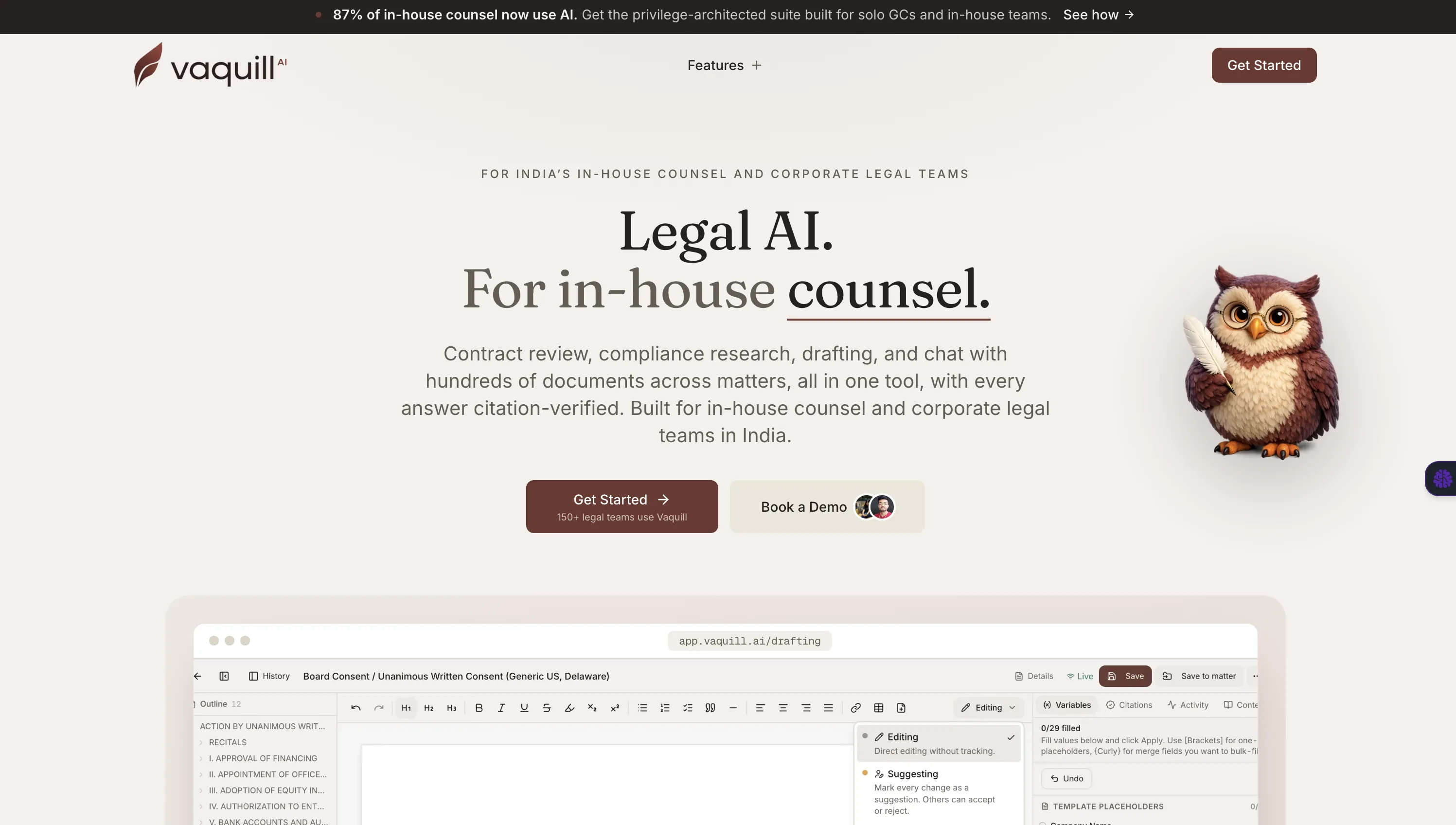
Category: In-house legal AI suite (research, statutes, drafting, review). At a glance: Self-serve, published pricing (sign up to see the latest) · Self-serve, 7-day trial · Best for lean in-house finance teams.
This is the all-in-one workbench entry on the list, and the one we build, so weigh the disclosure above. It pairs a US statutes and CFR research layer with drafting and review, so a regulatory question and the agreement it touches sit in one place.
What's good
- Research grounded in US statutes and the CFR, with linked citations you can open and check, covering the US Code and 50-state codes.
- Drafts and redlines credit and finance agreements in real Word track changes, where each edit is a discrete suggestion you accept or reject.
- Self-serve, published pricing (our own, no seat minimum), with a do-not-train-on-your-data policy.
Where it falls short
- Lighter on deep, specialized securities and case-law databases than the research-first incumbents. If your desk lives in dense SEC no-action letters and appellate securities case law, you will want a dedicated database alongside it.
- The public statutes API is statutes-only, not a case-law feed, so build plans should scope to that.
What users say: It is newer than the incumbents, so there is little outside forum talk yet, and we will not invent a verdict it has not earned.
Bottom line: Buy it if your week mixes regulatory questions with finance drafting and you want one grounded place to do both. Skip it if you need a deep specialized securities or case-law database as your primary research source.
3. CoCounsel: best for teams already living in Westlaw
Category: Legal research with AI. At a glance: $225 to $400+ per user/mo reported (more once Westlaw sits underneath) · Sales-led, demo required · Best for teams already on Westlaw.
CoCounsel is Thomson Reuters' AI assistant. For finance research grounded in Westlaw, it summarizes regulatory changes, searches statutes and case law, and supports drafting. In 2026 it tends to arrive tied to Westlaw rather than as a clean standalone.
What's good
- Users like it for ease, time savings, and grounded search across statutes and case law.
- Backed by Thomson Reuters, so the vendor is not going anywhere.
- A natural add-on if you already pay for Westlaw research.
Where it falls short
- It still makes up citations and can run thin on appellate material, so verify everything.
- The all-in cost climbs once a Westlaw subscription sits underneath it.
What users say: Users like the ease and search but warn it still fabricates citations and is thin on appellate material, so a human check stays non-negotiable.
Bottom line: Buy it if you already pay for Westlaw and want an assistant on top. Skip it if you do not, since you would be buying a research platform just to get the assistant.
4. Legora: best for large banking legal teams on shared matters

Category: Firm-side AI platform (banking solution). At a glance: $300 to $800 per user/mo (bundle plus add-ons; also a metered credit model) · Sales-led, demo required · Best for large, collaborative teams.
Legora markets a banking and finance solution covering loan documentation review, regulatory monitoring, and trade-finance checks against UCP 600. Its calling card is shared AI, where many people work the same matter at once. In June 2026 Legora moved its Agent Pro product to consumption-based pricing (source: legora.com).
What's good
- A finance-specific workflow: extract covenants and conditions from facility agreements, compare term sheets against market standards, and check letters of credit.
- Strong research, review, and drafting in one collaborative tool, cheaper per user than the top firm-side name.
- Integrates with iManage and SharePoint, with ISO 27001 and SOC 2 certifications.
Where it falls short
- Built and priced for large firms and departments, so it is heavy for a two-person finance team.
- Reliability and retention chatter has dogged the rollout, and answer quality can drop on very long documents.
What users say: Buyers report a rough rollout and retention gaps in legal-tech forums, alongside praise for the collaborative model. Verify the finance claims in your own pilot.
Bottom line: Buy it if you are a large banking legal team that needs live collaboration on shared deals. Skip it if you are lean, since the price and the reliability caveats both apply.
5. Ivo: best for fast, Word-native credit agreement review

Category: Dedicated contract review. At a glance: $500 per user/mo · Sales-led, demo required · Best for teams reviewing finance paper at volume.
Ivo is the leaner, faster name in playbook review. For a desk processing facility agreements, security documents, and NDAs against a standard, it redlines quickly and is easy to pick up.
What's good
- A genuine AI reviewer with playbook redlining, used by teams at Uber, Shopify, and Canva.
- Backed by a $55 million Series B at a valuation near $530 million.
- Word-native, so the redline lands where transactional lawyers work.
Where it falls short
- Onboarding leans on Ivo's team rather than self-serve setup.
- It is a point tool, so research, matters, and regulatory work all live elsewhere.
What users say: G2 reviewers describe a real AI reviewer with playbook redlining that is easy to learn, while flagging team-led onboarding and the occasional inaccuracy.
Bottom line: Buy it if credit and finance contract review is your dominant job and you have someone to run onboarding. Skip it if you want a self-serve trial or one place to run your whole function.
6. LegalOn: best for review where you want the reasoning shown

Category: Dedicated contract review. At a glance: $550/mo (Individual, billed annually; Teams custom) · Sales-led, demo required · Best for teams re-reading the same finance clauses.
LegalOn pairs AI with attorney-authored guidance and inserts redlines with a reasoning layer behind them. For finance lawyers who re-read the same indemnity, cap, and covenant language, the explanation matters as much as the flag.
What's good
- The reasoning layer is the part review skeptics tend to come around on.
- Long track record at the review job, with attorney-authored playbook guidance rather than raw model output.
- More than 8,000 customers and a well-funded vendor.
Where it falls short
- It is a review tool, not a workbench, so matters, broad drafting, and regulatory research live elsewhere.
- No self-serve path, and Teams pricing is custom.
What users say: We found mostly vendor testimonials rather than independent peer discussion, so treat the buzz as marketing until your own pilot confirms it.
Bottom line: Buy it if your recurring nightmare is re-reading the same finance clause and you want the reasoning shown. Skip it if you need one place for drafting, matters, and research together.
7. Spellbook: best for transactional finance lawyers who live in Word
Category: Dedicated contract review (Word-native drafting and redline). At a glance: $500 per seat/mo (base; six-month minimum on enterprise) · Sales-led, demo required · Best for a desk that never leaves Word.
Spellbook lives inside Microsoft Word, built for drafting and redlining where transactional lawyers spend their days. Its own roundup names loan and ISDA agreements as core use cases, with zero-data-retention security.
What's good
- The Word add-in gets singled out for praise by transactional lawyers.
- Handles multi-document workflows and regulatory playbooks for finance paper.
- Drafting and redlining happen in the tool people already use all day.
Where it falls short
- It still slips in the odd wrong citation, so check before you rely on it.
- Built for transactional work, which makes it thin for litigation or deep regulatory research.
What users say: Transactional lawyers rate it among the best-liked add-ins and praise the Word integration, though reviews also flag wrong citations and weak litigation support.
Bottom line: Buy it if your day happens in Word and your work is transactional finance. Skip it if you do litigation or cannot live with a six-month minimum term.
8. V7 Go: best for high-volume loan and covenant extraction

Category: Document automation applied to lending (not a legal-specific tool). At a glance: Quote-based / on request · Sales-led, demo required · Best for extracting terms across a portfolio.
V7 Go automates extraction and monitoring of loan terms: interest rates, payment schedules, collateral, and financial covenants. It is built for credit analysts and risk managers more than lawyers. Still, a finance legal team drowning in covenant tracking may find it useful.
What's good
- Strong at structured extraction across a stack of facility agreements.
- SOC 2 Type II certified, with integrations to loan systems like nCino and Loan IQ.
- Built for volume, so it scales to portfolio-level review.
Where it falls short
- Not a legal tool: no playbook redlining, no privilege-aware context, no legal research.
- Pricing is not published, so plan for a sales process.
What users say: As a general document-automation platform, its reviews come from operations and risk teams rather than legal forums, so judge it on a finance-document pilot of your own.
Bottom line: Buy it if your problem is extracting and tracking terms across many loans. Skip it if you need legal review, drafting, or grounded regulatory research, which it does not do.
Comparison table
| Tool | Price (per user/mo) | Category | Access | Free trial | Citations / grounding | Word-native redline | Best for |
|---|---|---|---|---|---|---|---|
| Bloomberg Law AI | Quote-based (bundled) | Research platform | Sales-led | No | Grounded in paid library | No | Securities and regulatory depth |
| Vaquill AI | Self-serve | In-house suite | Self-serve | Yes (7-day) | Linked statutes / CFR cites | Yes | Grounded research plus drafting |
| CoCounsel | $225 to $400+ | Research + AI | Sales-led | No | Grounded in Westlaw | Limited | Teams already on Westlaw |
| Legora | $300 to $800 | Firm-side platform | Sales-led | No | Grounded in regulatory text | Yes | Large banking teams |
| Ivo | $500 | Contract review | Sales-led | No | Playbook-based | Yes | Credit agreement review |
| LegalOn | $550 (annual) | Contract review | Sales-led | No | Attorney-authored guidance | Yes | Review with reasoning shown |
| Spellbook | $500 (base) | Contract review | Sales-led | No | Playbook-based | Yes | In-Word transactional work |
| V7 Go | Quote-based | Doc automation | Sales-led | No | Extraction only | No | Loan and covenant extraction |
Every price here is vendor-published or sourced inline where a third party publishes it, checked June 2026, so verify the current number before you buy. Where a vendor publishes nothing, we write "quote-based / on request" rather than guess. For deeper price math, see our legal AI pricing benchmark.
Why not just use ChatGPT or Copilot?
This is the first question most finance teams ask. General models fail the grounding test above: they predict plausible text instead of citing the rule. Three gaps make them wrong for privileged finance work.
- They fabricate citations. A general model invents a securities rule or a case cite that looks real. Even paid legal tools have measurable hallucination rates, so an ungrounded chatbot is a non-starter for a regulatory question.
- No Word-native redline. They give a chat summary of edits, not a track-changes file you can accept, reject, and send. The redline is the deliverable.
- No audit trail or data posture. Consumer terms are not built around MNPI, privilege, or a no-training guarantee.
Keep the general model for non-legal drafting. Move the privileged finance work onto a grounded tool.
How to actually decide
Run the grounding test first, then shop. Ask each finalist a Reg W or securities question with a number and see if it hands you a section to open. Any tool that cannot do that is out, whatever its drafting looks like. Then name the part of your week that hurts most and buy the matching category. If it is securities and regulatory questions, buy research depth: Bloomberg Law or CoCounsel where you already have the library, or a grounded statutes-plus-drafting suite if you want one bill. If it is credit and finance contract review, buy a review engine: Ivo, LegalOn, or Spellbook for in-Word work. If it is covenant tracking across a portfolio, an extraction tool like V7 Go does the job.
Most lean finance teams end up with two: a research and statutes layer plus a review or drafting engine. That is normal. The mistake is buying one and forcing it to do the other.
In banking work, "shows the source" beats "sounds right" every time.
For the broader category framework, read the best AI tools for lawyers and our AI contract review tools compared. To see how a workbench drafts finance clauses in Word, try it on a contract clause you know cold.
FAQ
What is the best AI tool for banking and finance lawyers?
There is no single best tool, because the work splits into research, review, and extraction. Match the tool to the task: a grounded research layer for securities and regulatory questions, a contract engine like Ivo or LegalOn for credit agreements, and an extraction tool for covenant tracking. Most in-house teams run two tools.
Can AI review loan and credit agreements accurately?
It can speed up the first pass, flag cross-defaults and financial covenants, and extract key terms, but accuracy is never guaranteed. Tools report high extraction rates on structured terms, yet a human still has to confirm every flagged provision. Treat AI as a fast first reviewer, not the final word.
Is AI safe for handling material non-public information?
It can be, if the vendor is built for it: SOC 2 Type II, US data residency where you need it, a written no-training clause, and clear limits on who can read your files. Get those terms in the MSA, not a marketing FAQ. Treat any vendor that will not commit in writing as a no.
Does legal AI handle securities and Dodd-Frank questions?
The research-grounded tools do best here, because they answer from current primary law with linked citations. A general chatbot will fabricate rules. Even with a grounded tool, securities work demands that you open and verify every cited authority before relying on it.
Do I need a specialized regulatory database, or is a generalist tool enough?
If your desk lives in dense securities materials, no-action letters, and appellate case law, a deep database like Bloomberg Law earns its keep. If your week mixes regulatory questions with finance drafting, a grounded statutes-plus-drafting suite may cover it for less. Know which side your work sits on before you buy.
How much do AI tools for finance lawyers cost?
Self-serve options publish per-seat pricing well below the sales-led names. The sales-led contract-review names sit near $500 to $550, firm-side platforms run $300 to $800, and research platforms are often quote-based and bundled with a subscription. Price to your real volume, not the brand.
Do these tools train on my data?
Some do by default, so ask first. Get a training-exclusion clause in the MSA, in writing, never a marketing FAQ. For MNPI-heavy work, also confirm data residency, retention limits, and sub-processors.
Which finance AI tools work inside Microsoft Word?
Ivo, LegalOn, Spellbook, and the all-in-one workbenches all produce real Word track-changes redlines for finance paper. Research-leaning tools tend to give a chat summary instead, which is not the same deliverable. If sending a clean redline to a counterparty is your job, test the Word export before you buy.
Last updated: June 2026.
New legal AI guides, weekly.
Further Reading

Co-Founder & CEO · Attorney
Arshita leads product and strategy at Vaquill, building the legal AI suite that solo, small-firm, and in-house US lawyers use to run a matter end to end.