The top contract management vendors for Fortune 500 legal teams are Icertis, SirionLabs, Ironclad, SAP Ariba, DocuSign CLM, Agiloft, Conga, LinkSquares, and Evisort. The three Gartner Magic Quadrant Leaders (Icertis, SirionLabs, Ironclad) anchor the high end; the rest fit specific stacks. All are quote-based at enterprise scale, with license budgets that typically start near $50,000 a year and climb into six figures.
A Fortune 500 legal department signs more contracts in a quarter than most firms see in a decade: master agreements, SOWs, NDAs, licenses, leases, and a long tail of one-off vendor paper. Every vendor below promises to tame that volume. The harder question is what happens when you need to read across the whole portfolio at once.
TL;DR
- The enterprise-grade CLMs that survive a Fortune 500 procurement cycle are Icertis, SirionLabs, Ironclad, SAP Ariba, DocuSign CLM, Agiloft, Conga, LinkSquares, and Evisort. Each owns the contract lifecycle: intake, redline, e-sign, repository, obligations.
- Icertis, SirionLabs, and Ironclad are the three Gartner Magic Quadrant Leaders for CLM (Gartner, 2025). SirionLabs rates 4.7 on Gartner Peer Insights, Icertis 4.6, and Icertis was named a 2026 Gartner Customers' Choice with 92 percent recommending it.
- Every one of them is quote-based at enterprise scale. License budgets typically start near $50,000 a year and run into six figures, with implementation often another $50,000 to $200,000 (Sirion pricing breakdown, 2026). No vendor publishes a rate card.
- A CLM is built for the lifecycle of contracts you author. The recurring F500 pain is extraction across contracts you inherit: M&A diligence, portfolio review, post-acquisition obligation sweeps.
- That extraction job is a different product category (Hebbia Matrix, Kira, Legora's tabular review), and it rides alongside a CLM rather than replacing it.
- The Document Matrix is the extraction grid we run. Rows are documents, columns are the fields you want, and every cell links to a source quote with page and paragraph citation. Up to 200 documents per matrix, credit-based. We do not sell a CLM; this layer sits beside one.
- For full mid-market pricing and the "do you even need a CLM" question, see our 2026 CLM breakdown. This post is enterprise-only.
Which three vendors are the Gartner Magic Quadrant Leaders for CLM?
Part of our document tools, redline, and matrix guide series.
For related document-tools coverage, see Contract Lifecycle Management in 2026: Ironclad, DocuSign, ContractWorks, and the AI Layer Eating the Bottom and Cost-Effective CLM Platforms Compared: What Small and Mid Firms Pay in 2026.
How we picked
We considered the dozen-plus CLMs that show up in enterprise procurement and Gartner's coverage, then kept the nine that a Fortune 500 legal department actually shortlists. We judged each on what matters at that scale: contract volume in the hundreds of thousands, integration depth against SAP, Oracle, and Salesforce, regulatory configurability per business unit, and the real implementation cost beyond the license. We did not rank them one through nine, because the right CLM depends on your system of record, not on a leaderboard.
Pricing is quote-based for every enterprise CLM, so per-vendor we say "Quote-based / on request." For the overall budget bands we cite named, dated sources: enterprise CLM licenses typically start near $50,000 a year and reach six figures, with implementation often $50,000 to $200,000 (Sirion contract-management cost breakdown, 2026).
For sentiment we use Gartner Peer Insights ratings (verified reviews from named buyers) where they exist, and we say so plainly where a vendor has little genuine peer discussion. We invent nothing.
What "Fortune 500 scale" actually changes
A 12-lawyer in-house team and a Fortune 500 legal department are not buying the same product even when the logo on the invoice is identical. At F500 scale, four things move from "nice to have" to "deal-breaker."
Volume. You are managing hundreds of thousands of active contracts, not thousands. Repository search has to stay fast at that count, and migration of the existing archive becomes its own project.
Integration depth. The CLM has to read and write against SAP, Oracle, and Salesforce, plus the DMS and the procurement stack. A connector that "supports Salesforce" in a demo and one that survives a real revenue-recognition workflow are different animals.
Regulatory configurability. A bank, a pharma company, and a defense contractor each have approval matrices, retention rules, and audit requirements that the platform must encode without custom code per business unit.
Implementation cost. The license is often the smaller line. Enterprise CLM rollouts run months and pull in legal ops engineers, a systems integrator, and a paid customer-success engagement.
If you are evaluating from a smaller in-house seat, our mid-market CLM comparison covers the cheaper end and the question of whether you need a full CLM at all. The rest of this post assumes you do.
The enterprise CLMs
All are quote-based at enterprise scale, with no published rate card. Pricing is custom by definition, set by volume, modules, and seat count, so we do not print a figure for any of them. The budget bands in the methodology block above apply across the field.
Icertis
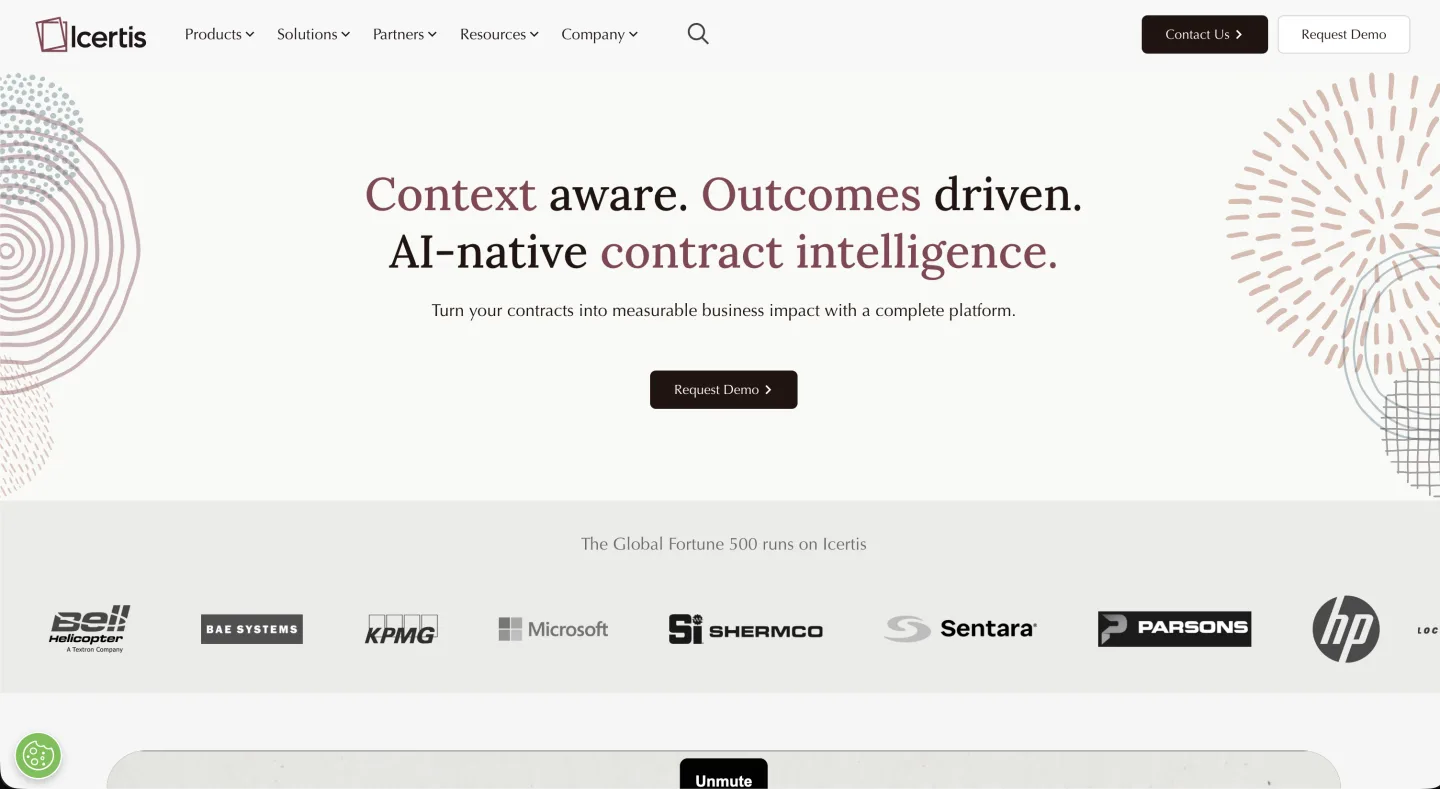
At a glance: Quote-based / on request · Sales-led · Best for the largest, most regulated procurement and supply-chain buyers.
Icertis is the closest thing the market has to a default for Fortune 100 procurement contracting. It leans hard into the "contract intelligence" framing, and it expects you to staff for it. It is a Gartner Magic Quadrant Leader for CLM (Gartner, 2025) and counts Microsoft and Johnson & Johnson among its named customers.
What users say: Icertis holds a 4.6 rating on Gartner Peer Insights and was named a 2026 Gartner Customers' Choice for CLM with 92 percent of reviewers recommending it. Reviewers consistently flag that the modular pricing climbs as you add capabilities.
What's good
- Deep SAP and Salesforce integration that matches how F500 procurement actually runs.
- Obligations, compliance, and risk surfaced from the repository, not bolted on later.
- Built to hold hundreds of thousands of active contracts without falling over.
Where it falls short
- It is heavy. Implementation is a real program, and it rewards a dedicated contract-operations team.
Bottom line: If you are a regulated Fortune 100 buyer with the headcount to run it, Icertis is the safe default. Smaller teams will drown in the configuration.
SirionLabs
At a glance: Quote-based / on request · Sales-led · Best for procurement and supplier-contract buyers who want obligation tracking and post-signature analytics first.
SirionLabs is the post-signature and supplier-management specialist, and the analysts back it. It has been a Gartner Magic Quadrant Leader for CLM for four straight years (Gartner, 2025) and ranked highest in Gartner's 2024 Critical Capabilities. Its pitch is reading obligations, risk, and performance out of contracts you already hold, which maps cleanly to how a Fortune 500 procurement org thinks.
What users say: SirionLabs carries a 4.7 rating on Gartner Peer Insights (82 reviews), the highest of the three Leaders, with buyers citing supplier-obligation tracking and analytics as the standout.
What's good
- AI-native extraction of obligations, risk, and performance metrics across large portfolios.
- Strong on the buy side: supplier governance, SLA tracking, and renewal risk.
- Built for volume, with named enterprises managing millions of contracts on it.
Where it falls short
- The sell-side authoring and self-serve experience is less polished than Ironclad's.
- Like every Leader at this tier, it is a staffed program, not a quick deploy.
Bottom line: If your pain is governing inherited supplier paper and proving obligations, SirionLabs is the strongest fit. If your daily job is authoring outbound sell-side contracts, weigh Ironclad first.
Ironclad
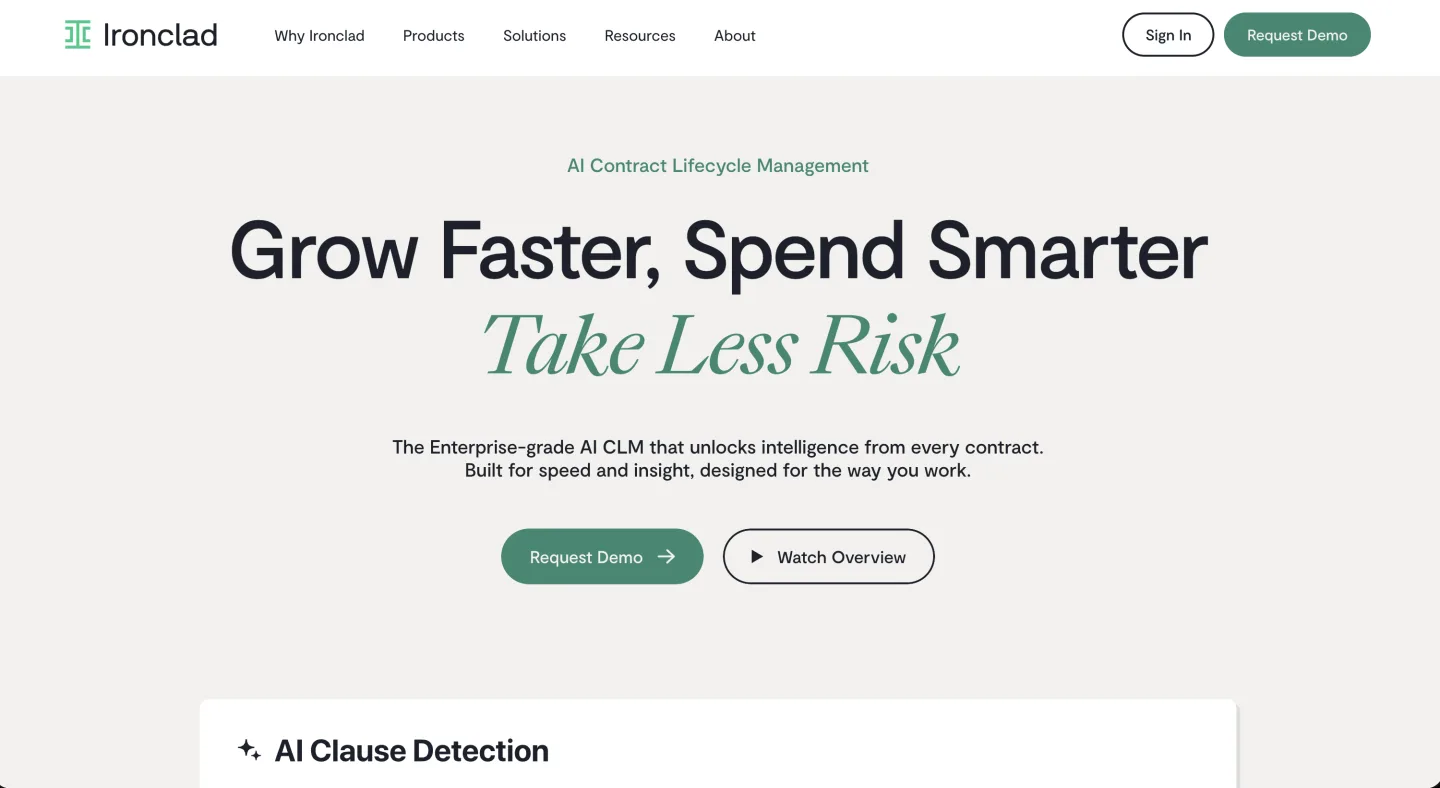
At a glance: Quote-based / on request · Sales-led · Best for enterprise legal ops teams that want modern authoring and have the engineering hours to configure it.
Ironclad is the one that feels built this decade. It keeps absorbing the AI-startup feature set, and the polish shows. It is the third Gartner Magic Quadrant Leader (Gartner, 2025), and its strength is workflow design without code.
What users say: Reviewers praise the ease of use and Salesforce integration, but two gripes recur across buyer write-ups: a steep learning curve with slow implementation, and a high total cost of ownership once you count the seats and the rollout (LinkSquares enterprise CLM roundup, updated Jan 2026).
What's good
- Clause-level redlining, workflow design, and post-signature analytics in one place.
- Mature Salesforce, Slack, and Microsoft 365 integrations.
- A modern authoring experience that legal ops teams actually like using.
Where it falls short
- Per-seat pricing can punish a company with a large non-legal workforce touching the platform.
- Implementation typically runs 8 to 16 weeks with a paid success engagement.
Bottom line: Ironclad is the strongest modern choice if you have the engineering hours to set it up. Just model the seat math before you sign, because the headcount touching it drives the bill.
DocuSign CLM
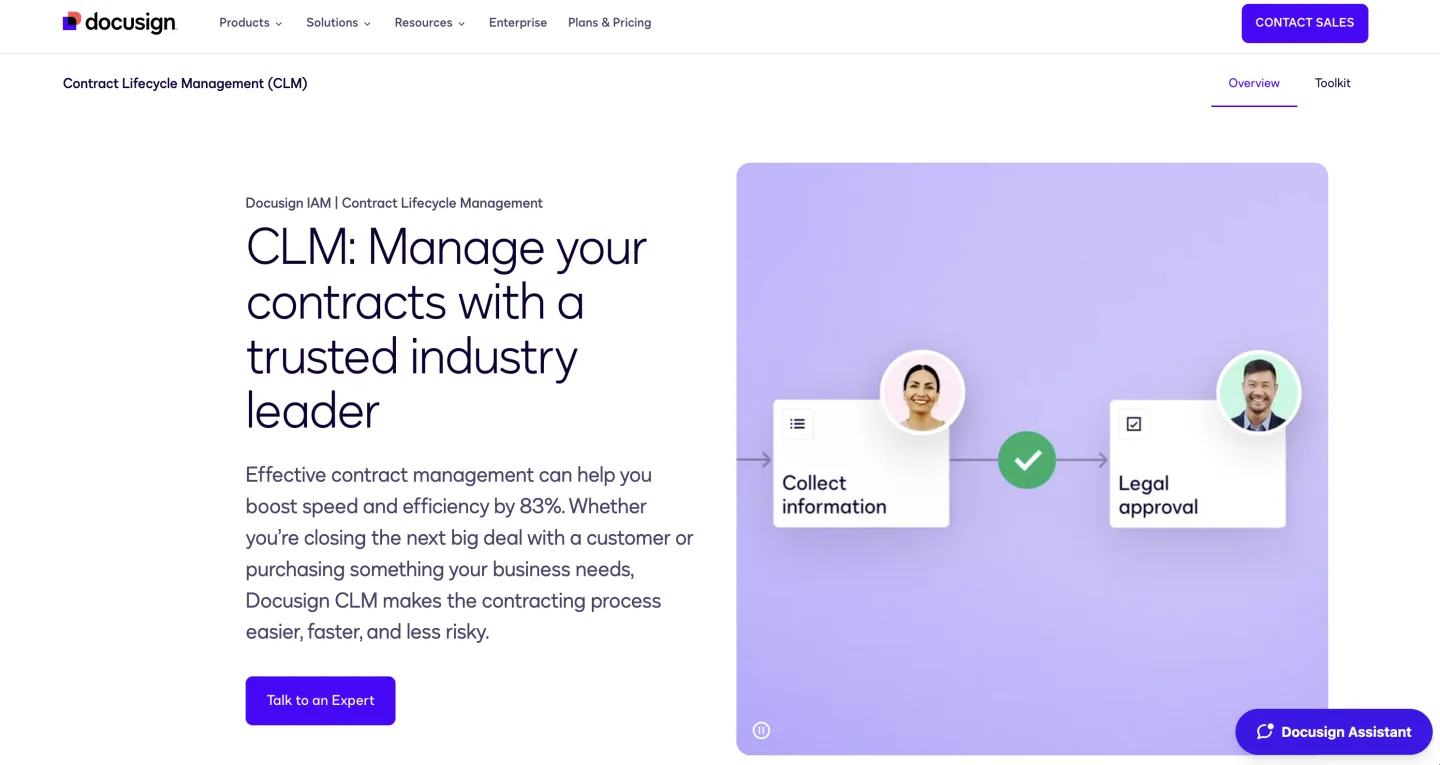
At a glance: Quote-based / on request · Sales-led · Best for companies already deep on DocuSign e-signature that want a single-vendor stack.
DocuSign CLM wins on one thing: it already lives where your counterparties sign. If most of your paper closes in DocuSign, the signature-to-repository path is clean.
What users say: The recurring buyer critique is that the platform is stitched together from acquisitions, which shows up as an uneven user experience and long implementation cycles (LinkSquares enterprise CLM roundup, updated Jan 2026).
What's good
- Native e-signature integration that needs no third-party connector.
- A single-vendor stack if you are already standardized on DocuSign.
- A tidy signature-to-repository handoff most rivals bolt on.
Where it falls short
- The pricing rewards add-on modules, so the all-in number tends to drift above the first quote.
Bottom line: Buy it if you are already a DocuSign shop and want one throat to choke. As a standalone CLM for a non-DocuSign stack, it is a weaker fit.
SAP Ariba
At a glance: Quote-based / on request · Sales-led · Best for SAP-run enterprises that want sourcing, procurement, and contracts in one stack.
SAP Ariba is the procurement-native pick for SAP shops. Contracts live next to sourcing and supplier collaboration, so if your spend already runs through Ariba, the contract module closes a loop rather than adding a silo. It shows up in nearly every enterprise CLM roundup for exactly that reason.
What users say: Buyer commentary frames it as powerful for procurement-led contracting but heavy and SAP-centric, so legal-led teams outside the SAP world rarely choose it standalone (recurring theme across the Whatfix and LinkSquares enterprise roundups, 2026). We did not find a standalone Gartner Peer Insights CLM score to cite, so we keep this modest.
What's good
- Sourcing, supplier management, and contracts in one procurement stack.
- Native fit for organizations already standardized on SAP.
Where it falls short
- It is a procurement platform first; the legal-authoring and redline experience trails the CLM specialists.
- Heavy to deploy and most valuable only inside the SAP ecosystem.
Bottom line: If SAP is your system of record and procurement owns contracting, Ariba is the obvious consolidation play. A legal-led department outside SAP will be happier with Icertis, SirionLabs, or Ironclad.
Agiloft
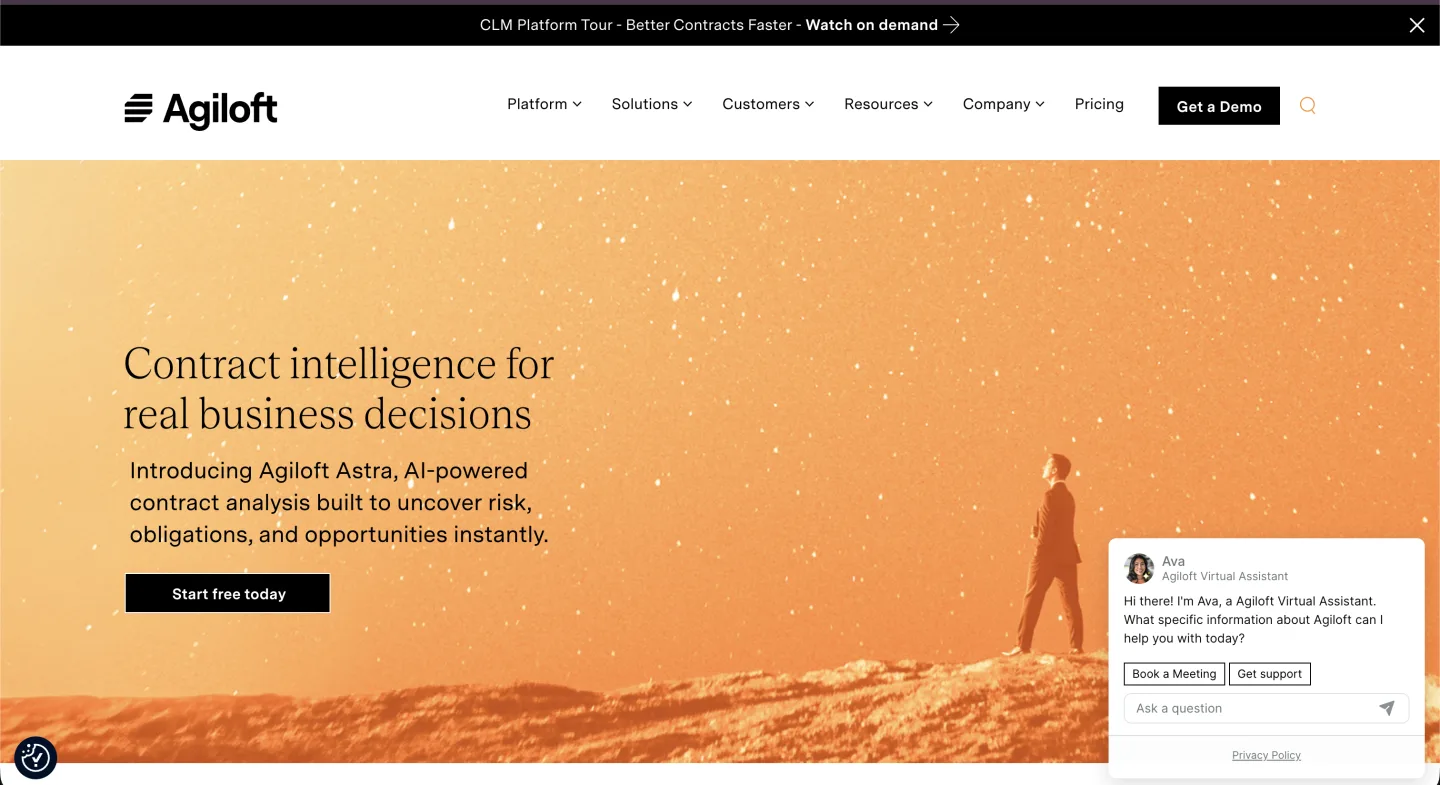
At a glance: Quote-based / on request · Sales-led · Best for buyers who want deep configurability without writing code.
Agiloft is the rules-engine pick. You can encode approval matrices that would need custom development elsewhere, all without a developer. It is one of the oldest CLMs on the market, and that maturity shows in how much it can be configured.
What users say: Reviewers single out the no-code configurability and enterprise-grade security; the flip side they raise is a utilitarian interface and a learning curve next to newer rivals (Whatfix and Spendflo CLM roundups, 2026).
What's good
- No-code configurability that handles unusual approval and compliance logic.
- Rules engines flexible enough for a business unit with idiosyncratic requirements.
- Less developer dependence than rivals once it is set up.
Where it falls short
- A real learning curve, and a UI more utilitarian than Ironclad's.
Bottom line: For a regulated unit with weird rules, Agiloft's flexibility is worth the rougher interface. If your needs are standard, you are paying for power you will not use.
Conga
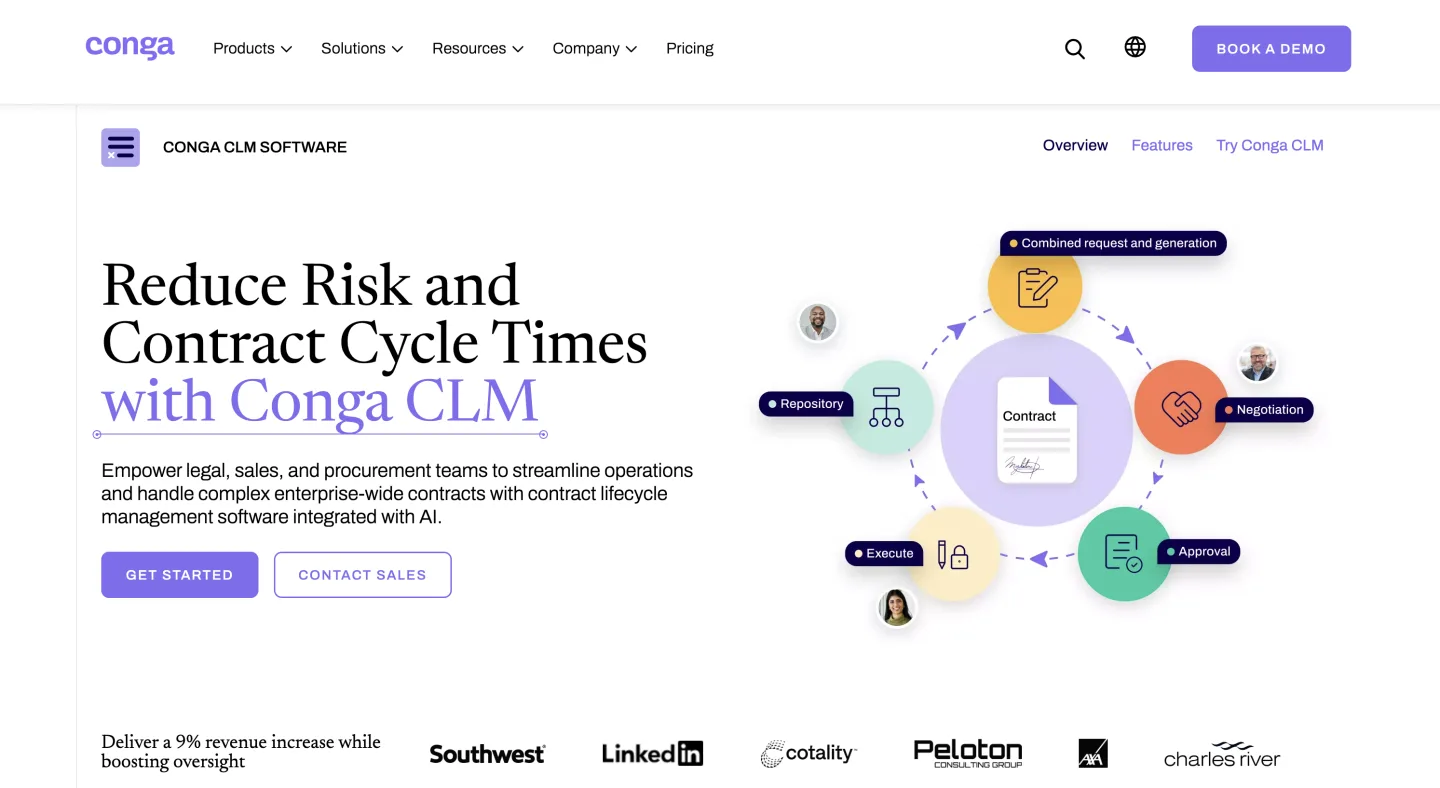
At a glance: Quote-based / on request · Sales-led · Best for Salesforce-centric organizations where CPQ and contracting share a workflow.
Conga grew up inside the Salesforce ecosystem, and that is its whole pitch. When contracting lives next to quoting and revenue ops, it fits.
What users say: Buyers like the template and workflow flexibility and the native DocuSign and Adobe Sign hooks; the common gripe is a clunky interface that hurts adoption and pushes teams back into shadow contracting (LinkSquares enterprise CLM roundup, updated Jan 2026).
What's good
- A natural fit when contracting sits beside CPQ and revenue operations.
- Tight Salesforce alignment for teams already built on that platform.
Where it falls short
- As a standalone CLM for a non-Salesforce-first legal department, it competes less cleanly against Icertis, SirionLabs, and Ironclad.
Bottom line: If Salesforce is your system of record, Conga is an easy yes. Outside that world, the Leaders make more sense.
LinkSquares
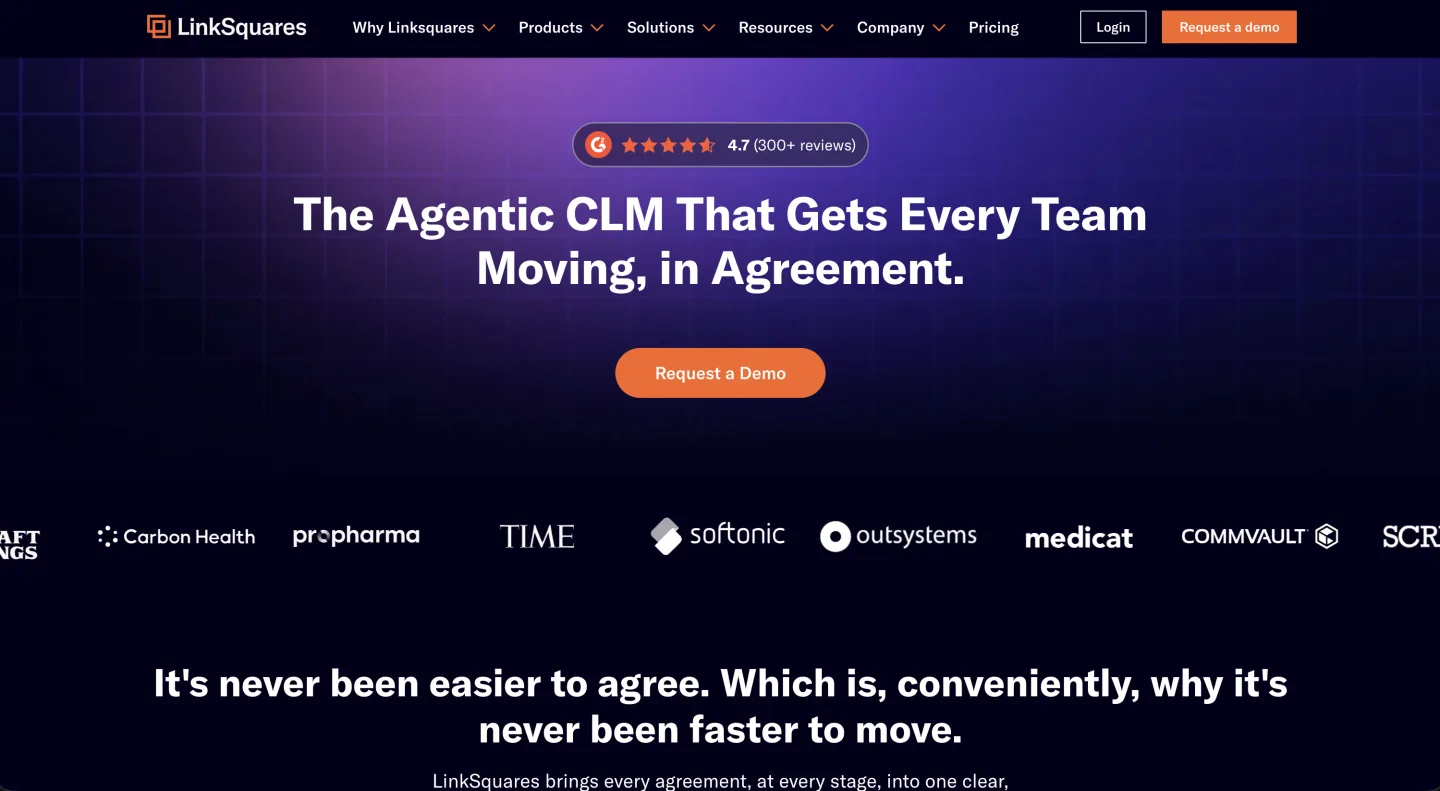
At a glance: Quote-based / on request · Sales-led · Best for in-house legal teams that want AI-assisted CLM with a lighter rollout than the Leaders.
LinkSquares is the in-house legal pick, built around the corporate legal team rather than procurement. It pitches enterprise-grade AI with a consumer-grade interface, which lands with legal departments that found the Leaders too heavy.
What users say: Its own positioning concedes it is optimized for in-house corporate teams over independent firms; reviewers value the AI extraction and the cross-team hub, and it sits in the enterprise CLM tier on G2 (LinkSquares, updated Jan 2026).
What's good
- AI extraction and a search-first repository aimed at legal, not procurement.
- Faster to stand up than the heavyweight Leaders.
Where it falls short
- Less suited to deep procurement and supplier-governance workflows than Icertis or SirionLabs.
Bottom line: For an in-house legal team that wants AI CLM without a multi-quarter program, LinkSquares is worth a look. Procurement-led buyers should still shortlist the Leaders.
Evisort
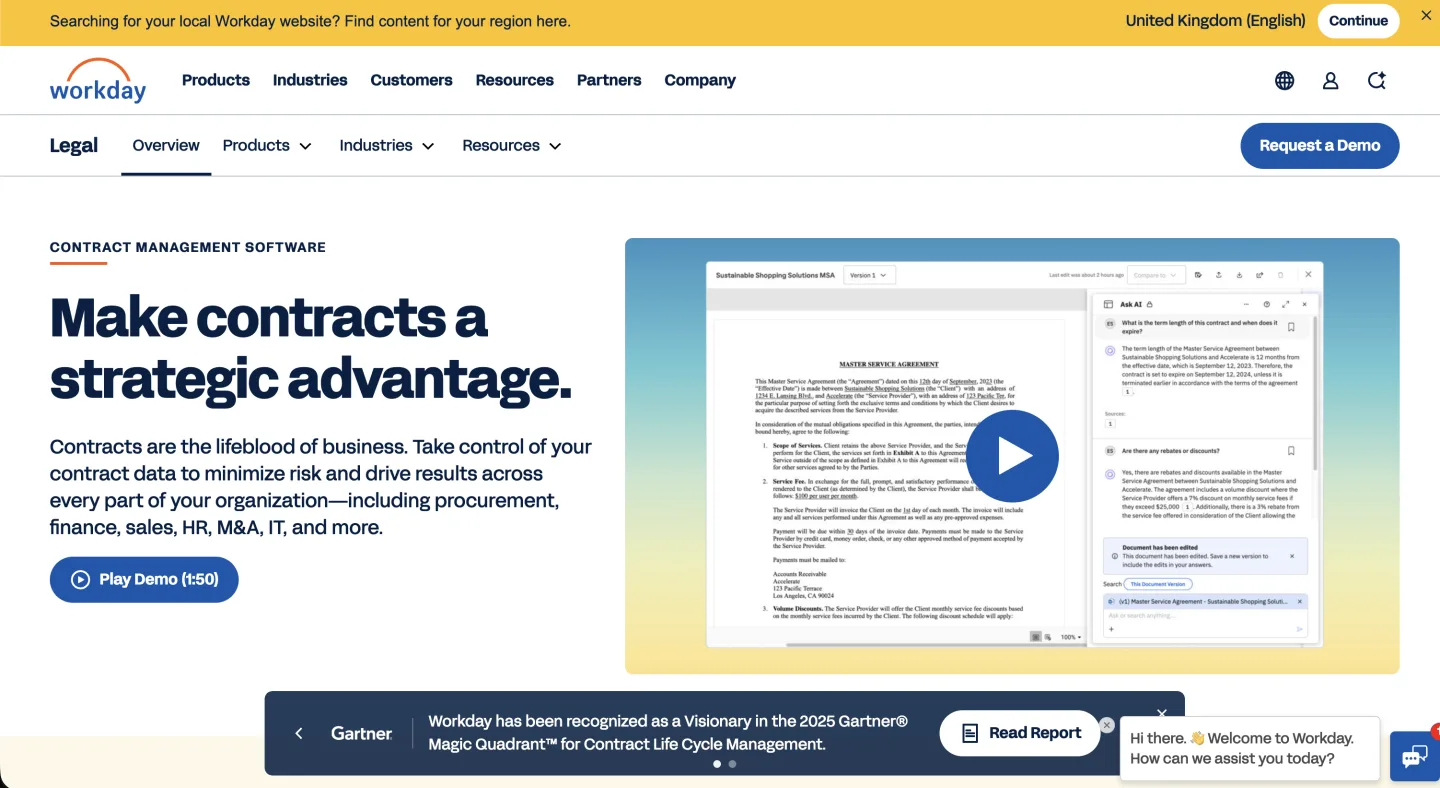
At a glance: Quote-based / on request · Sales-led · Best for buyers who want AI-first contract data extraction layered onto the lifecycle.
Evisort is the AI-extraction-forward CLM (now part of Workday after the 2024 acquisition). Its roots are in machine-read contract data, so it appeals to teams that want analytics and metadata extraction as a first-class feature, not an add-on.
What users say: Buyers cite the AI extraction and search as the draw; because it has folded into Workday, evaluate roadmap and integration direction before a long contract (recurring theme across 2026 CLM roundups; we found no standalone Gartner Peer Insights CLM score to cite).
What's good
- Strong AI extraction and contract analytics out of the box.
- Useful when you want the data layer to lead the lifecycle.
Where it falls short
- Post-acquisition roadmap and Workday alignment are the open question for a standalone CLM buyer.
Bottom line: If AI-read contract data is your priority, Evisort earns a slot on the list. Confirm the Workday integration path fits your stack before signing.
The honest summary
| Vendor | Pricing | Gartner Peer Insights | Strongest fit |
|---|---|---|---|
| Icertis | Quote-based / on request | 4.6 (MQ Leader) | Largest, most regulated F500 buyers |
| SirionLabs | Quote-based / on request | 4.7 (MQ Leader) | Supplier governance, obligation tracking |
| Ironclad | Quote-based / on request | MQ Leader | Modern authoring + legal ops engineering |
| SAP Ariba | Quote-based / on request | Not scored here | SAP-run procurement-led contracting |
| DocuSign CLM | Quote-based / on request | Not scored here | Existing DocuSign e-sign shops |
| Agiloft | Quote-based / on request | Not scored here | No-code configurability, unusual rules |
| Conga | Quote-based / on request | Not scored here | Salesforce-centric revenue workflows |
| LinkSquares | Quote-based / on request | Not scored here | In-house legal, lighter rollout |
| Evisort | Quote-based / on request | Not scored here | AI-first extraction (now Workday) |
Ratings are from Gartner Peer Insights (verified buyer reviews, accessed June 2026); Magic Quadrant positions are from Gartner's 2025 CLM Magic Quadrant. There is no single winner here. The right CLM is the one whose integration story matches your stack of record and whose configuration model your team can actually maintain.
The job a CLM does not do well
Every CLM above is optimized for the lifecycle of contracts your organization authors. Intake a request, generate from a template, redline against a playbook, route for signature, file the executed copy, track the obligations. That loop is the product.
The recurring Fortune 500 pain sits outside that loop. It shows up as questions like these:
- You just acquired a company. What are the change-of-control, assignment, and termination provisions across its 600 vendor contracts, and which ones trigger on close?
- Regulatory exposure shifted. Which of your 4,000 active MSAs cap liability below the new threshold, and what does each cap actually say?
- Diligence is due Friday. Pull governing law, IP assignment, and most-favored-nation clauses across this data room.
None of that is a workflow you author. It is reading across a portfolio you inherited, extracting the same fields from every document, and being able to defend each answer.
CLM repositories were not built for it: they store contracts and surface a handful of metadata fields, while ad hoc defensible extraction across hundreds of inherited documents is a different product category.
That category is the tabular-review or "matrix" job: Hebbia Matrix, Kira (now bundled into Litera), and Legora's tabular review all compete here. Hebbia Matrix is enterprise-only and quote-based, and we cover Legora's tabular review and enterprise AI pricing in our Harvey, Legora, and CoCounsel pricing breakdown.
This is not single-document chat or NDA triage (we evaluate that single-doc workflow separately in our NDA triage guide); it is structured extraction across the whole set.
Document Matrix: the extraction layer beside your CLM
The Document Matrix does exactly this job, and it is designed to sit alongside whichever CLM you run rather than replace it.
The pattern is the spreadsheet every lawyer already knows. Rows are documents, and columns are the questions you want answered from each one. You define the columns once, point it at the set, and extraction runs across every row in parallel.
What it does at F500 scale:
- Up to 200 documents per matrix. Drag in PDFs, DOCX, TXT, or XLSX. Scanned PDFs auto-route through OCR. Files populate as rows as they finish, so a large set streams in rather than blocking.
- Every cell is citation-grounded. Each answer links to the exact source passage with page and paragraph citation. Click a cell to read the supporting quote in context. The prompts are quote-grounded: the model has to return the supporting text alongside the extracted value.
- "Not found" instead of a guess. A cell where the document does not address the column returns "Not found," not a confident hallucination. For a GC who has to stand behind the answer, that distinction is the whole game.
- Prebuilt column templates. NDA, SaaS MSA, commercial lease, employment agreement, and IP license sets ship as starting points. Customize columns per matter (free-text questions like "Is there a change-of-control clause?" or structured date, currency, and multi-select types) without retraining anything.
- Credit-based, with guardrails. Each cell costs 1 to 3 credits depending on complexity, with a pre-run cost estimate and per-matrix caps so a 200-document run cannot run away from you.
The extraction quality comes from the same document-scoped retrieval that powers the platform's chat surface. For the case-law and statutory questions that come up mid-review, the in-product research surface is grounded in 8M+ US federal and state court opinions plus the full U.S. Code and CFR.
A concrete use: a 500-contract M&A diligence that runs 6 to 8 weeks of associate time today becomes a defined matrix run, with each cell traceable to its source. Lease abstraction, 20 to 50 data points across 200 leases, drops from roughly two weeks of paralegal time to about two days.
The CLM still owns the lifecycle, and Document Matrix owns the portfolio read.
The governance question every F500 GC asks
Before any extraction tool touches a contract portfolio, the General Counsel asks the right question: can we defend the output, and are we protecting client and counterparty confidences?
The relevant standard is ABA Formal Opinion 512 (July 2024), which addresses generative AI under the Model Rules. It covers competence, confidentiality, communication, candor, supervision, and fees. It is explicit on two points: lawyers must verify AI output rather than rely on it blind, and they must protect confidential information.
Citation grounding is how an extraction tool earns a place in that framework. Every Document Matrix cell links to the exact page and paragraph it came from, so verification is a click rather than a re-read across hundreds of documents.
The "Not found" behavior matters too: a tool that declines to answer when the text is silent is one a supervising lawyer can trust.
The confidentiality piece deserves its own diligence, because where your documents go and who can train on them is a procurement question in its own right. The law now recognizes a heightened expectation of privacy in comprehensive digital records (the Supreme Court's reasoning in Carpenter v. United States, 585 U.S. 296 (2018)), which is a useful frame for how seriously to treat a contract corpus.
Apply the same scrutiny to every vendor here: read the security page, the DPA, and the subprocessors list before you sign.
How to actually choose
Run two tracks, not one.
Track one is the CLM. Pick on integration depth against your system of record and on whether your team can maintain the configuration. Icertis, SirionLabs, and Ironclad (the three Gartner Leaders) anchor the high end; SAP Ariba, DocuSign CLM, Agiloft, Conga, LinkSquares, and Evisort fit specific stacks. Use the full pricing matrix and mid-market options to pressure-test the quotes.
Track two is extraction. Decide who handles the portfolio reads the CLM does not: diligence, post-acquisition sweeps, regulatory portfolio reviews. That is where Document Matrix earns its place, and where the citation-grounded, credit-based model makes a six-figure CLM more defensible rather than competing with it.
The mistake is assuming the CLM line item covers both. It rarely does.
FAQ
Who are the top contract management vendors for enterprises?
The enterprise field shortlists Icertis, SirionLabs, Ironclad, SAP Ariba, DocuSign CLM, Agiloft, Conga, LinkSquares, and Evisort. Icertis, SirionLabs, and Ironclad are the three Gartner Magic Quadrant Leaders for CLM (Gartner, 2025); the rest win on a specific stack fit such as SAP, Salesforce, or DocuSign.
Which CLM is the Gartner Magic Quadrant leader?
There are three Leaders in Gartner's 2025 Magic Quadrant for CLM: Icertis, SirionLabs, and Ironclad. SirionLabs has been a Leader for four consecutive years and ranked highest in Gartner's 2024 Critical Capabilities, while Icertis was named a 2026 Gartner Customers' Choice with 92 percent of reviewers recommending it.
How much does enterprise CLM software cost?
Enterprise CLM is quote-based, but the budget bands are sourced. Licenses typically start near $50,000 a year and climb into six figures by volume, modules, and seats, with implementation often another $50,000 to $200,000 (Sirion contract-management cost breakdown, 2026). A $100,000 license can become a $250,000 all-in commitment once you add integration, migration, and admin headcount.
Why are no per-vendor prices listed?
Every enterprise CLM here is quote-based and none publishes a rate card, so any single per-vendor number online is a guess. We cite the overall budget bands from a named, dated source instead, and say "on request" per vendor rather than print a figure we cannot stand behind.
SirionLabs vs Icertis: which should an enterprise pick?
Both are Gartner Leaders aimed at large, procurement-heavy buyers. SirionLabs leans into post-signature obligation tracking and supplier governance and rates 4.7 on Gartner Peer Insights; Icertis is the broad "contract intelligence" default at 4.6 with the largest named-customer roster. Choose SirionLabs if managing inherited supplier paper is the priority, Icertis if you want the widest module set across a regulated enterprise.
Which enterprise CLM is the best?
There is no single winner. Pick on integration depth against your system of record and on whether your team can maintain the configuration. Icertis, SirionLabs, and Ironclad anchor the high end, while SAP Ariba, DocuSign CLM, Agiloft, Conga, LinkSquares, and Evisort fit specific stacks.
Do I still need a separate extraction tool if I have a CLM?
Usually yes. A CLM is built for the contracts you author, not the ones you inherit through M&A or diligence. Portfolio reads across hundreds of inherited documents are a different job, which is where Document Matrix sits alongside the CLM.
New legal AI guides, weekly.
Further Reading
Top 12 Legal Redline Software Tools (2026)
Read postLegal Document Version Control: Which Platforms Track Versions
Read postHow to Build an NDA Playbook Your AI Can Actually Enforce
Read postLegal AI Workflows: How Law Firms Chain Multi-Step AI Tasks in 2026
Read postHow to Compare Documents and Export Clean Redlines (Step-by-Step)
Read postBulk Contract Review: How to Review Many Contracts at Once With a Document Matrix
Read post
Product & Content
The US primary law data API: statutes, regulations, constitutions, court rules, executive orders and agency guidance across 53 US jurisdictions, each section cited and linked to its official source, via REST, MCP or SQL.