Pick CoCounsel if your work runs on case law and you live in the Westlaw world. Pick Harvey if you are a large firm rebuilding how the whole practice works, with budget and procurement to match.
"Which is better" is the wrong question. These two tools chase different buyers. CoCounsel leans into research and the Thomson Reuters ecosystem. Harvey leans into firm-wide transformation for big law. The right question is "which fits the work in front of you," and that has a concrete answer.
This is a feature and fit comparison, checked June 2026. For the dollars-and-cents pricing breakdown, see our Harvey, Legora, and CoCounsel pricing reality post. This one stays on capabilities and who each tool is for.
TL;DR
- CoCounsel is Thomson Reuters' legal AI, sold as CoCounsel Legal. It began as Casetext's AI assistant before Thomson Reuters acquired it in 2023. Its edge is research grounded in Westlaw primary law and Practical Law guidance, with KeyCite citation checks built in.
- Harvey is a frontier-model platform built for large firms and enterprises. Its edge is breadth: Assistant, Vault, Knowledge, and purpose-built Agents that run complex work end to end.
- The split is the buyer. CoCounsel suits litigation and research teams already on the Thomson Reuters stack. Harvey suits big firms transforming how the whole practice works.
- Neither publishes pricing. Both are sales-led and tied to enterprise terms. CoCounsel usually rides on a Westlaw subscription.
- Both run frontier models from OpenAI and Anthropic under the hood, then add grounding, workflows, and security on top. The wrapper is where each one differs.
- Both still need human review. Grounding cuts hallucinations but does not end them, so verify every cite.
Part of our legal AI vendor comparison series.
What is the core split between CoCounsel and Harvey?
How we compared them
We read each vendor's current product pages, checked June 2026, plus third-party reviews, a peer-reviewed accuracy study, and the first major independent legal-AI benchmark (Vals AI, February 2025). We did not run our own side-by-side test here. So capability claims come from the vendors and named studies, and we flag where a number is reported rather than tested. Pricing is hedged on purpose: neither company publishes a public rate card.
CoCounsel vs Harvey at a glance
| Dimension | CoCounsel (Thomson Reuters) | Harvey |
|---|---|---|
| Best for | Research and litigation teams on Westlaw | AmLaw firms and large enterprises |
| Research grounding | Westlaw primary law, Practical Law, KeyCite | Firm knowledge, web, connected sources |
| Drafting | Word add-in, precedent-aware | Assistant and Word, workflow-driven |
| Contract review | Document review and clause extraction | Contract intelligence plus Agents |
| Agents / workflows | Deep Research, agentic workflows | Purpose-built Agents, Workflows |
| Document store | Matter workspaces | Vault for bulk analysis |
| Microsoft 365 | Yes (Word, 365) | Yes (Word, Outlook, SharePoint) |
| Security | SOC 2, ISO 27001, no train-on-data | SOC 2 Type II, ISO 27001, 27701, 42001 |
| Pricing | Quote-based, usually tied to Westlaw | Quote-based, enterprise, seat minimums |
| Self-serve trial | No | No |
Sources: Harvey product page and the CoCounsel Legal page, both checked June 2026.
Independent benchmark: how each scored
Most comparisons on this keyword lean on vibes. There is one hard data point worth citing. In February 2025, Vals AI ran the first major independent legal-AI benchmark, with Legaltech Hub and Cognia, scoring tools against a lawyer control group across seven task types: data extraction, document Q&A, document summarization, redlining, transcript analysis, chronology generation, and EDGAR research.
Both tools finished near the top. Harvey posted the highest overall score and won five of the six tasks it entered (it sat out EDGAR research). CoCounsel entered four tasks and won document summarization outright at 77.2%, ahead of the 50.3% lawyer baseline, and scored 89.6% on document Q&A, the third-highest single score in the study.
| Benchmark metric (Vals AI, Feb 2025) | Harvey | CoCounsel |
|---|---|---|
| Overall ranking | Highest overall score | Second overall |
| Tasks entered | 6 (sat out EDGAR research) | 4 |
| Tasks won | 5 of 6 entered | Document summarization |
| Document summarization | Entered, score not published | 77.2% (study best; lawyers 50.3%) |
| Document Q&A | Entered, score not published | 89.6% (3rd-highest single score) |
Two caveats keep this honest. The study is from early 2025, so both products have shipped many releases since, and LexisNexis withdrew before publication, so it is not a full field. Read it as a directional signal, not a live scoreboard. Source: Legal IT Insider on the Vals AI GenAI benchmark, February 2025. For the accuracy question that a benchmark score does not settle, see our note on legal AI that avoids hallucinating cases.
Research and grounding
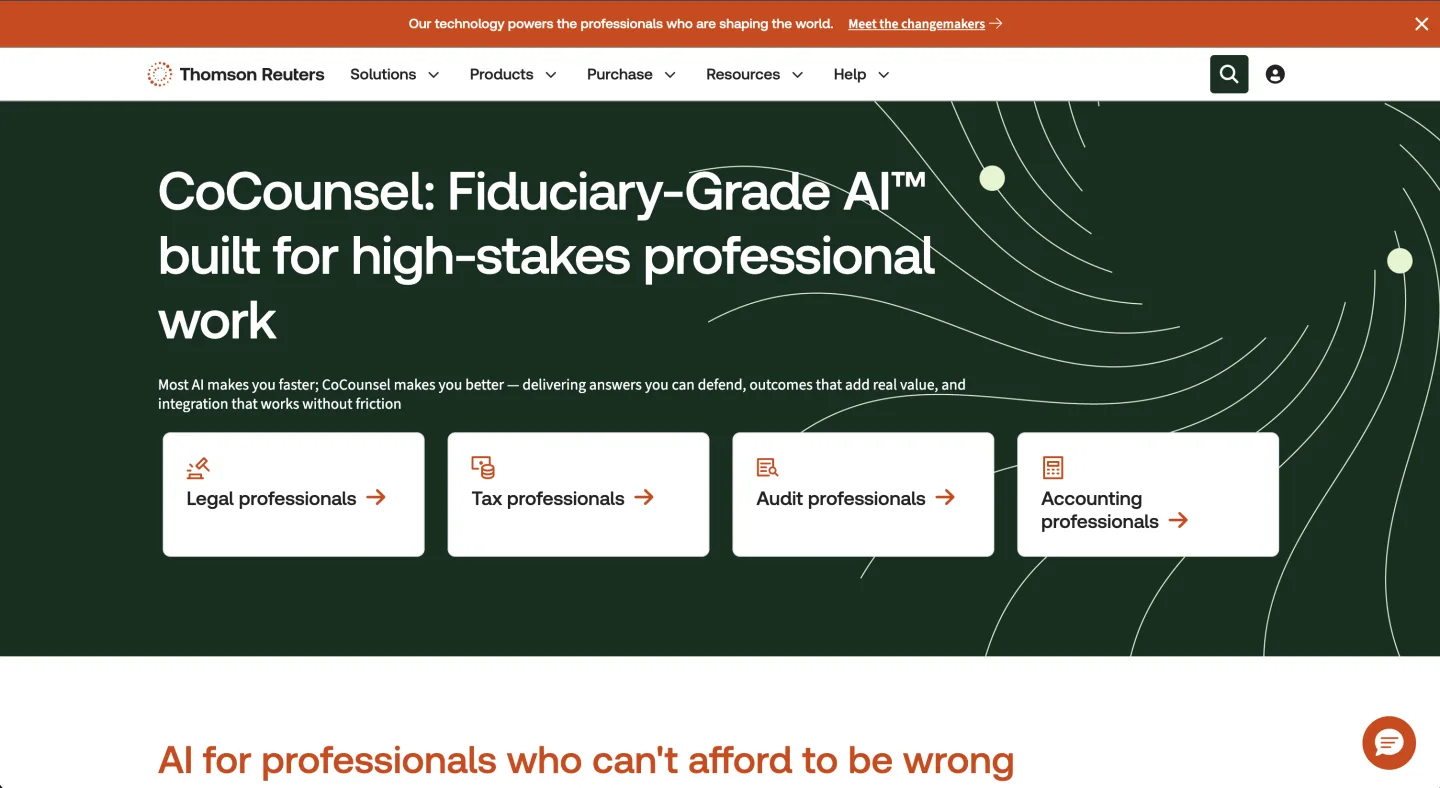
This is the clearest gap between the two, and it favors CoCounsel for research-led work.
CoCounsel reasons from Westlaw primary law and Practical Law guidance, with KeyCite signals on the citations it returns. Thomson Reuters calls it "the only legal AI that reasons using authoritative Westlaw primary law and trusted Practical Law guidance" on its CoCounsel Legal page. Its Deep Research mode plans and runs a multistep research workflow, then links each answer back to source.
Harvey grounds answers too, but in a different place. Its Knowledge product researches across legal, regulatory, and tax domains. Its ecosystem lets you "ground every answer in sources you trust," including firm files. Harvey does not ship its own editorial law database the way Westlaw does. For a litigator who lives in case law and KeyCite, that is a meaningful difference.
The honest caveat applies to both. A peer-reviewed Stanford HAI study found that even grounded legal research tools hallucinate on a real share of queries. Grounding lowers the rate. It does not get you to zero.
Drafting
Both draft inside Microsoft Word, and both are usable for real work. The flavor differs.
CoCounsel's drafting is precedent-aware and litigation-leaning. Its Word add-in searches Practical Law, SEC agreements, and firm precedents without leaving the document. That suits memos, briefs, and clause work where you want the source material one click away.
Harvey drafts through its Assistant and Word integration, and ties drafting into broader workflows. For a firm building a repeatable process, like a standard diligence memo or a regulatory response, Harvey's workflow layer does more of the orchestration. For a single fast first draft, both land in a similar place.
Contract review
Here the tools meet in the middle, with different ceilings.
CoCounsel does document review and contract analysis. It extracts terms, dates, and amounts across a document set, then runs review skills against them. It is solid, content-grounded contract work.
Harvey adds contract intelligence plus its Agents, which run multi-step processes end to end. For high-volume, repeatable review across a large matter, Harvey's agent scaffolding is built to carry more of the load. For a contained review tied to research, CoCounsel holds its own.
Integrations and document storage
Both connect to Microsoft 365. Beyond that, the stacks reflect each buyer.
Harvey integrates with iManage, SharePoint, Outlook, and Microsoft 365, and stores documents in Vault for bulk analysis. That fits a firm with an existing document management system and a security team to wire it up.
CoCounsel lives inside the Thomson Reuters world. It connects Westlaw, Practical Law, Microsoft 365, and document management in one interface, and organizes work in matter-specific workspaces. If you already run on Thomson Reuters, that is a short hop. If you do not, it is a bigger commitment.
Security and compliance
Both are built for enterprise trust, and both say they do not train on your data.
Harvey lists SOC 2 Type II, ISO 27001, ISO 27701, ISO 42001, plus GDPR and CCPA compliance on its product page. The ISO 42001 listing (the AI management standard) is worth noting for buyers who track AI governance.
CoCounsel carries SOC 2 and ISO 27001, with the Thomson Reuters compliance posture behind it. It states your data stays yours and is not used to train models. For most security questionnaires, both clear the bar. Confirm the current certificate list with each vendor during diligence.
What a real evaluation tests
A pilot tells you more than a demo, and a structured 30-day pilot beats an open-ended one. The two pilots look different, and they disappoint in different places.
A CoCounsel pilot tests research first. You run live questions and check whether answers hold up against Westlaw primary law and Practical Law. You compare KeyCite signals to your own read. Then you push document review: load a real document set and check term, date, and amount extraction. Where it disappoints: appellate depth and the odd invented or mis-cited authority, so reviewers end up checking every cite.
A Harvey pilot tests breadth. You drop a diligence set into Vault and run bulk analysis across it. You build a drafting workflow for a repeatable memo, then test an Agent on a multi-step task end to end. Where it disappoints: adoption. The agents are powerful, and busy associates often fall back to the chat box and leave the deeper workflows unused.
Procurement asks the same things of both. Where does data live, and who is a subprocessor? Do you train on our files? What are the SOC 2 and ISO certificates? What are the contract term, the seat minimum, and the renewal uplift? Get those answers in writing before the pilot ends, not after you sign.
Pricing, in brief
Neither company publishes a public price, and both sell through a sales motion. We will not restate the full math here. The short version, checked June 2026:
- CoCounsel usually rides on a Westlaw subscription, so the real cost is the Westlaw seat plus the AI layer. One reported configurator figure puts a solo on Westlaw plus CoCounsel near $639 per user per month on a one-year term (pricing reality post, citing Costbench, June 2026). Third-party estimates put the incremental CoCounsel layer near ~$100 to $200 per seat per month on top of Westlaw (AI Vortex estimate, 2026). Treat both as reported estimates, not quotes you will get.
- Harvey is enterprise, seat-based, with annual terms and reported seat minimums that put it out of reach for small teams. Third-party estimates land it near ~$150 to $300 per seat per month on annual enterprise terms (AI Vortex estimate, 2026), with one competitor page citing roughly $40,000 per year for 10 seats (Spellbook, 2026). No figure here is a published rate.
Want the per-seat ranges, the Westlaw bundle math, seat minimums, and Year-1 total cost with sources? Read our Harvey, Legora, and CoCounsel pricing reality post and the legal AI pricing benchmark.
CoCounsel: honest pros and cons
For a deeper look, see our honest CoCounsel review.
Where it wins
- Research grounding. Westlaw primary law, Practical Law, and KeyCite signals are a real edge for case-law work.
- Scale and trust. Thomson Reuters reported CoCounsel passing 1 million users across 107 countries in February 2026. The brand clears procurement easily.
- Verifiable answers. Linked citations and a visible reasoning path make output easier to check.
Where it falls short
- Tied to Westlaw. Most of the value assumes a Westlaw subscription, so the all-in cost and lock-in are higher than the AI line item suggests.
- No self-serve trial. You go through a Thomson Reuters quote and procurement cycle to evaluate it.
Harvey: honest pros and cons
For a deeper look, see our honest Harvey review. If the price is the sticking point, we track Harvey alternatives for in-house teams too.
Where it wins
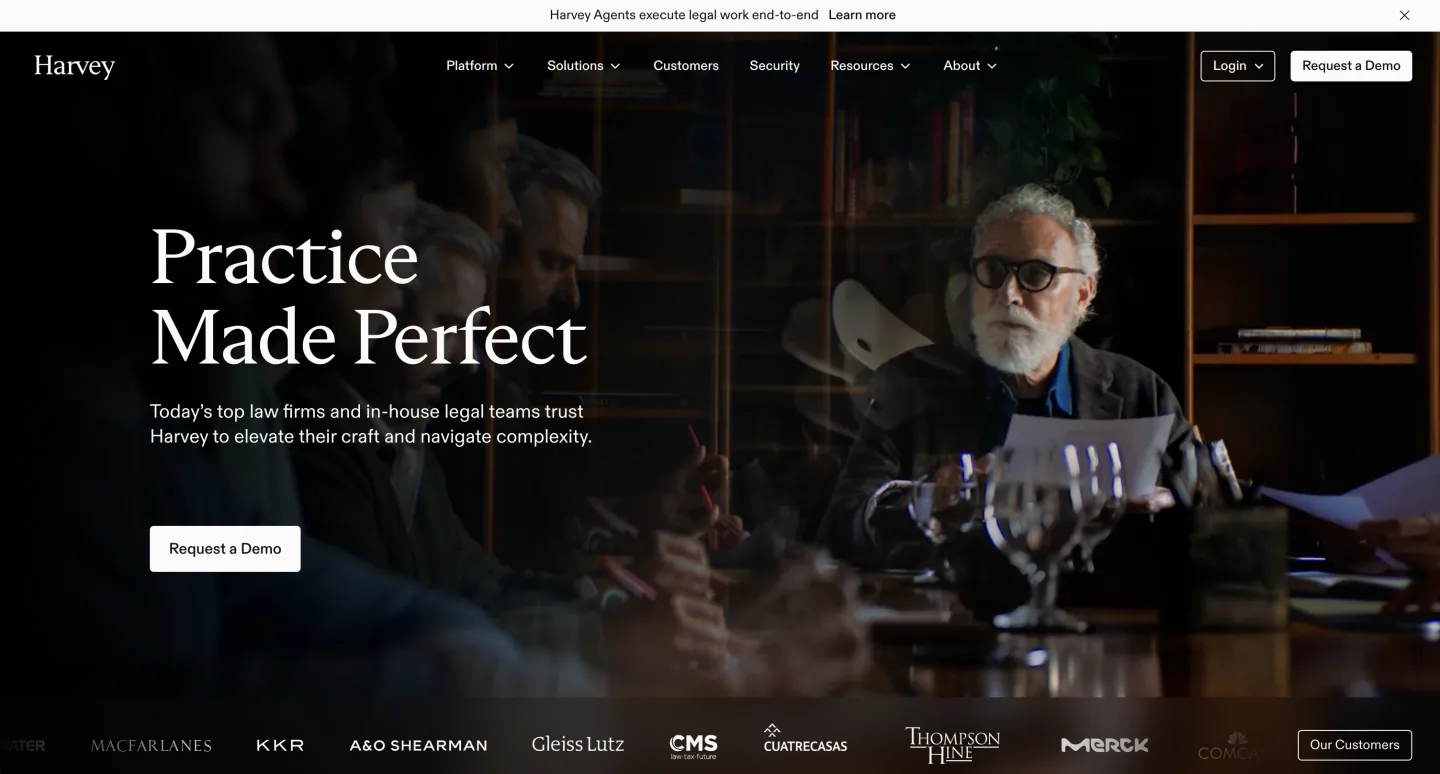
- Breadth and agents. Assistant, Vault, Knowledge, and purpose-built Agents cover end-to-end work across more than one task.
- Big-firm fit. Deep iManage and SharePoint integration, firm-specific grounding, and a security stack built for enterprise rollout.
- Momentum. Harvey raised at an $11 billion valuation in March 2026, with most of the AmLaw 100 as customers. The roadmap is well funded.
Where it falls short
- Price and seat minimums. It is built for big-firm economics. Small teams cannot buy what they need at a price that works.
- No native law database. Harvey grounds in your sources and the web, not an editorial case-law product like Westlaw. Research-led teams may want a research tool alongside it.
Who should pick CoCounsel
CoCounsel fits the litigation or research team already living in Westlaw. That is the buyer, plainly. Appellate practices and groups that judge a tool on citation accuracy and KeyCite signals get the most from it. You need someone to run a Thomson Reuters quote. And be comfortable that the real cost includes the Westlaw seat under it.
The single biggest reason to rule it out: you do not want a Westlaw relationship. Most of the value assumes one, so without it you are paying for grounding you cannot fully use.
Who should pick Harvey
Harvey fits the large firm or enterprise team remaking how the whole practice works. That is the buyer, plainly. You want one platform for research, drafting, review, document analysis, and custom agents. The depth pays off when you have the volume to fill it and the procurement to deploy it.
The single biggest reason to rule it out: your team is too small to clear the seat minimum. Below big-firm scale, you pay for seats and agents nobody opens.
A third option: in-house workbench tools
There is a real gap between these two. Both are built for firms and large enterprises with budget and procurement. A solo GC or a 2-to-10-person in-house team often does not need a Westlaw-grounded research engine or a firm-wide agent platform. And cannot justify either price.
For that buyer, a self-serve in-house legal workbench can be the better fit: research, drafting, and matter document management in one place, on a per-seat price with no procurement cycle. Several tools target that segment. For the daily research-and-draft loop, and a quick clause check, a workbench with a clause library often covers more than a small team expects.
This is not the right answer for a litigation-heavy firm that needs KeyCite, or for an AmLaw practice that needs firm-wide agents. It is the right answer when the firm-grade tools are more platform than you need.
The bottom line
CoCounsel and Harvey are both strong, and they are not really competing for the same buyer. CoCounsel is the research-led, Westlaw-grounded pick for teams in the Thomson Reuters world. Harvey is the breadth-and-agents pick for large firms remaking how they work. Match the tool to the work, not to the logo wall, and the choice gets simple.
If you are a smaller in-house team and both feel heavier than the work requires, price the self-serve segment before committing to either enterprise contract. The evaluation is cheaper and the answer arrives faster.
FAQ
Is CoCounsel or Harvey better for legal research? CoCounsel, for case-law-led research. It reasons from Westlaw primary law and Practical Law with KeyCite signals. Harvey does not match that with its own editorial database. Harvey grounds research in firm knowledge and connected sources instead. Both still need citation checks, per the Stanford HAI study on legal AI accuracy.
Is CoCounsel or Harvey better for contract review? It depends on volume. CoCounsel does solid document review and clause extraction. Harvey adds contract intelligence and Agents that run multi-step review end to end, which helps on large, repeatable matters. For a contained review tied to research, CoCounsel is enough.
Do CoCounsel and Harvey use the same AI models? Largely, yes. Both run frontier models from OpenAI and Anthropic under the hood, then layer grounding, workflows, and security on top. The difference is in that layer and the data each one grounds against, not the base model.
How much do CoCounsel and Harvey cost? Neither publishes a public price. Both are sales-led and quote-based, and CoCounsel usually rides on a Westlaw subscription. Harvey carries enterprise seat minimums and annual terms. For ranges and sources, see our pricing reality post.
Can a small firm or solo GC buy Harvey or CoCounsel? It is hard. Harvey's seat minimums are built for large firms. CoCounsel needs a Thomson Reuters quote and usually a Westlaw seat under it. Small and in-house teams often find both heavier and costlier than they need. That is why self-serve workbench tools exist for that buyer.
Does CoCounsel or Harvey train on my data? Both state they do not train on your data. Harvey lists SOC 2 Type II, ISO 27001, ISO 27701, and ISO 42001. CoCounsel carries SOC 2 and ISO 27001 with the Thomson Reuters compliance posture behind it. Confirm the current certificate list during diligence.
Which has better Microsoft Word integration? Both work inside Word. CoCounsel's add-in searches Practical Law, SEC agreements, and firm precedents in the document. Harvey ties Word drafting into broader workflows and integrates with Outlook and SharePoint. Pick based on whether you want source search or workflow orchestration in the document.
Which scored higher in independent benchmarks? In the Vals AI benchmark (February 2025), Harvey posted the highest overall score and won five of the six tasks it entered. CoCounsel finished second overall, won document summarization at 77.2% against a 50.3% lawyer baseline, and scored 89.6% on document Q&A. The study is over a year old and LexisNexis withdrew, so treat it as directional, not a current scoreboard.
Do I need both CoCounsel and Harvey? Rarely. They overlap on drafting and document review. Some large firms run Harvey for firm-wide agents and keep a Westlaw-grounded research tool alongside it, but paying for both is a big-firm move. Most teams pick one lane: research-led and Westlaw-grounded, or breadth-and-agents. A smaller in-house team usually needs neither at full scale.
Is there a free trial for CoCounsel or Harvey? No self-serve free trial for either. CoCounsel runs a sales-led evaluation through Thomson Reuters. Harvey offers pilots to large prospects through its sales team. If a trial matters to your evaluation, factor the procurement cycle into your timeline.
Last updated: July 2026.
New legal AI guides, weekly.
Further Reading
CoCounsel's Next Generation: What Is New and What It Means for In-House Teams
Read postThe Legal AI Funding Arms Race: What $11B Harvey Means for In-House Buyers
Read postCoCounsel Alternatives: 5 Options Compared
Read postGC AI vs Harvey: Which Legal AI Fits Your Team?
Read postHarvey vs Legora: Which Legal AI Should You Choose?
Read postWhat Lawyers Want From Legal AI in 2026: A 534-Lawyer Study
Read post
Co-Founder & CEO · Attorney
Arshita leads product and strategy at Vaquill, building the legal AI suite that solo, small-firm, and in-house US lawyers use to run a matter end to end.