If your legal work runs on case law and you already pay for Westlaw, the next generation of CoCounsel Legal is a real upgrade worth a look. If you are a lean, contract-first in-house team, it is a bigger lift than the headlines suggest, and the price is still tied to the Westlaw world.
Thomson Reuters opened early access to the next generation of CoCounsel Legal the week of June 22, 2026. It is the biggest rework of the product since Thomson Reuters bought Casetext in 2023. This post covers what actually changed, who it fits, and the honest read for an in-house buyer.
TL;DR
- Early access started June 22, 2026. US general availability is planned for August 2026, then Canada, the UK, and Australia. Source: Thomson Reuters and LawSites, June 2026.
- It is rebuilt on Anthropic's Claude Agent SDK. The old "skills" model is gone. The new system plans, picks tools, retrieves authority, and adapts mid-task, more like a colleague than a set of buttons.
- Three headline additions: Workspaces (a persistent home for each matter), Brief Builder (agentic drafting for briefs and motions), and a firm-intelligence layer that lets lawyers encode their own expertise.
- It reasons from three sources: Westlaw primary law, Practical Law guidance, and your organization's own knowledge, with citations you can trace.
- The buyer has not changed. This is still a research-led tool priced through the Westlaw relationship. Thomson Reuters does not publish a rate card.
- The in-house read: great for litigation and research teams on the Thomson Reuters stack, oversized for a two-person team that mostly redlines vendor contracts.
When is the next generation of CoCounsel Legal planned for US general availability?
Part of our legal AI vendor comparison series.
What the CoCounsel next generation actually changed
The old CoCounsel worked as a menu of discrete skills. You picked a task, like "review documents" or "prepare for a deposition," and it ran that one job. The next generation drops that menu. You describe what you need in plain language, and the system builds a plan and works through it.
Thomson Reuters built this on Anthropic's Claude Agent SDK. In their own framing it is a unified agentic platform that plans, selects tools, retrieves authoritative content, and adjusts partway through a job, the way a senior associate would. That is the real shift: from software you operate to a system you delegate to.
Three new pieces stand out for a buyer:
- Workspaces. A dedicated home for each matter. Your documents, precedents, and prior positions carry across sessions and across colleagues. This is the feature closest to how in-house teams actually organize work, by matter.
- Brief Builder. An agentic drafting tool for briefs and motions, grounded in Westlaw and Practical Law authority, with citation checking and issue spotting built in. This is squarely a litigation feature.
- Firm and organizational intelligence. A skill-authoring layer that lets lawyers encode their own expertise so the system reuses it. Useful, but it assumes you have the time to build those skills.
Thomson Reuters also announced connections to Microsoft 365, iManage, NetDocuments, SharePoint, HighQ, Icertis, DeepJudge, Supio, and Smokeball, plus an MCP integration with Claude. For a full look at how CoCounsel stacks against a frontier-model rival, see our CoCounsel vs Harvey breakdown.
The pitch: "Fiduciary-Grade" and grounded citations
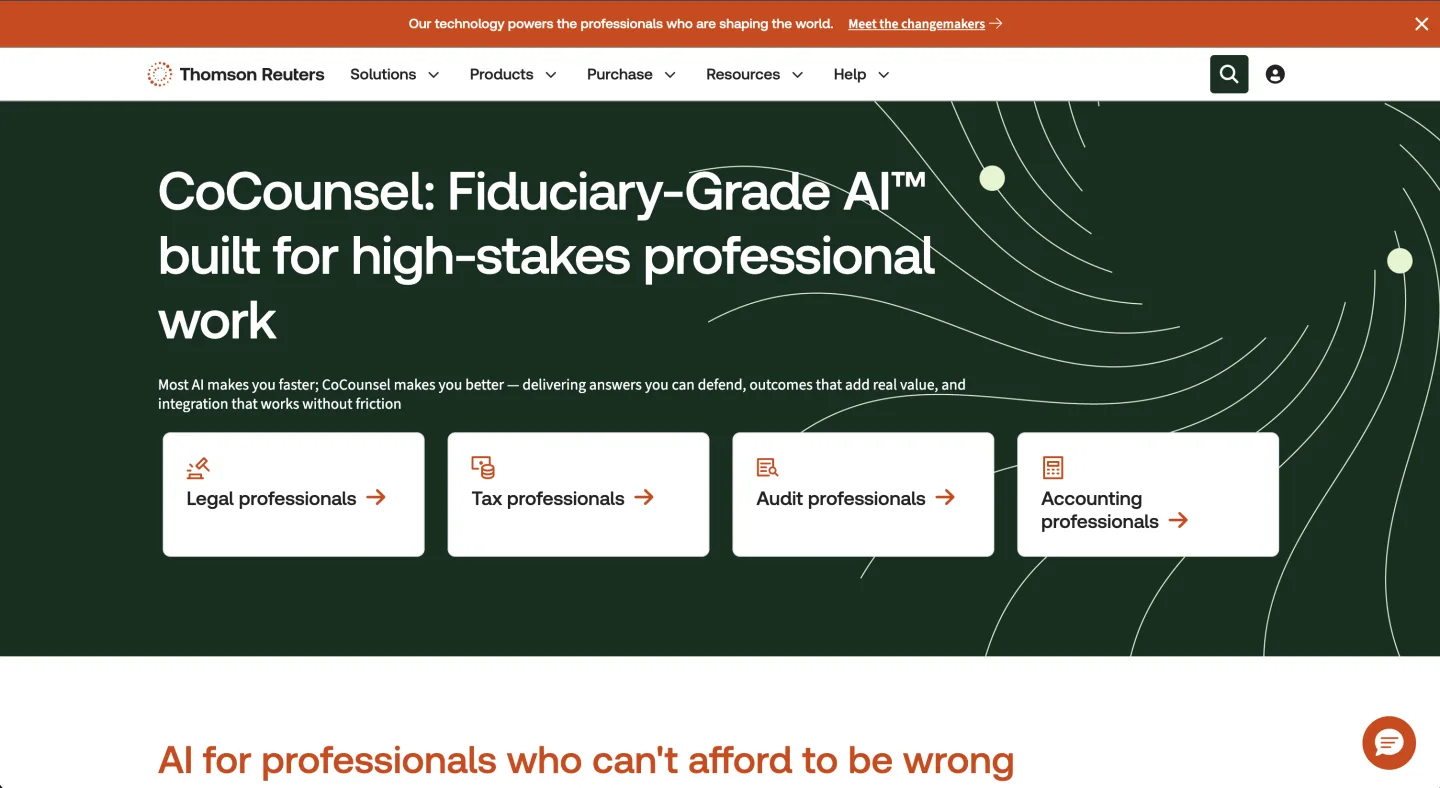
Thomson Reuters is marketing the release under a term it calls Fiduciary-Grade AI. Ragunath Ramanathan, its President of Legal Professionals, laid out the idea on April 23, 2026, per Artificial Lawyer. The claim is that verification is part of the system's architecture, not bolted on after the fact.
In plain terms, they built grounding and citation checking into the core. Artificial Lawyer reported a "citation ledger" that keeps a session-verifiable trail of where each cited authority came from. Every citation is meant to be traceable and inspectable, and Thomson Reuters says customer data does not train third-party models.
This matters for in-house counsel for one reason: the sanctions cases keep coming. Fake citations from ungrounded chatbots have gotten real lawyers fined. Grounding in Westlaw primary law lowers that risk. It does not remove it. You still verify every cite before it leaves your desk. We track that verification burden in our own honest CoCounsel review.
Who the next generation fits, and who it does not
Here is the honest split. CoCounsel is a research-first tool that got better at research and drafting. That is a great fit for some teams and an awkward one for others.
It fits well if you are a litigation or research-heavy team, you already live in Westlaw, and briefs and memos are a real part of your week. The Workspaces and Brief Builder features are built for exactly that motion. The Practical Law grounding is genuinely useful when you draft off known-good guidance.
It fits poorly if you are a small in-house team whose day is vendor contracts, NDAs, and DPAs. Brief Builder does nothing for a redline queue. The Westlaw-tied pricing is hard to justify when case-law research is a small slice of your work. And the firm-intelligence layer only pays off if you have time to author skills, which lean teams rarely do.
That fit gap is the whole game for in-house buyers. A tool built for the AmLaw research workflow can feel like a mismatch when your real job is turning contracts around fast. For a side-by-side of the two big research engines, our Lexis+ AI vs Westlaw AI comparison covers the underlying stacks.
What a procurement conversation looks like
If you take a demo, go in with three questions and do not leave without answers.
First, ask what the seat actually costs and whether it rides on a Westlaw subscription. Thomson Reuters does not publish pricing, and CoCounsel usually sits inside a larger Westlaw contract. If you do not already pay for Westlaw, you may be buying two things, not one.
Second, ask them to run the demo on your matters, not their canned examples. Bring three real documents: a messy vendor contract, a compliance question tied to a specific state, and one research task. Watch whether the citations hold up when you click through.
Third, ask what happens to your data and whether outputs are inspectable. The Fiduciary-Grade pitch says citations are traceable and your data does not train outside models. Make them show you the citation trail live, not on a slide.
For a lean team, the deeper question is whether a research-led platform matches a contract-led job. Many in-house teams find that a lighter, contract-first workbench covers more of their week for less money. That is the frame worth bringing to any legal-AI procurement call this year.
The honest read: a Westlaw retention play
Strip the launch language and one reading explains the most. The next generation of CoCounsel reads first as a Westlaw retention play. The Harvey-counterpunch and clean-workflow-shift angles each carry some truth: the agentic rebuild on Anthropic's Claude Agent SDK is real engineering, and Workspaces genuinely changes how a matter is organized. But look at where the value is anchored. The reasoning grounds in Westlaw primary law and Practical Law, the two assets no rival can copy. Pricing rides on the Westlaw subscription. The Fiduciary-Grade pitch leans on citation provenance that only the Thomson Reuters corpus supplies. Every one of those choices raises the cost for an existing Westlaw customer to decouple their AI reasoning layer from their research contract, which is exactly the move a Harvey or a frontier-model tool invites them to make. The connectors to iManage, NetDocuments, and Icertis widen the surface, and they widen it around the Westlaw core. Brief Builder deepens the same lock, since it is only as good as the Westlaw and Practical Law authority it drafts from. For a team already on the stack, the release makes complete sense. For a team that never bought Westlaw, its logic mostly evaporates.
Where Vaquill AI fits in the picture
We build Vaquill AI, a self-serve legal AI suite aimed at in-house counsel, so read this as an interested party. Where CoCounsel is research-first and sold through the Westlaw relationship, Vaquill AI is built around the contract-first day: drafting, redline and bulk contract review, and compliance against 50-state primary law, with published per-seat pricing and a four-layer verification pass on outputs. If your work is briefs and case-law research, CoCounsel is the stronger tool. If your week is contracts and you want to start without a sales cycle, it is worth a look. Compare the two on your own matters before you commit either way.
FAQ
What is the next generation of CoCounsel Legal?
It is a ground-up rebuild of Thomson Reuters' legal AI, opened for early access the week of June 22, 2026. Instead of a menu of fixed skills, it works as an agentic system: you describe a matter in plain language, and it plans the steps, pulls from Westlaw, Practical Law, and your own documents, and drafts with citations.
When is CoCounsel next generation generally available?
Thomson Reuters plans US general availability in August 2026, followed by Canada, the UK, and Australia. During early access, US customers can toggle between the new experience and the current version.
What is new compared to the old CoCounsel?
Three things stand out: Workspaces (a persistent home for each matter), Brief Builder (agentic drafting for briefs and motions), and a firm-intelligence layer for encoding your own expertise. Under the hood it now runs on Anthropic's Claude Agent SDK.
What does "Fiduciary-Grade AI" mean?
It is Thomson Reuters' marketing term for building grounding and citation verification into the core of the system rather than adding it later. In practice, citations are meant to be traceable to Westlaw and Practical Law sources, and the company says customer data does not train third-party models. It is a design claim, so test it in a demo.
How much does CoCounsel cost?
Thomson Reuters does not publish a public price. CoCounsel is typically sold through an enterprise agreement and often rides on a Westlaw subscription. Expect a sales-led quote, not a self-serve rate card.
Is CoCounsel a good fit for a small in-house team?
It depends on your work. If you do case-law research and draft briefs, it fits well. If your week is contract redlines, NDAs, and compliance questions, a lighter contract-first tool usually covers more of your day for less, since features like Brief Builder do not help a review queue.
Does CoCounsel still hallucinate?
Grounding in Westlaw primary law lowers the risk of fake citations, but no legal AI removes it. Verify every citation before it leaves your desk. That review step is still yours.
Last reviewed July 2026. Product details come from Thomson Reuters, LawSites, and Artificial Lawyer, dated June and April 2026. Verify current features and pricing with the vendor.
New legal AI guides, weekly.
Further Reading
Claude Fable 5 and Legal AI: What Its Benchmark Records Actually Mean
Read postThe AI Value Gap: In-House Counsel Want AI Results Their Outside Counsel Are Not Delivering
Read postClaude for Legal: What In-House Teams Need to Know
Read postCoCounsel Alternatives: 5 Options Compared
Read postWhat Lawyers Really Think of Legal AI in 2026 (Reddit + Reviews)
Read postSpellbook's Autonomous Contract Management: What It Means for In-House Teams
Read post
Co-Founder & CEO · Attorney
Arshita leads product and strategy at Vaquill AI, the US primary law data API. As an attorney, she decides which law we carry, how each section is sourced and cited, and what legal AI and compliance teams need from the data.