The fastest way to learn you are not Harvey's customer is to ask the price. You get a sales call, then a questionnaire, then a number between $1,200 and $2,000+ per user per month for unlimited AI use (a pay-as-you-go credit option sits on top).
For an Am Law 100 litigation team that math works. For a two-lawyer team holding up a 600-person company, it is a polite door in the face.
That gap is why "best Harvey alternatives for in-house counsel" keeps showing up in our own sales calls. Most roundups answering it list Harvey's enterprise peers, which have the same price problem.
This is the honest version: the tools in-house teams actually shortlist once Harvey is off the table, who each one fits, where it breaks down, and the real pricing as of mid-2026.
Short answer: The best Harvey AI alternatives for in-house counsel in 2026 are GC AI ($500/seat, in-house generalist), Spellbook (Word drafting), LegalOn ($550/mo, playbook review), and Ivo (lean review). For research-heavy litigation teams, CoCounsel and Lexis+ AI are the closest swaps. The right pick depends on the shape of your week, not the brand: workbench, point tool, or research-first.
TL;DR
- This is a ranked list of 9 Harvey alternatives for in-house counsel. GC AI leads for the solo in-house generalist with an open $500 seat, which Harvey will not match: Harvey does not sell to a small team at all.
- In-house teams pass on Harvey for three reasons, none about product quality: gated sales, a firm-first heritage, and a price of $1,200 to $2,000+ per user per month built for large-firm budgets.
- Trading Harvey for Legora, Ivo, or CoCounsel often buys you the same problem. They are very good and they are enterprise-priced. Match the buyer the tool was built for, not the logo.
- Two questions kill more vendors than any feature. Does it train on your data? Can you buy it this week without procurement? Ask both before the demo.
- Pick the shape (workbench, point tool, or research-first) before the brand. Most bad in-house buys compare tools that were never rivals.
How is GC AI sold to in-house teams?
Want the full evaluation framework instead of a shortlist? Our pillar, Legal AI for In-House Counsel: The Complete 2026 Guide, covers the jobs, the criteria, and the pricing reality. This post assumes you already decided Harvey is not your first buy.
How we picked
We ranked for the team leaving Harvey because of its price and its sales motion, not its product. The criteria are simple. Can you buy it this week without procurement, does it fit the in-house pipeline or just one station, and does the smallest viable purchase match a small team.
The real test is whether you can start without a sales call. So every price below is vendor-published or founder-confirmed and checked June 2026; anything the vendor keeps private we mark "quote-based / on request."
Sentiment comes from real forums, linked where the link returns a live page, named without a link where it sits behind a bot wall.
Why in-house teams look past Harvey
Harvey is not a bad product. It reached roughly $190 million in ARR and an $11 billion valuation by early 2026, with deep document work, agentic workflows, and a Lexis tie-in that big firms lean on. In-house teams pass for reasons about who Harvey was built to serve, not what it can do. For the full product breakdown, see our honest Harvey AI review.
It is gated by design. Harvey runs a high-touch motion: discovery call, security review, custom contract. A in-house team that wants to test the tool on three of its own NDAs this afternoon does not fit a sales cycle that assumes a procurement department.
Its roots are firm-first. Harvey grew up around outside-counsel work: large matters, large teams, billable hours. In-house work is a pipeline of vendor paper, and the value is in moving that paper, not going deep on one document.
The price is high. Harvey runs $1,200 to $2,000+ per user per month for unlimited AI use, with your tier and add-ons setting where you land. There is also a pay-as-you-go credit-metered option now. The full Harvey per-seat pricing breakdown covers where the renewal increase comes from. For most in-house teams, that buys a Ferrari to drive to the mailbox.
None of that makes Harvey wrong. It makes it a poor first buy for the reader here: in-house counsel, fractional GCs, CLOs, and lean two-to-ten-person teams with no procurement.
The product was never the issue, the fit was.
First, choose the shape
Most bad in-house AI buys come from comparing tools that were never rivals. A Word redline add-in and a research platform are as different as a stapler and a filing cabinet. Before any feature grid, decide which of three shapes you are buying.
The workbench. One place that drafts, reviews, redlines, manages matters, and holds your playbooks. The idea: in-house work is a connected pipeline, and the time leaks sit in the handoffs, not inside any one task.
The point tool. One job done better than anyone: review against a playbook, redline inside Word, NDA triage. If a single repeated task eats your week, a point tool beats a generalist on it. The risk is the wall you hit the day the work changes shape.
The research-first platform. The Westlaw and Lexis line with an AI assistant on top. Built for "what does the law say," not "draft and manage my contracts."
For a litigation docket it earns its keep. For a commercial team living in MSAs and DPAs, primary-law research is a smaller slice of the week than vendors imply.
Then run every candidate through three filters that decide more buys than features ever do.
- Data posture. Does the vendor train on your documents? Can you get training exclusion, encryption, and a retention term in writing? ABA Formal Opinion 512 (July 2024) puts confidentiality, competence, and AI supervision on you, which makes these questions a duty, not a nice-to-have.
- Procurement friction. Can you trial it this week? Or does it want a sales cycle, an annual commitment, and a seat minimum? A 10-seat minimum is a polite "you are not our customer."
- Price reality. The published spread across this market is more than 10x. Price tracks who the vendor sells to, not how well it reviews your NDA.
The best Harvey alternatives for in-house counsel, ranked
1. GC AI: best for the solo in-house generalist
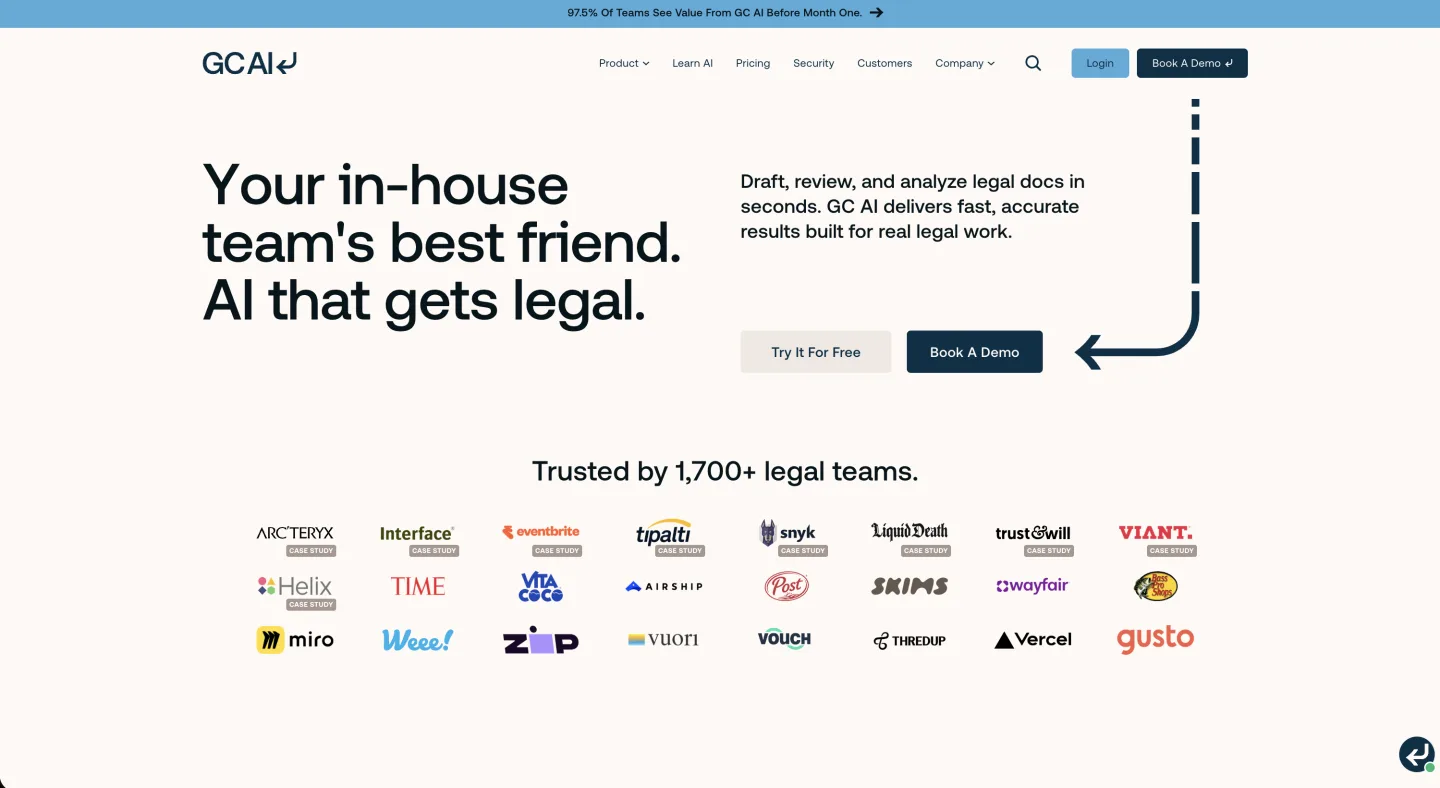
GC AI: a broad assistant built for the in-house generalist.
At a glance: $500 per seat/mo (Individual); Team/Enterprise on request · Self-serve, 14-day trial · Best for one lawyer covering many question types
GC AI is the cleanest "built for the in-house generalist" story on the list. It is the assistant for one lawyer at a 400-person company fielding an employment question at 9am, an NDA at 10, and a board memo by lunch.
What's good
- Broad coverage for triage and first-pass work across many question types
- Publishes its $500 seat price openly, with a 14-day trial and no seat minimum
- Founder is a three-time general counsel, so the workflow fit is real
Where it falls short
- Breadth over depth, so heavy playbook-enforced review may want a specialized engine next to it
- Team and Enterprise pricing is quote-based, not published
What users say: There is little genuine forum talk, mostly PR, so we will not invent buzz. One fair structural point: it publishes its $500 seat price while Harvey and Legora hide theirs (Legal Technology Hub).
Bottom line: Buy it if you are a solo or near-solo counsel who needs a strong generalist and an open price. Skip it if your week is heavy, structured review at volume.
Our honest GC AI review covers where the depth line falls.
2. Spellbook: best for transactional lawyers who live in Word
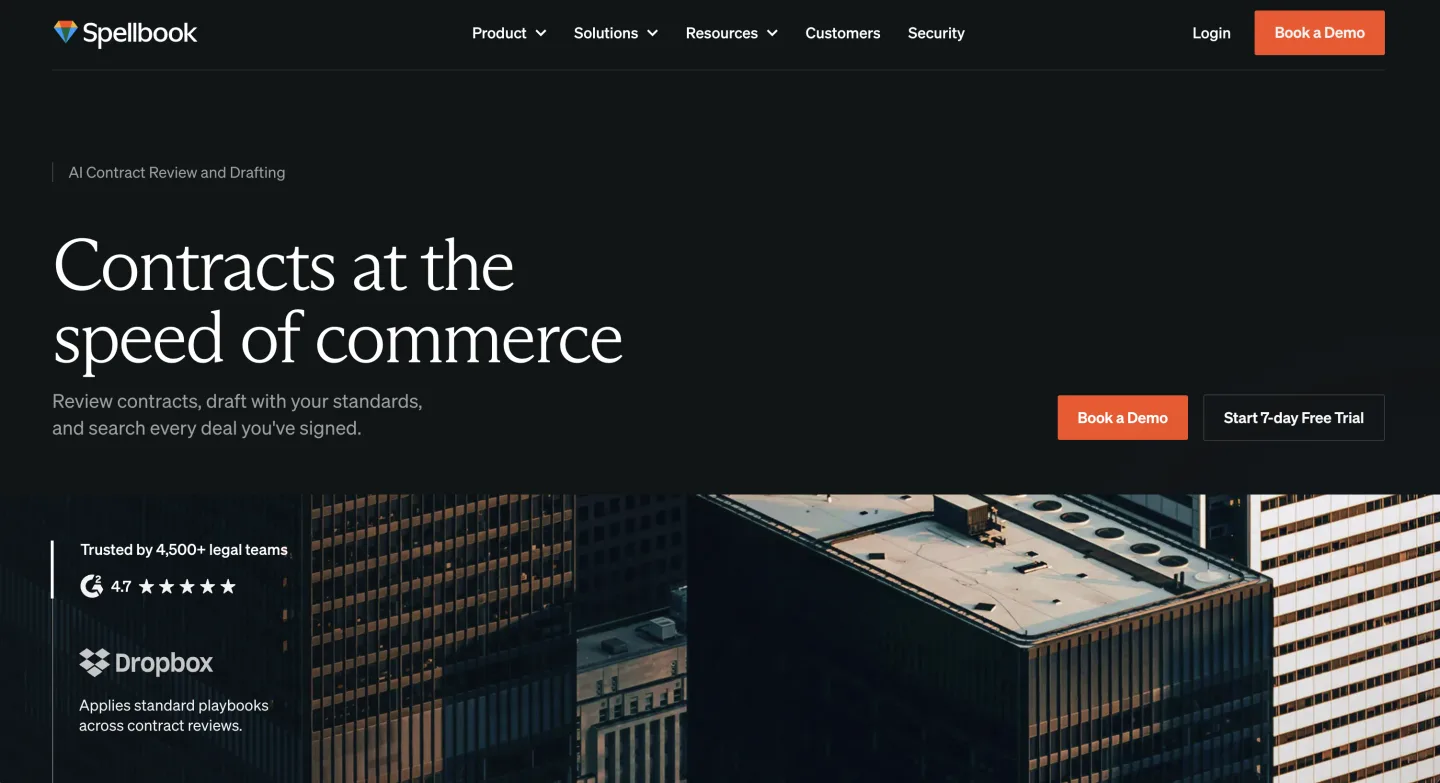
Spellbook: AI drafting and redlining inside Microsoft Word.
At a glance: $500 per seat/mo (base); quote-based, routes to demo · Sales-led, demo required · Best for transactional lawyers drafting in Word
If your day lives inside Microsoft Word, Spellbook is the most natural escape from Harvey here. It is an add-in for drafting and redlining where transactional lawyers already work, with clause benchmarking and custom playbooks on top.
What's good
- Lives inside Word, so there is no new tab and no new habit
- Clause benchmarking and custom playbooks for transactional work
- Best-liked tool in this space among transactional lawyers
Where it falls short
- Does not publish a price and routes you to a demo
- Transactional-only, so it is weak for litigation
- Still inserts wrong citations sometimes
What users say: Lawyerist rates it about 4.1 out of 5, praising the Word add-in while flagging the wrong-citation issue and the transactional-only scope (Spellbook review).
Bottom line: Buy it if drafting and redlining in Word is the bulk of your week and the $500 seat fits. Skip it if you need litigation coverage or a self-serve price.
Our Spellbook alternatives breakdown covers where the add-in model boxes you in.
3. LegalOn: best for high-volume playbook review

LegalOn: review-first contract checking against attorney-authored playbooks.
At a glance: $550/mo (Individual, billed annually); Teams custom · Sales-led, demo required · Best for teams whose week is mostly contract review
If your nightmare is re-reading the same indemnity clause for the four-hundredth time, LegalOn is built for that. It is review-first and has been at it longer than most, with attorney-authored playbooks and a reasoning layer behind its redlines.
What's good
- 50-plus attorney-authored playbooks and a reported 8,000-plus customers
- Checks incoming contracts against your standards and inserts redlines with reasoning
- Mature and focused, so it is reliable on the one job it does
Where it falls short
- A review engine, not a workbench, so matters, drafting, and research live elsewhere
- Teams pricing is custom, not published, and the entry seat is annual-billed
What users say: We found no genuine peer forum discussion, only vendor testimonials, so take the praise with that in mind.
Bottom line: Buy it if you have a real playbook and the volume to justify a dedicated review engine. Skip it if you need one tool to run the full pipeline.
4. Ivo: best for a lean, Word-native review tool

Ivo: the leaner, faster entrant in the playbook-review camp.
At a glance: $500 per user/mo · Sales-led, demo required · Best for teams who found the incumbents heavy
Ivo is the leaner, faster entrant in the playbook-review camp. Teams who found the older review tools heavy tend to like its clean interface, fast review, and in-house focus.
What's good
- Word-native redlining with a clean, fast interface
- Customers including Uber, Shopify, IBM, and Canva
- Raised a $55 million Series B in January 2026 at a reported $530 million valuation
Where it falls short
- A point tool, not a place to run your whole function
- Onboarding needs Ivo's team, and accuracy slips now and then
What users say: Reviewers on G2 call it a real AI reviewer with solid playbook redlining and easy to use, while flagging team-led onboarding and occasional inaccuracies (G2 reviews, behind a bot wall when we checked).
Bottom line: Buy it if review is your dominant job and you want a lighter feel than the incumbents. Skip it if you need a full workbench or a self-serve price.
The Ivo alternatives page covers that comparison.
5. Legora: best for large teams that want Harvey-grade breadth for less

Legora: the enterprise workbench heavyweight of the cycle.
At a glance: $300 to $800 per user/mo, plus pay-as-you-go credits · Sales-led, demo required · Best for large firms and well-funded legal departments
This is the trap entry. Teams leaving Harvey often shortlist Legora next, and on capability that makes sense, but it brings back the exact reason you left.
What's good
- Collaborative AI across research, review, and drafting
- Cheaper per seat than Harvey
- A genuinely strong, well-funded platform (reported $5.6 billion valuation as of April 2026); in June 2026 it moved its Agent Pro tier to consumption-based pricing (legora.com)
Where it falls short
- Still an enterprise workbench tuned for large-firm budgets
- Same demo-gated, security-review sales motion you left Harvey to escape
- Reliability complaints dominate the forum talk
What users say: On Reddit the cheaper price gets noted, but reliability complaints dominate: a botched rollout users nicknamed the "Letgora" team, retention gaps, and answer quality slipping past about 200 pages (r/legaltech).
Bottom line: Buy it if you are a large team that wants Harvey-grade breadth at a lower seat. Skip it if you bounced off Harvey for being gated, because Legora changes the logo, not the problem.
The Legora alternatives page covers the fit question.
6. CoCounsel: best for teams already living in Westlaw
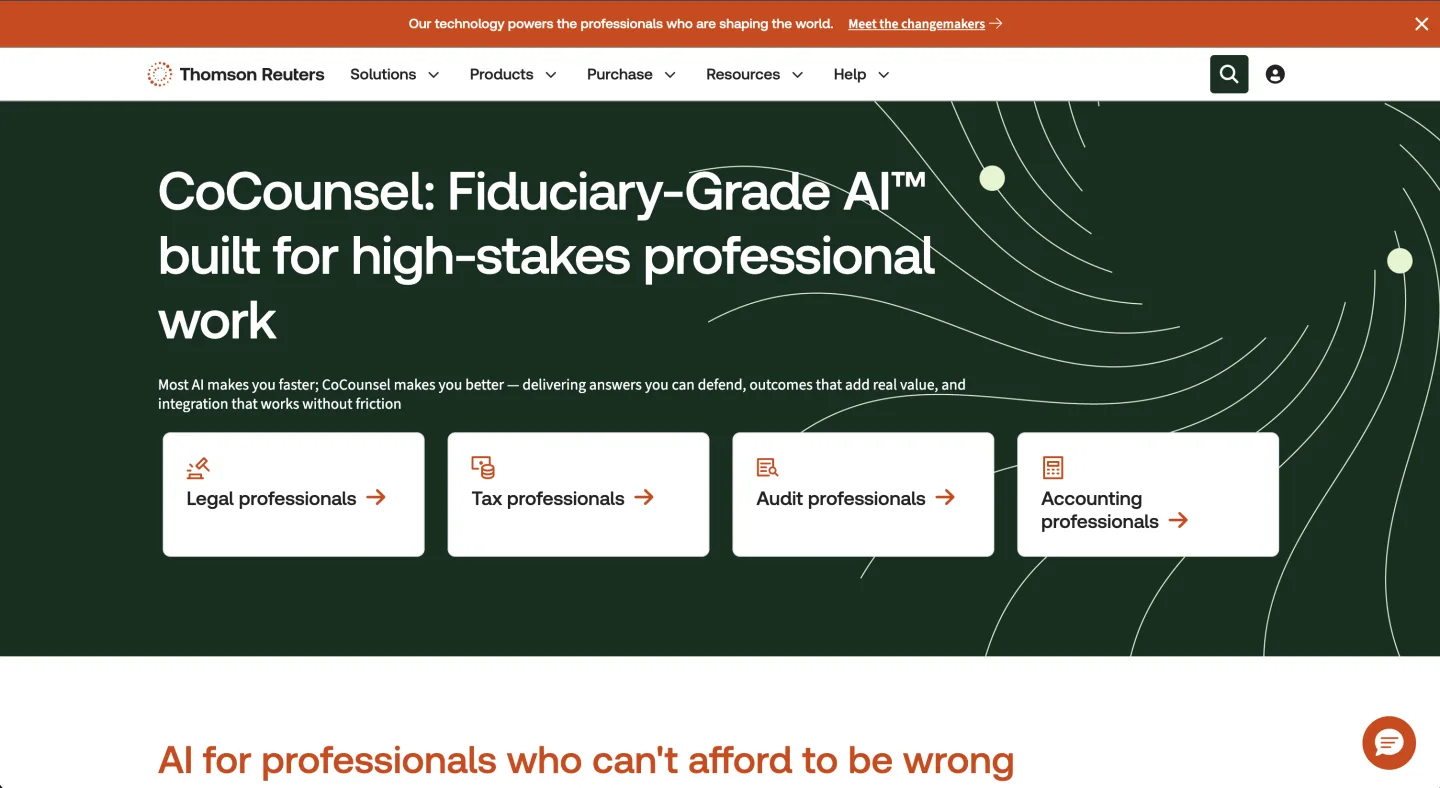
CoCounsel: Thomson Reuters' AI assistant.
At a glance: $225 to $400+ per user/mo, depending on capabilities · Sales-led, demo required · Best for litigation-leaning teams in the Thomson Reuters stack
CoCounsel is Thomson Reuters' AI assistant. If you already live in Westlaw for litigation research, it is a natural extension. If you do not, the research-platform gravity is the tail wagging the dog for commercial work.
What's good
- Slots into the Westlaw stack for litigation research
- Parallel Search and real time savings on document work
- Backed by Thomson Reuters, so it is not going anywhere
Where it falls short
- Research-platform gravity is wasted on a commercial in-house desk
- Still makes up citations, so you verify everything
- Thin on appellate material
What users say: Users like the ease, the time savings, and Parallel Search, but warn it still fabricates citations and is thin on appellate material, so verify everything (Michigan Law legal-tech series).
Bottom line: Buy it if your team is litigation-leaning and already in the Thomson Reuters world. Skip it if your week is commercial contracts and matters.
7. Gavel: best for document automation and templated work
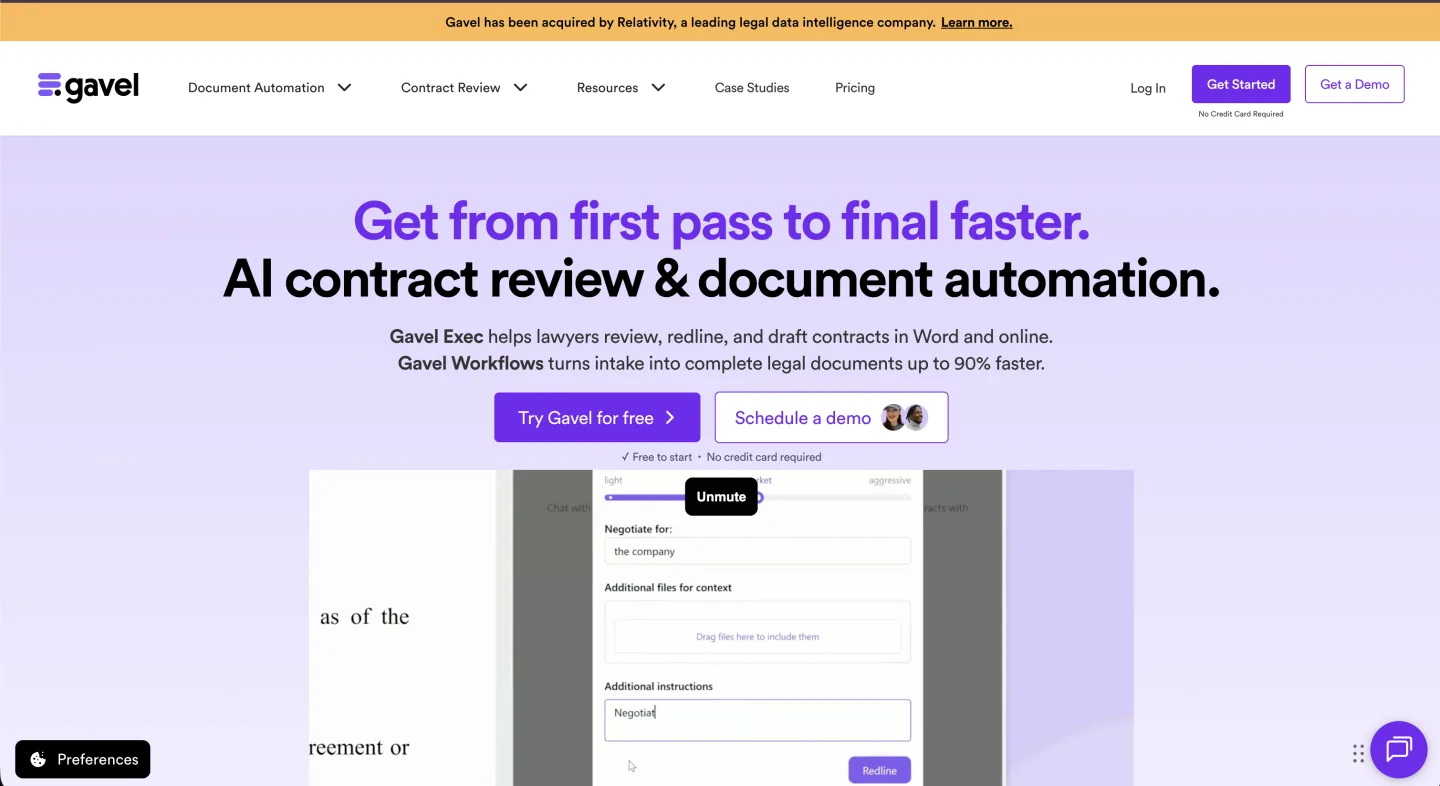
Gavel: document automation plus an AI contract-review product.
At a glance: Workflows $83 / $165 / $290 / $417 per month; Gavel Exec quote-based · Self-serve workflows, sales-led Exec · Best for teams living in templated, repeatable documents
Gavel comes at the problem from the document-automation side. It builds intake-driven document generation and workflows, with a separate AI contract-review product, Gavel Exec, on top.
What's good
- Strong automation engine for the same forms, again and again
- Publishes its workflow pricing, which is rare here (annual gets two months free)
- Gavel Exec earns real praise for surgical redlines
Where it falls short
- Anchored in document generation, not the review-redline-matter pipeline
- Gavel Exec is quote-based with no public price
- Heavy reviewers and full-function teams will find it covers part of the desk, not all of it
What users say: On Reddit, Gavel Exec earns praise for surgical redlines that do not turn the whole doc red, fast shipping, and a Projects feature that trains on your own clauses (r/legaltechAI).
Bottom line: Buy it if your week is templated document generation and you want a published workflow price. Skip it if you need a connected review-and-matter pipeline.
8. Paxton AI: best for research-first solos and small firms
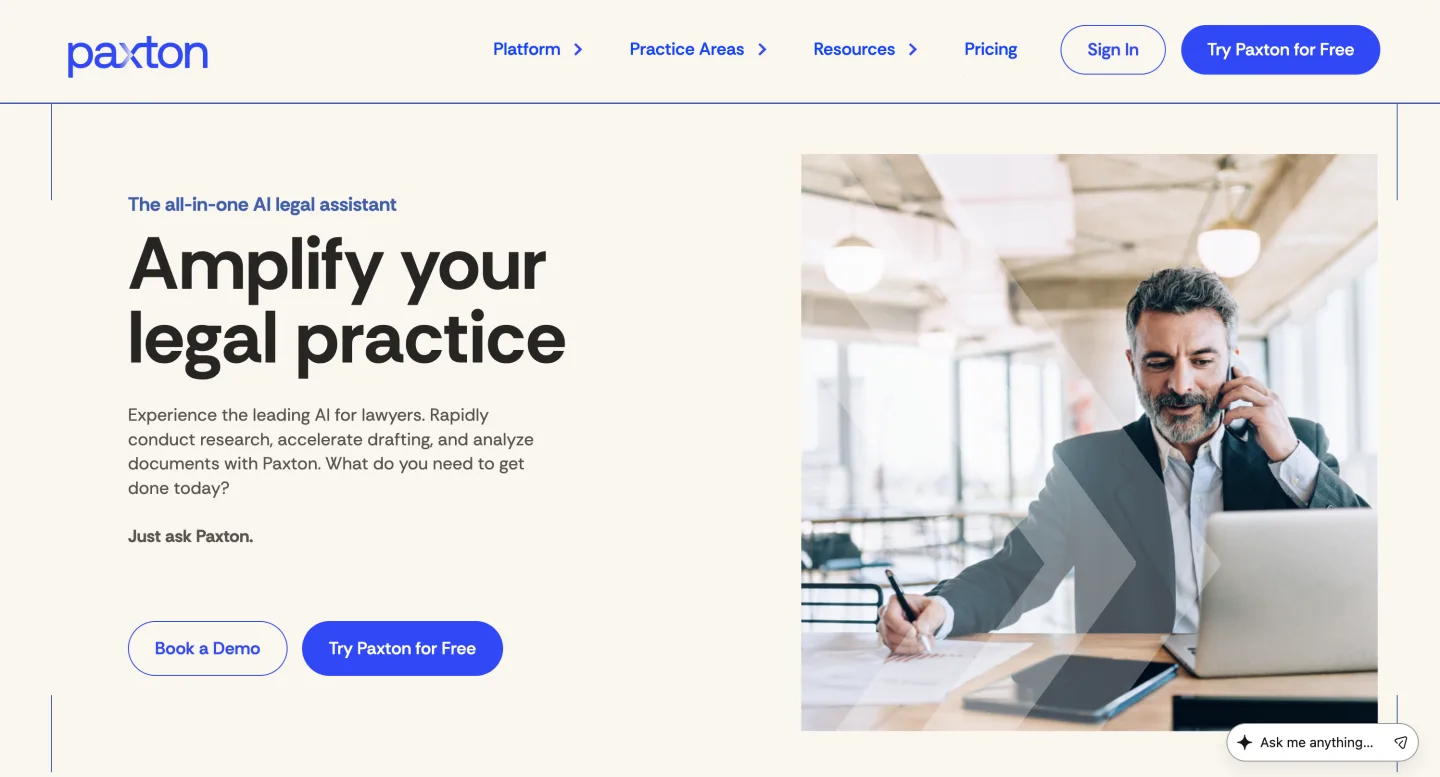
Paxton AI: research-first assistant with drafting and analysis.
At a glance: $499 per user/mo, or $2,999 per user/yr · Self-serve, 7-day trial · Best for research-heavy solos and small firms
Paxton AI leans research-first: legal research, drafting, and document analysis in one assistant for lawyers who want grounded answers with citations.
It publishes pricing and offers a 7-day trial, which puts it on the right side of the procurement test that knocks Harvey out.
What's good
- Self-serve with a published price and a 7-day trial
- Grounded research answers with citations, plus drafting and analysis
- Solos and small firms call it a game-changer
Where it falls short
- The seat is steep for a solo
- No independent hallucination benchmark
- Research-first shape fits a commercial in-house desk poorly
What users say: Lawyerist reports solo and small-firm enthusiasm while flagging the steep solo price and the absence of an independent hallucination benchmark (Lawyerist Paxton review).
Bottom line: Buy it if your week is research and analysis and you want a self-serve price. Skip it if your week is contract review, redlining, and matters.
9. Robin AI: check the vendor's footing before you shortlist it

Robin AI: mid-market contract review positioned below Harvey.
At a glance: $500 per user/mo (list) · Sales-led, demo required · Best assessed once its corporate position is clearer
Robin AI built its name on contract review and drafting aimed at the middle market, more accessible than Harvey and more AI-native than legacy CLM. The read in mid-2026 turns on corporate durability rather than the product itself.
What's good
- Mid-market positioning below Harvey's price
- More AI-native than legacy CLM
- Was a common shortlist name for Harvey-grade contract work without the Harvey motion
Where it falls short
- 2025 layoffs and a winding-up petition dominate the news
- Managed services were sold to Scissero in December 2025 while the software did not move with it
- The product roadmap is harder to assess than the feature set
What users say: Recent commentary focuses on the company's financial position rather than the software, and it has become a reference point in the wider debate about legal-AI funding (GeekLawBlog). Vendor durability is a fair thing to diligence on any multi-year contract.
Bottom line: Confirm the product is still being sold and get a current number in writing before you build a shortlist around it. For most teams today, that is a reason to look elsewhere.
Other Harvey competitors worth knowing
These do not make the in-house top 10, but they show up on most Harvey-alternative lists, so here is the honest one-line read on each.
- Lexis+ AI is the research-first swap if you already hold Lexis seats. It scored about 17% hallucination in the Stanford RegLab study (arXiv, 2024), the least-bad of the paid research tools tested, but its "hallucination-free linked citations" pitch is overstated and the seat is research-platform priced. See our Lexis+ AI review.
- Wordsmith pitches itself as an operating system for the in-house function, not just an assistant. Newer and quote-based, so trial it before you commit.
- LEGALFLY is a European-rooted in-house platform leaning on privacy and explainability. Quote-based, EU footprint stronger than US.
- Ironclad is a contract-lifecycle platform with an AI layer, not a Harvey-style assistant. Right call if your gap is CLM, not drafting and research; it runs alongside, not instead of, a workbench.
- Claude or ChatGPT Team is the honest cheap baseline at roughly $20 to $30 per seat. No legal grounding, no playbooks, no Word redlines, and you would not put privileged paper through a consumer tier, but plenty of in-house lawyers already use one for first drafts. If a legal tool cannot beat a $25 chatbot on your real work, do not pay for it.
Comparison table
| # | Tool | Price (per user/mo) | Access | Best for |
|---|---|---|---|---|
| 1 | GC AI | $500; Team/Enterprise on request | Self-serve, 14-day trial | Solo in-house generalists |
| 2 | Spellbook | $500 (base); quote-based | Sales-led, demo required | Transactional lawyers in Word |
| 3 | LegalOn | $550/mo (Individual, annual); Teams custom | Sales-led, demo required | High-volume playbook review |
| 4 | Ivo | $500 | Sales-led, demo required | Lean, Word-native review |
| 5 | Legora | $300 to $800 + PAYG | Sales-led, demo required | Large teams wanting breadth for less |
| 6 | CoCounsel | $225 to $400+ | Sales-led, demo required | Teams already in Westlaw |
| 7 | Gavel | $83 to $417 (Workflows); Exec quote-based | Self-serve workflows | Document automation |
| 8 | Paxton AI | $499 ($2,999/yr) | Self-serve, 7-day trial | Research-first solos |
| 9 | Robin AI | $500 (list) | Sales-led, demo required | Caution, footing unclear |
What to actually test before you sign
A shortlist of two does not need a sixty-day pilot. It needs an afternoon with real artifacts. Run the same checks on each finalist.
- Upload a known NDA or MSA you have redlined before, so you judge the output against your own answer, not a vendor sample.
- Open the redline in Word and confirm each change is a discrete suggestion a colleague can accept or reject, not a rewritten blob.
- Import one playbook clause and time the manual tagging. The gap between "five minutes" and "a week" is the real onboarding cost.
- Ask for SOC 2, a sub-processor list, and the training-exclusion clause in the MSA before the call ends, all in writing.
FAQ
Why is Harvey so expensive for in-house teams? Harvey was built around outside-counsel work and priced for Am Law budgets. The $1,200 to $2,000+ seat, the high-touch sales, and the firm-first features all assume large headcount and usage.
A small in-house team pays firm rates for work shaped differently.
Which Harvey alternative can I buy without a sales call? GC AI ($500), Gavel Workflows ($83 to $417), and Paxton AI ($499) are self-serve with published prices and trials. The rest route you to a demo before you see a real number.
Is a cheaper enterprise tool like Legora a good Harvey swap? Only if your reason for leaving was price alone. Legora runs $300 to $800 plus credits, but it keeps the demo-gated, security-review sales motion.
If you left Harvey to escape procurement, that swap changes the logo, not the problem.
Who are Harvey AI's main competitors? On capability, Legora and CoCounsel are the closest direct rivals, with Lexis+ AI on the research side. For in-house teams specifically, the realistic shortlist is GC AI, Spellbook, LegalOn, and Ivo.
The right one depends on whether you want a full workbench, a single point tool, or a research platform.
What is the best Harvey alternative for in-house counsel? For a lean two-to-ten-person team that wants one tool for drafting, review, redlining, and matters without a sales call, the self-serve workbench tier fits the in-house pipeline closely. For a solo generalist who wants an open price, GC AI at $500 per seat is the cleaner fit.
If most of your week is contract review against a playbook, LegalOn or Ivo will beat a generalist on that one job.
Is there a cheap or free Harvey alternative? There is no free legal-grade Harvey alternative worth running on real client work. The cheapest legal-specific options with published prices are Gavel Workflows (from $83) and, a tier up, GC AI and Paxton AI.
A general tool like Claude or ChatGPT Team runs about $20 to $30 per seat, but it has no legal grounding, no playbooks, and is wrong for privileged documents.
Does Harvey publish its pricing? No. Harvey does not publish pricing and routes every prospect through a sales call. Independent reporting and our own sales calls put it at $1,200 to $2,000+ per user per month for unlimited AI use, plus a newer pay-as-you-go credit option.
That opacity is the single most common reason in-house teams start shopping for alternatives.
See it on your own contracts
The fastest way past any feature grid is to run a tool on a contract you already know cold. Take an NDA or MSA you have redlined a hundred times, drop it in, and watch the redline land in your own Word track changes.
Whichever way you lean, test it on your own paper before you sign. Put the shortlist side by side on the same three contracts and judge against your own queue.
New legal AI guides, weekly.
Further Reading
The Best Spellbook Alternatives for In-House Counsel (2026)
Read postLegal AI Word Add-Ins Compared: 14 Tools, Features, and Pricing (2026)
Read postLaw Firm vs In-House Legal AI: Why Firm Tools Do Not Fit In-House Teams
Read postTop 10 AI Tools for General Counsel (2026)
Read post12 Best Legal AI Tools for In-House Counsel (2026)
Read postTop 14 Matter Management Tools for In-House Teams (2026)
Read post
Co-Founder & CEO · Attorney
Arshita leads product and strategy at Vaquill, building the legal AI suite that solo, small-firm, and in-house US lawyers use to run a matter end to end.