In the first half of 2026, legal AI vendors raised money faster than any category in enterprise software. Harvey hit an $11 billion valuation. Legora hit $5.6 billion and hired Jude Law. Clio spent a billion dollars buying a legal research company. Here is the takeaway for anyone running a two-person legal team: none of it changes what you should buy. A funding round measures investor conviction about a company's future revenue. It tells you little about whether the tool fits your Tuesday, and this capital is chasing BigLaw budgets, not yours.
TL;DR
- Harvey raised $200M at an $11B valuation in March 2026 (reported by CNBC), its fourth round in about a year, up from $8B two months earlier and $5B in June 2025.
- Legora closed a $600M Series D at a $5.6B valuation (TechCrunch) and ran a Jude Law billboard campaign near the Masters and Legalweek.
- Clio acquired legal-research firm vLex for $1B, the largest legaltech M&A on record, and raised a $500M Series G at a $5B valuation (LawSites).
- Wordsmith raised a $70M Series B ($100M total) to sell into in-house teams (Artificial Lawyer).
- Anthropic entered the category in May 2026 with Claude for Legal, 20-plus integrations, and 12 role-specific plugins (Fortune).
- The money funds enterprise sales and BigLaw features. For a lean in-house buyer, price and fit still beat hype.
What valuation did Harvey reach in March 2026?
What the legal AI funding numbers actually say
The numbers are real, and they are big.
Harvey raised $200 million in March 2026 at an $11 billion valuation, co-led by GIC and Sequoia, which pushed its total capital raised past $1 billion (CNBC, Mar 2026). That was its fourth round in roughly twelve months. The same company was valued at $8 billion two months earlier and $5 billion in June 2025. By its own account, Harvey now partners with most of the 100 largest US law firms, over 500 in-house teams, and 50 asset managers across 60 countries (vendor figures, not independently audited).
Legora, the European challenger, closed a $600 million Series D at a $5.6 billion valuation: a $550 million first close led by Accel in March, plus a $50 million extension from Nvidia's NVentures in late April (TechCrunch, Apr 2026). It crossed $100 million in ARR by its own account and, following Harvey's Gabriel Macht deal, hired Jude Law for a campaign under the slogan "Law just got more attractive," with billboards near Augusta National during the Masters and transit wraps aimed at Legalweek delegates (ABA Journal, 2026).
Clio, the practice-management incumbent, completed a $1 billion cash-and-stock acquisition of legal research firm vLex on November 10, 2025, the largest M&A deal in legaltech history, and paired it with a $500 million Series G at a $5 billion valuation led by NEA (LawSites, Nov 2025).
Wordsmith, an Edinburgh startup, raised a $70 million Series B in June 2026, backed by Highland Europe and Index Ventures ($100 million total), specifically to build a platform for in-house legal teams and expand into the US (Artificial Lawyer, Jun 2026).
Then the model maker showed up. In May 2026, Anthropic launched Claude for Legal with more than 20 integrations and 12 role-specific plugins, covering everything from M&A due diligence to employment-handbook drafting, and reported that legal was the top power-user function inside its Cowork platform (Fortune, May 2026).
Valuation is a bet, not a reference check
Here is the contrarian part, and it is the only part that matters if you are the one signing the invoice.
A funding round is a bet on a company's future revenue. It tells you little about whether the tool fits your Tuesday. When Sequoia values Harvey at $11 billion, it is underwriting a plan to sell four-figure-per-seat contracts to the largest firms on earth. That plan requires an enterprise sales team, a security-review team, an implementation team, and a feature roadmap built around what an AmLaw 100 litigation department needs. All of that has to be paid for. It gets paid for by the price you are quoted.
Look at where the money goes. Legora spent part of a $600 million round on Jude Law and billboards outside a golf tournament. That is a rational move if your buyer is a firm managing partner who sees the ad in an airport lounge. It does nothing for a solo GC redlining an NDA at 9 p.m. You are paying, in the seat price, for marketing aimed at someone who is not you.
The daily in-house loop is narrow and repetitive: review a contract, mark it against your playbook, answer a compliance question against current state law, draft the first pass of a policy or a response. Most of the arms-race spending funds capabilities that sit outside that loop: deposition prep, litigation-scale document review, matter-wide discovery, the deep-research workflows that justify a BigLaw price tag. Good features. Not your features.
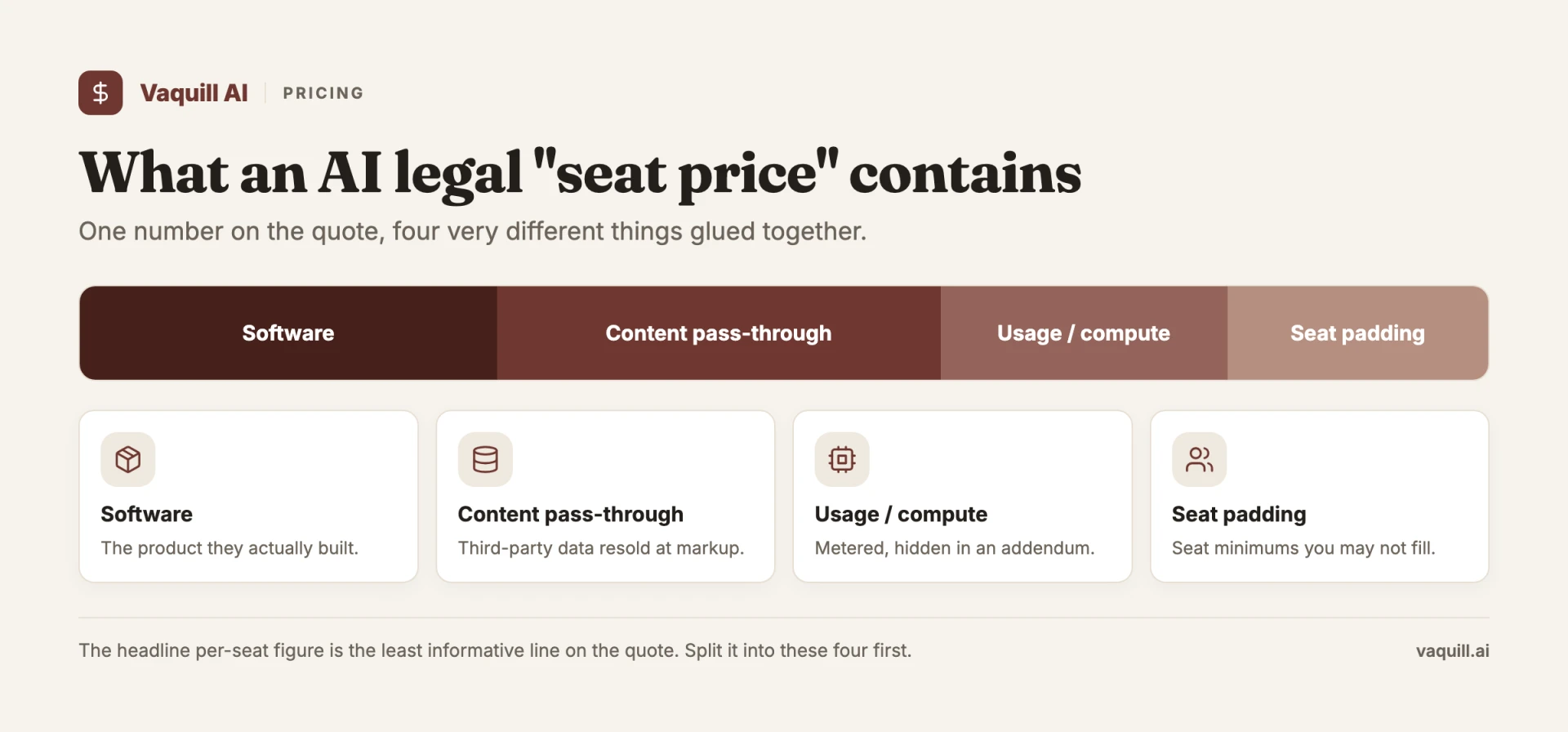
And the price is the whole point. Reported ranges (Harvey from third-party pricing breakdowns, Legora self-reported by the vendor, not published rate cards) put Harvey at $1,200 to $2,000+ per seat per month and Legora at $300 to $800, with seat minimums (roughly 25 seats at Harvey, 10 at Legora) that price out a lean team before the demo ends. We broke the full math down in what Harvey, Legora, and CoCounsel actually cost, and the legal AI pricing benchmark shows how far apart the headline seat price and the Year-1 bill really are.
| Vendor | 2026 valuation / raise | Per-seat price (reported) | Buys well for |
|---|---|---|---|
| Harvey | $11B ($200M, Mar 2026) | $1,200 to $2,000+ / seat / mo | Large firms, 25+ seats |
| Legora | $5.6B ($600M Series D) | $300 to $800 / seat / mo | Mid-to-large firms, 10+ seats |
| Clio + vLex | $5B ($1B acquisition) | Practice-management bundle | Small-firm private practice |
| Wordsmith | $100M total raised | Contact sales | In-house teams (enterprise motion) |
| Vaquill AI | Not a fundraising story | Self-serve | Lean in-house teams and solo GCs |
What a legal AI procurement call and a real pilot look like
The gap between the funding headlines and the daily job shows up the moment you get on a vendor call.
Ask Harvey or Legora for pricing and the conversation does not open with your workflow. It opens with seat count. The Harvey quote we have seen lands around a 25-seat minimum, so a two-lawyer team gets priced for twenty-five seats at roughly $1,200 to $2,000+ each: a floor near $30,000 a month before anyone logs in. Legora's minimum sits around 10 seats in the $300 to $800 range, a $3,000-plus floor. The demo is polished, the security questionnaire is thorough, and the follow-up email offers an annual-prepay discount that only pencils out if you can fill those seats. For a team that would leave eighteen of them empty, the discount is a mirage.
Now the other side, what the tool does once you stop counting seats. Take a lean team whose baseline NDA turnaround was 4.2 days: intake by email, a manual read against a Word playbook, two rounds of partner-style back-and-forth, then signature. In a 30-day pilot, the same team routed inbound NDAs through an AI redline against the same playbook, kept a human final read, and measured the loop.
- Median cycle time fell from 4.2 days to 1.3 days across 34 NDAs.
- First-pass acceptance, meaning the AI redline needed no manual correction, ran at 71 percent. The other 29 percent needed one human edit, usually a governing-law or liability-cap preference the playbook had not captured.
- Time logged per NDA dropped from about 55 minutes to 18 minutes, most of it now spent reviewing rather than typing.
The exact figures will move with your playbook and your contract mix, so treat them as a shape rather than a promise. The shape is what matters: contract in, redline out, human check is the loop a two-person team lives in every day, and it is testable in a month for the cost of one seat. A $30,000 monthly floor is not the ticket to that result. A working redline engine and a clean citation trail are.
Where a well-funded competitor genuinely helps you
Steelmanning the other side: the arms race is not all noise for in-house buyers.
Anthropic's entry matters. When the company that makes the underlying model ships a legal product, and when Wordsmith raises $70 million aimed squarely at in-house teams, the category is validating the exact use case a GC cares about: bringing work back in-house instead of sending it to a firm at $600 an hour. That is directional good news. More capital means better models, faster, and everyone building on frontier models (Vaquill AI included) benefits.
The catch is that "the category is real" and "this specific $1,200 seat is right for my two-person team" are different claims. The first is now settled. The second is still on you to test. If you want the shortlist framed around in-house needs rather than firm needs, start with the best legal AI tools for in-house counsel, and if you are weighing a self-serve competitor, our honest GC AI review shows the questions worth asking of any of them.
What a lean team should actually do
Ignore the valuation. Run a short structured test before you sign anything.
- Does it handle your daily loop well? Contract review against a playbook, a compliance answer against current 50-state law, a solid first draft. Not deposition prep you will never open.
- Can you buy one seat, month to month, with the real price on the site? If the price needs a sales call, the price is negotiable, which usually means high.
- Does it show its work? Clickable citations and a verification step, not a confident paragraph you have to fact-check line by line.
Structure the pilot the way the field note above did: pick one repeatable task, log a two-week baseline (cycle time, minutes per task, how often you rewrite the output), then run the tool on the same task for two to four weeks and compare the same three metrics. One seat is enough to learn everything the demo will not tell you.
FAQ
How much did Harvey raise and at what valuation? Harvey raised $200 million in March 2026 at an $11 billion valuation, co-led by GIC and Sequoia, bringing total capital raised past $1 billion (per CNBC). It was the company's fourth round in about a year, up from $8B two months earlier.
What is Legora's valuation? Legora reached a $5.6 billion valuation on a $600 million Series D: a $550 million first close led by Accel in March 2026, plus a $50 million Nvidia NVentures extension in late April (per TechCrunch).
Why did Clio buy vLex? Clio acquired legal research firm vLex for $1 billion (completed November 10, 2025) to add AI-powered legal research to its practice-management platform, and raised a $500 million Series G at a $5 billion valuation alongside it (per LawSites). It was the largest M&A deal in legaltech history.
Does a higher valuation mean a better legal AI tool? No. A valuation reflects investor expectations of future revenue, usually from large enterprise contracts. It says nothing about accuracy, citation quality, or whether the tool fits a small in-house team. Test the output on your own hardest questions instead.
Is the legal AI funding boom good for in-house teams? Partly. More capital means better underlying models and validates bringing work in-house (Wordsmith raised $70M aimed at exactly this, and Anthropic launched Claude for Legal in 2026). But most of the spending funds BigLaw features and enterprise sales, not the daily in-house contract-and-research loop.
What do Harvey and Legora cost per seat? Reported ranges (Harvey from third-party pricing breakdowns, Legora self-reported by the vendor, not official rate cards) put Harvey at $1,200 to $2,000+ per seat per month and Legora at $300 to $800, both with seat minimums (roughly 25 and 10 seats). See our full pricing breakdown for the Year-1 totals.
Did Anthropic launch a legal product? Yes. In May 2026 Anthropic launched Claude for Legal with more than 20 integrations and 12 role-specific plugins covering tasks from M&A due diligence to employment-handbook drafting, and reported legal as the top power-user function on its Cowork platform (per Fortune).
Skip the seat minimum and test the loop
You do not need an $11 billion valuation or a twenty-seat floor to fix your NDA turnaround. Vaquill AI runs drafting, redline and bulk contract review, compliance across all 50 states' primary law, and a four-layer verification pass, self-serve, one seat, month to month. Bring your three hardest real questions, read the citations it returns, and decide from the output rather than the funding headline. Start a free trial and run the 30-day loop on your own contracts.
This post is general information, not legal advice.
New legal AI guides, weekly.
Further Reading
Harvey vs Legora: Which Legal AI Should You Choose?
Read postDo Harvey and Legora Have APIs? What Each Publishes
Read postLegora Alternatives: 6 Options Compared
Read postGC AI vs Harvey: Which Legal AI Fits Your Team?
Read postCoCounsel vs Harvey: Which Legal AI Fits Your Team?
Read postLexis+ AI, CoCounsel and Westlaw AI: Is There an API?
Read post
Co-Founder & CEO · Attorney
Arshita leads product and strategy at Vaquill AI, the US primary law data API. As an attorney, she decides which law we carry, how each section is sourced and cited, and what legal AI and compliance teams need from the data.