In June 2023, a New York lawyer named Steven Schwartz stood in a federal courtroom and tried to explain why six of the cases in his brief did not exist. He had used a free AI tool. When he got nervous and asked it whether the cases were real, the tool assured him they were, and even told him they could be found on Westlaw and LexisNexis.
They could not. The judge sanctioned him and his colleague $5,000 (Mata v. Avianca, Inc., 678 F. Supp. 3d 443 (S.D.N.Y. 2023)).
That story gets told as a cautionary tale about AI. It is really a cautionary tale about the word "free."
So let me answer the question people actually type into Google: yes, there is free AI legal research. Several kinds, in fact. But "free" splits into two very different things that constantly get conflated, and only one of them is safe to build a workflow on.
Short answer: The best free legal research tools are the open primary-source databases. Google Scholar gives you real, citable US opinions at no cost. Descrybe.ai adds free AI summaries over millions of opinions. govinfo.gov and Cornell's Legal Information Institute give you free federal statutes and regulations. Many state and local bars include Fastcase or vLex free as a membership benefit. The honest catch: free tools give you the law, not a reliable good-law check, and free general-purpose chatbots (ChatGPT, Gemini, Perplexity) will invent citations. Use free data as your library, pay only for grounding and a citator.
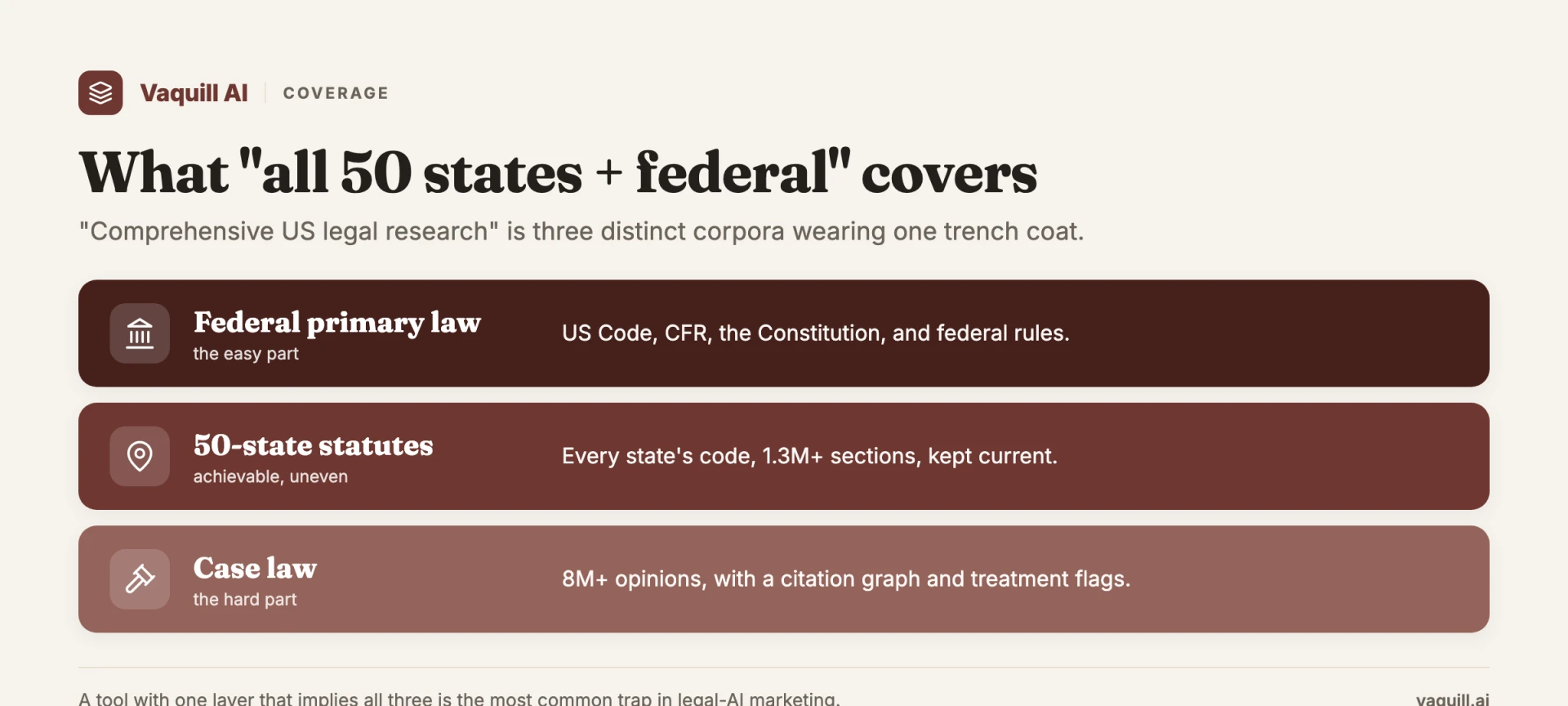
US legal research is three distinct corpora; ask which layers a tool actually has.
TL;DR
- "Free AI legal research" is two unrelated things wearing the same label: free primary-source data (Google Scholar, govinfo.gov) and free AI chatbots (ChatGPT, Perplexity, freemium legal bots).
- Free data is genuinely excellent for what it is. Free general-purpose AI is dangerous to cite, because it has no grounding layer and will invent authority that sounds correct.
- Google Scholar has no real citator. It will show you an opinion but cannot reliably tell you whether that opinion is still good law.
- The hidden cost of free is not dollars. It is verification time and malpractice exposure. ABA Formal Opinion 512 puts the duty to check squarely on you.
- The right baseline is free data plus paid grounding. Free is a fine starting point and a terrible finished workflow.
- The real free legal research tools worth bookmarking: Google Scholar, Descrybe.ai, govinfo.gov, Cornell's Legal Information Institute, and Fastcase or vLex through your bar membership.
Per the 2024 Stanford study cited here, what hallucination rate did Westlaw's AI-assisted research show?
Part of our legal AI vendor comparison and pricing series.
"Free" means two completely different products
When a solo lawyer asks whether free AI legal research exists, they usually picture one thing: a box where you type a legal question and get a researched answer, for nothing.
That product, in a trustworthy form, mostly does not exist for free. What exists for free are the two halves that, combined, would make it up.
The first half is data. The actual opinions, statutes, and regulations. The raw material.
The second half is the AI layer. The thing that reads a question, searches the data, and writes an answer with citations.
Free options exist for each half. They almost never exist together in a form you would stake a filing on.
Conflating the two is the single most common mistake I see lawyers make when they go shopping for "free," and it is exactly the mistake that put Steven Schwartz in front of a judge.
| What you want | Free options | What is missing |
|---|---|---|
| Read the actual law | Google Scholar, govinfo.gov | No real citator, no good-law check |
| Get an AI answer with citations | ChatGPT, Gemini, Perplexity free tiers | No grounding, citations may be invented |
| Grounded research with verified cites | (none, this is the paid part) | Retrieval over a real corpus, click-through verification |
The free data is real, and it is good
Start with the good news, because it is genuinely good.
Google Scholar indexes a deep archive of US federal and state case law alongside its academic papers. You can read full opinions, search by keyword, and follow citations.
For a solo who needs to pull up Carpenter v. United States, 585 U.S. 296 (2018), or check the holding in Loper Bright Enterprises v. Raimondo, 603 U.S. 369 (2024), it works. No login, no meter.
govinfo.gov and Cornell's Legal Information Institute round out the free primary-source layer for statutes and regulations: authenticated US Code, the CFR, and the Federal Register, with no login and no meter.
If you want primary sources without a Westlaw login, this is where serious people go.
So if your question is narrowly "can I read the actual law for free," the answer is an unqualified yes. Read how AI legal research actually works and you will see why this raw data layer matters so much: a grounded AI tool is only as honest as the corpus it is forced to cite from.
But here is where the free-data story quietly breaks.
Free data cannot tell you if a case is still good law
This is the part nobody mentions in the "use Google Scholar, it's free" advice, and it is the part that matters most in practice.
Google Scholar has no real citator. It has a "How cited" panel that lists opinions referencing your case, which is useful as a starting point. But it is not Shepard's, it is not KeyCite, and it is not BCite.
It will not flag, in red, that your case was reversed on appeal or overruled by a later decision. Both Clio and the Library of Congress's own legal-research guide make this point bluntly: to confirm a case is still good law on Scholar, you have to manually read through the citing opinions yourself and reason about whether any of them killed your authority.
Consider Chevron v. NRDC, 467 U.S. 837 (1984). For forty years that was the most-cited administrative-law case in the country. Then Loper Bright overruled it in 2024.
A paid citator screams that at you the instant you pull up Chevron. Google Scholar will happily show you the 1984 opinion in pristine condition, with no banner, no warning, nothing. If you do not already know the history, the free tool will not save you.
That is the hidden cost of free data: it shifts the entire burden of verification onto you, and verification is the expensive part of legal research. The reading is cheap. Knowing whether what you read still controls is the job.
For related vendor / pricing / buyer-guide coverage, see Best AI Legal Research for Solo Attorneys on a Budget (2026) and How Much Does an AI Legal Seat Really Cost in 2026? Reading Quotes Like a Buyer.
The free legal research tools worth bookmarking
Here is the practical list. These are the free tools and databases I actually point budget-conscious lawyers to, what each one gives you, and where each one stops. Most are free primary-source databases; a couple add a free AI layer. None of them, on their own, is a finished research system, and the table says why.
| Tool | What it is | Free tier gives you | Where it stops |
|---|---|---|---|
| Google Scholar | Free case-law and journal index | Full opinions, keyword search, a basic "How cited" list, no login | "How cited" is not Shepard's or KeyCite; no good-law flag |
| Descrybe.ai | Free AI search over case law | Plain-language AI summaries over millions of opinions, no sign-in for the free version | Coverage still expanding by state; verify every cite against the opinion |
| govinfo.gov | US GPO official source | Authenticated US Code, the Federal Register, the CFR, bills | Statutes and regs only; no case law, no AI |
| Legal Information Institute | Cornell Law open library | Free US Code, CFR, Supreme Court opinions, the Wex legal dictionary | Reference library, not a search-and-answer tool |
| Fastcase / vLex | Premium database, free via bar membership | Near-Westlaw-level case and statute coverage, often a citator, through many state and local bars | Free only if your bar includes it; not an open-web login |
| Oyez | Supreme Court archive | Free plain-English case summaries, audio, transcripts | US Supreme Court only |
A few honest notes on this list. Google Scholar is the easiest free way to read full opinions, but its "How cited" panel is not a real citator. Check your bar association first, because Fastcase or vLex through your bar is often the single biggest free upgrade available to a solo, and it can include a citator that the open-web tools lack. State bars that have offered this include California, Texas, Florida, and many others; confirm current terms with your own bar.
What none of these free tools do, including the AI-enabled ones, is hand you a reliable good-law check. That gap is the whole story, so here is why it bites.
The free AI is fluent, ungrounded, and the actual hazard
Now the other half. The chatbots.
A free ChatGPT, Gemini, or Perplexity session will answer a legal question instantly and in confident, well-organized prose. This is the experience that feels like "free AI legal research," and it is the most dangerous thing on this entire list.
General-purpose models are trained to produce plausible text. They are not connected, by default, to a verified legal corpus. So when you ask for case support, the model does what it was built to do: it generates text that looks like a citation.
Sometimes the citation is real. Sometimes it is a confident fabrication of a case that never existed, attached to a holding that sounds exactly like what you wanted to hear. Mata v. Avianca was not a freak event. It was the predictable output of asking an ungrounded model to do a grounded task.
And do not comfort yourself that this is a free-tier problem the expensive tools have solved. The most sobering data point in this whole conversation comes from a 2024 Stanford study published in the Journal of Empirical Legal Studies: even paid, premium legal-AI tools hallucinated.
The researchers reported hallucination rates around 17% for Lexis+ AI and roughly 34% for Westlaw's AI-assisted research. Those are tools with real legal databases bolted on, sold for thousands of dollars, and they still invented or misstated authority a meaningful fraction of the time.
Sit with the implication. If the grounded, expensive tools hallucinate at those rates, an ungrounded free chatbot is not somewhere in the same range.
It is necessarily worse, because it lacks the very mechanism (forced retrieval from a real corpus) that brought the paid tools down to those numbers in the first place. The free chatbot is not a budget version of legal AI. It is a different and more hazardous animal.
I have written more about this failure mode in AI hallucinations and the sanctions that follow.
What most people get wrong
Here is the trap, stated plainly.
People treat "free legal data" and "free legal AI" as the same shelf in the same store. They are not.
Google Scholar gives you real, citable opinions and zero AI answering and no reliable good-law check. The free chatbots give you fluent answers, real-feeling citations, and no grounding whatsoever. Neither one, by itself, is safe to drop into a brief.
The dangerous middle is where lawyers actually live: they read a case on Scholar (real), then ask a free chatbot to "summarize the law" on the issue (ungrounded), then trust the chatbot's framing because they already saw one real case and the rest sounded consistent.
That blend feels like rigorous free research. It is two different tools, each doing the half it cannot do safely.
The honest framing: free is a fine baseline and a terrible workflow. Free data is your library. Free chatbots are a brainstorming partner with a documented lying problem. Neither is a research system.
The hidden cost has a name, and it is competence
In July 2024, the ABA issued Formal Opinion 512 on a lawyer's use of generative AI. The headline is unglamorous and absolute: your duty of competence does not bend for the tool.
You are responsible for the accuracy of everything you file, regardless of what produced the first draft. The AI's confidence is not a defense. "It told me the cases were real" is, almost word for word, what did not work in Mata.
So price the "free" tool honestly. The subscription is zero. The cost is the hours you must now spend independently confirming every proposition and every citation, because the free layer either cannot verify good law (Scholar) or actively invents it (free chatbots).
For a solo billing their own time, that verification labor is the most expensive line item in the whole exercise. Free software, expensive lawyer. I walk through the full math in what legal research actually costs in 2026.
So what should a budget-conscious lawyer actually do
Stack the free layer correctly, then pay for the one thing free cannot give you.
Use the free data as your source of truth. Google Scholar and govinfo.gov are excellent for reading opinions and pulling statutory text. There is no reason to pay for the privilege of reading public law. Genuinely, use them.
Never let a free, ungrounded chatbot near a citation. Use it to outline an argument or rephrase a paragraph if you like. Do not let it tell you what the law says. It does not know; it predicts.
Pay for grounding and a citator, not for an AI personality. The thing worth money is a system that searches a real corpus, answers your actual question, and hands you citations you can click and verify against the underlying opinion.
That is the gap between a chatbot and legal research: a chatbot generates a citation, a grounded tool retrieves one and shows you where it came from.
This is the design principle behind any honest grounded legal research tool: answers should be generated only from real US federal and state opinions, every citation should link back to the source opinion so a reader verifies in one click, and a layered verification step exists precisely because the Stanford numbers proved that "we have a database" is not the same as "we don't hallucinate."
On the developer side, a public statutes API covers US Code, the CFR, and 52 state and territory codes (over 4 million sections); case-law access stays inside the in-product research flow, not the API. The point is not which logo you write the check to. The point is that the feature worth paying anyone for is the one free chatbots structurally cannot have.
If you want the actual comparison shopping (which tools, which tiers, what they cost, who they fit), that is a different exercise than this one, and I wrote it up separately for solo attorneys on a budget and for solo practitioners specifically.
This post is only here to settle the "is it free" question and to keep you out of the Mata hole. That post tells you what to buy once you have accepted that some part of this has to be bought.
FAQ
Is there a truly free AI legal research tool? Partly. Descrybe.ai gives free AI summaries over millions of real opinions with no sign-in, and Google Scholar gives free access to the underlying case law. What does not exist for free is a tool that retrieves from a verified corpus, answers your question, and hands you citators-checked cites you can stake a filing on. Free covers the data and some summarizing; grounding plus a good-law check is the paid part.
What is the best free legal research tool? For primary sources, Google Scholar is the easiest free way to read full opinions, and govinfo.gov plus Cornell's Legal Information Institute cover statutes and regulations. If your state or local bar includes Fastcase or vLex, that is often the best free upgrade because it can add a citator the open-web tools lack.
Can I use ChatGPT or Gemini for free legal research? Use them for brainstorming, outlining, or rephrasing, not for what the law says. Free general-purpose chatbots are not connected to a verified legal database by default, so they can fabricate cases that sound real. That failure mode is exactly what sanctioned the lawyer in Mata v. Avianca.
Does Google Scholar tell you if a case is still good law? No. Its "How cited" panel lists later opinions that reference your case, but it is not Shepard's, KeyCite, or BCite, and it will not flag a reversal or overruling. Both Clio and the Library of Congress legal-research guide make this point: on Scholar you confirm good law by reading the citing opinions yourself.
Is free legal AI safe to use? Free primary-source databases are safe to read and cite, as long as you run your own good-law check. Free general-purpose chatbots are not safe to cite from, because they have no grounding layer. Under ABA Formal Opinion 512, the duty to verify everything you file stays with you no matter what produced the draft.
Do free AI legal tools hallucinate? General-purpose chatbots do, often. Even paid, grounded tools were not clean: a 2024 Stanford study reported hallucination rates around 17% for Lexis+ AI and roughly 34% for Westlaw's AI-assisted research. An ungrounded free chatbot lacks the retrieval mechanism that brought those numbers down, so it is necessarily worse.
Is it free to read US statutes and regulations? Yes. govinfo.gov from the US Government Publishing Office gives you authenticated US Code, the CFR, and the Federal Register, and Cornell's Legal Information Institute mirrors the US Code and CFR for free. State codes are published free on each state's legislature site.
The one-sentence version
Free AI legal research, in the sense most people mean it, is a category error. There is free legal data, which is real and good and you should use it. There is free legal AI, which is fluent and ungrounded and will eventually hand you a case that does not exist.
The thing worth paying for sits exactly between them: grounding. Everything else, the reading, the brainstorming, the rough drafts, you can absolutely get for nothing.
New legal AI guides, weekly.
Further Reading
Legal AI Tools for Solo Practitioners: 7 Picks That Fit a One-Person Firm
Read postPersonal Injury AI in 2026: What It Actually Does for Plaintiff Lawyers
Read post7 Ways AI Helps Personal Injury Lawyers Win Cases Faster
Read postAI for Family Law: How Solo and Small-Firm Family Lawyers Use It
Read postTop AI Legal Research for Solo Attorneys on a Budget
Read postWhat AI Legal Tools Are Actually Trained on Federal and State Case Law
Read post
Product & Content
Legal AI suite for US working lawyers: research, drafting, document comparison, document matrix, matters, and citation-verified answers, in one tool.