Spend a week in a solo family-law practice and you stop romanticizing the work. The courtroom drama is maybe a tenth of it. The rest is a banker's box of bank statements, a client who texts at 11 p.m. because the other parent showed up early for pickup, a financial disclosure that is technically complete and quietly missing a brokerage account, and a hearing in nine days that you have not started preparing for because you spent yesterday reconciling someone's credit-card spending against their sworn income.
This is where AI for family law actually earns its keep, and it is not the part anyone demos on stage. The pitch decks show a parenting plan drafting itself. The real value is in the boxes of paper.
Short answer: the best uses of AI for divorce lawyers in a solo or small firm are financial-disclosure review across the full document set, chronology and custody-timeline building, first drafts of standard agreements and motions, version redlines, and statute and guideline-math lookups. Keep every best-interest, settlement, and read-the-client judgment for yourself, and verify any number or clause before it touches a filing. The affordable family law AI tools below range from roughly $39 to $300 a month for a solo, with the heavyweight research suites running higher.
That gap matters because of who is in this practice area. Family law is dominated by solos and tiny firms, and those are precisely the lawyers least likely to have adopted AI, even though they are drowning in the exact administrative load AI is good at.
The opportunity is lopsided, and so is the danger. Used on documents and records, AI is close to a force multiplier for a one-person shop. Used on the judgment calls that define a custody case, it is a confident liability.
This is the solo and small-firm tool-and-use guide. If you want the firm-level process map (intake, discovery, filing pipelines, who does what), read the companion AI for family law firms workflow playbook. This page stays on which tasks to hand the machine, which tools fit a one-person budget, and where a wrong answer will hurt you.
TL;DR
- The ABA's 2024 Legal Technology Survey (released March 2025) found 30% of lawyers use AI overall, but only 18% of solo practitioners do, versus 46% at firms of 100+ lawyers. The lawyers who need the leverage most have adopted it least.
- AI is genuinely transformative on the unglamorous 80% of family law: financial-disclosure review, document assembly, deadline and chronology tracking, statute lookup, and guideline math.
- It is dangerously seductive on the 20% that decides outcomes: the best-interest-of-the-child weighing, settlement strategy, and the emotional read of a client.
- The realer risk is not fabricated case law (the Mata v. Avianca failure). It is a plausible parenting-plan clause or asset summary that is subtly wrong for your jurisdiction, or that omits a disclosed asset, and gets signed off because it reads right.
- The right deployment: AI on the paper and the timeline, a human on every judgment call. Verify everything that touches a filing.
Per the ABA's 2024 survey cited here, what share of solo practitioners use AI?
Part of our legal AI vendor comparison and pricing series.
Family law AI tools at a glance
Most "best AI software for family law" lists mix three different kinds of product under one heading, which is how solos end up paying research-suite prices for a drafting job. Sort them by what they actually do first, then by price.
These are the categories a solo or small family practice actually shops, with public list prices where the vendor publishes one. Prices are per user per month and were checked June 2026; where a vendor only quotes on request, that is noted, and you should confirm current numbers before you buy.
| Category | Representative tools | Public price (per user/mo) | Best for |
|---|---|---|---|
| Practice management + AI add-on | Clio (Clio Duo), MyCase, PracticePanther | ~$39 and up (Clio Duo add-on tier, Clio pricing, June 2026) | Running the firm: calendaring, billing, light drafting |
| Drafting / document AI | Spellbook, Paxton | Paxton ~$159 (counselpro.ai roundup, June 2026); Spellbook quote-based | First drafts of agreements, motions, declarations |
| Legal research suites | CoCounsel, Lexis+ AI, Westlaw Precision | $100 to $500 (Divorce.law 2026 guide range, June 2026) | Case law, statutes, deep research |
| Family-law-specific | Divorce.law (Victoria AI), Family Law Software | $297 to $697 flat (Divorce.law 2026 guide, June 2026) | Jurisdiction forms, support/alimony calculators |
| Document review / matrix | General-purpose document AI, including Vaquill AI | Quote-based / on request | Disclosure review across dozens of files at once |
Two honest caveats on this table. The prices are vendor-published or third-party-reported, not a sticker we negotiated, so treat them as a starting point. And the categories overlap: CoCounsel does drafting too, Paxton does some research, so the "best for" column is about where each one is strongest, not its only trick.
Why the lawyers who need it most use it least
The headline number from the ABA's 2024 survey is that AI adoption is climbing: about 30% of lawyers now report using it. Dig one layer down and the adoption gap is stark. Solo practitioners sit at 18%. Firms with 100 or more lawyers sit at 46%. More than a two-and-a-half-fold difference.
That is backwards from where the leverage should go. A 200-lawyer firm has associates, paralegals, a knowledge-management team, and a litigation-support department. A solo family-law lawyer has herself and maybe a part-time assistant, and she is the one staring down the box of statements.
If any segment of the profession should be racing to automate the grunt work, it is the solos. Instead they are the most hesitant.
The survey is clear on why. Roughly three-quarters of the lawyers who have not adopted AI cite hallucination, the model confidently stating something false, as a primary concern. That is a rational fear, not technophobia.
It is also a fear that points you to the right answer rather than away from the tool: the fix for hallucination is grounding and verification, and the way to manage the risk is to deploy AI where a wrong output is catchable and cheap, not where it is invisible and decisive. We will come back to that distinction, because in family law it is the whole game.
The 80% where AI actually helps
Family-law practice is unusually document-heavy and deadline-dense for how little of it is published-opinion legal research. Here is where the leverage is real.
Financial disclosure review
This is the single best argument for AI in a family practice, and it is also the use case that single-document chat tools handle badly. A contested divorce produces dozens of artifacts: years of bank and brokerage statements, pay stubs, tax returns, retirement account summaries, credit-card histories, business records if a spouse owns a company.
The work is not reading any one of them. It is reconciling all of them against each other and against the sworn financial affidavit, then noticing what is missing.
A chat interface that ingests one PDF at a time cannot do that. What you want is extraction across the whole set into a structured grid: account, institution, balance, date, source document, so you can scan a column and spot the 401(k) that appears in the 2023 tax return but never shows up in the disclosure.
That is the kind of job a document matrix is built for, pulling the same fields across dozens of documents into a table you can sort, rather than asking one question of one file at a time.
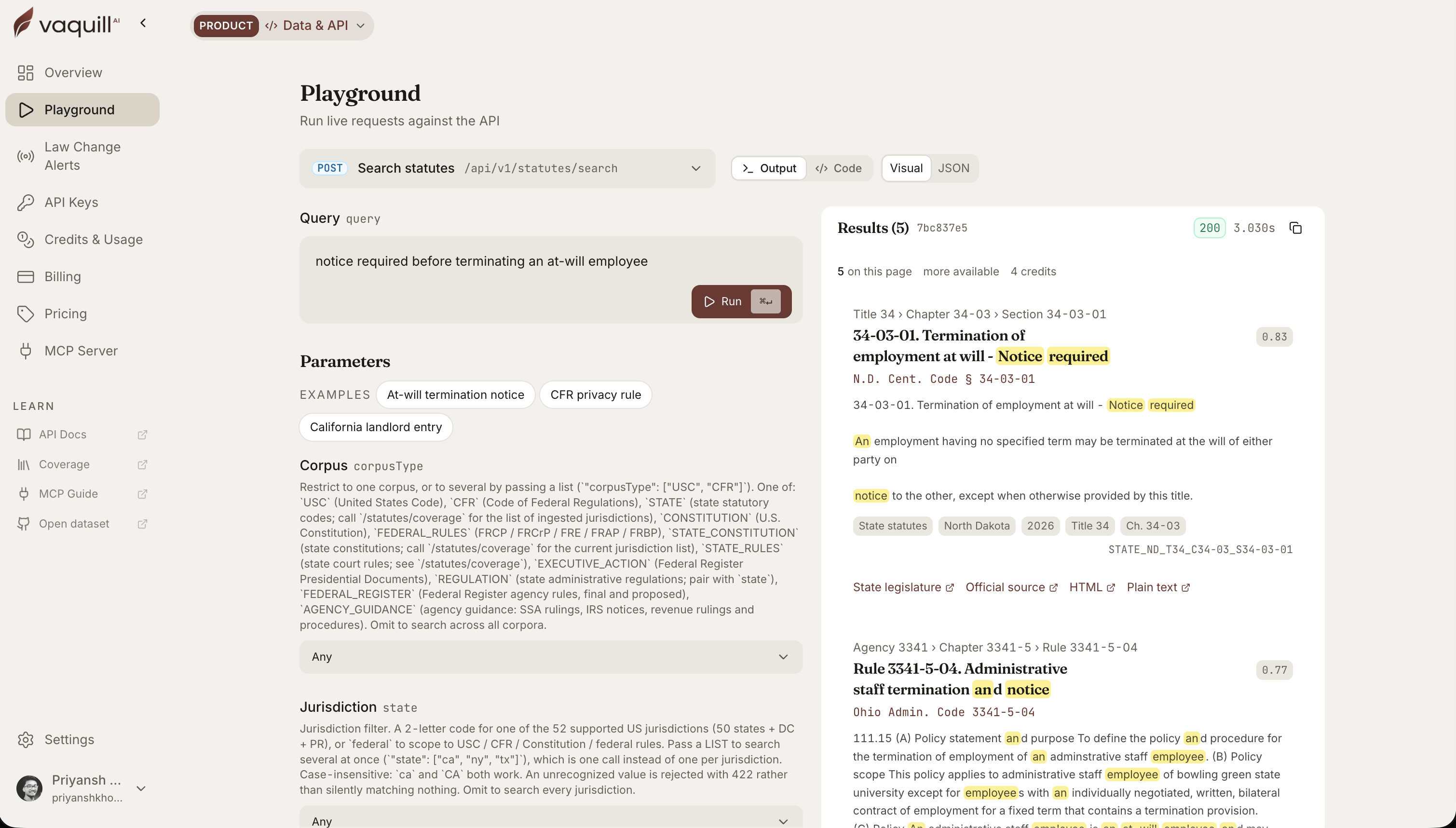 The same corpus behind this article, queried live. Every result carries its citation and a link to the official source.
The AI does the tedious extraction. You do the noticing. That division of labor is exactly right.
A caution worth stating plainly: extraction is not verification. The model can transcribe a balance wrong, or attribute a deposit to the wrong account. Treat the grid as a fast index into the source documents, not a substitute for them.
A worked example: the account that does not match the affidavit
Here is the kind of catch this workflow is for. Say you extract every account across a contested divorce file into a grid. Three populated rows look like this:
| Account | Institution | Balance | As of | Source doc |
|---|---|---|---|---|
| Checking ...4412 | First National | $8,210 | 2024-12-31 | Sworn financial affidavit |
| Brokerage ...8830 | Fidelity | $61,540 | 2023-12-31 | 2023 joint tax return (Sched. B) |
| 401(k) ...2207 | Vanguard | $142,900 | 2024-06-30 | Q2 2024 statement |
The grid surfaces the discrepancy you would otherwise miss flipping between PDFs: the Fidelity brokerage shows up on the 2023 tax return as generating dividend income, but it never appears in the sworn affidavit. That is your one-line flag: Brokerage ...8830 produced 1099-DIV income in 2023 but is absent from the disclosure; ask about it in the deposition.
The model did the extraction. The discrepancy is a fact in the documents. Whether it is an honest omission or a hidden asset is your call, and the follow-up is your work, not the tool's.
Chronologies and custody timelines
Custody fights run on timelines. Who had the kids which weekends, when the missed pickups happened, the sequence of texts before the restraining-order request, the pattern of late support payments. Building that by hand from emails, messages, and a client's recollection is slow and error-prone, and the sequence is often the case.
This is what a chronology builder is for: feed it the records and it assembles a dated, sourced timeline you can edit and drop into a brief.
The value is not just speed. A clean chronology surfaces patterns you would miss flipping between exhibits, the cluster of incidents around a specific month, the gap that undercuts the other side's narrative. Here too, the AI assembles and you judge. Whether a pattern is legally meaningful is your call, not the model's.
Document assembly and first drafts
Family law runs on forms and repeatable agreements: marital settlement agreements, parenting plans, financial declarations, standard motions. AI is good at first drafts of structured documents, and good at comparing versions.
When the other side sends back a revised MSA, you want a clean redline showing exactly what moved, which is the same document comparison discipline lawyers already use for commercial contracts. The mechanics transfer directly: AI generates and compares, you review every substantive change.
The boundary to hold: a first draft is a starting point, never a filing. The most dangerous output in family law is a parenting-plan clause that is well-written and subtly wrong for your state, which is a problem we will get to.
Statute lookup and guideline math
Family law is heavily statutory, and the statutes are knowable. California's custody analysis runs through its best-interest factors at Cal. Fam. Code 3011 and the joint-custody provisions at 3040. Child support runs on a statewide guideline formula at Cal. Fam. Code 4055.
AI is genuinely useful here: it can pull the operative section, explain the factors in plain language, and run the arithmetic of a guideline calculation faster than you can open the worksheet. Tools that ground statute answers in the actual code text, rather than the model's memory, are the ones worth using, and a statutes and legislation search (USC, CFR, and 50-state codes) is the right primitive for this.
What AI does not get to do is the part that follows. The guideline number is math; the deviation from guideline, and whether the best-interest factors cut toward one parent, is discretion the statute hands to a judge. The model can lay out the factors. It cannot weigh them for your client, and it should not pretend to.
(Scope reminder on APIs: the public statutes API is statutes/legislation only, not a case-law or grounded-answer endpoint; those are in-product features.)
For related vendor / pricing / buyer-guide coverage, see AI for Family Law Firms: A Workflow Playbook for Intake, Discovery, Filings and The Best Legal Research Tools for Solo Attorneys Doing Mostly Family Law.
The 20% where you do not trust the machine
Here is the opinionated core of this piece. The reason family law is the practice area where AI's value is most lopsided is that the work splits cleanly into two kinds, and AI is excellent at one and quietly hazardous at the other.
The hazardous kind is judgment under uncertainty about human beings. What custody arrangement actually serves this child. Whether this client should take the settlement or hold for trial. Whether the parent across the table is bluffing or breaking. Whether your own client is telling you the whole truth.
None of that is in the documents. It lives in tone, history, and a read of people that no model has, because the model has never been in the room.
The trap is that AI will answer those questions anyway, fluently and with total confidence. Ask a general-purpose model to recommend a parenting schedule and it will produce one, polished and plausible, with no idea that the father works night shifts or that the eight-year-old has severe anxiety about transitions.
The output is not flagged as a guess. It reads like advice.
The failure mode most people get wrong
When lawyers worry about AI, they usually picture Mata v. Avianca: the 2023 case where lawyers filed a brief full of citations ChatGPT invented, and got sanctioned for it. That is a real risk, and the fix is well understood, verify every citation against the actual source before it goes in a filing.
We have written about the sanctions cases and how to avoid them and about how grounded, RAG-based research differs from a model riffing from memory.
But fabricated citations are the loud failure. They are catchable precisely because they are checkable: a fake case either exists in the reporter or it does not. The quieter, more dangerous failure in family law is the plausible-but-wrong judgment-laden output.
A parenting-plan provision that is unenforceable in your jurisdiction. An asset-division summary that silently drops a disclosed account because it did not appear in the documents the model happened to weight. A support estimate that reads authoritative and applied the wrong county's local rules.
These do not announce themselves. They pass review because they sound like something a competent lawyer would write, and there is no reporter to check them against. The failure mode is over-trust on discretionary output, not citation fabrication.
This is also why ABA Formal Opinion 512 (July 2024) lands where it does: a lawyer's duty of competence and the duty of candor do not transfer to the tool. You own the output. The model is not a co-counsel; it is a very fast, very confident junior who has never met your client.
A sane deployment for a solo or small family practice
You do not need a six-figure platform or a consultant. You need a clear line between the work you delegate to AI and the work you keep.
Delegate to AI: financial-disclosure extraction across the full document set; chronology and timeline assembly from records; first drafts of standard agreements, declarations, and motions; redlines comparing document versions; statute pull-ups and guideline calculations; routine correspondence summaries.
Keep for yourself, always: the best-interest determination; settlement-versus-trial strategy; the read on opposing parties and your own client; any number or clause that goes in a filing, until you have traced it to its source; the final judgment on whether a pattern in the timeline actually means what it looks like it means.
A few operating rules that hold this together:
- Ground, then verify. Prefer tools that cite the document or statute they are answering from, and open the source before you rely on it. This is the entire answer to the hallucination fear that keeps most solos out.
- Mind the data, and the privilege. Family-law files are among the most sensitive documents a lawyer touches: financials, medical references, children's information. Before you upload anything, know whether the vendor trains on your inputs and where the data sits. We dug into where legal AI data actually goes, and for a family practice it is not an optional question. The privilege risk is not theoretical: in 2026, courts and bar commentators have warned that pasting client facts into a public consumer chatbot can be treated like handing them to a third party, which can waive attorney-client privilege. Use a tool with a business agreement that keeps your inputs out of training, not the free public chatbot.
- Pilot on one matter. Run a single contested-financials case through the document workflow before you change your whole practice. Measure the hours, not the marketing claims.
On those marketing claims: the trade press around family-law AI throws around numbers like 50 to 70% of drafting time saved, or six figures in recovered billables. Treat those as vendor-reported, because that is what they are.
The ABA's "Why Family Law Needs AI More Than Any Other Practice Area" framing is directionally right about the document-heavy reality of the work, and the vendor figures may even be achievable for your practice, but they are not independent measurements. Your own pilot is.
Where this leaves the solo family lawyer
The honest read is that the 18% adoption number among solos is a temporary state, not a permanent one. The hesitation is rational, and the answer to it is not "trust the AI more." The answer is to point AI at the work where a wrong output is cheap and catchable, the boxes of paper and the timelines, and to keep a human firmly on the work where a wrong output is invisible and decisive.
If you run a small family practice and you are still on the sidelines because you heard about the lawyer who got sanctioned, you are reacting to the wrong risk. Build the discipline of verification, deploy on documents and records, and the leverage is real.
Just never let a model make the best-interest call. That one is yours. It was always going to be yours.
We build Vaquill AI, a legal AI suite with a document matrix and chronology builder aimed at exactly the document-heavy 80% described here, with statute and citation grounding so answers point back to a source you can open. If you want to test the disclosure-review workflow on one matter, that is the honest place to start. Whatever tool you pick, the rule holds: ground it, verify it, and keep the judgment.
For more on fitting this into a one-person shop without overspending, see our guides for solo attorneys on a budget, the small-firm tech stack for 2026, the best legal research tools for solo family-law attorneys, and the solo-practitioner use case.
FAQ
What is the best AI for family law? There is no single best tool, because family-law work splits into different jobs. For disclosure review across many files, a document-matrix tool wins; for first drafts of agreements and motions, a drafting assistant like Spellbook or Paxton; for case law and statutes, a research suite like CoCounsel or Lexis+ AI. A solo should buy for the task eating the most hours, not the longest feature list.
How do divorce lawyers use AI? The practical uses are reconciling financial disclosures against the sworn affidavit, building dated custody chronologies from records, drafting first versions of marital settlement agreements and parenting plans, redlining the other side's revisions, and pulling statutes and running guideline support math. The judgment calls (best interest, settle-or-try, reading the client) stay with the lawyer.
Is it ethical to use AI in a divorce case? Yes, with supervision. ABA Formal Opinion 512 (July 2024) confirms a lawyer's duties of competence and candor do not transfer to the tool, so you own the output and must verify it. The bigger ethics trap is confidentiality: do not paste client facts into a public consumer chatbot, which can waive privilege.
How much do AI tools for family lawyers cost? For a solo, useful tools run roughly $39 a month for a practice-management AI add-on up to about $300 a month for a drafting assistant, with full research suites reported at $100 to $500 a month and family-law-specific platforms at $297 to $697 flat (divorce.software 2026 guide and counselpro.ai roundup, June 2026). Confirm current pricing with each vendor.
Can AI write a parenting plan? AI can produce a first draft of a parenting plan from your inputs, and it is good at the structured, repeatable parts. It cannot decide what schedule actually serves a specific child, and a clause that reads well can be unenforceable in your jurisdiction. Treat any AI parenting-plan draft as a starting point you rewrite, never a filing.
Will AI make up case law in a family-law brief? A general-purpose model can fabricate citations, which is what got lawyers sanctioned in Mata v. Avianca (2023). Use a grounded tool that cites the actual source and check every citation before filing. In family law the quieter risk is a plausible but wrong discretionary output, like a support estimate using the wrong county's rules, so verify substance, not just citations. See our writeup on AI hallucinations and sanctions and on how grounded RAG research works.
Is it safe to put client financial documents into AI? Only with a tool that contractually keeps your inputs out of training and stores data in a known place. Family-law files carry financials, medical references, and children's information, so vendor data handling is a gating question, not a footnote. We cover the specifics in where your legal AI data actually goes.
New legal AI guides, weekly.
Further Reading
Legal AI Tools for Solo Practitioners: 7 Picks That Fit a One-Person Firm
Read postPersonal Injury AI in 2026: What It Actually Does for Plaintiff Lawyers
Read post7 Ways AI Helps Personal Injury Lawyers Win Cases Faster
Read postAI for Family Law Firms: A Workflow Playbook for Intake, Discovery, Filings
Read postAI for Criminal Defense: Research, Timelines, Evidence Review
Read postLegal AI Suite Intake-to-Filing Workflow: A Day in the Matter
Read post
Co-Founder & CEO · Attorney
Arshita leads product and strategy at Vaquill, building the legal AI suite that solo, small-firm, and in-house US lawyers use to run a matter end to end.