
Part of the complete guide to Legal AI for In-House Counsel.
A general counsel at a mid-cap automotive supplier put it bluntly on a call this spring. "We had a containerized shipment of lithium-ion cells held at Long Beach for forty-one days. The CBP detention order cited UFLPA. Nobody on my team had read the importer's affidavit our supplier signed in 2023. By the time we tracked it down, we were paying demurrage on three other containers behind it."
That is the actual job of manufacturing in-house counsel in 2026. Triaging a forced-labor detention at a port while the plant in Tennessee runs out of cells in six days.
The legal AI conversation as written for the last two years has almost nothing to say about that job. Most of it is shaped for AmLaw transactional practice or solo plaintiff work.
Manufacturing in-house counsel sit in a different building: trade, customs, export controls, product liability, ESG disclosure, and thousands of supplier MSAs nobody has reread since signing. This post is the honest map.
Short answer: Legal AI for manufacturing in-house counsel is most useful on three jobs: reading thousands of supplier agreements as one matrix (which suppliers lack the forced-labor or export-control clauses you need), drafting and redlining master purchase and supply terms against a manufacturing playbook, and surfacing analogous regulatory enforcement (CBP rulings, BIS denial orders, CPSC consent decrees). It is weak on HTS and ECCN classification, where a specialty trade-compliance suite still wins. Plan on two or three tools, not one.
TL;DR
- Manufacturing in-house faces a stack other in-house teams do not. Tariffs (Sections 232, 301, IEEPA), forced-labor (UFLPA, Public Law 117-78), export controls (EAR at 15 CFR Parts 730-774, ITAR at 22 CFR Parts 120-130), OFAC sanctions, CPSC exposure (15 USC 2051 et seq.), and increasingly SEC and California climate disclosure. All running concurrently across hundreds to thousands of supplier agreements.
- Five workstreams absorb almost the entire calendar. Supplier contract management at scale, tariff classification and Section 232/301/UFLPA compliance, EAR and ITAR licensing, product liability and recalls, ESG and climate disclosure.
- Six evaluation criteria for manufacturing-fit legal AI. HTS classification and Customs research depth, UFLPA and sanctions screening integration, multi-jurisdictional contract templates, product liability case law research, regulatory tracking across EAR/ITAR/CPSC, and SOC 2 plus ITAR-aware handling of technical data.
- Five vendor archetypes match the work in 2026. Westlaw Precision for trade and Customs research, Bloomberg Law for regulatory and sanctions tracking, specialty trade compliance suites (Descartes Visual Compliance, Amber Road, Integration Point), specialty CLM (Ironclad, LinkSquares) with supplier modules, and general-purpose legal AI workbenches (Harvey, GC AI) for general counsel work.
After the June 4, 2025 change, what is the Section 232 tariff rate on steel and aluminum?
Part of our legal AI vendor comparison and pricing series.
Why manufacturing in-house has a different workload
In-house counsel at a SaaS company spends the week on inbound vendor MSAs, customer DPAs, and the occasional acquisition.
In-house counsel at a manufacturer spends the week on a portfolio that looks more like a bank's: thousands of supplier agreements, each tied to a part number, an Incoterm, an HTS code, a country of origin, and regulatory exposures the SaaS GC never has to think about.
Portfolio scale is the first delta. A Tier 1 automotive supplier typically runs three thousand to seven thousand active supplier agreements, signed across a fifteen-year window during which the standard MSA was revised at least four times and acquired companies brought in their own paper.
"What does our supplier base actually owe us on forced-labor cooperation" is, mechanically, a document-matrix problem against a heterogeneous stack nobody has touched since signing.
Regulatory concurrency is the second. Almost every Tier 1 manufacturer is, simultaneously, an importer of record under the Tariff Act, a US Person under the EAR, possibly registered with DDTC under ITAR, a manufacturer subject to CPSC reporting under 15 USC 2064, a workplace under OSHA, a discharger under at least one EPA permit, and a covered entity under at least one state climate statute. Each regime runs on its own clock.
The penalty math is the third. ITAR violations under 22 USC 2778 reach $1 million per occurrence on the criminal side. CPSC penalties under 15 USC 2069 can run to $120,000 per violation, indexed annually. UFLPA detentions assess no fine; they strand inventory.
CBP's UFLPA enforcement dashboard reports more than 18,000 shipments worth roughly $3.81 billion reviewed under UFLPA through early 2026, and FY 2025 alone saw about 7,325 shipments stopped, with only around 6.5% ultimately released (CBP UFLPA Statistics, as summarized by Troutman Pepper Locke and AAEI, 2025-2026). A detention is a clock running against your production schedule.
Portfolio scale plus regulatory concurrency plus high penalties is what makes manufacturing in-house different. AI gets evaluated against that triangle or it does not earn the seat.
The federal regulatory map
A manufacturing GC's bookshelf is statute and regulation citations they have to know cold.
Tariffs. Three live statutes in 2026. Section 232 of the Trade Expansion Act of 1962 (19 USC 1862) is the national-security tariff authority used for steel, aluminum, copper, and an expanding derivatives list.
After the May 30, 2025 announcement effective June 4, 2025, the rate is 50% on steel and aluminum (10% for the UK), up from the 25% and 10% legacy rates set in 2018. The Commerce inclusions process added over 400 product codes in August 2025; April 2026 modifications shifted tariffs onto the full value of certain goods rather than the metal-content portion.
Section 301 of the Trade Act of 1974 (19 USC 2411) is the unfair-trade authority used against China. IEEPA (50 USC 1701) is the emergency authority used for the reciprocal tariffs imposed in 2025.
Forced labor. The Uyghur Forced Labor Prevention Act, Public Law 117-78, creates a rebuttable presumption that any good "mined, produced, or manufactured wholly or in part" in the Xinjiang Uyghur Autonomous Region, or by entities on the UFLPA Entity List, is made with forced labor and barred from import under 19 USC 1307.
The Forced Labor Enforcement Task Force priority sectors expanded in 2025 to add caustic soda, lithium, steel, jujubes, and copper to the original list (aluminum, apparel, cotton, polysilicon, PVC, seafood, tomatoes).
Export controls. The Export Administration Regulations at 15 CFR Parts 730-774 govern dual-use items under Commerce's BIS. The Commerce Control List at 15 CFR Part 774 classifies items by ECCN; EAR99 catches the residual.
The International Traffic in Arms Regulations at 22 CFR Parts 120-130 govern defense articles under DDTC at State, with the US Munitions List at 22 CFR 121 as the inventory. A manufacturer of avionics components is almost certainly ITAR-registered.
Sanctions. OFAC runs comprehensive country programs against Russia, Iran, North Korea, Cuba, and Syria, plus sectoral and list-based programs. Authority traces to IEEPA (50 USC 1701) and the Trading with the Enemy Act.
Product safety. The Consumer Product Safety Act at 15 USC 2051 et seq. obliges manufacturers to report defects creating "substantial product hazard" under 15 USC 2064 within 24 hours of acquiring information reasonably supporting a duty to report. Recalls under 15 USC 2064(c) and (d) are negotiated; the leverage is the company's reporting record.
SEC disclosure. The SEC's climate-disclosure rule survived initial litigation but, post Loper Bright Enterprises v. Raimondo (144 S. Ct. 2244 (2024)), faces a Chevron-less standard of review. Manufacturing in-house counsel treat 2026 federal disclosure as a moving target with the floor set by California.
The state regulatory overlay
State law fills the gaps, sometimes punitively.
California Proposition 65 (Health & Safety Code § 25249.5 et seq.) requires warnings for products that expose Californians to listed chemicals. The list has run past nine hundred. Private enforcement under § 25249.7 generates the volume; manufacturers shipping consumer goods into California build Prop 65 review into every new SKU.
California SB 253 and SB 261 set the de facto floor for US climate disclosure now that federal rulemaking has slowed. SB 253 obliges public and private companies above $1B in revenue doing business in California to report Scopes 1, 2, and (from 2027) 3 emissions; SB 261 obliges companies above $500M to publish climate-related financial risk reports.
State product liability law. Strict liability under Restatement (Second) § 402A or Restatement (Third) varies by state. In a multi-state recall, the plaintiff's bar files in states with the most favorable liability rules. A 2026 in-house docket touches at minimum the products statutes in California, Illinois, New York, Texas, Florida, and Pennsylvania.
A federal-only compliance program in a Tier 1 manufacturer is, in 2026, malpractice.
The five workstreams AI actually compresses
Where does AI compress real time, and where is it a distraction?
Supplier contract management at scale. A 4,000-contract supplier portfolio is the canonical document-matrix use case. Columns: governing law, liability cap, indemnity scope, forced-labor cooperation clause, export-control flow-down, audit rights, change-of-control trigger. Rows: every active supplier.
The job is not "summarize one MSA." It is "which 87 of our 4,000 suppliers are missing the UFLPA cooperation language we added to the template in late 2022." That is a comparison across documents, sorted by risk.
We wrote up the pattern in what is a document matrix; the manufacturing application is the largest natural fit in the in-house world.
Tariff classification and Section 232/301/UFLPA compliance. HTS classification drives the duty rate, the Section 232 exposure, the Section 301 list mapping, and the UFLPA priority-sector flag. A manufacturer importing fifty SKUs a month does not need AI for classification; one importing six thousand does.
The question is whether the tool can read a commercial invoice, propose an HTS code with reasoning, and flag the Section 232, 301, and UFLPA overlays. Specialty trade-compliance vendors beat general-purpose legal AI by a wide margin here.
EAR and ITAR licensing. ECCN classification under the CCL is the EAR analog of HTS. Two AI moves: classification assistance (given a spec sheet, propose an ECCN grounded in the CCL and Commerce precedent, including BIS advisory opinions and DDTC commodity jurisdiction determinations), and license determination (walk the matrix in 15 CFR Part 738 against destination, end-user, end-use).
ITAR is harder because the technical-data protection rules under 22 CFR 120.10 and 120.11 mean any AI vendor handling ITAR-controlled data must demonstrate ITAR-aware infrastructure: US-person access controls, US-located processing, contractual restrictions.
Most general-purpose legal AI vendors are not ready for ITAR data. Ask directly and do not accept "we're SOC 2" as an answer.
Product liability and recalls. CPSC-side, the question is reporting timing: did facts from a field-failure report trigger the 24-hour clock under 15 USC 2064(b)? AI helps mostly with surfacing analogous CPSC enforcement letters and consent decrees.
Litigation-side, the question is case-law research across state product-liability statutes. The manufacturing GC cares less about novel doctrine and more about the operative model jury instructions and the appellate trend on specific defect theories.
The verification posture is the gate. A hallucinated product-liability case is the same Mata risk as in any other practice.
ESG and climate disclosure. The work is drafting and review against an evolving rule set: SB 253 and SB 261 reports, voluntary CDP submissions, supplier-questionnaire responses to large-customer ESG demands.
AI compresses the first draft and the cross-walk between frameworks (TCFD, IFRS S2, SEC, California). It does not replace the data assembly, which is an operational problem outside legal.
The supply agreement clauses AI actually flags
The supplier contract matrix is abstract until you see the clauses it sorts on. A manufacturing master purchase or supply agreement carries a specific set of provisions a SaaS MSA never touches. Here is what a tuned review surfaces on a real tooling-supplier agreement, with the position it breaks and the one-line flag.
| Clause in the supplier paper | What standard manufacturing practice expects | The flag |
|---|---|---|
| "Risk of loss passes EXW Supplier's plant (Incoterms 2020)." | Buyer wants FCA or DAP so the supplier, not the buyer, clears export and bears in-transit risk to a named point. | EXW pushes export clearance and loading risk onto the buyer. Counter to FCA named place. |
| "Warranty period: 12 months from delivery." | Auto and industrial buyers run 24 to 36 months, or tie warranty to field hours, to match the OEM warranty they owe downstream. | Warranty shorter than the buyer's own downstream obligation. Back-to-back gap. |
| "Supplier's aggregate liability shall not exceed the purchase price of the nonconforming goods." | Product-recall and field-action costs dwarf unit price; buyer wants recall and epidemic-failure carve-outs above the cap. | Cap excludes recall, retrofit, and product-liability indemnity. Unacceptable for safety parts. |
| No forced-labor or UFLPA cooperation clause. | Buyer needs supply-chain tracing cooperation, audit rights, and a right to terminate on a UFLPA Entity List match. | Missing UFLPA cooperation language. Cannot build the CBP documentary package. |
| No export-control flow-down. | EAR and ITAR obligations must flow down to the supplier for any controlled technical data or part. | Missing EAR/ITAR flow-down. Compliance gap on controlled items. |
| "Force majeure includes any event beyond reasonable control." | Buyer wants explicit allocation for tariffs, sanctions, and port closures, plus a duty to mitigate and a cap on excused duration. | Open-ended force majeure with no tariff or duty-to-mitigate carve-out. |
That is the artifact: a populated set of rows a reviewer can act on in one pass, well past the generic "AI reviews your contracts" pitch. The job is to run this comparison across every active supplier at once and sort by risk. Reading one agreement well is the easy part.
How the supplier-matrix review runs
The six evaluation criteria
The demo questions for a manufacturing buyer are not the generic ones.
HTS classification and Customs research depth. Can the tool propose an HTS code from a product spec, cite the relevant Customs ruling letters (HQ and NY rulings), and surface the Section 232 and 301 overlays for that code? Westlaw Precision and trade-compliance specialty vendors handle this; general-purpose legal AI usually does not.
UFLPA and sanctions screening integration. Does the tool ingest the UFLPA Entity List and the OFAC SDN List, refresh them on publishing cadence, and run supplier and beneficial-owner screens? Or does the vendor expect you to bolt on a separate screening tool? The integrated answer is the only credible one.
Multi-jurisdictional contract templates. Does the playbook library cover Delaware, New York, California, Texas, plus Incoterms 2020 references and UCC Article 2 defaults?
Generic CLM templates that assume a SaaS MSA do not survive contact with a tooling-supplier agreement that touches consigned inventory, IP ownership in supplier-developed dies, and buy-back obligations on EOL inventory.
Product liability case-law research. Across the operative state corpora, does the research surface model jury instructions, the appellate trend on the relevant defect theory, and a clean verification path to the underlying opinions?
Regulatory tracking across EAR, ITAR, CPSC, and the tariff regimes. Does the tool track Federal Register notices, BIS and DDTC interpretive guidance, CPSC advisory opinions and consent decrees, and tariff proclamations, and push alerts on the regimes the company is actually exposed to? Bloomberg Law's regulatory tracking is the comparison standard.
SOC 2 and ITAR-aware handling of technical data. For any ITAR-registered company, the infrastructure question is the gate question. SOC 2 is necessary and not sufficient. Ask for a written statement of ITAR posture and accept nothing less.
A vendor that ducks two or more of these is not a manufacturing-fit tool.
The five vendor archetypes that fit manufacturing in 2026
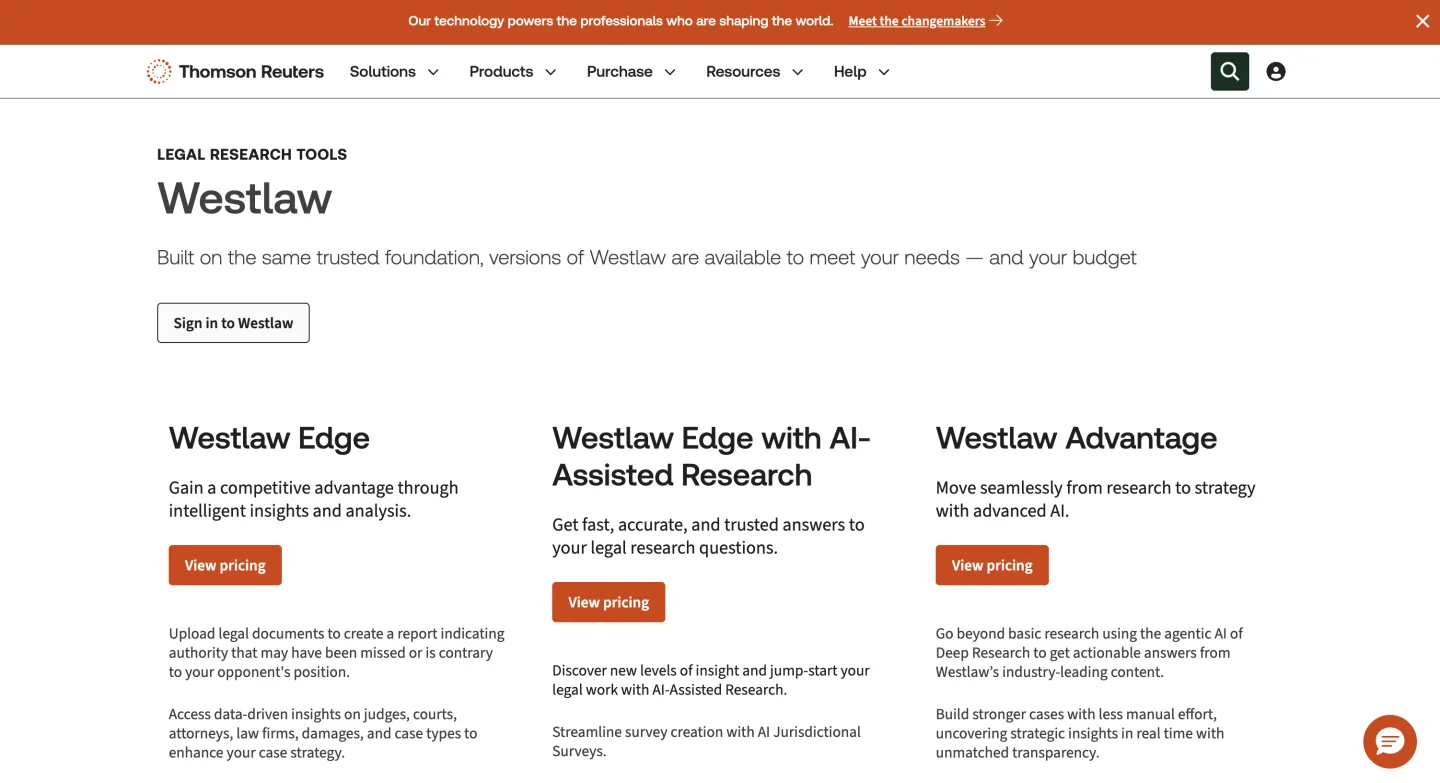
Thomson Reuters / Westlaw Precision for trade and Customs research. The strength is the depth of CBP ruling letters, BIS denial orders, DDTC charging letters, and regulatory archives across the tariff regimes. The AI assistant adds drafting and summary; the underlying corpus is the moat.
Bloomberg Law for regulatory and sanctions tracking. Coverage of OFAC, BIS, and DDTC enforcement, plus tariff and trade-action coverage, sits at the operative bar. Many manufacturing departments carry both Westlaw and Bloomberg.
Specialty trade compliance suites. Descartes Visual Compliance, Amber Road (now part of E2open), and Integration Point are the operational tools for HTS classification, denied-party screening, license determination, and entry-filing workflow.
These are not legal-AI products in the Harvey sense; they are domain workflow stacks the in-house team and the customs broker share. For any manufacturer with meaningful import volume, one sits underneath the legal workflow.
Specialty CLM with supplier modules. Ironclad and LinkSquares have built or are building supplier-side modules with the flow-down language, audit-rights, and UFLPA-cooperation provisions manufacturers actually need. Generic CLM tools that started in sales paper do not handle consigned inventory, tooling ownership, buy-back, or multi-tier audit.
General-purpose legal AI workbenches. Harvey, GC AI, and Eudia fit drafting, summarizing, basic research, and agenting across a matter folder. They are not the right tool for HTS classification or UFLPA screening.
The mistake we see most often on manufacturing buy calls is the assumption that one vendor will cover everything. None will. Two to three vendors, with clear ownership of which workstream sits where, beats any single-vendor pitch.
2026 priorities
Three things will absorb the calendar.
Tariff strategy under the second Trump administration. The 232, 301, and IEEPA stack is shifting under the company's feet. The April 2026 modification of the Section 232 framework to tariff full value rather than metal content reshapes the cost model for any derivatives manufacturer. AI helps with the modeling and the cross-walk; the strategy decision sits with the GC and the CFO.
UFLPA enforcement intensification. The FY 2025 detention count of 7,325 shipments, with only 6.5% released, is the operative signal. The expanded priority sectors put almost every Tier 1 supplier portfolio inside the enforcement aperture for some commodity.
The work is preemptive: building the documentary package that survives a CBP review before a container is detained, not after.
ESG disclosure with California as the floor. With SEC climate rulemaking in post-Loper limbo, the operative 2026 disclosure regime is California SB 253 and SB 261. Manufacturers above the revenue thresholds doing business in California are filing now; the supplier-side Scope 3 data assembly is the multi-year project.
The general counsel who treats these three as scheduled, resourced workstreams rather than fire drills outperforms the one who treats each detention or tariff change as a surprise. That is the calendar discipline AI buys you, when the tool is the right shape for the work.
Where Vaquill AI fits, honestly
Vaquill AI is the right tool for the supplier-contract matrix and the drafting and redlining work, not for HTS or ECCN classification. If your job this quarter is "which of our 4,000 suppliers are missing the UFLPA cooperation or export-control flow-down language," that is the document-matrix workflow Vaquill AI is built for: read the whole set at once, sort by risk, draft the amendment. For HTS classification, denied-party screening, and entry filing, keep the specialty trade-compliance suite underneath.
The honest tradeoff: Vaquill AI does not ingest the UFLPA Entity List or the OFAC SDN List as a live screening feed, so pair it with the screening tool you already run.
For the underlying pattern across supplier portfolios, see what is a document matrix and the bulk contract review walkthrough. For caps and indemnity specifics, see indemnification caps by state. For the broader buyer's playbook, see legal AI for in-house counsel and /topics/in-house-counsel.
FAQ
What is the best legal AI for manufacturing in-house counsel?
There is no single best tool. Manufacturing legal work splits across trade and Customs research (Westlaw Precision, Bloomberg Law), HTS classification and denied-party screening (specialty suites like Descartes Visual Compliance), supplier contract review and drafting (a document-matrix workbench), and general matter work. Most teams run two or three tools with clear ownership of which workstream sits where.
Can AI handle HTS classification and tariff codes?
General-purpose legal AI is weak here. HTS classification drives the duty rate plus Section 232, 301, and UFLPA overlays, and it relies on CBP ruling letters and a structured tariff schedule. Specialty trade-compliance suites beat general legal AI by a wide margin on classification. Use legal AI for the contract and research side, not for proposing tariff codes you will file on.
How does AI help with UFLPA and forced-labor compliance?
AI helps build the documentary package before a container is detained, not after. It reads the supplier base as a matrix and flags which agreements lack forced-labor cooperation, audit rights, and the right to terminate on a UFLPA Entity List match. It does not replace live screening against the UFLPA Entity List or the OFAC SDN List, which needs a dedicated screening feed.
Is legal AI safe for ITAR-controlled technical data?
Only if the vendor demonstrates ITAR-aware infrastructure: US-person access controls, US-located processing, and contractual restrictions. SOC 2 alone is necessary and not sufficient. For any ITAR-registered manufacturer, ask for a written statement of ITAR posture and accept nothing less before sending controlled technical data to any AI tool.
What contract clauses should AI flag in a supplier agreement?
The manufacturing-specific ones: Incoterms 2020 allocation (EXW versus FCA or DAP), warranty period against the buyer's downstream obligation, liability caps that exclude recall and product-liability costs, missing UFLPA cooperation language, missing EAR and ITAR flow-down, and open-ended force majeure with no tariff or duty-to-mitigate carve-out. The value is running this across every active supplier at once.
Can AI draft master purchase and supply agreements?
Yes, for the first draft and the redline against a manufacturing playbook. AI drafts the master terms, applies your fallback positions on caps and warranty, and produces a clean comparison against the supplier's paper. A lawyer still owns the negotiation and the final call. Generic CLM templates that started in sales paper do not survive a tooling-supplier agreement with consigned inventory and buy-back terms.
Does AI replace trade compliance software for manufacturers?
No. Trade-compliance suites own HTS classification, denied-party screening, license determination, and entry filing, which sit underneath the legal workflow. Legal AI sits above it for contract review, drafting, regulatory research, and matter work. They are complementary layers, and for any manufacturer with meaningful import volume you need both.
How much time does legal AI save a manufacturing legal team?
Treat vendor figures as vendor figures. Genie AI cites a 14-day to 4-day drafting compression for manufacturing teams (Genie AI manufacturing page, 2026), and the ACC AI Center of Excellence reports generative AI use among in-house lawyers more than doubling over the past year, with drafting and legal research the top reported gains. The honest read: AI compresses first drafts and document-matrix review most, and saves little on the data assembly behind ESG disclosure, which stays an operational problem.
New legal AI guides, weekly.
Further Reading
- Legal AI for Chief Legal Officers (CLOs) in 2026
- AI Compliance Check: CCPA, GDPR, and SOX for In-House Teams (2026)
- Rolling Out Legal AI to Your Team (Adoption Playbook)
- How to Reduce Outside Counsel Spend With AI in 2026
- How to Run a Legal AI Pilot in 30 Days (2026)
- Legal AI for In-House Counsel: The Complete 2026 Guide

Co-Founder & CEO · Attorney
Arshita leads product and strategy at Vaquill AI, the US primary law data API. As an attorney, she decides which law we carry, how each section is sourced and cited, and what legal AI and compliance teams need from the data.