Short answer: the best matter management software for an in-house legal team is the one built for your size and your actual fire. In-house teams (solo GC up to about ten people) want a per-user tool with fast onboarding and AI scoped to the matter, like Vaquill AI, Xakia, or Streamline AI. Large departments auditing seven-figure outside-counsel spend want an enterprise legal management (ELM) suite, like Brightflag, LawVu, CounselLink, or Thomson Reuters Legal Tracker. Buying the wrong category is the expensive mistake.
Most matter management roundups are written by people who have never closed a matter. They count features, build a grid, and call it a day. That is useless when you are a three-person team deciding whether to spend $30,000 a year on a tool built for a department of forty.
So here is the ranked list I wish I had read before six demos. Fourteen real players, what each is good at, and where each falls apart.
One question decides everything. Are you buying this to run a legal-ops function, or to stop drowning in requests with a team too small to have a function at all? Those are different products, and vendors blur the line on purpose.
TL;DR
Part of our in-house counsel guide series.
- "Matter management software" is two markets pretending to be one. The enterprise legal-ops suites (Brightflag, LawVu, Litify, CounselLink, Legal Tracker, Onit, TeamConnect, SimpleLegal) are built around outside-counsel spend and e-billing. The lighter tools (Xakia, Streamline, Clio) are built around intake, triage, and practice management. Buying the wrong category is the costly mistake.
- Five jobs any matter tool has to do: take in intake without email chaos, give every matter a visible status, hold the matter's documents in one place, show where legal spend is going, and report on it. Most tools nail two or three and charge enterprise prices for the gap.
- Most of these vendors do not publish a price on their own site. A few real numbers exist from third-party listings: Xakia runs about $100/user/mo and LawVu about $150/user/mo, while Brightflag starts around $2,500/mo and Onit around $6,500/mo (Software Finder, June 2026). Clio publishes an EasyStart starting price of $49/user/mo on its own site. For the rest, plan on a sales call.
- Xakia and Streamline are the honest picks for in-house teams: per-user, no lock-in, weeks not quarters to onboard. The trade is less depth on spend analytics.
- The 2026 shift is AI-native. The matter is becoming where the work happens, not just where it gets filed. That is why we rank Vaquill AI as a close #2 for in-house teams, while being fair that a mature spend platform like Brightflag still takes the top spot on spend, e-billing, and reporting.
Which tool ranks #1 for departments with a seven-figure outside-counsel spend problem?
How we picked
We ranked for the buyer we write for: in-house teams. The real test is whether a three- to ten-person team can run the tool without a six-month rollout, and whether the AI is scoped per matter rather than turned loose on everything.
A folder you can reason inside, safely, beats a spend engine you never feed.
Prices here are vendor-published where the vendor publishes one. Where it does not, we use the best dated third-party figure we could verify, such as the Software Finder matter-management roundup (June 2026), and we name the source inline. Most ELM vendors stay quote-based on their own sites, so you will still see "quote-based / on request" a lot. That is the truth, not a dodge.
How we ranked this list
This is a ranked list, not a tie, and it reflects one bias we state up front. For in-house teams, the matter is where the work should happen, not just where it gets filed. So an AI-native workspace that drafts, reviews, and redlines against the matter, like Vaquill AI, sits near the very top, just behind a proven enterprise legal management (ELM) suite whose spend analytics, e-billing, and reporting an AI-native newcomer has not matched yet.
That bias has limits, and we mark them under each tool. If your problem is auditing a seven-figure outside-counsel budget, the incumbents below beat everything on spend analytics and e-billing. Read the reason under #1, then jump to the tool built for your size.
Comparison table
Prices are vendor-published where the vendor publishes one, otherwise the best third-party figure we could verify, with the source named. "Quote-based" means no public number and a sales call to scope it.
| Tool | Price | Access | Category | Best for |
|---|---|---|---|---|
| Brightflag | ~$2,500/mo (Software Finder, Jun 2026) | Sales-led | ELM / spend | Seven-figure outside-counsel spend |
| Vaquill AI | Published | Self-serve, 7-day trial | AI-native workspace | Solo GCs and 2-to-10-person teams |
| LawVu | ~$150/user/mo (Software Finder, Jun 2026) | Sales-led | In-house workspace | Mid-to-large departments |
| Litify | Quote-based + Salesforce license | Sales-led | Salesforce-native | Legal ops on Salesforce |
| CounselLink | Quote-based | Sales-led | ELM / e-billing | Large departments controlling spend |
| Legal Tracker | Quote-based | Sales-led | ELM / e-billing | Departments living in e-billing |
| Onit | ~$6,500/mo (Software Finder, Jun 2026) | Sales-led | ELM / AI spend | Enterprise global workflows |
| TeamConnect | Quote-based | Sales-led | Enterprise ELM | Fortune-class departments |
| SimpleLegal | Quote-based, trial offered | Sales-led | Enterprise-lite ELM | Growing departments |
| Xakia | ~$100/user/mo (Software Finder, Jun 2026) | Sales-led, month-to-month | Light matter mgmt | 5-to-15-person teams |
| Clio | EasyStart from $49/user/mo (published) | Self-serve + sales | Practice management | Small firms and in-house teams |
| Streamline AI | Quote-based | Sales-led | Intake-first | Request-driven teams |
| Evisort | Quote-based | Sales-led | Contract intelligence | Contract-first teams |
| LinkSquares | Quote-based | Sales-led | Contract lifecycle | Large contract books |
1. Brightflag: best for departments with a real outside-counsel spend problem
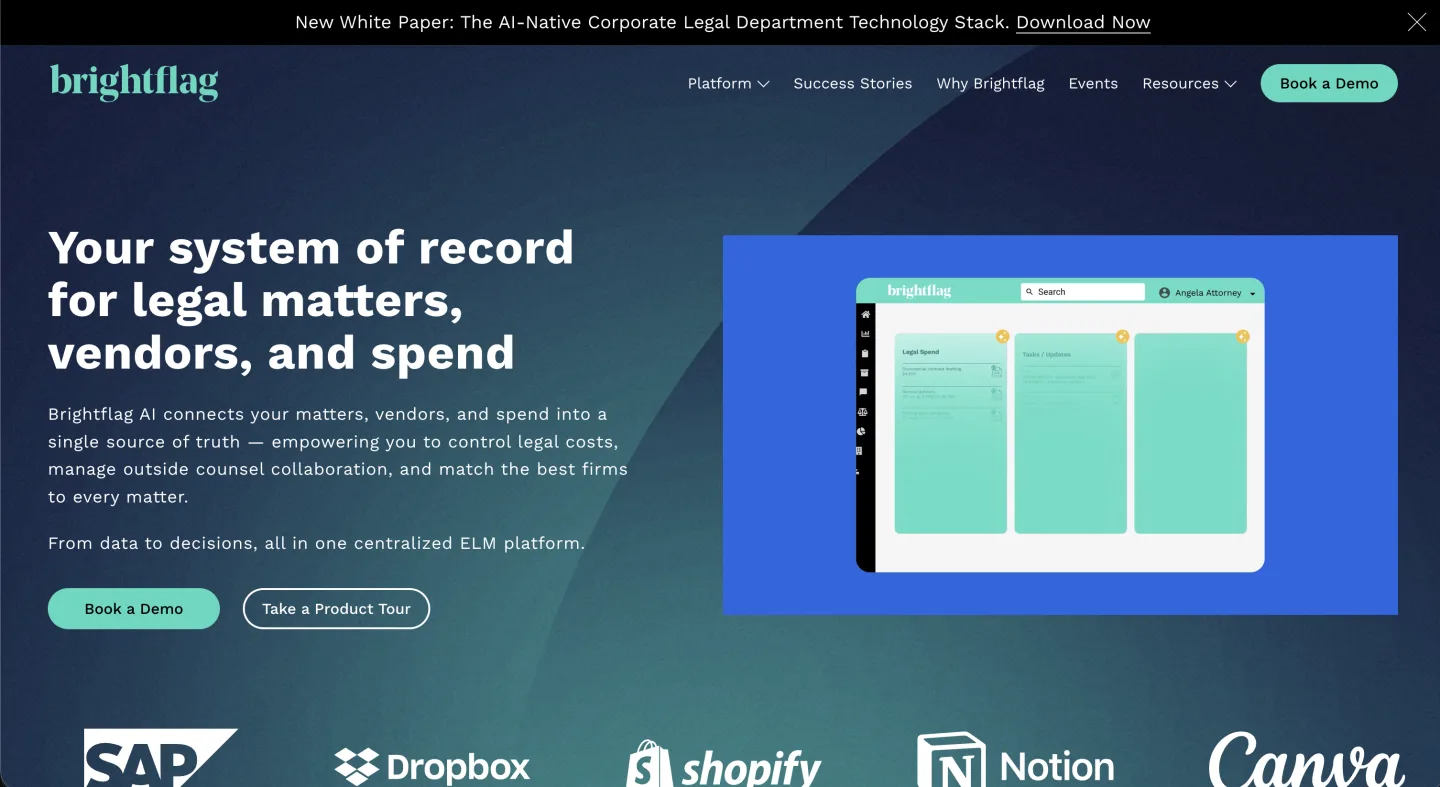
At a glance: ~$2,500/mo starting (Software Finder, June 2026); vendor does not publish · Sales-led, demo required · Best for departments with seven-figure outside-counsel spend
Brightflag is a spend platform with strong matter management around it. Its AI reads outside-counsel invoices line by line, which is real and useful if you have a lot of them.
What's good
- Spend analytics go deeper than anything an AI-native newcomer offers today.
- Invoice review by AI catches billing issues a human skims past.
- Mature reporting that holds up in front of a CFO.
Where it falls short
- Pricing scales with legal spend and modules, so a modest spend buys a Ferrari to drive to the mailbox.
- The matter tooling sits in service of the invoices, not the legal work.
What users say: There is little candid forum discussion, mostly vendor and analyst writeups, so we will keep this modest.
Bottom line: Buy Brightflag if outside-counsel spend is the fire and it is worth several thousand a month to control. Skip it if your spend is small, because you will pay for an engine you never feed.
2. Vaquill AI: best for in-house teams that want the work to happen in the matter
Vaquill AI's matters workspace: every matter is its own workspace where drafting, review, and research happen against the files.
At a glance: Self-serve, published pricing (sign up to see the latest) · Self-serve, 7-day trial · Best for solo GCs and 2-to-10-person legal teams
Vaquill AI is an AI-native legal workbench where matter management is the spine, not a filing cabinet bolted onto an invoice engine. Every matter, vendor, and business unit is its own workspace holding thousands of documents.
What's good
- Intake by upload, Google Drive, or a per-matter email address, across 50+ file formats, with status tracking built in.
- Extracted facts sorted into key facts, parties, amounts, obligations, and conflicts, each clickable back to the exact source line, plus per-document and full-matter summaries.
- Drafting, contract review, and redline run inside the matter they belong to, and the AI is aware of the client and matter metadata behind every question.
- Self-serve pricing that sits below the enterprise suites, with no sales gate.
Where it falls short
- Younger than a 15-year-old e-billing engine, so it does not audit a $5M outside-counsel spend the way Brightflag or LawVu do.
- Spend analytics and rate-card enforcement are thin next to the dedicated ELM tools.
What users say: There is little independent forum discussion yet, so we will not invent praise.
Bottom line: If a in-house team is doing a large team's work and needs the matter to be where that work gets done, this is a strong pick. If spend control is the whole game, buy a dedicated spend platform instead.
Vaquill AI's matters workspace handles intake, documents per matter, and the review and drafting that attach to them.
3. LawVu: best for enterprise teams that want one coherent workspace
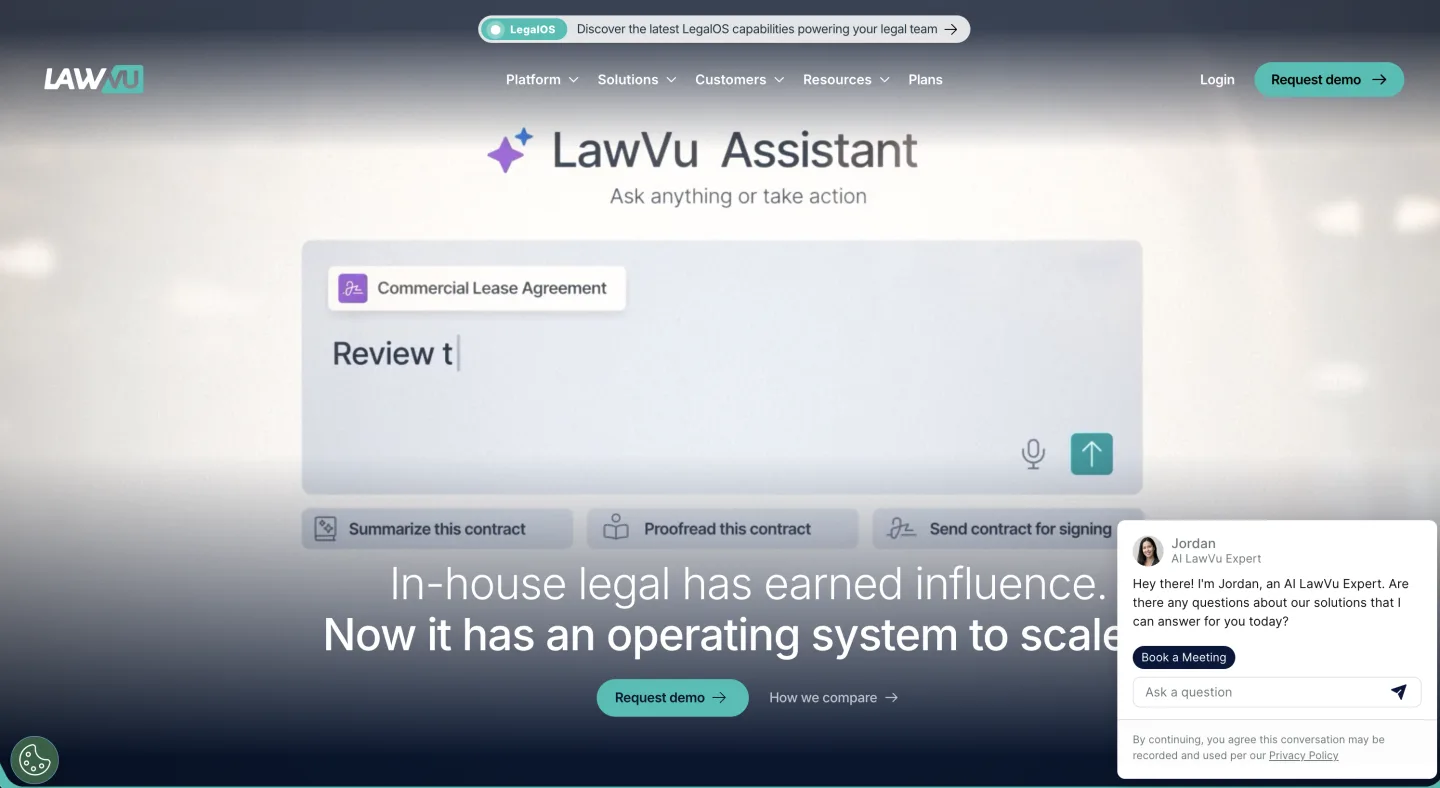
At a glance: ~$150/user/mo (Software Finder, June 2026); vendor does not publish · Sales-led, demo required · Best for mid-to-large departments adopting a full workspace
LawVu sits more in-house-native than the pure ELM tools. It calls itself a legal workspace, with matter management at the core and contract and spend management layered on.
What's good
- Bundles an assistant, agentic workflows, drafting, and matter management into one screen.
- The strongest "one coherent workspace, not a stack of point tools" pick in the enterprise tier.
- Leaning hard into AI, which is the direction the whole tier is moving.
Where it falls short
- Coherence at that scope is a real implementation and a real budget.
- It rewards teams big enough to adopt the whole thing, so a small team uses a fraction of it.
What users say: Forum discussion is thin beyond vendor channels, so we will not overstate it.
Bottom line: LawVu is a strong pick if you have the size to adopt the full workspace and the budget for the rollout. A four-person team will pay for scope it never reaches.
4. Litify: best for teams already standardized on Salesforce
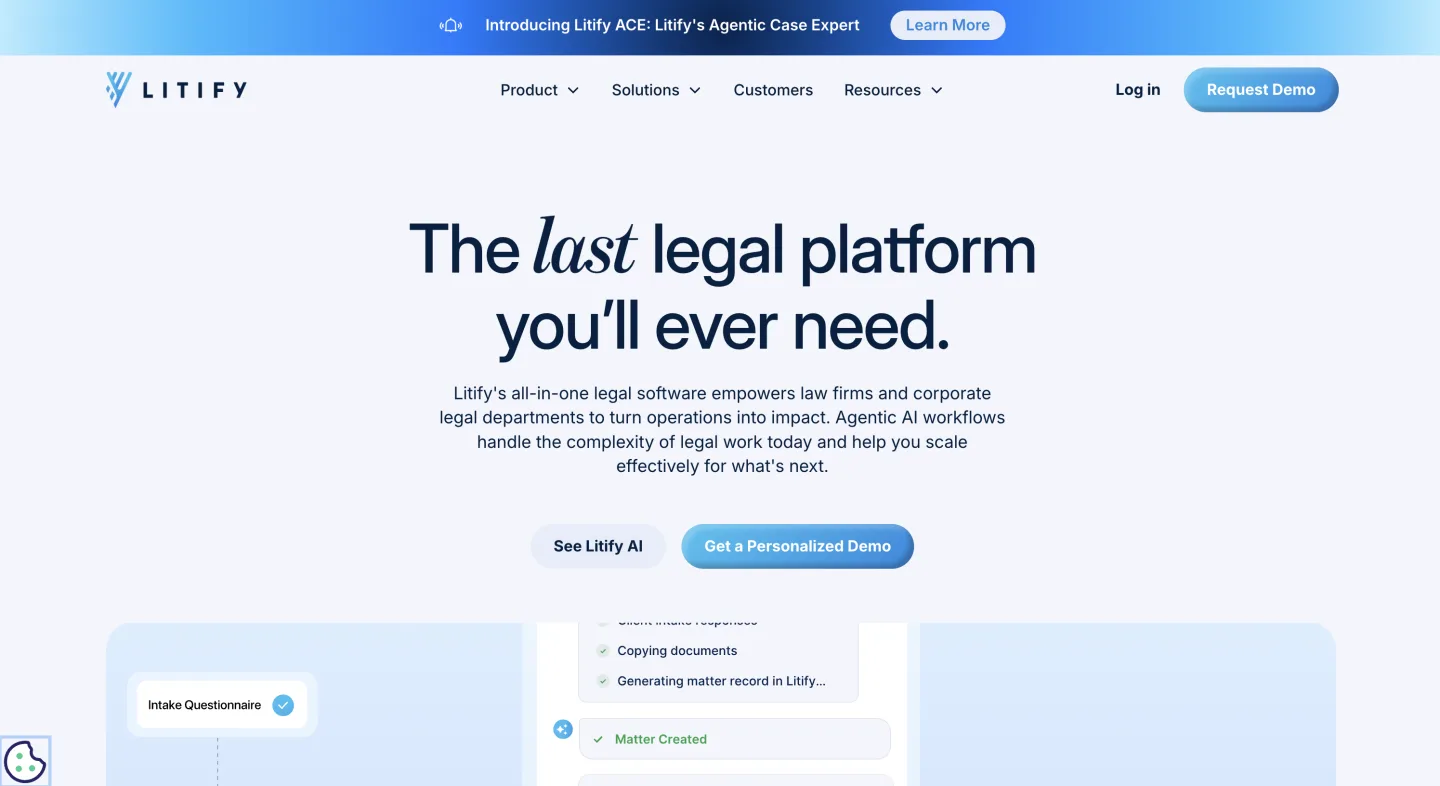
At a glance: Quote-based / on request, plus Salesforce licensing · Sales-led, demo required · Best for serious legal operations on Salesforce
Litify is the Salesforce-native option, and that is the whole story, good and bad. Building on Salesforce gives you a mature platform and real customization.
What's good
- Mature platform with real customization and security you do not have to think about.
- Fits teams already living inside Salesforce.
- A serious platform for a serious legal operation.
Where it falls short
- Salesforce economics: a platform-license minimum, setup fees, and a total that climbs once licensing folds in.
- Implementations are not quick.
What users say: Public peer discussion is limited, so we will not fabricate a verdict.
Bottom line: Litify makes sense for a large operation already standardized on Salesforce. For a team of four, it is a category error.
5. LexisNexis CounselLink: best for large departments defending every dollar
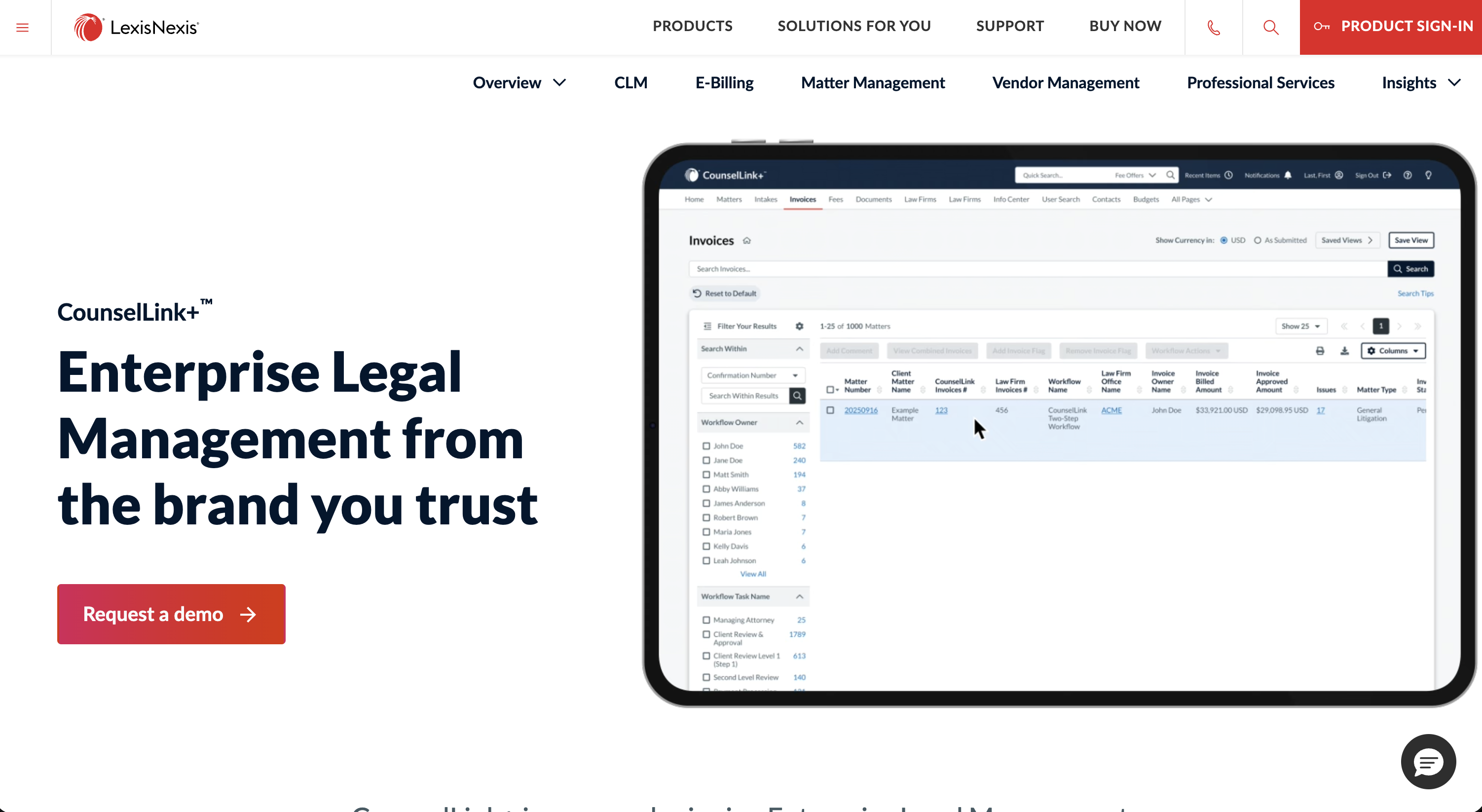
At a glance: Quote-based / on request · Sales-led, demo required · Best for large departments measured on controlled spend
CounselLink is a deep, mature, spend-and-e-billing-first ELM sold to large departments. Its strengths are matter and spend management at scale.
What's good
- Rate-card enforcement and spend management built for scale.
- Reporting that holds up in front of a CFO.
- A known quantity already on most large-department shortlists.
Where it falls short
- Enterprise pricing, not published per seat.
- Built for a buyer a in-house team is not.
What users say: Candid forum chatter is sparse, mostly analyst coverage, so we keep this modest.
Bottom line: If you run a large department that measures success by controlled outside-counsel spend, CounselLink is already on your list. If you are a in-house team, it is built for someone else.
6. Thomson Reuters Legal Tracker: best for departments that live in e-billing
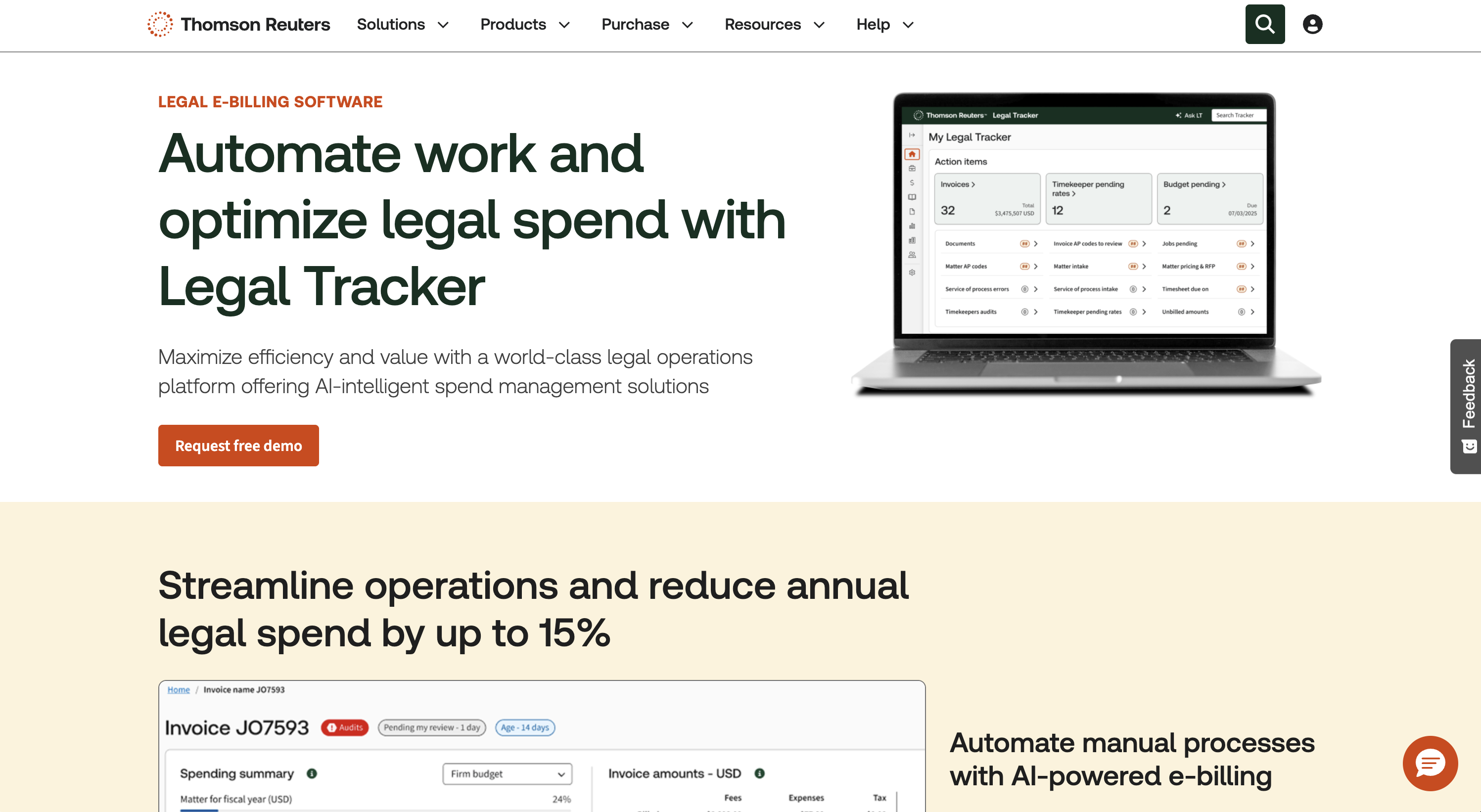
At a glance: Quote-based / on request · Sales-led, demo required · Best for departments measured on outside-counsel spend
Legal Tracker, once sold as Serengeti, is Thomson Reuters' ELM for in-house legal. It pairs matter management with e-billing and spend reports. It serves more than 1,800 corporate teams.
What's good
- AI invoice review and rate benchmarks are mature, with years of data behind them.
- Spend dashboards and reports that a CFO will accept.
- Wide use, so peers and outside firms already know the tool.
Where it falls short
- The matter side serves the invoices, so the legal work stays elsewhere.
- Pricing is quote-based and scoped for big spend, not a in-house team.
What users say: Candid forum talk is sparse beyond analyst writeups, so we keep this modest.
Bottom line: Legal Tracker fits a team whose core metric is controlled outside-counsel spend. A in-house team with little spend will pay for an engine it never feeds.
7. Onit: best for enterprise teams with complex global workflows
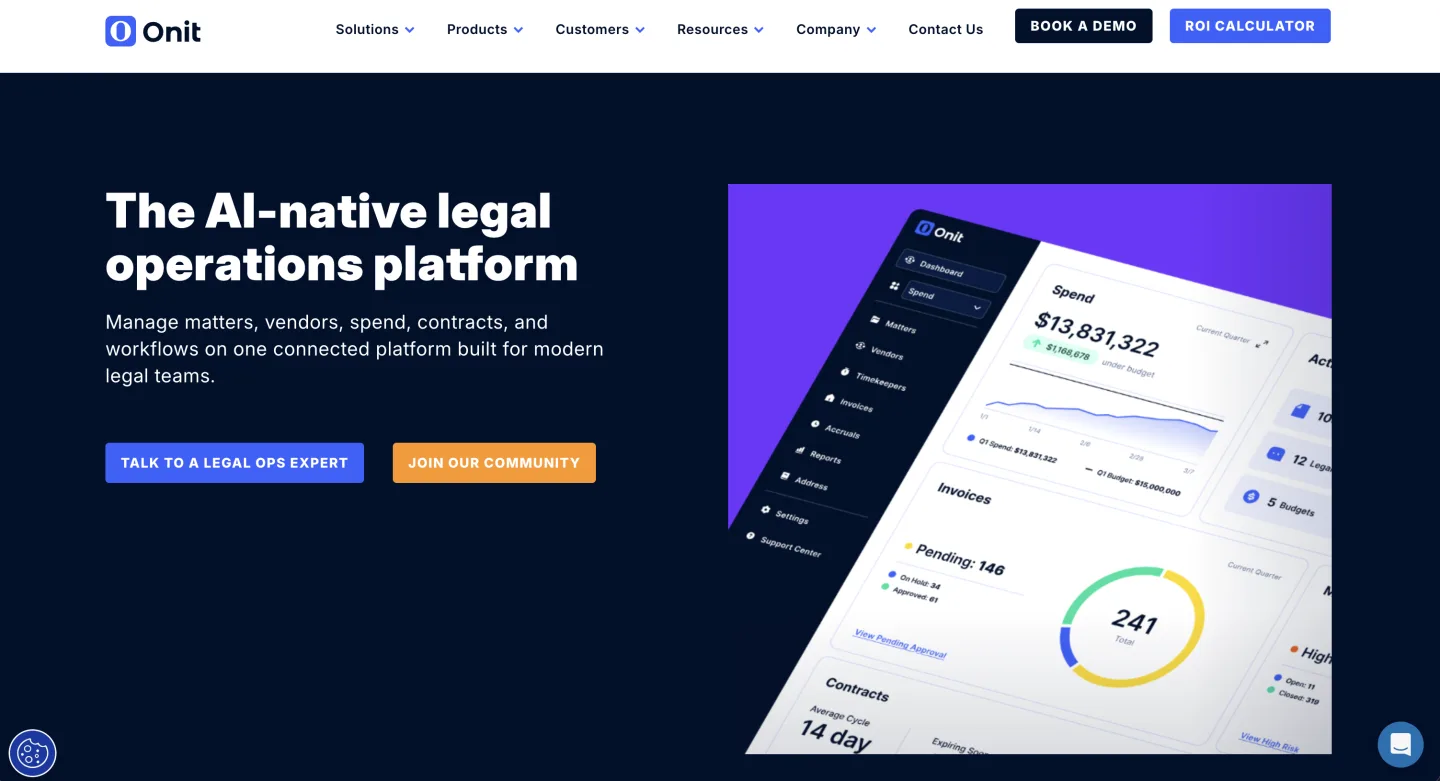
At a glance: ~$6,500/mo starting (Software Finder, June 2026); vendor does not publish · Sales-led, demo required · Best for enterprise and upper-mid-market departments
Onit is a long-standing ELM vendor. Its recent story is Unity, an AI-native ELM that pairs matter and spend management with an AI invoice-review Spend Agent.
What's good
- Real depth for large teams with complex global workflows.
- The Unity Spend Agent reviews invoices automatically.
- A lighter path exists through its SimpleLegal product below.
Where it falls short
- Implementation and module sprawl are real.
- Aimed at enterprise buyers, which is why Onit points lighter buyers elsewhere.
What users say: Independent forum discussion is limited, so we will not embellish.
Bottom line: Onit fits enterprise departments that need depth and can absorb the build. Smaller teams should look at SimpleLegal or skip the tier entirely.
8. Mitratech TeamConnect: best for large enterprises that need one system of record
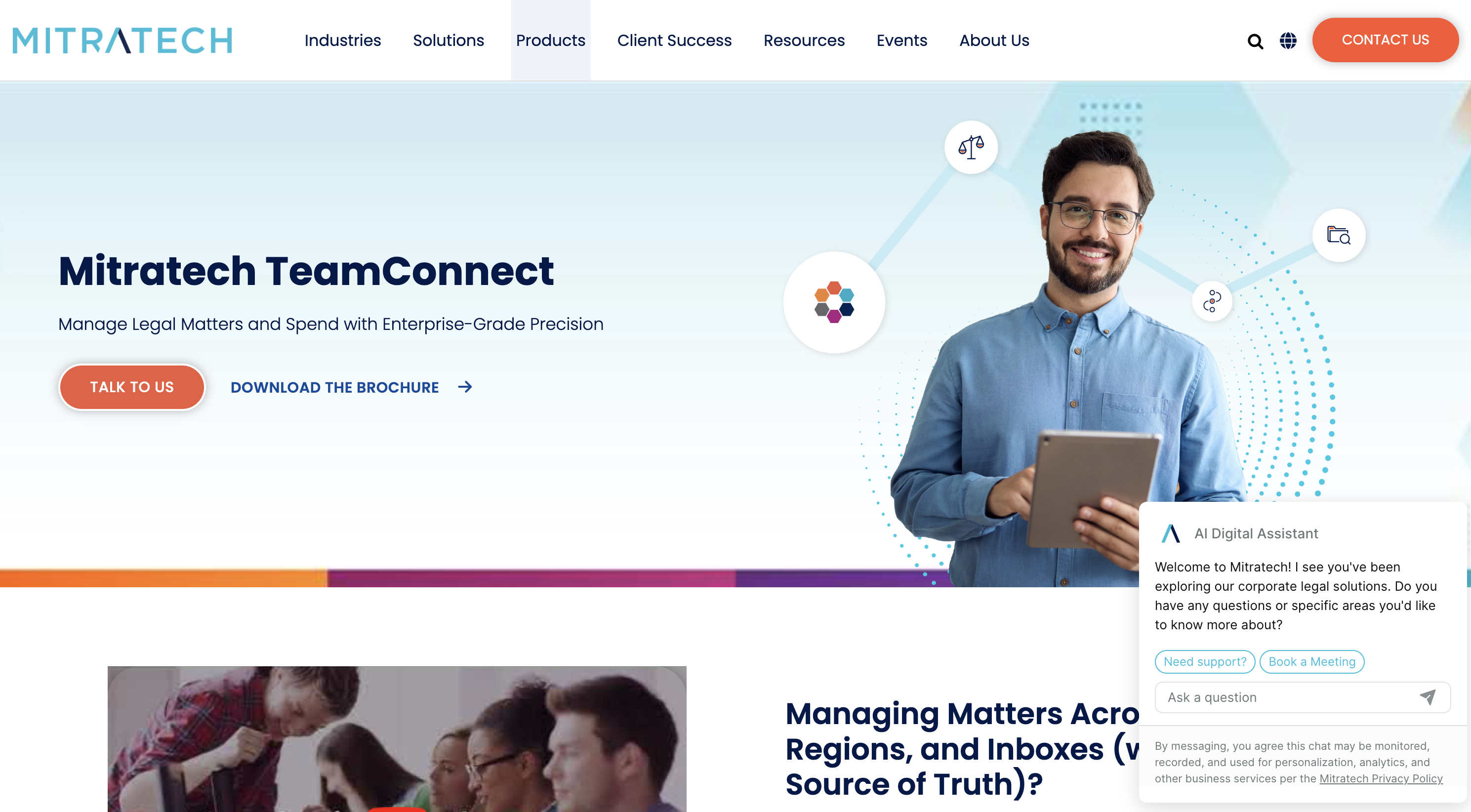
At a glance: Quote-based / on request · Sales-led, demo required · Best for Fortune-class legal departments
TeamConnect is Mitratech's enterprise legal management tool. Mitratech says it runs in 60 percent of the Fortune 100. It holds matters, invoices, outside-counsel records, and compliance work in one system.
What's good
- Deep setup options for large teams with strict process and audit needs.
- Matters, spend, and compliance sit in one system of record.
- A long track record at scale, with the integrations that brings.
Where it falls short
- Setup is a real project, often with consultants and a long timeline.
- The scope and price are built for a big company, not a five-person team.
What users say: Independent peer talk is limited beyond vendor and analyst coverage, so we keep this modest.
Bottom line: TeamConnect fits a large team that needs one system of record and can staff the rollout. A in-house team will use a sliver of it and resent the bill.
9. SimpleLegal: best for growing departments that want enterprise-lite
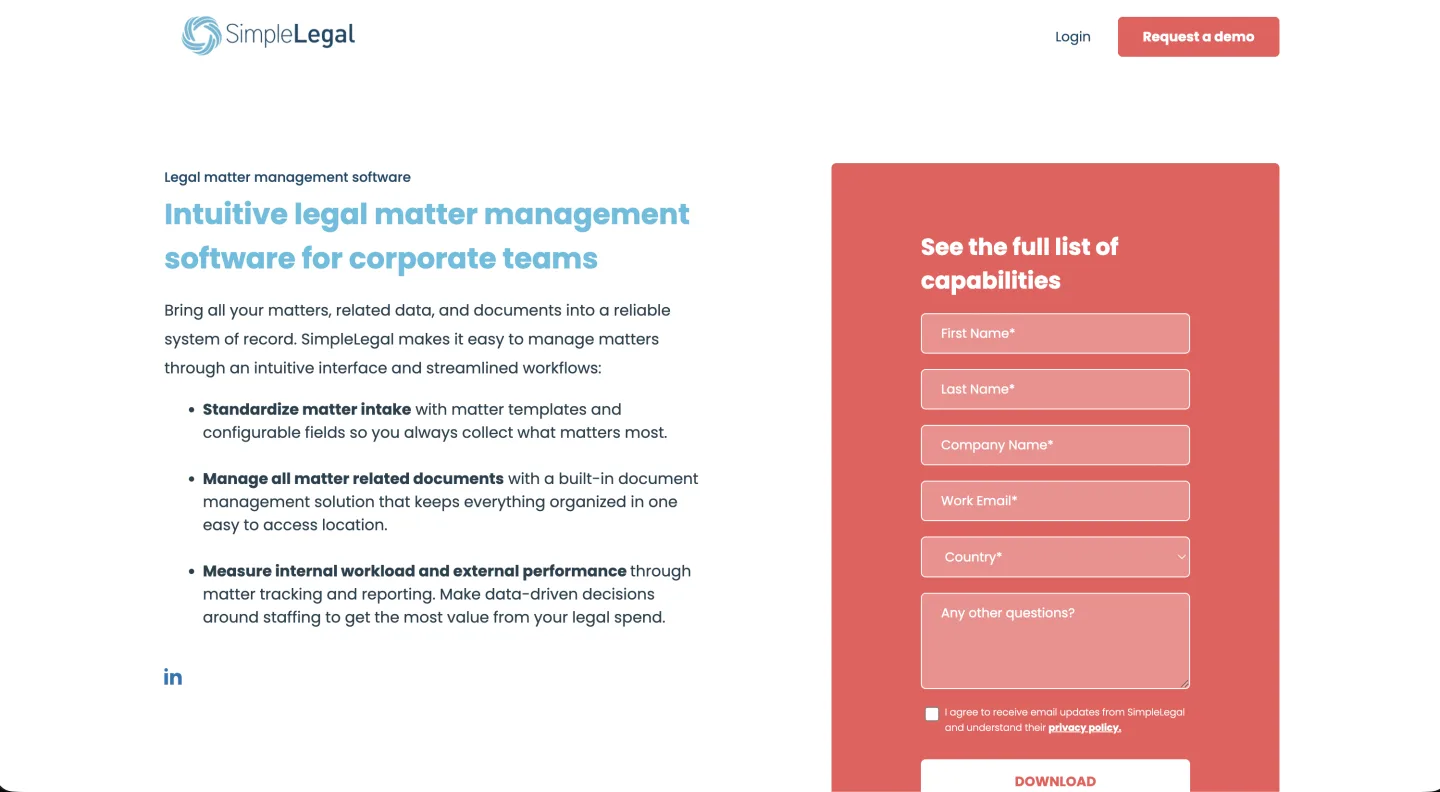
At a glance: Quote-based / on request, trial offered · Sales-led, demo required · Best for growing departments not ready for full ELM
SimpleLegal, now an Onit product, is the lighter ELM for growing legal departments. You get e-billing, matter management, vendor management, and reporting without the full enterprise build.
What's good
- Quick to adopt and easy to configure for the tier.
- A more realistic enterprise-lite option than Onit's flagship.
- Covers e-billing and vendor management in one place.
Where it falls short
- No published per-seat figure and no free version.
- Organizes around spend and invoices, not the legal work itself.
What users say: Genuine peer reviews are thin, so we keep commentary modest.
Bottom line: SimpleLegal works for a growing department that wants e-billing without the enterprise project. Teams that want the matter to be where the work happens will want an AI-native tool instead.
10. Xakia: best for small in-house teams that refuse to be forced into enterprise shape
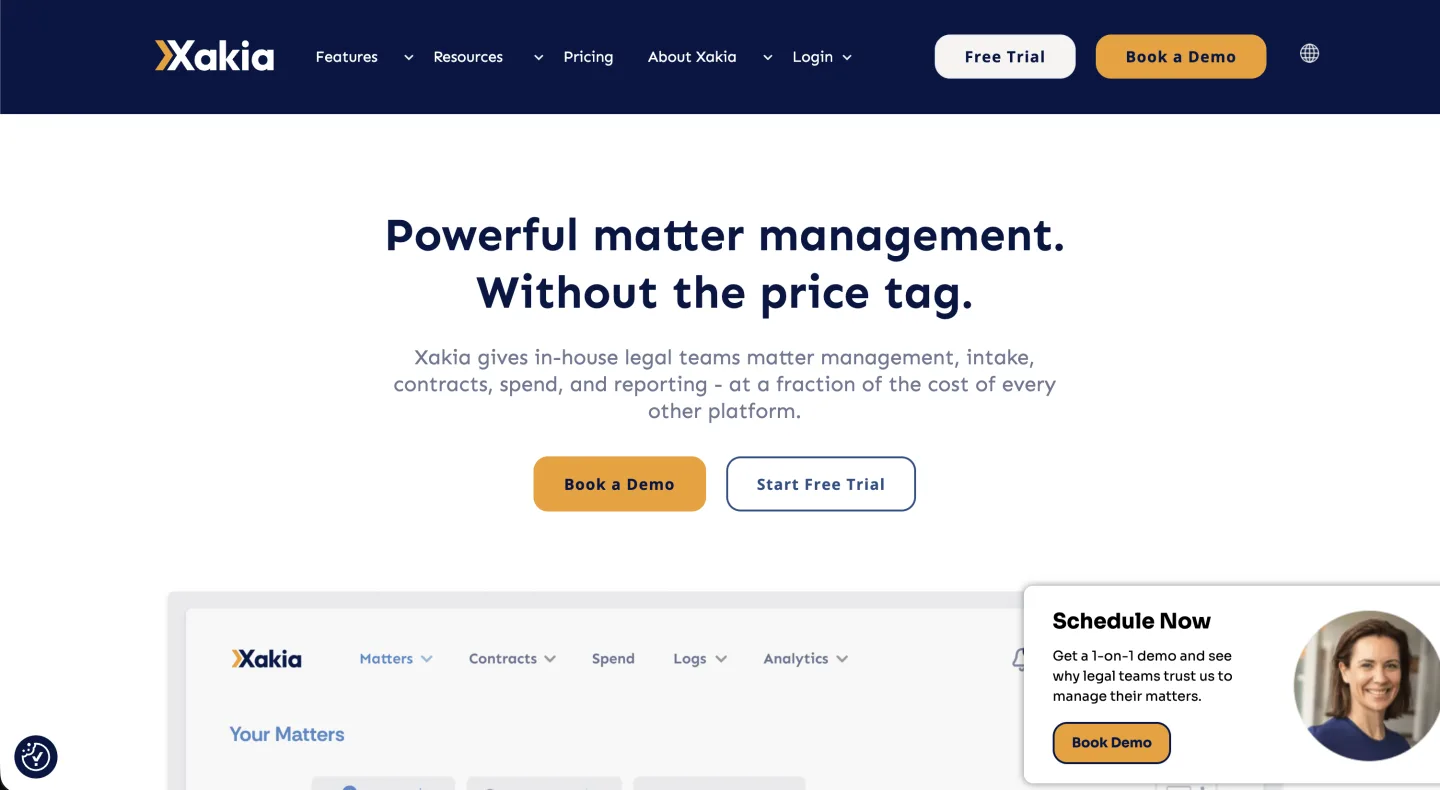
At a glance: ~$100/user/mo (Software Finder, June 2026), month-to-month options · Sales-led, demo required · Best for five-to-fifteen-person teams
Xakia is the tool I most often see fit a small in-house team without forcing it into an enterprise shape. It does intake and triage, matter management, light contract and spend tracking, and dashboards.
What's good
- Per-user pricing with month-to-month options and no lock-in.
- No extra charge for internal requesters or the external-counsel portal.
- A five-person team can start small and not get punished for it.
Where it falls short
- Spend analytics are not as deep as Brightflag's.
- A large outside-counsel budget will eventually outgrow it.
What users say: Public peer discussion is limited, so we will not overstate the buzz.
Bottom line: Xakia is a smart pick for a in-house team that wants real matter management without enterprise weight. Skip it if controlling a large outside-counsel budget is your core problem.
11. Clio: best for small firms and in-house teams that want practice management too
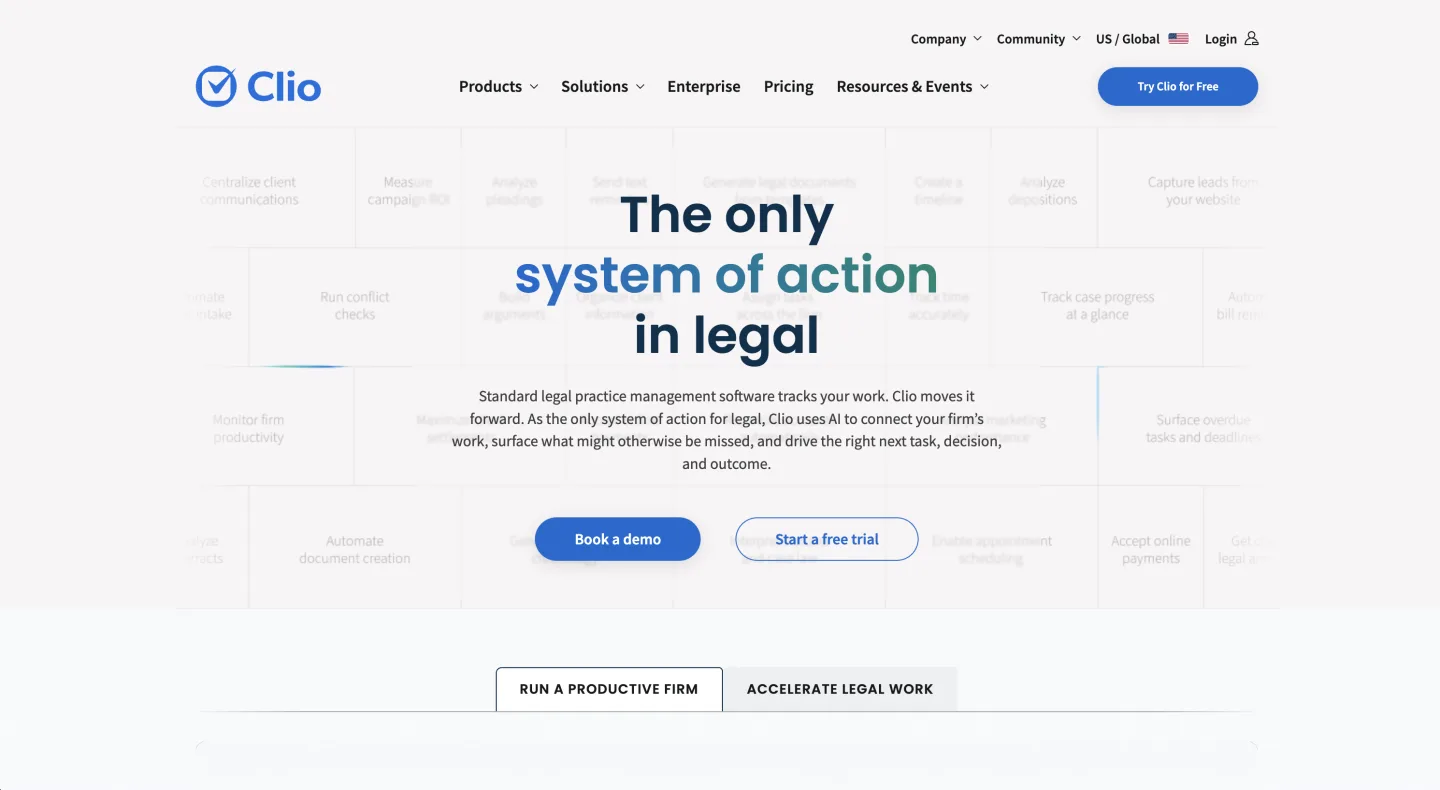
At a glance: EasyStart from $49/user/mo, higher tiers quote-based · Self-serve plus sales-led · Best for small firms and small in-house teams that want matters plus billing
Clio is practice and matter management built for small law firms. In-house teams pick it up for the same reasons. It tracks matters and contacts, stores documents, and handles time, billing, and calendars in one place.
What's good
- Mature matter and document tools with a wide app network.
- Self-serve setup, so a small team can be live without a long project.
- EasyStart lists a per-user starting price, which most of this list does not.
Where it falls short
- It is firm-shaped, so it centers on client billing, not internal intake and spend.
- The AI sits beside the matter, not inside the legal work itself.
What users say: Clio is widely reviewed by small firms, with praise for breadth and gripes about cost creep as add-ons stack up. We keep the in-house read modest, since most reviews come from firms.
Bottom line: Clio fits a small firm or a in-house team that wants matters, documents, and billing in one self-serve tool. It is the wrong shape if your fire is internal intake, spend control, or AI that works inside the matter.
12. Streamline AI: best for teams drowning in requests from everywhere
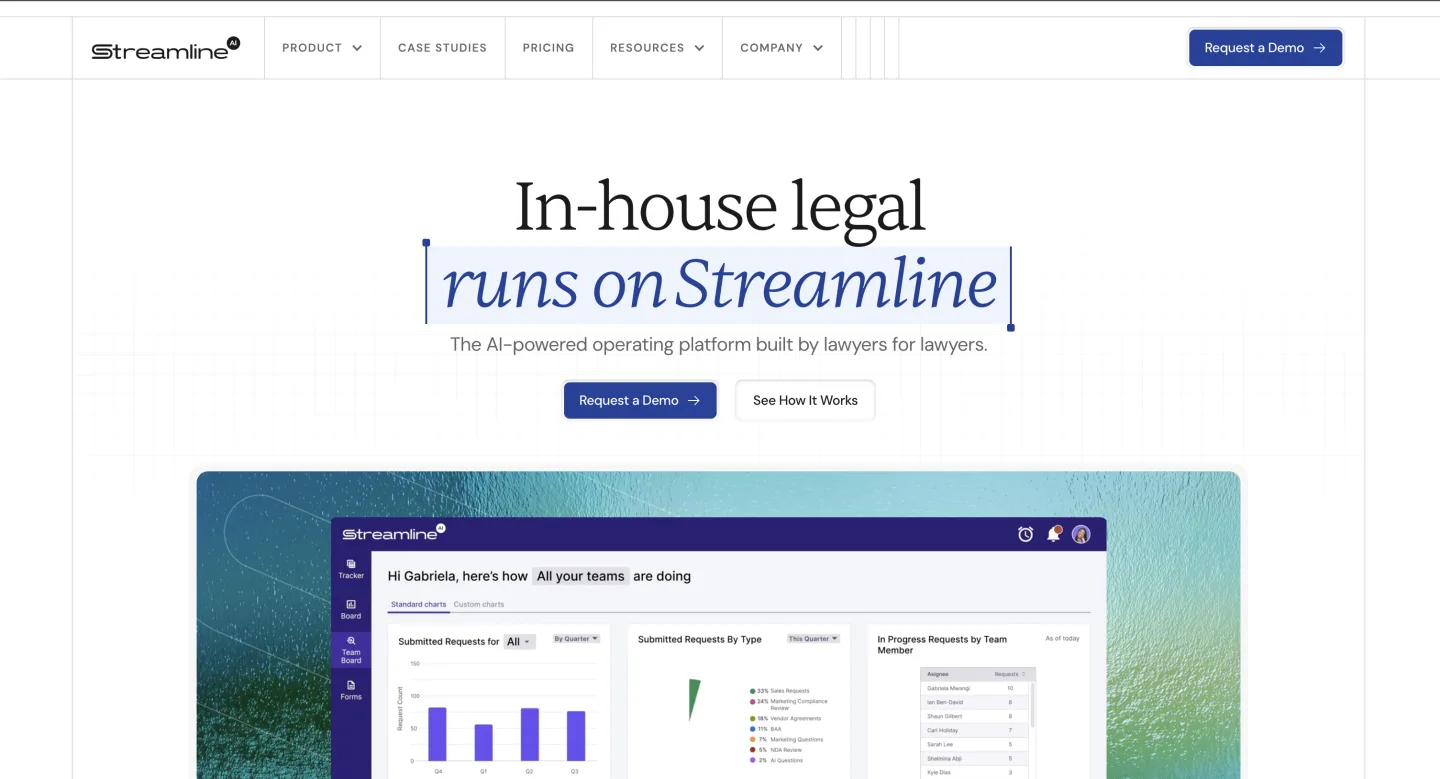
At a glance: Quote-based / on request · Sales-led, demo required · Best for request-driven legal teams
Streamline AI comes at the same buyer from the intake side. It was built to solve intake, and it captures every request flowing into Legal: forms, email, Slack, and Salesforce.
What's good
- Automates assignment, approvals, and workflow with live status.
- One of the most focused answers when requests come from everywhere.
- Strong matter management for request-driven work.
Where it falls short
- No self-serve number off the website, and pricing scales with workflows.
- Built for request-driven work rather than litigation.
What users say: Candid forum discussion is sparse, so we keep this modest and invent nothing.
Bottom line: Streamline fits a team whose pain is "requests come from everywhere and nothing is tracked." It is the wrong shape if your work is litigation-heavy rather than intake-heavy.
13. Evisort (Workday CLM): best for contract-first teams, not matter managers
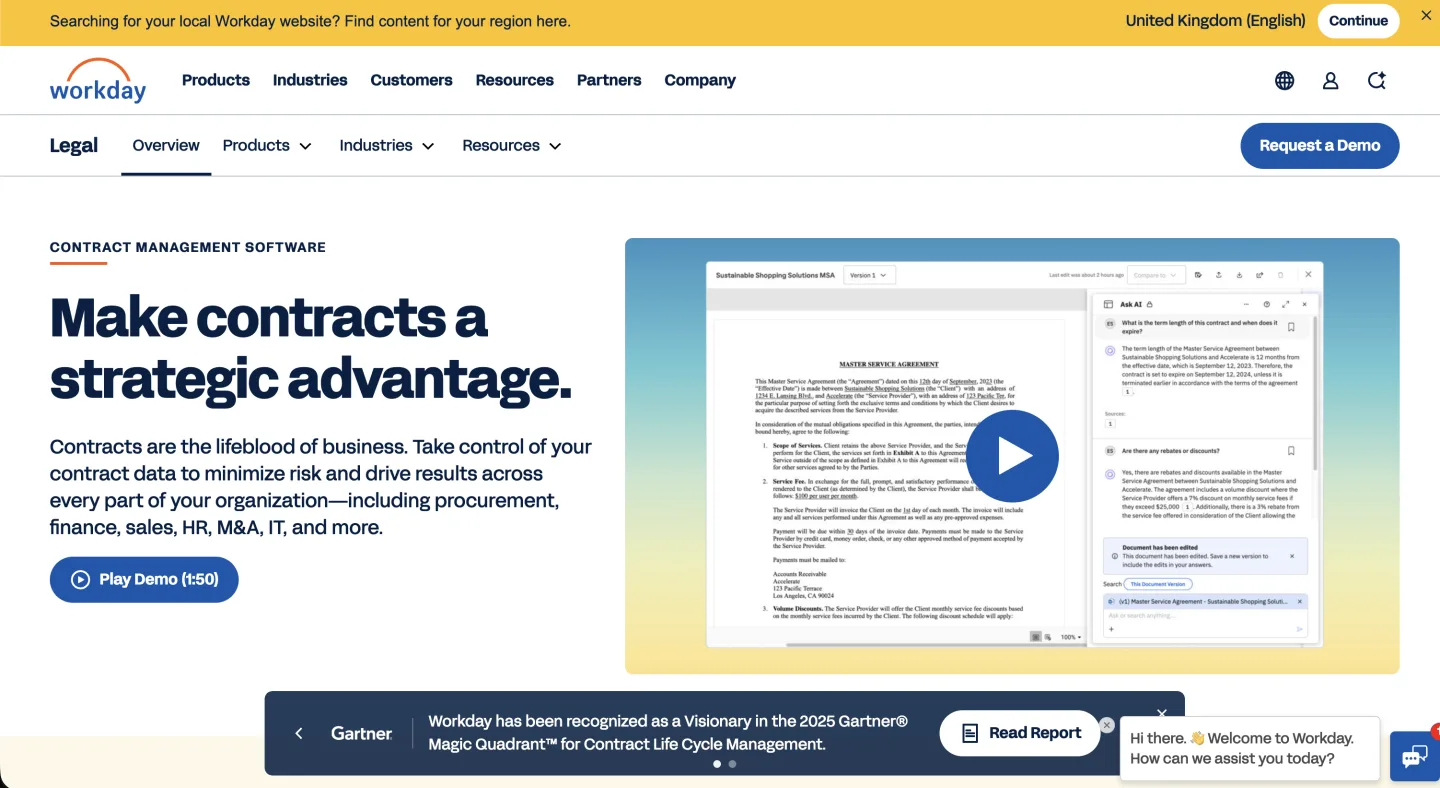 Evisort, now Workday Contract Lifecycle Management, is contract-intelligence-first rather than a matter manager.
At a glance: Quote-based / on request · Sales-led, demo required · Best for teams centered on large contract repositories
Evisort is an AI contract intelligence platform. Workday acquired it, and it now sells as Workday Contract Lifecycle Management, powered by Evisort AI.
What's good
- Strong at reading, organizing, and pulling data out of large contract repositories.
- Overlaps with the "documents per matter" job.
- Backed by Workday after the acquisition.
Where it falls short
- It is not a true matter manager.
- Nothing published for 2026, and no fit for intake, status, and spend across a mixed portfolio.
What users say: Independent forum chatter is limited, so we will not embellish.
Bottom line: Consider Evisort if contracts are the center of your world, not litigation or general matters. It is the wrong tool for a mixed matter portfolio.
14. LinkSquares: best for contract teams shopping alongside matter tools
At a glance: Quote-based / on request · Sales-led, demo required · Best for teams managing a large book of contracts
LinkSquares is contract lifecycle management with AI analysis, sold in its Analyze and Finalize tiers. Like Evisort, it is contract-first, not matter-first.
What's good
- Strong at managing a large book of contracts.
- Pulls structured data out of contracts.
- Often shortlisted alongside matter tools by contract teams.
Where it falls short
- It is not a general matter manager.
- Pricing is quote-based with nothing published per seat.
What users say: Public peer discussion is thin, so we keep this modest.
Bottom line: LinkSquares earns a place because contract teams shop it next to matter tools. It is not the pick if you need intake, status, and spend across general matters.
Matter management software is really two markets
Here is the most useful thing I can tell you, and the reason the ranking splits the way it does. "Matter management software" is a label two very different products both claim.
The first product grew out of enterprise legal management, or ELM. Its center of gravity is money: invoices from outside firms, e-billing, accrual tracking, rate cards, and spend analytics the CFO will see.
Matter management got bolted on because every invoice has to attach to a matter, and Brightflag, LexisNexis CounselLink, Onit, and Thomson Reuters Legal Tracker all live here.
The second product grew out of the opposite problem. A small team is buried under requests from Sales, Finance, and HR, with no outside-counsel spend worth analyzing. Its center of gravity is the request, the workflow, and the status, and Streamline and Xakia both sell to that buyer.
Buy from the first category to solve a second-category problem and you pay for a spend engine you never feed. You sit through a six-month implementation. You train a four-person team on a system built for forty.
I watched a five-lawyer department do exactly this. Their outside-counsel spend was under $400K a year, almost all to one firm, so the e-billing engine they bought had nothing to chew on.
Ninety days in, they used the matter list and document store, ignored the analytics half they were sold on, and re-platformed to something a tenth the price.
What a matter tool actually has to do
Strip away the marketing. Any serious tool is judged on five jobs.
Intake. A new matter has to enter the system without becoming a thread in someone's inbox. Good tools give a stakeholder a form, a Slack or Teams shortcut, or an email address that opens a matter on its own. If a tool's intake is "the lawyer types it in," it is not solving your real problem.
Status. Anyone with permission should see where a matter stands without sending a "quick question, any update?" message. This sounds trivial. It is the single feature that buys you the most peace.
Documents per matter. Every document should live with its matter, not scattered across a shared drive, three email threads, and someone's desktop. This is the boring plumbing that decides whether the tool is usable in year two, when the matter has 400 documents instead of four.
Spend visibility. What is this matter costing, and where is the outside-counsel money going? For enterprise teams this is the whole game. For in-house teams it is often a nice-to-have, since the spend is mostly the team's own salaries.
Reporting. Roll all of it into something you can put in front of a GC, board, or CFO: matters open, by type, by business unit, aging, at risk. The tools that win on reporting have dashboards a non-lawyer can read without a tutorial.
The uncomfortable truth is that most tools nail two or three of these and charge as if they nailed five. Your job in a demo is to find the seams.
The AI-native shift, and where it changes the math
One thing makes a 2026 roundup different from a 2023 one. Matter management is stopping being a filing system and starting to be where the work happens.
For thirty years, the tool's job was to remember where the documents lived while the lawyer did the thinking. The 2026 shift is toward generative AI for in-house teams and AI-native workflows, with automation at the core rather than AI bolted on. You see it in LawVu folding an assistant into its product, in Onit's Unity Spend Agent, and in Streamline reading and routing requests on its own.
A matter is no longer a folder with a status. Intake gets read and triaged on its own. A chronology builds itself from the documents you drop in, and you can ask questions of the matter's own files and get answers grounded in them.
For buyers, this collapses two budget lines: matter management in one tool and "legal AI" in another. The AI-native bet is that those belong together, because the AI is only trustworthy when it is scoped to the matter you are working.
We have argued before that per-matter segregation is the whole point, and that conversational search only works when it is bounded to one matter's files. For a concrete run-through, see a day in the matter, from intake to filing.
This is the lane Vaquill AI plays in. It is a deliberate bet against the e-billing incumbents, and the reason it sits at #2 for in-house teams, just behind the proven spend platforms. The review, redlines, and chronology happen against the matter, scoped to it, not in a separate AI tab.
The trade is real. The AI-native tools are younger than CounselLink, so if your problem is reducing a large outside-counsel budget, buy the spend platform. If a small team is doing a large team's work, the AI-native workspace beats a folder with a status field.
The seven questions to ask in every demo
Sales engineers run the demo on the happy path. Your job is to drag it off, in the room, before you sign.
- Intake from the requester's side, not the admin view. Show me what a salesperson sees opening a new matter. If the answer is "the lawyer enters it," that is your answer.
- The 300-document matter. Open one that already has hundreds of files and watch it load, sort, and search. Elegant with four, miserable with four hundred, is this category's most common failure.
- Status without a meeting. Have a non-lawyer pull up three open matters live. If it needs a tutorial, it will not get used.
- Permissioning. Show me a matter one user can see and another cannot. For in-house teams this is a confidentiality control, not a nice-to-have.
- Export. Get my data out now, in a format I can read. A vendor who stalls here is telling you something about lock-in.
- A report I did not pre-configure. Open matters by type, business unit, aging, at risk. The pre-built dashboard is rehearsed, so ask for one that is not.
- The honest implementation timeline. Not "fast." Weeks or months, who from my side, for how many hours, and what goes wrong most often?
Clear all seven without a "let me get back to you" and the tool is a real contender for your size. Most clear four or five. The two they dodge tell you what they are not.
How a in-house team should actually choose
Skip the feature grid. Answer four questions in order.
First, what is on fire? Outside-counsel spend points to Brightflag, CounselLink, Onit, or LawVu, and requests point to Streamline or Xakia. The work itself points to an AI-native workspace like Vaquill AI.
Second, how many people log in weekly? Under ten, and anything with a ten-license minimum and a six-month implementation is the wrong shape no matter how good it is. A four-person team should be live in weeks, not quarters.
Third, where do your documents live, and what happens in year two? Run the 300-document test. A tool elegant with four and miserable with four hundred quietly becomes the thing nobody uses.
Fourth, filing system or workbench? If you just need organized matters and clean reporting, do not pay for AI you will not use. If you want the matter to be where review, drafting, and search happen, do not buy a static system you will outgrow.
The mistake I see most is buying up. A in-house department gets sold the enterprise suite because the demo was impressive, and a year later uses 15% of it and resents the bill. The right answer is usually the tool built for your actual size and your actual fire.
FAQ
What is the difference between matter management and ELM? ELM is built around outside-counsel spend, e-billing, and rate cards, with matter management bolted on. Pure matter management centers on intake, status, and documents. In-house teams usually want the second, since they have little spend to analyze.
Why are so many of these tools quote-based? Most ELM vendors price on legal spend, matter volume, and modules, so they need a sales call to scope a number. That is why you see "quote-based / on request" across the list. Plan on a demo to get a figure.
Do small in-house teams need AI matter management? If you want the matter to be where review, drafting, and search happen, yes. If you just need organized files and clean reporting, a lighter tool like Xakia is enough. The wrong move is paying enterprise prices for AI you never use.
What is the difference between matter management and case management? Case management is firm-shaped, built around clients, billable time, and trust accounting. Matter management is built for in-house teams, so it centers on internal intake, status across a mixed portfolio, documents per matter, and spend on outside counsel. A in-house team that picks a case-management tool usually fights its billing-first defaults for months.
How much does matter management software cost? It ranges widely. Lighter per-user tools land around $49 to $150 per user per month (Clio EasyStart is $49, Xakia about $100, LawVu about $150 per Software Finder, June 2026). Enterprise ELM suites are quote-based and price on legal spend and modules, often several thousand dollars a month and up (Brightflag starts around $2,500/mo, Onit around $6,500/mo per the same source). Vaquill AI is self-serve and published.
How long does it take to implement matter management software? A lighter per-user tool can be live in days to a few weeks for a small team. Enterprise ELM rollouts run months and often need consultants, data migration, and integration work. Ask for an honest timeline in the demo, including who from your side it needs and for how many hours.
What should an in-house legal team look for in matter management software? Five jobs decide it: intake without email chaos, visible status on every matter, documents stored per matter, spend visibility on outside counsel, and reporting a GC or CFO can read. Match the tool to whichever of those is on fire, then test the others on a real 300-document matter before you sign.
See it on your own matters
No roundup settles the question, but loading a real matter into a real tool does. To test the AI-native side, open a workspace and run it on your own matters, or read how Vaquill AI's matters workspace handles intake and documents per matter. Bring your messiest matter, because that is the only honest test.
New legal AI guides, weekly.
Further Reading
12 Best Legal AI Tools for In-House Counsel (2026)
Read postBuild vs Buy: Legal AI for In-House Teams (2026)
Read postIn-House Legal Software: A 2026 Buyer's Guide for In-House Teams
Read postLegal AI for In-House Counsel: The Complete 2026 Guide
Read postHow to Run a Legal AI Pilot in 30 Days (2026)
Read postMatter Intake and Triage Workflow for the Solo GC
Read post
Product & Content
Legal AI suite for US working lawyers: research, drafting, document comparison, document matrix, matters, and citation-verified answers, in one tool.