Picture a diligence team with a data room of 50-odd commercial agreements, a close eight days out, and an associate who has spent the week dropping each contract into a chat window and asking the same five questions: who's the counterparty, what's the term, does it survive a change of control, what's the notice period, what's the governing law. (This is an illustration, not a real engagement.)
By Friday there is a spreadsheet that looks finished. Then the partner asks, "So how many of these terminate if we close?" And the room goes quiet, because three people touched that spreadsheet, the question was worded three slightly different ways, and the honest answer is: we don't actually know. We have 50 paragraphs. We don't have a count.
That gap, between 50 paragraphs and one defensible count, is the whole reason to review contracts at scale with AI in the first place. And it is the one job a single-document chat window structurally cannot do.
Not because it isn't smart enough. Because asking 50 documents the same question one chat at a time guarantees the answers drift, and drift is invisible until a partner asks for a number.
Reviewed and corrected on 12 October 2026. This is general information, not legal advice.
Short answer: Bulk contract review means applying one identical question to many contracts at once and lining the answers up so you can sort, filter, and count them. The tool for it is a document matrix: rows are documents, columns are fields. You upload the set, define a typed schema (constrained values like freely assignable / consent required / terminates), run the extraction once across every document, then verify the cells. It is the right machine for M&A diligence, renewal sweeps, and repapering. Single-document chat is the wrong shape, because running it once per contract is how you manufacture the drift.
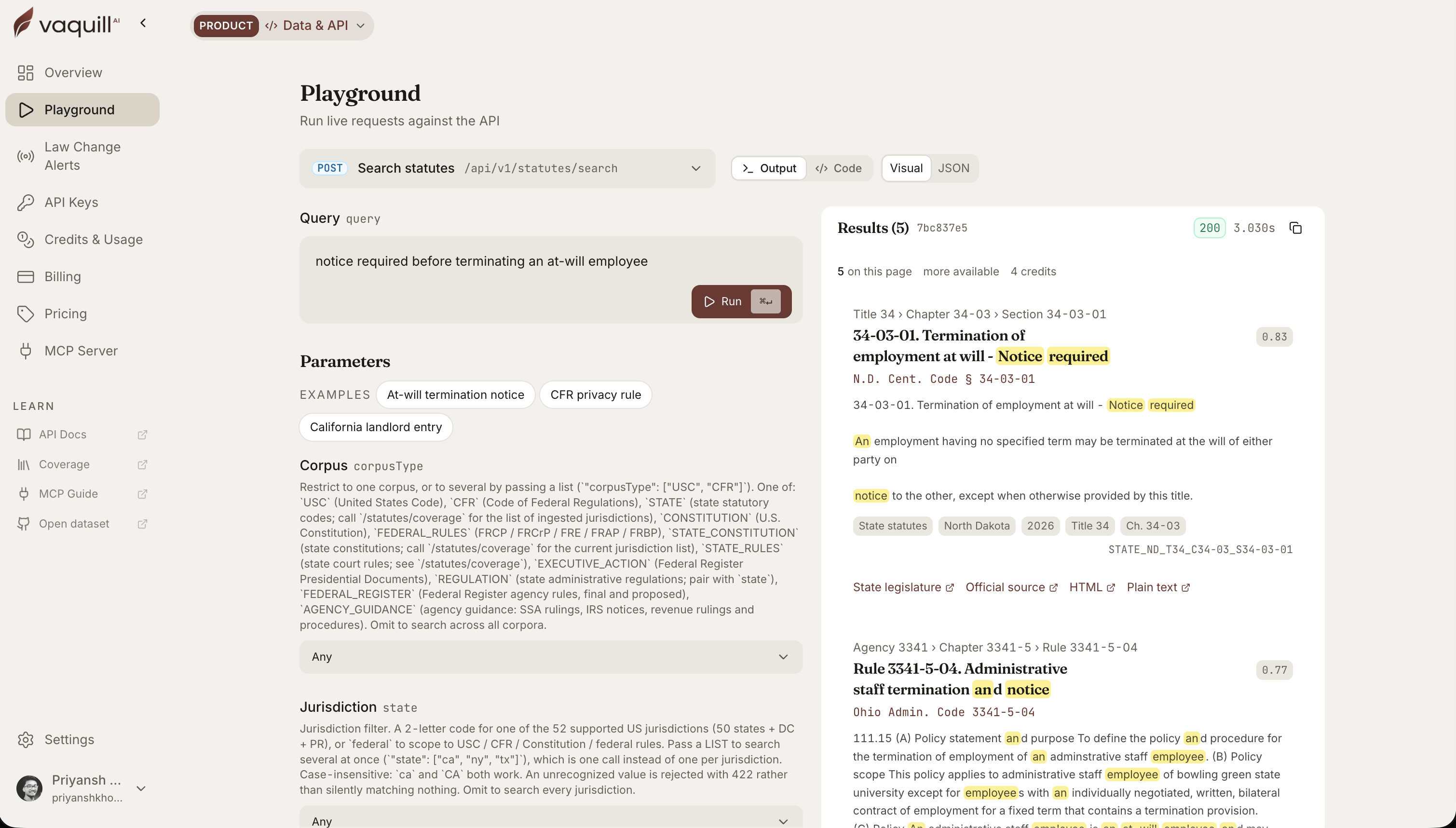 A live statute search in the Vaquill AI playground. Each hit shows its citation and links to the official source, which is the check the statute-reconciliation step later in this piece relies on.
TL;DR
- Bulk clause extraction across a portfolio is the diligence job single-doc chat cannot do. One chat per document guarantees drift; a grid (rows = documents, columns = fields) makes drift visible and the count defensible.
- "Can AI extract a clause from 50 contracts" has been a solved problem for years. Kira, Luminance, Legora, Harvey all do it. The 2026 differentiator is whether the output is auditable and reconciled against law.
- The industry sells speed. Speed is the commodity. Consistency plus cell-level provenance is the actual moat.
- The discipline lives in the schema (typed, constrained fields defined before the run), not the model. Vague prompts produce unsortable prose.
- A "legal" cell is not verified just because it matches the contract. Statutes can constrain an assignment the contract is silent about (Anti-Assignment Act, FCC transfer rules).
- For the step-by-step mechanics, see the companion build walkthrough. This piece is the why.
Per the post, a perfectly traced freely assignable cell can still be wrong because...
Part of our document tools, redline, and matrix guide series.
For related document-tools coverage, see How to Build a Document Matrix to Compare Contracts, Leases, and Filings and Can AI Analyze Legal Documents? Extraction Across 50 Contracts at Once.
The demo that wins is the demo that lies
Every AI contract tool demos the same way, and it works every time. The rep drops in one NDA, asks twelve pointed questions, and the model answers each one beautifully. You walk away convinced. What that demo proves is exactly one thing: how the tool performs on document number one.
Diligence does not die on document one. It dies on document forty-one, where the model's answer drifts a couple of degrees off the framework it used on document one, and nobody is reading closely enough at 11 p.m. to catch it.
The single-doc chat is genuinely excellent at depth. Drop in one master services agreement and interrogate it for an hour and you will learn things. That is real value, and it is the right tool when you are doing focused, single-agreement work like clause-by-clause contract review or sorting inbound NDAs in triage.
But depth on one document is the opposite of the portfolio problem. The portfolio problem is not "understand this contract deeply." It is "apply one identical question to 50 contracts and line the answers up so I can sort, filter, and count them."
Those are different shapes of work, and the chat window is the wrong shape for the second one. You can feel the wrongness the moment you try to scale it: you copy-paste the same prompt 50 times, you reword it slightly without meaning to, you paste 50 free-text answers into a spreadsheet, and the inconsistency is baked in before you ever notice it.
This is why a document matrix is not a faster chat. It is the inverse of one. Single-doc chat asks one document a hundred questions. A matrix asks a hundred documents the same question.
The unit of value flips from cleverness to consistency, and consistency is the thing the portfolio job actually needs.
Drift is the enemy, and the grid is built to kill it
Here is the mechanism, because it matters. When you ask 50 contracts the same question through 50 separate chats, each answer is generated in isolation, in slightly different words, by a model that has no memory of how it answered the last one.
"Change of control" gets called a "clean assignment clause" in document 14 and a "consent trigger" in document 41, and they might be describing the identical provision. You cannot see that, because the answers live in 50 different transcripts. There is no column to compare them in.
A grid removes the degrees of freedom on purpose. Every answer to "change-of-control treatment" lands in the same column, formatted the same way, drawn from the same constrained set of allowed values. Now drift is not invisible. It is the outlier that jumps out of a clean column the way a typo jumps out of a clean paragraph.
When 48 leases say "30 days written notice" and one says "10 business days," you see it instantly, because they sit on top of each other. When two contracts you marked "freely assignable" turn out to be the only two with a regulated counterparty, the grid surfaces that the moment you sort.
Here is what three populated rows actually look like once the schema is doing its job. Notice the column does the work: the outlier in row 3 is the one a partner will ask about.
| Document | Change-of-control treatment | Notice period (days) | Governing law | Source span |
|---|---|---|---|---|
| MSA, Acme Logistics | consent required | 30 | Delaware | Sec. 14.2, "no assignment...without prior written consent" |
| MSA, Birch Foods | freely assignable | 30 | New York | Sec. 12.1, "may assign to any affiliate or successor" |
| Supply Agreement, Crest Telecom | freely assignable | 10 | California | Sec. 9.3, "freely assignable by either party" |
Row 3 reads clean and traces perfectly to its clause, and it is still the dangerous cell: Crest holds an FCC authorization, so a transfer of control of Crest itself can require prior FCC approval under rules the contract never mentions (more on that below). A blank cell would be its own finding too. If the "termination on change of control" field came back empty for a contract, that can mean the agreement is silent, which is a result, not a gap to paper over.
The structure is the insight, and it is the part the speed pitch misses entirely. A vendor will tell you the matrix saved your associate three days. Harvey's M&A diligence article reports that at GSK Stockmann, AI-assisted diligence saved 15 to 20 percent of time on standard workflows and up to 75 percent on unstructured data rooms, and that PwC's co-development with Harvey produced diligence workflows "executed over 10,000 times."
Treat those as reported vendor figures from specific firms, not laws of physics. But notice what even the vendor's framing keeps circling back to: applying "the same analytical framework to each document" for a "consistent level of analysis across the full dataset." The time savings are the headline. Consistency is the product.
The pattern is mature, which changes the question you should be asking
It helps to know none of this is new. The row-document, column-prompt grid has a name and a decade of history. Legora ships it as Tabular Review, where "each document becomes a row and AI-generated prompts correspond to columns," built for "analyzing hundreds or thousands of documents."
Go back further and Kira (acquired by Litera in 2021) and Luminance built their reputations on machine-learning extraction across diligence sets, well before the current foundation models existed.
So when a tool pitches you on whether it "can extract the change-of-control clause from 50 contracts," that is a settled question. It can. Everyone's can. The technology has been good enough to pull a governing-law clause out of a lease for years. Asking a 2026 tool whether it can extract is like asking a 2026 spreadsheet whether it can add.
The real question, the one almost nobody puts on the demo slide, is: can you trust the grid it produced? That is where the work actually is now, and where the failures hide. Two failures specifically: the schema you didn't define well enough, and the provenance the tool didn't give you.
When you actually reach for bulk review: three jobs
Bulk contract review is not one workflow. It is a shape of work that shows up in a few specific moments, and naming them helps you spot when the matrix is the right tool instead of the chat window.
M&A due diligence. A data room lands with dozens or hundreds of commercial agreements and a close date that does not move. You need every contract scored on the same axes: change-of-control treatment, assignment, term, governing law, exclusivity. ClearyX published a case study of reviewing 479 commercial contracts for a global company's $2 billion acquisition, reporting approximate time savings of 40 to 60 percent and estimated savings of 50 percent in legal fees versus traditional associate review (ClearyX case study, read 12 October 2026). Treat that as a single reported engagement, not a benchmark, but the shape is exactly the matrix: one framework applied to the whole set.
Renewal and obligation sweeps. Once or twice a year you pull every active vendor agreement to find what auto-renews, what the notice windows are, and which prices step up. The question is identical across the portfolio, so the column set is reusable. LegalOn's 2026 State of AI for In-House Legal survey of 452 in-house professionals reports an average of 3.1 hours reviewing a single contract (LegalOn, read 12 October 2026). At that average, 500 contracts a year is about 1,550 hours, roughly 190 eight-hour working days, on review alone. A standing matrix is how you stop paying that tax every cycle.
Repapering. A law changes, a parent company is acquired, or a template gets rewritten, and now every counterparty contract has to be checked against the new standard. This is the purest bulk job, because you are asking one yes-or-no question (does this contract already comply, or does it need an amendment) across the entire book at once.
All three share the same property: the same question, asked identically, across a defined set, with the answers forced into a comparable shape. That is the matrix, and it is why none of these survive being run as 50 separate chats.
Most people get the easy part right and the hard part wrong
A common mistake under deadline pressure is treating the grid like a faster chat. They upload the 50 documents, type something vague like "summarize the key terms," and run it. What comes back looks productive: 50 rows, each cell a tidy paragraph of prose.
That output is not much use. A column of paragraphs cannot be sorted or diffed, and it cannot answer "how many terminate on change of control," because the answer is buried in 50 differently-worded summaries, and you are right back where the chat window left you, just with nicer formatting.
The discipline is to define a typed, constrained schema before you run anything. Not "summarize assignment," but a field called change-of-control treatment whose allowed values are exactly three: freely assignable, consent required, terminates. A date field that returns a date. A notice-period field that returns a number of days.
The schema does the same job a database column type does: it forces the output into a shape you can compute over. "Consent required" as one of three values is sortable and countable. "The agreement contains certain provisions relating to assignment that may, under specified circumstances, require..." is not.
This is the part the model cannot do for you, and it is the part that determines whether the grid is worth anything. The model filling the cells is the easy part. Deciding what the cells should be, with what types and what constrained values, encoding the actual question the partner asked into the column structure, that is where the judgment lives.
I won't re-walk the mechanics here, because there is a step-by-step build walkthrough that does exactly that: how to define fields, run the grid, normalize the output, and export. Read it if you want the how. This piece is about the why, and the why is: the schema is the work, and the speed everyone sells you is downstream of getting it right.
The cell can match the contract and still be wrong
Now the second trust failure, and the one that separates a defensible grid from a dangerous one.
The cautionary tale everyone in legal AI knows is Mata v. Avianca, the 2023 case where lawyers filed a brief citing cases ChatGPT invented and were sanctioned. It is usually told as a hallucination story. The deeper lesson is about unverified output. The lawyers filed the cases without checking them.
A diligence grid carries the same risk. A cell reading "consent required" has no value unless you can click through to the exact clause, in the exact contract, that supports it. An extraction you cannot trace is worse than no extraction, because it carries false confidence straight into a closing memo.
So the first non-negotiable is cell-level provenance: every value links back to the span it came from, and that link survives the export to whoever inherits the spreadsheet.
But there is a subtler version, and it is the one I want senior readers to sit with. Even a perfectly traceable cell can be wrong about the law. Verifying a cell against the contract only confirms the contract says what the grid claims. It does not confirm the contract is the whole story.
Assignment is the cleanest example. A contract can be flatly silent on assignment, or even explicitly permissive, and the assignment can still be constrained by statute.
Federal government contracts are the textbook case. The Anti-Assignment Acts (41 U.S.C. 6305 on contracts, 31 U.S.C. 3727 on claims against the United States) restrict assignment regardless of what the four corners of the agreement say. Section 6305(a) says the party to whom the Government gives a contract "may not transfer the contract or order, or any interest in the contract or order, to another party," subject to statutory exceptions.
A regulated industry adds another layer. Under 47 C.F.R. 63.24, an international section 214 authorization may be assigned, or control of it transferred through a change of control of the holder, "only upon application to and prior approval by the Commission." That rule governs the FCC authorization and the carrier's ownership, not the assignment clause of an ordinary supply agreement, so a deal that changes control of a carrier can need FCC approval however freely its contracts read. State procurement rules can add their own constraints, so check them. A grid cell that confidently reports "freely assignable," sourced perfectly to a clause that genuinely says so, can still be the cell that blows up the close.
That is why reconciling the legal cells against actual statute is a distinct verification step, not a nicety. This is the one place a statutes lookup belongs in the matrix workflow. Vaquill AI's US primary law API serves the U.S. Code, the CFR, and state codes across 56 jurisdictions, along with court rules and agency guidance, so the "does the law constrain this assignment" check can be programmatic instead of a manual trip to a separate database.
For this particular step the scope fits, because the question, "does a statute override what this clause allows," lives in the codes.
Why this is the job single-doc chat cannot do
Pull the threads together and you can see why bulk extraction is structurally a different machine, not a bigger version of the same one.
Single-doc chat optimizes for depth on one document, generated in isolation, with no enforced shape and no cross-document comparison. That is precisely the wrong set of properties for a portfolio.
The portfolio needs the same question asked identically across the set, answers forced into a comparable shape, drift made visible, and every cell traceable to both its source clause and the law that governs it. You cannot bolt those properties onto a chat window by running it 50 times. Running it 50 times is how you manufacture the drift in the first place.
This is also why the matrix is the workflow that comes after triage, not instead of it. Triage sorts a pile into keep, negotiate, escalate. The matrix is what you reach for once you have a defined set and now need to compare every survivor against every other survivor on the same axes.
Different job, different machine. And it is foundational to corporate diligence work specifically, because that is where 50-document data rooms land on a Friday with a Tuesday close.
If your firm runs the same kind of review on a cadence (the same vendor-contract fields every quarter, the same lease fields every deal), the schema stops being something you rebuild from memory and becomes a reusable asset. That is the logic behind saving extraction patterns as skills: the constrained-value field set you got right once is exactly the thing you want to run again without re-deriving it under deadline.
What to actually demand from a bulk-review tool
If you take one thing from this, make it a checklist you run against any tool that claims to review contracts at scale with AI. Skip the extraction question; everyone passes it. Ask these instead:
- Does it force a typed schema, or does it let me run a vague prompt and hand me prose? If it happily returns paragraphs, it will let you ship an unsortable grid.
- Does every cell link to the source span, and does that link survive export? No provenance, no trust, no defensible count.
- Can I sort and filter on constrained values, or am I scanning free text? The whole point is sorting by the outlier column.
- Does it leave room to reconcile legal cells against statute? Because the contract is only half the picture on anything assignment-related.
- Does it treat empty cells as findings? A blank "renewal option" can mean the contract is silent, which is itself a result. A tool that guesses to fill the blank is planting landmines.
The grid is mature technology. The judgment around it is not, and it is the entire reason a portfolio review holds up when a partner asks for a number.
Speed is what gets sold. The model is the easy part. It always was.
FAQ
What is bulk contract review?
Bulk contract review is the practice of analyzing many contracts at once against the same set of questions, instead of reading each one end to end. In practice you load the whole set into a document matrix, define the fields you care about (term, assignment, change of control, governing law), and run one extraction that fills a comparable cell for every contract. The output is a grid you can sort, filter, and count.
How do you review hundreds of contracts at once?
Define a typed schema first: name each field and constrain its allowed values (for example, change-of-control treatment can only be freely assignable, consent required, or terminates). Then run that schema across the full set so every contract is scored the same way, and verify the cells against their source clauses. The schema is the work; the model filling cells is the easy part. The step-by-step mechanics are in How to Build a Document Matrix to Compare Contracts.
Can AI review multiple contracts at the same time?
Yes, and it has been able to for years. Pulling a governing-law or change-of-control clause out of a stack of contracts is a settled capability that Kira, Luminance, Legora, Harvey, and others all offer. The open question in 2026 is whether the grid it produces is auditable: does every cell link to its source clause, and can you reconcile the legal cells against statute.
What is mass contract review used for?
Three jobs mainly: M&A due diligence (scoring a data room of agreements on the same axes before a close), renewal and obligation sweeps (finding auto-renewals, notice windows, and price step-ups across an active portfolio), and repapering (checking every counterparty contract against a changed law or a new template). All three ask one identical question across a defined set.
Is AI accurate enough for bulk contract review?
It is accurate enough to extract, but accurate extraction is not the same as a correct legal answer. A cell can match the contract perfectly and still be wrong about the law, because a statute can constrain something the four corners are silent on. That is why a verification step (cell-level provenance plus a statute reconciliation) matters more than the raw extraction accuracy. See why AI hallucinations get lawyers sanctioned for the cautionary case.
How much time does bulk contract review save?
Reported figures vary by source and engagement. LegalOn's 2026 survey reports an average of 3.1 hours per contract for manual review, and ClearyX reported approximate time savings of 40 to 60 percent on a 479-contract diligence engagement (both read 12 October 2026). Treat these as vendor-reported numbers rather than guarantees. The durable value is consistency you can audit, which outlasts any headline speed claim.
What is the difference between bulk contract review and a document matrix?
A document matrix is the tool; bulk contract review is the job it does. The matrix is the grid (rows are documents, columns are fields). For the conceptual primer, see What Is a Document Matrix, and for how it differs from redlining, see Document Matrix vs Document Comparison.
A closing takeaway
Speed is the commodity in bulk contract review. Cell-level provenance and statute reconciliation are the parts a partner will still ask you about in two years.
If your matrix needs to reconcile a clause against the statute behind it, Vaquill AI's US primary law API returns the current section text to check each cell against.
New legal AI guides, weekly.
Further Reading
Top 12 Legal Redline Software Tools (2026)
Read postHow to Build an NDA Playbook Your AI Can Actually Enforce
Read postLegal AI Workflows: How Law Firms Chain Multi-Step AI Tasks in 2026
Read postHow to Compare Documents and Export Clean Redlines (Step-by-Step)
Read postLegal Document Version Control: Which Platforms Track Versions
Read postRedline vs Track Changes: What Lawyers Actually Mean (and When to Use Each)
Read post
Product & Content
The US primary law data API: statutes, regulations, constitutions, court rules, executive orders and agency guidance across 53 US jurisdictions, each section cited and linked to its official source, via REST, MCP or SQL.