Part of the complete guide to Legal AI for In-House Counsel.
Short answer: Legal AI for SaaS companies works best when you scope it to the real SaaS workload, not a generic "review my contract" demo. The five surfaces that dominate a SaaS legal queue are customer MSAs and order forms, vendor DPAs, sub-processor notice, AI governance for your own product, and multi-state privacy compliance. No single tool covers all five well, so the right buy for AI for SaaS in-house counsel is usually two or three tools plus a written playbook.
Adoption is not the open question anymore. 52% of US in-house counsel started using generative AI in 2025, more than double the 23% a year earlier (2026 ACC Chief Legal Officers Survey, 1,049 CLOs across 43 countries). The open question is which surface to point it at first.
The first buying mistake SaaS in-house teams make is treating legal AI as a single procurement: one vendor, one demo cycle, one POC, one signature. The work does not fit one vendor.
The Monday queue at a Series C SaaS company runs like this: a Fortune 500 MSA with dozens of redlines, ten or so inbound NDAs, several vendor DPAs, new sub-processors the platform team added last sprint, a half-finished AI governance memo the CTO needs Thursday, and a CCPA opt-out ticket from product because the TDPSA cure period in Texas is active.
That is not one workflow. It is five. The team that buys one tool to handle all five ends up with a CLM that drafts AI policies poorly, an extraction tool that does not route contracts, and a Word add-in with no repository.
Scope the buy to two or three tools, each tuned to a specific surface, with a written playbook holding them together.
TL;DR
- SaaS in-house counsel run a contract-velocity workload that is structurally different from law-firm or non-tech in-house work. Five patterns dominate: enterprise customer MSAs, vendor DPAs, sub-processor management, AI governance for the company's own product, and multi-state privacy compliance.
- The 2026 buyer needs six things from the tool: custom-paper redlining playbooks, a DPA standard term library, sub-processor and supply-chain tracking, integration into Salesforce and HubSpot and Slack and Word, privacy-law-aware drafting across CCPA and the EU and the multi-state alphabet soup, and an API.
- The four vendors that best match SaaS in-house in 2026 are Ironclad, LinkSquares, GC AI, and Spellbook. Each is good at a different slice; none is good at all of it.
- The biggest pitfall is not picking the wrong tool. It is over-customizing the playbook in month one, under-investing in AI governance for the product side, and treating sub-processor changes as a quarterly project instead of a continuous obligation.
What share of US in-house counsel started using generative AI in 2025?
Part of our in-house counsel guide series.
Why SaaS in-house is structurally different
Five facts make SaaS in-house unlike, say, in-house at a manufacturer or a healthcare system.
Customer MSA velocity is the killer. A Series B SaaS company with a mid-market motion can close on the order of one to two hundred net-new enterprise customers a year. A meaningful share arrive on the customer's MSA, which makes custom-paper review the dominant time sink.
Vendor DPAs proliferate faster than anyone budgets for. A typical mid-size SaaS company runs dozens of subscription tools (Snowflake, Datadog, Segment, Stripe, Twilio, Auth0, Linear, Notion, Figma, Sentry).
Every one ships a DPA on first signature and a revised DPA when they amend their sub-processor list. The risk is drift: a slightly different SCC posture Tuesday than Monday.
Sub-processor management is a two-way obligation. A SaaS company is itself a sub-processor in its customers' DPAs, and every change to its own infrastructure triggers customer notice obligations. Platform adds a new inference vendor Monday; by Tuesday legal owes notice to every enterprise customer whose DPA has prior-notice language.
The company is shipping AI. Every SaaS company in 2026 is bolting generative features into the product. Legal owns the governance regime: training, inference, disclosures, the answer when a customer asks "do you train on our data."
Privacy law is no longer one statute. CCPA at Cal. Civ. Code § 1798.100 et seq., amended by CPRA, set the template. Then Virginia (CDPA, Va. Code § 59.1-575 et seq.), Colorado (CPA, Colo. Rev. Stat. § 6-1-1301 et seq., implemented under SB 21-190), Connecticut (CTDPA, Conn. Gen. Stat. § 42-515 et seq., from SB 6), Utah (UCPA, Utah Code § 13-61-101 et seq.), and Texas (TDPSA, from HB 4) all turned on. Each has its own opt-out, its own definition of sensitive data, its own thresholds.
The count keeps climbing. 19 states had enacted comprehensive privacy laws by the start of 2026, with Indiana, Kentucky, and Rhode Island taking effect on January 1 (IAPP, January 2026; the live count is in the IAPP State Privacy Legislation Tracker). A SaaS company selling nationally inherits all of them at once.
The five SaaS-specific contract patterns
Customer MSAs. A meaningful share of inbound enterprise paper arrives as customer-side MSA. The AI unlock is not "review this contract." It is "redline against our playbook, flag every deviation, propose the negotiation move."
A written playbook with named fallback positions on LoL, indemnity, IP ownership, termination, audit rights, and data security gives the model something to compare against. Without it the output is a generic redline, which lawyers correctly distrust.
Spellbook's 2026 State of Contracts report indicates AI compresses first-pass review meaningfully for teams running a written playbook and barely at all for teams without one.
Vendor DPAs. The reverse problem. The SaaS company is now the customer. The lift is consistency: a standard-term library so the model knows what positions you accept on processor breach notice, audit rights, sub-processor flow-down, SCCs for EEA transfers, and deletion timelines.
GDPR Article 28 is the reason. A processor agreement that does not pin down breach notice, instruction-following, deletion, and audit is non-compliant by definition. Eighty vendor DPAs with subtle variations is a compliance position you cannot describe in two sentences. The fallback positions worth pinning down before you review another one are in our DPA negotiation playbook for in-house counsel.
Sub-processor inventory management. Platform adds a vendor that processes customer personal data; it becomes a sub-processor under every customer DPA the SaaS company signed. Most enterprise customer DPAs require prior notice (often 30 days) and a right to object.
The AI lift is not drafting; it is tracking. A maintained inventory mapped to the customer DPAs each one triggers notice for. The obligation in-house teams most consistently fumble: engineers add the vendor and tell nobody, then a customer audit asks "you added that sub-processor when?"
Here is what the mapped artifact looks like in practice, for one real-world change. Platform swaps an inference provider on a feature that touches customer text:
| New sub-processor | Data category | Customer DPAs triggered | Notice term | Deadline |
|---|---|---|---|---|
| Inference vendor (US-hosted) | Customer-submitted text | 41 of 210 (have prior-notice clause) | 30-day prior notice + right to object | Day 0 of go-live minus 30 |
| Same vendor, EEA customers | Personal data | 6 (SCC + transfer-impact terms) | Prior notice + updated SCC Annex | Same window |
The exact numbers do not matter here. What matters is that the answer should be a one-screen lookup instead of a week spent grepping through signed PDFs. That is the SaaS-specific use case a generic contract summarizer does not touch.
AI governance for the SaaS product itself. The company's own product ships AI features. Legal owns the policy that determines what those features do with customer data: training, providers, retention, opt-out.
The ABA's Formal Opinion 512 (2024) addresses lawyer use of AI, not vendor product features, but the disclosure logic is identical. The policy needs quarterly review, propagation into customer-facing terms, and surfacing in sales conversations. If you are writing this from scratch, start from our AI governance policy template for in-house legal and adapt the product-side sections.
Multi-state privacy compliance. A growing block of states (California, Virginia, Colorado, Connecticut, Utah, Texas, and others) have comprehensive consumer privacy statutes in force, with more on deck.
A SaaS company selling nationally needs an opt-out workflow that complies with all of them and a privacy notice that names each state's specific rights. A model that knows the differences across statutes beats a junior associate spending a week on the comparison chart.
Two more SaaS surfaces buyers underweight: order forms and security questionnaires
Two patterns sit next to the big five and get cut from most buyer guides.
Order forms attached to the master. Enterprise deals close on a short order form that references the MSA but quietly overrides it: a one-off SLA credit, a non-standard payment term, a logo-use carve-out, an early-termination right. The risk is an order form that contradicts the master nobody re-reads. The AI lift is conflict detection across the order form, the MSA, and the DPA in one pass, not three separate reads.
Security questionnaires. Every enterprise prospect ships one (CAIQ, SIG Lite, or a bespoke spreadsheet) before signature. Legal usually co-owns the answers with security. The same facts repeat across hundreds of questionnaires a year: encryption posture, sub-processor list, breach-notice timing, data-residency, SOC 2 scope. A maintained answer library that an AI can draft from turns a multi-day questionnaire into a same-day one. We cover the legal side of this in the vendor security questionnaire guide for in-house counsel.
Six evaluation criteria for SaaS-fit legal AI
Custom-paper redlining playbooks. Can the tool import your written playbook and produce a redline against your fallbacks on your last inbound MSA?
If the output reads "your fallback says LoL = 12 months fees; incoming says uncapped; counter at super-capped 3x for IP," the tool is fit-for-purpose. If it produces a clause-by-clause summary, it is not.
DPA standard term library. Can you load your positions on breach notice, audit, SCCs, deletion, and sub-processor flow-down? Does the tool flag drift across signed DPAs? Most contract review tools will summarize a DPA but will not benchmark it against the eighty-three you already signed.
Sub-processor and supply-chain tracking. Does the tool maintain an inventory of your own sub-processors, the customer DPAs they implicate, and the notice obligations each change triggers? The most under-served surface in the current market.
Integration into Salesforce, HubSpot, Slack, and Word. Contracts originate in Salesforce or HubSpot, get discussed in Slack, get redlined in Word, close in DocuSign. A tool that requires the lawyer to leave Word, log into a separate web app, and copy text back and forth will not stick.
Privacy-law-aware drafting. Can the tool produce a multi-state privacy notice naming rights under CCPA, CPRA, CDPA, CPA, CTDPA, UCPA, TDPSA, and the EU, and update the notice when a new state turns on? If you rewrite from scratch each time, the tool is not pulling its weight.
API access. Most SaaS in-house buyers skip this and regret it. A SaaS company building internal tools wants to surface clause-library lookups, DPA risk flags, and statute-text pulls inside its own systems.
The credible primitives to ask for are a statutes and regulations API (US Code, CFR, 50-state codes) and a clause-library API your engineers can call.
What gets rejected in demos
Three things consistently kill a vendor demo for a SaaS in-house buyer. First, the tool that cannot ingest the buyer's actual playbook and produce a redline against it on the buyer's last inbound MSA; if the demo runs on the vendor's sample contract, it is a brochure, not a demo.
Second, the tool whose AI features hide behind a "schedule an enablement call" gate and cannot be tested in the first session. Third, the tool that pretends to do every surface at one price; the honest answer to "does it do CLM plus Word redlining plus repository analytics plus AI governance drafting" is no for every vendor on the market.
The contrarian take: legal AI will not solve sub-processor management.
The category does not have a strong tool for mapping platform vendor changes to customer DPA notice. That is a process problem owned by ops and engineering. Buying CLM software and expecting it to solve sub-processor flow is the second buying mistake SaaS in-house teams make.
The four vendors that fit SaaS in-house in 2026
Four vendors do enough of the workload to be worth a serious look. None is dominant on all six criteria. The right move is usually one core tool plus one or two adjacent ones.
| Vendor | Primary surface | Pricing | Custom-paper redline | DPA drift check | Sub-processor tracking | Best for |
|---|---|---|---|---|---|---|
| Ironclad | CLM / intake routing | Enterprise, quote-based | Strong | Partial | Weak | High-volume customer MSA and DPA flow |
| LinkSquares | Repository analytics | Enterprise, quote-based | Partial | Partial | Weak | Understanding the position you already signed |
| GC AI | Word add-in for in-house | Per seat, $500/mo (published) | Strong | Partial | Weak | 1-to-5-lawyer review teams |
| Spellbook | Word drafting + market data | $500/seat (demo-gated) | Strong | Weak | Weak | Teams doing first-draft generation |
Pricing for GC AI and Spellbook is the vendors' own published or stated figure; Ironclad and LinkSquares do not publish. Read the per-vendor takes below for the nuance the table flattens.
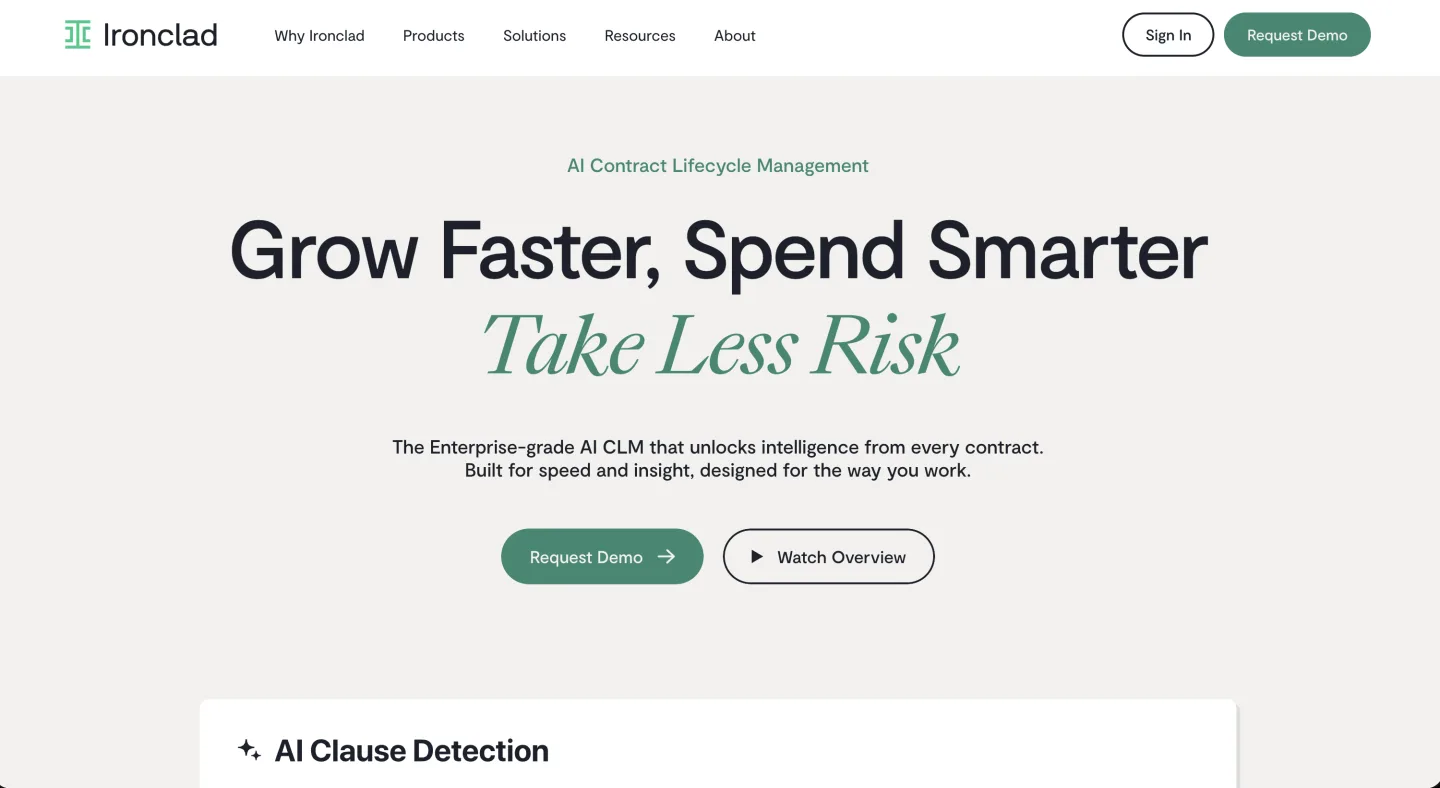
Ironclad. The CLM built for high-volume custom-paper. Workflow flexibility on inbound paper is the central pitch; the Salesforce-native motion lands with revenue ops teams.
AI features handle clause extraction, redlining against a playbook, and clause-library benchmarking. Pricing is enterprise quote-based, not published. Underperforms on: AI governance drafting, multi-state privacy notice generation. Use it for the customer MSA and vendor DPA flow, not for the AI policy memo.
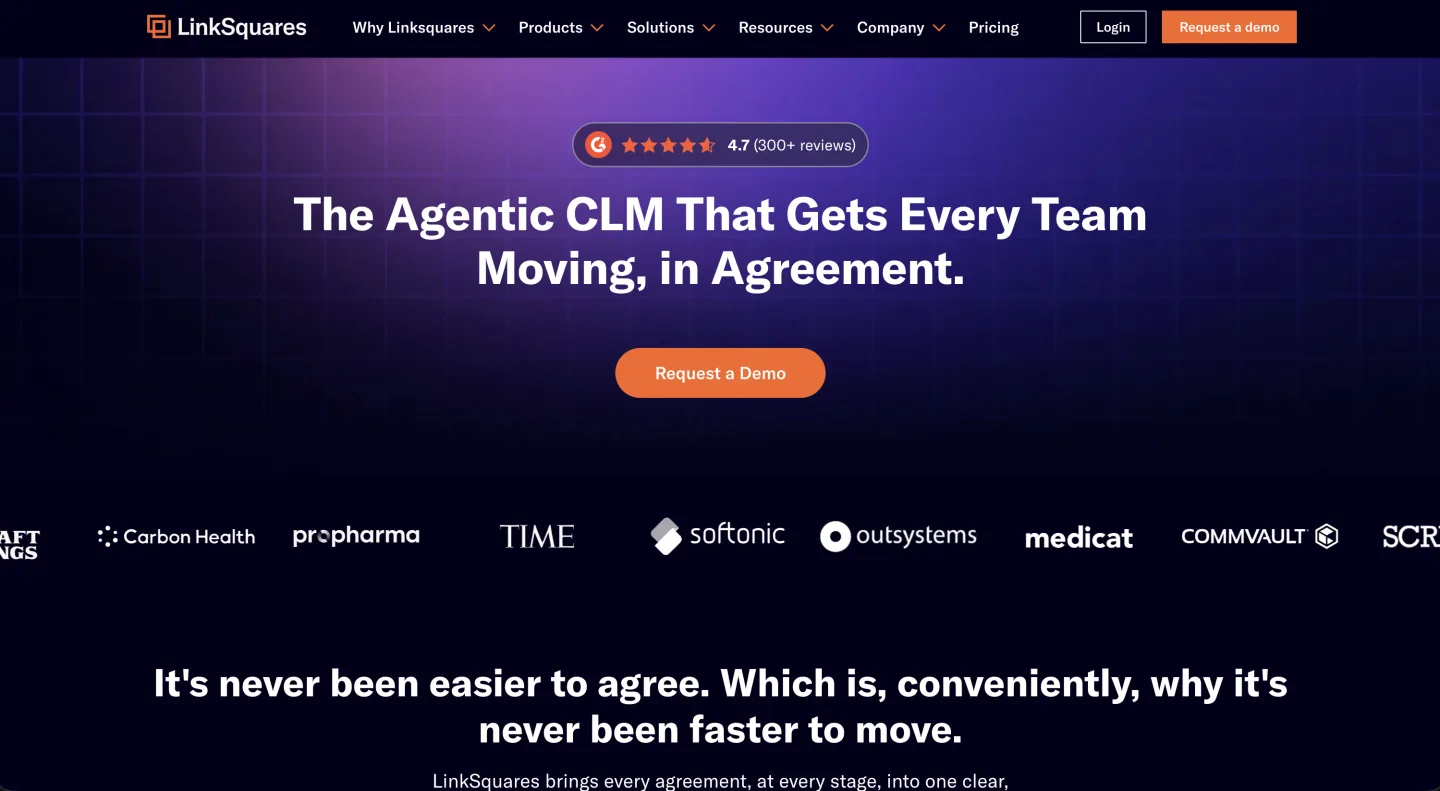
LinkSquares. Post-execution analysis and repository with a strong AI extraction layer. The fit is less about drafting and more about understanding the position the company is already in: pull every signed customer MSA, ask "which of these have uncapped IP indemnity," get an answer in minutes instead of weeks.
Pricing is enterprise quote-based, typically lighter than Ironclad because the workflow surface is narrower.
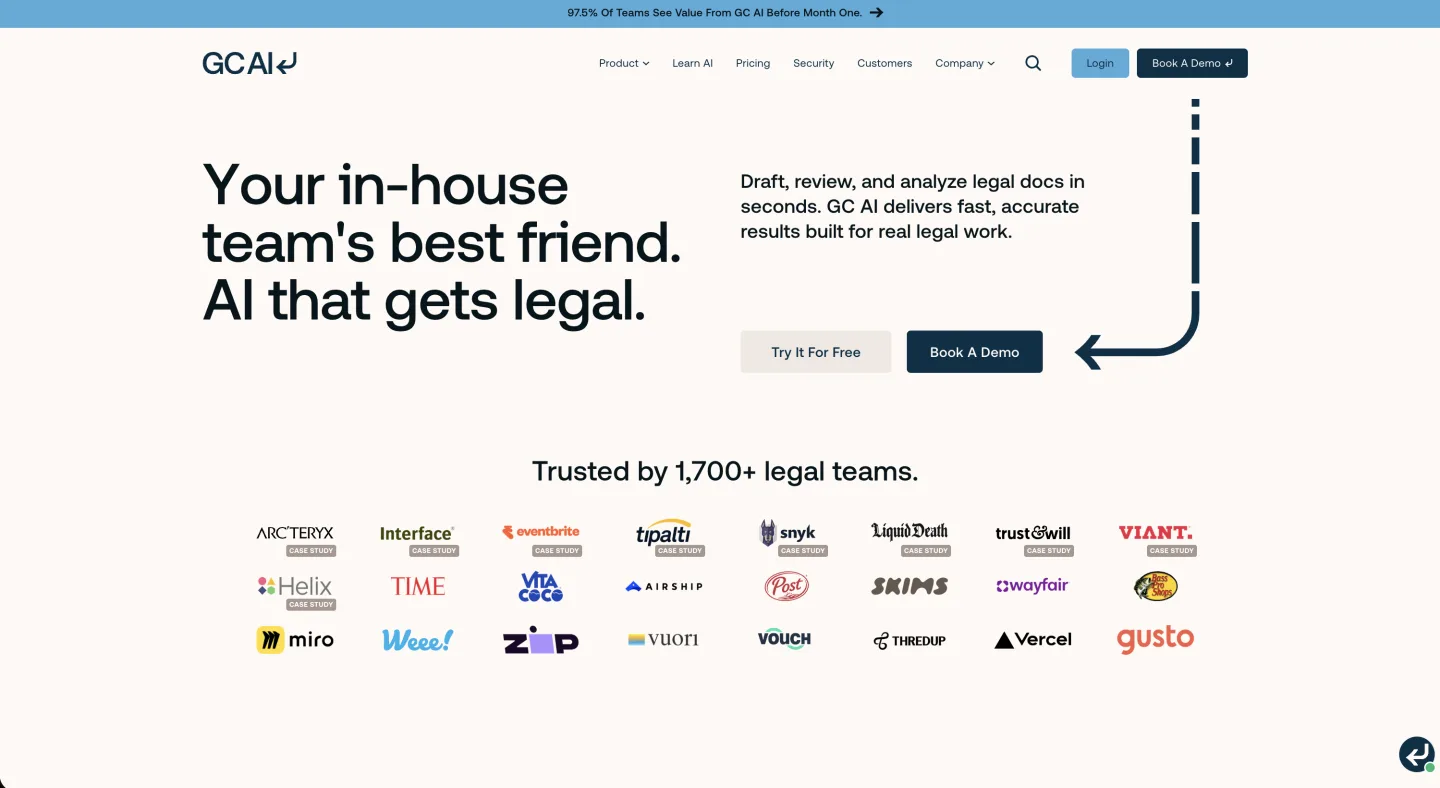
GC AI. Purpose-built for in-house counsel. Word add-in as the primary surface. Per-seat pricing is published on the vendor site, which is honest and unusual for the category.
Opinionated: redlining against a playbook, drafting from a clause library, comparing two contracts, answering "what's our position on X." Strongest fit at 1-to-5 lawyers. Underperforms on: sub-processor inventory, deep CLM workflow, repository analytics.
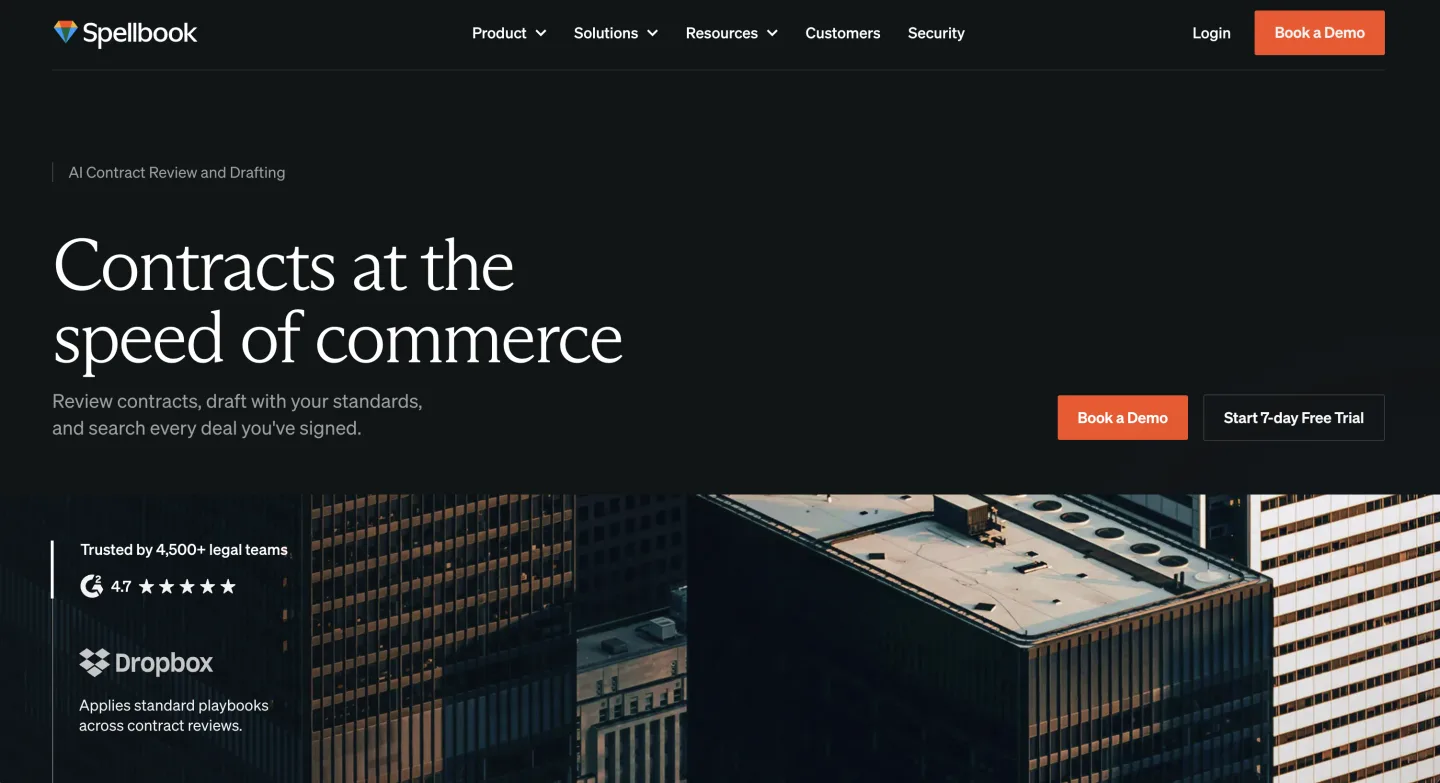
Spellbook. Drafting and redline, anchored on Word, with market-data clause comparison as the differentiator. The pitch is that the model has seen many versions of a clause and can show market norms when you redline.
Spellbook does not list pricing publicly and routes you to a demo, but the base plan is $500 per seat. Good fit for teams that do enough drafting to want first-draft generation. Underperforms on: repository, sub-processor tracking, post-execution surface.
A reasonable SaaS in-house stack at a 150-person company: Ironclad for routing and the customer-MSA and DPA flow; GC AI or Spellbook as the in-Word redlining layer; LinkSquares for repository analytics if inbound volume justifies it; a written AI governance policy maintained outside any of the four.
The choice between GC AI and Spellbook usually comes down to whether the mix leans review (GC AI) or first-draft generation (Spellbook); the choice between Ironclad and LinkSquares comes down to whether the bottleneck is intake routing or repository visibility.
A typical week at a 1-to-3-person legal team
Monday: a Fortune 100 prospect demands a custom security addendum by Friday. The CRO already promised it. The addendum has incident-response timing (12 hours) and audit rights (annual on-site) outside the playbook fallback. Tier 4: GC review.
Tuesday and Wednesday: MSA and DPA review. Each MSA loads against the playbook, the AI generates a first-pass redline, counsel reviews the deltas. Each DPA benchmarks against the standard term library; drift gets flagged.
The tradeoff surfaces here: a 5-redline MSA from a strategic customer gets less time than a 60-redline one from a tactical customer, because the strategic customer's deviations are the ones that will repeat.
Thursday: governance. The AI policy memo for the product team is due. The CTO wants language about training on customer data for a feature shipping in two weeks. Engineering wants a yes; legal needs to know which inference provider and what the data-retention contract says.
The feature ships either with conservative language (opt-in only, limited training use) or it slips a week while legal renegotiates the inference vendor's DPA. Product agrees to ship opt-in and renegotiate in parallel.
Friday: repository hygiene. The weekly report: renewal notice windows expiring next quarter, clauses outside the playbook in the last 30 days, trend on negotiation cycle time. The CFO asks the GC for that cycle-time number twice a quarter.
Common pitfalls
Over-customizing the playbook in month one. New teams write 80-page playbooks before they have signed 80 contracts. Start with one page per contract type, write down the actual fallbacks the team is using, and update quarterly.
Failing to operationalize sub-processor changes. Platform adds a vendor Monday; legal finds out in October during a customer audit. The fix is process: every platform vendor add is a ticket with a legal review step and a tracked prior-notice obligation.
Under-investing in AI governance for the product side. The CTO is shipping AI features. The marketing site says one thing, the DPA says another, the internal engineering policy says a third. The fix is one written AI policy, ratified quarterly, propagated into customer-facing terms, and reviewed by legal and engineering before any new AI feature ships.
Trying to skip the CLM. A SaaS company at $20M ARR can run on spreadsheets. By $50M ARR it cannot. Buying a CLM at $30M ARR is six months too late.
2026 priorities
Three things sit at the top of the list.
AI governance for the product, with customer-facing disclosures synchronized. The most common customer audit question in 2026 is "do you use our data to train your models, and which sub-processors do." A team that cannot answer in two sentences loses enterprise deals.
Sub-processor visibility as a real workflow, not a quarterly project. Notice half-life is days. The tooling and the process need to match that pace.
Multi-state privacy compliance as a maintained artifact. The privacy notice and opt-out workflow are not one-time work; they refresh every time a new state turns on.
For an in-house team starting this week, the first move is concrete: pull the last ten signed customer MSAs and the last ten signed vendor DPAs, benchmark each against the written playbook, and list every deviation. The drift you find is the buying spec.
Where Vaquill AI fits
Vaquill AI is a legal AI suite (research, drafting, and matter document management) aimed at in-house teams. For SaaS work, the honest fit is the in-Word redlining and DPA-benchmarking layer: load your playbook, redline an inbound MSA against your fallbacks, and benchmark a vendor DPA against the positions you already accept. The statutes API also lets engineers pull current US Code, CFR, and 50-state privacy-statute text into internal tools, which is the privacy-notice maintenance problem in primitive form.
Where Vaquill AI is not the answer: it is not a full CLM, so if your bottleneck is Salesforce-native intake routing at high volume, pair it with a routing tool rather than expecting one product to do both. Sub-processor inventory mapping is still a process you own, not a feature any vendor sells well.
If you want to test the redline-against-your-playbook claim on your own last inbound MSA, see Vaquill AI pricing and start a trial and bring a real contract instead of a sample.
For the deeper playbook on routing and fallback positions, see the in-house contract review playbook.
FAQ
What is the best legal AI for SaaS companies? There is no single best tool, because SaaS in-house work spans five surfaces (customer MSAs, vendor DPAs, sub-processor notice, product AI governance, and multi-state privacy) that no one product covers well. For high-volume customer-paper routing, Ironclad fits; for in-Word review at 1-to-5 lawyers, GC AI or Spellbook fit; for repository analytics, LinkSquares fits. Most teams run two or three plus a written playbook.
How is AI for SaaS in-house counsel different from generic contract review AI? A generic tool summarizes a contract. SaaS in-house work needs redlining against your own playbook, drift detection across dozens of signed DPAs, conflict checks between an order form and the master MSA, and privacy drafting that knows the differences across 19-plus state statutes. Those are SaaS-specific jobs a summarizer does not do.
Can legal AI review a DPA against GDPR Article 28? Yes for the drafting and flagging side. A tool loaded with your standard positions can flag where an incoming DPA misses breach notice, instruction-following, deletion, or audit terms that Article 28 requires. It cannot replace a privacy lawyer's judgment on transfer mechanics or a novel SCC posture; treat the output as a first pass.
Does legal AI handle sub-processor management for SaaS companies? Only partially, and this is the most under-served surface. The hard part is operational: mapping each new platform vendor to the customer DPAs it triggers notice for, on a deadline measured in days. Today that is a process owned by legal, ops, and engineering together, supported by a maintained inventory rather than solved by one tool.
Is it safe to put confidential SaaS contracts into legal AI? It depends on the vendor's data terms. Look for a signed DPA, SOC 2 Type II, and a zero-data-retention arrangement with the underlying model provider so your contracts are not used for training. We walk through how to verify those claims in we do not train on your data: how to verify it.
How many state privacy laws does a SaaS company have to comply with in 2026? 19 states had comprehensive consumer privacy laws enacted by the start of 2026, with Indiana, Kentucky, and Rhode Island taking effect on January 1 (IAPP, January 2026). A nationally selling SaaS company needs an opt-out workflow and a privacy notice that account for all of them, plus the EU regime.
When should a SaaS company buy a CLM? A SaaS company can run on spreadsheets at roughly $20M ARR. By $50M ARR it cannot. Buying a CLM at $30M ARR is usually about six months too late, because the migration of signed paper into the system takes longer than teams expect.
New legal AI guides, weekly.
Further Reading
Generative AI for Legal: An In-House Counsel's Guide (2026)
Read postAI Governance Policy for In-House Legal Teams: A 2026 Template
Read postLegal AI for Chief Legal Officers (CLOs) in 2026
Read postRolling Out Legal AI to Your Team (Adoption Playbook)
Read postAI Compliance Check: CCPA, GDPR, and SOX for In-House Teams (2026)
Read post12 Best Legal AI Tools for In-House Counsel (2026)
Read post
Co-Founder & CEO · Attorney
Arshita leads product and strategy at Vaquill, building the legal AI suite that solo, small-firm, and in-house US lawyers use to run a matter end to end.