A legal AI suite is one product that covers research, drafting, document comparison, a review matrix, a matter folder, and agents in a single place. A point tool does one of those well and leaves you to stitch the rest together. In 2026, the best legal AI platform for most solos and in-house teams is the suite, because the moat moved off the search bar and onto the rest of the matter. This piece explains why that happened, names the real players (Harvey, Legora, CoCounsel, Vaquill AI), and gives you a six-question demo to test any vendor.
For forty years, the economic logic of legal tech was a rectangle on a screen with a blinking cursor in it. You typed a Boolean string. The system returned a stack of cases. You paid for the right to type the string.
Westlaw and Lexis built two of the most durable franchises in professional software on that one interaction, and a generation of lawyers learned that "legal research" and "the search bar" were the same noun.
That equivalence broke somewhere between 2024 and 2026, and most of the industry is still pretending it didn't.
The 2026 question is not which search bar is smartest. It is which workbench you live in for the whole matter. Research is one tab on it.
So is drafting, comparison, a matrix across forty NDAs, a matter folder, and an agent that chains three of those while you take a call. The signal showed up in the deal flow before it showed up in the marketing.
TL;DR
- Westlaw and Lexis built billion-dollar businesses around the search bar. That era functionally ended between 2023 and 2025. The new shape is the matter workbench, with research as one surface among many.
- The deal flow tells you the category shifted. Thomson Reuters bought Casetext for $650M in 2023. Clio closed a $1 billion acquisition of vLex to build an "Intelligent Legal Work Platform" (Clio press release, 2026). Hebbia, an early "AI for legal" darling, pivoted into financial services. This is suite consolidation, and search innovation is not driving it.
- Free data killed the data moat. The public corpus of US court opinions now runs to millions of cases and keeps growing. When the corpus is public, the moat moves to the workflow built on top.
- Buyers move in a predictable order. Solos and small firms first (lowest procurement friction), in-house counsel at small companies next, BigLaw last (highest switching cost).
- The new evaluation criteria are not "is the chat good." They are suite breadth, verification posture, self-serve vs sales-gated, data lineage, and whether the thing has an API and an MCP so it actually fits into a 2026 stack.
What did Thomson Reuters pay for Casetext?
Part of our legal AI vendor comparison and pricing series.
What just happened in the cap tables
You don't need a thesis on the future of legal AI; you need the deal sheet from the last thirty months.
In June 2023, Thomson Reuters paid $650 million for Casetext. The price wasn't about ARR. Casetext had shipped CoCounsel, the first product that treated "legal research" as one of about ten things a lawyer needed AI to do in a day.
TR didn't buy a smarter search bar. It bought a workbench it could weld onto Westlaw's data spine.
In 2026, Clio closed a $1 billion acquisition of vLex and folded vLex's Vincent AI into what it calls an "Intelligent Legal Work Platform," alongside a $500M Series G at a $5B valuation (Clio press release, 2026; ABA Journal). Note the framing. Not "the world's best legal research." A practice-management company bought a research and AI company to put research inside the matter, and not next to it.
Hebbia, once a marquee AI-for-law play, leaned into financial services. The lesson isn't that legal AI failed for them; it's that horizontal AI infrastructure with a thin legal wrapper is the wrong shape for this market.
Spellbook's 2026 State of Contracts report found contract teams running well over half of routine review through AI as a first pass, with humans stepping in for negotiation. Workbench use case, not search.
Four deals, one direction. The category isn't "AI for legal research" anymore. It's the matter workbench.
Why the search bar stopped being a moat
In 1975, when Mead Data Central was building what became Lexis, the moat was the database. Digitizing federal and state case law was a multi-year capital project. Building a citation graph required armies of editors.
Maintaining headnotes and key numbers was a publishing operation with the labor profile of a national newspaper. The search bar on top was the lightest part of the product.
That asymmetry held for forty years. It's why Westlaw and Lexis could charge what they charged. They weren't selling a query interface; they were selling access to a privately maintained version of the law you couldn't get anywhere else.
In 2026, the corpus is mostly free. The public collection of US court opinions now runs into the millions, with centuries of digitized state reporters layered in.
The federal government publishes the U.S. Code and the CFR. State legislatures publish their codes. The serious products built on this public corpus lean on grounding, which sits underneath the broader argument for grounding rather than training as the thing that matters.
When the corpus moves from scarce to abundant, the moat moves with it, to what you do with the data and to the rest of the matter that used to live in a separate stack.
The AI layer is increasingly commoditized too. Frontier models from a handful of labs do the heavy lifting across every legal AI product on the market.
The model is not the moat. Anyone pitching a proprietary model as the differentiator in 2026 is selling a wrapper and calling it a foundry.
The "rest of the matter" is the actual moat now: drafting against a playbook, comparing two versions of a document, building a matrix across forty contracts, organizing a matter folder, running an agent that chains those together, verifying citations before a brief goes out the door. These are workbench features, and they are hard to bolt onto a product that started life as a database with a query box on top.
For related vendor / pricing / buyer-guide coverage, see Why Harvey Costs $2,400 a Seat in 2026 (and Whether It's Worth Anywhere Near That) and The Small-Firm Legal Tech Stack That Actually Works in 2026.
The new shape
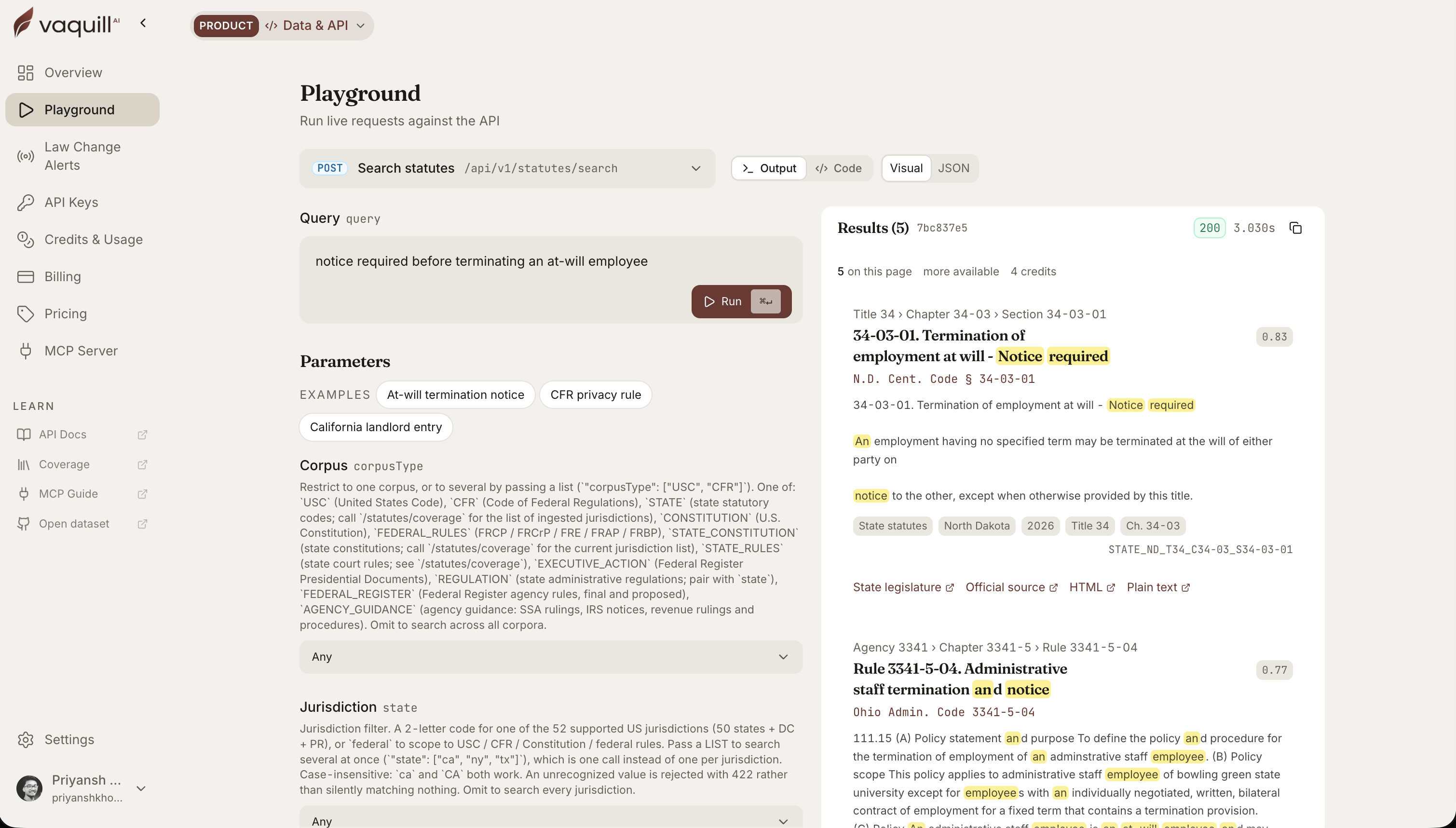 The same corpus behind this article, queried live. Every result carries its citation and a link to the official source.
A 2026 legal AI workbench, viewed honestly, has roughly eight surfaces:
- Research grounded on a real corpus, with citations you can open
- Drafting against a playbook, with first-pass redlines
- Document comparison that produces a clean export, not a chat about the diff
- A matrix that puts forty documents on one axis and the dimensions you care about on the other
- A matter folder where uploads, conversations, drafts, and citations live together
- Agent mode that chains a research step, a drafting step, and a verification step without you babysitting each one
- Verification wired into the entire surface, not bolted on as a separate "fact checker" tab
- Integrations: an API for the things you want to pull into other tools, MCP so Claude or Cursor can use the same primitives from inside a developer environment
One of those eight is research. The 2026 buyer is evaluating the other seven, and the vendors built around the other seven are the ones who compound. Harvey, Legora, CoCounsel, and Eudia are competing on suite breadth, not search quality. The frame has changed under the feet of the incumbents.
A pattern keeps showing up on small-firm calls. A five-lawyer plaintiff firm we spoke with this spring ran Westlaw, a CLM tool, a separate redline product, and a bookmarked free legal-AI chat. Four contracts, four DPAs, four invoices, roughly $2,400 a month total.
They didn't switch because the search was better somewhere else. They switched because consolidating three of those four into one workbench killed a procurement headache and cut their AI-and-research line item by about 40%. That story is repeating in every state, and it's invisible to anyone who only reads the AmLaw trade press.
Legal AI suite vs point tool: how the 2026 players compare
Here is the practical split. Suites try to cover most of the eight surfaces; point tools go deep on one. Prices below are the vendor's own published or founder-confirmed figures where noted, and per-seat per month unless stated. Where a vendor publishes nothing, it is marked quote-based.
| Product | Shape | Covers research + drafting + compare + matter | Self-serve | Price (per seat / mo) | Best for |
|---|---|---|---|---|---|
| Harvey | Suite | Yes | No, sales-gated | $1,200 to $2,000+ (reported); also metered credits | BigLaw and large in-house |
| Legora | Suite | Yes | No, sales-gated | $300 to $800 (founder-confirmed); also metered credits | Mid-size to large firms |
| CoCounsel (Thomson Reuters) | Suite, on Westlaw | Yes | No, sales-gated | $225 to $400+ (founder-confirmed) | Firms already on Westlaw |
| GC AI | Suite, in-house focus | Research + drafting, lighter on matter | Yes, Individual tier | $500 Individual (gc.ai/pricing) | In-house counsel |
| Vaquill AI | Suite, solo / small / in-house | Yes, plus API and MCP | Yes | See pricing | Solos and in-house teams |
| Spellbook | Point tool, contract drafting | Drafting only | No | $500 (founder-confirmed); quote-based on site | Word-centric contract work |
| Paxton AI | Point-leaning, research + drafting | Research + drafting | Yes, 7-day trial | $499, or $2,999/yr (paxton.ai/pricing) | Research-first solos |
| Westlaw / Lexis | Search incumbent + AI add-on | Research-led | No | Quote-based, committee sale | AmLaw retention |
The pattern in the table is the whole argument. The products built around the full matter are the ones a small buyer can actually adopt in an afternoon, and the search incumbents still route you through a committee.
Who loses in this shift
Two groups.
The first is the pure search-bar incumbents. Westlaw and Lexis are racing: they shipped AI assistants, bought Casetext, and are not unaware. The problem is structural.
Their pricing, procurement cycles, and enterprise contracts are tuned for AmLaw firms that buy through committee at six figures a year per seat. That model does not bend to a solo who wants to sign up Tuesday for $100/month and start drafting Wednesday. We mapped the gap in what Westlaw costs solos and small firms in 2026 and why a Westlaw alternative is the real 2026 question.
The second is the pure point tools. Spellbook for contracts. Litera for redlines. Lexion (Docusign) for CLM. Each is a real product.
The problem is the one corporate IT has had with point tools forever: five vendors equals five contracts, five DPAs, five places client data could leak. A solo doesn't have the appetite. An in-house team at a Series B doesn't have the procurement bandwidth.
The suite wins not because it's better at each feature, but because it's better at the feature procurement actually cares about: "one vendor."
Point tools survive in big-firm departments with the procurement muscle for a stitched stack. That's a real market. It's not the growth market.
The strongest counterargument is that Westlaw and Lexis hold AmLaw through pure switching cost and that suite vendors will never crack it. Partially right, largely irrelevant.
BigLaw will keep its incumbent seats well into the 2030s because conflicts databases, citator integrations, and partner-level habit are not getting ripped out. But the segment growing fastest is not BigLaw. It's the long tail of solo, small, mid-size, and in-house buyers who never had a $50K Westlaw contract to defend.
Incumbents winning defensive retention in their original segment does not contradict suite vendors winning new-customer formation in the segment that's actually opening up. Only one of those produces the next billion-dollar company.
Who buys first
Solo lawyers and small firms move first. No committee, the principal is the buyer and the user, switching cost is a credit card and an afternoon.
In-house counsel at small and mid-size companies move next. Procurement exists, but it isn't a multi-month gauntlet, and the GC has authority to sign for the team. The pitch isn't "replace Westlaw"; it's "replace the spreadsheet, the email folder, and the Google Drive that the contracts live in today," which is an easier sell.
BigLaw moves last. Switching costs are enormous, partner buy-in is required, malpractice carriers want established vendors, and existing Westlaw and Lexis contracts are sunk-cost glue. Any vendor building strategy around landing BigLaw first is building strategy around the wrong customer.
So if you are a solo or a fifteen-lawyer firm shopping for AI in 2026, evaluate workbenches priced and packaged for you. The 2024 question was "which Westlaw competitor." The 2026 question is "which workbench."
The new evaluation criteria
If the buyer is looking at a workbench rather than a search bar, the evaluation rubric changes. Five things actually matter now:
Suite breadth. Does the product cover research, drafting, comparison, matrix, matters, and agent in one place, or are you going to find yourself paying for three vendors to recreate it? Breadth without depth is a demo; depth without breadth is a point tool. You want both.
Verification posture. Post-Mata, honest products build verification into the workflow instead of shipping a separate "fact check" toggle. The failure to probe isn't "did the model make up a case."
It's the subtler one: agent mode pulled a statute section, drafted around it, and the section has since been amended; or the parallel reporter cite is wrong; or the case was reversed in 2023 and the model is quoting the trial-court opinion. See legal AI that avoids hallucinating cases and how to verify AI legal citations before filing.
Self-serve vs sales-gated. A vendor that won't let you sign up, pay, and use the product without a thirty-minute discovery call is telling you something about their target customer, and it's probably not you. Exceptions exist (regulated deployments, on-prem) but they should be exceptions.
Data lineage. Whose corpus, whose API, whose model? "We have proprietary data" is increasingly a tell that the vendor is muddying the question. Honest products name third-party dependencies and tell you which model does the inference. Murky lineage is a risk you inherit at deployment.
API and MCP availability. This is the 2026 differentiator most buyers don't ask about and then regret. Three exports to demand in any demo: statute or regulation text in machine-readable JSON, a redline diff export between two document versions, and a matrix CSV.
If a vendor cannot produce all three, you are buying a silo. The honest scope is the useful scope: a statutes-only API is more credible than a vague "case-law API" that nobody can actually integrate against, and the MCP layer is what lets a developer plug research directly into Claude or Cursor without scraping. "No programmatic access at all" is not acceptable anymore.
Notice what's not on that list. Search relevance ranking. The number of cases in the index. Boolean operator support.
The classic search-bar metrics are still real, but they are table stakes now, not differentiators. If a vendor leads with them, they are pitching you a 2018 product in 2026 clothes.
The six-question demo
If you only remember one thing from this post, remember the questions. Run every vendor demo through them and you'll see who's serious in about thirty minutes:
- Show me the exact source for a citation in your last answer.
- Pull current statute or CFR text for a section that was amended in the last six months, and surface the amendment date inline.
- Compare two versions of a contract and export the redline as a clean Word file.
- Build a matrix across ten documents and export the matrix as CSV.
- Demo agent mode chaining a research step, a drafting step, and a verification step on one matter.
- Show me your API docs and your MCP server.
A vendor that ducks any of these is telling you which feature they hope you won't ask about. Take the hint.
Where it goes in the next twenty-four months
Three things, in order.
Consolidation continues. The category cannot support the current count of well-funded suite vendors plus incumbents plus point tools indefinitely. The interesting acquisitions will not be "big AI vendor buys small AI vendor."
They'll be practice-management or document-management companies buying AI vendors to put AI inside the matter, the way Clio did with its $1B vLex purchase. Watch the CLM and PM vendors as acquirers.
Vertical suites emerge. The generalist workbench works for solos and small firms because their work is varied. Up-market, specialization wins.
Supio and Eve are building plaintiff-side suites; GC AI and Eudia are building in-house counsel suites; corporate transactional and litigation will follow. The endgame is a small number of horizontal suites and a long tail of vertical ones, with shared data primitives underneath.
MCP becomes the default integration plane. Model Context Protocol is doing for AI-tool integration what HTTP did for web services.
The vendors that ship clean MCP servers in 2026 show up in the next wave of agent stacks; the ones that don't find themselves on the outside of every Claude or Cursor workflow a lawyer-developer builds. The serious vendors are already there. The laggards have eighteen months.
The same corpus behind this article, queried live. Every result carries its citation and a link to the official source.
FAQ
What is a legal AI suite? A legal AI suite is one product that handles most of a matter in a single place: research on a real corpus, drafting against a playbook, document comparison, a review matrix across many files, a matter folder, and agent steps that chain those together. A point tool does one of those well and assumes you'll buy others for the rest.
Legal AI suite vs point tool: which is better? For solos and in-house teams, the suite usually wins, because the thing procurement cares about is "one vendor, one contract, one DPA." Point tools still make sense inside big firms that have the IT muscle to stitch a stack and want best-of-breed depth on one task, such as contract redlines.
What is the best legal AI platform in 2026? There is no single best one for everyone. Harvey and Legora fit BigLaw and large in-house teams, CoCounsel fits firms already on Westlaw, GC AI fits in-house counsel, and self-serve suites like Vaquill AI and Paxton AI fit solos and small firms. Match the shape to your segment and budget, then run the six-question demo above.
How much does a legal AI platform cost? It ranges widely. Harvey runs $1,200 to $2,000+ per user per month (reported) and Legora $300 to $800 (founder-confirmed, with newer metered-credit options), CoCounsel $225 to $400+ (founder-confirmed), GC AI lists $500 for its Individual tier (gc.ai/pricing), and Paxton AI lists $499 per month or $2,999 per year (paxton.ai/pricing). Westlaw and Lexis remain quote-based committee sales.
Is Harvey or CoCounsel a suite or a point tool? Both are suites. Harvey covers research, drafting, review, and agents and sells to firms and corporate legal teams. CoCounsel is the suite Thomson Reuters built on top of Westlaw and Practical Law. Both are sales-gated, so a solo cannot sign up and pay the same afternoon.
Did the search bar stop being a moat for Westlaw and Lexis? The data moat shrank because most of the corpus is now public, including millions of US court opinions and the federal U.S. Code and CFR. The incumbents still hold AmLaw on switching cost, but new-customer growth has moved to suites priced for smaller buyers.
Why does a legal AI tool need an API and an MCP server? An API lets you pull statute text, redline diffs, or a matrix CSV into your other tools. An MCP server lets an agent in Claude or Cursor call those same primitives directly. A vendor with neither is a silo, which is a real cost when you try to automate a workflow later. See how to add legal research to an AI agent over MCP.
Who should buy a legal AI suite first? Solos and small firms move first because the buyer, user, and budget owner are the same person. In-house counsel at small and mid-size companies are next. BigLaw moves last, held by switching cost and existing Westlaw and Lexis contracts.
The bottom line for buyers
If you are a solo or a in-house team weighing the suite against a stack of point tools, Vaquill AI is a self-serve legal AI suite that puts research, drafting, comparison, a matter folder, an API, and an MCP server in one place. You can see the workbench and pricing before talking to anyone.
New legal AI guides, weekly.
Further Reading
Legal AI Tools for Solo Practitioners: 7 Picks That Fit a One-Person Firm
Read postPersonal Injury AI in 2026: What It Actually Does for Plaintiff Lawyers
Read post7 Ways AI Helps Personal Injury Lawyers Win Cases Faster
Read postAI for Family Law: How Solo and Small-Firm Family Lawyers Use It
Read postTop AI Legal Research for Solo Attorneys on a Budget
Read postWhat AI Legal Tools Are Actually Trained on Federal and State Case Law
Read post
Product & Content
Legal AI suite for US working lawyers: research, drafting, document comparison, document matrix, matters, and citation-verified answers, in one tool.