Short answer on price: vLex does not publish a sticker price for Vincent AI. Third-party sites peg self-serve access near $69 per user per month with Vincent included (AI Vortex, Apr 2026), and firm plans starting around $399 per user per month (Spellbook, Jun 2026), while more than 40 state bars bundle the Fastcase base free. Here is the context that explains that spread.
In June 2025, Clio paid one billion dollars for vLex. Then it raised a $500 million Series G at a $5 billion valuation a few months later, and by November the deal had closed.
It was the largest acquisition in legal-tech history, and it told you almost everything you need to know about where this comparison is heading.
Because when people ask me to compare Westlaw and vLex, they usually expect a feature grid. Citator versus citator, headnotes versus headnotes, who has more state coverage. That grid exists, and I'll give you the parts that matter.
But the more honest framing is this: these two products now sit at opposite ends of a strategic fork, and both ends have been swallowed by something larger. Westlaw is the depth play, decades of editorial labor wrapped in Thomson Reuters. vLex is the breadth play, a billion documents across 100-plus countries, now a feature inside Clio's practice-management empire.
The question for a US solo or small firm is not "which is bigger." It's "which philosophy am I actually paying for, and do I use it."
TL;DR
- vLex Vincent AI pricing, in one line: no public sticker price; third-party figures run from ~$69/user/mo self-serve to ~$399/user/mo for firm plans, and free through 40-plus state bars. Vincent AI is included in whatever vLex plan you land on, so the plan is the variable, not the assistant.
- Westlaw vs vLex in one line: Westlaw wins US depth (KeyCite, Practical Law, Precision AI plus CoCounsel) and costs the most; vLex wins global breadth and price (1B+ documents, Vincent AI, often free through your bar). US-only firms care more about verifiable US answers than either headline.
- Westlaw is depth. Deepest US case law, KeyCite, Practical Law, decades of editorial enhancement. You pay for it: roughly $133 to $266/month per the published Westlaw Classic tiers, with CoCounsel AI pushing past $400.
- vLex is breadth. After the 2023 Fastcase merger it became the self-described "world's largest global law library," over one billion documents spanning 100+ countries (vLex coverage page, June 2026), with Vincent AI built on top. Free to many lawyers through bar memberships.
- vLex AI = Vincent, included. Westlaw splits its AI into Precision AI (embedded research) and CoCounsel (the ex-Casetext agent, priced as an add-on). vLex bundles Vincent AI into every subscription at no extra cost, which is the core of its price story.
- As of November 2025, vLex is owned by Clio, the leading SMB practice-management platform, for $1B. That echoes the Casetext-into-Thomson-Reuters pattern: challengers get absorbed, and absorption tends to erode the disruptive pricing that made them interesting.
- For most US-only practices, "1 billion global documents" is a tax you pay and never use. You rarely touch the 100-plus foreign systems. What you need is verifiable US answers at a price that survives the month.
- The deciding factor is verifiability, not catalog size. A leaner US-focused tool grounded in 8M+ US opinions (case-law research as an in-app feature, not a public API) plus full USC, CFR, and 52 state and territory codes can beat both on focus.
For a US-only firm, what does this post say actually decides malpractice exposure?
vLex Vincent AI pricing at a glance
vLex publishes no sticker price for Vincent AI, and Vincent is bundled into whatever vLex plan you land on, so the plan is the variable, not the assistant. Here are the figures cited across this post, in one place:
| Access path | Published figure | Source |
|---|---|---|
| Bar bundle (Fastcase legacy) | Free to members | 40+ state bars (e.g. the Florida Bar member benefit) |
| Self-serve, Vincent included | ~$69 per user/mo | AI Vortex, Apr 2026 |
| Vincent AI subscription, starting | ~$399 per user/mo | Spellbook, Jun 2026 |
| Direct from vLex | Not published, quote only | vLex product page + Lawyerist review, 2026 |
Read the spread as the signal: a tool quoted anywhere from free to about $399 per user per month prices by which door you walk through (bar member, self-serve solo, or negotiated firm seat), not by the assistant. The full walk-through of that spread, and what it means if you buy direct, is in the pricing section further below.
The short verdict
Pick Westlaw if you are litigation-heavy and lean on KeyCite plus Practical Law, and the $266 to $400-plus monthly cost is noise. Pick vLex if your state bar bundles it free or you want Vincent AI without a separate add-on bill, and you sometimes need international materials. If you are US-only and keep paying for one platform's signature feature without using it, a focused US tool (Vaquill AI runs on published, self-serve pricing) does the core job for less.
Part of our legal AI vendor comparison and pricing series.
Two products, two bets
Start with what each company actually believes.
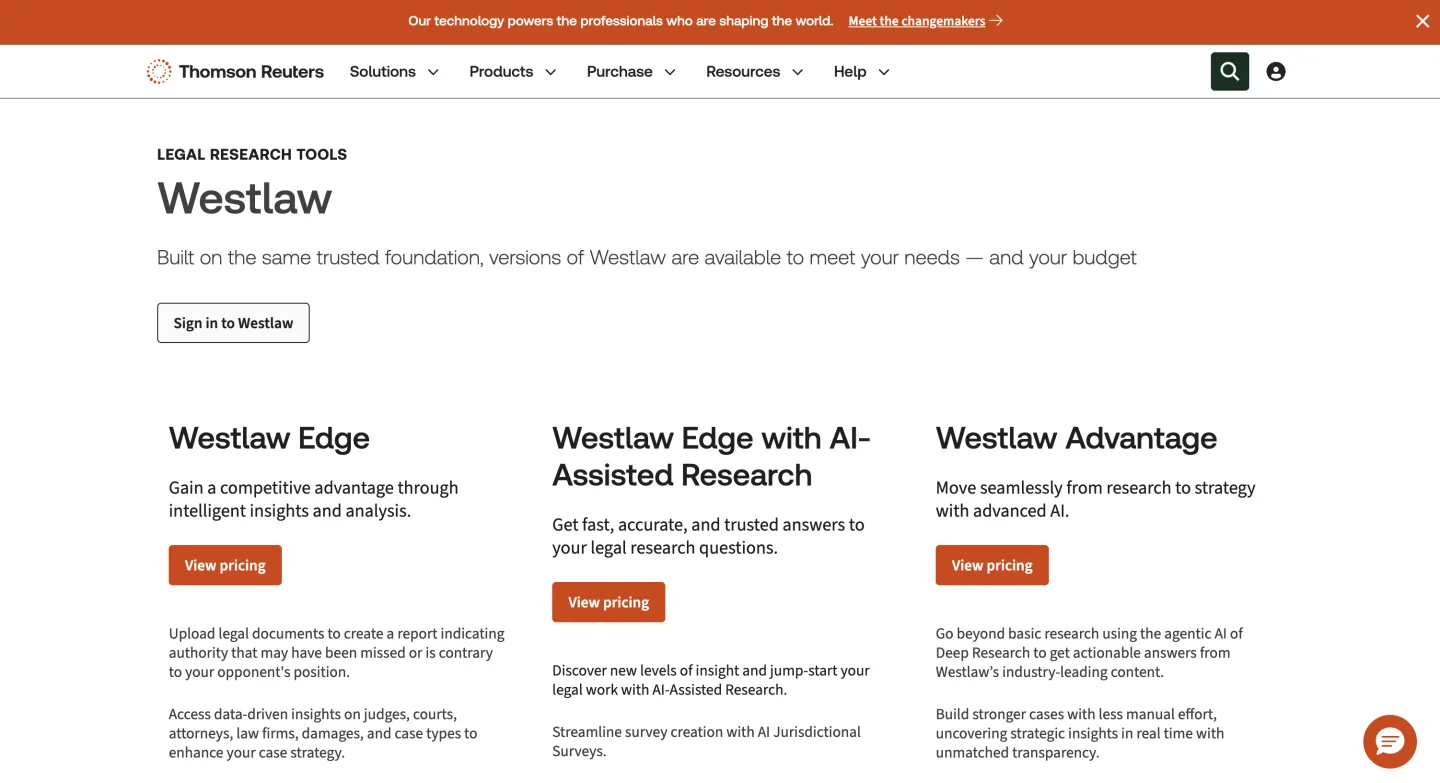
Thomson Reuters believes the value is in the layer humans add on top of raw law. KeyCite is not a list of citations; it is editorial judgment about whether a case is still good law, whether it was distinguished, criticized, or overruled.
Practical Law is not statutes; it is practice notes written by lawyers who know what a non-compete clause should say in Delaware. Headnotes, the Key Number System, annotations: all of it is the product of editors, and it has been accumulating since West Publishing started printing reporters in the 1870s.
That is the moat, and it is real. When you are checking whether a 1998 Ninth Circuit opinion survived a 2019 en banc decision, KeyCite's depth of negative-treatment analysis is genuinely hard to replicate. I won't pretend otherwise.
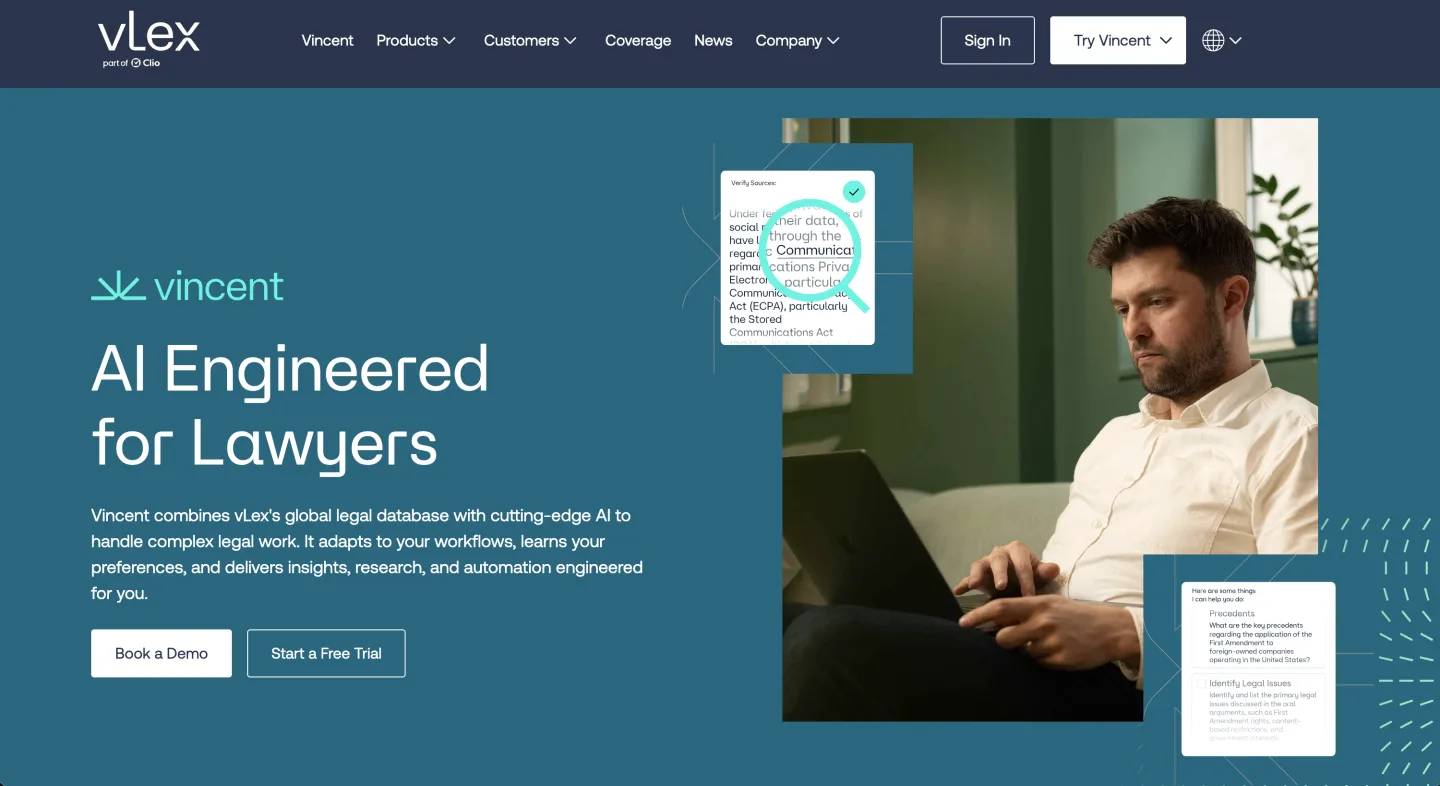
vLex bet on the opposite thing: scale and ownership of the corpus. The 2023 merger with Fastcase combined two large libraries into what the companies called the "ultimate training data set" for legal AI. The ABA Journal covered the merger in exactly those terms.
The logic is that if you own a billion documents across 100-plus countries, you control the raw material that AI models need, and Vincent AI sits on top of that material. It is a platform bet, not an editorial bet.
Both bets are defensible. Neither is automatically right for you.
At a glance
| Axis | Westlaw | vLex |
|---|---|---|
| Bet | Editorial depth | Library breadth |
| Coverage | US federal and state, deeply annotated | 1B+ documents across 100+ countries |
| Citator | KeyCite, decades of editorial labor | Cert, AI plus human review |
| AI: research | Precision AI (embedded) | Vincent AI (included) |
| AI: agent / drafting | CoCounsel (ex-Casetext, add-on) | Vincent AI memos and headnotes |
| Pricing (small firm) | ~$133-$266/mo Classic; $400+/mo with AI | Free via bar; no public price, ~$69-$399/user/mo cited by third parties (AI Vortex Apr 2026; Spellbook Jun 2026) |
| Owner (Nov 2025) | Thomson Reuters | Clio ($1B acquisition) |
| Best fit | Litigation-heavy practices that lean on KeyCite and Practical Law | Solos who get free bar access or want Vincent AI without an add-on bill |
For related vendor / pricing / buyer-guide coverage, see Westlaw vs LexisNexis: A Plain-English 2026 Breakdown for Solo and Small Firms, How Much Does Westlaw Cost in 2026? Solo, Small-Firm, Westlaw Plus Pricing, and whether LexisNexis is worth it and the better alternatives.
Coverage: depth versus breadth, and why breadth is mostly noise
Here is the part most comparison articles get backwards.
They treat vLex's billion documents as a straightforward advantage. More is better, the reasoning goes. But "more" includes case law from Spain, Mexico, the UK, the EU, and dozens of Latin American and European systems.
If you run a personal injury practice in Ohio or a family law shop in Texas, the marginal value of Chilean labor law is precisely zero. You are paying for breadth as a line item whether you use it or not.
Westlaw's coverage is narrower in jurisdiction count but deeper where US lawyers actually work: federal appellate and district opinions, all 50 state court systems, statutes, regulations, and an editorial layer on top of every one of them. For a US litigator, that depth is more useful than vLex's 100-plus-country sprawl.
But notice what this means. The real coverage question for a US firm is not "how many countries" or even "how many documents." It's:
- Does it have the federal and state opinions I cite?
- Does it tell me whether they are still good law?
- Does it have the statutes and regulations my matters turn on?
On the first, both are competent for US primary law. On the second, Westlaw's KeyCite wins on depth; vLex's Cert citator combines AI and human review across hundreds of thousands of citations but does not match KeyCite's granularity of negative treatment.
On the third, statutory coverage is where a focused tool can quietly outperform a giant catalog, because what matters is whether the section you need is current and verifiable, not whether the platform also holds the Spanish civil code.
To put a concrete example on it: when a question turns on fair use, you want 17 U.S.C. § 107, the actual section text, current edition, citation in hand, openable and checkable. That is a precise retrieval problem. It has nothing to do with how many foreign jurisdictions a library spans.
A statutes API that returns exactly USC_T17_C1_S107, "Limitations on exclusive rights: Fair use," from a corpus refreshed weekly, solves it in one call. Coverage breadth and statutory verifiability are different axes, and US firms care far more about the second.
What Vincent AI actually does
Vincent AI is not one feature. It is a set of workflows layered on the vLex library, and the marketing name hides how many distinct jobs sit underneath it. The ones that matter for a US practice, per vLex's own product page (Jul 2026):
- Ask a research question. Natural-language query in, a grounded answer with citations out.
- 50-state survey. One prompt generates a multi-jurisdiction analysis across all 50 states. This is the feature most reviewers single out as Vincent's standout.
- Compare jurisdictions. Side-by-side treatment of an issue across selected regions.
- Contract and redline analysis. Reviews an agreement, flags legal risk, and explains what a redline changed and why.
- Litigation intelligence. Judge, lawyer, law-firm, and party profiling drawn from docket data, fed by Docket Alarm's litigation database (cited at 820M+ filings in the Lawyerist review, 2026).
- Vincent Studio. Build and save custom multi-step workflows instead of re-prompting from scratch.
vLex's own marketing (vlex.com/vincent-ai, Jul 2026) claims 8 of the 10 largest law firms use Vincent, a 38% minimum productivity lift from independent benchmarking, and 3.67x more reliable output than leading general-purpose LLMs in randomized testing. Those are vendor numbers from controlled settings. Treat them as directional and test them against your own matters before you rely on them.
AI: "trained on a billion documents" is not the flex it sounds like
The phrase "ultimate training data set" is doing a lot of work in vLex's positioning, and it deserves scrutiny.
Training an AI model on a billion legal documents and grounding an answer in verifiable citations are not the same thing. A model trained on a giant corpus learns patterns, statistical regularities, the shape of legal language. It does not, by virtue of training, cite you a real case you can open.
That gap is exactly where the famous failures live. Mata v. Avianca in 2023 was the sanctions case that made the problem impossible to ignore: a lawyer submitted a brief full of cases that did not exist, generated by a model that had been trained on plenty of real law and still invented citations wholesale. ABA Formal Opinion 512 (July 2024) now makes the duty of verification explicit.
So when you evaluate the AI side of Westlaw versus vLex, the question is not "whose corpus is bigger." It's "when the assistant gives me an answer, can I click through to the underlying authority and confirm it says what the tool claims."
Westlaw splits its AI into two products, and the names matter when you shop. Precision AI is the research assistant embedded in the platform, tuned to Westlaw's editorially curated corpus, which helps grounding. CoCounsel is the agentic layer absorbed from the $650M Casetext acquisition in 2023, sold as an add-on, and it goes further into drafting, document review, and multi-step tasks. vLex answers both with a single product: Vincent AI generates headnotes, finds similar cases, and drafts memos on top of the merged library, included in the subscription rather than billed separately.
So the real "Vincent vs Precision" question is narrower than the marketing. For day-to-day research grounding, Vincent and Precision AI are close, and independent law-librarian tests (the February 2025 "AI Smackdown," covered by LawSites) found distinct strengths rather than one clear winner. Where Westlaw pulls ahead is CoCounsel's agentic drafting and review, which Vincent does not fully match. Where vLex pulls ahead is that you get its assistant without a second invoice.
Both are capable. Both still require you to verify, because that is the nature of the technology, not a flaw in either vendor. If you want the longer version of why retrieval-grounded answers behave differently from trained ones, we wrote it up in how AI legal research works, and the practical checklist is in how to verify AI legal citations before filing.
Pricing: the consolidation tax
Now the part that actually decides things for small firms.
Westlaw's published pricing is the more transparent of the two, and it is not gentle. A one-year Westlaw Classic subscription runs roughly $133/month for a single state, around $200/month for all states, and about $266/month for all states plus federal, per the figures we documented in our legal research costs breakdown.
Add CoCounsel and you are into custom quotes that, by all accounts, push well past $400/month. There are also the per-document surprises and the cancellation friction (the only accepted cancellation method, in some reports, is a physical letter mailed within a narrow window). We covered all of that in the Westlaw alternatives roundup.
What Vincent AI actually costs
Here is the honest answer to the most-Googled version of this comparison: vLex does not post a sticker price for Vincent AI, and the third-party figures do not agree. That disagreement is the finding, not a dodge.
| Access path | Published figure | Source |
|---|---|---|
| Bar bundle (Fastcase legacy) | Free to members | 40+ state bars (e.g. the Florida Bar member benefit) |
| Self-serve, Vincent included | ~$69 per user/mo | AI Vortex, Apr 2026 |
| Vincent AI subscription, starting | ~$399 per user/mo | Spellbook, Jun 2026 |
| Direct from vLex | Not published, quote only | vLex product page + Lawyerist review, 2026 |
Read the spread as the signal. A tool quoted anywhere from free to about $399 per user per month is a tool whose price depends entirely on which door you walk through: bar member, self-serve solo, or negotiated firm seat. Vincent AI is included in whatever vLex plan you land on, so the real variable is the plan, not the assistant. If your bar bundles Fastcase, your Vincent AI is free today. If you buy direct as a firm, expect a quote, and expect it to land above the $69 self-serve number the comparison sites cite.
For a large share of US lawyers the cost is effectively zero, bundled into 40+ state bar memberships through the Fastcase legacy. That is a genuinely strong value proposition: if your bar gives you vLex Fastcase, you have competent primary-law research at no marginal cost, and Vincent AI is part of the bundle rather than a paid add-on.
But here is the consolidation wrinkle. vLex is now owned by Clio. Casetext is now owned by Thomson Reuters. The pattern in legal tech is consistent: a disruptive challenger gets acquired by a suite, and over time the pricing and the disruptive edge get absorbed into the parent's commercial logic.
I am not predicting vLex's bar-bundled access disappears tomorrow. I am saying that the independence that made it a clean price disruptor is gone, and the incentives now run through a practice-management company that has its own bundling and upsell strategy. The acquisition theme, and what it means for where your data and your spend end up, is the subject of where your legal AI data actually goes.
Who each one actually fits
Let me be concrete, because "it depends" is useless. Follow the decision from the top.
Choose Westlaw if you are a litigation-heavy practice that lives and dies by citator depth, you bill enough that $266 to $400+/month is noise, and you genuinely use Practical Law's secondary materials. The editorial depth is the product.
If KeyCite's negative-treatment analysis saves you from one bad citation a year, it has paid for itself. This is a real fit for a certain kind of firm, and I'd never tell that firm to leave.
Choose vLex Fastcase if your state bar bundles it (take the free access, obviously), you occasionally need international or comparative materials, and you want a broad library without a per-document meter. For a solo doing general practice who already gets it through the bar, it is the obvious baseline.
Look harder if you are a US-only solo or small firm and you find yourself paying for either platform's signature feature without using it. You are paying Westlaw for editorial depth you skim past, or paying (in attention and lock-in, if not dollars) for vLex's 100-plus foreign systems you never open.
In that case the deciding factors collapse to three: does it answer US questions, does it cite authority I can open and verify, and does the price survive the month.
That last profile is where the AI-native suites come in, the Harvey, Legora, and CoCounsel cohort. The point of a focused US-only tool is not to out-library vLex or out-edit Westlaw.
It is to ground in-app research in 8M+ US federal and state opinions (case-law research as an in-product feature, not a public API) plus the full U.S. Code, CFR, and 50-state statutes, and hand you citations you can click, the same grounded-over-guessing standard behind our open accuracy benchmark. No foreign-jurisdiction tax, no per-document meter. If you want the full menu of switching options rather than this two-platform comparison, the alternatives roundup walks through six of them.
What most people get wrong
The trap is treating "biggest library" and "deepest citator" as the two ends of a single quality spectrum, then assuming you should pick whichever end you can afford.
But coverage size and citator depth are not the variables that decide a malpractice exposure or a monthly invoice. Verifiability decides the first. Price-versus-usage decides the second.
A US firm that buys vLex for its billion documents is buying a number, not an outcome. A US firm that buys Westlaw for KeyCite and then never opens Practical Law is buying half a product at full price.
And the meta-point, the one the Clio acquisition makes unavoidable: both of these are now arms of larger suites. Westlaw inside Thomson Reuters, vLex inside Clio. The independent-disruptor era is closing.
When you choose, you are not just choosing a research tool. You are choosing which mega-suite's commercial gravity you want to live inside, or whether you'd rather run a focused stack that does the US-only job and gets out of your way.
FAQ
How much does vLex Vincent AI cost?
vLex does not publish a public price for Vincent AI. Third-party comparison sites put self-serve access around $69 per user per month with Vincent included (AI Vortex, Apr 2026), while others quote Vincent AI starting near $399 per user per month for firm plans (Spellbook, Jun 2026). For more than 40 state bars, the Fastcase base is free as a member benefit, and Vincent AI rides on top of whatever plan you hold. Practical takeaway: if your bar bundles vLex, your Vincent AI is free; if you buy direct, budget for a quote, not a sticker.
What can Vincent AI do?
Vincent AI runs a set of legal workflows on vLex's library: natural-language research questions, 50-state surveys, jurisdiction comparisons, contract and redline analysis, and litigation intelligence (judge, lawyer, and party profiling). Vincent Studio lets you save custom multi-step workflows. It also generates memos and headnotes and finds similar cases. Like any AI tool, it still requires you to open and confirm each cited authority.
Is vLex owned by Clio?
Yes. Clio completed its $1 billion acquisition of vLex in November 2025, the largest deal in legal-tech history. vLex, and the Fastcase library that merged into it in 2023, now sits inside Clio's practice-management ecosystem rather than operating as an independent research company.
What is Vincent AI on vLex?
Vincent AI is vLex's generative assistant. It drafts memos, generates headnotes, and finds similar cases across vLex's merged library of more than a billion documents across 100-plus countries. Like every AI research tool, it still requires you to open the cited authority and confirm it, which ABA Formal Opinion 512 (July 2024) makes an explicit duty.
Does Westlaw or vLex have better coverage?
It depends on whether you value depth or breadth. Westlaw is deeper where US lawyers work: federal and all-50-state opinions, statutes, and regulations with an editorial layer (KeyCite, Practical Law, the Key Number System) on top. vLex is broader, with a billion-plus documents across 100-plus countries. For a US-only practice, most of vLex's foreign coverage goes unused.
How much does Westlaw cost compared to vLex?
Westlaw Classic runs roughly $133 per month for a single state, around $200 for all states, and about $266 for all states plus federal, per the Capterra and Franklin County Law Library pricing tables, with CoCounsel AI pushing past $400. vLex publishes no public price and is free for many US lawyers through 40-plus state bar memberships via the Fastcase legacy, with third-party quotes ranging from ~$69 to ~$399 per user per month for paid plans.
Is vLex Fastcase free?
For a large share of US lawyers, yes. More than 40 state bars bundle vLex Fastcase as a member benefit, so you may already have it through your dues. Whether that free access survives Clio's ownership over the long term is an open question, given how legal-tech consolidation tends to fold pricing into the parent's commercial logic.
What is the KeyCite vs Cert citator difference?
KeyCite is Westlaw's citator, built on decades of editorial labor and known for granular negative-treatment analysis. Cert is vLex's citator, combining AI with human review across hundreds of thousands of citations. KeyCite wins on depth of negative-treatment detail; Cert is competent but less granular. Neither removes your duty to verify before you cite.
Is vLex Vincent AI better than Westlaw Precision AI?
For everyday research grounding they are close, and law-librarian testing (the February 2025 "AI Smackdown") found distinct strengths on both sides rather than a clear winner. Westlaw pulls ahead through CoCounsel, its separate agentic layer for drafting and document review, which Vincent does not fully match. vLex pulls ahead on price, since Vincent is included in the subscription while Precision AI plus CoCounsel are part of Westlaw's higher, add-on-driven cost.
Can I switch from Westlaw to vLex without losing research capability?
For US primary law (federal and state opinions, statutes, regulations), most solo and small firms can switch and keep doing the core job, especially if your bar bundles vLex Fastcase free. What you give up is depth on the editorial layer: KeyCite's granular negative-treatment analysis and Practical Law's secondary materials. If your practice leans on those daily, the switch costs you something real; if you rarely open them, you are paying Westlaw for a feature you do not use.
Is vLex as good as Westlaw for legal research?
For breadth and price, vLex is ahead: over one billion documents across 100-plus countries and Vincent AI included, often free through your bar. For US editorial depth, Westlaw is still ahead on the citator (KeyCite) and on practice notes (Practical Law). The honest answer depends on your work: international or budget-driven practices favor vLex, while US litigation that lives on citator depth favors Westlaw.
Westlaw vs vLex: which should a solo or small firm pick?
Pick Westlaw if you are litigation-heavy, lean on KeyCite and Practical Law, and the $266 to $400-plus monthly cost is noise. Take vLex Fastcase if your bar bundles it free and you occasionally need international materials. If you are US-only and find yourself paying for either platform's signature feature without using it, a focused US tool grounded in 8M-plus opinions plus full USC, CFR, and 52 state and territory codes (Vaquill AI runs on published, self-serve pricing) can do the job for less.
New legal AI guides, weekly.
Further Reading
Harvey AI Pricing 2026: Per-Seat Cost and the Renewal Increase
Read postHarvey AI Pricing: $1,200-$2,000/Seat vs Legora & CoCounsel
Read postLexis+ AI vs Westlaw AI 2026: Pricing + Which Hallucinates Less
Read postLexis+ AI vs Westlaw AI vs Vaquill AI: The Honest AI Legal Research Comparison
Read postTop AI Legal Research for Solo Attorneys on a Budget
Read postBest AI Software for Plaintiff Law Firms (2026): 11 Tools Compared
Read post
Co-Founder & CEO · Attorney
Arshita leads product and strategy at Vaquill, building the legal AI suite that solo, small-firm, and in-house US lawyers use to run a matter end to end.