Most rate sheets a GC inherits are wrong in the same way. Partner rates from 2023, no segmentation past "AmLaw / mid-size / boutique," a national average that papers over a 70% New York to Atlanta spread, and a footnote citing "industry surveys" that no one can name.
That document then anchors a panel RFP 20% below where the market actually clears, and the firm's pricing team eats the gap for breakfast.
The hourly rate in a partner's email signature is not the rate the law department pays. It is the opening bid. After volume discounts, blended teams, year-end true-ups, and the occasional caved fee letter, the booked number is 65% to 85% of sticker.
Getting both ends right (the sticker you are negotiating against and the effective number you are willing to pay) is the whole job.
The 2026 problem is that the sticker has moved fast. The Thomson Reuters Institute's Law Firm Rates Report 2026 (published October 2025) found worked rates up 7.4% in 2025 against a 2.8% inflation rate, the latest in a decade of firms pushing rates at roughly twice inflation. The 2025 State of the US Legal Market report, produced with Georgetown Law's Center on Ethics and the Legal Profession, told the same story for 2024.
Wells Fargo's Legal Specialty Group quarterly survey of roughly 130 of the largest US firms points the same way. A GC who has not rebuilt their benchmark file in eighteen months is negotiating against a price book that no longer exists.
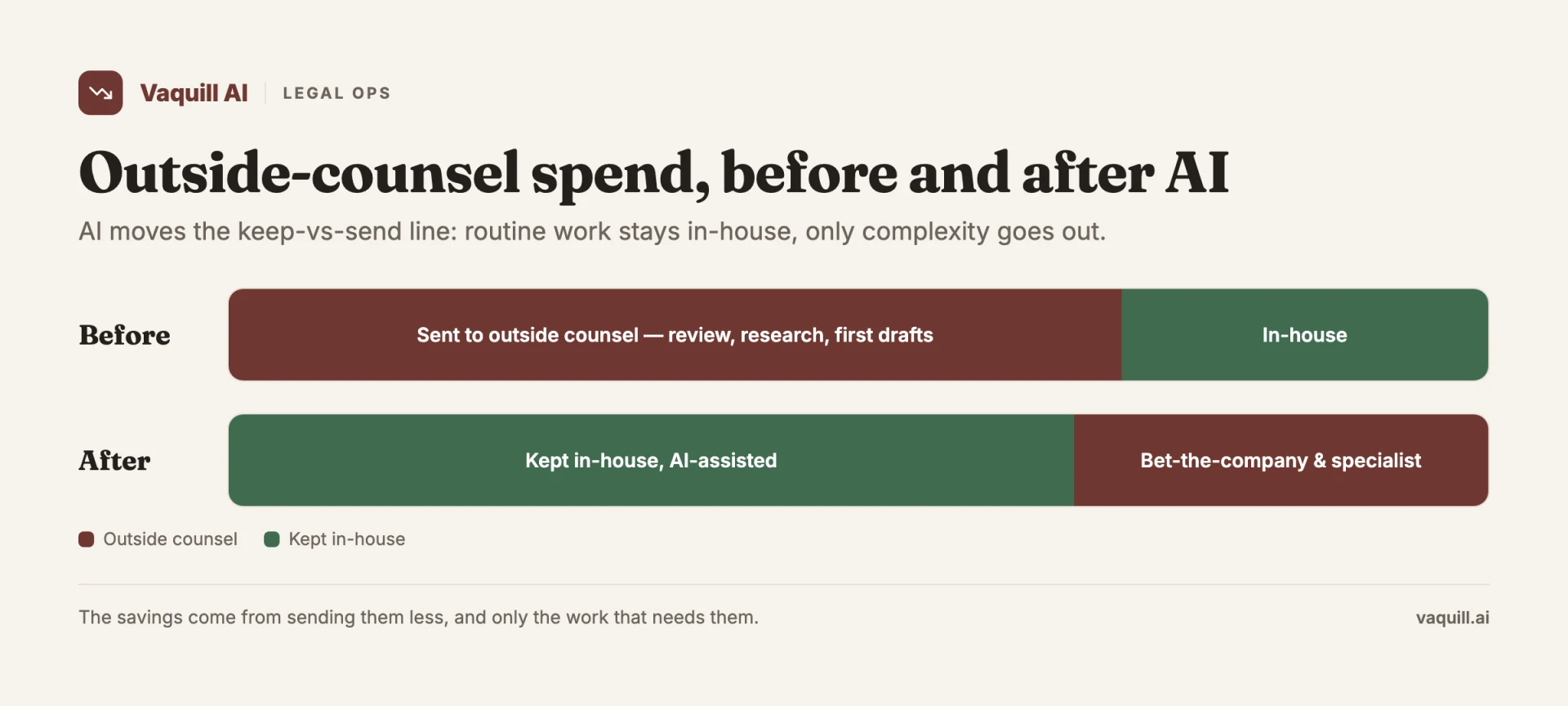
AI moves the keep-vs-send line: routine work stays in-house, only complexity goes out.
The short answer: what outside counsel charge in 2026
For in-house buyers, the planning number that matters is the partner sticker rate by firm segment: AmLaw 100 partners run roughly $1,500 to $3,000 per hour in 2026, AmLaw 200 partners $1,100 to $1,800, mid-size regional partners $700 to $1,200, and solos $300 to $600. Effective rates (what the law department actually pays after discounts) land around 70 to 80% of those numbers.
For broad market context, the all-practice national average lawyer rate is $349 per hour (Clio Legal Trends Report, data 2025, updated March 2026), ranging from $492 in DC to $196 in West Virginia. That blended consumer-facing average sits far below the AmLaw bands corporate buyers negotiate, which is exactly why segment matters more than any single national figure.
TL;DR
Part of our in-house counsel guide series.
- AmLaw 100 partner sticker rates run roughly $1,500 to $3,000 per hour in 2026, with a handful of New York transactional partners (Wachtell, Sullivan & Cromwell, Paul Weiss, Kirkland) clearing $3,000 on premium work. AmLaw 200 partners land $1,100 to $1,800. Mid-size regional firm partners $700 to $1,200. Boutique partners $700 to $1,200 depending on specialty. Solos $300 to $600.
- Rates have compounded at roughly 6 to 8% per year since 2020, far above the underlying CPI, driven by the 2021 to 2024 associate lateral wars and the post-Cravath-scale cost base. GenAI productivity has not yet shown up as price relief.
- Effective rates run about 70 to 80% of sticker at most large companies, once standard discounts, blended rates, AFAs, and year-end true-ups are netted out. Sophisticated buyers push that to the low 60s on commodity work.
- The real 2026 fight is GenAI cost-shifting. Firms are keeping the productivity gains as margin expansion; law departments are starting to claw them back through capped fees, fixed-fee task baskets, and matter-level efficiency commitments.
AmLaw 100 partner sticker rates in 2026 run roughly:
Methodology in one paragraph
The ranges triangulate three source families. Firm-side worked rates from Thomson Reuters Peer Monitor and Wells Fargo's Survey of Law Firm Economics. Buyer-side realized rates from Wolters Kluwer ELM Solutions LegalView (the Real Rate Report dataset). Sticker anchors from publicly filed Chapter 11 retention applications.
Where I give a range, treat it as the band most of the segment falls in. Where I name a firm and a number (Wachtell at $3,500, Kirkland in the FTX filings), treat that as an anchored data point, not an average. LegalView realized invoice data consistently runs 70 to 80% of firm-disclosed sticker, which is the gap the back half of this post is about.
Where the benchmark numbers actually come from
Four datasets sit underneath almost every credible benchmark in the market.
Thomson Reuters Peer Monitor / Financial Insights, sourced from 175+ US firms including roughly two thirds of the AmLaw 100, feeds the Thomson Reuters Institute's quarterly Law Firm Financial Index and annual State of the Market reports.
Wolters Kluwer ELM Solutions LegalView, built on billing data through the Passport and TyMetrix 360 e-billing platforms, aggregates billions of dollars of actual paid invoices. Shows realized rates net of write-offs and discounts. The annual Real Rate Report is drawn from that pool.
Wells Fargo Legal Specialty Group Survey of Law Firm Economics, run quarterly, covers around 130 of the AmLaw 200 plus a sample of mid-size firms. The cleanest read on firm-level revenue, demand, worked rates, and realization.
Citi Hildebrandt Client Advisory, the annual outlook from Citi's Law Firm Group and Hildebrandt Consulting, draws from a similar contributor pool to Wells Fargo. The document most managing partners read in January.
Two cautions. Public AmLaw rate anecdotes mostly come from Chapter 11 retention applications (Boy Scouts of America, Purdue Pharma, FTX, SVB Financial all surfaced billing rates), but the sample skews toward firms with restructuring practices and toward rates quoted to a bankruptcy judge, which is a venue where firms have an incentive to disclose the higher end of their range to anchor fee-application defenses.
And GC surveys undershoot because GCs report effective, not sticker; netting the firm-side and buyer-side feeds against each other is the cleaner picture.
Rate ranges by firm segment
Numbers below are 2026 sticker rates (standard rates a firm quotes to a new matter, before negotiated discounts). Effective rates run lower; see the negotiation section.
Treat the bands as triangulated planning ranges, not market-wide absolutes; any given partner can sit a band above or below depending on practice, tenure, and recent lateral history.
AmLaw 100
The top of the market has compressed at the top and widened at the bottom. Roughly:
| Role | Range (2026) |
|---|---|
| Senior partner, premium transactional | $2,200 to $3,500 |
| Partner, average | $1,500 to $2,500 |
| Counsel / of counsel | $1,200 to $1,900 |
| Senior associate (7th-8th year) | $1,200 to $1,800 |
| Mid-level associate (4th-5th year) | $900 to $1,400 |
| Junior associate (1st-2nd year) | $700 to $1,100 |
| Paralegal | $450 to $700 |
Public anchors at the top: Kirkland & Ellis's FTX retention application (filed in the Delaware bankruptcy in late 2022) disclosed restructuring partners in the $2,000 to $2,465 range; Sullivan & Cromwell's FTX retention application the same period showed lead partner rates over $2,000.
The 2023 SVB Financial Group Chapter 11 retention filings from Sullivan & Cromwell pushed top partner rates above $2,200, and the 2023 to 2024 Purdue Pharma fee applications surfaced AmLaw 100 restructuring partner rates north of $2,500.
Wachtell Lipton, which does not file as debtor's counsel under its own name, has been reported by The American Lawyer and Bloomberg Law at $2,500 to $3,500 on premium M&A and crisis work. Treat the $3,500 as a ceiling for very specific senior partners on very specific matters, not a median.
AmLaw 200
The 101 to 200 band tracks the AmLaw 100 with a roughly 25 to 35% discount at every level, with significant spread depending on the firm's strongest markets.
| Role | Range (2026) |
|---|---|
| Senior partner | $1,300 to $1,800 |
| Partner, average | $1,100 to $1,500 |
| Counsel | $900 to $1,300 |
| Senior associate | $850 to $1,200 |
| Mid-level associate | $700 to $1,000 |
| Junior associate | $550 to $850 |
Mid-size firms (50 to 200 lawyers, often regional)
This is the segment most in-house counsel at mid-cap companies actually buy. Think regional powerhouses, single-city firms, or national mid-size firms outside the AmLaw 200.
| Role | Range (2026) |
|---|---|
| Senior partner | $750 to $1,250 |
| Partner, average | $600 to $1,000 |
| Counsel | $500 to $850 |
| Senior associate | $500 to $800 |
| Mid-level associate | $400 to $650 |
| Junior associate | $325 to $525 |
Boutiques (5 to 30 lawyers, specialty practice)
Specialty boutiques (white-collar defense, IP litigation, antitrust, complex commercial, tax controversy, ERISA) have closed most of the rate gap to AmLaw at the partner level.
A senior antitrust boutique partner in DC often bills like an AmLaw 100 partner because that is exactly what they were until they left.
| Role | Range (2026) |
|---|---|
| Senior partner, premium specialty | $1,200 to $2,000 |
| Partner, average | $700 to $1,200 |
| Counsel / senior associate | $600 to $1,000 |
| Mid-level associate | $450 to $750 |
The gap to AmLaw widens fast on associate work because boutiques have less juniority to leverage. That is part of the value proposition: leaner staffing, more partner time per matter, fewer eyes on every draft.
Solo and very small (1 to 4 lawyers)
| Role | Range (2026) |
|---|---|
| Senior solo, niche practice | $400 to $600 |
| Solo, general business | $300 to $500 |
| Newly minted solo | $225 to $350 |
A solo doing corporate work for a series-A startup in a secondary market is a different animal from a solo doing white-collar defense in DC. Niche and reputation drive the variance more than seniority.
The non-hourly piece matters more here than at AmLaw. Boutiques and solos sell fixed-fee work (formation packages at $2,500 to $5,000; trademark filings at $750 to $1,500 per class plus USPTO fees; sub-$25M acquisition data-room buildout at $15K to $40K) and subscription fractional GC arrangements ($8K to $25K per month for a defined scope, covering outsourced general counsel for a sub-100-person company).
Specialty boutiques now run hybrid contingent structures on commercial litigation and patent enforcement, where the cap and success fee, not the headline hourly, drive the economics. A GC pricing this market against AmLaw hourly bands will overpay because the deal is structured differently.
By practice area
Practice mix matters as much as firm segment. For two partners at the same AmLaw 100 firm, the M&A partner books a higher rate than the labor and employment partner, and the gap has been widening since 2022.
| Practice | AmLaw partner range (2026) | Notes |
|---|---|---|
| M&A / private equity | $1,800 to $3,000 | Premium on deal partners with sell-side reputation |
| Restructuring / bankruptcy | $1,800 to $2,800 | Premium reflects 2023 to 2025 demand surge |
| Securities / capital markets | $1,700 to $2,500 | IPO partners at the top of this band |
| Tax (transactional) | $1,500 to $2,400 | Specialist tax partners run hot |
| White-collar / investigations | $1,500 to $2,500 | DOJ alumni at premium |
| IP litigation | $1,300 to $2,200 | Patent trial partners at the top |
| Complex commercial litigation | $1,300 to $2,100 | |
| Antitrust (transactional + investigations) | $1,500 to $2,400 | |
| Employment / labor (single-plaintiff) | $1,000 to $1,600 | Compresses against employment boutiques |
| Real estate (transactional) | $1,200 to $1,800 | |
| Tech transactions / commercial | $1,200 to $2,000 |
The pattern: practices where the buyer is a CFO or a board (M&A, securities, restructuring) clear the highest rates. Practices where the buyer is a department head (employment, real estate ops, day-to-day commercial) get more rate pressure because the buyer signs the invoice every month.
By geography
City matters less than it used to. The 2021 to 2023 lateral wars dragged DC, Chicago, Boston, and LA partner rates up toward New York, and a Houston energy partner at a major firm now bills inside the New York range. Still, real spread.
The realized-invoice spread is wider than most rate cards admit. Wolters Kluwer ELM Solutions Real Rate Report data, reported by Legal Dive, put the typical New York City partner at $1,189 against $470 in Phoenix, a 153% differential on paid invoices (not sticker). The bands below are sticker; the realized gap between top and bottom metros is even larger.
| Metro | Senior partner band (AmLaw, 2026) |
|---|---|
| New York | $1,800 to $3,500 |
| San Francisco / Silicon Valley | $1,700 to $2,800 |
| Washington DC | $1,500 to $2,500 |
| Chicago | $1,400 to $2,300 |
| Los Angeles | $1,400 to $2,400 |
| Boston | $1,300 to $2,200 |
| Houston (energy / M&A) | $1,500 to $2,400 |
| Dallas | $1,200 to $2,000 |
| Atlanta | $1,200 to $1,900 |
| Miami | $1,100 to $1,800 |
| Denver, Seattle, Minneapolis | $1,100 to $1,700 |
A practical rule: a Texas or Atlanta partner from a top-10 AmLaw firm now bills inside the bottom of the New York band, not at a "regional discount." If your panel-management spreadsheet still discounts non-coastal offices by 30%, it is out of date.
Test in any RFP cycle: ask the firm for 2024 and 2026 standard rate cards for the same partner in the same office. If the standard rate jumped more than 14% in two years, you have the opening to push for more than the headline discount.
The 2020 to 2026 trajectory
Worked rates at large US firms grew about 4% in 2019, then accelerated.
| Year | AmLaw worked-rate growth (approx.) | Driver |
|---|---|---|
| 2020 | 5.5% | COVID-era retention, modest demand |
| 2021 | 6.4% | Deal boom, first round of associate pay raises |
| 2022 | 6.7% | Second wave of raises to $215K Cravath scale |
| 2023 | 7.5% | Lateral war peak, demand mix shift |
| 2024 | 8.3% | Cravath base to $225K, then $235K mid-year |
| 2025 | 7.4% | Slowing demand, sticky cost base |
The 2025 figure of 7.4% (against a 2.8% inflation rate) is the headline of the Thomson Reuters Institute Law Firm Rates Report 2026. Earlier-year figures are drawn from Thomson Reuters Peer Monitor and Wells Fargo / Citi Hildebrandt commentary; treat the pre-2025 numbers as approximate. Compounded, sticker at the top of the market is up roughly 50% from 2020 to 2026, against US CPI of about 22% over the same window.
The premium-services price index has decoupled from the broader economy, a position firms can defend exactly as long as demand stays inelastic.
Two drivers. The Cravath-scale pay ladder dragged the cost base up faster than the broader economy, and firms passed it through. And the demand mix tilted toward higher-rate work (restructuring, investigations, complex M&A) and away from commoditized matters. Both are weaker in 2025 to 2026.
How GCs negotiate effective rates below sticker
Sticker is not what the law department pays. Five mechanisms close the gap, and a serious in-house team uses three or four of them on every panel firm.
Volume discounts off rack rates. A 5 to 15% discount off standard rates in exchange for preferred or panel status. The 15% ceiling breaks on the largest panel relationships, where 18 to 22% shows up.
Blended rates. A single hourly rate for a defined team (partner, senior associate, mid-level, paralegal all billed at, say, $850). Works best on portfolios of similar work. Set between the senior associate and partner rate, which favors the client when leverage is heavy and hurts the client when partner attention dominates.
Alternative fee arrangements. Fixed fees per matter type (per HSR filing, per second request, per single-plaintiff employment defense). Capped fees with a collar (hourly to the cap, savings shared below it). Success or contingent components on specific outcomes.
The Real Rate Report has shown AFAs at 10 to 20% of large-company outside spend, concentrated in IP, employment, and routine litigation, with penetration flat for five years. That is a story about how hard AFAs are to write well.
Year-end true-ups. Rebates against annual spend, triggered at thresholds. A 3% rebate over $5M and 5% over $10M against a particular firm is a real number that shows up only in the year-end reconciliation.
Matter budgeting with variance review. Budget at the outset, monthly burn, escalation when variance crosses a threshold. The savings are not a lower rate per hour, they are fewer hours billed at the high rate.
Net across all five, the realized effective rate at a sophisticated buyer runs roughly 70 to 80% of standard rate on partner time at most firms, sometimes lower on associate time where leverage and AFAs bite hardest. Wolters Kluwer's Real Rate Report has shown an effective-to-standard ratio in that range across its data pool for several years running; treat it as the central tendency, not the outcome on every matter.
The implication for in-house counsel building a 2026 budget: a partner's $2,000 sticker is a planning number of $1,400 to $1,600, not $2,000.
In a fee letter, this stacks. A Fortune 500 GC retaining a top-50 firm for commercial litigation and employment work in 2026 typically lands: 15% off rack rates; blended team rate around $850 for associate-plus-partner staffing; 3% rebate over $4M in annual fees, 5% over $8M; fixed-fee single-plaintiff employment defense at $35K to $85K by stage; annual matter-budget review with a 10% variance escalation.
Stacked, they take a $1,900 partner sticker to an effective rate in the high $1,300s. The firms that resist all five have the bargaining power to do so, which in 2026 is a shorter list than five years ago.
The 2026 pressure: GenAI cost-shifting
The interesting fight in outside-counsel pricing for the next twenty-four months is not whether rates keep growing; they probably do, at a softer pace. It is who captures the GenAI productivity surplus.
The story firms are telling internally is that AI assistance lets associates produce more output per hour, which means matters close faster, which means realization improves at constant rates. The story law departments are starting to tell is that if the firm's first-pass diligence review now takes 12 hours of associate time instead of 40, the invoice should reflect that.
Those two stories cannot both be true on the same matter.
The early data is mixed. Thomson Reuters' Future of Professionals reports show firms expecting AI to expand margins and corporate buyers expecting AI to lower bills. Almost no firm has voluntarily cut a rack rate to reflect AI productivity.
Law departments are responding through structure rather than rate. ACC's 2025 Law Department Management Benchmarking Report showed cost control in the top three CLO priorities for the third year running, with "outside counsel efficiency" emerging as a distinct line item separated from headline rate negotiation.
One concrete example. In 2025 several AmLaw 100 firms quietly began quoting first-pass NDA review at a fixed fee per document ($250 to $500 by length and complexity) rather than the prior 1.5 to 3 hour associate baseline. The firm absorbs the AI productivity gain on the input side; the client gets predictability.
The same pattern is showing up on standard MSA review for software vendor portfolios, closing checklists for sub-$50M PE add-on acquisitions, and first drafts of routine employment policies. None of those task baskets was AFA-eligible three years ago.
The buyer behavior change underneath: GCs running 200+ NDAs a year have stopped asking for an hourly discount and started asking for a unit rate, which is a different negotiation.
The structural moves to watch in 2026:
- AI-aware fee letters. Require disclosure of AI-assisted work product categories and exclude the firm's AI-tool seat license from the bill as overhead, not a disbursement.
- Fixed-fee task baskets. First-pass NDA review, due-diligence summary memos, deposition summaries moved off hourly. The firm chooses how to use AI; the client pays a number reflecting the new task economics.
- Efficiency commitments in panel terms. "Hours billed on Category X matters in 2026 will not exceed 85% of the 2024 baseline absent material scope change." Easier to write than to enforce, but the conversation itself reprices the relationship.
- Outside-counsel guidelines that name AI work. Several Fortune 100 law departments updated their outside-counsel guidelines in the past eighteen months to address AI use; the trend is toward disclosure plus efficiency expectations rather than blanket bans.
The firms that will hold rates in 2026 are the ones who can point to specialist work AI does not eat: contested M&A where the negotiation is the product, SEC enforcement defense where the staff relationships cannot be encoded, complex tax structuring across interacting regimes, crisis investigations where the buyer is hiring a name.
The squeeze is on practices where leverage was always high and the work is repeatable: first-pass diligence, document review, routine drafting, deposition summarization, NDA and MSA turns. A competent in-house team with a workbench seat now closes most of that gap, which is why several Fortune 500 law departments have started naming AI-assisted task categories in their 2026 outside-counsel guidelines rather than negotiating firm-by-firm.
The real ceiling on outside-counsel rates in 2026 is not what the firm thinks it is worth. It is what a law department can produce in-house with a workbench and a seat license.
One audit to run this quarter. Pull the last twelve months of invoices for your top five panel firms, group them by matter type, and compute the realized blended rate for each. Lay it next to the segment band in this post.
Flag every matter type where realized blended is more than 15% above the band's midpoint and the firm cannot point to specialist work that justifies the premium. That list is the agenda for the year-end true-up conversation, and it is shorter and more concrete than the panel-wide rate-reduction argument GCs traditionally bring to the same meeting.
Sophisticated procurement teams already do this; legal departments mostly do not, which is the gap.
FAQ
What is the average hourly rate for a law firm partner in 2026?
There is no single number; it depends on firm segment. AmLaw 100 partners run roughly $1,500 to $3,000 in 2026 sticker, AmLaw 200 partners $1,100 to $1,800, mid-size regional partners $700 to $1,200, and solos $300 to $600. The all-practice national average across every lawyer is $349 per hour (Clio Legal Trends Report, data 2025, updated March 2026), but that consumer-facing blend is far below what corporate buyers negotiate in BigLaw.
How much do AmLaw 100 partners charge per hour?
Most AmLaw 100 partners bill $1,500 to $2,500 sticker, with premium transactional partners reaching $2,200 to $3,500. Public anchors come from Chapter 11 retention filings: Kirkland & Ellis disclosed restructuring partners at $2,000 to $2,465 in the FTX bankruptcy (late 2022), and Purdue Pharma fee applications surfaced AmLaw 100 restructuring partners north of $2,500. Treat $3,500 as a ceiling for specific senior partners on specific matters, not a median.
Why are law firm rates rising faster than inflation?
Worked rates grew 7.4% in 2025 against 2.8% inflation, the latest in a decade of firms pushing rates at roughly twice inflation (Thomson Reuters Institute, Law Firm Rates Report 2026). Two drivers: the Cravath-scale associate pay ladder dragged the cost base up faster than the broader economy, and demand tilted toward higher-rate work like restructuring and investigations.
What is the difference between sticker and effective outside counsel rates?
Sticker is the rate in the partner's email signature, the opening bid. Effective is what the law department actually pays after volume discounts, blended-team rates, alternative fee arrangements, and year-end true-ups. Realized invoice data runs about 70 to 80% of sticker at most large companies, and sophisticated buyers push commodity work into the low 60s.
How do GCs negotiate outside counsel rates down?
Five mechanisms stack: volume discounts off rack rates (5 to 15%, sometimes 18 to 22% on big panels), blended team rates, alternative fee arrangements (fixed and capped fees), year-end true-up rebates, and matter budgeting with variance review. Stacked, they take a $1,900 partner sticker to an effective rate in the high $1,300s. See Outside Counsel Guidelines Template for the panel-terms language.
How much can an in-house team cut outside counsel spend?
The biggest savings come from keeping repeatable work in-house (first-pass diligence, NDA and MSA turns, routine drafting) rather than only negotiating the hourly rate down. Pull twelve months of invoices for your top five panel firms, compute realized blended rate by matter type, and move every matter type running above the segment band into a fixed-fee basket or in-house. See Reduce Outside Counsel Spend With AI for the workflow.
For related operational playbooks, see Outside Counsel Guidelines Template and Legal Department KPIs in 2026.
That invoice audit is easier when matter spend lives in one place. Vaquill AI keeps matter management and the work product against each matter in the same workbench, which is where the keep-vs-send line gets drawn in practice.
New legal AI guides, weekly.
Further Reading
Outside Counsel Guidelines Template: 12 Rules Every GC Should Include in 2026
Read postHow Big Should an In-House Legal Team Be? Benchmarks by Company Size
Read postLegal AI for Chief Legal Officers (CLOs) in 2026
Read postRolling Out Legal AI to Your Team (Adoption Playbook)
Read postAI Compliance Check: CCPA, GDPR, and SOX for In-House Teams (2026)
Read post12 Best Legal AI Tools for In-House Counsel (2026)
Read post
Co-Founder & CEO · Attorney
Arshita leads product and strategy at Vaquill, building the legal AI suite that solo, small-firm, and in-house US lawyers use to run a matter end to end.