To reduce outside counsel spend with AI, pull your high-volume, low-novelty work back in-house. Tag last year's invoices by category, set a keep-vs-send threshold on novelty and downside risk, use AI to handle the first pass on routine contracts, diligence, and research memos, then track outside spend per category against that baseline. Departments doing this report double-digit cuts to external legal fees. A 14% reduction off total outside spend is a realistic target. Negotiated rates, billing guidelines, and AI invoice review trim more on top.
Open last quarter's outside counsel invoices and sort them smallest to largest. The bottom of that list, the $1,400 NDA review, the $3,800 vendor-MSA markup, the $4,000 "can we do this in California" memo, is where you reduce outside counsel spend. Not the litigation line at the top. The bottom.
Dozens of small matters a firm billed at associate-plus-partner rates that your own team could have closed in twenty minutes with the right tool.
Most law departments know this in their gut. What they do not have is the number, the line where "obviously route it out" becomes "obviously keep it in," and a way to prove the savings to a CFO who has heard the AI pitch before and wants the receipts.
This is that worksheet. Where the money actually leaks, which of those leaks an in-house team can close with AI in 2026, how to set the threshold for what still belongs at a firm, and how to measure the dollars so the savings survive contact with finance.
TL;DR
- Outside counsel is roughly half of a typical legal budget. The 2024 ACC Law Department Management Benchmarking Report puts the median department at 48% of total spend going outside, with law firms taking 87% of that external dollar. That is the pool you are working from.
- The leak is not litigation. It is volume: NDAs, vendor MSAs, DPAs, first-pass diligence, form drafting, and the short research memo. These are repetitive, low-novelty, and the worst use of a $1,900-an-hour partner.
- AI lets a in-house team pull most of that volume back in-house. Departments running AI-assisted review report double-digit cuts to outside spend, but only the ones who set a clear keep-vs-send threshold and actually measure it.
- The threshold is not "complex vs simple." It is novelty and risk concentration. Route out what is bespoke, adversarial, or bet-the-company. Keep what is patterned, even if there is a lot of it.
- The savings math is blunt: hours reclaimed times blended firm rate, minus the cost of the tool and your own time. Run it per work category, not as one blended guess, or finance will not believe you.
What reduction off total outside spend does the post call a realistic target?
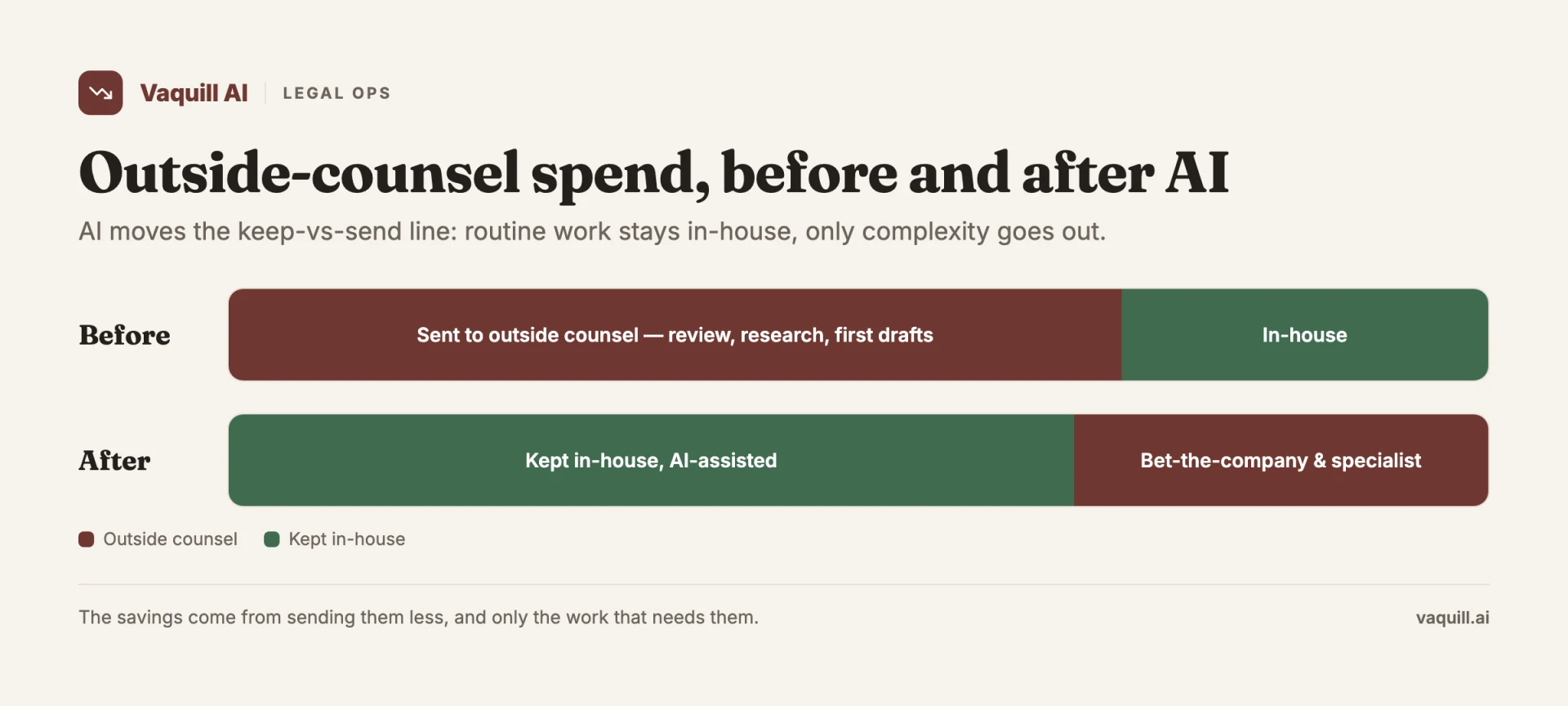
AI moves the keep-vs-send line: routine work stays in-house, only real complexity goes out.
Where the spend actually leaks
The first instinct is to point at litigation, and litigation is genuinely expensive. But litigation is also lumpy, hard to predict, and the place where you most want a specialist who has tried this exact motion before.
It is rarely the leak. The leak is the steady drip of routine matters that get reflexed out to a firm because that is how it has always worked.
Walk the invoices for a quarter and the pattern repeats across almost every department: a small set of contract types and tasks generates most of the outside billing line count, even when no single matter is large. In a recent piece in Today's General Counsel, a GC put the share of NDAs, contracts, and subpoena-style questions at roughly 70% of inbound legal mail.
That is not where judgment earns its fee. That is throughput.
Look at how a single routine NDA actually bills out. A firm staffs it with a mid-level associate at, say, 1.5 hours to read and redline, marks it up to the relationship partner for a 0.3-hour glance, adds the e-billing admin line, and you get a $1,200 to $1,600 invoice for a document where your only real decision was whether to accept their mutual-indemnity language.
Multiply that by the forty NDAs a year a growing company signs and the line is real money for work that never required outside judgment. A bit of NDA triage up front, sorting the standard ones from the few that carry real risk, keeps almost all of that line in-house.
Four categories carry most of the recoverable spend:
Routine contract review. Inbound NDAs, the counterparty's standard MSA, vendor agreements, order forms, DPAs. The counterparty sent you their paper, you have a position on every clause that matters, and the only real work is comparing their draft to what you will accept.
A firm doing this charges associate time, marks up to the relationship partner, and hands you back a redline you could have produced from your own playbook.
First-pass diligence. In a deal or a vendor onboarding, someone has to read a stack of contracts and pull the assignment clauses, change-of-control triggers, exclusivity, and termination terms into a summary. This is reading at scale. It is precisely the work that gets staffed deep at a firm, which means it is precisely the work that runs up the bill fastest.
Research memos. The "can we do X in California" question that comes back as a four-page memo and a $4,000 line item. A lot of these are well-trodden. You are not the first company to ask whether a non-compete survives in a given state, and the firm is not researching it from scratch either.
Form drafting and templating. The follow-on NDA, the SOW off an existing MSA, the cease-and-desist, the standard amendment. Drafting from a known starting point, not from a blank page.
None of these is glamorous. All of them are billable. And all four are now squarely inside what an in-house team can do with the right tooling instead of a retainer.
Why 2026 is the year the math changed
Two things moved at once. Firm rates kept climbing and the tools got good enough to actually displace the routine work.
On rates, the Thomson Reuters Institute's 2026 State of the Corporate Law Department report found worked rates grew 7.3% in the most recent cycle, more than double inflation, and that 36% of general counsel expect to increase outside spend over the coming year against only 20% planning to cut.
AmLaw 50 standard partner rates now sit in roughly the $1,900 to $2,100 range, with our own 2026 outside counsel rate benchmarks breaking down the spread by segment and city. The drift is structural, not a one-year spike. Doing nothing means the same matters cost more every year.
On tooling, the change is that AI moved from "summarize this document" to producing a deliverable a lawyer can ship. The relevant unit is no longer a chatbot answer. It is a reviewed contract with a redline in real Microsoft Word track changes, a diligence matrix across forty agreements, a first-draft memo with the issues already framed. That is the work you were paying a firm to produce.
Here is the gap that makes this a real opportunity rather than a marketing line. The same Thomson Reuters research found that 82% of legal departments either do not measure AI's ROI or are not sure whether they do. Adoption is rising fast and measurement is not.
The departments capturing real savings are not the ones with the most licenses. They are the ones who decided what to pull in-house and then tracked it.
Reduce outside counsel spend with a keep-vs-send threshold
The wrong filter is "complex versus simple," because complexity is a feeling and it expands to justify whatever you are already doing. The useful filter is two questions: how novel is this, and how concentrated is the downside.
A concrete decision table makes the line hard to argue with:
| Matter | Novelty | Downside | Call |
|---|---|---|---|
| $25K vendor NDA, standard mutual terms | Low | Bounded | Keep in |
| 20-contract diligence scrape for a routine acquisition | Low | Bounded | Keep in (AI first pass) |
| Settled state-law non-compete question | Low | Bounded | Keep in |
| $2M DPA with a security indemnity and uncapped breach exposure | Medium | Concentrated | Send out |
| Diligence on a regulated-asset acquisition (licenses, FDA, financial) | High | Concentrated | Send out |
| First-impression regulatory question in a new jurisdiction | High | Concentrated | Send out |
The pattern is the diagonal: low novelty plus bounded downside stays in, regardless of volume; high novelty or concentrated downside goes out, regardless of how routine the paperwork looks.
One warning before you let the table run on autopilot. Some work that looks routine hides concentrated downside, and those are the matters that punish an over-eager keep-in rule.
A privacy DPA with an uncapped breach indemnity, an export-controls touchpoint in a vendor agreement, a wage-and-hour question dressed up as a simple policy review, regulated-industry terms with licensing exposure: the document is short and the form is familiar, but the tail risk is not.
Route it out when:
- The matter is adversarial and contested. Litigation, a regulator at the door, a dispute that could go to a courtroom. You want someone who has lost and won this fight before.
- The downside is bet-the-company. The acquisition, the financing, the clause that could sink the deal if it is wrong. Specialist judgment is cheap insurance against a catastrophic number.
- The work is genuinely novel for your business. First time in a new jurisdiction, a regulatory regime you have never touched, a structure with no precedent in your files.
- You need independence on the record. Sometimes the value of outside counsel is precisely that they are outside, for a board, an auditor, or a privilege posture.
Keep it in when:
- The work is patterned. You have done this shape of deal or reviewed this kind of paper before and you have a position.
- The volume is high and the unit value is low. Forty NDAs is not forty hard problems. It is one problem forty times.
- Speed matters more than a second opinion. The sales team needs the NDA signed today, not in the firm's queue behind a litigation deadline.
- The risk is bounded and known. A standard vendor agreement under a modest contract value is not where the company gets hurt.
Most departments find that once they apply this honestly, a surprising amount of what currently goes out belongs in.
The reflex to send routine contracts to a firm is, as one practitioner put it, a habit you can no longer afford.
Our in-house contract review playbook goes deeper on building the keep-vs-send rule into your intake.
A worked example you can adapt
Numbers make this concrete. These are illustrative figures for a single mid-market department, not a study. Plug in your own.
Say your department sends out $1.2M a year in outside counsel spend. Pull the invoices and tag them by category. A common shape:
| Category | Annual outside spend | Routine share |
|---|---|---|
| Litigation and disputes | $480,000 | low, keep out |
| Routine contract review | $300,000 | high |
| Diligence and deal support | $220,000 | medium |
| Research memos | $120,000 | high |
| Form drafting | $80,000 | high |
Focus on the four recoverable categories: $720,000. Now be conservative about how much of each you can actually pull back. Not all of it. Some contract review is genuinely strange, some diligence needs a specialist, and some memos touch novel ground.
Assume you recapture 60% of the routine portion across those four. That is roughly $430,000 of work moving in-house.
But moving work in-house is not free. It lands on your own team, and the only way the savings are real is if the tool does enough of the lift that you are not just hiring back the cost in headcount. Say AI handles the first pass and your in-house lawyers do the judgment layer, and the loaded cost of that internal time plus the software runs you $110,000 a year (a few seats and a meaningful chunk of one lawyer's time).
Net reduction: roughly $320,000, or about 27% off the recoverable pool and 14% off total outside spend. That 14% figure is not a coincidence. It lines up with the double-digit reductions departments running AI-assisted review have reported in late-2025 vendor case studies, which is a useful sanity check that the model is not fantasy.
Treat any published vendor number as a ceiling someone is motivated to inflate, not a promise, and prove your own against your own invoices.
One thing to pin down before finance does it for you: define the blended firm rate you are crediting. The honest version includes the partner-review markup and the e-billing admin lines, not just the associate's hourly rate, because that is what the matter actually cost you. Credit the full invoice you avoided, per category, or the savings will not reconcile against the general ledger.
The honest caveats, because finance will ask:
- The internal cost is real and it is mostly your lawyers' time. If they are already at capacity, some of the "savings" is capacity you got back, not cash that hits the budget line. Separate the two explicitly: cash savings is invoices you stopped paying; capacity savings is hours your team reclaimed. Claim each in its own column and never blend them, because a CFO will discount the whole number if they catch you double-counting.
- Year one is lighter than steady state. You are building playbooks, tuning the tool to your positions, and learning what it gets wrong. The full number shows up in year two.
- Some categories will under-deliver and some will beat the estimate. That is why you tag by category instead of waving at one blended percentage.
To run this against your real invoices instead of these placeholders, the ROI calculator walks the same math with your numbers.
What it takes to pull the work in
Buying the software is the easy part. Three things have to be in place around it, or the work bounces back out to the firm within a quarter.
A playbook the AI can apply. Your fallback positions, your dealbreakers, your standard carve-outs, written down. This is what turns "review this NDA" into "review this NDA against our positions and flag every deviation."
Departments that skip this step get generic review and conclude AI does not work, when what failed was the absence of a standard. Building the playbook is also the part that compounds: every matter makes it sharper.
Work product that ships, not a chat transcript. A redline a counterparty's lawyer will accept has to arrive as real track changes in Word, not a list of suggestions you then have to retype. A diligence summary has to be a matrix you can hand to the deal lead.
If the output needs an hour of cleanup, you did not save the hour. This is the practical line between a model and a workbench, and it is the difference between the work staying in or drifting back out.
A keep-vs-send rule wired into intake. The threshold from the section above only works if it triggers automatically when a matter comes in, rather than living in someone's head. Otherwise the busy lawyer reflexes it out to the firm and the playbook never sees it.
This is the work Vaquill AI is built for: AI review and redlining in native Word track changes, playbooks and a document matrix for diligence at scale, and matter management so the keep-vs-send call is part of intake instead of an afterthought.
The point of naming it once is the shape of the tool, not the logo. Whatever you use, it has to clear those three bars or the spend creeps back.
The other levers, ranked by effort
Pulling work in-house is the biggest lever, but it is not the only one. The other moves are faster to start and stack on top of the in-house shift. Here is the honest order, cheapest effort to most.
AI invoice and bill review. This is the downstream lever: catch the overbilling on work you still send out. AI reads invoice line items against your outside counsel guidelines and flags block billing, duplicate entries, unapproved rate increases, and admin tasks billed as legal work. Departments using e-billing with rule enforcement see a 5% to 10% annual reduction in outside counsel spend just from catching what manual review misses (Legal Dive, October 2023). It is the lowest-effort win because it does not change who does the work, only what you pay for it.
Billing guidelines with teeth. Rate caps by task, no first-year associates on routine matters, no charging for internal conferences, partner time only where partner judgment is needed. Guidelines do nothing unless something enforces them, which is why they pair with invoice review. Our outside counsel guidelines template lays out the twelve rules that carry the most savings.
Rate negotiation and alternative fee arrangements. Hourly is the default, not the only option. Fixed fees on clearly scoped work, capped fees with an hourly ceiling, volume discounts tied to annual spend, and multi-year rate freezes all move money. The leverage is real because, as the Thomson Reuters Institute notes, controlling outside counsel cost ranks at the top of legal-ops priorities year after year (Legal Department Operations Index). Bring the AI-built spend data to the negotiation so you are arguing from your own numbers.
ALSPs for the middle tier. Some work is too much volume for your team but does not need a firm partner. Alternative legal service providers and fractional contract counsel sit between in-house and BigLaw on price. Use them for surge diligence, a four-month commercial-counsel gap, or a document-review push, and reserve the firm for genuine specialist judgment.
The in-house shift and these four are not either-or. The savings compound: AI does the routine work you keep, guidelines and invoice review discipline the work you send, and negotiation lowers the rate on whatever is left.
Measuring it so the savings are real
The reason 82% of departments cannot prove AI ROI is that they never set a baseline. Fix that first.
Baseline before you start. Pull last year's outside spend by the same categories you will track. This is your before. Without it, any number you report later is an opinion.
Track outside spend per category, monthly. Not total spend, which moves for a hundred reasons. The categories you targeted. If routine contract review spend is falling and litigation is flat, the program is working. If total spend is up because of a lawsuit, that is noise, not failure.
Count what you kept in. Every matter you handled internally that would have gone out is a data point. Volume times your blended firm rate for that category is the gross saving. This is the number that makes the CFO conversation easy, because it is countable.
Watch cycle time, not just cost. A NDA turned around the same day instead of waiting in a firm's queue is a revenue-enablement story, not just a cost story. Sales feels it. That is the metric that protects the budget line when someone questions the tool.
Re-tag quarterly. Some work you sent out at first will move in as your playbook matures. Some you kept in will prove too hairy and go back out. The threshold is a living line, not a one-time decision.
If you want the broader frame around evaluating and adopting AI in a law department, our complete guide to legal AI for in-house counsel is the pillar this sits under. For the rate side of the equation, the 2026 outside counsel rate benchmarks give you the blended numbers to plug into the savings math, and the outside counsel guidelines template covers the discount and billing discipline that compounds with everything above. The legal tools overview lays out the review, redlining, and matrix capabilities in one place.
FAQ
How much can AI actually reduce outside counsel spend?
Departments running AI-assisted contract review and research report double-digit cuts to external legal fees, with 14% off total outside spend a realistic target once the routine work moves in-house. The figure depends on how much of your spend is high-volume, low-novelty work. The bigger your routine contract and memo load, the more there is to recapture. Treat any single vendor case study as a ceiling, not a promise, and prove your own against your invoices.
What outside counsel work should stay with a firm?
Route out anything adversarial, bet-the-company, genuinely novel for your business, or where you need independence on the record. Litigation, a regulator at the door, a financing, a first-impression regulatory question, or a clause that sinks the deal if it is wrong all belong outside. Keep the patterned, high-volume, bounded-risk work in.
Is AI invoice review the same as reducing spend with AI?
No. Invoice review is the downstream lever: it catches overbilling on work you already sent out, typically a 5% to 10% reduction. Pulling work in-house is the upstream lever: it prevents the invoice from existing at all. The two stack. Invoice review is the faster win, in-house shift is the bigger one.
How do I prove the savings to a CFO?
Set a baseline of last year's outside spend by category before you start, then track spend per category monthly against it. Count every matter you kept in-house that would have gone out, valued at the full blended firm rate you avoided, including partner markup and admin lines. Keep cash savings (invoices you stopped paying) in a separate column from capacity savings (hours your team got back), because blending them invites a discount on the whole number.
Will AI replace outside counsel?
No. It changes the mix. AI lets a in-house team handle the patterned volume that used to get reflexed out to a firm, so the firm work shifts toward genuine specialist judgment, litigation, and bet-the-company matters. The relationship narrows to where it earns its fee.
What is a keep-vs-send threshold?
A rule wired into matter intake that routes work based on two questions: how novel is this, and how concentrated is the downside. Low novelty plus bounded downside stays in, regardless of volume. High novelty or concentrated downside goes out, regardless of how routine the paperwork looks. Built as intake fields rather than a gut call, it stops the busy-lawyer reflex of sending everything to the firm.
How long before the savings show up?
Year one is lighter than steady state because you are building playbooks, tuning the tool to your positions, and learning what it gets wrong. The full number usually lands in year two. Set expectations with finance accordingly rather than promising the steady-state figure in month three.
Run the numbers on your own spend
Whatever tool you land on, the method does not change: tag last year's invoices by category, set the keep-vs-send threshold on novelty and risk, pull the patterned volume in-house, and measure outside spend per category against the baseline. Do that and a 14% cut off total outside spend is a conservative target, not a stretch.
Start with the math. The Vaquill AI ROI calculator runs the same model on your real invoice numbers, and you can see the review and redlining in action to judge whether the work product actually ships. The savings only count if the deliverable is one your lawyers would have sent anyway.
New legal AI guides, weekly.
Further Reading
Your First Legal Hire: Building an In-House Function With AI
Read postLegal Department KPIs in 2026: What to Actually Measure
Read postLegal AI for Chief Legal Officers (CLOs) in 2026
Read postRolling Out Legal AI to Your Team (Adoption Playbook)
Read postAI Compliance Check: CCPA, GDPR, and SOX for In-House Teams (2026)
Read post12 Best Legal AI Tools for In-House Counsel (2026)
Read post
Product & Content
Legal AI suite for US working lawyers: research, drafting, document comparison, document matrix, matters, and citation-verified answers, in one tool.