The honest answer is that it depends on your revenue, headcount, and risk, but the benchmarks are tighter than most people expect. The median corporate legal department runs about six people, and a company employs roughly eight lawyers for every $1 billion in revenue. Small companies staff far leaner than the raw count suggests, and the biggest driver is not size but complexity.
This page collects the in-house legal team size benchmarks worth knowing, each with a named report and a year. Every figure is third-party. We invented none of it. Where the sources use different survey years or definitions, we say so in plain language.
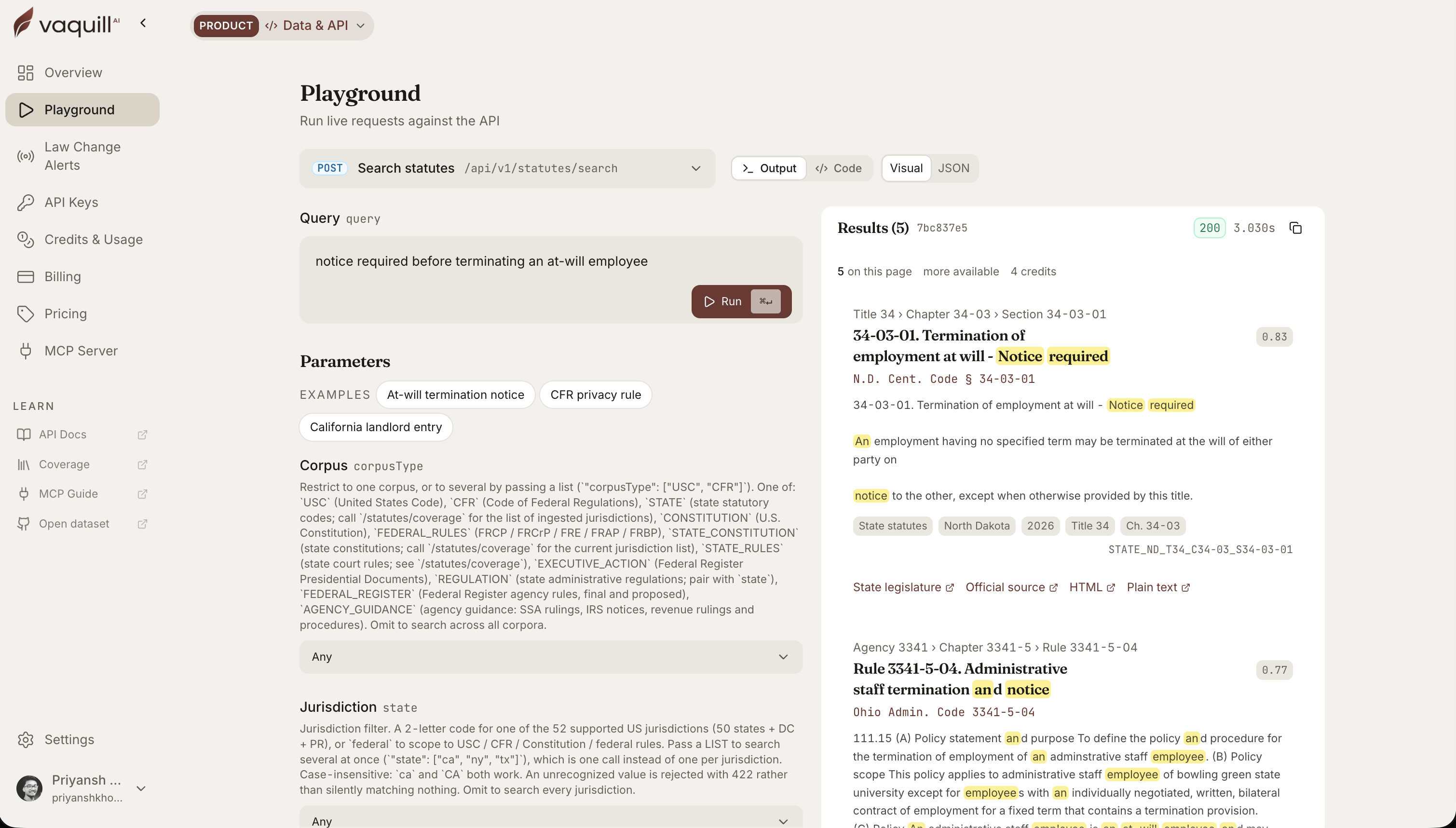 The same corpus behind this article, queried live. Every result carries its citation and a link to the official source.
TL;DR
- The median legal department is small. Across 427 departments, the median team was six people (ACC and Major, Lindsey & Africa, 2022 Law Department Management Benchmarking Report).
- About eight lawyers per $1 billion in revenue. The overall median was eight lawyers per $1 billion, rising to 17 at small companies and falling to three at the largest (ACC, 2021 Law Department Management Benchmarking Report).
- The median company has seven lawyers. That ranged from two lawyers under $1 billion in revenue to 92 lawyers at companies over $20 billion (ACC, 2024 Law Department Management Benchmarking Report).
- Lawyer density varies by industry. Lawyers per $1 billion ran from 10.2 in information to 7.7 in finance (ACC and MLA, 2025 Law Department Management Benchmarking Report).
- Two-thirds of the team are lawyers. On average, lawyers made up 66% of legal staff, with paralegals at 12% and legal operations at 5% (ACC, 2022 report).
- The first hire tracks spend, not headcount. A common rule of thumb: hire in-house when outside-counsel fees reach about twice the cost of an in-house lawyer (Thomson Reuters and practitioner guidance, 2024).
Per the ACC benchmarks in this post, what is the overall median number of lawyers per $1 billion in revenue?
Part of our in-house legal operations series.
What percentage of general counsel say efficiency is a top priority?
About 35% of chief legal officers name operational efficiency as their top strategic priority, the single most-cited answer, per the 2025 ACC Chief Legal Officers Survey of 772 legal-department leaders. Efficiency edged out cost control and technology adoption as the leading focus for the year ahead.
The short answer, then the ratios
There is no single correct team size. There is a defensible range for your revenue, headcount, and industry.
Start with two anchor ratios. First, lawyers per $1 billion in revenue, which normalizes for how much business the team supports. Second, lawyers per employee, which normalizes for how many people the team serves. Both come from the same survey family, so they move together.
Here is the trap. The raw headcount question ("how many lawyers should we have?") is the wrong one. The right question is capacity: how many contracts, matters, and risk decisions can the team absorb per person. A in-house team that automates routine work supports far more business per lawyer than the benchmark implies. We come back to that at the end.
The common benchmark ratios
Two ratios do most of the work. The tables below give the numbers and their sources.
The most cited ratio is lawyers per $1 billion in revenue. The overall median was eight, but the figure is much higher at small companies and drops fast as revenue scales.
The size labels below are the ACC survey's own. In the ACC benchmarking family, "small" is under $1 billion in revenue, "medium" is roughly $1 billion to $5 billion, and "large" is above that, with the top band set at $20 billion or more.
| Company size (ACC band) | Lawyers per $1 billion in revenue | Source (year) |
|---|---|---|
| Overall median | 8 | ACC (2021) |
| Small (under $1B) | 17 | ACC (2021) |
| Medium ($1B to $5B) | 4 | ACC (2021) |
| Large (over $5B) | 3 | ACC (2021) |
The math behind the drop is simple. If a $500 million company employs five lawyers, that is 10 lawyers per $1 billion. A $50 billion company with 100 lawyers is only two per $1 billion. Legal work does not scale one-for-one with revenue, so density falls as the business grows.
The second ratio is lawyers per employee. Small companies run about one lawyer per 200 employees. Large multi-billion-dollar companies stretch to roughly one lawyer per 1,000 employees, per the ACC benchmarking family. For information-technology companies specifically, the 2024 ACC report put the median near one lawyer per 270 employees.
What this means for you: if you are a $200 million company with two lawyers, you are close to the small-company norm. If you are a $5 billion company running four lawyers per $1 billion, you are heavier than the median and should ask why.
Legal team size by company stage
Team size climbs in steps, not a smooth line. The steps track revenue bands in the ACC data.
| Company stage | Revenue band | Typical legal team | Source (year) |
|---|---|---|---|
| Startup / early | Under $1 billion | 2 lawyers, 4 total staff (median) | ACC (2024) |
| Growth / mid-market | $1 billion to $5 billion | Single-digit lawyers, growing ops | ACC (2022) |
| Large | Up to $20 billion | Dozens of staff | ACC (2022) |
| Enterprise | Over $20 billion | 92 lawyers, 158 total staff (median) | ACC (2024) |
The median legal department across all sizes was six people, per the ACC and MLA 2022 report, which surveyed 427 departments across 24 industries and 26 countries. That median hides a wide spread. Small companies ran three team members. Companies over $20 billion ran 98.
For a startup, the timing of the first hire matters more than the target size. A common rule of thumb, cited in Thomson Reuters and practitioner guidance, is to hire in-house when outside-counsel fees reach about twice the fully loaded cost of an in-house lawyer. In practice, many companies make that hire somewhere between 50 and 100-plus employees, earlier in regulated sectors.
What drives a bigger or smaller team
Revenue sets the baseline. Five factors move you off it.
Industry and regulation. Lawyer density varies by sector. The 2025 ACC and MLA report put lawyers per $1 billion at 10.2 for information, 9.7 for professional services, 7.8 for pharmaceuticals and medical devices, and 7.7 for finance. Heavily regulated businesses carry more lawyers per dollar.
Contract volume. A company that signs thousands of commercial agreements a year needs more review capacity than one with a handful of large deals. Volume, not revenue, drives the drafting and review workload.
M&A and transactions. Active dealmaking spikes legal demand in bursts. A deal-heavy company staffs for peaks it cannot fully predict, which pushes headcount above the revenue-based benchmark.
Litigation and disputes. A company with active litigation, regulatory investigations, or high product-liability exposure staffs differently from one with a clean risk profile.
International footprint. Operating across jurisdictions multiplies the compliance surface. More countries usually means more legal staff, or more outside counsel, or both.
Composition also shifts with size. On average, lawyers made up 66% of legal staff, paralegals 12%, other staff 9%, administrative staff 8%, and legal operations professionals 5%, per the ACC 2022 report. At companies under $1 billion, lawyers were about 70% of the team. At companies over $20 billion, that fell to 53% as paralegals, legal ops, and specialists took on more of the load.
How in-house teams cope with more work
The benchmark headcount is not the whole story. In-house teams punch above their size through three levers.
Outside counsel. Small departments push overflow, specialist, and litigation work to law firms rather than hiring for it. Outside-counsel spend is the release valve that lets a two-lawyer team support a growing company.
Legal operations. Even small teams now add ops capacity to run intake, vendor management, and process. The ACC data shows legal ops as a growing slice of the department, especially above $1 billion in revenue.
Automation and AI. Routine drafting, first-pass contract review, and legal research are the tasks software absorbs. A in-house team that automates the repetitive work frees its lawyers for judgment calls, which lets a small department support a much larger business. We cover the shift in depth in how AI is transforming in-house legal teams.
This is where the capacity view beats the headcount view. Two lawyers with strong automation and a good outside-counsel panel can carry the load that used to take four. Tools like Vaquill AI exist to lift that per-lawyer capacity for solo GCs and small teams.
How to benchmark your own team
Do not copy a number off a chart. Run the comparison against your own inputs.
- Pull your two ratios. Divide your lawyer count by revenue in billions, and by total employees. Those are your lawyers per $1 billion and lawyers per employee.
- Find your band. Match your revenue and industry to the ACC tables above. That gives you the median for a company like yours.
- Compare and explain the gap. If you are leaner than the median, check whether outside counsel or automation is covering the difference. If you are heavier, ask what is driving it, such as litigation, regulation, or M&A.
- Measure capacity, not just count. Track matters closed, contracts reviewed, and turnaround time per lawyer. A in-house team with strong throughput does not need to hit the median. For the metrics that matter, see legal department KPIs and what to measure.
- Re-run it yearly. Team size should follow the business. Revenue, headcount, and deal volume all shift, so last year's ratio can mislead.
How to use these benchmarks (without becoming one)
A benchmark is a defense, not a target. Here is how to use it like a GC, not a spreadsheet.
Defend your number to the CFO with work, not peers. When finance asks why legal has three lawyers instead of two, do not point at the ACC median. Point at the workload. Tie your headcount to contract volume, revenue growth, and open risk. "We closed 900 contracts last year, up 40%, with two lawyers, and cycle time is slipping" wins the argument. "The benchmark says three" loses it. The peer number is context. Your own workload is the case.
A lean headcount can be an expensive one. Outside-counsel spend makes headcount misleading. A three-person team that pays law firms $4 million a year is not lean. It is a large legal function wearing a small badge. Add outside spend to internal cost before you call a team efficient. The right measure is total legal cost against revenue and risk, not bodies on the payroll. A GC who cuts one hire and doubles firm spend has not saved anything.
Know when a benchmark becomes a bad hiring target. The ratio is a rearview mirror. It tells you what comparable companies did, not what your workload needs. Chasing a ratio backfires two ways. Hire up to the median when the work is flat, and you pad cost. Refuse to hire because you are already "at benchmark" while contracts pile up, and you starve the function. Staff the queue, not the chart. If matters are late and your lawyers are underwater, hire, even if the ratio says you are fine. If the queue is clear at a lean headcount, hold, even if the ratio says you are short.
The verdict
The right size is the one that clears your workload at acceptable risk, and the benchmarks are a starting point, not a target. The median department is six people. A typical company runs about eight lawyers per $1 billion in revenue, leaner at the top end and denser in regulated industries. Startups usually make the first hire when outside-counsel spend outgrows the cost of bringing the work inside.
The better frame is capacity per unit of business, not raw headcount. A two-lawyer team that automates routine work and uses outside counsel well can support a company that the benchmarks say needs four. If you want to lift that per-lawyer capacity, Vaquill AI is built for solo GCs and small in-house teams. For the wider market picture, see our legal AI statistics and what a general counsel does.
How we sourced these numbers
Every statistic on this page is third-party, dated, and named. We ran searches across the ACC benchmarking report family, fetched the primary coverage where we could, and checked each cited link in July 2026.
A few caveats apply to all of it:
- Definitions vary. "Lawyers," "legal staff," and "team members" are not the same count. We label which one each figure uses so you can compare like with like.
- Survey years differ. The ACC benchmarking report updates yearly, and the exact medians move a little each edition. We cite the specific year for every figure rather than blending them.
- Medians hide spread. A median is the middle of a wide range. Your company can sit well above or below it for good reasons, so use the band, not a single number.
- Some figures come from summaries. Several ACC report numbers below are cited from third-party coverage (Legal Dive and Apperio) of the ACC reports, not the paywalled reports themselves. We name the summary and the underlying report and year for each.
Treat every number here as directional. Use it as a market backdrop, then benchmark your own team against your own workload.
FAQ
How many lawyers should a company have? It depends on revenue and industry. The overall median was about eight lawyers per $1 billion in revenue, rising to 17 at small companies and falling to three at the largest (ACC, 2021 benchmarking report). The median company across all sizes had seven lawyers (ACC, 2024). Start from your revenue band, then adjust for regulation, contract volume, and litigation.
What is a typical in-house legal team size? The median legal department was six people across 427 surveyed departments (ACC and Major, Lindsey & Africa, 2022). That ranged from about three team members at companies under $1 billion in revenue to 98 at companies over $20 billion. Most corporate legal departments are small.
How many lawyers per employee is normal? Roughly one lawyer per 200 employees at small companies, stretching to about one per 1,000 at large multi-billion-dollar companies, per the ACC benchmarking family. For information-technology companies, the 2024 ACC report put the median near one lawyer per 270 employees. The ratio widens as the company grows.
When should a startup hire its first in-house lawyer? A common rule of thumb is to hire when outside-counsel fees reach about twice the fully loaded cost of an in-house lawyer (Thomson Reuters and practitioner guidance, 2024). In practice, many companies make the hire between 50 and 100-plus employees, earlier in regulated sectors like fintech or medical devices.
How many lawyers per $1 billion in revenue is standard? The overall median was eight (ACC, 2021). By industry, the 2025 ACC and MLA report put it at 10.2 for information, 9.7 for professional services, 7.8 for pharmaceuticals and medical devices, and 7.7 for finance. Density falls as revenue rises, because legal work does not scale one-for-one with the business.
What percentage of a legal team are lawyers? About two-thirds. On average, lawyers made up 66% of legal staff, paralegals 12%, other staff 9%, administrative staff 8%, and legal operations 5% (ACC, 2022). Lawyers are a higher share at small companies (around 70%) and a lower share at the largest (about 53%), where paralegals and legal ops take on more work.
How big is a legal team at a $1 billion company? Companies at the small end (under $1 billion in revenue) ran a median of about two lawyers and four total legal staff (ACC, 2024). As revenue climbs into the low billions, teams move into single-digit lawyers with growing legal operations support. The exact size depends heavily on industry and contract volume.
What percentage of general counsel say efficiency is a top priority? About 35% of chief legal officers rank operational efficiency as their top strategic priority, the most-cited answer, per the 2025 ACC Chief Legal Officers Survey of 772 legal-department leaders. It outranked cost control and technology adoption, reflecting pressure to do more work with a lean team.
Is my legal team too small? Not necessarily. Being below the benchmark median is fine if outside counsel and automation cover the gap and your turnaround times hold. Measure capacity (matters closed, contracts reviewed, cycle time per lawyer), not just headcount, before deciding to hire. A in-house team with high throughput can outperform a larger one.
Sources
All links checked July 2026. Where a link points to Legal Dive or Apperio, that page is third-party coverage of the underlying ACC report, not the ACC report itself.
- ACC and Major, Lindsey & Africa, 2022 Law Department Management Benchmarking Report (via Legal Dive coverage) (report 2022)
- ACC, 2021 Law Department Management Benchmarking Report (via Apperio summary) (report 2021)
- ACC, 2024 Law Department Management Benchmarking Report (via Apperio summary) (report 2024)
- ACC and MLA, 2025 Law Department Management Benchmarking Report (2025)
- Thomson Reuters, advice for general counsel at a startup (first-hire timing) (2024)
Last updated: July 2026.
New legal AI guides, weekly.
Further Reading
Outside Counsel Rate Benchmarks 2026: AmLaw vs Boutique vs Solo
Read postLegal AI for Chief Legal Officers (CLOs) in 2026
Read postRolling Out Legal AI to Your Team (Adoption Playbook)
Read postAI Compliance Check: CCPA, GDPR, and SOX for In-House Teams (2026)
Read post12 Best Legal AI Tools for In-House Counsel (2026)
Read postTop 14 Matter Management Tools for In-House Teams (2026)
Read post
Co-Founder & CEO · Attorney
Arshita leads product and strategy at Vaquill AI, the US primary law data API. As an attorney, she decides which law we carry, how each section is sourced and cited, and what legal AI and compliance teams need from the data.