The Texas non-compete that arrived in the data room last quarter looked like every other one. A Houston-based enterprise software seller, fifteen sales reps across Austin, Houston, Dallas. Two years, nationwide, "any competing product," no garden leave, no recital of the confidential-information exchange.
Diligence flagged it unenforceable. The seller's GC swore it held "because we're in Texas." The gap between those positions is the six-figure escrow holdback that ended up on the closing balance.
The position this post defends: Texas is one of the friendlier reasonableness-based states, but the statute and case law punish overreach in a specific way that makes aggressive drafting worse than disciplined drafting.
The drafter who treats Texas as Florida loses. The drafter who treats it as California loses. The drafter who treats it as a state with a real reformation rule, a real damages cap, and a real Business Court watching the M&A and equity-grant docket wins predictably.
Short answer: yes, non-competes are enforceable in Texas. A covenant holds when it is ancillary to an otherwise enforceable agreement and reasonable in time, geographic area, and scope of activity, under Tex. Bus. & Com. Code 15.50. Twelve months and a territory the employee actually worked is the safe zone. Overbroad covenants get reformed by the court, but the employer recovers no damages for the period before reformation, so writing narrow pays off.
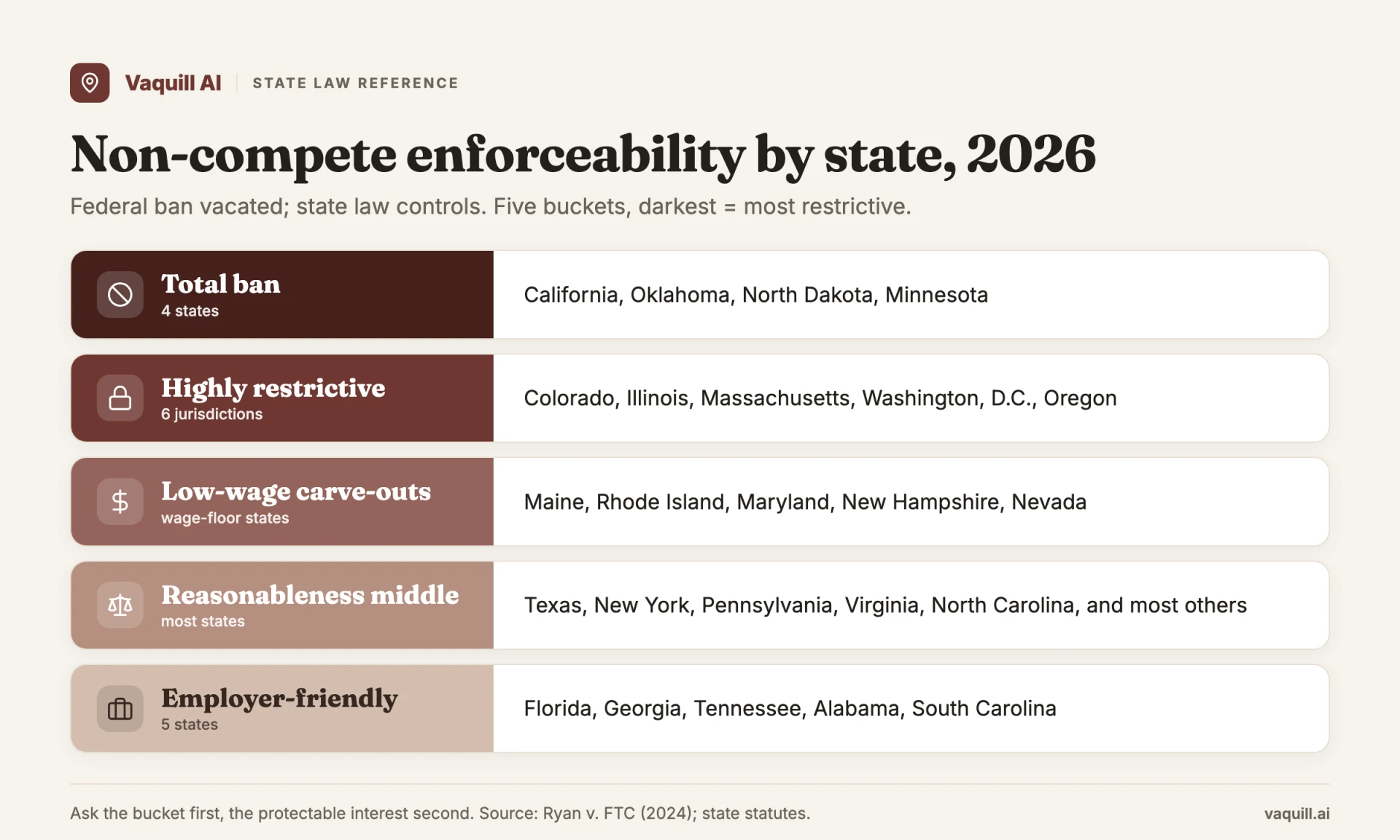
Every state sorts into one of five enforceability buckets; darkest is most restrictive.
TL;DR
- Texas enforces post-employment non-competes under Tex. Bus. & Com. Code § 15.50, but only when the covenant is "ancillary to or part of an otherwise enforceable agreement" and reasonable in time, geographic area, and scope of activity.
- The foundational standard is Light v. Centel Cellular Co. of Texas, 883 S.W.2d 642 (Tex. 1994), softened by Alex Sheshunoff Management Services v. Johnson, 209 S.W.3d 644 (Tex. 2006) on at-will consideration. The Texas Supreme Court then relaxed the consideration analysis in Marsh USA Inc. v. Cook, 354 S.W.3d 764 (Tex. 2011), holding consideration need only be "reasonably related" to a protectable interest, not "give rise to" the interest in restraining competition.
- Texas courts blue-pencil under § 15.51(c). Overbroad restrictions get reformed, not voided, but the statute caps damages for the period before reformation, which is why aggressive drafting backfires.
- HB 19 created the Texas Business Court, in operation since September 1, 2024. Qualifying non-compete disputes (typically sale-of-business, equity-grant, or executive disputes above the dollar threshold) land there now.
- SB 1318 rewrote the physician carve-out in § 15.50(b), effective September 1, 2025. Buyout capped at the physician's total annual salary and wages at termination, term capped at one year, geography capped at a five-mile radius, void if the physician is discharged without good cause, terms stated clearly and conspicuously in writing. A new § 15.501 extends the buyout, one-year, five-mile, and writing limits to dentists, professional and vocational nurses, and physician assistants (without the physician-only good-cause provision).
A Texas court reforms an overbroad non-compete on the eve of trial. What can the employer recover for the period before reformation?
Part of our all-50-states legal reference series.
The statutory framework: §§ 15.50 to 15.52
The Texas Covenants Not to Compete Act lives in three sections of the Business and Commerce Code.
§ 15.50(a) sets the general standard. A covenant is enforceable if it is "ancillary to or part of an otherwise enforceable agreement at the time the agreement is made," and if its limitations on time, geographical area, and scope of activity are reasonable and "do not impose a greater restraint than is necessary to protect the goodwill or other business interest of the promisee."
Three independent ideas: the covenant has to attach to something else (ancillary), the host agreement has to be enforceable in its own right, and the restrictions have to be reasonable in three dimensions.
§ 15.50(b) is the physician carve-out, and as of September 1, 2025 it is a different statute than it was the day before. SB 1318 tightened the physician rules and added a companion § 15.501 that carries similar limits to dentists, professional and vocational nurses, and physician assistants.
§ 15.51 is the remedies section, and where blue-pencil lives. If a court finds the covenant overbroad, it "shall reform" the limitations to be reasonable and enforce the reformed covenant only prospectively. Reformation is mandatory, not discretionary.
§ 15.52 preempts inconsistent state law. Texas common-law non-compete doctrine is whatever the statute says it is.
The Light v. Centel standard
The Texas Supreme Court's foundational non-compete case is Light v. Centel Cellular Co. of Texas, 883 S.W.2d 642 (Tex. 1994). It established the "give rise to" test: consideration for the non-compete had to give rise to the employer's interest in restraining competition.
Read narrowly, the employer had to give the employee confidential information or trade secrets, not just any benefit.
For roughly fifteen years, Light decided most Texas non-compete disputes and tilted the field toward employees. A covenant given in exchange for an at-will job offer with no specific exchange of confidential information was vulnerable.
Drafters compensated with buried confidentiality recitals: "Employer agrees to provide Employee with confidential information; Employee agrees in exchange not to compete." The pattern worked but was fragile.
The first crack came in Alex Sheshunoff Management Services, L.P. v. Johnson, 209 S.W.3d 644 (Tex. 2006). The court held that an at-will employment agreement with an illusory promise can still satisfy the Act once the employer actually performs the promise (delivers the confidential information), turning the unilateral contract into an "otherwise enforceable agreement." Sheshunoff killed the argument that an at-will covenant could never qualify because it was not enforceable the moment it was signed.
That fragility broke fully in 2011. In Marsh USA Inc. v. Cook, 354 S.W.3d 764 (Tex. 2011), the Texas Supreme Court held consideration need only be "reasonably related" to a business interest worthy of protection, not "give rise to" the interest in restraining competition.
The consideration in Marsh was stock options given to a managing director, and the court found them reasonably related to protecting goodwill.
Marsh did not overrule Light expressly. It functionally relaxed it. Practitioners now treat the Texas standard as a "reasonably related" inquiry.
Stock, restricted units, signing bonuses tied to a confidentiality undertaking, specialized training, and access to customer relationships have all survived post-Marsh challenges.
The four-pillar enforceability test
Strip the statute to its operating components and Texas non-compete enforceability collapses into four pillars. Miss any one and the covenant fails or gets reformed to nothing.
Pillar one: ancillary to an enforceable agreement. The covenant cannot stand alone. It rides on a contract that is itself enforceable, with consideration reasonably related to a protectable interest.
Common hosts: employment agreements (exchange: confidential information or specialized training), equity grants (the Marsh fact pattern), sale-of-business agreements. Least durable: a bare offer letter with no recital.
Pillar two: reasonable as to time. Texas courts routinely enforce twelve months and reform anything past twenty-four. Default: twelve months for sales and operations roles, eighteen to twenty-four for senior executives, longer only in sale-of-business covenants where the seller is paid for the restraint.
Pillar three: reasonable as to geographic scope. Geography has to track the territory the employee actually worked. A salesperson with a five-county East Texas territory should have a covenant covering those five counties, not the entire state.
Pillar four: reasonable as to scope of activity restrained. The covenant restricts what the employee actually did, not everything the employer does. A software sales rep selling enterprise accounts is not restrained from graphic design at a competitor.
This pillar catches the most kitchen-sink drafting: "any work for any competitor" almost never survives as written.
Blue-pencil and why it disciplines drafting
Section 15.51(c) requires Texas courts to reform overbroad covenants rather than void them. On its face that is employer-friendly.
The statute does something more subtle. When a covenant is reformed, the employer "may not recover damages for any breach of the covenant occurring before its reformation."
If an employer writes a twenty-four-month nationwide all-activities covenant and a court reforms it on the eve of trial to twelve months, three counties, sales only, the employer can enforce prospectively but recovers nothing for the period before reformation. Eighteen months of competitive damage, zero dollars recoverable.
The disciplined Texas drafter writes the covenant they would actually want to enforce, not the broadest covenant they could plausibly defend. The damages cap converts reformation insurance into a tax on overreach.
Recent appellate authority and the 2024 to 2026 trend
Two intersecting developments shape Texas non-compete practice as of mid-2026.
The first is the FTC non-compete rule, which originated in the Northern District of Texas. Ryan, LLC v. FTC, No. 3:24-cv-00986-E, 2024 WL 3879954 (N.D. Tex. Aug. 20, 2024), set the rule aside nationwide under the APA.
The FTC appealed to the Fifth Circuit in October 2024 and withdrew the appeal in September 2025. The federal answer reverted to "ask your state." For Texas employers, the state-law framework above never stopped being the operative law.
The second is a steady drumbeat of Texas appellate authority refining, mostly in employers' favor, the contours of reasonably related consideration and reasonable restriction. The trajectory since Marsh has been incremental relaxation.
The before-and-after that matters: a 2009 covenant opened with a long confidentiality recital because Light demanded it. A 2025 covenant opens with the equity grant or bonus letter and cites the goodwill interest directly, because Marsh loosened the consideration node.
Drafters who never updated their template since Light still produce covenants that work, but signed by an at-will workforce that no longer believes the recital.
The Texas Business Court angle
HB 19, effective September 1, 2024, created the Texas Business Court: a specialized court system handling commercial disputes that meet specific subject-matter and dollar-amount thresholds. The Business Court has concurrent jurisdiction with state district courts. The headline number to know: qualified-transaction disputes originally needed more than $10 million in controversy. HB 40 dropped that floor to more than $5 million effective September 1, 2025, and now lets parties aggregate joined claims, counterclaims, and cross-claims to clear it.
Non-compete disputes can land in the Business Court when they arise out of a qualifying transaction, typically a sale of business, an equity grant, or an executive employment package, and when the amount in controversy clears the threshold. Ordinary employee disputes between a former rep and her old employer stay in district court.
Three implications for the drafter.
First, the Business Court hears a different docket: judges picked for commercial-law expertise, faster motion practice, and early opinions (such as Energy Transfer v. Culberson Midstream, 2024 Tex. Bus. 3, the first published Business Court opinion, holding that cases filed before September 1, 2024 cannot be removed) showing a court that takes procedure seriously.
Second, M&A and equity-grant covenants in the docket are read against a more sophisticated reader; sloppy ancillary-agreement drafting that might survive a district court motion gets caught earlier.
Third, TRO practice has been more disciplined, with judges expecting a serious bond and a clean record on the reasonableness factors at the TRO stage. A thin protectable-interest declaration that flew in a Friday-afternoon district court hearing does not survive a Business Court intake.
Industry-specific notes
Healthcare practitioners. The area where Texas non-compete law changed most in the last twelve months. SB 1318 amended § 15.50(b) effective September 1, 2025, applicable to agreements entered or renewed on or after that date.
For a physician non-compete to be enforceable, it must (i) include a buyout not exceeding the physician's total annual salary and wages at termination, (ii) have a term not exceeding one year, (iii) limit the geographic area to a five-mile radius from the primary practice location, (iv) be void if the physician is involuntarily discharged without good cause (a reasonable basis related to the physician's conduct, job performance, or contract record), and (v) state all terms clearly and conspicuously in writing.
The companion § 15.501 carries the buyout cap, one-year term, five-mile radius, and clear-writing requirement to dentists, professional and vocational nurses, and physician assistants. It does not give those practitioners the physician-specific good-cause protection. Administrative roles, where the practitioner is not engaged in clinical practice, sit outside the carve-out.
Health-care employers should treat these covenants as a separate template, not a variant of the general employee covenant.
Sales roles. The category that produces the highest case volume in Texas. Recurring fact pattern: a salesperson with a defined territory and customer book leaves for a competitor, the old employer files for a TRO, and the dispute turns on whether the geography and activity scope track what the salesperson actually did.
Peg geography to the compensation plan's territory and scope to the products the employee actually sold during a defined look-back. The clauses that fail in drafting review every quarter: "any competing product" (too broad on scope), "the United States" (too broad on geography), and "any work for a competitor" (too broad on activity). All three get reformed.
Executives. The most permissive subcategory. Senior executives with broad responsibilities, deep customer relationships, and meaningful equity sustain longer durations (eighteen to twenty-four months), broader geographies, and broader activity scope. Consideration is usually equity, which is a clean post-Marsh fit.
The failure mode is underspecification: a covenant that says "competing business" without defining the competitive landscape invites a scope fight at the worst possible time.
Language that survives: "the business of providing [specific product line] to [specific customer type] in [specific region]." Language that does not: "any business competitive with the Company."
Drafting calls that survive in Texas
Pillars are easy to recite. The calls are where the covenant lives or dies.
Twelve versus twenty-four months. Twelve is the safe default because Texas courts most consistently enforce that duration without reformation. Twenty-four is defensible for a senior executive with a multi-year customer cycle (enterprise software ARR, energy origination, wealth management).
Every month past twelve adds risk on the time pillar and raises the chance of eve-of-trial reformation, which kills pre-reformation damages. Ask whether the employer would still want the covenant at twelve months; if yes, write twelve.
National versus territory-tracked geography. Nationwide covenants survive for executives with genuinely national P&L responsibility and almost nowhere else. Below the C-suite, tie geography to "the counties in which Employee provided services during the final twelve months of employment."
The formula flexes with the facts and forecloses the defense that the employee never worked in the restricted area. National geography on a regional sales role looks like maximum protection on paper and gets reformed to the territory anyway, with the employer eating pre-reformation damages.
Confidential-information versus equity recital. Pre-Marsh, the confidentiality exchange was the only durable consideration structure. Post-Marsh, equity, RSUs, or a meaningful retention bonus tied to a protectable interest work just as well, without the at-will-employee argument that the confidentiality recital is illusory.
A company without an equity program should still use the confidentiality recital, but it must be paired with an actual confidentiality protocol (document classification, access controls) or the defense argues the exchange was fictional.
Non-compete versus non-solicit. A narrower non-solicitation covenant survives reformation more reliably and captures most of the protection in sales-role fact patterns. Use both when customer book and labor risk are independent; use only the non-solicit when the customer book is the whole risk.
Reformation clause. Always include one. Section 15.51(c) requires reformation anyway, but the contractual clause confirms intent and forecloses argument.
A worked example. A Texas midstream operator signs a senior originator at $325,000 base plus $75,000 in restricted units. First-instinct draft: twenty-four months, statewide, all hydrocarbon marketing.
Disciplined draft: fifteen months (the typical counterparty contract cycle), counties along the operator's actual pipeline footprint, scope defined as "commercial origination of midstream services to producers in the Permian Basin and Eagle Ford."
The disciplined version survives a Business Court TRO. The first draft gets reformed at preliminary injunction; the employer collects nothing for the eight months of competitive harm before reformation.
FAQ
Are non-competes enforceable in Texas? Yes. Texas enforces post-employment non-competes under Tex. Bus. & Com. Code 15.50 when the covenant is ancillary to an otherwise enforceable agreement and the limits on time, geography, and scope of activity are reasonable. Texas is more employer-friendly than California (which bans them) but punishes overbroad drafting through reformation.
How long can a Texas non-compete last? There is no fixed cap in the statute, but courts most consistently enforce twelve months and routinely reform anything past twenty-four. Eighteen to twenty-four months can hold for senior executives, and longer terms survive in sale-of-business covenants where the seller is paid for the restraint.
What is the Texas Covenants Not to Compete Act? It is Tex. Bus. & Com. Code sections 15.50, 15.51, and 15.52. Section 15.50 sets the enforceability standard, 15.51 covers procedures and remedies (including mandatory reformation of overbroad covenants), and 15.52 preempts inconsistent common law.
Can a Texas court rewrite an overbroad non-compete? Yes. Under section 15.51(c), if a covenant is overbroad the court "shall reform" it to be reasonable and enforce the reformed version. The catch: the employer may not recover damages for any breach that happened before reformation, and relief is limited to an injunction going forward.
What is the leading Texas non-compete case? Marsh USA Inc. v. Cook, 354 S.W.3d 764 (Tex. 2011). It held that consideration only needs to be "reasonably related" to a protectable business interest such as goodwill, relaxing the older "give rise to" test from Light v. Centel Cellular Co. of Texas, 883 S.W.2d 642 (Tex. 1994). Alex Sheshunoff Management Services v. Johnson, 209 S.W.3d 644 (Tex. 2006), is the bridge case on at-will consideration.
Are physician non-competes enforceable in Texas? Yes, but SB 1318 (effective September 1, 2025) tightened section 15.50(b): the buyout is capped at the physician's total annual salary and wages, the term at one year, geography at a five-mile radius from the primary practice location, and the covenant is void if the physician is discharged without good cause. A new section 15.501 applies similar limits to dentists, professional and vocational nurses, and physician assistants.
Does a non-compete survive if the employee is fired? For most employees, yes. The covenant does not automatically dissolve on termination, and Texas does not require for-cause termination as a precondition. The exception is physicians: under SB 1318, a physician non-compete is void if the physician is involuntarily discharged without good cause.
Is a non-solicitation agreement treated the same as a non-compete in Texas? Texas analyzes customer and employee non-solicitation covenants under the same section 15.50 reasonableness framework, but a narrower non-solicit survives reformation more reliably than a full non-compete and often captures most of the protection in sales-role disputes.
Compare neighboring regimes in our California, Florida, and Colorado guides, or see the full non-compete enforceability by state map.
Vaquill AI lets you draft Texas covenants against a reusable playbook that encodes the twelve-month default, territory-tracked geography, and the SB 1318 physician rules, so the disciplined draft is the one that comes out by default.
New legal AI guides, weekly.
Further Reading
California Non-Compete Section 16600 in 2026: The Strictest Ban in the US
Read postColorado Non-Compete Law in 2026: HB 22-1317 and the Highly Compensated Threshold
Read postFlorida Non-Compete Enforceability in 2026: The CHOICE Act + Section 542.335
Read postGeorgia Restrictive Covenants Act in 2026: Drafting Non-Competes That Survive
Read postIllinois Freedom to Work Act in 2026: Non-Compete Rules, Income Thresholds, and Drafting
Read postMassachusetts Non-Compete Agreement Act: A 2026 Drafting Guide
Read post
Co-Founder & CEO · Attorney
Arshita leads product and strategy at Vaquill, building the legal AI suite that solo, small-firm, and in-house US lawyers use to run a matter end to end.