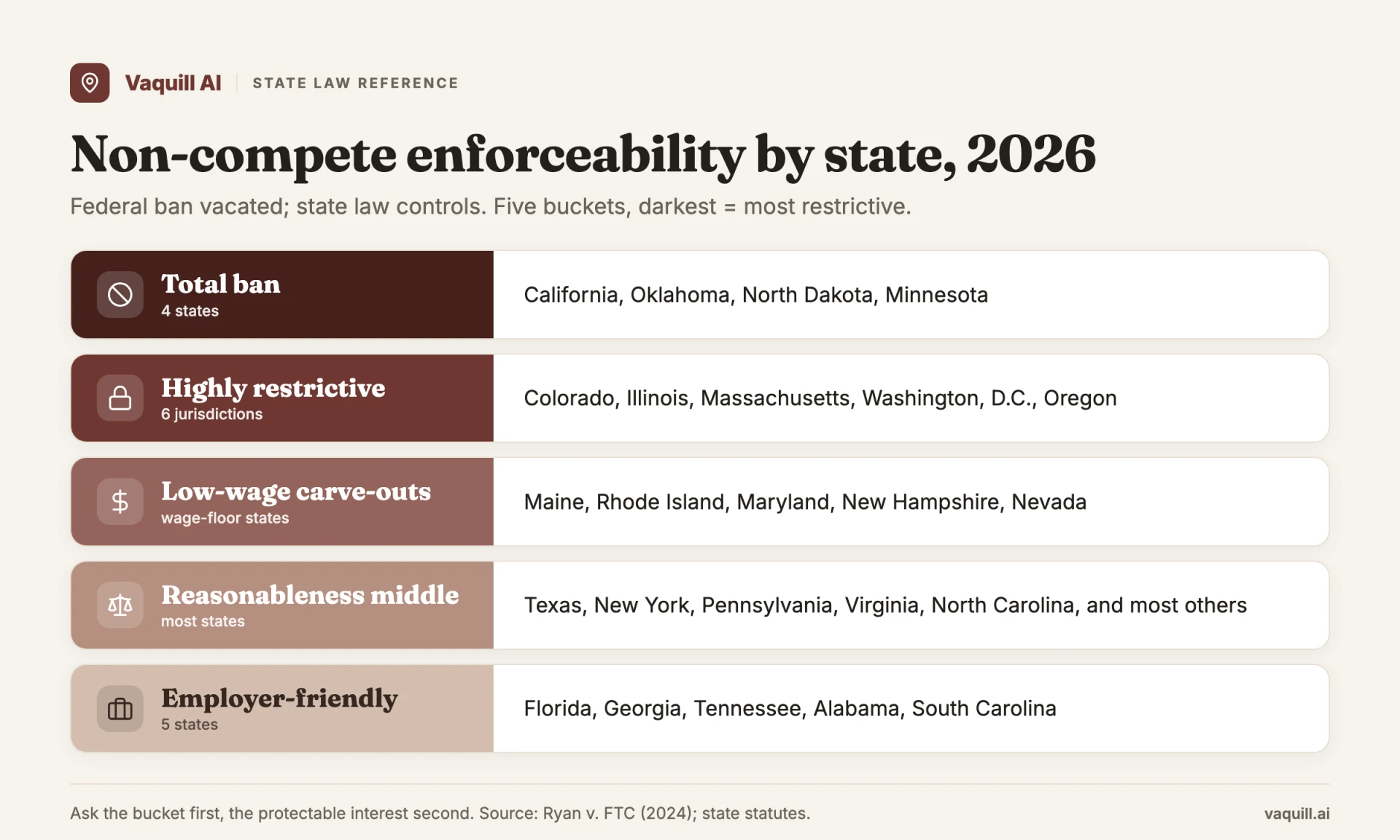
Every state sorts into one of five enforceability buckets; darkest is most restrictive.
Are non-competes enforceable in California?
No. Non-competes are not enforceable in California. Cal. Bus. & Prof. Code § 16600 voids almost every employee non-compete, and the 2024 amendments (AB 1076 and SB 699) made the ban the strictest in the United States. The covenant is void no matter how narrowly it is drafted, void even if it was signed in another state before the employee moved to California, and void even if the contract picks another state's law. Three narrow exceptions survive, all tied to selling a business or dissolving an entity (§§ 16601, 16602, 16602.5), and none of them reach a rank-and-file employee.
For employers, the stakes changed in 2024. § 16600.1 required individualized written notice by February 14, 2024 to current and post-2022 former employees that their non-competes are void, and § 16600.5 bars any attempt to enforce a void covenant and gives the worker a private right of action with damages, an injunction, and attorney's fees. Failure to notice is an act of unfair competition under § 17200, with civil penalties up to $2,500 per violation.
The rest of this guide pulls the exact statutory text, the controlling cases, the exceptions, and a 2026 drafting checklist for both sides.
The form letter that landed in February
If you are in-house counsel at a multi-state employer with even one California worker on the payroll, the California Section 16600 non-compete regime in 2026 is not a future risk; it is a present, accruing exposure under the California Unfair Competition Law, four-year statute of limitations and all, on every restrictive-covenant clause you have not yet stripped from your California-resident employees' agreements.
By late February 2024, plenty of people who had worked for a California employer in the prior two years started receiving the same odd email. Subject line: a variant of "Notice regarding restrictive covenants in your employment agreement."
Body: the company you used to work for is informing you that the non-compete clause buried in your offer letter, the one you may have forgotten about, is void and unenforceable as a matter of California law.
That mass-mailing was not a public-relations move. It was statutory compliance under Cal. Bus. & Prof. Code § 16600.1, with a hard deadline of February 14, 2024.
Employers that missed the deadline committed an act of unfair competition by operation of § 16600.1(c), which channels violations into Bus. & Prof. Code §§ 17200 et seq. and gives the worker, the AG, and four kinds of local prosecutor concurrent authority to bring claims.
That is the California non-compete regime in 2026. The ban is older than most readers (§ 16600 dates from 1872). What is new is the enforcement architecture wrapped around it.
If you are in-house counsel for a multi-state employer with even one California-resident on the payroll, the operative question is no longer "can I write a non-compete." It is "what is my exposure for the ones still sitting in the desk drawer."
TL;DR
- Cal. Bus. & Prof. Code § 16600 voids virtually every employee non-compete. AB 1076 (eff. Jan. 1, 2024) added § 16600.1, requiring employers to send individualized written notice to current and former (post-Jan. 1, 2022) employees by February 14, 2024 that their non-competes are void. Failure to notify is an act of unfair competition under § 17200.
- SB 699 (eff. Jan. 1, 2024) added § 16600.5: no employer may even attempt to enforce a non-compete against a California worker, no matter where the contract was signed or where the work occurred. Employees, former employees, and prospective employees get a private right of action with damages, injunctive relief, and attorney's fees.
- The narrow exceptions (§§ 16601, 16602, 16602.5) cover sale-of-business goodwill, partnership dissolution, and LLC member dissolution. They do not stretch.
- Edwards v. Arthur Andersen LLP, 44 Cal. 4th 937 (2008), killed the "narrow restraint" exception. AMN Healthcare Servs. v. Aya Healthcare Servs., 28 Cal. App. 5th 923 (2018), pulled employee non-solicits inside § 16600's gravity well. Customer non-solicits and broadly drafted NDAs are next.
- The first putative class action under amended § 16600 (Stashik v. Oakley, Inc., Cal. Super. Ct. Orange Cnty., filed May 14, 2025) tests whether plaintiffs' lawyers will run notice-failure cases like wage-and-hour PAGA cases. They will.
Under AB 1076, by what date did California employers have to notify affected employees that their non-competes are void?
Part of our all-50-states legal reference series.
The statute, read literally
The whole regime turns on twenty-eight words. Cal. Bus. & Prof. Code § 16600(a):
"Except as provided in this chapter, every contract by which anyone is restrained from engaging in a lawful profession, trade, or business of any kind is to that extent void."
For 150 years that text did the work, with the courts grinding through every clever attempt to draft around it. The 2024 amendments to § 16600 added subsections (b) and (c) for the avoidance of doubt, in case anyone was still trying.
Subsection (b)(1): § 16600 "shall be read broadly, in accordance with Edwards v. Arthur Andersen LLP (2008) 44 Cal.4th 937, to void the application of any noncompete agreement in an employment context, or any noncompete clause in an employment contract, no matter how narrowly tailored, that does not satisfy an exception in this chapter." Subsection (b)(2) confirms this "does not constitute a change in, but is declaratory of, existing law," so it reaches back, not just forward. Subsection (c) closes a separate gap: the ban "shall not be limited to contracts where the person being restrained" is a party, so a no-hire pact between two employers that locks out a third company's workers is in scope too.
The phrase that matters in (b)(1) is "no matter how narrowly tailored." The legislature was writing past the courts, instructing them to stop looking for the line that would save a particular clause.
There is no line. There are only the three statutory exceptions, and you fit inside one of them or your covenant is void.
The two 2024 amendments, in their actual order
SB 699: enforcement is now its own tort
Signed September 1, 2023. Effective January 1, 2024. SB 699 added Cal. Bus. & Prof. Code § 16600.5 and did three things that matter.
First, it codified extraterritoriality. § 16600.5(a): "Any contract that is void under this chapter is unenforceable regardless of where and when the contract was signed." A non-compete signed in Boston between a Massachusetts company and a Massachusetts resident becomes unenforceable the moment that employee moves to California. The choice-of-law clause does not save it.
Second, it banned attempted enforcement and made it a civil violation. § 16600.5(b): "An employer or former employer shall not attempt to enforce a contract that is void under this chapter regardless of whether the contract was signed and the employment was maintained outside of California." § 16600.5(d) provides that an employer who enters or attempts to enforce a void contract "commits a civil violation." The exposure here is civil liability, with no criminal penalty attached.
Note the word "attempt." Filing a TRO in Delaware against the California-based ex-employee is the attempt. The cease-and-desist letter is the attempt. The threatening LinkedIn message from a former boss is, on a fair reading, the attempt.
Third, it built a private right of action. § 16600.5(e)(1): "An employee, former employee, or prospective employee may bring a private action to enforce this chapter for injunctive relief or the recovery of actual damages, or both."
§ 16600.5(e)(2) adds reasonable attorney's fees and costs for the prevailing employee. Not the prevailing party. The prevailing employee. Employers who win do not collect.
The interaction with out-of-state litigation is the lawyer-y part. If a Massachusetts employer sues a California employee in Massachusetts state court to enforce a non-compete, the California employee now has at least a plausible counter-suit ready under § 16600.5(b) and (e): bring it in California Superior Court for an injunction against further prosecution, plus damages for the cost of defending the Massachusetts action.
The First Circuit in DraftKings Inc. v. Hermalyn, No. 24-1443 (1st Cir. Sept. 26, 2024), affirmed a preliminary injunction enforcing a Massachusetts choice-of-law clause against a recently relocated executive, applying the Restatement (Second) materially-greater-interest test and holding the employee had not shown California's interest was materially greater on the facts.
Hermalyn did not resolve the harder question, whether § 16600.5(b) creates an independent California cause of action against the out-of-state employer for filing the foreign suit at all. That second question is still open, and California plaintiff-side counsel are already framing it. For why these clauses fail more often than drafters expect, see our state-by-state breakdown of choice-of-law clauses that quietly fail.
AB 1076: the notice mandate and § 17200 exposure
Signed October 13, 2023. Effective January 1, 2024. AB 1076 amended § 16600 (the "no matter how narrowly tailored" language above) and added § 16600.1.
§ 16600.1(a): "It shall be unlawful to include a noncompete clause in an employment contract, or to require an employee to enter a noncompete agreement, that does not satisfy an exception in this chapter."
§ 16600.1(b)(1): For current employees and any former employee employed after January 1, 2022, whose contract includes a non-compete clause "that does not satisfy an exception in this chapter," the employer "shall, by February 14, 2024, notify the employee that the noncompete clause or noncompete agreement is void." § 16600.1(b)(2) specifies the form: "a written individualized communication to the employee or former employee, and shall be delivered to the last known address and the email address of the employee or former employee."
§ 16600.1(c) is the teeth: "A violation of this section constitutes an act of unfair competition within the meaning of Chapter 5 (commencing with Section 17200)." That tethers the notice mandate to the entire UCL apparatus.
Civil penalties up to $2,500 per violation under § 17206. Concurrent enforcement authority for the Attorney General, district attorneys, county counsel, and city attorneys of cities with populations over 750,000. A four-year statute of limitations. And, through § 17200's incorporation of unlawful conduct, derivative claims by competitors and worker-plaintiffs.
The notice deadline passed without much public enforcement noise at first. AG Rob Bonta issued a consumer alert in early 2024 reminding California workers of their rights under the new statutes, but no high-profile public enforcement action followed in 2024. The plaintiffs' bar started picking up the slack.
The publicly reported first putative class action under amended § 16600 is Stashik v. Oakley, Inc., a complaint filed in California Superior Court in May 2025; the plaintiff worked briefly at an Irvine facility for entities headquartered out of state and seeks to certify a class of California employees subject to restrictive covenants who were not properly noticed under § 16600.1.
Whatever happens on the merits, the case is the template the plaintiff-side bar has been waiting for: notice failure as a class action, not a one-off.
The exceptions, in order of how often counsel try to squeeze through them
§ 16601: sale of business goodwill
The cleanest exception. An owner who sells "the goodwill of a business" or substantially all of the assets, shares, or interests, including any interest in a partnership or LLC selling its goodwill, may agree with the buyer "to refrain from carrying on a similar business" within a specified geographic area where the business was sold. The covenant binds the seller, not random employees of the acquired entity who happened to be holding stock options at closing.
The trap is M&A counsel who paper a § 16601 covenant against rank-and-file engineers as part of an acquihire. That is not a § 16601 covenant. It is an employee non-compete with a fancy hat, and AMN's logic eats it.
§ 16602: partnership dissolution
A partner may agree, upon dissolution or disassociation, not to carry on a similar business within the geographic area where the partnership had transacted business. Narrow. Almost no modern lawyer cases turn on it because partnerships have mostly aged out as the entity of choice.
§ 16602.5: LLC member dissolution
The 2006 sibling of § 16602. Members of an LLC may agree, in connection with dissolution or member dissociation, to refrain from carrying on a similar business within the area where the LLC transacted business. Mirrors § 16602's logic.
That is the entire list. There is no senior-executive exception. There is no garden-leave exception.
There is no exception for trade-secret protection, because the courts have repeatedly held that California's Uniform Trade Secrets Act (Civil Code §§ 3426 et seq.) already protects what protectable interests exist, without need of a non-compete overlay.
Edwards: why "narrow restraint" died
Before 2008, the Ninth Circuit had floated a "narrow restraint" exception, citing Campbell v. Bd. of Trs. of Leland Stanford Jr. Univ., 817 F.2d 499 (9th Cir. 1987), under which a covenant that left most avenues of practice open could be enforced. The California Supreme Court read that line and said no.
Edwards v. Arthur Andersen LLP, 44 Cal. 4th 937 (2008), involved a senior tax manager whose employment agreement with Andersen prohibited him from providing services to any Andersen client he had worked with in the previous 18 months, plus a no-solicit of co-workers for one year.
After Andersen's post-Enron collapse, KPMG agreed to hire Edwards, contingent on Andersen releasing him from the covenants. Andersen refused unless Edwards released other claims. Edwards sued for tortious interference.
The court held the covenants void under § 16600 and rejected the narrow-restraint exception in plain terms: "Section 16600 is unambiguous, and if the Legislature intended the statute to apply only to restraints that were unreasonable or overbroad, it could have included language to that effect. We reject Andersen's contention that we should adopt a narrow-restraint exception to section 16600 and leave it to the Legislature, if it chooses, either to relax the statutory restrictions or adopt additional exceptions to the prohibition-against-restraint rule under section 16600." 44 Cal. 4th at 950.
Edwards is the structural opinion. The legislature wrote it into § 16600(b)(1) in 2024 to make sure no court would forget. The case that mattered in 2008 mattered more in 2024.
The newer fight: non-solicits and NDAs as backdoor non-competes
Employee non-solicits
For two decades, employers comfortable with the § 16600 ban worked around it by inserting clauses that did not literally restrain post-employment competition, just employee solicitation. The leading defense was Loral Corp. v. Moyes, 174 Cal. App. 3d 268 (1985), which had upheld a no-raid clause as a minor restriction not reaching into § 16600.
AMN Healthcare Servs., Inc. v. Aya Healthcare Servs., Inc., 28 Cal. App. 5th 923 (2018), ended that. The Fourth District held that a clause barring departing AMN recruiters from soliciting AMN's travel nurses for one year was "a restraint of a substantial character" on the recruiters' ability to engage in their lawful profession.
The court "doubt[ed] the continuing viability of Loral Corp. post Edwards" (28 Cal. App. 5th at 938). Federal courts in California have largely followed AMN. The California Supreme Court has not yet weighed in directly, but the practical reality is that broad employee non-solicits are dead-letter risk.
Customer non-solicits
The doctrine here is partly settled and partly contested. Edwards itself held that a clause barring solicitation of former clients fell within § 16600's prohibition. Lower courts and federal district courts in California have largely followed for clauses framed as bare post-employment customer non-solicits.
The narrower question, whether a clause keyed specifically to misappropriation of confidential customer information rather than to the bare act of solicitation can survive as a trade-secret protection clause, is less cleanly resolved; appellate authority points in the direction that bare customer non-solicits do not survive § 16600 absent a sale-of-business hook.
The safer working counsel for 2026: assume any post-employment customer non-solicit not tied to a § 16601 transaction will fail in California state court. If you are litigating one of these for the employer in 2026, you are running uphill into a UCL counterclaim with civil penalties up to $2,500 per violation and the prevailing-employee attorney's-fee shift of § 16600.5(e)(2).
NDAs that effectively restrain competition
The newer enforcement frontier. An NDA that defines "confidential information" as everything the employee learned at the company, then prohibits the employee from "using" any of it post-employment, is a non-compete with extra words.
The 2024 statutory language voids "any noncompete clause in an employment contract, no matter how narrowly tailored" under § 16600(b)(1). A maximalist NDA that functions as a restraint fits inside that language. Brown v. TGS Mgmt. Co., 57 Cal. App. 5th 303 (2020), invalidated overbroad confidentiality and use clauses on this theory in a securities-trading context. Expect Brown to be the citation that does the work in NDA cases for the rest of the decade.
The line between an enforceable NDA and a backdoor non-compete sits at the difference between disclosure and use. A clean clause says: "Employee shall not disclose Confidential Information to any third party." A doomed clause says: "Employee shall not, during or after employment, use any Confidential Information for any purpose other than the Company's benefit."
The second formulation, paired with a maximalist definition of Confidential Information, prevents the employee from working in the same field at all, because using their accumulated know-how is the job. Brown is the case that pulls that draft inside § 16600.
Counsel for outbound employers underestimate this constantly; the in-house counsel who refuse to sign a "use" prohibition on the way out the door are reading the right cases. For how confidentiality clauses hold up elsewhere, our NDA enforceability by state reference maps the same disclosure-versus-use line across jurisdictions.
What multi-state employers should be doing, and what most are not
The pattern I see on calls with in-house counsel for companies with operations in California and one or two restrictive-covenant states (often Massachusetts, Florida, or Illinois) breaks into three buckets.
The good bucket: the company built a California-specific employment-agreement template that strips the non-compete, narrows the NDA to actually-confidential information with no post-employment use prohibition that reaches general knowledge, drops the employee non-solicit entirely, and either drops the customer non-solicit or rebuilds it as a trade-secret-protection clause keyed to specific protected information. The notice letters went out in February 2024 to the entire current and former-since-2022 workforce. The legal-ops team keeps a log.
The middle bucket: the company sent some notice letters, mostly to current California-domiciled employees, but missed the former employees who left in 2022 and 2023, and missed the remote workers who relocated into California after the contract was signed. The employment agreement still has a non-compete with a generic "if any provision is unenforceable, sever it" clause, and the legal team thinks severability saves them.
This is the single most common 2026 California drafting mistake I see, and it is worth pulling apart. Severability would save the contract as a whole from collapsing if the covenant got struck. It does not save the employer from § 16600.1's standalone prohibition on "includ[ing] a noncompete clause in an employment contract" in the first place.
The unfair competition violation crystallizes at the moment the agreement is signed (or, for pre-2022 ones, the moment the notice deadline passed). A severability clause is a remedy clause; it speaks to what happens after a court strikes a provision. § 16600.1(c) is a regulatory clause; it speaks to the act of putting the provision in. They operate on different timelines.
The mid-bucket employer's risk is not "what happens if we try to enforce." It is "every California agreement we still hold with an unstripped non-compete is a UCL count waiting to be pleaded, severability clause notwithstanding."
The same mistake shows up in a remote-workforce wrinkle. A Boston-based fintech I worked with had a clean nationwide template with a 12-month non-compete and a Massachusetts choice-of-law clause. They moved to fully remote in 2021.
By 2024 they had thirty engineers who had signed the Massachusetts-flavored contract in 2022 and then relocated to California, Oregon, or Washington in 2023. Nobody updated the agreement when the move happened. The legal team treated the relocations as a payroll issue and a tax issue, not a contracts issue.
When SB 699 took effect, every one of those thirty engineers came into § 16600.5(b)'s scope. Same template, same signature page, suddenly different statute. The fix was a thirty-page workstream the company did not budget for.
The bad bucket: the company still uses a single nationwide template with a non-compete that runs against everyone, has done no notice, and treats California as "we will deal with it if it comes up." When the test case lands, this is the bucket that gets named in the complaint.
If you are doing this in 2026, the order of operations is straightforward. Pull every employment agreement signed since January 1, 2022. Identify every employee or former employee who was a California resident at any point during or after the agreement. Send the § 16600.1(b) notice to anyone you have not noticed. Update the template to strip the covenant for California workers. Keep proof of mailing and email delivery.
The cost of doing this is a week of paralegal time. The cost of not doing it is an open-ended UCL exposure (civil penalties up to $2,500 per violation under § 17206), a four-year statute of limitations, and the attorney's-fee shift of § 16600.5(e)(2) if the test case reaches the merits.
What the redline looks like, in practice
A national employment-agreement template usually carries language like this in the restrictive-covenants article:
"For a period of twelve (12) months following the termination of Employee's employment for any reason, Employee shall not, directly or indirectly, engage in any business that competes with the Company in any geographic area in which the Company conducts business."
The California-compliant version is not a narrower version of that paragraph. It is no paragraph at all for that clause, plus a defined-term cleanup so the trade-secret protection clause still works on its own.
The replacement language a lot of in-house teams settle on, after the second round of outside-counsel review, looks closer to:
"Employee acknowledges that the Company's trade secrets, as defined in Cal. Civil Code § 3426.1(d), are valuable Company assets. Employee shall not, during or after employment, disclose any Company trade secret to any third party, except as required by law or with the Company's prior written consent. Nothing in this Agreement shall be construed to prohibit Employee from engaging in any lawful profession, trade, or business of any kind, including with a competitor of the Company, after the termination of employment."
The second sentence is what the cautious drafters add. It is a belt-and-suspenders disclaimer that the agreement is not, and is not intended to be, a restraint under § 16600.
Combined with notice under § 16600.1 and a clean Labor Code § 2870 invention-assignment clause, that is the package that survives California review without giving up the trade-secret protection that actually mattered.
The 2026 drafting checklist, both sides
What cannot be in a California employment agreement: any post-employment restriction on competing (however narrow); any post-employment restriction on soliciting former co-workers (assume AMN governs); any post-employment restriction on soliciting former customers, unless tied to a § 16601 sale; any NDA that prohibits use, not just disclosure, of information beyond statutorily protected trade secrets; any choice-of-law clause selecting a non-California state's law for a California resident with the purpose of evading § 16600; any forum-selection clause that pushes a California employee out of California without independent counsel, prohibited by Lab. Code § 925.
What can replace the non-compete in the protectable-interest analysis: a narrow trade-secret clause scoped to information that actually qualifies under Civ. Code § 3426.1(d); a clean invention-assignment clause under Lab. Code § 2870; a confidentiality clause that prohibits disclosure (not use) of specifically defined confidential information; and, if the company is willing to pay for it, a garden-leave-style structure dressed as continued employment with reduced duties for the transition window.
Most of the work, frankly, is the trade-secret clause and the document-handling protocols around it. The protectable interest exists in California; you just cannot get there through a covenant.
Where this is going
Three trend lines to track over the next twenty-four months.
First, the AG enforcement question. Bonta has issued guidance and warnings but has not yet brought a public enforcement action against an employer for failing to send § 16600.1 notices or for attempting to enforce a non-compete under § 16600.5(b). The dog has not bitten. The first public action will reset the market. Plaintiffs' firms are filing in the meantime.
Second, the out-of-state enforcement collision. DraftKings was a win for the Massachusetts employer in the First Circuit on materially-greater-interest grounds, but it did not resolve the harder question of whether § 16600.5(b) gives the California employee a direct cause of action against the out-of-state employer in California for filing the out-of-state suit.
When that question reaches the Ninth Circuit or the California Supreme Court, the answer will determine whether choice-of-law clauses retain any teeth for California-resident workers. Right now, the careful reading of § 16600.5(b) plus § 16600.5(e)(1) says the employer is exposed in California whether or not it wins in Massachusetts.
Third, the spread of similar regimes. Minnesota's 2023 ban borrowed structure from § 16600. New York vetoed a comparable bill in December 2023 because it lacked a senior-executive carve-out. The Massachusetts and Washington threshold regimes look like compromises but the legislative drafting in both states cites California's experience in the committee reports. For how the rest of the country sorts out, the non-compete enforceability by state map puts all fifty in one place.
The federal answer is gone after Ryan, LLC v. FTC vacated the FTC rule. California is the model that legislatures in labor-friendly states are studying. The strictest ban in the US is also the most likely template for the next wave.
FAQ
Are non-competes enforceable in California?
No. Under Cal. Bus. & Prof. Code § 16600, an employee non-compete is void in California, no matter how narrowly it is written. The only carve-outs are tied to selling a business or dissolving a partnership or LLC (§§ 16601, 16602, 16602.5), and they do not apply to ordinary employees. If a California employer asks you to sign a non-compete, it is almost certainly unenforceable.
What is California Business and Professions Code 16600?
Section 16600(a) states that "every contract by which anyone is restrained from engaging in a lawful profession, trade, or business of any kind is to that extent void." It dates from 1872. The 2024 amendment (AB 1076) added subsection (b)(1), which directs courts to read the ban "broadly" and void any non-compete "no matter how narrowly tailored," and subsection (c), which extends the ban to contracts even where the restrained person is not a party.
Does the California non-compete ban apply if I signed the contract in another state?
Yes. Section 16600.5(a) makes a void non-compete "unenforceable regardless of where and when the contract was signed." A covenant signed in Massachusetts or Texas becomes unenforceable once the employee works in California, and a choice-of-law clause picking another state does not save it. One caveat: in DraftKings Inc. v. Hermalyn (1st Cir. 2024), a federal court outside California still enforced a Massachusetts covenant on its facts, so the out-of-state-litigation question is not fully settled.
What was the February 14, 2024 non-compete notice deadline?
Section 16600.1(b) required employers to send individualized written notice by February 14, 2024 to all current employees and any former employees employed after January 1, 2022 whose contracts contained a void non-compete, telling them the clause is void. The notice had to go to both the last known mailing address and the email address. Missing the deadline is an act of unfair competition under § 17200.
What are the penalties for an illegal non-compete in California?
A violation of § 16600.1 is unfair competition under § 17200, which carries civil penalties up to $2,500 per violation under § 17206, a four-year statute of limitations, and enforcement by the Attorney General, district attorneys, and large-city attorneys. Separately, § 16600.5 lets the employee, former employee, or prospective employee sue for damages and an injunction, and a prevailing employee recovers attorney's fees under § 16600.5(e)(2).
What are the exceptions to California's non-compete ban?
There are three, all narrow. Section 16601 lets the seller of a business's goodwill or ownership interest agree not to compete in the area sold. Section 16602 covers partners on dissolution or dissociation. Section 16602.5 covers LLC members on dissolution or dissociation. There is no senior-executive exception, no garden-leave exception, and no trade-secret-protection exception.
Are non-solicitation agreements enforceable in California?
Mostly not. AMN Healthcare Servs. v. Aya Healthcare Servs. (2018) treated a broad employee non-solicit as a "restraint of a substantial character" that § 16600 voids, and doubted the older Loral rule that once allowed them. Customer non-solicits not tied to a § 16601 sale are also at high risk. A narrow trade-secret clause that protects specific confidential information is the safer route.
What can replace a non-compete in California?
Protectable interests still exist, just not through a covenant. California employers rely on a trade-secret clause scoped to information that qualifies under Civ. Code § 3426.1(d), a clean invention-assignment clause under Lab. Code § 2870, and a confidentiality clause that bars disclosure (not post-employment use) of defined confidential information. A void "use" prohibition can be pulled back inside § 16600 under Brown v. TGS Mgmt. Co. (2020).
For pulling the current text of § 16600, § 16600.1, § 16600.5, and the rest of the chapter directly out of the California Business and Professions Code, see the US primary law API.
This is where an in-house workbench like Vaquill AI earns its keep: AI drafting and saved negotiation playbooks let you swap an unenforceable covenant for the trade-secret and confidentiality package California actually allows, instead of rebuilding the language by hand each time.
Want to draft California-compliant employment terms faster? Start a free Vaquill AI trial, or see how AI drafting works.
New legal AI guides, weekly.
Further Reading
Colorado Non-Compete Law in 2026: HB 22-1317 and the Highly Compensated Threshold
Read postFlorida Non-Compete Enforceability in 2026: The CHOICE Act + Section 542.335
Read postGeorgia Restrictive Covenants Act in 2026: Drafting Non-Competes That Survive
Read postIllinois Freedom to Work Act in 2026: Non-Compete Rules, Income Thresholds, and Drafting
Read postMassachusetts Non-Compete Agreement Act: A 2026 Drafting Guide
Read postNew York Non-Compete Law in 2026: Enforceability, BDR Rule, and Drafting
Read post
Co-Founder & CEO · Attorney
Arshita leads product and strategy at Vaquill, building the legal AI suite that solo, small-firm, and in-house US lawyers use to run a matter end to end.