Yes, non-competes are enforceable in Florida, and as of 2026 the state is one of the most employer-friendly in the country. The legacy statute, Fla. Stat. § 542.335, enforces a covenant backed by a legitimate business interest and reasonable in time, area, and line of business. The 2025 CHOICE Act adds a second, stronger regime for high earners with restrictions up to four years and a mandatory preliminary injunction.
The thing most drafting teams get wrong about Florida non-competes in 2026 is treating the state as one regime when it has become two. There is the legacy § 542.335 covenant, with its tiered presumptions and mandatory blue-pencil modification, that has governed Florida restrictive covenants since 1996. And there is the new CHOICE Act regime in §§ 542.41 to 542.45, which became law in 2025 and runs in parallel for high-earner employees and contractors and ships with a mandatory preliminary injunction.
Teams that draft against the first while quietly ignoring the second leave the strongest available protection on the table. Teams that try to force every covenant into the second discover the technical requirements (salary threshold, written acknowledgment, seven-day review period) and end up back in § 542.335 by default.
A concrete example: a Florida non-compete in a Tampa SaaS offer letter that crossed our desk in spring 2026. Three years, nationwide, "any business that competes with the Company in any line of business."
The general counsel had cut and pasted from a California parent template with no Florida recitals, no legitimate-business-interest pleading, and a generic "to the maximum extent permitted by law" reformation clause. The drafter bolted on the magic line at the bottom: "This Agreement shall be governed by the laws of the State of Florida." The candidate's lawyer redlined it. The deal almost died.
What would have saved it: a § 542.335-shaped recital naming the customer relationships and confidential information at issue, geography tied to the executive's actual sales territory, and (because comp cleared the salary threshold) a parallel CHOICE Act covered non-compete vehicle ready to deploy. Florida law was the right choice. The template was the wrong template.
The position this post defends: Florida sits at the most employer-friendly end of the US non-compete spectrum, and after the CHOICE Act the gap between Florida and second-tier reformation states has widened.
The drafter who treats § 542.335 as a license to scribble watches the court reform the covenant into something narrower than the disciplined draft would have produced. The drafter who picks the right vehicle and matches the statutory requirements gets a covenant that survives preliminary-injunction practice with damages on the table.
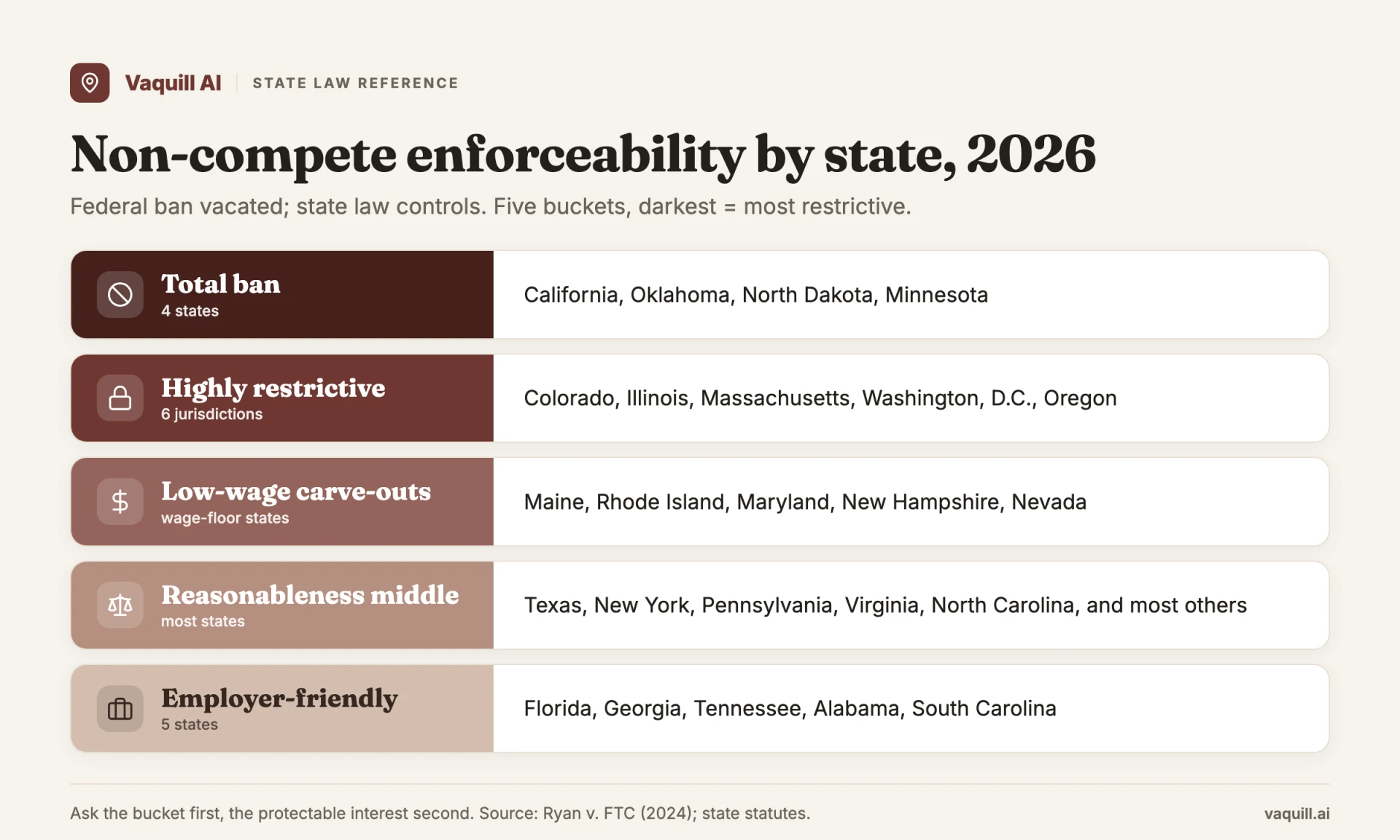
Every state sorts into one of five enforceability buckets; darkest is most restrictive.
TL;DR
- Florida sits at the most employer-friendly end of the US non-compete spectrum in 2026. Fla. Stat. § 542.335 codifies enforceability with statutory presumptions favoring 6-month to 2-year restrictions, and the 2025 CHOICE Act (Senate Bill 1494) added a new statutory regime for high-earner non-competes and garden leave that protects restrictions up to four years.
- The CHOICE Act, codified at Fla. Stat. §§ 542.41 to 542.45 (garden leave in § 542.44, non-compete in § 542.45), applies to covered employees earning more than twice the annual mean wage in the relevant Florida county (roughly $80,000 to $150,000 depending on county) and to covered garden leave structures where the employer keeps the worker on payroll without assigning work.
- For agreements outside the CHOICE Act, § 542.335 keeps the legacy presumptions: 6 months or less is presumed reasonable, 6 months to 2 years is rebuttable but presumed reasonable, more than 2 years is presumed unreasonable for the typical employee context.
- Section 542.336 invalidates physician non-competes only in counties where one entity employs or contracts with every physician practicing that specialty. The Florida rule is narrow and targets monopoly conditions; it does not ban ordinary physician non-competes where competing practices exist.
- Florida courts modify rather than void. The statute directs the court to grant only the relief reasonably necessary to protect the legitimate business interest, and Florida explicitly forbids courts from refusing enforcement based on "any rule of contract construction" that disfavors restraints of trade.
Under the 2025 CHOICE Act, how long can a covered Florida non-compete last?
Part of our all-50-states legal reference series.
The statutory framework: Fla. Stat. § 542.335
The Florida Valuable Consideration Restraints statute is one of the most prescriptive non-compete statutes in the country. § 542.335 reads less like a common-law standard and more like a checklist a court is told to follow.
Subsection (1)(a) requires the covenant to be in writing and signed by the person against whom enforcement is sought.
Subsection (1)(b) requires the party seeking enforcement to plead and prove "one or more legitimate business interests justifying the restrictive covenant." The statute lists qualifying categories including trade secrets, valuable confidential business or professional information, substantial relationships with specific prospective or existing customers, customer goodwill associated with a trademark or trade name, geographic location, marketing or trade area, and extraordinary or specialized training.
The list is "not limited to" those categories. The Florida Supreme Court read the catchall in White v. Mederi Caretenders Visiting Servs. of Se. Fla., LLC, 226 So. 3d 774 (Fla. 2017), to allow protection of referral-source relationships in home health care.
Subsection (1)(c) requires the restraint to be "reasonably necessary to protect" the interest. If overbroad, the court "shall modify the restraint." Modification is mandatory, not discretionary, and is the source of Florida's blue-pencil practice.
Subsections (1)(d) and (1)(e) lay down the presumptions practitioners actually plan around. For a former employee, agent, or independent contractor, six months or less is presumed reasonable and more than two years is presumed unreasonable. Sale-of-business covenants get longer windows: three years or less presumed reasonable, more than seven years presumed unreasonable.
Subsection (1)(g) is where Florida's pro-employer tilt becomes obvious. Courts "shall not employ any rule of contract construction that requires the court to construe a restrictive covenant narrowly, against the restraint, or against the drafter of the contract." They "shall not consider any individualized economic or other hardship that might be caused to the person against whom enforcement is sought."
Hardship to the worker is a non-factor by statute. That is the single most lopsided drafting rule in any state non-compete statute.
The 2025 CHOICE Act
The Florida Contracts Honoring Opportunity, Investment, Confidentiality, and Economic Growth Act passed the Legislature on April 24, 2025 as Senate Bill 1494 (companion House Bill 1219) and became law without Governor DeSantis's signature. The act states an effective date of July 1, 2025; the official Florida Statutes history note for Chapter 2025-213 records the constitutional effective date as August 15, 2025. Either way, it governs covered agreements entered in or after summer 2025. It does not replace § 542.335. It creates a parallel regime for two species of covered agreement, sitting alongside the legacy statute.
The CHOICE Act applies only to covered employees and independent contractors who earn more than twice the annual mean wage in the Florida county where the employer's principal place of business is located, or where the worker resides if the employer sits outside Florida. The threshold ranges roughly from $80,000 in lower-wage counties to nearly $150,000 in Miami-Dade and parts of South Florida. Healthcare practitioners are excluded.
Inside that perimeter, the statute creates two vehicles.
Covered non-compete agreement (§ 542.45). A non-compete up to four years restricting the worker from providing services to another employer where the worker would "provide similar services" or where it is "reasonably likely" the worker would use the employer's confidential information or customer relationships.
The employer must give the worker the proposed agreement at least seven days before the employment offer expires, notify the worker in writing of the right to consult counsel, and the worker must acknowledge in writing access to confidential information or customer relationships.
Covered garden leave agreement (§ 542.44). A notice-of-termination structure up to four years where the employer keeps the worker on payroll at full base salary and benefits. After the first ninety days of the notice period, the employer is not required to assign work. Either party may shorten the notice period unilaterally. The worker remains contractually bound during the garden leave, which is the trade for the salary continuation.
Automatic preliminary injunction. The provision that changes litigation posture. On the employer's motion the court "shall preliminarily enjoin" the worker from engaging in any activity that would breach a covered agreement.
The worker can dissolve the injunction only by proving, "by clear and convincing evidence, and based on non-confidential information," either that no unfair competition or threat to the legitimate business interest exists, or that the employer failed to pay the promised consideration.
The covenant is enforced first; the worker litigates to escape it second.
Damages and fees. A prevailing employer recovers "all available monetary damages for all available claims" plus attorneys' fees and costs. The employer can also plead in the alternative under § 542.335 or trade-secret law.
The combination is unusually employer-favorable. As of mid-2026, no other state statute on the books combines a four-year ceiling, mandatory preliminary injunction, clear-and-convincing burden on the worker to dissolve, and an explicit fee-shift in the employer's favor in a single covered-agreement regime.
Statutory presumptions for non-CHOICE-Act agreements
Most Florida non-compete drafting in 2026 still happens under § 542.335 because most Florida employees do not clear the CHOICE Act salary threshold. The legacy presumptions matter, and they remain the spine of day-to-day enforceability analysis.
Six months or less: presumed reasonable. The floor of safety. The presumption is rebuttable in theory; in practice, an employer that asked for six months and proved a legitimate business interest wins on the time pillar. Standard duration for hourly workers, junior sales reps, and short-tenured employees.
Six months to two years: rebuttable presumption of reasonableness. The workhorse range. Twelve months is the default for sales and operations roles with meaningful customer contact. Eighteen months is defensible for managers and team leads. Twenty-four months sits at the edge and invites a fact fight.
The presumption flips the burden: the worker proves unreasonableness rather than the employer proving reasonableness.
More than two years: presumed unreasonable. Outside the sale-of-business context and outside the CHOICE Act, a covenant longer than two years starts from a defensive crouch. Courts modify aggressively in this range, often reducing to twenty-four months and reforming geography or scope at the same time.
Sale-of-business covenants: three to seven years. A sale of business or sale of a professional practice supports a three-year covenant as presumptively reasonable and a seven-year ceiling beyond which the presumption flips. The longer window reflects future goodwill, not just labor.
The legacy fact pattern that reaches the appellate courts most often: an eighteen-month statewide covenant on a midlevel salesperson. The fight is whether "statewide" is reasonably necessary or whether the court should modify to the territory the salesperson actually worked.
Post-White v. Mederi, Florida courts are comfortable modifying geography rather than voiding the covenant. The employer gets enforcement on a narrowed footprint; the salesperson loses the headline argument but wins on scope.
Industry-specific notes
Healthcare. Fla. Stat. § 542.336 voids physician non-competes only when one entity employs or contracts with, directly or through affiliated entities, every physician practicing a given specialty in a county. The void stays in effect until three years after a second entity begins offering that specialty in the county. The statute is narrowly targeted at monopoly conditions and does not prohibit ordinary physician non-competes where competing practices exist.
The CHOICE Act excludes healthcare practitioners from its covered-agreement regime, so a physician covenant in 2026 is governed by § 542.335 plus § 542.336, never by the CHOICE Act vehicles. Hospital systems hiring specialists in markets they dominate should pressure-test the § 542.336 analysis county by county; the statute looks at the county-level competitive map, not the system's national footprint.
Sales. The category that produces the most case law. Florida courts have repeatedly affirmed that substantial relationships with specific customers, prospective customers, and (after White v. Mederi) referral sources qualify as legitimate business interests.
Recurring drafting failure: an employer claims protection of "all customers of the Company." Courts will modify to "customers with whom the employee had substantive contact during the final twenty-four months of employment." Drafters who write that language in front get cleaner injunctions.
Tech. Trade-secret protection runs in parallel under Florida's Uniform Trade Secrets Act, Fla. Stat. §§ 688.001 to 688.009. The drafter pleads both. The CHOICE Act becomes attractive for tech because the salary threshold is easier to clear, the four-year window matches actual product cycles, and the automatic preliminary injunction is meaningful for fast-moving competitor scenarios.
The clause that fails review every quarter: "engaging in the business of software." Replace with "the business of providing [specific product category] to [specific market segment]" and modification risk drops.
Recent appellate authority
The Florida Supreme Court's most consequential modern non-compete decision remains White v. Mederi Caretenders Visiting Servs. of Se. Fla., LLC, 226 So. 3d 774 (Fla. 2017), which resolved a District split and held that home-health referral sources can be a legitimate business interest under § 542.335. The opinion's reasoning extends beyond home health; the catchall in § 542.335(1)(b) reaches relationships the statute does not list expressly, as long as the employer pleads and proves the interest.
After White v. Mederi, the Districts have been reading the protectable-interest list generously while staying disciplined on time, geography, and activity scope. The Fourth DCA's foundational referral-source decision, Infinity Home Care, L.L.C. v. Amedisys Holding, LLC, 180 So. 3d 1060 (Fla. 4th DCA 2015), remains the working template.
Florida has never required the Texas Light v. Centel showing that consideration "give rise to" the protectable interest; § 542.335 simply requires a legitimate business interest, not a particular consideration mechanism. Initial employment, continued employment, equity, and signing bonuses all work. Drafters who borrow from out-of-state templates sometimes overengineer the recital. Florida does not need it.
The first wave of CHOICE Act reported decisions is still building. The act took effect July 3, 2025, and early appellate guidance on §§ 542.41 to 542.45 is thin as of mid-2026.
Trial-court posture in Florida circuit court and in the Middle and Southern Districts has been consistent with the statutory text, with the burden shifting to the worker to rebut by clear and convincing evidence, but the first definitive appellate constructions of the automatic-injunction language are still working through the system.
Blue-pencil rule
Florida's blue-pencil practice under § 542.335(1)(c) is mandatory modification. A court that finds the covenant overbroad cannot void it; the court "shall modify the restraint." Same direction as Texas, but the Florida statute pairs it with the no-narrow-construction and no-hardship rules in subsection (1)(g). The combination is more employer-friendly than the modification regime in most reformation states.
The Florida Supreme Court applied this approach in the White v. Mederi litigation itself: rather than refusing enforcement of a referral-source covenant the Fifth DCA had read as unprotectable, the Court held referral sources fall within § 542.335(1)(b) on the right facts, remanded, and left modification of duration and scope for the trial court to apply against the statute's reasonableness criteria.
That is the working pattern: appellate courts confirm the protectable interest, trial courts modify the contours.
A typical modification fact pattern, drawn from a pattern repeated across Fourth and Second DCA decisions: a salesperson with a defined territory and customer book signs a twenty-four-month, statewide, "any competing business" covenant. The trial court finds substantial customer relationships protectable, agrees twenty-four months is at the outer edge but not unreasonable, modifies the geography to the counties the salesperson actually serviced during the look-back, and narrows the activity scope to the specific product line the salesperson sold.
The employer gets a real injunction on a narrower footprint and can pursue damages on the conduct that fell within the reformed restriction. The salesperson loses the headline argument that the covenant should be voided.
Florida courts are not infinite tailors. If the covenant cannot be saved (no protectable interest, fatal procedural defects under § 542.335(1)(a)), the court denies enforcement. The blue-pencil rule rescues overbroad covenants, not non-compliant ones.
Drafting checklist for the Florida non-compete
A working checklist for 2026, split between the two regimes:
For a vanilla § 542.335 covenant.
- In writing, signed by the worker. Florida does not enforce oral covenants.
- Specific recital of the legitimate business interest: substantial customer relationships, confidential information, specialized training, customer goodwill, or referral sources. Plead the ones that apply.
- Duration calibrated to the tiers. Six months for short-exposure roles; twelve to eighteen for sales and operations; twenty-four for senior roles; longer only in sale-of-business covenants.
- Geography tied to the worker's actual territory, not the entire state by default.
- Scope tied to the work the worker actually did: specific product line, customer type, market segment.
- Florida choice-of-law and choice-of-venue clause. Out-of-state courts sometimes refuse to apply Florida law where the worker has no Florida contact.
For a CHOICE Act covered non-compete or covered garden leave.
- Confirm the worker clears the salary threshold (more than 2x annual mean wage in the relevant Florida county). Pull current county wage data.
- Confirm the worker is not a healthcare practitioner. The exclusion is statutory.
- Provide the seven-day review period and written notice of right to consult counsel. Document the dates.
- Recite the worker's access to confidential information or customer relationships. The CHOICE Act requires the acknowledgment.
- Pick the vehicle. Covered non-compete for sudden departures. Covered garden leave where the employer can absorb the salary cost during a predictable transition.
- Define termination-for-cause precisely. The CHOICE Act does not supply a default.
- Florida law and Florida venue. The automatic preliminary injunction provision only attaches in Florida courts.
A drafter who misses a technical requirement loses the CHOICE Act enforcement boosters. The covenant drops back into § 542.335 territory, which is still generous but not as generous.
Multi-state employer strategy
For a national employer with workers across California, Massachusetts, New York, and Florida, the question every quarter is whether a Florida choice-of-law clause pulls a non-Florida worker into Florida's enforcement regime. The answer depends on the worker's contacts with Florida and the receiving state's public-policy hostility to the covenant.
Florida choice-of-law works cleanly for workers who live, work, or have substantial business contact in Florida. It gets challenged when applied to a worker with no Florida nexus. California will not enforce a non-compete against a California-based worker regardless of the contract. Massachusetts has its own statutory framework that displaces Florida law. New York applies its own reasonableness test and may honor Florida law where the contract has a genuine Florida connection.
The play most clients land on after the analysis: pick the worker's home state by default, but use Florida and the CHOICE Act vehicles selectively for executives and high-comp roles with genuine Florida contacts. The selective-Florida pattern is showing up in covenant books reviewed during 2025 and 2026 M&A diligence, particularly for Florida-headquartered companies and for national companies with substantial Florida operations.
A working drafting habit for 2026: pull § 542.335, §§ 542.41 to 542.45, and § 542.336 side by side before sending the next Florida covenant out of the data room, and ask which of the three vehicles the role actually fits.
Teams that draft these covenants at volume keep the § 542.335 recital, the CHOICE Act vehicle, and the geography-to-territory move in a reusable playbook. Vaquill AI's drafting and playbook tools let you encode that structure once and apply it to each new Florida covenant. You can draft your next covenant in Vaquill AI and keep the statutory checklist attached.
FAQ
Are non-competes enforceable in Florida? Yes. Florida is one of the most employer-friendly states for restrictive covenants. Under Fla. Stat. § 542.335 the employer must plead and prove a legitimate business interest and keep the restraint reasonable in time, area, and line of business. The 2025 CHOICE Act adds a stronger track for high earners.
How long can a Florida non-compete last? Under § 542.335, six months or less is presumed reasonable for employees, six months to two years is presumed reasonable but rebuttable, and more than two years is presumed unreasonable. Sale-of-business covenants get three years presumed reasonable and seven years as the ceiling. A CHOICE Act covered non-compete can run up to four years.
What is the Florida CHOICE Act non-compete? The CHOICE Act (Florida Contracts Honoring Opportunity, Investment, Confidentiality, and Economic Growth Act), codified at Fla. Stat. §§ 542.41 to 542.45, became law in 2025. It creates two vehicles for high earners: a covered non-compete (§ 542.45) and covered garden leave (§ 542.44), both enforceable up to four years.
Who does the CHOICE Act apply to? Covered employees and independent contractors who earn more than twice the annual mean wage in the relevant Florida county, roughly $80,000 to nearly $150,000 depending on county. Healthcare practitioners are excluded, and the worker needs a Florida nexus through the employer's principal place of business or the worker's residence.
Does the CHOICE Act make injunctions automatic? Close to it. On the employer's motion the court must preliminarily enjoin a covered worker from breaching the agreement. The worker can dissolve the injunction only by proving, by clear and convincing evidence and on non-confidential information, that no unfair competition exists or that the employer failed to pay the promised consideration.
Are physician non-competes enforceable in Florida? Usually yes. Fla. Stat. § 542.336 voids a physician non-compete only when one entity employs or contracts with every physician practicing that specialty in a county, and the void lasts until three years after a second entity enters. Outside that monopoly condition, physician covenants are governed by § 542.335, and the CHOICE Act does not apply to healthcare practitioners.
Can a Florida court rewrite an overbroad non-compete? Yes. Section 542.335(1)(c) directs the court to modify an overbroad restraint rather than void it. Courts most often narrow geography to the territory the worker actually serviced and tighten the activity scope to the specific product line. The blue-pencil rule rescues overbroad covenants, not ones that fail the writing or signature requirements.
Does Florida choice-of-law work for out-of-state workers? It works cleanly for workers who live, work, or have substantial business contact in Florida. It gets challenged for workers with no Florida nexus, and states like California will not enforce a non-compete against their own residents regardless of the contract.
Compare neighboring regimes in our Texas, California, New York, and Massachusetts guides, or see the full non-compete enforceability by state map. For drafting across regimes, see our choice-of-law clause breakdown.
New legal AI guides, weekly.
Further Reading
California Non-Compete Section 16600 in 2026: The Strictest Ban in the US
Read postColorado Non-Compete Law in 2026: HB 22-1317 and the Highly Compensated Threshold
Read postGeorgia Restrictive Covenants Act in 2026: Drafting Non-Competes That Survive
Read postIllinois Freedom to Work Act in 2026: Non-Compete Rules, Income Thresholds, and Drafting
Read postMassachusetts Non-Compete Agreement Act: A 2026 Drafting Guide
Read postNew York Non-Compete Law in 2026: Enforceability, BDR Rule, and Drafting
Read post
Co-Founder & CEO · Attorney
Arshita leads product and strategy at Vaquill, building the legal AI suite that solo, small-firm, and in-house US lawyers use to run a matter end to end.