The clause arrived in a Chicago-based SaaS company's standard offer letter, two paragraphs, no recital, no salary carve-out, no notice language. Twelve-month non-compete, statewide, all "competing services." The offeree was a customer success manager paid $68,000 base plus a small bonus targeted at $72,000 on-target.
The hiring manager wanted the clause executed before start, which was four days away. The clause was void on its face, and nobody in the loop knew it.
The position this post defends: Illinois is one of the more legible non-compete regimes in the country, but its legibility punishes lazy drafting in a particular way. The statute names the dollar thresholds, the notice period, the disclosure language, and the reformation posture.
If the covenant fails any of the named requirements, no judicial sympathy follows. The drafter who treats Illinois like a reasonableness-only state and ignores 820 ILCS 90/ loses every time.
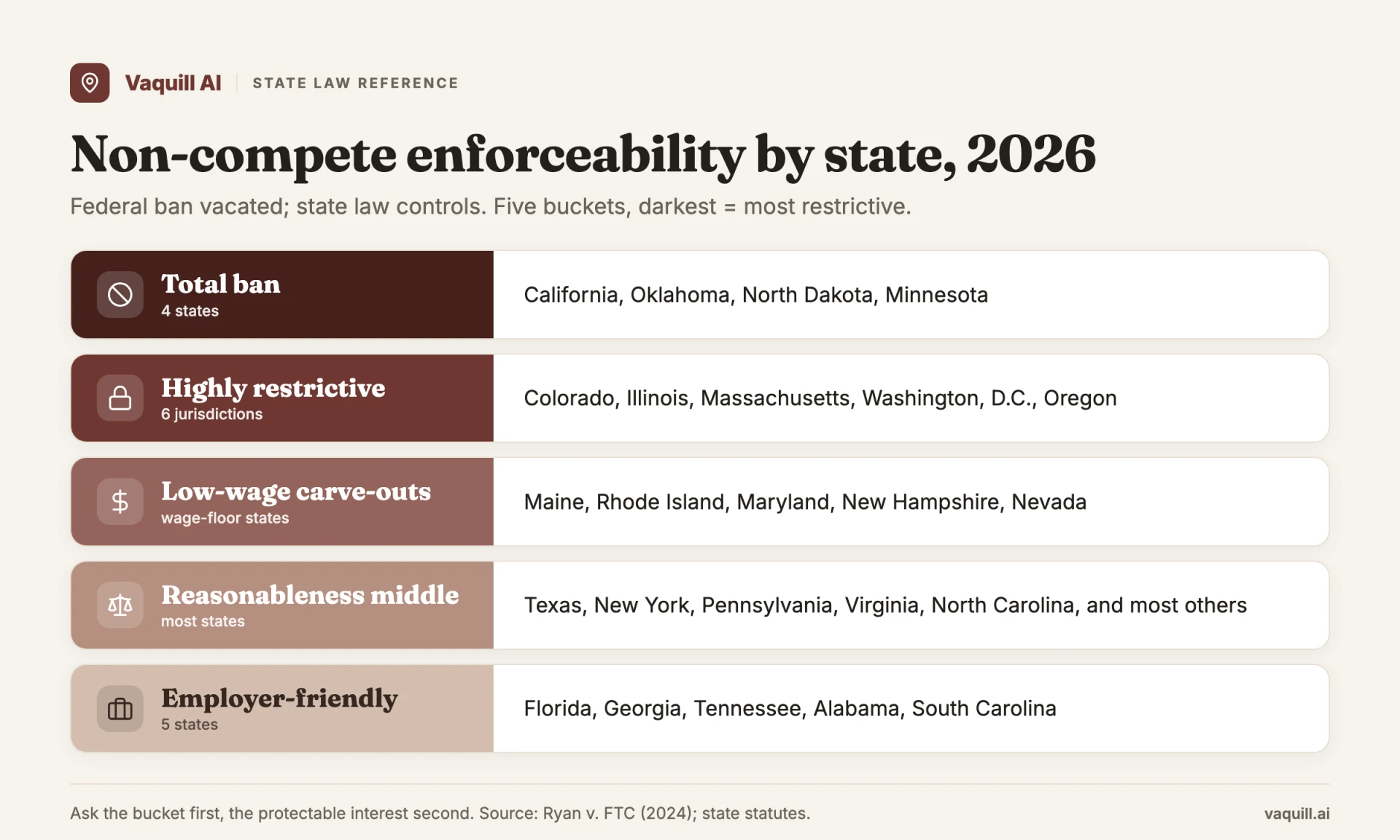
Every state sorts into one of five enforceability buckets; darkest is most restrictive.
TL;DR
- The Illinois Freedom to Work Act, 820 ILCS 90/1 et seq., took effect January 1, 2017 and was substantially amended by Public Act 102-358, effective January 1, 2022.
- The 2022 amendments (820 ILCS 90/10) bar non-competes against any employee earning $75,000 or less per year, and bar non-solicits against any employee earning $45,000 or less. Both thresholds step up every five years through 2037 ($90,000 / $52,500 by 2037).
- Procedural minimums under 820 ILCS 90/20: 14 days to review, an express written advisement that the employee should consult counsel, or the covenant is void.
- Enforcement bites both ways. A prevailing employee recovers costs and reasonable attorney's fees (820 ILCS 90/25), and the Attorney General can seek civil penalties up to $5,000 per violation or $10,000 per repeat violation within five years (820 ILCS 90/30).
- Above the threshold, Reliable Fire Equipment Co. v. Arredondo, 2011 IL 111871, governs reasonableness through a totality-of-the-circumstances test; Fifield v. Premier Dealer Services, Inc., 2013 IL App (1st) 120327, supplies the two-years-or-other-consideration rule that the statute now reflects.
- Reformation is discretionary under 820 ILCS 90/35, and the legislature wrote a preference against "extensive judicial reformation." Courts that do reform look at good-faith drafting, fairness, and whether the contract authorized severance.
- The FTC's nationwide non-compete ban never took effect. A federal court set it aside in Ryan LLC v. FTC (N.D. Tex., Aug. 2024) before its September 4, 2024 effective date, so Illinois employers rely on 820 ILCS 90/, not a federal rule.
In 2026, at or below what annual earnings figure is an Illinois non-compete void under the Freedom to Work Act?
Part of our all-50-states legal reference series.
Are non-competes enforceable in Illinois?
Yes, but only above an income floor and only if the employer follows the process. Under the Illinois Freedom to Work Act (820 ILCS 90/10), a non-compete is void against any employee earning $75,000 or less per year, and a non-solicit is void against any employee earning $45,000 or less. Above those floors the covenant still has to give the employee 14 days to review, advise the employee in writing to consult a lawyer (820 ILCS 90/20), rest on adequate consideration, and be reasonable in time, geography, and scope under Reliable Fire. Miss any one and the covenant is void before a court reaches the merits.
| Restriction | 2026 income floor | Jan 1, 2027 | Jan 1, 2032 | Jan 1, 2037 |
|---|---|---|---|---|
| Non-compete (820 ILCS 90/10(a)) | $75,000 | $80,000 | $85,000 | $90,000 |
| Non-solicit (820 ILCS 90/10(b)) | $45,000 | $47,500 | $50,000 | $52,500 |
Thresholds confirmed against Hinshaw & Culbertson and the Chicago Bar Association summaries of Public Act 102-358; the escalator is written into 820 ILCS 90/10.
The statute: 820 ILCS 90/
The Illinois Freedom to Work Act lives in the Employment chapter of the Illinois Compiled Statutes. The structure is short and self-contained; the operative provisions number fewer than ten.
820 ILCS 90/5 is the definitions section. It defines "covenant not to compete," "covenant not to solicit," and (after the 2022 amendment) "adequate consideration." The consideration definition is the one that catches templates, covered below.
820 ILCS 90/10 sets both income prohibitions in one section. Subsection 10(a): no employer may enter a covenant not to compete with any employee whose actual or expected annualized earnings do not exceed $75,000 per year, rising to $80,000 on January 1, 2027, $85,000 on January 1, 2032, and $90,000 on January 1, 2037. Subsection 10(b): the non-solicit floor is $45,000, stepped up by $2,500 every five years ($47,500 in 2027, $50,000 in 2032, $52,500 in 2037). The lower non-solicit floor reflects the legislature's view that solicitation is a milder restraint, but the cliff is just as hard.
"Earnings" means salary, bonuses, commissions, and any other taxable compensation reflected on a W-2, plus elective deferrals (401(k), 125, 132). Practitioners undercount the threshold when they look only at base; the statute is written against the W-2.
Subsection 10(d) carries the industry carve-outs. No covenant against a construction worker as defined in the section. No covenant against an individual covered by a collective bargaining agreement under the Illinois Public Labor Relations Act or the Illinois Educational Labor Relations Act.
820 ILCS 90/15 sets the substantive validity test. A covenant is void unless the employee receives adequate consideration, the covenant is ancillary to a valid employment relationship, it is no greater than required to protect a legitimate business interest, it imposes no undue hardship, and it is not injurious to the public. This is the statutory home of the Reliable Fire reasonableness inquiry.
820 ILCS 90/20 is the procedural section, and where most templates fail. Two requirements appear together: the employer must (i) advise the employee in writing to consult with counsel before signing, and (ii) provide the employee a copy of the covenant at least 14 calendar days before the commencement of employment, or at least 14 calendar days to review.
The employee may voluntarily sign before the 14 days expire. If either requirement is missing, the covenant is void.
820 ILCS 90/25 is the fee-shifting section, and it tilts the litigation math hard toward employees. If an employer files suit or arbitration to enforce a covenant and the employee prevails, the employee recovers all costs and reasonable attorney's fees. There is no reciprocal fee award for the employer. A weak covenant is not just unenforceable; pursuing it can hand the other side a fee judgment.
820 ILCS 90/30 is the Attorney General enforcement section. When the AG has reasonable cause to believe an employer is engaged in a pattern or practice that violates the Act, the AG may sue. The court may impose a civil penalty up to $5,000 per violation, or up to $10,000 per repeat violation within a five-year period, and each affected employee counts as a separate violation. A standard offer-letter clause rolled out to a whole class of underpaid hires is the fact pattern that turns one drafting error into a stacked penalty.
820 ILCS 90/35 addresses reformation. Extensive judicial reformation "may be against the public policy of this State." Courts may reform or sever in their discretion, weighing fairness as originally written, good-faith effort, the extent of reformation needed, and whether the parties included a severance clause. Illinois is not a strict blue-pencil state and not a strict reformation state; it is a reluctant-reformation state.
The Act has no choice-of-law section. An Illinois employer cannot opt out by writing "Delaware law governs" into the contract; Illinois courts run a common-law conflicts analysis and apply Illinois law when Illinois has the materially greater interest (the worker lives here, the work happens here, the contract was signed here). The choice-of-law clause is a litigation argument, not an escape hatch.
What Public Act 102-358 actually changed
The 2022 amendments did three things and codified two.
The first new thing is the income threshold. The original 2017 Act (Public Act 99-860) banned non-competes only against "low-wage employees," defined as those earning the greater of $13.00 per hour or the applicable minimum wage. Public Act 102-358 replaced that narrow band with the $75,000 / $45,000 structure and the five-year escalator.
The cliff is hard: $74,999 in expected annualized W-2 earnings means the non-compete is void, regardless of the employee's role or sophistication.
The second new thing is the 14-day notice and advice-of-counsel disclosure at 820 ILCS 90/20. Both are conditions of enforceability, not best practices. The disclosure must be in writing. The 14 days runs from delivery, not from the offer date.
Practitioners burn this by emailing the offer letter with the covenant attached, then asking for signature within a week. The covenant is void at signing.
The third new thing is the construction-industry ban at 820 ILCS 90/10(d), which intersects with the state's broader push on worker classification.
The codification is the Fifield rule and a partial codification of the reformation posture. Fifield v. Premier Dealer Services, Inc., 2013 IL App (1st) 120327, held that continued at-will employment is adequate consideration for a post-employment covenant only if the employment lasts at least two years after signing, absent additional consideration.
The amended statute defines "adequate consideration" as two years of employment after signing the agreement, or "other professional or financial benefits adequate by themselves." The legislature did not pick a dollar figure for "other benefits," which leaves a fight every time the consideration question is live.
The piece the statute did not change is the reasonableness test. Above the threshold, with adequate consideration, with the notice and disclosure in order, the covenant still has to survive Reliable Fire.
Reliable Fire and the totality-of-circumstances test
The Illinois Supreme Court's foundational non-compete authority is Reliable Fire Equipment Co. v. Arredondo, 2011 IL 111871. The court resolved a long-running split in the appellate districts and rejected the rigid two-factor test that had limited "legitimate business interest" to confidential information and near-permanent customer relationships.
The Reliable Fire test has three operative requirements. The covenant must (i) be no greater than required to protect a legitimate business interest of the employer, (ii) impose no undue hardship on the employee, and (iii) not be injurious to the public.
The legitimate-business-interest inquiry is a totality of the circumstances, with relevant factors including the near-permanence of customer relationships, the employee's acquisition of confidential information through employment, and the time and geographic scope of the restriction.
Two practical consequences. First, the test is fact-intensive at every node, which means the record at the preliminary injunction stage matters more than the words on the page. Employers who file with a thin protectable-interest declaration and a maximum-breadth covenant lose more often than employers who file with a tight declaration and a covenant that already reflects the actual restriction needed.
Second, "legitimate business interest" is not a checklist. A sales role with a defined book of long-tenure enterprise customers is a different fact pattern than a marketing coordinator with no customer contact, and the same covenant fails one and survives the other. Drafters who use a single covenant for all roles trade durability for convenience and get caught in litigation.
Adequate consideration: the Fifield trap
Fifield is the rule that catches the most templates. A new hire signs a non-compete on day one of employment. Six months later, the employer terminates without cause. The employer sues to enforce. The covenant fails because the consideration (continued at-will employment) never matured into the required two years.
The statute now codifies the result. 820 ILCS 90/5 defines adequate consideration as either (i) the employee worked for the employer for at least two years after signing the agreement, or (ii) the employer otherwise provided consideration adequate to support an agreement to not compete or not solicit, which can consist of a period of employment plus additional professional or financial benefits, or merely professional or financial benefits adequate by themselves.
What survives in practice. A signing bonus tied to the covenant, paid upfront, with a clawback if the employee resigns before a defined date. A meaningful equity grant with vesting tied to continued service. A promotion with a base-salary increase, contemporaneous with the new covenant. A retention bonus paid mid-tenure when the covenant is introduced for the first time.
The common thread is consideration that is identifiable, monetizable, and contemporaneous with the restraint.
What does not survive. A signing bonus already promised in the offer letter, then "exchanged" for the covenant in a second document. A vague reference to "training and confidential information" without an actual confidentiality protocol or trade-secret inventory. An equity grant with vesting unrelated to the covenant period.
Industry-specific notes
Healthcare. Physician non-competes sit under a separate statute, 225 ILCS 60 (the Medical Practice Act), in addition to 820 ILCS 90/. The Medical Practice Act does not prohibit physician non-competes but tracks them against the Act's reasonableness standard, and post-Reliable Fire the analysis collapses into the same totality test.
Hospital and large-group employers facing physician departures rarely litigate to enforce a broad restraint; the predictable outcome is a buyout negotiation, with the covenant working as a settlement framework rather than an actual restriction.
Non-physician practitioners (NPs, PAs, therapists) sit under 820 ILCS 90/ directly; the income threshold is binding, and the same reasonableness analysis applies regardless of the patient population.
Construction. Public Act 102-358 banned covenants against construction workers as defined in 820 ILCS 90/10(d). The carve-out has a labor-classification interface: employers reclassifying workers as "supervisors" or "managers" to escape the ban have seen tighter scrutiny under the Illinois Employee Classification Act. The cleanest read for in-house counsel at a construction firm is that the prohibition is broad and the exceptions are narrow.
Trucking and logistics. Federal preemption is the live issue. The Federal Aviation Administration Authorization Act preempts state laws related to motor carrier prices, routes, and services, but courts have generally not extended preemption to employment-side restrictive covenants against drivers. Multi-state carriers running Illinois terminals should assume 820 ILCS 90/ applies to drivers based in Illinois, and that the $75,000 cliff is real for the typical driver wage band.
Recent appellate authority and the 2024 to 2026 trend
Two intersecting developments shape Illinois non-compete practice as of mid-2026.
The first is the legislative drumbeat. House Bill 3213, introduced in the 104th General Assembly, would void all non-competes and non-solicits entered into on or after January 1, 2026, regardless of jurisdiction. House Bill 1642 would raise the non-compete threshold to $300,000. Neither has reached the governor's desk as of this writing.
The signal that matters is direction: every legislative proposal in the last three sessions has pushed the threshold up, not down, and the carve-outs for construction and labor-covered workers keep widening. Drafters relying on the current $75,000 floor should assume it is a temporary number.
The second is the appellate trajectory after Reliable Fire and the 2022 amendments. Covenants signed without the 14-day notice or without the written advice-of-counsel disclosure (820 ILCS 90/20) are being held void rather than reformed, and the fee-shifting rule at 820 ILCS 90/25 means a losing enforcement attempt can cost the employer the employee's legal bill.
On the substantive side, the totality test from Reliable Fire has produced predictable outcomes when the record is built honestly: tight protectable-interest declarations win, and kitchen-sink "all competitors, all activities, all geography" covenants either fail or get the narrow reformation 820 ILCS 90/35 permits.
The before-and-after that matters for in-house counsel: a 2019 covenant could lean on continued at-will employment plus a confidentiality recital and survive most challenges.
A 2026 covenant signed without the 14-day notice is void on the face of the statute, and a 2026 covenant supported only by at-will employment fails Fifield the moment the employee separates within two years.
Drafting checklist for an Illinois non-compete that survives
The checklist below assumes the employee is above the income threshold and the role merits a covenant in the first place. If either is false, do not draft.
Notice and disclosure. Deliver the covenant at least 14 calendar days before signing or before employment commences, whichever applies. Include a written statement advising the employee to consult with counsel before signing. Document the delivery date in a way the employee acknowledges (signed acknowledgment, email confirmation with timestamp).
Consideration. Pair the covenant with consideration that is identifiable and contemporaneous. A signing bonus paid on day one with a clawback tied to the covenant. An equity grant with vesting. A meaningful base-salary bump for a mid-tenure introduction. Do not rely on continued at-will employment alone unless you can wait two years to enforce.
Time. Twelve months is the disciplined default for non-competes, six to twelve for non-solicits. Eighteen to twenty-four months for senior roles where the customer cycle and confidential information are durable. Anything past twenty-four months invites a reasonableness challenge that 820 ILCS 90/35 reluctance to reform will not save.
Geography. Track the geography to the territory the employee actually worked. "The State of Illinois" for a Chicago-based account executive serving Cook, DuPage, and Lake counties fails the reasonableness inquiry. "The counties in which Employee provided services during the final twelve months of employment" is the formula that flexes with the facts and forecloses the defense.
Activity scope. Restrict what the employee actually did, not everything the employer does. A software AE selling mid-market is not restrained from enterprise field engineering at a competitor. The scope clause should reference the specific product line, customer type, and function the employee performed.
Legitimate business interest recital. Plead the interest the covenant protects, with specificity. "Confidential information" without a confidentiality protocol or trade-secret inventory looks fictional under Reliable Fire. Name the interest (customer relationships in a defined book, access to a defined data set, specialized training in a documented program) and tie the restraint to that interest.
Reformation clause. Include one even though 820 ILCS 90/35 makes reformation discretionary. The clause signals good-faith drafting and goes to one of the factors the court weighs.
Choice-of-law and forum. Do not paper over an Illinois employee with Delaware choice-of-law or out-of-state forum-selection. Illinois courts apply Illinois law to Illinois workers under a common-law conflicts test, the dodge usually fails, and the attempt itself signals bad faith.
A worked example. A Chicago fintech hires a senior compliance officer at $185,000 base plus $40,000 in restricted units. First-instinct draft: twenty-four months, nationwide, "any competing financial services business."
Disciplined draft: twelve months, the counties where the officer interfaced with regulators and customers (typically Cook plus two contiguous counties for travel), scope limited to "compliance functions in the consumer lending vertical for U.S. state-licensed lenders." Notice delivered 16 days before signing, consult-counsel disclosure in the body of the covenant email, equity grant booking on day one.
The disciplined version survives a preliminary injunction. The first draft draws a void-for-failure-of-process ruling at the threshold motion and never reaches the merits.
Multi-state employer strategy
The recurring fact pattern: a multi-state employer with a uniform national covenant hires an Illinois employee, or a non-Illinois employee transfers into Illinois. Three rules apply.
First, the law of the place where the employee works generally governs. An Illinois employee performing work in Illinois falls under 820 ILCS 90/ regardless of where the employer is headquartered.
Second, choice-of-law clauses pointing to friendlier jurisdictions (Delaware, Texas, Florida) usually fail when the worker is an Illinois resident. The Act has no choice-of-law section; Illinois courts apply Illinois law under a common-law conflicts analysis when Illinois has the materially greater interest. The same is true for forum-selection clauses requiring litigation outside Illinois.
Third, transferring an employee into Illinois mid-tenure resets the analysis. The covenant signed in Indiana when the employee was an Indiana resident does not automatically follow into Illinois.
Counsel for the new Illinois employer should issue a new covenant that complies with 820 ILCS 90/, including the 14-day notice and consult-counsel disclosure, paired with additional consideration tied to the transfer (relocation bonus, promotion, equity refresh).
The cleanest multi-state approach is a state-rider architecture: a base national covenant with explicit state-specific riders that supersede the base for employees in that state. The Illinois rider applies the income threshold, the notice and disclosure, the Fifield-compliant consideration, and the Reliable Fire-compliant reasonableness.
Counsel for a multi-state employer who tries to run one national document through Illinois discovers the gap when the first Illinois employee leaves.
The 14-day notice, the Fifield-compliant consideration, and the state-rider architecture are the kind of structure worth encoding once as a playbook rather than re-checking by hand each hire. Vaquill AI's drafting and playbook tools let you reuse that scaffolding across Illinois covenants. You can draft your next covenant in Vaquill AI.
FAQ
Are non-competes enforceable in Illinois in 2026? Yes, against the right employee and only with the right process. The covenant is void if the employee earns $75,000 or less per year, if the employer skipped the 14-day review period or the written advice to consult counsel, if there is no adequate consideration, or if the time, geography, or activity scope is unreasonable under Reliable Fire. Clear all of those and the covenant can be enforced.
What is the Illinois Freedom to Work Act? It is the state statute (820 ILCS 90/) that governs non-compete and non-solicit covenants. The original 2017 version protected only low-wage workers; Public Act 102-358, effective January 1, 2022, added the $75,000 non-compete floor, the $45,000 non-solicit floor, the 14-day notice, the advise-to-consult-counsel rule, and fee-shifting for prevailing employees.
What is the income threshold for a non-compete in Illinois? $75,000 in annual earnings for non-competes and $45,000 for non-solicits in 2026. Earnings means W-2 compensation (salary, bonus, commissions) plus elective deferrals, not base salary alone. Both floors rise on January 1, 2027, to $80,000 and $47,500, and continue stepping up through 2037.
How long can a non-compete last in Illinois? The Act sets no fixed maximum, so duration is judged for reasonableness under Reliable Fire. Twelve months is the disciplined default for non-competes and six to twelve for non-solicits; eighteen to twenty-four months can hold for senior roles with durable customer relationships, and anything longer invites a reasonableness challenge.
Can an employer use a Delaware choice-of-law clause to avoid the Illinois rules? Usually not. The Act has no choice-of-law section, but Illinois courts apply a common-law conflicts test and use Illinois law when the worker lives and works in Illinois and Illinois has the materially greater interest. The out-of-state clause becomes an argument, not an escape hatch.
What happens if an Illinois non-compete is unenforceable? A court can hold the covenant void or, in its discretion, reform or sever it under 820 ILCS 90/35, though the legislature discourages extensive rewriting. If the employer sued to enforce and the employee won, the employee recovers costs and reasonable attorney's fees under 820 ILCS 90/25, and the Attorney General can pursue civil penalties for a pattern of violations.
Does the Fifield two-year rule still apply? In substance, yes. Fifield v. Premier Dealer Services, 2013 IL App (1st) 120327, held that continued at-will employment is adequate consideration only after about two years, and the 2022 amendment's definition of adequate consideration reflects that, treating two years of post-signing employment, or other professional or financial benefits adequate on their own, as the bar.
Did the FTC ban end non-competes nationwide? No. The FTC rule was set aside in Ryan LLC v. FTC (N.D. Tex., Aug. 2024) before its September 4, 2024 effective date and never took effect. Illinois non-compete questions are decided under 820 ILCS 90/ and Illinois case law.
Related state guides
- Pillar: non-compete enforceability by state in 2026
- Neighbors and contrasts: California, Texas, Florida, and Massachusetts
- Cross-cutting: choice-of-law clauses, state by state
New legal AI guides, weekly.
Further Reading
California Non-Compete Section 16600 in 2026: The Strictest Ban in the US
Read postColorado Non-Compete Law in 2026: HB 22-1317 and the Highly Compensated Threshold
Read postFlorida Non-Compete Enforceability in 2026: The CHOICE Act + Section 542.335
Read postGeorgia Restrictive Covenants Act in 2026: Drafting Non-Competes That Survive
Read postMassachusetts Non-Compete Agreement Act: A 2026 Drafting Guide
Read postNew York Non-Compete Law in 2026: Enforceability, BDR Rule, and Drafting
Read post
Co-Founder & CEO · Attorney
Arshita leads product and strategy at Vaquill, building the legal AI suite that solo, small-firm, and in-house US lawyers use to run a matter end to end.