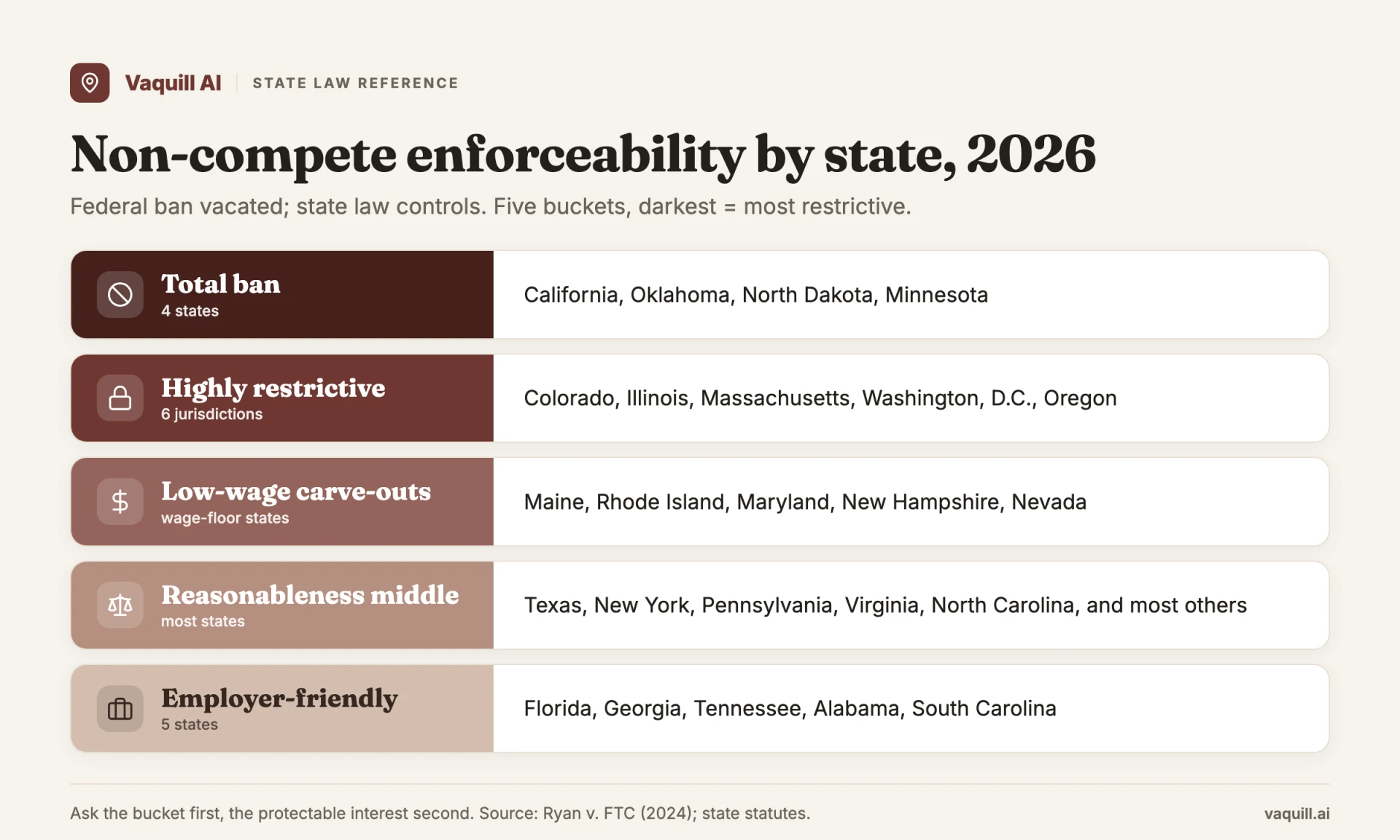
Every state sorts into one of five enforceability buckets; darkest is most restrictive.
Yes, non-competes are enforceable in Massachusetts, but only if they clear every requirement in the Massachusetts Noncompetition Agreement Act, Mass. Gen. Laws ch. 149 § 24L, for agreements signed on or after October 1, 2018. The Act caps most non-competes at 12 months, requires 10 business days of advance notice plus the right to consult counsel, and demands either a garden leave payment (a default of 50% of the employee's highest base salary during the restricted period) or other consideration named in the agreement. It also bars non-competes outright against several groups: hourly (FLSA non-exempt) workers, student interns, anyone 18 or younger, and employees laid off or fired without cause.
So a Massachusetts non-compete is real and enforceable when drafted to the statute, and dead on arrival when it is not. The rest of this guide walks each requirement, the consideration fight that decides most cases, the categories of people who cannot be bound, and the 2025-2026 developments that changed how the courts read § 24L.
The Tuesday morning call
A GC at a Boston biotech called us last fall. A senior research lead had given notice and was walking to a competitor. The non-compete was eighteen months old, signed at hire. The GC wanted to know in twenty minutes whether to send a cease-and-desist or eat the loss.
We told her to eat the loss. The agreement said consideration was "continued employment and access to confidential information," which is the most common drafting failure under the Massachusetts Noncompetition Agreement Act and the one Suffolk Superior judges have killed for five years.
The Massachusetts non-compete is not the cheap clause it still is in Florida or Texas. It is a budget item with eight gates, and the most expensive way to learn that is in a preliminary injunction hearing your company is going to lose.
The position this post defends: for most non-C-suite hires in Massachusetts in 2026, a tight non-solicit paired with a forfeiture-of-equity clause does more work at less cost than a true non-compete, and the SJC's reasoning in Miele v. Foundation Medicine, Inc. (Mass. 2025) makes that approach appellate-blessed.
True non-competes belong with the cohort where the company would happily write a six-figure garden leave check.
TL;DR
- The statute is mature law. Mass. Gen. Laws ch. 149 § 24L took effect October 1, 2018 and imposes eight mandatory requirements: writing, notice, garden leave or other consideration, 12-month cap, reasonable geography, reasonable activity scope, public policy, and severability.
- Garden leave is the safe path; the consideration rules are still contested. The statutory default is 50% of highest annualized base salary across the restricted period. The Act also allows "other mutually-agreed upon consideration" named in the agreement, and the federal courts have split on how thin that other consideration can be (NuVasive, Inc. v. Day, D. Mass. 2019, read it broadly; later decisions and most practitioners treat bare "continued employment" as a loser). Name a real number (sign-on bonus, equity, lump-sum cash) and you sidestep the fight.
- Five categories of employees are statutorily excluded: FLSA non-exempt, undergrad/grad interns, short-term student workers, anyone 18 or younger, and employees terminated without cause or laid off.
- Recent appellate authority is sharpening the edges. Automile Holdings, LLC v. McGovern, 483 Mass. 797 (2020) governs reformation and sale-of-business anti-raiding covenants. The SJC's 2025 decision in Miele v. Foundation Medicine, Inc. confirms § 24L does not reach non-solicits, even when paired with a forfeiture clause.
- Choice-of-law clauses are not an escape hatch. A Massachusetts resident or employee for 30 days before separation cannot be contracted out of § 24L. The DraftKings, Inc. v. Hermalyn litigation in the District of Massachusetts reinforces this for Boston-headquartered multi-state employers.
Under the Massachusetts Noncompetition Agreement Act, what is the statutory default garden leave payment?
Part of our non-compete enforceability by state map.
The statutory framework
§ 24L applies to "employee noncompetition agreements" entered into on or after October 1, 2018. Pre-October 2018 agreements live or die under the older common-law reasonableness test.
Several common covenants sit outside § 24L by express text: non-solicits, NDAs, sale-of-business covenants when the seller is a significant equity holder, forfeiture-for-competition agreements, and separation covenants if the employee gets seven business days to rescind.
The cheapest way to lose a § 24L fight is to draft a non-compete when what you actually wanted was a non-solicit, a forfeiture clause, or a separation covenant. Whether you are inside the statute is the first question; the protectable interest is the second.
The eight mandatory requirements
A post-October 2018 employee non-compete must clear every gate in § 24L(b). Miss one and the agreement is not enforceable. No partial credit.
1. In writing and signed by both parties. Electronic signatures count. An unsigned employer signature line has been raised as a defense more than once.
2. Notice: 10 business days before start or signing. For a new hire, by the earlier of a formal offer or 10 business days before commencement. For an existing employee, 10 business days before effective date. The agreement must also state the employee's right to consult counsel before signing.
Most enforceability failures here are an offer letter sent Friday for a Monday start with the non-compete attached. Void on day one.
3. Garden leave or other mutually-agreed upon consideration. The most-litigated subsection. § 24L(b)(vii) requires "a garden leave clause or other mutually-agreed upon consideration between the employer and the employee, provided that such consideration is specified in the noncompetition agreement."
Garden leave default: at least 50% of highest annualized base salary in the trailing two years, paid pro-rata. Alternative: "other mutually-agreed upon consideration," named in the agreement.
The federal courts have not fully settled how much the "other consideration" alternative lets employers skip the garden leave payment. NuVasive, Inc. v. Day (D. Mass. 2019) read it broadly and accepted general consideration language. Later decisions and most practitioner commentary treat bare "continued employment" as inadequate, and Cynosure (D. Mass. 2022) upheld a non-compete backed by named stock options. Working practice: write the dollars or units in the document so you never have to litigate which way a judge reads § 24L.
4. Reasonable in duration: 12 months default, 24 maximum. 12 months from cessation is the ceiling, extended to 24 only on a documented basis in fiduciary breach or unlawful property taking. A 24-month term without that basis signals overreach.
5. Reasonable in geographic scope. The safe harbor is the geography in which the employee provided services or had material presence or influence in the trailing two years. Mirror the safe harbor language directly.
6. Reasonable in scope of proscribed activity. Limited to the specific services the employee actually performed in the trailing two years. "Any business competitive with employer" is overbroad on its face.
7. Consonant with public policy. Physician non-competes are barred by M.G.L. c. 112 § 12X, nurses by c. 112 § 74D, broadcasters by c. 149 § 186. Outside those categorical bars, public policy fights bleed into prongs 5 and 6.
8. Severable, with reformation available. An unenforceable provision should not void the whole document. The court can reform, but the moving party must propose a specific narrower term. Automile, below.
The excluded employees
§ 24L(c) puts these categories outside any post-employment non-compete:
- Employees classified as non-exempt under the FLSA.
- Undergraduate or graduate students in an internship or short-term employment while enrolled in an educational institution.
- Employees who have been terminated without cause or laid off.
- Employees 18 years of age or younger.
"Terminated without cause" is the carve-out in-house counsel keep tripping over. The statute does not define cause. Define it inside the agreement using a tight list: material breach of a written policy, felony conviction, gross misconduct, willful failure to perform after notice. A definitional vacuum gets resolved for the employee at the injunction stage.
The non-exempt carve-out is broader than employers expect. A non-compete against a worker whom plaintiff's counsel can re-classify in a wage audit is doubly exposed: covenant void, wage claim treble.
Recent appellate authority
The case law has caught up with the statute. A small cluster of decisions now does most of the work.
Automile Holdings, LLC v. McGovern, 483 Mass. 797 (2020). The SJC's first major post-MNAA decision addressed reformation and anti-raiding covenants tied to the sale of a minority equity stake.
The SJC upheld the anti-raiding covenant on the merits but reined in judicial reformation: the moving party must propose a specific narrower term, and the employer cannot hand the bench a broad covenant and ask it to draw the line. The opinion also confirmed sale-of-business covenants get the lenient sale-of-business reasonableness test and sit outside § 24L.
Miele v. Foundation Medicine, Inc. (Mass. 2025). The SJC held § 24L does not reach a non-solicit, even when paired with a forfeiture-of-severance clause in a separation or transition agreement.
If the protectable interest is customer or employee relationships rather than competitive activity, a tight non-solicit with a forfeiture-of-severance backstop avoids § 24L entirely and is now appellate-blessed.
The consideration line of cases (D. Mass.). The federal decisions do not all read § 24L the same way. NuVasive, Inc. v. Day (D. Mass. 2019) accepted broad consideration language and declined to require the 50% garden leave payment. Most later decisions and practitioner commentary push the other way and treat bare "continued employment" as too thin to count. The safe read is the conservative one: if your form still says "in consideration of continued employment," assume it is broken.
Cynosure, LLC v. Reveal Lasers LLC (D. Mass. 2022). Stock options, named in the agreement, were accepted as "other consideration." Sign-on bonuses, retention bonuses, RSUs, and lump-sum cash payments have all been treated as adequate where named in the document.
Misiaszek v. Korn Ferry (D. Mass. 2024). On garden leave structure, a clause that conditions payment on the employer continuing to pay can still work, so long as the employer cannot walk away from the obligation except on the employee's breach. The point: if you choose garden leave, the payment has to be a real, non-illusory promise for the full restricted period.
DraftKings, Inc. v. Hermalyn (D. Mass. / 1st Cir. 2024). A Boston-headquartered employer enforced a Massachusetts choice-of-law clause against a former executive who relocated to California to join a competitor; the First Circuit affirmed, applying Massachusetts law and holding California's interest in its non-compete ban was not materially greater. The case (1st Cir. No. 24-1443, decided September 26, 2024) is the lead recent authority for Boston tech and life-sciences companies losing talent to the Bay Area.
Anaplan Parent LP v. Brennan (Mass. Super. 2025). A new wrinkle that surfaced in late 2025: a Superior Court read "employer" under § 24L narrowly and refused to enforce a non-compete signed only by the parent company rather than the employee's actual employing entity. The fix is mechanical but easy to miss: the entity that signs the employee's paycheck has to be a party and signatory to the covenant.
How the BLS actually treats overbroad covenants
A pattern shows up across Business Litigation Session orders since 2021. Judges are not friendly to drafters who overreach and ask the bench to clean up. Automile gave them the grounds: the moving party has to propose a specific narrower term, not delegate line-drawing.
A two-year nationwide covenant against a regional sales engineer, garden leave bolted on as an afterthought, is not getting reformed into a 12-month New England covenant on the fly. The injunction is denied; the parties settle.
Bad-faith overbreadth gets priced. A form copied from a Texas affiliate gives the court no incentive to do the drafter's work. An agreement engineered for the role (services tied to the trailing two years, geography tracking the safe harbor, consideration named in dollars) gets a different reception.
The form is the case.
The 50% garden leave rule in practice
Garden leave is what distinguishes Massachusetts from every other reasonableness-test state. It is also the feature in-house counsel most often misunderstand.
The floor: 50% of the highest annualized base salary in the trailing two years, paid pro-rata during the restricted period. If the restricted period is 12 months and the highest base in the lookback is $300,000, the bill is $150,000 across 12 monthly payroll cycles.
The figure excludes bonuses, commissions, RSU vesting, 401(k) match, and benefits. The statutory base is "base salary," read strictly.
Garden leave payments are also wages, so failure to pay exposes the employer to M.G.L. c. 149 §§ 148, 150: treble damages and fee-shifting.
How serious firms structure consideration in 2026:
- Sign-on bonus, named. $25,000 to $100,000 lump sum within 30 days of hire, clawback if the employee resigns inside a defined period. Defensible under KPM and Cynosure.
- Equity grant tied to the covenant. RSUs or options vesting through the restricted period, forfeiture on breach. The Cynosure structure.
- Retention bonus midstream. For agreements signed after hire, a stated dollar amount on signing, expressly identified as the § 24L(b)(viii) "fair and reasonable consideration."
- Full garden leave for the senior cohort. Pure 50%-of-base for the C-suite or departures where the company wants the person on the bench rather than at the competitor.
The trap is the hybrid: "garden leave at the company's election, or otherwise other adequate consideration." Not a garden leave clause (the obligation is contingent) and the "other consideration" is unnamed. Pick a lane, write the number, sign the page.
A concrete contrast. The broken recital, which appears in roughly half the agreements I am asked to look at: "Employee acknowledges that this Agreement is supported by adequate consideration, including continued employment and access to confidential information." That sentence loses the injunction.
The fix, which costs $25,000 and a paragraph: "As consideration for the covenants in Section 4, Employer shall pay Employee a one-time sign-on bonus of $25,000, payable within thirty (30) days of the Effective Date. Employee acknowledges this payment is mutually-agreed upon consideration specified in this Agreement under M.G.L. c. 149 § 24L(b)(vii)." Same paper. Different outcome.
Drafting checklist
Run a post-October 2018 non-compete through these checks before shipping. Any "no" or "uncertain" means the document stays on your desk.
- Both parties signed, with a documented date.
- Notice provided by the earlier of a formal offer or 10 business days before start (new hire), or 10 business days before effective date (existing employee), with the right-to-counsel statement on the face.
- Consideration: garden leave at 50% of base, or a specified sign-on bonus, equity grant, retention bonus, or cash payment, with amount and timing in the agreement itself.
- Duration: 12 months or less from cessation. Longer needs a documented basis in fiduciary breach or unlawful property taking; never above 24 months.
- Geography: tracks the safe harbor (where the employee provided services or had material presence or influence in the trailing two years).
- Activity scope: limited to the specific services the employee actually performed in the trailing two years.
- Excluded employees: confirm the employee is not FLSA non-exempt, a student intern, under 18, or already terminated without cause.
- Severability and reformation: the agreement is severable, reformation language tracks Automile.
For healthcare professionals, broadcasters, or other carve-out categories, check the occupational statute. § 24L compliance does not override those categorical bans.
Multi-state employer notes
§ 24L(e) voids any choice-of-law provision whose effect is to avoid § 24L's requirements, when the employee is, and has been for at least 30 days before cessation, a resident of or employed in Massachusetts. A Boston engineer who relocates to Texas the week of resignation is still inside § 24L. The flip side runs through the choice-of-law clause analysis: a Massachusetts employer can often hold an employee who moves to a non-compete-hostile state to Massachusetts law.
The mirror case is DraftKings v. Hermalyn: a Massachusetts-headquartered employer enforcing a Massachusetts choice-of-law clause against a former employee who relocated to California. The court applied Massachusetts law because California did not have a materially greater interest, even though California voids almost all non-competes under Section 16600.
The practical advice for Boston employers losing talent to the Bay Area: draft the Massachusetts choice-of-law and choice-of-forum clauses tight, file in the District of Massachusetts, and rely on the home-court interest analysis.
A composite document a sophisticated multi-state employer ships in 2026 has three layers: a § 24L-compliant non-compete (for Massachusetts-jurisdictional employees), a non-solicit (outside the Act after Miele), and a forfeiture-of-equity or forfeiture-of-severance clause tied to both. The combination is more durable than any single covenant. Employers covering the Northeast should pair this with the New York non-compete rules, which run on a different reasonableness standard.
FAQ
Are non-competes enforceable in Massachusetts? Yes, but only when they satisfy the Massachusetts Noncompetition Agreement Act, Mass. Gen. Laws ch. 149 § 24L, for agreements signed on or after October 1, 2018. The agreement has to be in writing and signed by both parties, give the required advance notice, run no longer than 12 months, stay reasonable in geography and activity, and be backed by garden leave or other named consideration. Miss any one requirement and a court will refuse to enforce it.
What is the Massachusetts Noncompetition Agreement Act? It is the 2018 statute (§ 24L) that sets the rules for employee non-competes in Massachusetts. It replaced the older judge-made reasonableness standard for agreements signed on or after October 1, 2018, with a list of mandatory requirements. Pre-October 2018 agreements are still judged under common law.
What is the 50% garden leave rule? If an employer uses a garden leave clause to support a non-compete, the statutory default is to pay the former employee at least 50% of their highest annualized base salary over the prior two years, spread across the restricted period. So a 12-month restriction on someone whose top base was $300,000 costs about $150,000. Employers can instead use "other mutually-agreed upon consideration" named in the agreement, such as a sign-on bonus or equity grant.
How long can a non-compete last in Massachusetts? The default ceiling is 12 months from the end of employment. It can stretch to 24 months only where the employee breached a fiduciary duty or unlawfully took company property, and only with that basis documented. A flat 24-month term with no such justification reads as overreach.
Who cannot be bound by a non-compete in Massachusetts? The Act bars non-competes against employees classified as non-exempt under the FLSA (most hourly workers), undergraduate and graduate students in internships or short-term roles, anyone 18 years old or younger, and any employee terminated without cause or laid off. Several professions are barred separately by occupation-specific statutes: physicians (M.G.L. c. 112 § 12X), nurses (c. 112 § 74D), and broadcasters (c. 149 § 186), among others.
Does an employee have to be given advance notice? Yes. For a new hire, the employer must provide the agreement by the earlier of a formal offer or 10 business days before the start date. For an existing employee, it is 10 business days before the agreement takes effect. The agreement must also state that the employee has the right to consult a lawyer before signing.
Is "continued employment" enough consideration for a Massachusetts non-compete? It is risky. The Act requires garden leave or "other mutually-agreed upon consideration" specified in the agreement. The federal courts have split (NuVasive, Inc. v. Day (D. Mass. 2019) accepted broad language; later decisions push the other way), so the safe practice is to name a specific payment like a sign-on bonus, retention bonus, or equity grant in the document itself.
Can a Massachusetts employer use a choice-of-law clause to dodge § 24L? No, not against a covered employee. The Act voids any choice-of-law provision designed to avoid § 24L when the worker has been a Massachusetts resident or employed in Massachusetts for at least 30 days before separation. Massachusetts employers can, though, often hold a departing employee to Massachusetts law even after a move out of state (DraftKings v. Hermalyn, 1st Cir. 2024).
The position, plainly
The right question for in-house counsel is not "is the non-compete enforceable." It is "do we actually need a non-compete for this hire, or does a tight non-solicit plus a forfeiture-of-equity clause get us 90% of the protection at 10% of the cost."
Below the C-suite, the second answer is usually correct, and Miele now blesses it explicitly. Reserve true non-competes for the cohort where you would write the 50% garden leave check without flinching.
For the rest, draft the non-solicit and the forfeiture clause, and keep the non-compete in the drawer.
Once the gates are clear, the work is repeatable drafting: the same § 24L-compliant non-compete, non-solicit, and forfeiture layers, with the consideration written in dollars each time. Vaquill AI handles that drafting and lets you encode the named positions as a reusable playbook so the next agreement starts from the compliant form instead of a Texas copy. You can draft from a playbook or start a 7-day trial.
New legal AI guides, weekly.
Further Reading
California Non-Compete Section 16600 in 2026: The Strictest Ban in the US
Read postColorado Non-Compete Law in 2026: HB 22-1317 and the Highly Compensated Threshold
Read postFlorida Non-Compete Enforceability in 2026: The CHOICE Act + Section 542.335
Read postGeorgia Restrictive Covenants Act in 2026: Drafting Non-Competes That Survive
Read postIllinois Freedom to Work Act in 2026: Non-Compete Rules, Income Thresholds, and Drafting
Read postNew York Non-Compete Law in 2026: Enforceability, BDR Rule, and Drafting
Read post
Co-Founder & CEO · Attorney
Arshita leads product and strategy at Vaquill, building the legal AI suite that solo, small-firm, and in-house US lawyers use to run a matter end to end.