Short answer: yes, non-competes are enforceable in Georgia, but only for five categories of "covered employee" under O.C.G.A. § 13-8-53(a), only for a reasonable time (two years or less is presumed reasonable under § 13-8-57), and only with a tightly defined activity and geographic scope. The Georgia Restrictive Covenants Act, O.C.G.A. § 13-8-50 et seq. (effective May 11, 2011), lets courts modify overbroad covenants under § 13-8-53(d), but two 2024-2025 appellate rulings (Wimmer and Herzig) changed how that plays out.
An Atlanta SaaS company's GC called the week before sales kickoff. Three regional AEs had jumped to a competitor on a covenant that read twenty-four months, "any business competitive with the Company anywhere in the United States," "any capacity," with no recital that the salespeople qualified under any of the five § 13-8-53(a) covered-employee categories.
The duration was defensible; twenty-four months sits at the top end of the § 13-8-57 rebuttable presumption of reasonableness for employee covenants. The "any capacity" activity scope and the missing covered-employee recital were the problems. The covenant got reformed down to a customer non-solicit at the next hearing. The other AE walked.
One stance carries through the rest of this post: after All States AG Parts, LLC v. Herzig (Ga. Ct. App. Feb. 2025), the "blue-pencil me later" fallback that Georgia plaintiffs used to lean on at TRO is weaker than it looks. The Court of Appeals affirmed a trial court that refused to fix an "in any capacity" non-compete because the edit it required was a rewrite, not a trim.
Two failure modes track through the rest of this post, the missing covered-employee recital and the loose activity scope, because those are the lines defense-side briefs will run at and the lines trial courts now have appellate cover to refuse to rewrite.
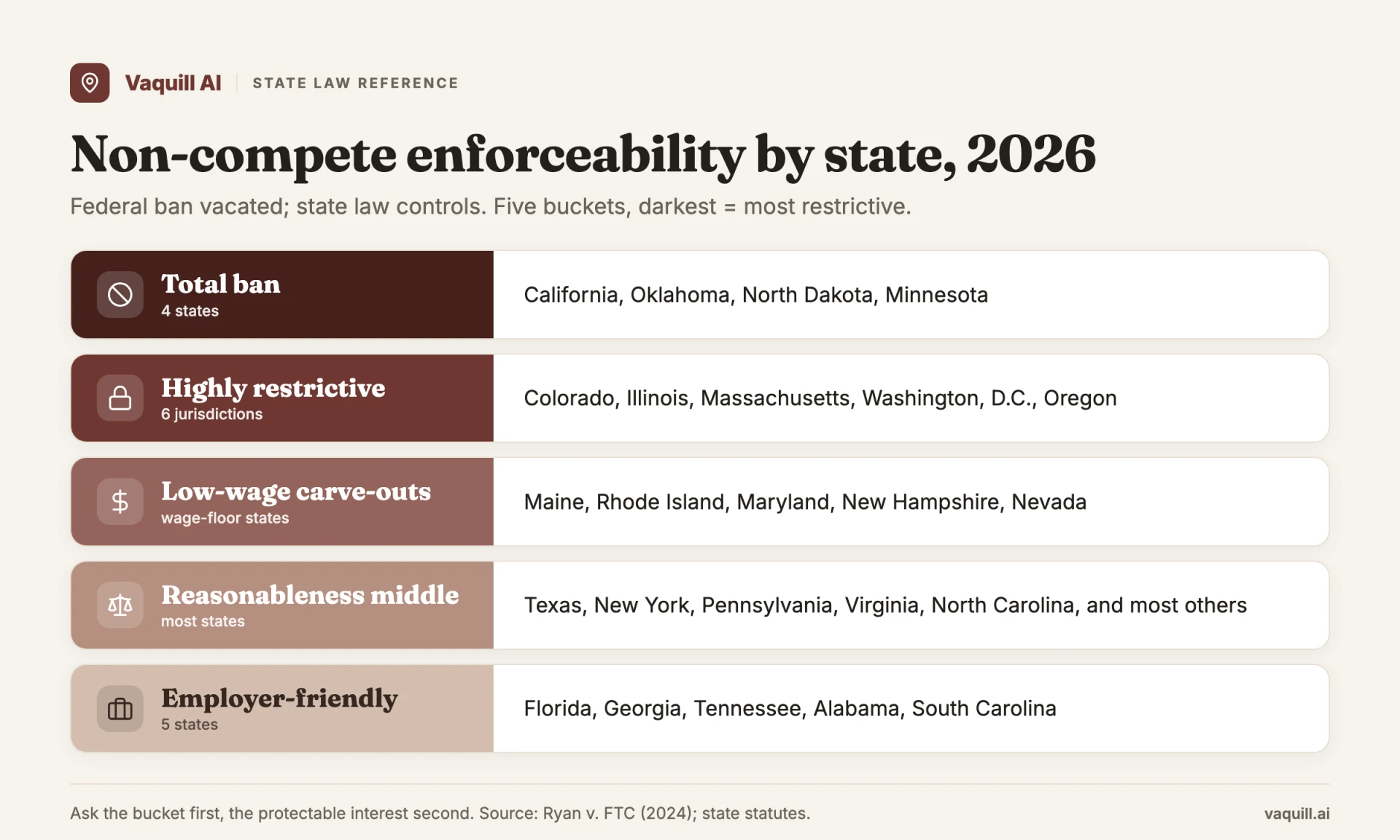
Every state sorts into one of five enforceability buckets; darkest is most restrictive.
TL;DR
- The Georgia Restrictive Covenants Act, O.C.G.A. § 13-8-50 through § 13-8-59, applies to agreements entered into on or after May 11, 2011. It replaced a strict-scrutiny common-law regime in which courts voided rather than modified overbroad covenants.
- Five "covered employee" categories in § 13-8-53(a) gate the non-compete (not the non-solicit): executives, key employees, research and development personnel, customer-facing sales with material customer contact, and personnel with confidential-information access. Get the category wrong in the recital and the non-compete fails on the threshold.
- Duration presumptions in § 13-8-57: up to two years is presumed reasonable for an employee covenant, more than two and up to five for a sale-of-business covenant, with longer terms presumed unreasonable.
- Blue-pencil authority in § 13-8-53(d) is the most pro-employer feature in the statute. Georgia courts "may modify" overbroad covenants. They are not required to, and the Court of Appeals in All States AG Parts, LLC v. Herzig (2025) reaffirmed that an "in any capacity" non-compete is too vague to fix with the blue pencil.
- The Georgia Supreme Court in North American Senior Benefits, LLC v. Wimmer, No. S23G1146 (Ga. Sept. 4, 2024), held that an employee non-recruitment covenant (the non-solicitation of fellow employees) does not require an express geographic term, reversing the Court of Appeals. Geographic reasonableness still applies; it just does not have to be stated. The same logic helps customer non-solicits, but the case itself involved a non-recruitment clause.
Under O.C.G.A. Section 13-8-57, how long can a Georgia employee non-compete run and still be presumed reasonable?
Part of our all-50-states legal reference series.
The statutory framework: §§ 13-8-50 to 13-8-59
The Act sits in Article 4 of Chapter 8 of Title 13, enacted after a 2010 constitutional amendment authorizing the legislature to displace common law on restrictive covenants. Effective May 11, 2011.
Anything signed before that date still runs on the old common-law strict-scrutiny regime with no reformation.
Four sections do the work: § 13-8-51 (definitions, including the operative meanings of "key employee," "material contact," and "confidential information"), § 13-8-53 (subsection (a), the five covered-employee categories for the non-compete; (b), the customer non-solicit; (d), the discretionary blue-pencil power), § 13-8-56 (construction rules, including subsection (3): "the scope of competition restricted is measured by the business of the employer"), and § 13-8-57 (duration presumptions, two years for employee non-competes, five for sale-of-business).
The five categories of "covered employee" under § 13-8-53(a)
Section 13-8-53(a) is the gate. A post-employment non-compete is enforceable only when the employee falls into one of five categories. Get this wrong in the recital and the rest of the covenant is irrelevant.
Executives. Defined functionally. Employees who "customarily and regularly direct the work of two or more other employees" with authority to hire or fire (or recommend it). A VP of Sales running a six-person team is in. A "VP" individual contributor with a title bump is not.
Key employees. § 13-8-51(8). The employee, through the employer's investment of time, training, money, or trust, has gained high notoriety or influence with the employer's customers, vendors, or business relationships.
The broadest category, and the one drafters reach for when the employee does not cleanly fit elsewhere. Recite the specific training, customer relationships, or trust.
Research and development personnel. Professionals in research, development, or engineering. Narrower than it reads. A PM attending standups is not R&D. An engineer writing patentable code is.
Personnel in possession of "selective" or "specialized" information. § 13-8-51(13). Where most sales reps and account managers actually live.
Material-contact customer-facing personnel. § 13-8-53(b) governs customer non-solicitation, separate from non-compete authority, and turns on "material contact" with customers within the last twenty-four months.
A Georgia non-compete that does not allege which category the employee falls into, with supporting facts, is one fact dispute away from a threshold loss.
The statutory presumptions under § 13-8-57
Employee non-competes: two years or less is presumed reasonable, more than two is presumed unreasonable. Sale-of-business covenants: five years or less is presumed reasonable. Franchise covenants tied to the franchise relationship get no presumption; duration runs with the franchise term.
The presumptions are rebuttable but rarely rebutted. A drafter who writes a thirty-month employee non-compete because "the customer cycle is longer" surrenders the presumption and inherits the burden at the injunction hearing.
Georgia default: twenty-four months for executives and key employees, twelve to eighteen for everyone else, longer only in sale-of-business covenants where the seller is paid for the restraint.
The contrast with Texas matters. Texas blue-pencils overbroad durations down and bars pre-reformation damages. Georgia blue-pencils too, but whether the court uses the blue pencil at all is discretionary.
Running past two years in Georgia is asking a court to exercise discretion you may not get.
Blue-pencil authority under § 13-8-53(d)
The statute reads that if a covenant is "unreasonable in time, geographic area, or scope of prohibited activities," the court "may modify the restraint provision and grant only the relief reasonably necessary."
"May modify." Discretionary, not mandatory. Compare Texas § 15.51(c) ("shall reform"). Georgia gives the trial court a power it can decline to exercise. Georgia courts have long described the limit this way: the blue pencil "marks, but it does not write." A court can strike offending words; it cannot supply new material terms the parties left out.
All States AG Parts, LLC v. Herzig (Ga. Ct. App. Feb. 2025) is the recent application. The trial court declined to blue-pencil a non-compete that prohibited the former employee from associating with a competitor "in any capacity," and the Court of Appeals affirmed.
Striking "in any capacity" alone would have left the covenant prohibiting the employee from "engaging in a business" similar to the former employer's, with no specified restricted activities. No abuse of discretion in refusing to rewrite.
After Herzig, trial courts have appellate cover to refuse to rewrite a covenant that needs more than a trim.
This shows up at the TRO stage. Fulton County and Gwinnett benches now expect plaintiff's counsel to flag the specific blue-pencil edit they want, not a generic "the Court may reform as necessary." A motion that fails to identify the line item to be trimmed reads as a request to rewrite.
The defense brief: cite Herzig, point at the activity-scope clause, ask the court to deny the TRO rather than reform it.
A concrete redline of an "any capacity" clause makes the point: change "Employee shall not, directly or indirectly, associate with any Competing Business in any capacity for a period of twenty-four (24) months" to "Employee shall not, for twelve (12) months following termination, perform sales, account management, or customer relationship services for any Competing Business, where 'Competing Business' means a person or entity offering [specific product line] to [specific customer segment], in the counties listed on Schedule A (the counties in which Employee performed services in the final twenty-four (24) months of employment)." The first version invites a Herzig refusal. The second invites enforcement.
Industry-specific notes
Healthcare. Unlike Texas (which rewrote its physician carve-out in SB 1318 in 2025), Georgia has no separate carve-out for physicians or other licensed health-care practitioners; physician covenants run on the general § 13-8-50 framework.
Drafting heuristic: a defined radius from each practice location reads better than a "metro Atlanta" geography, and specialty-specific activity scope outperforms a generic "practice of medicine" formulation. A buyout option is the standard hedge.
Technology and the Atlanta corridor. Tech Square, Cumberland, and Alpharetta produce most of the contested tech-sector covenants. Recurring fact pattern: a software engineer or PM leaves on a covenant naming "the software industry" as the restricted activity.
The § 13-8-51(13) selective-or-specialized-information category is usually a cleaner fit than executive or key-employee, but only if the recital specifies what the information was: the code, the architecture, the roadmap, the customer feedback corpus.
Sales. The volume category. Recurring losing pattern: a multi-state employer rolls out the same national template for Georgia-resident reps, twenty-four months, "any competing business," "any capacity." After Wimmer, the missing geography in the employee non-solicit is no longer fatal. After Herzig, the activity scope still is. Peg activity to the products and customer segments the rep actually worked.
Recent appellate authority: what changed in drafting
Three lines of authority reshaped Georgia drafting in 2025 and 2026.
North American Senior Benefits, LLC v. Wimmer, No. S23G1146 (Ga. Sept. 4, 2024) changed the front end. The covenant at issue was an employee non-recruitment clause (barring solicitation of the employer's own staff). The Supreme Court reversed the Court of Appeals and held that a restrictive covenant does not need an express geographic term to be enforceable; reasonableness is judged on the totality of the circumstances. (Source: Littler analysis, Sept. 2024.)
The reasoning is not limited to non-recruitment. The same totality-of-circumstances standard applies to customer non-solicits and non-competes, so covenants that defense counsel had been attacking on missing-geography grounds stopped losing on that ground alone. Drafting move post-Wimmer: lean harder on the non-solicit instead of forcing borderline employees into the § 13-8-53(a) non-compete.
All States AG Parts, LLC v. Herzig (Ga. Ct. App. Feb. 2025) changed the back end. The Court of Appeals affirmed a refusal to blue-pencil an "in any capacity" non-compete. The trial court's line, that fixing the covenant would require "a much bigger pencil than the legislature envisioned the court's having," is now the quote every plaintiff plans around. (Source: FordHarrison; opinion on FindLaw, All States Ag Parts LLC v. Herzig, Ga. Ct. App. 2025.)
Drafting move post-Herzig: write activity scope tight enough that a trial court does not have to rewrite anything.
The "janitor rule" line predates the 2011 Act. Decisions interpreting § 13-8-56(3) consistently hold that even though scope is measured by the employer's business, a covenant that effectively bars the former employee from any role at a competitor is overbroad. Herzig is the current application.
Read together, Wimmer and Herzig are a litigation choice. Plaintiff's counsel facing a borderline-covered employee should think twice about leading with the § 13-8-53(a) non-compete and consider leading with the § 13-8-53(b) customer non-solicit.
Post-Wimmer, the non-solicit does not die on a missing geographic term. Post-Herzig, the non-compete is harder to rescue with a blue pencil. The cleanest preliminary-injunction record now often starts at the non-solicit and adds the non-compete only when the covered-employee fact pattern is strong.
Drafting checklist for the § 13-8-53 covenant
Six items.
1. Recite the covered-employee category and supporting facts. Name the § 13-8-53(a) basis (executive, key employee, R&D, selective/specialized information) or, for the non-solicit, the material-contact basis. Cite the team, the training, the customer book, the specific confidential information.
Without the recital, the threshold fight begins on a clean slate and the employer carries the burden.
2. Set duration at twenty-four months or under. Twelve to eighteen for operating roles. Eighteen to twenty-four for executives and key employees with multi-year cycles.
3. Define activity scope by product or service category, not by industry. "Sale of [product line] to [customer type]" survives. "The software industry" does not. After Herzig, scope vagueness loses on the merits and at the blue-pencil stage.
4. Tie geographic scope to actual work. Post-Wimmer, the customer non-solicit can survive without an express geographic term, but be ready to defend the implied geography. For a § 13-8-53(a) non-compete, state the counties, MSAs, or named markets where the employee actually worked, with a lookback period (typically the final twenty-four months).
5. Use the non-compete and the non-solicit together. A § 13-8-53(b) customer non-solicit requires only material contact, not covered-employee status, and survives reformation more reliably. Lean on the non-solicit when the employee is borderline on § 13-8-53(a).
6. Include a reformation clause invoking § 13-8-53(d). It does not compel discretion, but it removes the argument that reformation conflicts with party intent.
Multi-state employers: don't use the same template
The most common Georgia failure is a multi-state employer using a single national template for Georgia-resident employees. The Texas template (mandatory reformation, no covered-employee gate) misfires in Georgia. The Florida template under Fla. Stat. § 542.335 misfires too. For how the rules stack up across all 50 states, see our non-compete enforceability by state map.
Use a Georgia exhibit attached to the standard employment agreement: recite the § 13-8-53(a) category, anchor duration to § 13-8-57, peg geography to the employee's actual market, tie activity scope to the product line, include the reformation clause. Same scaffolding for Texas and Florida with different anchors. One template, three jurisdiction-specific schedules.
A worked example. An Atlanta logistics-software vendor signs a $185,000 regional sales lead covering Georgia, Alabama, and Tennessee, plus $30,000 RSUs. First-instinct draft: twenty-four months, "the United States," "any competing software business."
Tightened draft: eighteen months, Georgia plus the Alabama and Tennessee counties in the assigned territory, scope as "sale of transportation management software to mid-market shippers," customer non-solicit limited to material-contact accounts in the last twenty-four months.
The tightened version survives a Fulton State Court TRO. The first draft hits Herzig at the activity-scope level and may not get blue-penciled.
FAQ
Are non-competes enforceable in Georgia? Yes. Since the Georgia Restrictive Covenants Act took effect on May 11, 2011, employee non-competes are enforceable when the employee fits one of five "covered employee" categories in O.C.G.A. § 13-8-53(a), the duration is reasonable (two years or less is presumed reasonable under § 13-8-57), and the activity and geographic scope are tied to the work the employee actually did. Covenants signed before May 11, 2011 still run on the old common-law rule, where a court voids an overbroad covenant instead of fixing it.
How long can a non-compete last in Georgia? For employees, two years or less is rebuttably presumed reasonable under § 13-8-57; more than two years is presumed unreasonable. For someone who sold a business, up to five years is presumed reasonable, because the seller was paid for the restraint. In practice most enforceable employee covenants run twelve to twenty-four months.
What is the Georgia Restrictive Covenants Act? It is O.C.G.A. § 13-8-50 through § 13-8-59, the statute Georgia adopted after a 2010 constitutional amendment let the legislature change the common law on restrictive covenants. It defines who can be bound, sets duration presumptions, and gives courts discretion to modify (blue-pencil) an overbroad covenant under § 13-8-53(d) rather than throw it out.
Who counts as a "covered employee" under § 13-8-53(a)? Five categories: executives who customarily direct two or more employees with hire-or-fire authority; key employees who gained notoriety or influence through the employer's investment; research, development, or engineering personnel; employees with selective or specialized information; and sales or customer-facing staff with material contact. A non-compete that does not allege which category applies, with supporting facts, is exposed on a threshold challenge.
Can a Georgia court rewrite (blue-pencil) an overbroad non-compete? It may, but it does not have to. Section 13-8-53(d) says a court "may modify" an unreasonable covenant. The power is discretionary, and the blue pencil "marks, but it does not write," so a court can strike offending words but cannot add missing material terms. In All States AG Parts, LLC v. Herzig (Ga. Ct. App. Feb. 2025), the Court of Appeals affirmed a refusal to fix an "in any capacity" non-compete because the edit needed was a rewrite.
Do Georgia non-solicitation agreements need a geographic limit? No express territory is required. In North American Senior Benefits, LLC v. Wimmer, No. S23G1146 (Ga. Sept. 4, 2024), the Georgia Supreme Court held that a restrictive covenant does not need a stated geographic term to be enforceable; reasonableness is judged on the totality of the circumstances. The covenant in that case restricted recruiting the employer's own staff, and the same standard applies to customer non-solicits.
Does Georgia have a separate non-compete rule for physicians? No. Unlike Texas, which set physician-specific terms, Georgia has no carve-out for doctors or other licensed practitioners. Physician covenants run on the general § 13-8-50 framework, so a defined radius from each practice location and a specialty-specific activity scope hold up better than a broad "practice of medicine" restriction.
Did the FTC ban on non-competes change Georgia law? No. A federal court blocked the FTC's 2024 rule before it took effect (Ryan LLC v. FTC, N.D. Tex.), the FTC dropped its appeal in September 2025, and the rule was formally removed from the federal regulations in early 2026. The FTC has said it will pursue non-competes case by case instead. Georgia non-competes are still governed by the state statute and case law above, so confirm the current federal status before relying on any nationwide ban.
The § 13-8-53(a) covered-employee recital, the tight activity scope, and the non-compete-plus-non-solicit pairing are exactly the kind of structure worth encoding once as a playbook. Vaquill AI's drafting and playbook tools let you reuse that scaffolding across Georgia covenants instead of re-typing it each hire. You can draft your next covenant in Vaquill AI.
New legal AI guides, weekly.
Further Reading
California Non-Compete Section 16600 in 2026: The Strictest Ban in the US
Read postColorado Non-Compete Law in 2026: HB 22-1317 and the Highly Compensated Threshold
Read postFlorida Non-Compete Enforceability in 2026: The CHOICE Act + Section 542.335
Read postIllinois Freedom to Work Act in 2026: Non-Compete Rules, Income Thresholds, and Drafting
Read postMassachusetts Non-Compete Agreement Act: A 2026 Drafting Guide
Read postNew York Non-Compete Law in 2026: Enforceability, BDR Rule, and Drafting
Read post
Co-Founder & CEO · Attorney
Arshita leads product and strategy at Vaquill, building the legal AI suite that solo, small-firm, and in-house US lawyers use to run a matter end to end.