Are non-competes enforceable in Colorado? Mostly no. Under C.R.S. 8-2-113 as rewritten by HB 22-1317 (effective August 10, 2022), a non-compete is void unless it protects trade secrets, runs no broader than reasonably necessary, and the worker earns at least the "highly compensated" threshold, which is $130,014 for 2026. Customer non-solicits need 60 percent of that ($78,008.40). Healthcare covenants are void at any income after SB 25-083. Enforcing a void covenant exposes the employer to a $5,000-per-worker civil penalty and, in the intimidation scenario, a criminal charge.
A Denver SaaS company sent over its employee package last quarter. Same template for everyone: AEs at $95,000 OTE, senior engineers at $185,000, VP of sales at $260,000.
The non-compete was twelve months, "anywhere the Company does business," with a one-page acknowledgment buried in the offer letter. The package failed the diligence checklist in three independent ways before we reached the choice-of-law clause.
The position this post defends: Colorado is not a "ban" state, but the post-HB 22-1317 framework is hostile enough that any covenant written before August 10, 2022 should be presumed broken, any covenant written between 2022 and 2025 should be re-papered against the 2026 thresholds, and any healthcare covenant should be treated as void on entry.
Sophisticated employers still get Colorado wrong in two recurring ways: they assume a choice-of-law clause saves them, and they assume equity grants count toward the highly compensated threshold. Both assumptions are wrong, and both produce the kind of clean-record losses that pre-empt the entire enforcement posture.
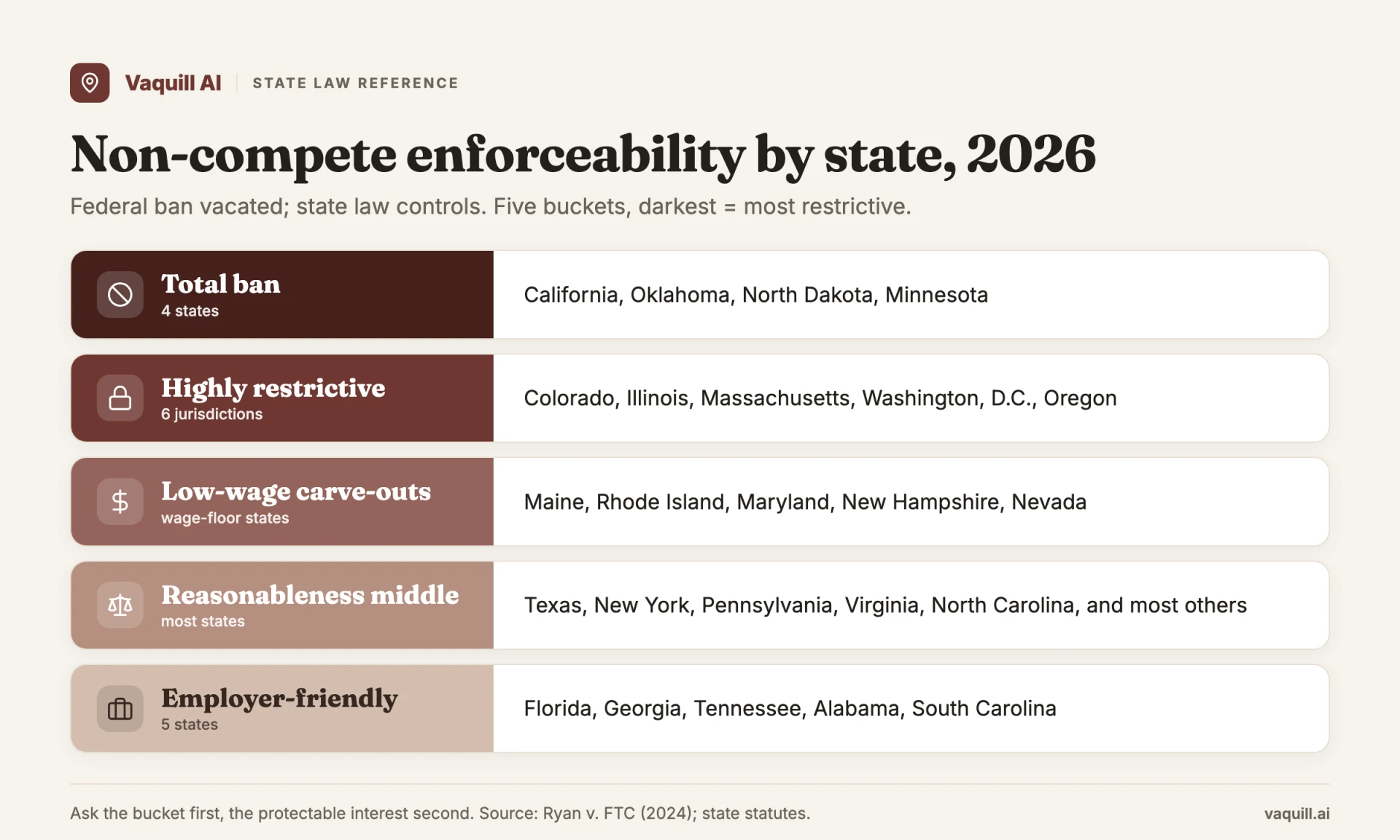
Every state sorts into one of five enforceability buckets; darkest is most restrictive.
TL;DR
- HB 22-1317, effective August 10, 2022, rewrote C.R.S. § 8-2-113 to make most non-competes void unless the covenant protects trade secrets AND the employee earns above the "highly compensated worker" threshold. The 2026 number is $130,014 in annualized cash compensation, set by the Colorado Department of Labor and Employment in its annual PAY CALC Order.
- Customer non-solicitation covenants ride on a lower threshold of 60 percent of the highly compensated number, which is $78,008.40 for 2026.
- Section 8-2-113(1) makes it a Class 2 misdemeanor (up to 120 days, $750) to use force, threats, or intimidation to prevent someone from working. Presenting an unlawful covenant as a condition of employment can be charged on that hook.
- Subsection (8) adds a civil penalty of $5,000 per worker (or prospective worker) harmed by an unlawful covenant, on top of actual damages, attorney fees, and injunctive relief.
- The statute requires separate written notice before signing (or 14 days before the effective date for current employees), with the covenant identified by its terms.
- SB 25-083, effective August 6, 2025, voided non-competes and customer non-solicits for physicians, advanced practice registered nurses, certified midwives, and dentists regardless of income.
- The choice-of-law and venue piece (§ 8-2-113(8)) blocks out-of-state employers from contracting around any of this for Colorado-resident workers.
What is the 2026 Colorado highly compensated threshold a non-compete must clear under HB 22-1317?
Part of our all-50-states legal reference series.
The statutory framework: C.R.S. § 8-2-113
Section 8-2-113 is titled "Unlawful to intimidate worker, agreement not to compete," and the title is the first signal that this is not a neutral reasonableness statute.
§ 8-2-113(1) makes it unlawful "to use force, threats, or other means of intimidation to prevent any person from engaging in any lawful occupation." SB 21-271 attached a Class 2 misdemeanor penalty.
§ 8-2-113(2) voids any covenant restricting trade, business, profession, or occupation, with four exceptions: sale of a business, executive and management personnel (reworked into the highly compensated framework), trade-secret protection, and recovery of training expenses for workers employed less than two years.
§ 8-2-113(3) is the trade-secret exception and the operative pillar for most employee covenants. The covenant must protect trade secrets, no broader than reasonably necessary, with the worker earning at least the highly compensated threshold both at signing and at enforcement.
Subsection (4) is the parallel customer non-solicit rule at 60 percent. Subsections (5) through (7) carry notice obligations and rules of construction. Subsection (8) voids any choice-of-law or venue clause that would deprive a Colorado-based worker of the statute's protections.
The HB 22-1317 requirements: five things that must all line up
HB 22-1317 collapsed the old reasonableness-plus-status framework into a compliance checklist. Miss any item and the covenant fails. Two items reset every January 1.
Trade-secret protection is the substantive hook. The covenant has to be "for the protection of trade secrets," and "no broader than reasonably necessary" to protect them. The statute borrows the trade-secret definition from C.R.S. § 7-74-102(4) (the Colorado Uniform Trade Secrets Act).
General fear of competition does not qualify. Customer goodwill, training investment, and "know-how that is not quite a trade secret" do not qualify under subsection (3); they used to support a broader "executive" exception that HB 22-1317 narrowed.
The highly compensated threshold for 2026 is $130,014. The Colorado Department of Labor and Employment publishes the annual number in its Publication and Yearly Calculation of Adjusted Labor Compensation Order (the "PAY CALC" Order, 7 CCR 1103-14). The number resets every January 1, so always check the covenant against the order in force for the relevant year:
| Year | Highly compensated (non-compete) | Customer non-solicit (60%) |
|---|---|---|
| 2022 (from Aug 10) | $101,250 | $60,750 |
| 2023 | $112,500 | $67,500 |
| 2024 | $123,750 | $74,250 |
| 2025 | $127,091 | $76,254.60 |
| 2026 | $130,014 | $78,008.40 |
Thresholds from the CDLE PAY CALC Order (7 CCR 1103-14); 2025 and 2026 figures confirmed by Foley & Lardner (Jan 2025) and Epstein Becker Green (Jan 2026). Verify the current year's order before relying on any figure.
"Annualized cash compensation" includes salary, commissions, and nondiscretionary bonuses, but not equity grants on their own and not discretionary bonuses. The threshold must be met at signing AND at enforcement. An employee who fell below the threshold the year before separation is outside the statute even if they were above it on signing.
The customer non-solicit threshold for 2026 is $78,008.40. Subsection (4) lets employers enforce a customer non-solicit at 60 percent of the highly compensated number. A non-solicit at this lower threshold has the same trade-secret-protection requirement and the same "no broader than reasonably necessary" cap.
Notice is a hard procedural gate. Section 8-2-113(5) requires a separate notice (not buried in the offer letter, not packaged inside a fifty-page handbook) identifying the covenant by its terms.
For prospective workers, notice must come before they accept the offer. For existing workers, at least 14 days before the earlier of the effective date or the date any associated consideration is given. The notice must be clear and conspicuous, in the language the worker is fluent in, signed by the worker; the employer carries the burden of proof on each element.
Reasonable in time, scope, and geography is still law. HB 22-1317 did not displace the underlying reasonableness inquiry. A covenant that clears the threshold and the notice gate can still fail on duration (twelve months default, eighteen for genuinely senior roles), geography (track where the employee actually worked), or scope of activity (track what they actually did).
The penalties: criminal under § 8-2-113(1), civil under § 8-2-113(8)
There are two separate exposures, and the civil one is the bigger day-to-day risk.
The civil penalty bites first. Section 8-2-113(8) lets a worker or the attorney general recover $5,000 for each worker (or prospective worker) harmed by an unlawful covenant, plus actual damages, reasonable attorney fees and costs, and injunctive relief. The $5,000 is per head, so a single offer template pushed across a sales floor of 20 below-threshold reps is $100,000 in statutory penalties before anyone proves a dollar of actual loss.
The criminal penalty is the deterrent. SB 21-271, effective March 1, 2022, made a violation of subsection (1) a Class 2 misdemeanor under § 18-1.3-501, carrying up to 120 days in jail and a $750 fine. Prosecution does not have to prove an injunction was sought; the threat is enough.
Where this catches employers: presenting an unlawful non-compete as a condition of continued employment can be read as a "threat" within the meaning of subsection (1). Telling a $95,000 account executive that she will be sued if she joins a competitor, when the covenant is void on its face because she earns below the highly compensated threshold, is the textbook fact pattern.
In closely held companies, owners and HR directors who signed off on the policy are within the prosecutable class.
No reported conviction has surfaced as of mid-2026, but the in-terrorem effect on counsel, who must now advise that a standard cease-and-desist letter against a departing employee may itself be a criminal act if the underlying covenant is void, changes the playbook.
The 2025 amendments: SB 25-083
SB 25-083, signed June 3, 2025 and effective August 6, 2025, is the second major rewrite in three years. It does not change the highly compensated framework for general employees; it bolts on a healthcare regime and tightens the sale-of-business carve-out.
Healthcare workers. Non-compete covenants and customer non-solicits that restrict the practice of medicine, advanced practice registered nursing, certified midwifery, or dentistry are void regardless of income and regardless of the trade-secret rationale. The carve-out reaches physicians (including physician assistants), APRNs, certified midwives, and dentists.
It applies to agreements entered or renewed on or after August 6, 2025; pre-existing covenants are not retroactively voided, but given how often healthcare agreements roll over, the practical effect is a fast functional ban.
Patient communications. SB 25-083 also bars employers from restricting a departing healthcare worker's ability to inform patients about the departure, share new contact information, and tell patients they have a right to choose their provider. This kills the "no patient list, no soft-launch" clauses that healthcare systems used to enforce against departing physicians.
Sale-of-business carve-out, tightened. The prior exception was being used in private-equity rollups to bind minority equity holders who were really employees with a small option pool. SB 25-083 limits the exception to covenants restricting competition by an actual owner of an interest in the business, with a specific economic-interest test for minority shareholders.
A covenant on a 0.5 percent option holder is no longer reliably defensible under the sale-of-business exception; evaluate those signers under the highly compensated framework instead.
Industry-specific notes
Healthcare. The biggest practical change for 2025 to 2026. Hospitals, physician groups, dental DSOs, and midwifery practices should assume their post-August 2025 covenants on practitioners are void on entry.
Leverage moves to confidentiality covenants, training-repayment for workers employed less than two years (still allowed under § 8-2-113(2)(d)), and, where ownership is real, sale-of-business covenants on actual equity holders. Treating SB 25-083 as a "future-only" issue and leaving existing physician contracts in place until renewal is the most common compliance error.
Technology. Engineers and PMs at large Boulder and Denver public companies typically clear the threshold on base alone; the analysis collapses to the trade-secret hook and the notice piece.
The recurring failure: an engineer at $145,000 base joins a startup at $135,000 base plus heavy equity. The startup compensation no longer meets the threshold for ongoing enforcement, and the analysis at 2023 signing does not automatically carry forward.
Sales. The category with the most below-threshold employees. Reps at $80,000 to $115,000 OTE do not clear the highly compensated number and most do not clear the customer non-solicit threshold either.
The reflexive "all customers, all geographies, twelve months" non-solicit is void as written. The defensible move is a non-solicit limited to customers the employee actually serviced in the trailing twelve months, plus a confidentiality covenant that never needed the threshold.
Recent appellate authority
Reported appellate case law on the post-HB 22-1317 framework is still thin. The leading pre-2022 appellate authority is Crocker v. Greater Colorado Anesthesia, P.C., 2018 COA 33, where the Colorado Court of Appeals invalidated a physician non-compete on two grounds: enforcement against a physician displaced by a merger was unreasonable, and the liquidated-damages provision was not reasonably related to actual injury.
Crocker still drives the liquidated-damages analysis on any pre-August 2025 physician covenant that remains in force. Post-2022 litigation has mostly produced trial-court orders rather than published appellate opinions.
The honest read: plan around the statute text, the PAY CALC Order, and the notice mechanics, not around a reservoir of helpful decisions that does not yet exist.
Choice-of-law for Colorado-based remote workers
The most consequential subsection for multi-state employers is § 8-2-113(8). Any contractual provision that requires a Colorado-resident worker to (i) adjudicate restrictive-covenant disputes outside Colorado, or (ii) apply the law of any other state to those disputes, is void as against Colorado public policy.
The practical implication for a New York or California-based employer with Colorado remote workers: the default "governed by the laws of the State of [HQ jurisdiction]" clause does not survive on the non-compete piece when the employee primarily works from Boulder.
The Colorado statute applies. The Colorado notice rules apply. The Colorado thresholds apply. A Texas employer who would happily reform a covenant under § 15.51(c) at home does not get to import that cushion for a Denver-based remote worker.
A multi-state employer onboarding remote workers under one template either maintains state-specific addenda or accepts that its template is governed by the most restrictive state's law wherever a Colorado, California, Minnesota, or D.C. resident signs. Most pick the addenda route once they see the criminal exposure.
Colorado is strict, but it is not alone. California voids non-competes outright under Section 16600, and Washington runs its own annually adjusted salary floor. For the full picture, see the non-compete enforceability by state map and the more permissive end of the spectrum in Texas.
What actually goes wrong (the Denver SaaS pattern)
Back to the Denver SaaS package. Three failure modes.
The $95,000 AEs were below both thresholds but had signed the same non-compete and customer non-solicit as the $260,000 VP. Void on entry under § 8-2-113(3) and § 8-2-113(4). The cease-and-desist template the company had used twice in 2024 to push departing AEs away from a competitor was, on that reading, the textbook fact pattern for the criminal exposure piece.
The $185,000 senior engineers cleared the threshold on base in 2024, but two had taken sabbatical-driven base reductions to $115,000 for 2025, expected to be made whole through RSU acceleration. RSU acceleration does not count as annualized cash compensation. Outside the statute at enforcement, even if they were above it on signing.
The $260,000 VP's notice page lived as page 47 of an offer letter zipped into the onboarding portal. Section 8-2-113(5) requires a separate, clearly identifiable notice. The hidden notice fails the gate; the covenant against the most senior signer was the easiest to invalidate.
Salary tiering is not optional. A confidentiality-only template for sub-threshold staff. A confidentiality + tightly scoped customer non-solicit for the $78,008.40-to-$130,014 band. A trade-secret-protection non-compete with separate notice machinery for the above-threshold band. Healthcare carve-out templates layered on top.
Drafting checklist for the Colorado non-compete that survives
A covenant the company can actually defend in front of a Denver state-court judge in 2026 looks like this:
One. Confirm the worker's annualized cash compensation meets the highly compensated threshold ($130,014 for 2026) against the current PAY CALC Order at both signing AND enforcement. If not, drop the non-compete; consider a customer non-solicit if the worker meets the 60 percent threshold ($78,008.40 for 2026).
Two. Confirm the worker is not in a healthcare role covered by SB 25-083. If they are, drop the non-compete and the customer non-solicit; redirect to confidentiality, training-repayment for sub-two-year employees, and, if equity is real, sale-of-business covenants on actual equity.
Three. Articulate the trade-secret interest with specificity. Generic references to "proprietary information" will not survive a § 8-2-113(3) challenge. Name categories (source code repositories, customer-pricing models, undisclosed product roadmaps) and tie scope to them.
Four. Twelve months default; geography tracks where the employee worked; scope tracks what they did.
Five. Give the separate written notice required by § 8-2-113(5): before acceptance for new hires, at least 14 days before the effective date or any associated consideration for existing employees. Identify the covenant by its terms in the worker's fluent language, with a signature line. Do not bury it on page 47 of an offer letter.
Six. Drop any choice-of-law or venue clause that purports to remove the covenant from Colorado law for a Colorado-resident worker. The clause is void under § 8-2-113(8) and signals to a reviewing judge that the employer is evading the framework.
Seven. Include a confidentiality covenant separately. Enforceable without the threshold and carrying most of the actual protection value.
FAQ
Are non-competes enforceable in Colorado?
Most are not. Under C.R.S. 8-2-113, a non-compete is void unless it protects trade secrets, is no broader than reasonably necessary, and covers a worker earning at least the highly compensated threshold ($130,014 for 2026) both at signing and at enforcement. Healthcare practitioner covenants are void at any income level after SB 25-083.
What is the Colorado non-compete salary threshold for 2026?
$130,014 in annualized cash compensation for a non-compete, and $78,008.40 (60 percent of that) for a customer non-solicitation. The Colorado Department of Labor and Employment resets both figures every January 1 in its PAY CALC Order, so the number that controls is the one in force when the covenant is signed and again when it is enforced.
Does a choice-of-law clause let an out-of-state employer avoid Colorado's rules?
No. Section 8-2-113(8) voids any choice-of-law or venue clause that would strip a Colorado-resident worker of the statute's protections. A New York or Texas employer with a Colorado remote worker is held to Colorado thresholds, notice rules, and penalties regardless of what the contract says.
What is the penalty for an unenforceable non-compete in Colorado?
A civil penalty of $5,000 per worker (or prospective worker) harmed, plus actual damages, attorney fees, and injunctive relief under subsection (8). Using force, threats, or intimidation to keep someone from working is separately a Class 2 misdemeanor under subsection (1), carrying up to 120 days in jail and a $750 fine.
How long can a Colorado non-compete last?
The statute sets no fixed cap, but the covenant still has to be reasonable in time, geography, and scope. In practice twelve months is the workable default, with eighteen months defensible only for genuinely senior roles, and geography limited to where the worker actually worked.
Are physician and healthcare non-competes enforceable in Colorado?
No. SB 25-083, effective August 6, 2025, voids non-competes and customer non-solicits that restrict the practice of medicine, advanced practice nursing, certified midwifery, or dentistry, regardless of income, for agreements entered or renewed on or after that date.
Does equity or RSU compensation count toward the threshold?
No. Only "annualized cash compensation" (salary, commissions, nondiscretionary bonuses) counts. Equity grants, RSU acceleration, and discretionary bonuses do not, so a worker paid heavily in equity can fall below the threshold and out of the statute even after starting above it.
What notice does Colorado require before a non-compete is signed?
A separate, clear, and conspicuous written notice identifying the covenant by its terms, signed by the worker. New hires must get it before accepting the offer; existing workers at least 14 days before the earlier of the effective date or any associated consideration. Burying it in an offer letter or handbook fails the gate.
Holding the salary tiers, separate notice machinery, and healthcare carve-outs straight across a multi-state template is the part an in-house workbench like Vaquill AI handles well: AI drafting and saved negotiation playbooks let you generate the state-specific addenda from one base agreement rather than editing seven copies by hand.
Want to draft Colorado-compliant covenants faster? Start a free Vaquill AI trial, or see how AI drafting works.
New legal AI guides, weekly.
Further Reading
California Non-Compete Section 16600 in 2026: The Strictest Ban in the US
Read postFlorida Non-Compete Enforceability in 2026: The CHOICE Act + Section 542.335
Read postGeorgia Restrictive Covenants Act in 2026: Drafting Non-Competes That Survive
Read postIllinois Freedom to Work Act in 2026: Non-Compete Rules, Income Thresholds, and Drafting
Read postMassachusetts Non-Compete Agreement Act: A 2026 Drafting Guide
Read postNew York Non-Compete Law in 2026: Enforceability, BDR Rule, and Drafting
Read post
Co-Founder & CEO · Attorney
Arshita leads product and strategy at Vaquill, building the legal AI suite that solo, small-firm, and in-house US lawyers use to run a matter end to end.