Most "Paxton AI alternative" posts turn into a price fight and stop there. That skips the real question. What does the tool do on a normal Tuesday? Four NDAs sit in the queue. A vendor MSA needs a markup against your playbook. A PM is waiting on a renewal clause. Paxton AI and Vaquill AI both answer legal questions well. They are built for different jobs.
Paxton AI is a solid US legal AI assistant. It raised a $22M Series A from Unusual Ventures in January 2025. It leans toward research and assistant-style Q&A across case law and regulation. Vaquill is an in-house legal AI workbench. You get AI drafting, contract review, AI redlining with real Microsoft Word track changes, matter management, compliance checks, negotiation playbooks, document comparison, and the Document Matrix. Research is in there too. It is one tool on the bench, not the whole bench. Say you run a lean 2-10 person in-house team, or you are a fractional GC standing up the function. The question is not "which assistant is smarter." It is "which one survives my contract week."

TL;DR
- Paxton AI is a real, well-funded US product. It has a mature compliance posture (SOC 2, ISO 27001, HIPAA) and named-lawyer testimonials. If procurement is your gate, it clears it on day one.
- Paxton costs $499 per user per month, or $2,999 per user per year (50% off annual). There is a 7-day trial. It is built around research and Q&A. Vaquill is the in-house workbench (drafting, contract review, AI redline, matters) at $99/user/month or $990/user/year, with a 7-day free trial and self-serve signup.
- Vaquill leads with the workbench: AI drafting, AI redlining with true Word track changes, contract review playbooks, compliance checks, document comparison, the Document Matrix, and matter management. Research is a strong supporting feature, not the pitch.
- Paxton's gaps for in-house teams: no interactive citation graph, no shareable research links, no Slack or Telegram or WhatsApp access, no MCP server, and no public developer API. Its citator emails you when it is done instead of checking inline.
- Pick Paxton if you need a research assistant that has already passed your security review. Pick Vaquill if your week is contracts and matters and you want the full in-house workbench at about one-fifth the seat cost.
Part of our legal AI vendor comparison series.
What Paxton AI actually is
Paxton AI calls itself an all-in-one AI legal assistant for US legal teams. The core is research and Q&A. You ask a legal question and get an answer grounded in a case-law and regulation index. You can run document analysis on an upload. You can use Quick-Start Drafting for motions, letters, and contracts. It is competent and jurisdiction-aware. Its headline accuracy claim is a 94% score on the Stanford Legal Hallucination Benchmark.
That is a useful tool. It is also a different shape from a workbench. Paxton is built for the question-and-answer loop and single-document analysis. Vaquill is built for the in-house production line. Draft it, review it, redline it in Word, compare versions, run it across forty contracts in a matrix, and keep it filed by matter. Both are fair bets. The rest of this post is about which one fits the in-house chair.
 AI legal research inside the workbench. Ask in plain English and get a cited answer grounded in statutes and case law. Every citation is 4-layer verified. Research is one tool here, not the whole product.
Where Paxton AI is genuinely strong
A fair comparison names the rival's real wins. Paxton has several, and Vaquill is still building toward some of them.
It is well-funded with a US sales and product engine. Paxton raised a $22M Series A from Unusual Ventures in January 2025. That money pays for a US sales team, marketing, and steady product work. Those are real edges over most early-stage legal AI. They show up in polish and in how fast support answers.
Its compliance posture is published, not "in progress." Paxton lists SOC 2, ISO 27001, and HIPAA certifications. Some companies want a finished security questionnaire and a SOC 2 report before a trial even starts. Paxton clears that gate on day one. We are honest about where Vaquill stands. SOC 2 Type I attestation is in progress. Today the posture is AES-256 at rest, TLS 1.3 in transit, tenant isolation, US data residency on AWS, and a contractual promise not to train on your data. For a regulated buyer, Paxton's published certifications are a real edge.
It has a strong US brand and practice-area presence. Paxton runs dedicated practice-area pages for family law, personal injury, employment, criminal, and corporate. It publishes a Stanford benchmark score. The site is built to rank, and the brand is known in the US legal AI conversation.
It has named US lawyer testimonials. Paxton features named US lawyers and firms on its homepage. That is social proof Vaquill is still gathering. It matters to a skeptical buyer making a first AI purchase. We say so plainly instead of hand-waving it.
If those four things top your buying list, this is a short comparison. Paxton wins on procurement-readiness and brand trust today. The picture changes once you score the product against the real in-house workload.
How Paxton AI and Vaquill compare
| Capability | Paxton AI | Vaquill |
|---|---|---|
| Starting price (per user, monthly) | $499/month or $2,999/year (50% off annual) for the Individual plan, card-required 7-day trial, enterprise custom | $99/user/month, $990/user/year on annual (17% off), no tiers, no per-feature gating. See pricing |
| Free trial | Card-required 7-day trial only | 7-day free trial, full feature access, start at app.vaquill.ai |
| Primary orientation | General legal research and assistant-style Q&A | In-house workbench: drafting, contract review, AI redline, matters |
| AI drafting | Quick-Start Drafting for motions, letters, contracts, jurisdiction-aware | Template and agentic drafting with jurisdiction-aware clauses, grounded in live case law and statutes before generating |
| AI redlining | Document analysis and suggested edits | AI redline with real Microsoft Word track changes you accept or reject in Word |
| Contract review playbooks | Document upload and AI analysis | Expert Skills: Contract Review, NDA Triage, Risk Assessment, Compliance Check, plus negotiation playbooks |
| Document comparison | Single-document analysis | First-class version comparison and clean redline export |
| Document Matrix | Not advertised | Run one set of questions across 40+ contracts at once and get a structured grid |
| Multi-document chat | Document upload and AI analysis, not advertised at 100-doc scale | Upload 100+ documents, chat across all of them, inline citations to the exact highlighted PDF page |
| Matter management | Single-document chat | Matters with role-based access, email-to-matter inbox, auto-built chronologies |
| Answer verification | Async AI Citator, runs in background and emails when ready | 4-layer inline verification on every answer (text match, citation check, meaning, AI cross-check) with confidence scores |
| Interactive citation graph | No interactive graph surface | Visual citation graph with treatment flags (followed, distinguished, limited, overruled) |
| Shareable research links | Not advertised | Public or private shareable link per research thread, email in one click |
| MCP server (Claude / ChatGPT / Cursor) | None, closed app | Native MCP server for Claude, ChatGPT Desktop, Cursor, VS Code, Windsurf |
| Slack / Telegram / WhatsApp access | Web app only | Send a question from Slack, Telegram, WhatsApp, or Signal, get a cited answer back |
| Developer REST API | No public self-serve API | Self-serve REST API for AI answers, search, citation, statute lookup |
| US corpus | Proprietary case-law and regulation index | Millions of federal and state opinions, full US Code, CFR, all 50 state statute codes |
| Compliance posture | SOC 2 + ISO 27001 + HIPAA (published) | SOC 2 Type I in progress, AES-256, TLS 1.3, US data residency, no training on customer data |
| Named lawyer testimonials | Multiple named US lawyers on homepage | Collecting consented, attributed testimonials |
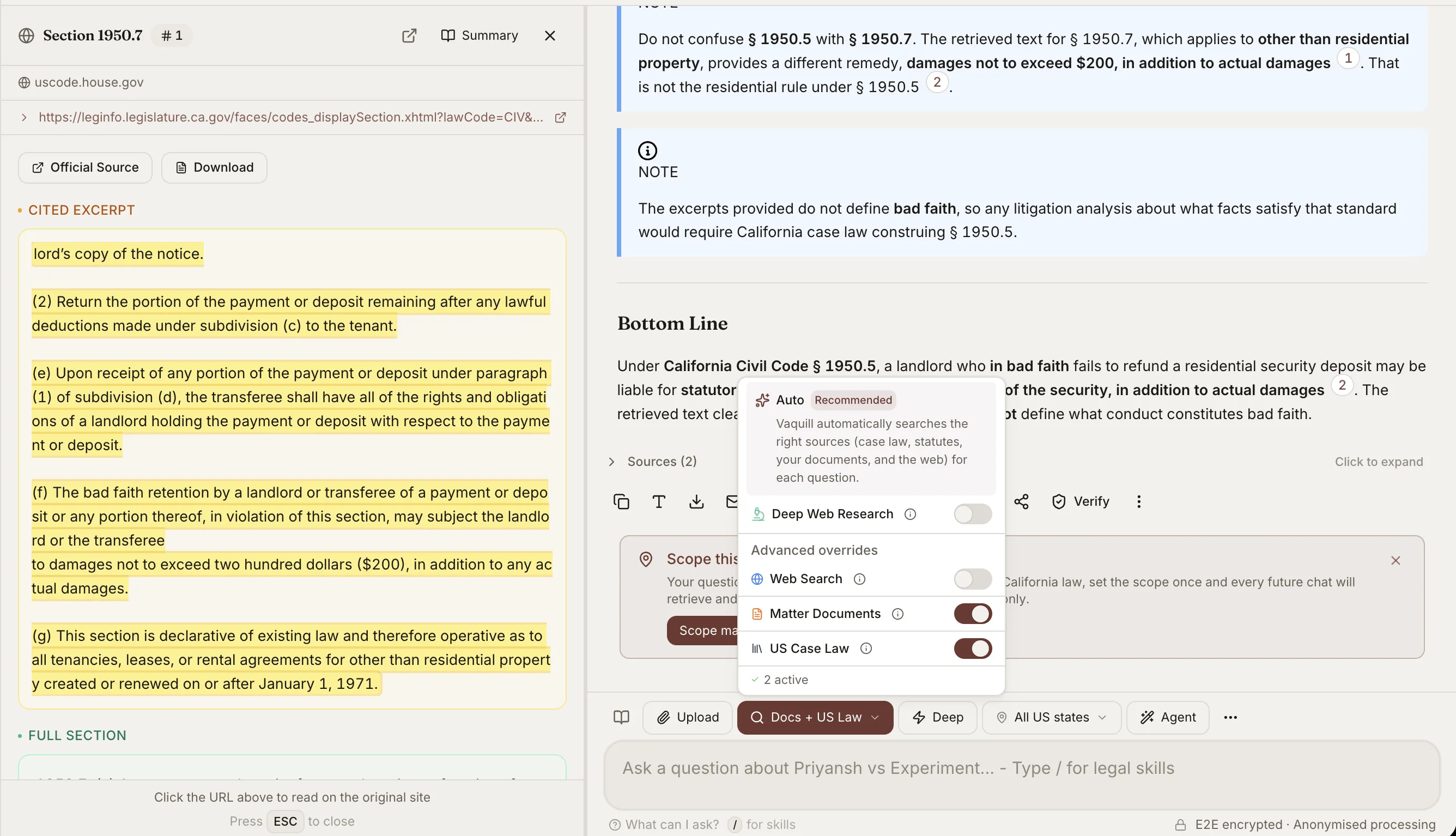 Verified citations, inline. Each answer links to its source with claim-level confidence scoring. You see the trust signal before a citation goes into a brief or a memo, not in an email an hour later.
What people actually say about Paxton AI
Solo and small-firm users are warm on it. The Lawyerist independent review collects "game-changer" type praise from lawyers who like the speed and the research loop. The gripes are worth knowing too. The price feels steep for solos. There is no independent hallucination benchmark to back the 94% claim. The tool is US-only. And it does not plug into practice-management software, so it lives apart from where the rest of the firm's work sits.
Where Paxton AI falls short for in-house teams
The table is the map. Here is the texture, framed around the in-house workload rather than the demo.
The seat cost is about 5x. Paxton's Individual plan lists $499/month or $2,999/year (50% off annual). For a fractional GC or a lean team, that is real money before a single contract is drafted. Vaquill is $99/user/month or $990/user/year on annual (17% off). That is about one-fifth of the cost, with the full feature set on every seat. A three-lawyer team runs $297/month on Vaquill. The same team runs $1,497/month on Paxton's individual pricing.
No interactive citation graph. Paxton ships an async AI Citator. It emails you when the analysis is done and shows citing and related cases in a panel. It does not render an interactive citation network. Say you need to trace how a doctrine evolved. Or check that a case has not been quietly limited or overruled. You export and cross-check by hand. Vaquill's citation graph shows treatment flags on every edge, on screen.
No inline verification, only an async citator. The Paxton Citator runs in the background and emails when ready. That is fine for a deep dive you scheduled in advance. It is not what an in-house lawyer drafting at 11 PM wants before pasting a citation into a board memo. Vaquill runs 4-layer verification inline on every answer with confidence scores. No waiting.
No shareable research links. Every research thread in Paxton stays inside its app. There is no public or private link to forward to a colleague, a business stakeholder, or outside counsel. In-house work runs on quick hand-offs, and that friction adds up.
No multi-channel access. Paxton is a web app only. No Slack bot, no Telegram, no WhatsApp, no SMS-style interface. If you are between meetings and need a fast clause check, you open the app on your phone instead of just texting the question. Vaquill answers from Slack, Telegram, WhatsApp, and Signal.
No MCP server or developer API. Paxton is a closed app. No MCP server for Claude or ChatGPT Desktop, no public REST API, no developer docs. A legal-ops team that wants to wire legal Q&A into its own workflows cannot build on Paxton. Vaquill exposes both a native MCP server and a self-serve REST API.
Where Paxton AI fits well
To be fair to the jobs Paxton is built for:
Research-first practices. If your week is mostly legal research and Q&A rather than contract work, Paxton's core loop is competent and well-marketed.
Regulated buyers who need certifications first. Some firms will not run a trial without a finished SOC 2 report and ISO 27001 on file. Paxton's published posture removes that blocker on day one.
Teams that value named-lawyer social proof. If a homepage full of named US attorneys is the trust signal that gets your purchase approved, Paxton has it today.
Practice-area firms. Paxton's practice-area pages (family, PI, employment, criminal) reflect a product positioned around those workflows, with strong brand presence.
Where Vaquill fits well
Vaquill is built for a specific buyer. Think in-house counsel, fractional GCs, CLOs, and lean 2-10 person in-house teams. Their week is mostly contracts and matters.
The contract production line. Draft a clause set. Run it through Contract Review and NDA Triage. Redline it with real Word track changes the business team can accept or reject. Compare versions, and keep everything filed by matter. That end-to-end loop is the legal tools workbench. It is the difference between an assistant and a workbench.
Bulk review without the grind. The Document Matrix runs one question set across forty contracts at once and returns a structured grid. Upload a full deal room of 100+ documents, chat across all of it, and get inline citations to the exact highlighted PDF page. A single-document loop does not cover this shape.
Matter-organized work. Everything sits under a matter with role-based access. Forward a document to your matter inbox and get cited answers back in the same email thread. Chronologies build themselves from the dates across every matter document.
Seat math that fits a lean budget. $99/user/month, self-serve, 7-day free trial, no procurement gauntlet to start. For a team standing up the in-house function on a real budget, that matters. You can try it this week instead of waiting two quarters for a sales cycle.
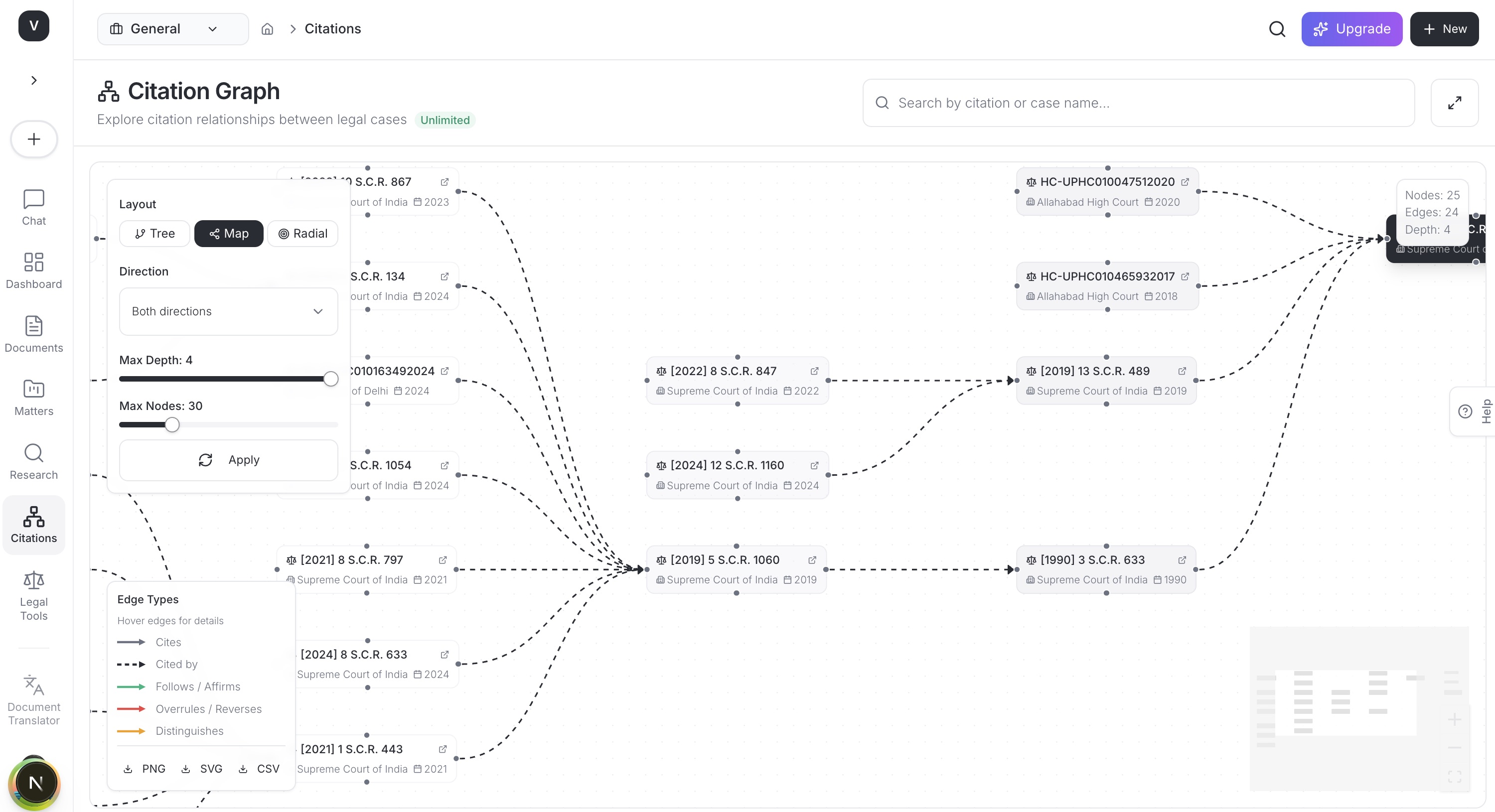 Citation graph with treatment flags. See how any opinion has been followed, distinguished, limited, or overruled across federal and state courts. It is the check Paxton's async citator emails you about later.
When Paxton AI is the right call
Pick Paxton AI if your procurement demands a SOC 2 Type II report and published certifications before a trial starts. Pick it if named-lawyer testimonials are the trust signal that gets your purchase approved. Pick it if your work is genuinely research-first and a 5x seat-price gap does not change your math. Paxton is a real product with a real team and real funding. If it has already cleared your security review and it works for you, there is no reason to pry it loose.
When Vaquill is the better fit
Pick Vaquill if you are in-house counsel, a fractional GC, a CLO, or part of a lean in-house team. Your week is contracts and matters more than open-ended research. You want the in-house workbench. That means AI drafting, contract review and NDA triage playbooks, and AI redlining with real Word track changes. It means compliance checks, document comparison, the Document Matrix across dozens of contracts, and matter management with an email inbox and auto-chronologies. You also want strong research underneath it: a citation graph with treatment flags, 4-layer inline verification, and the full US corpus. Add an MCP server for Claude and ChatGPT Desktop, plus a developer REST API. All at $99/seat with a self-serve 7-day free trial. Vaquill is the real alternative for in-house teams that want the whole production line without enterprise sales gating. Start at app.vaquill.ai or see pricing.
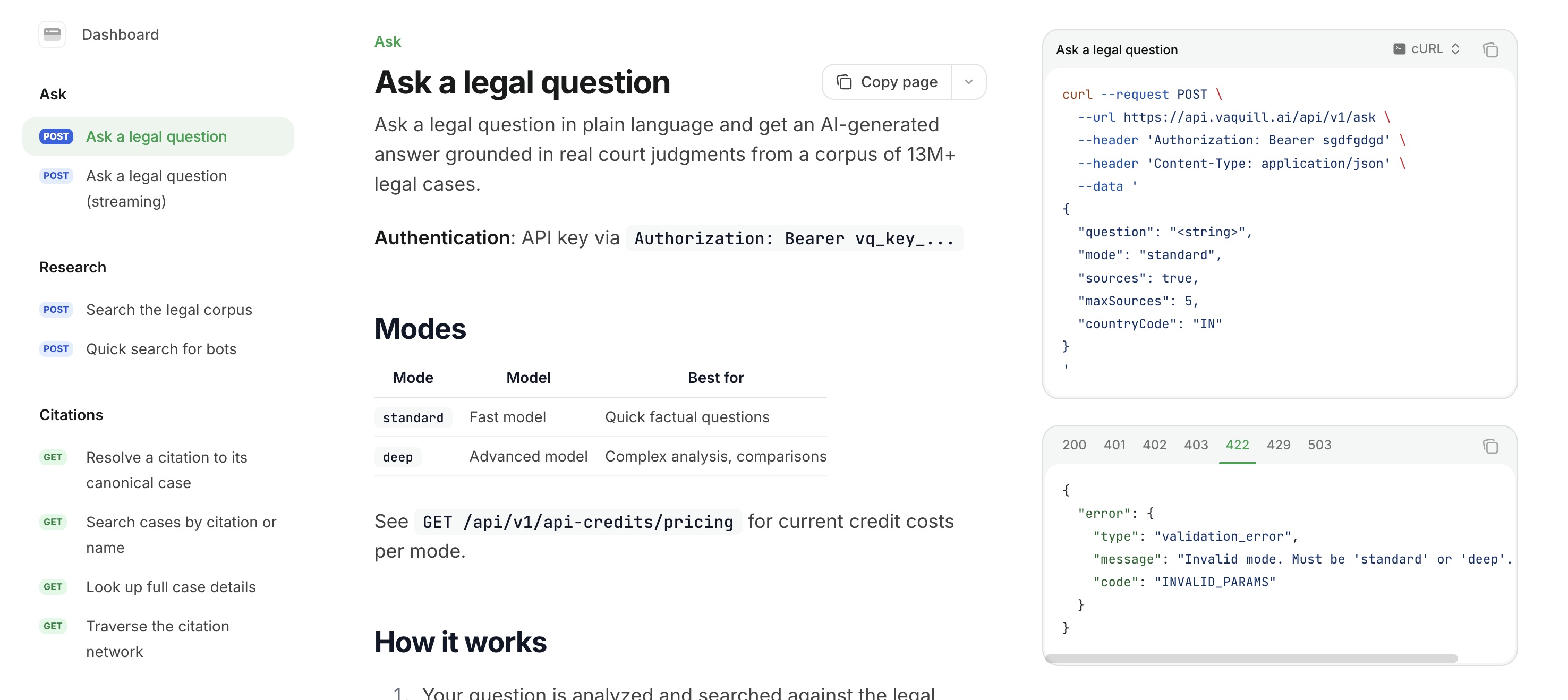 Developer API and MCP. AI answers, statute search, and section lookup over REST and MCP, already indexed and hosted. Paxton's closed app does not offer this.
FAQ
How much does Paxton AI cost compared to Vaquill? Paxton's Individual plan is $499/month or $2,999/year (50% off annual), with custom enterprise pricing and a 7-day trial. Vaquill is $99/user/month or $990/user/year on annual (17% off), with no tiers and no per-feature gating, and a 7-day free trial. For a lean in-house team, that is about one-fifth of the per-seat cost.
Is Vaquill a workbench or just another research assistant? A workbench. Vaquill leads with AI drafting, contract review playbooks, AI redlining with real Word track changes, document comparison, the Document Matrix across 40+ contracts, and matter management. Research is a strong supporting tool, not the headline. Paxton centers on research and Q&A.
Does Paxton AI have a citation graph? Not an interactive one. Paxton ships an async AI Citator that emails you when the analysis is done and shows citing and related cases in a panel. Vaquill gives you an interactive citation graph with visual treatment labels (followed, distinguished, limited, overruled) you can explore directly.
Does Paxton AI do AI redlining with Microsoft Word track changes? Paxton offers document analysis and suggested edits. Real Word track changes that the business team can accept or reject natively in Word are Vaquill's surface. For in-house teams whose counterparties live in Word, that is the difference between a suggestion and a redline.
Does Paxton AI have shareable links, messaging bots, or an MCP server? No. Paxton is a closed web app. No public or private shareable research links, no Slack or Telegram or WhatsApp access, no MCP server for Claude or ChatGPT Desktop, and no public developer API. Vaquill provides all of these natively. See the MCP integration guide and the REST API docs.
Is Paxton AI more accurate than Vaquill? Paxton advertises a 94% score on the Stanford Legal Hallucination Benchmark. One thing to know: reviewers note there is no independent benchmark behind that number. Vaquill runs every answer through a 4-layer check: exact text match, citation check, meaning, and AI cross-check. The confidence scores show up inline, not in a background email. Both approaches are reasonable. Vaquill's gives you the trust signal before a citation goes into a brief or a board memo.
What about SOC 2 and compliance? This is Paxton's clear edge today. Paxton lists SOC 2, ISO 27001, and HIPAA certifications. Vaquill has SOC 2 Type I attestation in progress. Today it enforces AES-256 at rest, TLS 1.3 in transit, tenant isolation, US data residency on AWS, and a contractual promise not to train on your data. If your procurement requires a finished SOC 2 report before a trial, Paxton clears that gate now.
Who should stay with Paxton AI instead of switching? If your company has already cleared Paxton through procurement, requires published certifications today, and your work is research-first, Paxton is a reasonable choice. If your week is contracts and matters, and you want the full in-house workbench at about one-fifth the seat cost, Vaquill is built for you.
Sources
- Paxton AI pricing (official pricing page)
- Paxton AI $22M Series A (LawSites / LawNext, Jan 2025)
- Paxton AI security and compliance posture
- Paxton AI platform overview
- Paxton AI family law solutions page
- Paxton AI small law firms page
- Lawyerist independent Paxton AI review
- Stanford HAI: legal AI hallucination benchmark study
- Vaquill pricing
- Vaquill for in-house counsel
- Vaquill MCP connector documentation
- Vaquill legal tools workbench


