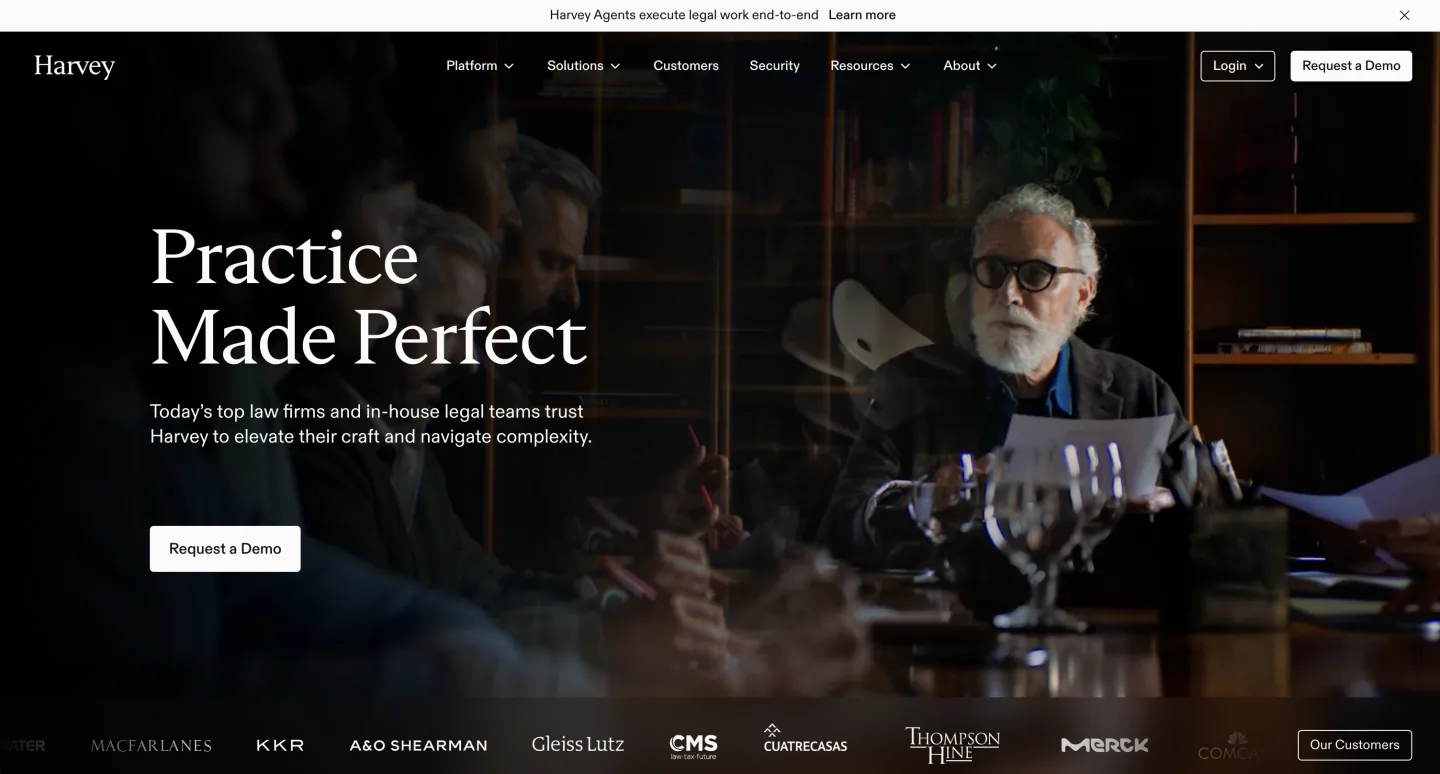
Harvey is the best-funded legal AI company in the world. Most of what it is famous for is true. The $8B valuation, the run to $100M ARR, the adoption by half the AmLaw 100: that is real traction at the top of the market. If you are weighing Harvey against Vaquill AI, do not let anyone tell you Harvey is weak. It is very good at what it was built for.
The catch is who it was built for. Harvey is made for AmLaw firms and Fortune 500 legal teams. Its sales motion matches that. Access is sales-gated. Contracts are annual. The buying cycle runs for months. So if you are a fractional GC, a CLO at a Series B, or the whole two-person legal team at a SaaS firm, you are not the buyer Harvey wants. That is the wedge this post lives on. Let's be clear about it.
TL;DR
- Harvey is firm-first and enterprise-shaped. It runs $1,200 to $2,000+ per user per month for unlimited AI usage. The price is a bundle, so your tier and add-ons set the per-seat number. There is also a pay-as-you-go credit plan. It is priced for larger firms, not solo GCs or lean 2-to-10-person in-house teams.
- Vaquill is an in-house legal AI workbench built for that smaller tier. You get AI drafting, contract review, AI redlining with real Microsoft Word track changes, matter management, compliance checks, negotiation playbooks, and document comparison in one self-serve product.
- Pricing is the cleanest contrast. Vaquill is $99 per user per month, or $990 per user per year (17 percent off), with a 7-day free trial. Harvey is $1,200 to $2,000+ per user per month, sold through a sales call on an annual contract with a roughly 25-seat minimum (so the smallest realistic entry is around $360,000 a year), with the credit plan as the only metered way in.
- Harvey wins on enterprise depth. Vault for firm-scale storage and bulk analysis, custom Workflows, Deep Research, iManage, Microsoft plugins, and a global footprint.
- Vaquill wins on access and privilege posture for small teams. PII is anonymized before any document reaches a model. Zero data retention with OpenAI and Anthropic. US data residency. No training on your data. BAA available. Self-serve from day one.
- The question is not "which is better." It is "which is built for your tier." For most US in-house teams under ten lawyers, Harvey's price and sales gate fit bigger buyers. Vaquill is the self-serve workbench built for you.
What Harvey is genuinely good at
Skip the vendor-vs-vendor reflex for a moment. Harvey earned its spot. A fair review names the good before the gaps.
It is the best-funded company in the category, by a wide margin. Harvey has raised over $500M. It confirmed an $8B valuation in its Series F in December 2025. It is reportedly raising at $11B as of February 2026. That cash buys real product speed and strong infrastructure. Does your firm need SSO, audit logs, paid support, and a vendor that will still be here in five years? Then that balance sheet is a feature.
It owns the enterprise market. Harvey is used by over 50 percent of AmLaw 100 firms. It has more than 1,000 customers across 60-plus countries. It reached $100M ARR, the biggest revenue figure of any legal AI startup. That is not a pilot graveyard. That is real adoption at the top of the market.
Its enterprise feature set is deep. Assistant handles Q&A. Vault handles firm-scale storage and bulk analysis. Custom Workflows handle repeatable tasks. Deep Research runs multi-step analysis across firm documents. Add Microsoft Word and Outlook plugins, an iManage integration, and a mobile app, and you have a toolkit shaped for how big firms run.
It is going global. Harvey partnered with SCC Online for Indian legal content and opened a Bengaluru office. Big firms like AZB & Partners and Shardul Amarchand Mangaldas are on board. If you run a firm with offices abroad, that reach matters.
None of this is in dispute. This post answers a narrower question. What happens when a lean in-house team, not an AmLaw firm, tries to buy.
One more honest note. Even fans are split on value. On r/legaltech, lawyers gripe about the price, the hard sales push, and the NDAs on pricing itself. One put it well: "the associates hated Harvey, but the partners went with it because they think it's magic." (r/legaltech pricing threads, Nov 2025; links are blocked to logged-out readers.) The product is strong. The buying part is the pain.
How Harvey and Vaquill compare
| Capability | Harvey | Vaquill |
|---|---|---|
| Access model | Enterprise-only. No self-serve signup. Sales calls and annual contract talks first. | Self-serve signup. 7-day free trial right away. No sales calls. |
| Pricing | $1,200 to $2,000+ per user per month for unlimited AI usage. The price is a bundle, so tier and add-ons set the per-seat number. There is also a pay-as-you-go credit plan. Annual contracts with a roughly 25-seat minimum, sold through sales. (Harvey AI pricing) | Flat per-seat: $99/user/month, $990/user/year (17 percent off). No tiers, no per-feature gating. 7-day free trial. |
| Target market | AmLaw 100, global elite firms, large enterprise legal teams. Sales-gated. | In-house counsel, fractional GCs, and CLOs at lean 2-to-10-person US legal teams. |
| Drafting | Word and Outlook plugins help you draft inside your existing tools (strength). | AI drafting from plain English with jurisdiction-aware clauses, plus AI redlining with real Microsoft Word track changes on export. |
| Contract review and redlining | Vault bulk analysis and custom Workflows for firm-scale review (strength). | Contract review with clause-level risk flags, negotiation playbooks, and redlines exported as native Word track changes. |
| Matter management | Project and matter folders in the Harvey workspace at enterprise scale (strength). | Matter workspaces with a forward-to-matter inbox, 100-document chat across a full matter, and auto-built chronologies. |
| Document comparison and matrix | Vault supports bulk upload and analysis (strength). | Document comparison plus Document Matrix to extract and compare the same fields across hundreds of contracts at once. |
| Compliance and playbooks | Custom Workflows can encode firm processes (strength). | Built-in compliance checks and 8 expert Skills (Contract Review, NDA Triage, Risk Assessment, Compliance Check, and more) as guided playbooks. |
| Data posture for small teams | Enterprise terms negotiated one contract at a time. | Privilege-architected by default. PII anonymized before model calls, zero data retention with OpenAI/Anthropic, US data residency, no model training, BAA available. |
| Integrations | Word/Outlook plugins, iManage, mobile app (strength). | REST API and MCP server for Claude Desktop, Cursor, VS Code, Windsurf. 50-plus file formats, Google Drive import, OCR. |
| Legal research | Research via the LexisNexis partnership for US content. | Research grounded in US federal and state opinions plus statutes, with 4-layer citation verification. A supporting feature, not the headline. |
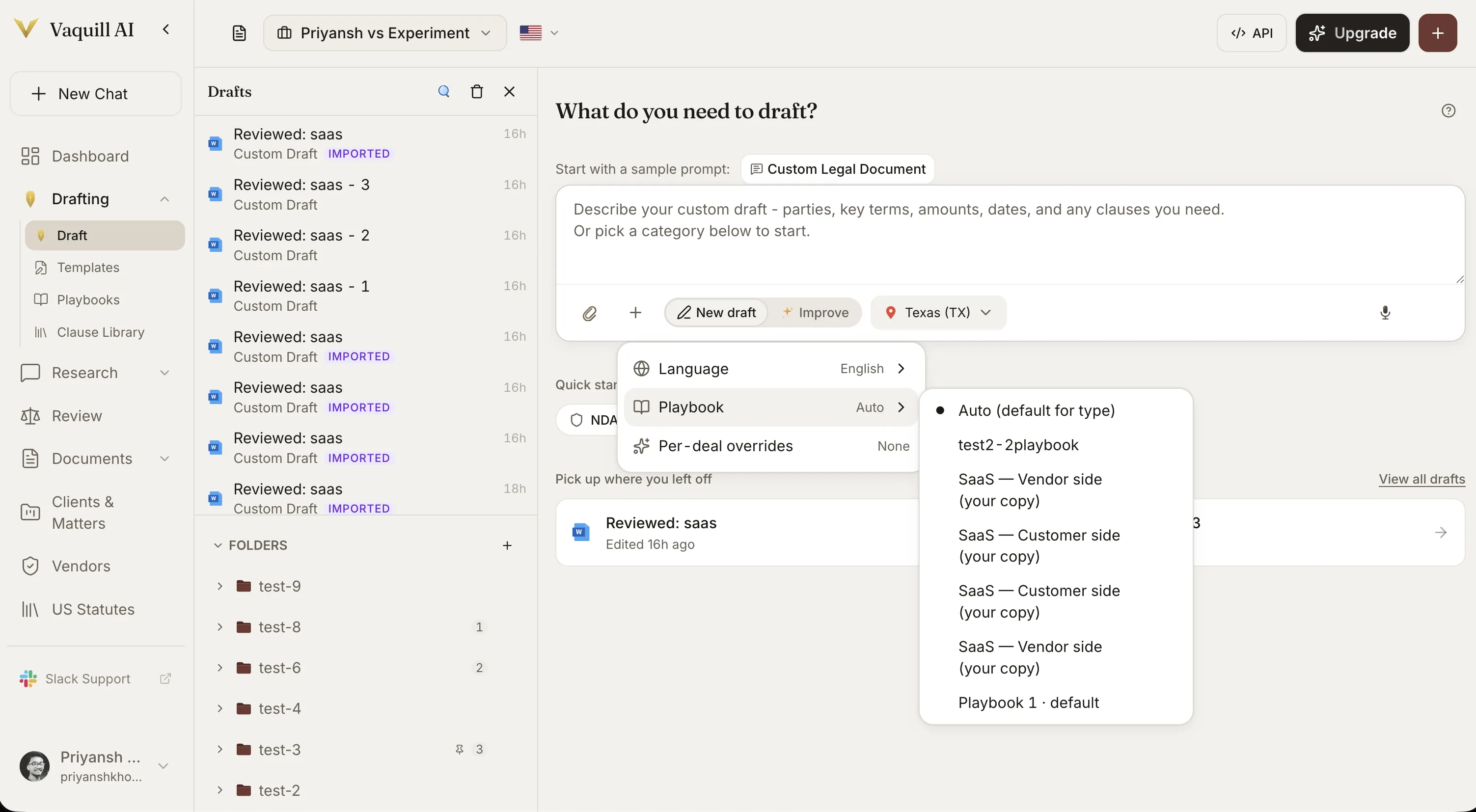 Drafting. Describe a document in plain English, draft with jurisdiction-aware clauses, and export to Word with real track changes.
Where Harvey leaves the in-house tier behind
Harvey's strengths and its limits are the same fact from two angles. The enterprise shape that serves AmLaw firms is the exact thing that shuts out a lean in-house team.
The price is built for firms, not in-house budgets. Harvey is $1,200 to $2,000+ per user per month for unlimited AI usage. The price is a bundle, so tier and add-ons set the per-seat number, on annual contracts, with a pay-as-you-go credit option, sold through sales. There is also a roughly 25-seat minimum, so the smallest realistic entry is around $360,000 a year, six figures before it runs a single contract through the tool. For a fractional GC carrying three companies, that math never starts.
There is no self-serve door. Harvey wants sales calls, contract talks, and a buying cycle that can run 60 to 90 days. A solo GC who wants to test a tool against next week's vendor MSA cannot. The friction is the point. The motion is built to screen out small accounts, not sign them up.
The fastest-growing in-house group is shut out by design. Fractional GCs and lean 2-to-10-person teams are the part of the market adding legal AI fastest in 2026. They are also the exact part Harvey's sales motion will not serve. That is not a knock on the product. It is a fact about who the product is for.
Privilege posture is handled custom, not by default. Harvey negotiates data terms one contract at a time. That works when you have a procurement team to do it. A two-person legal team does not. For that team, "can this hold up if privilege is challenged" needs a built-in answer, not a custom rider.
What an in-house team actually buys Vaquill to do
Vaquill is a workbench, not a research engine with a chat box stuck on top. The use cases below are the in-house jobs that come up again and again. They are why the tool gets opened on the third Tuesday of the month, not just in the demo.
The lean in-house team Harvey is not priced for. You are the legal department, or you run a team of two to ten. You carry contracts, compliance, board questions, and routine business work. You need the same workbench an AmLaw associate gets, minus the enterprise contract. Vaquill gives you drafting, contract review with redlines as real Word track changes, document comparison, Document Matrix across hundreds of contracts, compliance checks, and matter workspaces. All self-serve, on a 7-day free trial, with no sales call and no procurement gauntlet. Privilege architecture is the floor: PII anonymized before model calls, zero data retention with OpenAI and Anthropic, US data residency, no training on your data, BAA available.
The fractional GC running several companies. You bill against your time, so the tool has to pay for itself in hours saved on routine markup. Negotiation playbooks and 8 expert Skills turn an NDA or a vendor MSA into a first-pass redline you tidy up instead of write from scratch. Matter workspaces keep each client's files, threads, and docs separate and searchable, so context never bleeds across jobs.
The CLO standing up legal AI for the first time. You need answers your board memos can ship on. You need a data posture you can defend without a custom contract. Compliance checks and 4-layer citation verification mean board answers ship grounded in real authority. Confidence scores flag which ones need a second look.
The legal-ops lead who wants to automate. You want to wire the workbench into the tools your team already uses. Vaquill ships a self-serve REST API and an MCP server for Claude Desktop, Cursor, VS Code, and Windsurf. No enterprise contract needed to start.
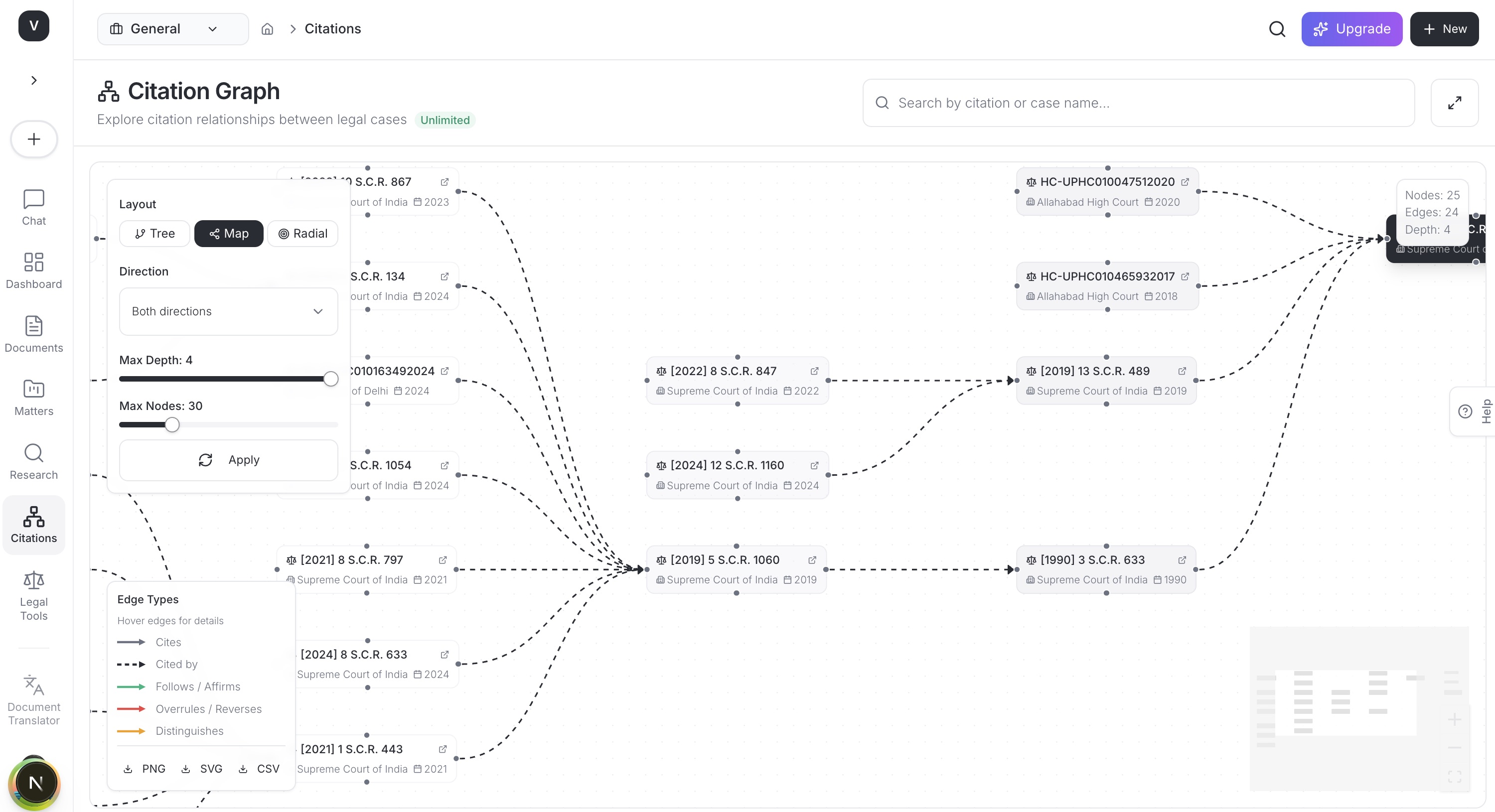 Citation graph. When research is the job, see how any opinion has been followed, distinguished, limited, or overruled across federal and state courts.
The matter workflow is where the workbench shape shows up clearest. Forward any document to your matter address and it lands indexed, with cited answers coming back in the same email thread. No app switch. Upload a whole deal room or pleading set and chat across all of it at once with 100-document chat. Chronology Builder pulls every date and event across the matter into an exportable timeline. None of this requires a firm big enough to clear Harvey's procurement.
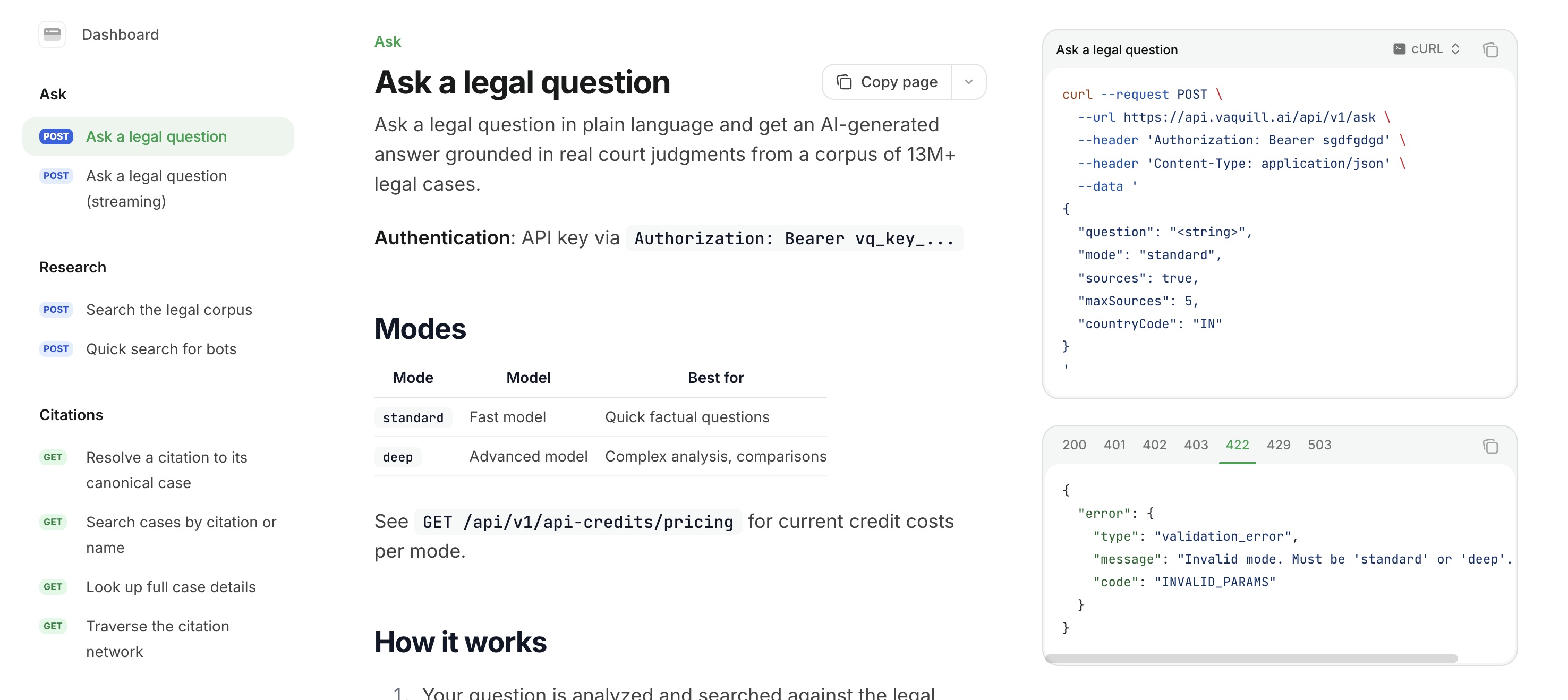 Developer API. AI answers, statute search, and section lookup over REST and MCP, self-serve, no enterprise contract to begin.
When Harvey is the right call
Choose Harvey if you are at an AmLaw 100 or BigLaw firm, or a Fortune 500 in-house team, with the budget and runway for an enterprise contract. Harvey is best in class for that tier on Vault, custom Workflows, Deep Research, iManage, and the Microsoft plugins. If your firm needs to layer AI on top of an existing LexisNexis subscription, roll out across hundreds of seats with firm-wide admin controls, and can absorb a 60-to-90-day procurement cycle, Harvey is the right pick. The capital behind it and the AmLaw adoption are real signals it will keep delivering for that segment. Do not try to make a tool built for 500 seats fit a three-person team. Do not try to make a tool built for three people run a global firm.
When Vaquill is the better fit
Choose Vaquill if you are in-house counsel, a fractional GC, or a CLO at a lean 2-to-10-person US legal team, and you need a real workbench without an enterprise contract. You get AI drafting, contract review, AI redlining with native Word track changes, matter management, compliance checks, negotiation playbooks, document comparison, and Document Matrix in one self-serve product. It is $99 per user per month, with a 7-day free trial and no sales call. The privilege posture is built in, not negotiated: PII anonymized before model calls, zero data retention with OpenAI and Anthropic, US data residency, no model training, and a BAA available. If Harvey's price and sales cycle are built for bigger firms than yours, Vaquill is the workbench built for your tier. Start the trial at app.vaquill.ai, run next week's contract through it, and decide on evidence, not a pitch.
 Research, when you need it. Ask in plain English and get a cited answer grounded in statutes and case law, every citation 4-layer verified. A supporting surface in the workbench, not the whole product.
FAQ
How much does Harvey AI cost compared to Vaquill? Harvey is $1,200 to $2,000+ per user per month for unlimited AI usage. The price is a bundle, so tier and add-ons set the per-seat number. There is also a pay-as-you-go credit plan. All of it runs on annual contracts sold through sales, with a roughly 25-seat minimum that puts the smallest realistic entry near $360,000 a year. Vaquill is $99 per user per month with a 7-day free trial, or $990 per user per year on annual (17 percent off). No tiers, no per-feature gating. For the full per-seat breakdown and where the renewal increase comes from, see Harvey AI pricing in 2026.
Is Harvey AI a fit for in-house counsel at a small team? Not for lean teams. Harvey is built for AmLaw 100 firms and large enterprise legal teams. At $1,200 to $2,000+ per user per month, sold through sales on annual contracts with a roughly 25-seat minimum and no self-serve signup, it is priced for bigger buyers than fractional GCs or 2-to-10-person in-house teams. Vaquill is built for that tier, with self-serve signup, $99 per user per month, and a 7-day free trial.
Does Vaquill do AI redlining and contract review like the enterprise tools? Yes. Vaquill reviews contracts with clause-level risk flags, runs negotiation playbooks against your standards, and exports redlines as real Microsoft Word track changes. The markup lands the way your counterparties expect to get it. Document Matrix extends this across hundreds of contracts at once when you need to compare the same fields in bulk.
Can Vaquill organize work by matter the way I run my in-house function? Yes. Vaquill organizes everything by matter or client with role-based access (Owner, Admin, Member, Viewer). Each matter has its own inbox. Forward a contract or pleading to your matter address and it lands indexed, with answers returned in the same email thread. 100-document chat lets you query a whole deal room at once, and Chronology Builder pulls dates and events into an exportable timeline.
Does Harvey AI have its own case law database? No. Harvey does not keep a proprietary case law database. US case law access comes through a partnership with LexisNexis. Vaquill grounds research in US federal and state opinions plus statutes directly, with 4-layer citation verification. For in-house teams, research is a supporting feature, not the main reason to buy.
What is Harvey AI's funding and valuation? Harvey confirmed an $8B valuation in its Series F in December 2025, and is reportedly raising at $11B as of February 2026. It has reached $100M ARR and serves over 50 percent of AmLaw 100 firms, making it the best-funded legal AI company in the world.
The bottom line
Harvey is excellent. Harvey is also not for you if you run a lean in-house team. Both are true at once. The enterprise depth that makes Harvey right for an AmLaw firm is the same shape that prices out and gates the fractional GC and the two-person legal function. Vaquill is the in-house workbench for that tier: drafting, contract review, redlining in real Word track changes, matter management, compliance, playbooks, and document comparison, self-serve at $99 a seat. For a longer look at Harvey on its own terms, see our Harvey AI review. To see the workbench in context, read about solutions for in-house counsel, the legal tools, and AI drafting. Or just start the 7-day free trial and run a real contract through it.
Sources
- Harvey reportedly raising at $11B valuation (TechCrunch, Feb 2026)
- Harvey confirms $8B valuation in Series F (TechCrunch, Dec 2025)
- Harvey reaches $100M ARR and 42 percent of AmLaw 100 (Artificial Lawyer, Aug 2025)
- Harvey company page: 1,000+ customers across 60+ countries
- Harvey customers page: over 50 percent of AmLaw 100
- Harvey Vault platform overview
- Harvey and LexisNexis strategic alliance (Jun 2025)
- Harvey Microsoft Word and Outlook integrations
- Harvey AI pricing guide (eesel.ai)
- Harvey Developer API documentation portal
- Vaquill API documentation: ask a legal question
- Vaquill MCP server documentation


