GC AI and Vaquill AI sell to the same person. That person is the lawyer who is the legal department, or one of two to ten who are. Both wrap a frontier model in legal scaffolding. Both do contract review and drafting. Both keep matters in one place. So the thing that decides most evaluations is not a feature box you tick. It is the seat price and the contract behind it. GC AI is $500 per seat per month. It is sold like an enterprise tool. That means a buying process and the time it takes. Vaquill is $99 per user per month, self-serve, with a 7-day trial and every feature on every seat. Maybe you are a solo GC. Maybe you run a lean team with no procurement department and no five-figure software line. If so, that gap is the whole story.
This is a head-to-head for in-house counsel choosing between the two. We are biased. Vaquill is our product. We still kept this honest, because in-house buyers call references and run trials, and a puffed-up comparison just wastes your week. GC AI is a good product. The case for Vaquill is not that GC AI is bad. It is that the in-house workbench should not cost $6,000 a year per lawyer. And a small team should not have to clear an enterprise contract just to start.
TL;DR
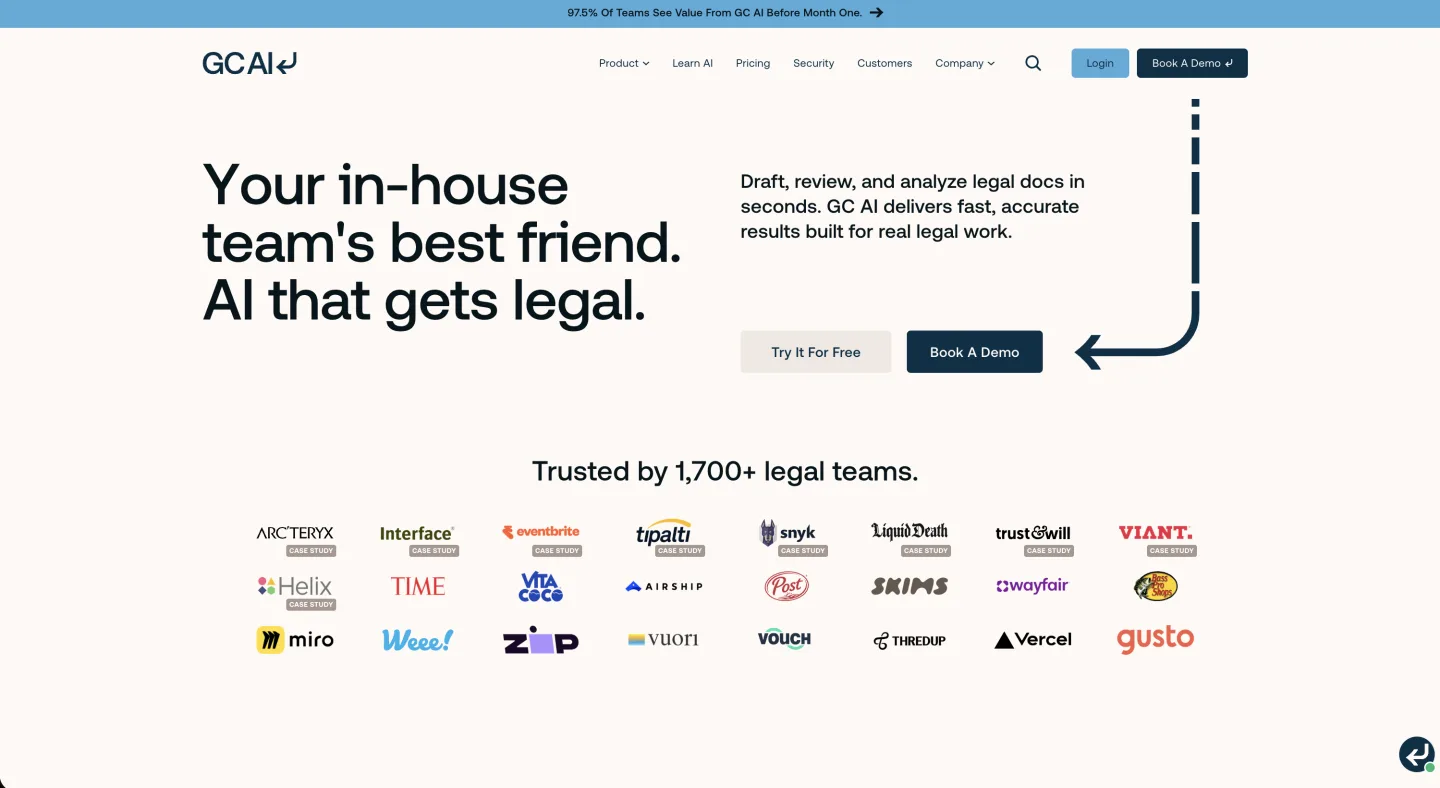
- GC AI is the biggest in-house legal AI platform in 2026. It reports use across 1,300+ legal departments. It has a three-time GC founder, raised $73M, runs a Word-native workflow, and publishes a price of $500 per seat per month.
- Vaquill is an in-house legal AI workbench at $99 per user per month ($990 per year, about 17% off). It has a 7-day free trial, it is self-serve, and there is no per-feature gating.
- Here is the wedge. GC AI is priced and shaped for bigger departments. Vaquill is the workbench a solo GC, a fractional GC, or a 2 to 10 person team can actually buy.
- Both cover the in-house core: drafting (NDAs, MSAs, vendor agreements), clause-by-clause review, redlining, matter workspaces, and compliance checks. Vaquill also adds AI redlining as native Word track changes, a Document Matrix across many contracts, multi-step workflows, and negotiation playbooks. All on one self-serve seat.
- GC AI's real edge: a more mature Word add-in, a 20,000-line legal system prompt, multi-model RAG, and far more in-house customers in production. If you want the most battle-tested in-house tool and you have the budget, GC AI is a fair pick.
- Vaquill's edge: privilege architecture by default. PII gets stripped before model calls. There is zero data retention with OpenAI and Anthropic, US residency, and a BAA on request. You get the full workbench on one tier, at a price a small team can approve.
Want the other side first? See our honest GC AI review for in-house counsel. It covers where GC AI wins, where it has gaps, and who should look elsewhere.
What GC AI gets right
Credibility first. Pretending GC AI is weak would be wrong, and you would catch it in the first demo anyway.
Real in-house traction and funding. GC AI has raised $73M total at about a $555M valuation. It reports use across 1,300+ legal departments. That is not vapor. It means the product will keep getting investment, and the vendor will be around to renew. If you have watched a legal tech startup vanish mid-contract, that matters.
Multi-model RAG with exact-quote checking. GC AI runs multi-model RAG across Anthropic, OpenAI, Google, and Cohere, and picks the model per task. Its Exact Quote feature pulls verbatim text from the source so you can check a claim against the document it came from. After Mata v. Avianca, that kind of check is table stakes, and GC AI does it cleanly.
Deep Microsoft Word integration. GC AI's Word add-in handles in-document redlining, clause drafting, contract comparison, and version tracking. All of it happens inside Word, where most in-house lawyers already live. A three-time GC built the product, and it shows. The playbooks target the exact four-document corpus (NDAs, DPAs, SaaS MSAs, commercial MSAs) that eats most of an in-house contract week. That is product design from inside the chair, not a generic AI tool with a legal coat of paint.
None of that is marketing fluff. If you have the budget and you want the most mature, most-deployed in-house tool out there, GC AI earns the look.
How GC AI and Vaquill compare
| Capability | GC AI | Vaquill |
|---|---|---|
| Target buyer | In-house teams, priced and shaped toward mid-market and enterprise departments | In-house counsel, fractional GCs, CLOs, and lean 2 to 10 person teams |
| Pricing | $500/mo or $5,000/yr per seat, Individual plan. Team and Enterprise are quoted | $99/user/mo, or $990/user/yr (about 17% off). No tiers, no per-feature gating |
| Free trial | 14-day | 7-day, self-serve, start now |
| AI drafting | Document and clause drafting in Word | Drafting for NDAs, MSAs, and vendor agreements, with an in-app editor |
| Contract review | Agentic playbook-driven review, strong | Clause-by-clause review with severity-flagged risk and compliance checks |
| Redlining | In-document redlining via the Word add-in (strength) | AI redlining as native Word track changes you can accept or reject |
| Negotiation playbooks | Pre-built playbooks for NDAs, DPAs, MSAs (strength) | Negotiation playbooks plus 8 expert Skills (NDA Triage, Risk Assessment, Compliance Check, and more) in chat |
| Document comparison | Version comparison and discrepancy extraction | Document comparison with real track changes export |
| Document Matrix | Not a documented first-class feature | Pull the same terms (liability cap, governing law, termination) across many contracts at once |
| Compliance checks | Contract-level review | CCPA, GDPR, and HIPAA checks with flags |
| Matter management | Projects with persistent matter memory | Matter workspaces, 100-document matter chat, email-to-matter inbox, auto-built chronologies |
| Multi-step workflows | Agentic playbook runs | Agent Mode chains steps on its own (up to 5 iterations, 3 tool calls each) plus multi-step workflows |
| Team collaboration | Sharing on Team plans | Role-based access (Owner, Admin, Member, Viewer) on every seat |
| Data posture | Enterprise terms via GC AI | PII anonymized before model calls, zero data retention with OpenAI and Anthropic, US residency, no training on your data, BAA available |
| Developer API | Private alpha, single-turn, request access | Production REST API and MCP server, self-serve |
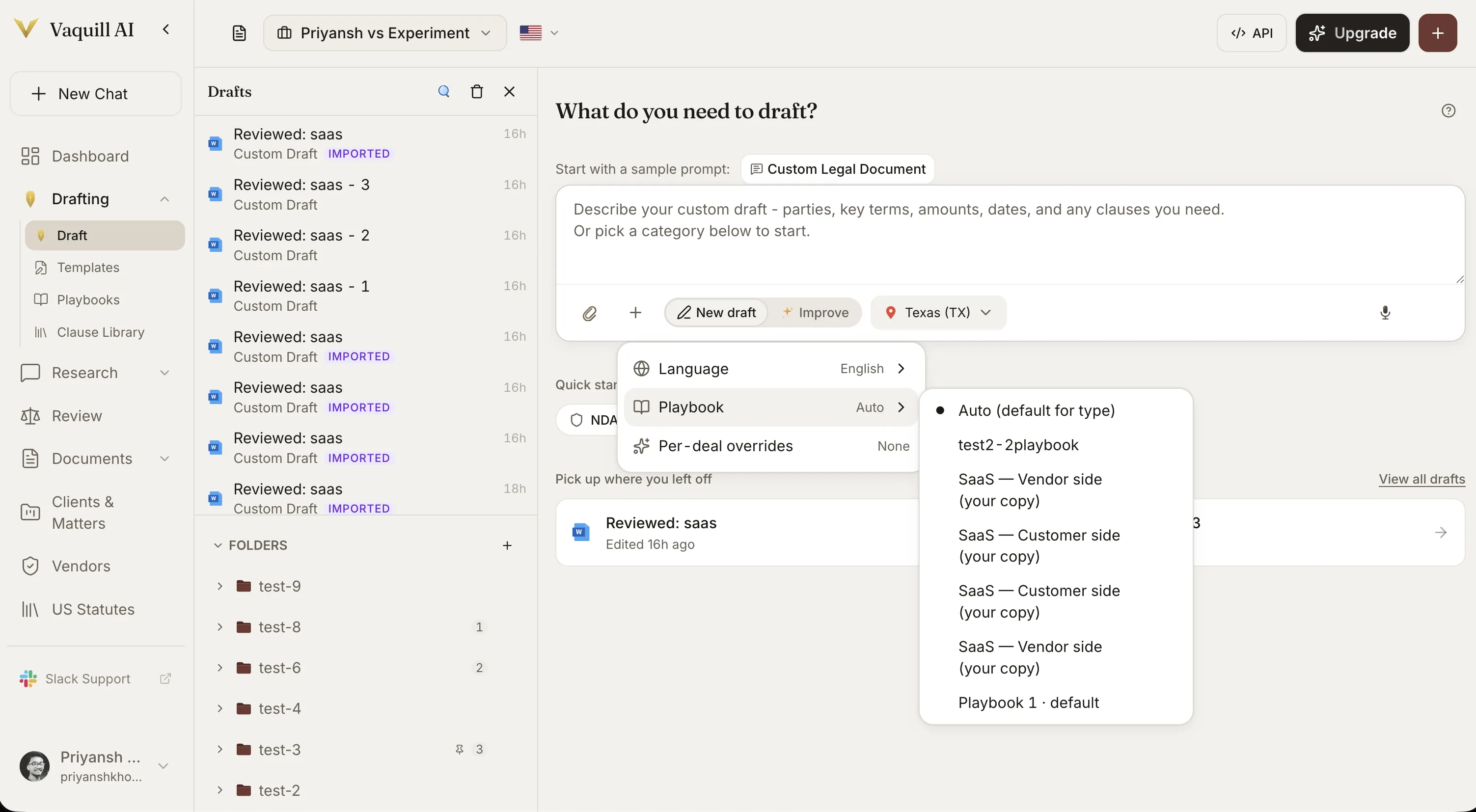
AI drafting. Generate NDAs, MSAs, and vendor agreements, then fix them clause by clause in the editor instead of starting from a stale template.
Where GC AI's price and shape leave a gap
GC AI is good. The catch for most readers of this post is who it was built to be sold to.
$500 per seat is in-house-team pricing, not lean-team pricing. The Individual plan is $500/month or $5,000/year per seat. Team and Enterprise are quoted. A Series B GC with three lawyers signs for $1,500 a month. A solo GC, or a fractional GC covering a 30-person startup, is staring at a big number. That is hard to justify before the tool has proven itself. And there is no cheaper tier that keeps the features. Vaquill is $99 per user per month with a 7-day trial and no per-feature gating, so the math works at one seat.
The buying motion costs you too, on top of the price. Annual plans built for larger teams, plus custom quotes for Team and Enterprise, mean a process. A quote, a call, a contract. A lean in-house team has no buying runway and a queue that will not clear itself. Vaquill is self-serve. You start the trial, you use the workbench the same day, and you expense one seat without a 60-day cycle.
Privilege architecture is not a documented default. In 2026 the in-house question moved from "can this make us faster" to "can this hold up if it gets challenged." Vaquill is built for the second question. PII gets anonymized before any document reaches a model. There are zero data retention contracts with OpenAI and Anthropic. Data stays in US residency on AWS. No training on customer data. A BAA is available, and SOC 2 alignment is underway. That is the posture a small in-house team needs to defend a tool choice in a board meeting or an audit. And you get it without negotiating a custom enterprise rider.
The API is in private alpha. GC AI's API is in private alpha. Single-turn completions only, request-access. If legal ops wants to wire the tool into a workflow, that is a hard ceiling. Vaquill ships a production REST API and an MCP server for Claude Desktop, Cursor, and VS Code, all self-serve.
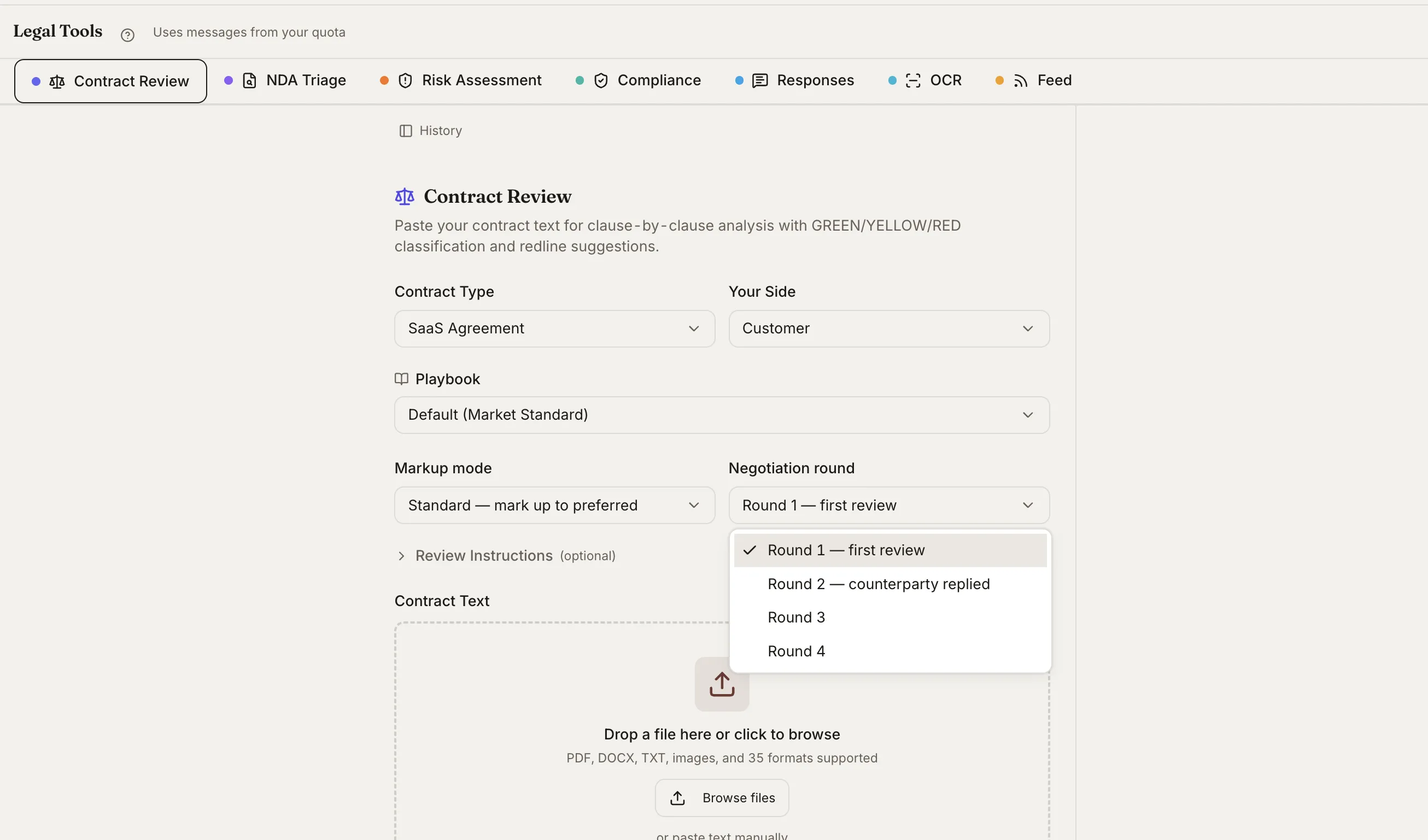
Contract review and compliance. Clause-by-clause risk flags plus CCPA, GDPR, and HIPAA checks, ranked by severity so you triage instead of reading every line cold.
What in-house teams actually use this for
The decision is not abstract. Here is where each tool earns its seat in a real in-house week.
Reviewing and redlining inbound contracts. A vendor MSA lands at 4pm with a Friday signature ask, because of course it does. You run it against your standards, get a severity-ranked list of deviations (liability cap, indemnity carve-outs, auto-renewal, governing law), and ship a markup. GC AI does this with playbook-driven review inside Word. Vaquill does it with clause-by-clause review and AI redlining exported as native Word track changes the other side can accept or reject. Both are strong here. The difference is the seat price behind the workflow.
Drafting from scratch. A founder needs an NDA for a partner chat tomorrow. You draft it, tune the clauses to your posture, and send it without opening a stale template. Both tools draft. Vaquill keeps drafting, review, and matters in one workbench on one self-serve seat.
Pulling terms across a contract stack. Diligence asks the question every GC dreads: what is our liability cap and governing law across every active vendor agreement? Reading 40 PDFs by hand is the bad old way. Vaquill's Document Matrix pulls the same fields across many contracts into one grid. GC AI does not surface this as a first-class feature. And it is exactly the bulk-review job a lean team hits during diligence or a renewal sweep.
Running matters over weeks. A dispute or a deal runs six weeks, and you do not want to re-upload documents every session. GC AI's Projects holds matter memory. Vaquill gives you matter workspaces with 100-document matter chat, an email-to-matter inbox, and auto-built chronologies. Role-based access means a colleague can pick it up.
Compliance checks before sign-off. A data processing addendum needs a CCPA, GDPR, or HIPAA read before it goes out. Vaquill runs compliance checks with flags so you catch the gap before counterparty counsel does.
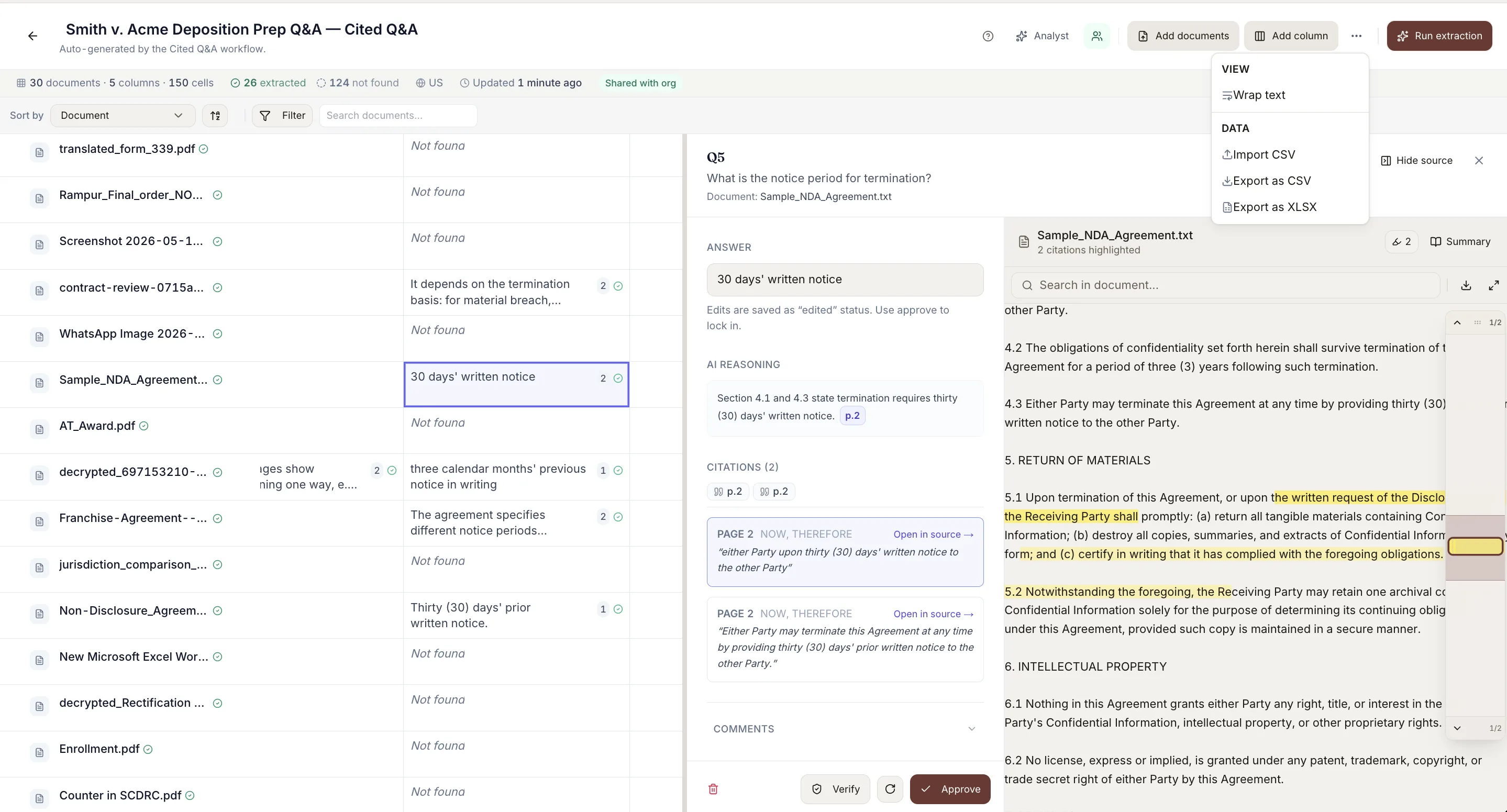
Document Matrix. Pull liability caps, governing law, and termination terms across a whole stack of contracts at once instead of opening them one by one.
What in-house buyers say about GC AI
Here is the honest part. There is little real forum discussion of GC AI. Most of what is online is PR. So we will not invent praise or quotes that do not exist.
One thing does stand out. GC AI publishes its $500 per seat price right on its pricing page. Harvey and Legora keep their numbers behind a sales call. For a buyer, an open price beats a "request a quote" button, even when the number is high. You can see GC AI's vendor profile on the Legal Technology Hub listing.
When GC AI is the right call
Choose GC AI if you are an in-house team at a mid-market or enterprise company. You need the budget to take down $500 per seat across the department. You want the polished Word add-in as the center of gravity. And you have the procurement runway to land an annual contract. GC AI has real depth on Word-native drafting and redlining. The multi-model RAG layer is solid. And the in-house customer base in production is big enough that you are buying a proven path, not a bet. Maybe your week is 70% contracts inside Word. Maybe your CFO will not blink at a five-figure annual line. If so, GC AI is a fair, even default, choice.
When Vaquill is the better fit
Choose Vaquill if you are in-house counsel, a fractional GC, a CLO, or you run a lean 2 to 10 person team. You need one workbench, on one self-serve seat. It covers drafting, clause-by-clause review, AI redlining in real Word track changes, the Document Matrix, compliance checks, and matter management. Maybe $500 per seat and an enterprise cycle put GC AI out of reach. Maybe Harvey will not take a call from a team your size. Vaquill is the option built for your tier. You get the same in-house core. You also get privilege architecture by default and a price you can approve at one seat, then grow into.
The honest line: GC AI is the more battle-tested tool for a department with budget and procurement. Vaquill is the better fit for the much larger group of in-house lawyers who do the same work without either.
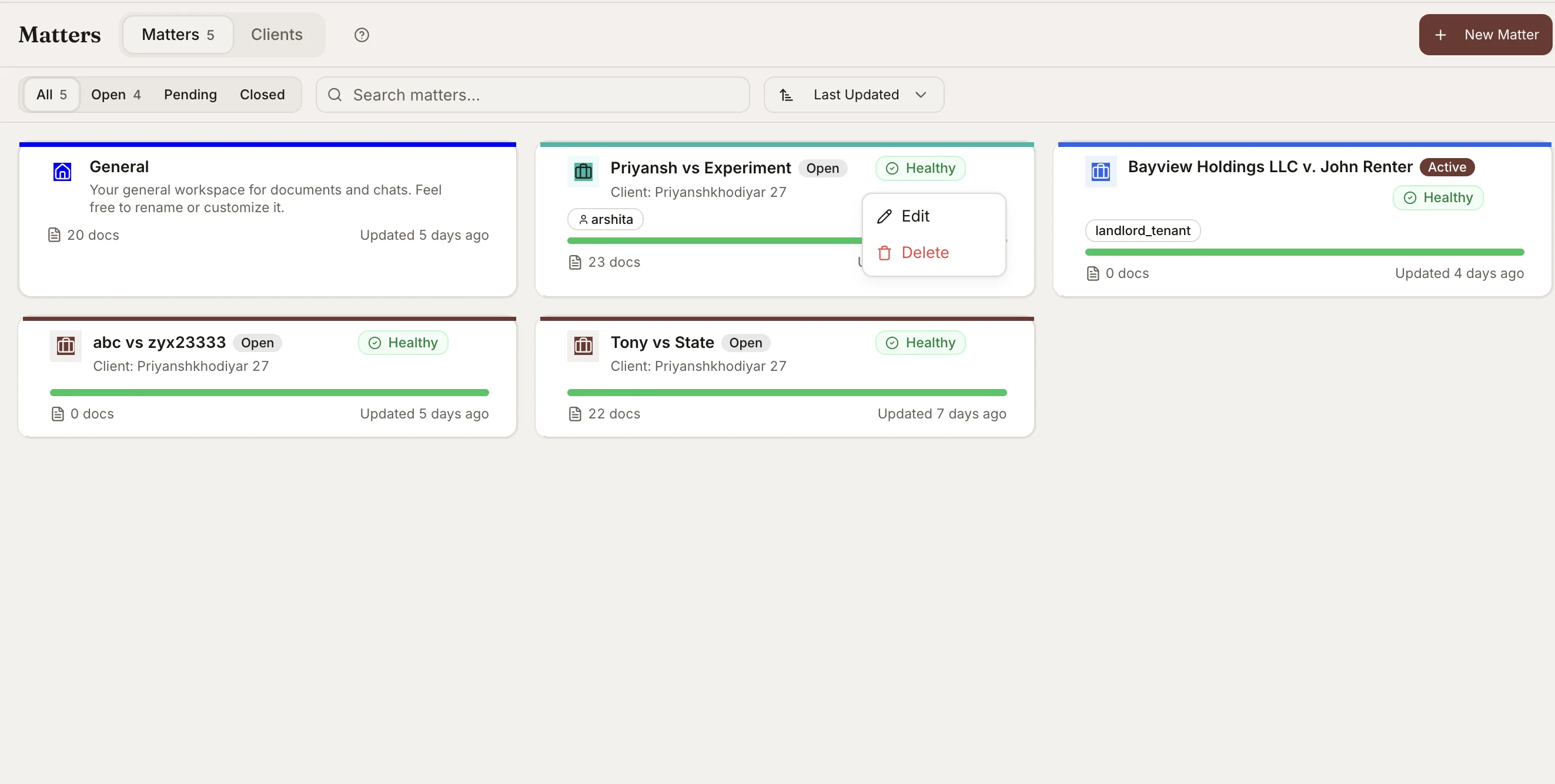
Matter workspaces. Keep documents, research threads, and an auto-built chronology together per matter, with an email-to-matter inbox so nothing lives only in your inbox.
FAQ
How much does GC AI cost compared to Vaquill?
GC AI's Individual plan is $500/month or $5,000/year per seat. Team and Enterprise plans are quoted. There is a 14-day free trial. Vaquill is $99/user/month, or $990/user/year on annual (about 17% off), with a 7-day free trial. Vaquill has no tiers and no per-feature gating. Every seat gets every feature. For a solo or lean team, that is about one-fifth the per-seat cost.
Is Vaquill a real alternative to GC AI for in-house counsel?
Yes. Both are built for in-house work: drafting NDAs, MSAs, and vendor agreements, clause-by-clause review, redlining, compliance checks, and matter management. GC AI leans on a mature Word add-in and a large enterprise customer base. Vaquill delivers the same in-house core. It adds AI redlining as native Word track changes, a Document Matrix across many contracts, multi-step workflows, and privilege architecture by default. All of it on a self-serve seat at $99/user/month.
Does Vaquill work with Microsoft Word?
Vaquill produces AI redlines as native Word track changes. You open them in Word and accept or reject clause by clause. GC AI's strength is an in-document Word add-in, where the editing happens inside Word itself. If a fully Word-native editing surface is a must-have for you, weigh that against the seat price and the rest of the workbench.
Can a fractional or solo GC use Vaquill without a procurement process?
Yes. Vaquill is self-serve with a 7-day free trial. You sign up and start using the workbench the same day. You expense one seat at $99/month. No quote, no call, no enterprise contract. That is the core difference from GC AI's $500-per-seat, custom-quote shape for Team and Enterprise.
Does GC AI have a public API?
GC AI's API is in private alpha. It is single-turn completions only, it requires requesting access, and there is no guaranteed availability or SLA. Vaquill ships a production REST API and an MCP server for tools like Claude Desktop, Cursor, and VS Code, all self-serve.
What does "privilege-architected" mean for Vaquill?
PII gets anonymized before any document reaches a model. Vaquill runs zero-data-retention contracts with OpenAI and Anthropic. Data stays in US residency on AWS. Customer data is never used to train models. A BAA is available, and SOC 2 alignment is underway. The point is a data posture a small in-house team can defend in a board meeting or an audit. And you get it with no custom enterprise rider.
Where to go next
- Vaquill for in-house counsel: the workbench, mapped to the in-house week.
- AI drafting: how Vaquill drafts NDAs, MSAs, and vendor agreements.
- Legal tools: contract review, redlining, compliance checks, and the rest of the toolset.
- Honest GC AI review: the other side, where GC AI wins and where it does not.
- Start a 7-day free trial: self-serve, one seat, no procurement.
Sources
- GC AI Series B announcement: $60M raise, $73M total, $555M valuation
- GC AI Series B coverage (Artificial Lawyer)
- GC AI Series B press release (BusinessWire)
- GC AI pricing page: $500/month or $5,000/year Individual plan
- GC AI pricing documentation: Individual and Team plan details
- GC AI for Word: Microsoft Word add-in with redlining and clause drafting
- GC AI AI models documentation: Anthropic, OpenAI, Google, Cohere, auto-selection
- GC AI API documentation: private alpha, single-turn completions
- GC AI vendor listing (Legal Technology Hub)
- GC AI review: an AI tool for in-house counsel (Maryland State Bar)
- In-house AI startup GC AI raises $60M (Law.com)
- GC AI study: in-house teams reclaim 14 hours per week (BusinessWire)
- GC AI homepage: 1,300+ legal departments


