The best AI tools for general counsel are the ones that fit the GC job, not the law-firm job. As a GC, you do not bill hours. You answer the board, you ride herd on outside counsel, and you carry a whole legal function with one or two people.
So this list ranks tools by what a general counsel actually does each week, not by feature count or funding round.
AI is already table stakes on the in-house desk. 87% of general counsel reported their teams using generative AI in 2026, up from 44% a year earlier (FTI Consulting and Relativity, The General Counsel Report, 2026). The question stopped being whether to adopt and became which tool actually fits your desk.
If you want the broader tool field for an in-house team, read our companion roundup, the best legal AI tools for in-house counsel. That post compares the products. This one is about your role: the GC of one, the fractional GC, the head of legal who is also the whole department.
TL;DR
- Pick the tool by your dominant GC job, not the brand. Board and risk work, contract throughput, and outside-counsel oversight each reward a different tool.
- GC AI ranks first for the GC who fields every question type, with the clearest in-house-generalist pitch on the list. Vaquill AI is the close second for the GC of one: one workbench covers draft, review, matter, and renewal, flat, with a no-train-on-your-data policy.
- The two questions that kill most vendors: does it train on your data, and can you buy it without a sales cycle? Ask both before the demo.
- Funding does not equal fit. Harvey and Legora are strong tools built and priced for large firms. A one-person department pays enterprise rates for power it cannot use.
- Most enterprise names gate pricing behind a sales call. Only a few (Vaquill AI, Paxton) let a solo GC self-serve a trial with a card.
What share of general counsel reported their teams using generative AI in 2026?
How we picked
We ranked these for the general counsel role: a lawyer who owns the function, reports up, and has no buying committee. We weighted the jobs a GC carries that an associate does not.
The criteria: clear pricing with no seat minimum, data posture, matter and board context, real Word track changes, outside-counsel and risk visibility, buying friction, and vendor staying power.
The real test for a GC: can one person run the tool, brief the board off it, and buy it without a procurement cycle? We weighed ten tools against that bar.
Every price below is vendor-published or founder-confirmed as of mid-2026, sourced inline where a third party publishes it. Where we cannot confirm a number, we write "quote-based / on request" instead of guessing. Sentiment lines come from real forums and review sites, linked where the page loads; where there is little genuine talk, we say so and invent nothing.
Comparison table
| Tool | Price (per user/mo) | Access | Best for the GC job | Free trial | Source |
|---|---|---|---|---|---|
| GC AI | $500 (Individual) | Sales-led (higher tiers) | Triaging every question that lands on the GC desk | No | gc.ai/pricing |
| Vaquill AI | Published | Self-serve | Running the whole function as a GC of one | Yes (7-day) | Vaquill AI (own) |
| Harvey | $1,200 to $2,000+ | Sales-led, demo | GCs in large departments with firm-scale workflows | No | Founder-confirmed |
| Legora | $300 to $800 | Sales-led, demo | GCs coordinating a bigger legal team on shared matters | No | Founder-confirmed |
| Spellbook | $500 (base, reported) | Sales-led, demo | The transactional GC who lives in Word | No | Buyer-reported, quote-gated |
| CoCounsel | $225 to $400+ | Sales-led, demo | GCs who need a research answer they can cite to the board | No | Founder-confirmed |
| Ivo | $500 | Sales-led, demo | High contract volume the GC must clear without a team | No | Founder-confirmed |
| Robin AI | $500 | Sales-led, demo | GCs who do vendor-durability diligence first | No | Founder-confirmed |
| Paxton AI | $499 ($2,999/yr) | Self-serve | The research-leaning solo GC on a budget | Yes (7-day) | paxton.ai (published) |
| LegalOn | $550 (annual) | Sales-led, demo | GCs who want the reasoning behind each redline | No | legalontech.com |
A note on the "best for" column: it names the GC role, not a generic feature. The same tool can be a great firm product and a poor fit for a solo GC, and that gap is the whole point of this list.
The 10 best AI tools for general counsel
One privilege note sits above any feature list. "Do not train on your data" is the floor, not the finish line. For each finalist, ask where your files live, for how long, who at the vendor can read them, and which sub-processors touch the text.
1. GC AI: best for triaging every question that lands on the GC desk
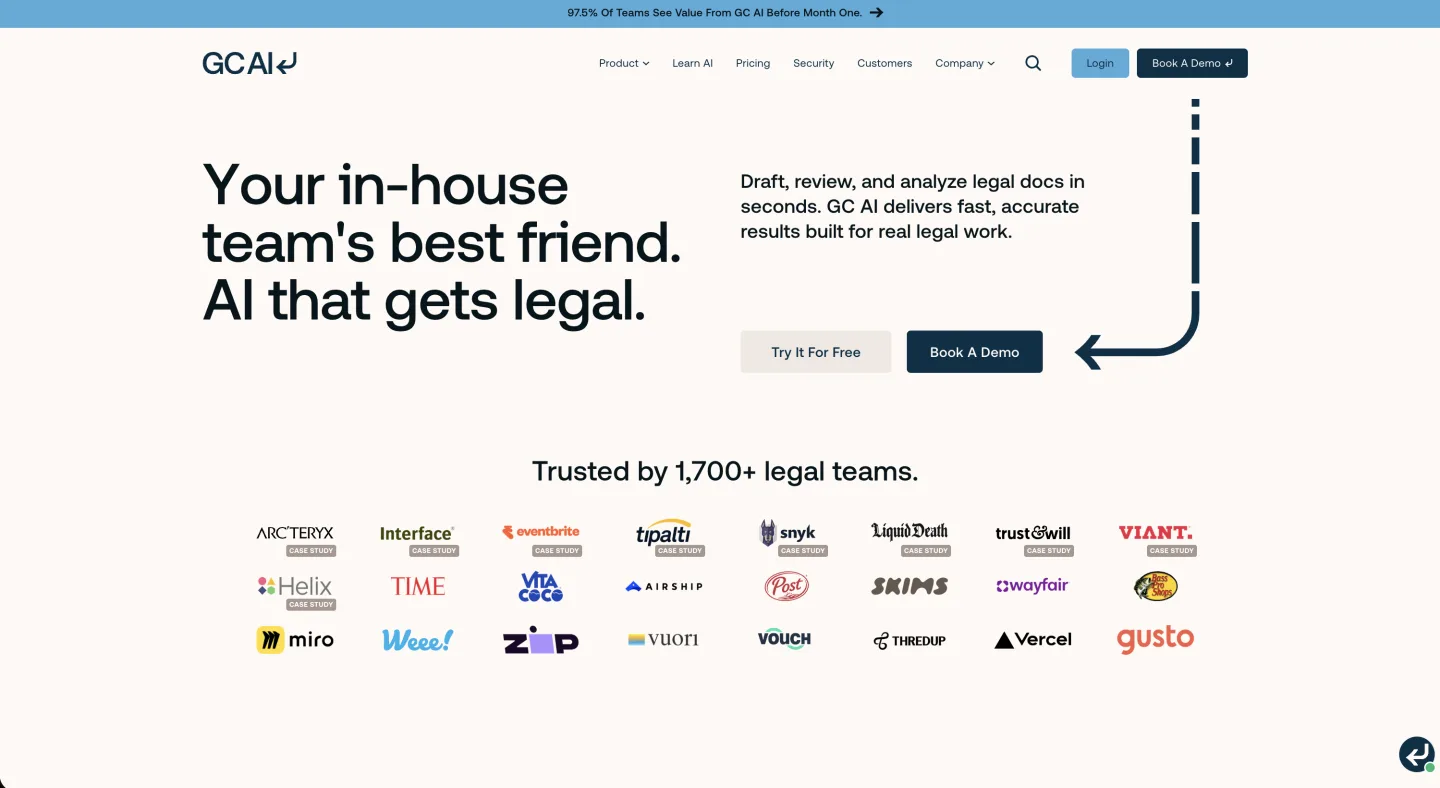
At a glance: $500 per seat/mo (Individual; Team and Enterprise on request) · Sales-led for higher tiers · Best for the solo generalist GC.
GC AI has the clearest "built for the in-house generalist" pitch on the list, which maps well to the GC who fields anything. Picture one lawyer who takes an employment question at 9am, an NDA at 10, and a board memo by lunch.
What's good
- Range across question types is real, so the unpredictable GC desk has a tool that does not flinch at the next ask.
- Publishes its $500 Individual price openly (gc.ai/pricing).
- Backed by a $60 million Series B in November 2025, so the runway is there.
Where it falls short
- Breadth over depth: a GC with a week of playbook-enforced contract review will want a specialist engine next to it.
- Higher tiers still route through sales, so a lean GC only self-serves at the top price.
What users say: There is little genuine forum talk about GC AI yet, mostly press and launch coverage, so we will not pretend it has a verdict (Legal Technology Hub vendor profile).
Bottom line: Buy it if you are one generalist GC covering everything and value range over depth. Skip it if your week is high-volume contract review, where a specialist will beat it.
See our honest GC AI review.
2. Vaquill AI: best for running the whole function as a GC of one
At a glance: Self-serve, published pricing (sign up to see the latest) · 7-day trial · Best for the GC of one and in-house departments.
Vaquill AI is the only tool here that covers the full GC week from open to close at a price one person can sign without a committee. It is a workbench, so the draft, the redline, the matter, and the renewal all live in one place.
What's good
- Drafts, reviews, and redlines in real Microsoft Word track changes, where each edit is a discrete suggestion you accept or reject before it goes to a counterparty or the board.
- Keeps work in privilege-aware matter context, so an NDA, its redline, and its renewal stay together and you can brief leadership without rebuilding the file.
- Reusable playbooks plus a document matrix across a stack of contracts let a solo GC clear volume without hiring.
- Flat, published, self-serve per-seat pricing, no seat minimum, with a do-not-train-on-your-data policy.
Where it falls short
- Lighter on deep primary-law and case-law research than the research-first platforms, so a heavy-litigation GC will want a research tool alongside it.
- If you already run a mature CLM, Vaquill AI overlaps with it instead of slotting underneath.
What users say: Vaquill AI is newer than the heavyweights, so there is little outside forum talk yet. We will not invent a verdict it has not earned.
Bottom line: Buy it if you are the whole function and want one bill that covers draft, review, matter, and renewal. Skip it if your GC job is mostly heavy research, or you already have a CLM you love.
Start on app.vaquill.ai.
3. Harvey: best for GCs in large departments with firm-scale workflows

At a glance: $1,200 to $2,000+ per user/mo (bundle plus add-ons; also a metered credit model) · Sales-led, demo required · Best for large legal departments.
Harvey is the category's gravity well and the name your CEO will forward you an article about. It is genuinely strong at deep document work and agentic workflows that big departments lean on.
What's good
- Deep, agentic document work holds up at scale, the kind of load a GC running a real team actually puts on it.
- Integrations large departments rely on, including a Lexis tie-in.
- Reported at an $11 billion valuation and roughly $190 million ARR by late 2025, so the vendor is not going anywhere.
Where it falls short
- For a GC of one, the value case is murkier than the valuation suggests.
- Complaints cluster around price, pushy sales, and NDAs on pricing.
What users say: One buyer summed it up: "the associates hated Harvey, but the partners went with it because they think it's magic" (r/legaltech pricing thread).
Bottom line: Buy it if you run a large department that uses the enterprise workflow it is built for. Skip it if you are a one-person function paying enterprise prices for power you cannot use.
Our Harvey alternatives breakdown walks through who clears that bar.
4. Legora: best for GCs coordinating a bigger team on shared matters

At a glance: $300 to $800 per user/mo (bundle plus add-ons; also a metered credit model) · Sales-led, demo required · Best for GCs leading a shared-matter team.
Legora (formerly Leya) is the other heavyweight, and its calling card is shared AI where many people work the same matter at once. That collaboration angle fits a GC managing several lawyers, not a solo function.
What's good
- Research, review, and drafting share one collaborative tool, so a GC can keep a team working off the same matter.
- Cheaper per user than Harvey at the comparable tier.
- Past $100 million in ARR and 1,000-plus customers (Legora, April 2026), so the platform is widely adopted.
Where it falls short
- Reliability chatter is louder than the price suggests, including legal-hold and retention gaps a GC has to own.
- Buyers in the pricing thread below report answer quality slipping on very long documents, so spot-check output on big files.
What users say: Users report a rollout rough enough to nickname the team "Letgora," plus retention gaps and a "wrapper over Claude" complaint (r/legaltech pricing thread).
Bottom line: Buy it if you lead a sophisticated team with the budget and a real need for live collaboration. Skip it if you are lean, since the price and reliability caveats both apply.
The Legora alternatives page covers the fit question.
5. Spellbook: best for the transactional GC who lives in Word

At a glance: ~$500 per seat/mo (base, buyer-reported; not listed publicly, reported six-month minimum) · Sales-led, demo required · Best for a GC whose day is drafting in Word.
Spellbook lives inside Microsoft Word, built for drafting and redlining right where transactional work happens. For a GC whose desk never leaves Word, it is one of the most natural fits here.
What's good
- Transactional lawyers single out the Word add-in, which covers most of a deal-heavy GC's day.
- Best-liked of the bunch among transactional users.
- Drafting and redlining happen in the tool you already use all day.
Where it falls short
- It still slips in the odd wrong citation, so check before you rely on it in front of the board.
- Built for transactional work, which makes it thin for a GC carrying litigation oversight.
What users say: Transactional lawyers rate it the best-liked of the bunch and praise the Word add-in, though the same reviews flag wrong citations and weak litigation support (Lawyerist Spellbook review).
Bottom line: Buy it if your GC day is transactional and happens in Word. Skip it if you carry litigation oversight or work outside Word much, since the add-in is built for deal drafting and goes thin past it.
Our Spellbook alternatives breakdown covers where the add-in model wins and where it boxes you in.
6. CoCounsel: best for GCs who need a research answer they can cite to the board
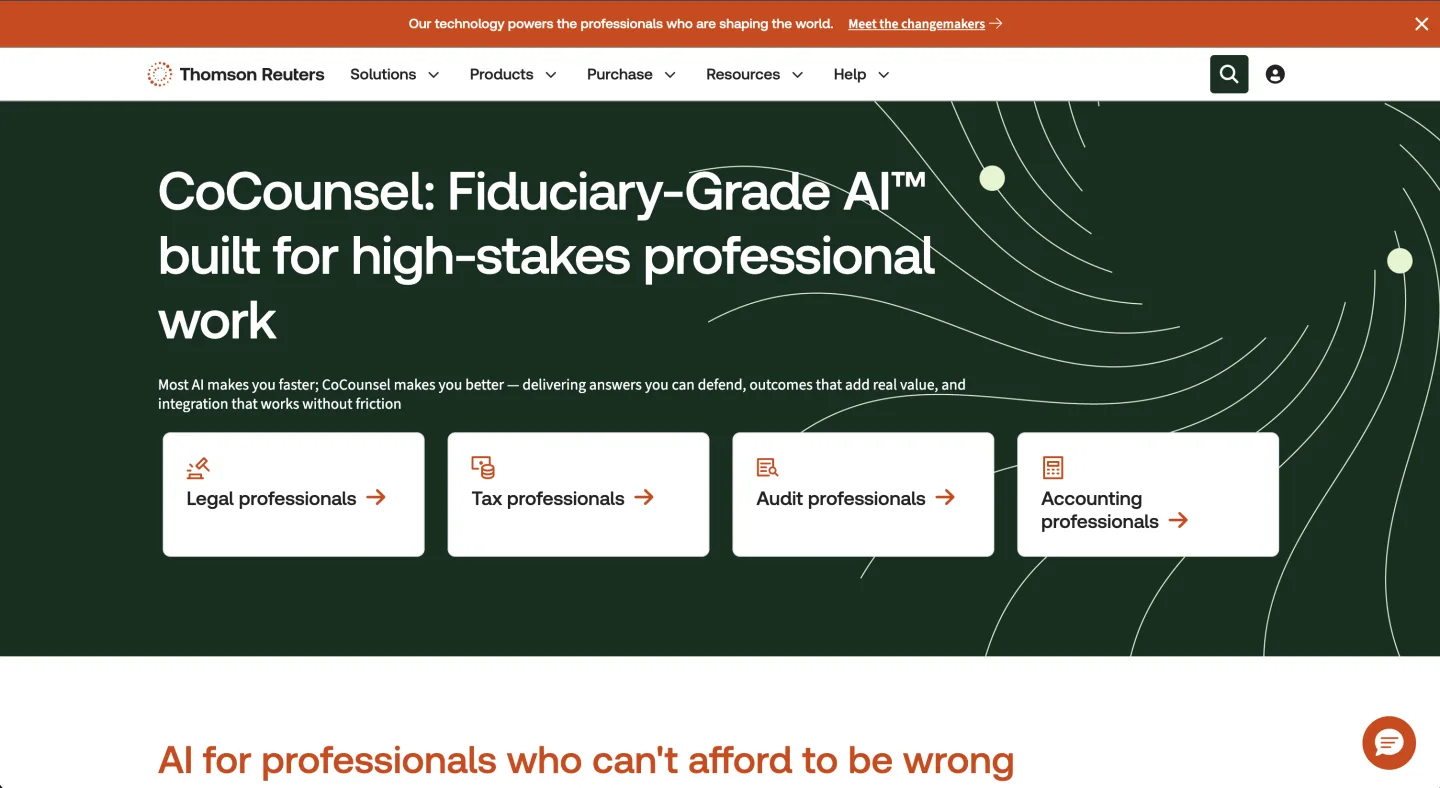
At a glance: $225 to $400+ per user/mo (depending on features; more once Westlaw sits underneath) · Sales-led, demo required · Best for GCs already on Westlaw.
CoCounsel is Thomson Reuters' AI assistant. In 2026 the notable move is the bundling: it tends to arrive tied to Westlaw rather than as a clean standalone, which matters for a GC pricing the all-in cost.
What's good
- Ease, time savings, and Parallel Search are the recurring praise, and together they speed the "what does the law say" question a GC has to answer fast.
- Sitting on Westlaw adds the primary-law corpus, headnotes, and KeyCite citator under the assistant, which a standalone chatbot does not have.
- A natural add-on if you already live in Westlaw for research.
Where it falls short
- It still fabricates citations and runs thin on appellate material, so a GC cannot brief leadership off it without verifying.
- The all-in cost climbs once a Westlaw subscription sits underneath it.
What users say: Users like the ease and Parallel Search but warn it still fabricates citations and is thin on appellate material, so verify everything (University of Michigan legal-tech series).
Bottom line: Buy it if you already pay for Westlaw and want an assistant on top. Skip it if you do not, since you would be buying a research platform just to get the assistant.
7. Ivo: best for high contract volume the GC must clear without a team

At a glance: $500 per user/mo · Sales-led, demo required · Best for a GC drowning in contract review.
Ivo is the leaner, faster name in the playbook-review camp. It has a clean interface and a clear in-house focus, with customers like Uber, Shopify, IBM, and Canva.
What's good
- Playbook redlining is easy to pick up, so a GC can enforce positions at volume from day one.
- Teams that found the big names heavy tend to land here and stay.
- Backed by a $55 million Series B at a valuation near $530 million.
Where it falls short
- Onboarding leans on Ivo's team rather than self-serve setup, which is friction for a GC with no help.
- Built for enterprise, and reviewers still catch the odd inaccuracy.
What users say: Buyers describe a real AI reviewer with playbook redlining that is easy to pick up, while flagging team-led onboarding and the occasional inaccuracy. We could not link a public review page that loads, so treat this as directional until your own pilot confirms it.
Bottom line: Buy it if review is the bulk of your GC week and you can spare time for onboarding. Skip it if you also need drafting or research, since Ivo is review-only and leaves both jobs on another login.
See the Ivo alternatives page.
8. Robin AI: best for GCs who do vendor-durability diligence first

At a glance: $500 per user/mo · Sales-led, demo required · Best for a GC who checks the runway before signing.
Robin AI belongs on any honest list, both for what it built and for the warning it now sends a GC about vendor risk. It was one of the first to pair AI with human experts for in-house contract review.
What's good
- Early, serious contract-review product founded by a former Clifford Chance lawyer.
- Pairs AI with human experts, a fit for the GC who wants a second set of eyes on a redline.
- Still shipping the core review product despite the 2025 turmoil.
Where it falls short
- A planned $50 million round failed to close, followed by layoffs of about fifty roles.
- Managed services went to Scissero and part of engineering was absorbed by Microsoft.
What users say: Forum talk about Robin is no longer about the product but the money, citing it as the poster child for the "legal AI bubble" (Artificial Lawyer, Geek Law Blog).
Bottom line: Buy it only after you confirm runway, data export rights, and MSA termination terms in writing. Skip it if you cannot stomach the vendor risk, since stabler names do the same job.
9. Paxton AI: best for the research-leaning solo GC on a budget

At a glance: $499 per user/mo, or $2,999 per user/yr · Self-serve, 7-day trial · Best for a research-first solo GC.
Paxton is the research-leaning name on the cheaper end. Solos talk about it like a tool that gave them their evenings back, which is the dream for a GC with no team.
What's good
- Built around research, drafting, and document analysis in one place (pricing published).
- Prints its price openly, which in this market counts as a personality trait.
- Self-serve 7-day trial, so a solo GC can test before a single call.
Where it falls short
- The price is steep for a true solo, and there is no independent hallucination benchmark.
- It is US-only and does not plug into practice management.
What users say: Solos call it a "game-changer" while flagging the steep price, the lack of an independent benchmark, and no practice-management integration (Lawyerist Paxton AI review).
Bottom line: Buy it if much of your GC week is "what does the law say" and you want self-serve research. Skip it if your day is contract-and-matter work, where a workbench fits better.
10. LegalOn: best for GCs who want the reasoning behind each redline

At a glance: $550/mo (Individual, billed annually; Teams custom) · Sales-led, demo required · Best for a GC who re-reads the same clauses.
LegalOn has been at contract review longer than most, with more than 7,000 customers and $200 million in total funding (LegalOn, July 2025). Its model pairs AI with attorney-authored guidance and inserts redlines with a reasoning layer behind them.
What's good
- A GC can defend a position to the business with the reasoning shown, which is the part review skeptics tend to come around on.
- Long track record at the review job specifically, not a general assistant retrofitted for contracts.
- Attorney-authored playbook guidance sits behind the suggestions, not raw model output.
Where it falls short
- It is a review tool, not a workbench, so a GC's matters, drafting, and research all live elsewhere.
- No self-serve path, and Teams pricing is custom.
What users say: There is no genuine peer forum discussion of LegalOn that we could find, only vendor testimonials, so treat the buzz as marketing until your own pilot says otherwise.
Bottom line: Buy it if your recurring nightmare is re-reading the same indemnity clause and you want the reasoning shown. Skip it if you do not re-litigate the same clauses often enough to value an attorney-authored reasoning layer, since a plainer reviewer will do.
The four GC jobs no tool feature list will name
Most of the field is built around the document jobs: draft, review, redline. A general counsel carries four more that rarely show up on a pricing page, so test for them before you buy.
- Board and risk reporting. You translate legal exposure into a slide a non-lawyer board can act on. The tool that helps here keeps matters and their status in one place, so you brief from current facts instead of rebuilding a tracker the night before.
- Outside-counsel management. You hand work out, then judge the bill and the work product. You need a clean record of what you sent, what came back, and what you paid, which is matter context, not a chat window.
- The whole-function-of-one. No paralegal, no associate, no second reviewer. The tool either compresses the week into something one person can carry, or it adds another login you do not have time to feed.
- Company-wide AI governance. More and more, you own the AI-use policy and answer the board on model risk, a job well beyond using AI yourself. 66% of directors now use AI for board work while only 22% of boards have an AI governance process in place (Diligent Institute and Corporate Board Member, What Directors Think 2026), and that gap lands on the GC. The tool you pick should model the posture you will have to enforce elsewhere: no training on your data, clear retention, an auditable trail you can show.
A workbench earns its place by helping with the board, outside-counsel, and whole-function jobs at once, and by carrying a data posture you can point to when the governance question lands on your desk. A point tool helps with one job and leaves the rest on your plate, which is fine if that one job is most of your week.
Why not just ChatGPT or Copilot?
Almost every GC asks this first, and it deserves a straight answer. You already have a seat, it drafts a decent email, so why pay for legal AI?
Because general-purpose models are ungrounded for legal work. They predict plausible text; they do not check it against the law or your own positions. Three concrete gaps for a GC:
- They fabricate citations. A general model will invent a case name and a citation that looks real, which is the last thing you want in a board memo.
- No Word-native redline. They give you a chat summary of edits, not a Microsoft Word track-changes file you can accept, reject, and send. The redline is the deliverable.
- No matter context or data posture. They do not keep an NDA, its redline, and its renewal together, and consumer terms are not built around privilege, US data residency, or a no-training guarantee.
Keep the chatbot for non-legal drafting and brainstorming you will check anyway. Move the privileged work you sign your name to onto a grounded tool.
How a GC should actually decide
Strip away the funding noise and the choice gets short. Name the GC job that owns the biggest share of your week, then buy the best tool for it.
If it is the full flow of draft, review, matter, and renewal that one person has to carry, buy the workbench. If it is one repeated job, buy the best point tool: Ivo or LegalOn for review, Spellbook for in-Word drafting, Paxton or CoCounsel for research.
For a function of one, fit beats horsepower every time.
Then price to your real volume, not the brand's shine. The vendors who quote Am Law prices know who they built the tool for, and it is usually not a GC of one.
FAQ
What is the best AI tool for a general counsel of one?
A workbench that covers the whole week beats a stack of point tools when one person carries the function. Vaquill AI fits that with self-serve buying; GC AI fits the generalist who values range over depth. Buy for the job that owns most of your week.
How much does AI for general counsel cost in 2026?
Among the self-serve names, Paxton publishes $499 per user per month, or $2,999 a year (paxton.ai/pricing). Sales-led names sit higher, often $500 to $2,000 or more per user per month. Price to your real volume, not the brand.
Does AI actually save a GC time, or is that vendor spin?
The adoption curve is real: 87% of GCs reported their teams using generative AI in 2026, up from 44% a year earlier (FTI Consulting and Relativity, The General Counsel Report, 2026). Vendor ROI figures run higher than you should take at face value. GC AI, for instance, reports users saving 14 hours per lawyer per week and cutting outside-counsel spend 14% (GC AI ROI study, December 2025), but that is the vendor's own study on its own users. Baseline your own hours on three real tasks during a two-week pilot and measure against that number, not the brochure.
Can a GC buy legal AI without a sales call?
Yes, for some. Vaquill AI and Paxton both offer a self-serve 7-day trial you can start with a card. Most enterprise names (Harvey, Legora, Ivo, LegalOn, Robin AI, CoCounsel) gate pricing behind a demo, so factor that procurement time in.
Do these AI tools train on my data?
Some do by default, so this is the first question to ask. Get a training-exclusion clause in the MSA, not just a marketing FAQ. If the vendor will not put it in writing, treat that as a no.
Which AI helps a GC manage outside counsel?
The tools that keep matters and their history in one place help most, since outside-counsel oversight is matter work, not chat. A workbench tracks what you sent, what came back, and the status; pure review or research tools do not. Look for matter context, not just a document feature.
Is AI safe for a GC to use on privileged documents?
It can be, if the vendor is built for it: PII anonymized before model calls, zero retention with the model provider, US data residency, no training on your data, and a BAA where you need one. Get those in the MSA. Treat any vendor that will not commit in writing as a no.
Which AI for GCs works inside Microsoft Word?
Vaquill AI, Spellbook, Ivo, LegalOn, and Robin AI all produce real Word track-changes redlines. The research-leaning and generalist tools tend to give a chat summary of edits, which is not the same deliverable. Test the Word export before you buy if sending a clean redline is your job.
Is purpose-built AI better than ChatGPT for a general counsel?
For producing legal deliverables you will rely on, yes. ChatGPT and other general models are ungrounded: they fabricate citations, do not produce Word-native redlines, and are not built around privilege or a no-training guarantee. Keep the general model for non-legal drafting; move privileged work onto a grounded tool.
See it on your own contracts
The fastest way past a feature grid is to run a tool on a contract you already know cold. Take an NDA or MSA you have redlined a hundred times, drop it in, and watch the redline land in your own Word track changes.
Try it on your own paper at app.vaquill.ai, or read how to build a one-person legal function with AI.
New legal AI guides, weekly.
Further Reading
AI NDA Review Software: 9 Tools Compared (Pricing + What They Flag)
Read post19 Best AI Tools for Lawyers in 2026
Read postLaw Firm vs In-House Legal AI: Why Firm Tools Do Not Fit In-House Teams
Read postHarvey AI Pricing 2026: Per-Seat Cost and the Renewal Increase
Read postTop Contract Management Vendors for Fortune 500 Legal Teams
Read postHarvey AI Pricing: $1,200-$2,000/Seat vs Legora & CoCounsel
Read post
Co-Founder & CEO · Attorney
Arshita leads product and strategy at Vaquill, building the legal AI suite that solo, small-firm, and in-house US lawyers use to run a matter end to end.