Yes, non-competes are still enforceable in New York in 2026, but only when reasonable. There is no statewide ban: the 2023 ban bill (S3100A) was vetoed, and the narrower 2025-2026 bills (S4641, S9759) are still stuck in committee. Enforceability turns on the common-law BDO Seidman reasonableness test, which strikes overbroad covenants instead of trimming them.
The single biggest mistake in New York restrictive-covenant drafting in 2026 is treating an empty statute book as employer-friendliness. It is the opposite. Overbroad drafting is the real risk: the common-law BDR test (BDO Seidman v. Hirshberg, 93 N.Y.2d 382 (1999)) punishes the maximalist covenant by striking it entirely, not by reforming it down.
The Texas drafter who loaded the covenant at twenty-four months nationwide and trusted reformation walked away with a reformed but enforceable restriction. The New York drafter who tried the same move on a head-of-sales hire walked away with nothing, because the overreach itself triggered the bad-faith bar to partial enforcement.
That is the analysis a Manhattan Commercial Division judge runs at the motion-to-dismiss stage, and it is decided by the same 1999 Court of Appeals opinion that has controlled most every New York restrictive-covenant fight for a quarter century.
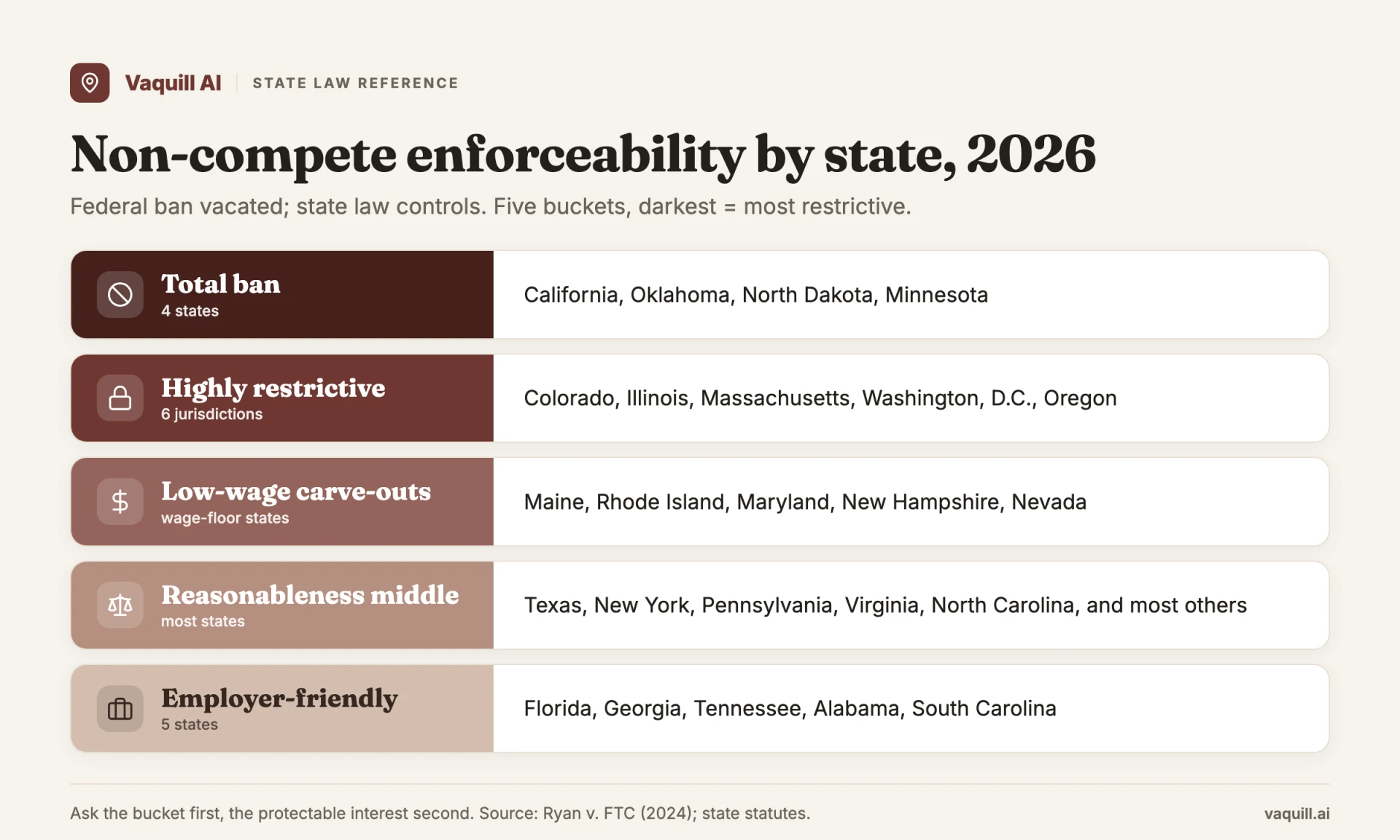
Every state sorts into one of five enforceability buckets; darkest is most restrictive.
TL;DR
- New York has no non-compete statute. Enforceability runs through the common-law reasonableness test in BDO Seidman v. Hirshberg, 93 N.Y.2d 382 (1999), as refined by Reed, Roberts Assocs. v. Strauman, 40 N.Y.2d 303 (1976).
- Governor Hochul vetoed S3100A in December 2023. Senator Sean Ryan reintroduced a narrower version as S4641 in February 2025; the Senate passed S4641 on June 9, 2025, but it stalled in Assembly Labor. A substantively identical bill, S9759, was re-introduced on April 6, 2026 and sits in Senate Labor. No ban is law yet.
- The BDR test is three-pronged. The legitimate-interest list is narrow: trade secrets, confidential customer information, or services that are unique or extraordinary.
- Financial-services covenants run through the Protocol for Broker Recruiting and FINRA Rule 2140, not a state non-compete statute.
- Inevitable disclosure remains disfavored. EarthWeb, Inc. v. Schlack, 71 F. Supp. 2d 299 (S.D.N.Y. 1999), aff'd, 205 F.3d 1322 (2d Cir. 2000), and Janus et Cie v. Kahnke, 2013 WL 4053804 (S.D.N.Y. Aug. 12, 2013), are still the citations to beat.
- Customer non-solicits survive when anchored to a real protectable interest. Equity-grant forfeiture covenants get more deference than wage-side non-competes.
Under New York's pending S4641 and S9759 bills, what compensation level would exempt a highly compensated individual from the non-compete ban?
Part of our all-50-states legal reference series.
The BDR framework: BDO Seidman v. Hirshberg
The Court of Appeals decided BDO Seidman v. Hirshberg, 93 N.Y.2d 382 (1999) in May 1999. The firm tried to enforce an eighteen-month, Buffalo-metro covenant against a former accounting manager who had taken some of his personal clients.
The court announced the operative test for the next two-plus decades and reformed the covenant in the process.
The three prongs, in the order BDO Seidman uses them:
- The restraint must be no greater than required to protect a legitimate interest of the employer.
- It must not impose undue hardship on the employee.
- It must not be injurious to the public.
Layered onto those three is a separate reasonableness inquiry into duration, geographic scope, and activity restrained, treated as part of prong one rather than a freestanding factor. Practitioners often describe the test as four-factor; the substantive law is the same.
The legitimate-interest list is the real bottleneck. BDO Seidman, building on Reed, Roberts Assocs. v. Strauman, 40 N.Y.2d 303 (1976), limits cognizable interests to: protection of trade secrets, protection of confidential customer information, and protection against competition by an employee whose services are "unique or extraordinary."
The court added one nuance specific to professional-services firms: an employer has a legitimate interest in the "client base the employer has developed at its own expense," but not in the personal clients the departing employee brought with him. That distinction reformed the covenant in BDO Seidman itself and is the most cited piece of the opinion.
The court also blue-pencils, but the New York version is narrower than Texas-style mandatory reformation. A court may partially enforce an overbroad covenant only where the employer shows "an absence of overreaching, coercive use of dominant bargaining power, or other anti-competitive misconduct."
The strategic consequence: a Texas drafter who loaded the covenant at twenty-four months nationwide and lost the reformation fight still walked out with an enforceable twelve-month regional covenant. The New York drafter loses the whole covenant because the overreach itself was treated as the bad-faith evidence that bars partial enforcement.
Blue-penciling in New York is a benefit reserved for the drafter who tried to write within the lines and missed by a little.
The vetoed statute and the bills still pending
S3100A passed both chambers in 2023 and reached the Governor's desk on December 12, 2023. It would have categorically prohibited non-compete agreements in employment, with a private right of action and liquidated damages up to $10,000 per violation.
Governor Hochul vetoed it on December 22, 2023. The veto message faulted the bill for the absence of an income threshold and a sale-of-business carve-out, and signaled willingness to sign a narrower version.
Senator Sean Ryan reintroduced the narrower bill on February 10, 2025 as S4641. The 2025 framework keeps the prohibition for ordinary workers but exempts "highly compensated individuals" earning an average annualized cash compensation of $500,000 or more (indexed annually to the New York State CPI for urban consumers).
Even for the highly compensated, the bill caps any permissible non-compete at one year, requires paid garden leave during the restriction, and excludes health-related professionals from the high-earner exemption.
The Senate passed S4641 on June 9, 2025 by a 40 to 22 vote and delivered it to the Assembly, where it stalled in the Assembly Labor Committee without being reported out. Senator Michael Gianaris then re-introduced a substantively identical bill, S9759, on April 6, 2026; as of mid-2026 it sits in the Senate Labor Committee and no version has reached the Governor since the 2023 veto. For now, BDR is the operative law.
The position to take in 2026 planning: assume the Hochul-approved framework lands in some form within the next two sessions, treat $500,000 as the threshold to design around, and write wage-side non-competes for sub-threshold workers as if they will be void by 2027.
The drafting bottleneck: what counts as a legitimate interest
Most New York non-compete fights collapse at the first prong. The employer pleads a legitimate interest in "confidential information and customer relationships" without specifying what, in this employee's hands, was actually confidential or proprietary.
Trade secrets. Real trade-secret protection survives. The pleading identifies the secret with reasonable particularity (formulae, source code, non-public pricing, customer lists not derivable from public sources). A generic recitation of "proprietary methods" does not clear the bar.
Confidential customer information. The cleanest pattern. The employee had non-public information about pricing, contract terms, decision-makers, or buying cycles, and is using it to displace the employer at specific accounts. The covenant is enforceable to the customer set the employee serviced. BDO Seidman's carve-out for the employee's personal clients is the cap.
Unique or extraordinary services. The narrowest path. Reserved for entertainers, professional athletes, and a small set of executives whose skills cannot be replaced from the market. Most senior corporate roles do not meet the standard.
The Commercial Division's Manhattan docket in 2024 produced a steady run of motions to dismiss granted on covenants that failed at prong one.
Multiplier Inc. v. Moreno, addressed in the Manhattan Commercial Division in 2024, is the pattern: a one-year nationwide non-compete in a Proprietary Information and Assignment Agreement, employer pleads "confidential information and customer relationships" without specifics, the covenant gets read as facially overbroad. The blue-pencil ask did not save it because the overreach (nationwide on a regional role) was itself the bad-faith indicator.
What this looks like in practice. The TRO papers that win identify a specific account where the employee had non-public information, name the confidential data set, and tie the requested injunction to that scope. The papers that lose ask for a blanket order shutting the employee out of "the industry."
A TRO denied at the first morning hearing is usually a non-compete dead at preliminary injunction, because the legitimate-interest finding has already been made against the employer on a thin record.
The drafting implication runs backward into the covenant itself: write the clause the TRO papers will need, not the clause the employer wishes it had.
Inevitable disclosure: still disfavored
The PepsiCo v. Redmond, 54 F.3d 1262 (7th Cir. 1995), inevitable disclosure doctrine never took root in New York. EarthWeb, Inc. v. Schlack, 71 F. Supp. 2d 299 (S.D.N.Y. 1999), aff'd, 205 F.3d 1322 (2d Cir. 2000), is still the canonical New York rejection: absent evidence of actual misappropriation or breach of a non-compete agreement, the doctrine applies only in the "rarest of cases."
Janus et Cie v. Kahnke, 2013 WL 4053804 (S.D.N.Y. Aug. 12, 2013), reinforced the line, refusing to recognize inevitable disclosure as a stand-alone claim absent allegations of actual misappropriation.
An employer trying to bootstrap a non-compete by arguing the employee will "inevitably" use confidential information is on a path the Southern District has been closing off for twenty-five years. The argument occasionally surfaces in TRO papers; it almost never holds up at preliminary injunction without separate evidence of actual taking.
Customer non-solicits: the lower-friction path
Non-solicitation covenants directed at customers receive friendlier treatment than non-competes, as long as they track BDO Seidman's scope. A clause restricting solicitation of customers the employee personally serviced or had material contact with during employment is enforceable in the run of cases.
A clause restricting solicitation of "any customer of the Company" usually is not, because it sweeps in customers the employee never met.
Employee non-solicits (no-raid clauses) face less scrutiny. Reasonable no-raid clauses (typically twelve months, limited to employees the departing person worked with) get enforced without the same intense BDR drilling.
The 2026 drafting move: lead with a tight customer non-solicit and a no-raid, and add the non-compete only where the legitimate-interest case is genuinely strong.
Industry-specific notes
Financial services. The Protocol for Broker Recruiting governs most adviser transitions between signatory firms. The Protocol lets a departing registered representative take a defined data set (client name, address, phone, email, account title) to a new signatory firm and use it to solicit those clients, overriding contractual non-solicits between Protocol firms.
FINRA Rule 2140 prohibits interference with a customer's request to transfer an account where there is no existing dispute. Major broker-dealers withdrew from the Protocol in 2017 and 2018, which is why TRO practice has migrated back to New York Supreme Court for non-Protocol transitions.
Practitioners sometimes conflate Rule 2140 with FINRA Rule 2070; Rule 2070 governs personal accounts of FINRA-associated persons, not broker mobility.
Healthcare. Physician non-competes are where New York courts are most openly skeptical, on public-policy grounds going back to Karpinski v. Ingrasci, 28 N.Y.2d 45 (1971). A narrow covenant where the employer has a real protectable interest in the patient base survives. Broader covenants get reformed downward or struck.
The pending Ryan/Gianaris framework (S4641 and its 2026 successor S9759) would itself ban non-competes for health-related professionals regardless of income, on top of the existing public-policy skepticism toward physician covenants.
Tech and VC-backed companies. New York courts give meaningfully more deference to restrictive covenants embedded in equity grants and vesting schedules. A non-compete tied to vested-share forfeiture gets a different undue-hardship analysis than a wage-side non-compete with no separate consideration: the employee is giving up money already on the table, not being stopped from earning.
Recent appellate authority worth tracking
Two things are happening in parallel. At the Commercial Division trial-court level, motions to dismiss on facially overbroad non-competes are getting granted more readily, even where the employer pleads a colorable trade-secret theory. Geographic-scope failure is the most common driver: nationwide or multi-state covenants in roles that are obviously regional do not survive a motion to dismiss the way they sometimes did in 2018.
At the appellate level, the framework is not changing; the First and Second Departments continue to apply BDO Seidman and its line of cases without expanding the legitimate-interest categories. The practical effect is asymmetric: the trial bench is doing more screening, the appellate bench is reinforcing the existing doctrine.
The Appellate Division has also clarified that restrictive covenants in commercial contracts (sale-of-business and partnership contexts) get more deference than employee covenants: bargained-for restraints between sophisticated parties with separate counsel survive at scopes that would fail in the employment context. The commercial-vs-employment line matters more in New York than in some other reasonableness states.
Drafting checklist for a covenant that survives BDR
A New York non-compete that holds up at motion to dismiss and preliminary injunction has the following structure.
Specific protectable interest, identified in the recitals. Not "confidential information generally." A defined category (non-public client pricing, deal pipeline, source-code architecture) tied to the role.
Duration calibrated to the interest. Six to twelve months is the comfortable band. Eighteen survives for executives with multi-year customer cycles. Twenty-four and beyond is for sale-of-business contexts; in employee covenants it reads as overreach.
Geographic scope tracking actual footprint. Pin geography to where the employee worked during a defined look-back. A New York City wealth manager's covenant covers the metro, not the United States.
Activity restraint tracking what the employee did. "Any business competitive with the Company" almost never survives. Solicitation of customers the employee serviced, or work in the specific competitor's specific product line, almost always does.
Doomed scope language: "Employee shall not directly or indirectly engage in any business that competes with the Company in any geographic area in which the Company conducts business." Defensible scope language: "Employee shall not, for twelve months following termination, solicit business from any client of the Company with whom Employee had material contact during the final twelve months of employment, in the product lines Employee covered, in the New York metropolitan area."
The first formulation is the one that triggers the bad-faith bar to partial enforcement. The second tracks the BDR factors and gives the court something to enforce.
Customer non-solicit and no-raid as first-line restrictions. The non-compete adds value only where genuine trade-secret exposure cannot be policed by the narrower covenants.
Consideration that is real and specific. Equity, signing bonuses with claw-back tied to the covenant, and specific training all work; "continued employment" alone is the weakest position.
A defensible choice-of-law clause. New York courts apply New York law where the work and employee are in New York, regardless of a Delaware choice. Include it but do not treat it as load-bearing.
A worked example. A New York fintech hires a head of sales at $475,000 base plus $200,000 in restricted units. First-instinct draft: eighteen months, United States, all fintech businesses, employment-letter consideration.
Disciplined draft: twelve months, New York City metro plus the three regions the head of sales actually manages, scope defined as direct-to-consumer wealth-management products competing with the company's specific line, with the equity grant as recited consideration and a customer non-solicit and no-raid as separate covenants.
The disciplined version survives a motion to dismiss. The first draft gets carved up and the company recovers nothing.
When to skip the non-compete entirely
Three calls separate the disciplined New York drafter from the one whose covenants get struck on motion.
When the customer non-solicit is enough, skip the non-compete. Sales roles, account-management roles, and most customer-facing operations roles. The protectable interest is the book; the customer non-solicit captures it. Adding a non-compete on top doubles the litigation exposure and almost never adds enforceable scope.
When the protectable interest is general industry experience, skip the non-compete. Senior individual contributors whose value at the new employer is their accumulated knowledge of the market are not running on confidential information.
A New York court reads "general skill and knowledge" as the employee's own, not the employer's. The covenant against this employee fails at prong one.
When the consideration is "continued at-will employment," skip the non-compete. A non-compete added mid-employment without separate consideration is the most fragile fact pattern in the New York case law. Pay for the covenant with equity, a retention bonus, or a meaningful raise, or drop the covenant entirely.
The clauses most likely to trigger judicial hostility, in rough order: nationwide geography on a regional role, "any business competitive with the Company" scope, restrictions on customers the employee never serviced, and any restriction on a healthcare practitioner where the employer cannot articulate a specific harm beyond competition.
Drafters who recognize these as red flags before filing a complaint avoid most of the trouble. Drafters who recognize them only at oral argument do not.
Multi-state employer notes
The fact pattern that produces the most missed exposure: a non-New York employer with a New York-resident employee on a template signed in another state, with an out-of-state choice-of-law clause. The employer assumes its home-state law governs.
New York courts and federal courts sitting in New York generally apply the materially-greater-interest analysis under the Restatement (Second) of Conflict of Laws § 187, and where the employee lives and works in New York, New York's interest is usually held materially greater. The choice-of-law clause does not survive where it would deprive a New York worker of BDR protection.
The reverse pattern matters too. A New York employer with employees in California should assume California law applies to the California-resident employee no matter the choice-of-law clause; § 16600.5 reaches the attempted enforcement itself.
FAQ
Are non-competes enforceable in New York in 2026? Yes, when they are reasonable. New York has no non-compete statute, so enforceability runs through the common-law BDO Seidman test. A covenant tied to a real protectable interest (trade secrets, confidential customer information, or unique services), reasonable in time and geography, can be enforced. An overbroad one is struck rather than trimmed.
Did New York ban non-competes? No. The Legislature passed a near-total ban (S3100A) in 2023, but Governor Hochul vetoed it on December 22, 2023. Narrower follow-on bills (S4641, then the substantively identical S9759 re-introduced April 6, 2026) remain in committee. No ban is law as of mid-2026.
What is the BDO Seidman test? It is the three-part reasonableness standard from BDO Seidman v. Hirshberg, 93 N.Y.2d 382 (1999). A non-compete is enforceable only if it (1) is no broader than needed to protect a legitimate employer interest, (2) does not impose undue hardship on the employee, and (3) is not injurious to the public. Courts also weigh duration, geography, and the activity restrained.
How long can a non-compete last in New York? There is no fixed cap under current law. Six to twelve months is the comfortable band for employee covenants; eighteen months can survive for executives with long customer cycles. The pending S4641/S9759 framework would cap any permitted non-compete at one year with paid garden leave.
Are physician non-competes enforceable in New York? Sometimes, but courts are openly skeptical on public-policy grounds going back to Karpinski v. Ingrasci, 28 N.Y.2d 45 (1971). A narrow covenant protecting a real patient-base interest can survive; broad ones get reformed down or struck. The pending bills would ban non-competes for health-related professionals regardless of income.
What is the $500,000 non-compete threshold in New York? It is the proposed exemption, not current law. Under S4641 and S9759, the ban would not apply to "highly compensated individuals" earning average annualized cash compensation of $500,000 or more (indexed to CPI). Those high earners could still be bound by a one-year non-compete with paid garden leave.
Does New York enforce out-of-state non-competes against New York employees? Usually it applies New York law instead. Where the employee lives and works in New York, courts run the materially-greater-interest analysis under Restatement (Second) of Conflict of Laws § 187 and generally apply BDO Seidman, even if the contract names another state's law.
For a cross-state view, see our non-compete enforceability by state map.
Drafting the BDR-compliant covenant that follows from that statute is its own task. Vaquill AI handles the drafting side, with playbooks that hold your preferred and fallback positions consistent across the fifty different state standards.
New legal AI guides, weekly.
Further Reading
California Non-Compete Section 16600 in 2026: The Strictest Ban in the US
Read postColorado Non-Compete Law in 2026: HB 22-1317 and the Highly Compensated Threshold
Read postFlorida Non-Compete Enforceability in 2026: The CHOICE Act + Section 542.335
Read postGeorgia Restrictive Covenants Act in 2026: Drafting Non-Competes That Survive
Read postIllinois Freedom to Work Act in 2026: Non-Compete Rules, Income Thresholds, and Drafting
Read postMassachusetts Non-Compete Agreement Act: A 2026 Drafting Guide
Read post
Co-Founder & CEO · Attorney
Arshita leads product and strategy at Vaquill, building the legal AI suite that solo, small-firm, and in-house US lawyers use to run a matter end to end.