A defense lawyer I traded notes with last winter was building a suppression motion around a Carpenter problem: cell-site location data, no warrant, the usual Fourth Amendment fight. She had the file in front of her. The affidavit, the docket, two prior orders from the same judge, a 30-page expert declaration on tower geometry.
And she did what a lot of smart people do now. She opened a general AI chat box and started asking it questions.
It answered beautifully. It explained the good-faith exception, summarized the Stored Communications Act, walked her through the relevant test. The only problem: it was answering about the law in the abstract, not about her case.
When she pasted in a paragraph of her affidavit and asked "does this fall inside the exception," the model cheerfully reasoned over the snippet she gave it and ignored the other 29 pages it had never seen. That is the gap this whole post is about.
To search matter files conversationally is not the same thing as pointing a chatbot at the law and hoping. It is the inverse of generic legal AI search, and the difference is not the model. It is the boundary.
Short answer: To chat with your legal documents, you put the matter's files into a bounded workspace and ask plain-language questions against that set. The system runs retrieval-augmented generation over only those documents, then answers with citations to the exact source span so you can open the page and check it. That is what separates "search legal documents with AI" from a generic chatbot: the AI answers from your file, not from the whole internet, and it can say "not in this file" instead of guessing.
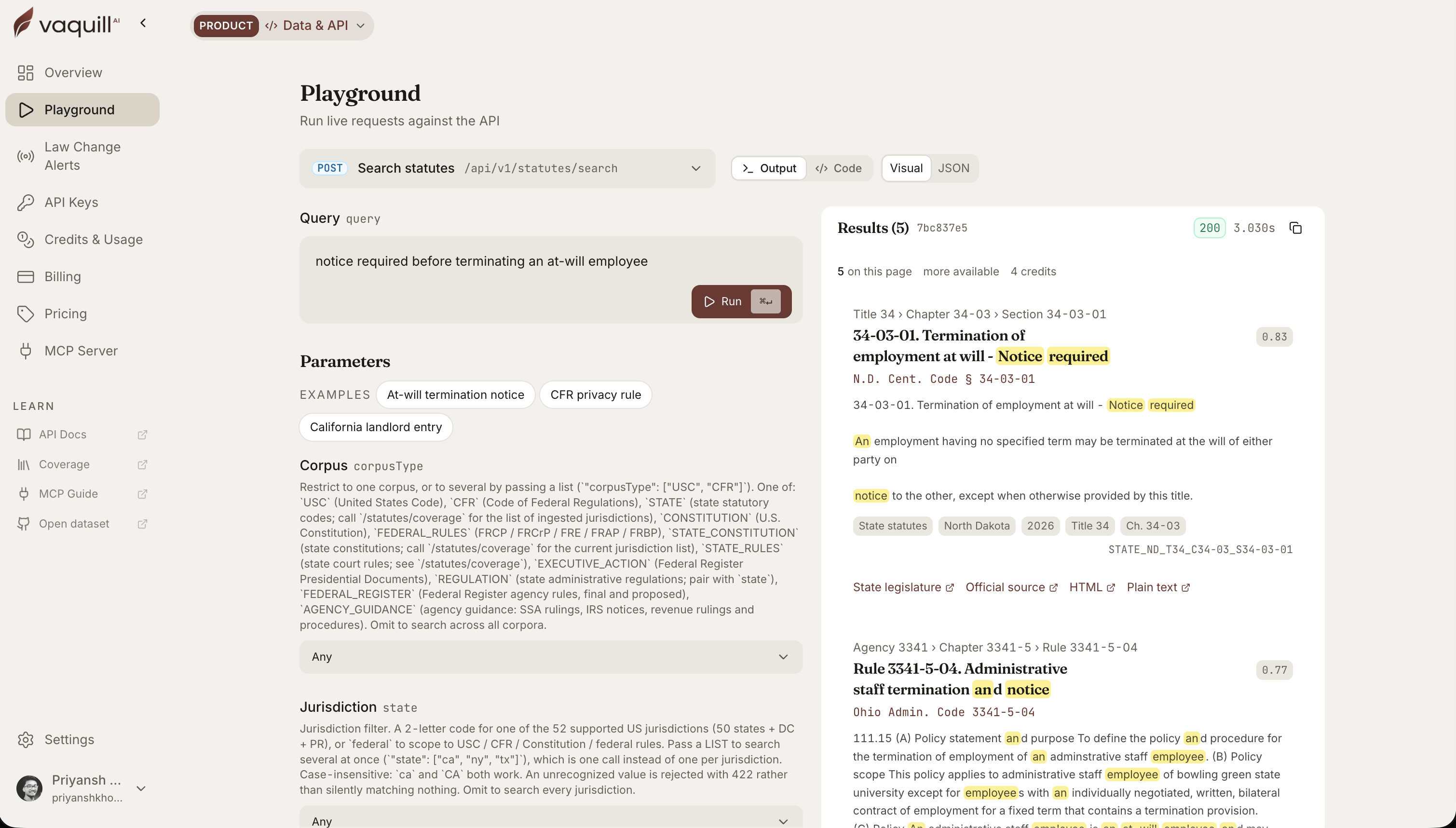 The same corpus behind this article, queried live. Every result carries its citation and a link to the official source.
TL;DR
- Conversational search over your matter files is not "a chatbot pointed at a folder." A generic assistant searches everything and guesses what is relevant. Matter-scoped search starts from a bounded, known set of documents and answers against that.
- The bounded set is the whole trick. A smaller, governed, persistent search space is what makes retrieval trustworthy, citations checkable, and answers reproducible session to session.
- Most people think the win is "the AI can read my files now." Wrong axis. The win is the boundary. Generic search fails silently with confident, wrong retrieval. Scoped search fails loudly or not at all.
- Good per-matter retrieval has four parts: a scoped corpus, character-verifiable citations back to your own documents, memory that survives the tab close, and structured output across the whole file (a grid), not one-document-at-a-time chat.
- This is now a tracked category, not a vendor claim. DeepJudge sells matter-scoped folder search; LQ.AI markets persistent matter-scoped projects with verifiable citations; Legaltech Hub tracks search and retrieval as its own GenAI use-case among top firms.
In the Stanford RegLab and HAI study the post cites, roughly what share of queries did Westlaw AI-Assisted Research hallucinate on?
Part of our document tools, redline, and matrix guide series.
For related document-tools coverage, see Autonomous Legal Research: What Agent Mode Actually Does (and Where It Breaks) and Legal AI Workflows: How Law Firms Chain Multi-Step AI Tasks in 2026, and how legal AI remembers your preferences across sessions.
The failure mode nobody puts on the invoice
Start with what actually goes wrong, because it is sneakier than people assume. The headline fear in legal AI is hallucination: the model invents a case, the lawyer files it, sanctions follow (the 2023 Mata v. Avianca mess made that the canonical horror story).
But matter search has a quieter failure that is arguably worse than a fabricated cite, because at least a fake citation can be caught by checking the reporter.
The quiet failure is silent false retrieval. You ask a generic assistant a question about your client, and it retrieves from a global blob: its training data, some uploaded fragments, maybe a few documents you happened to attach this session.
It produces a confident, fluent, internally consistent answer. And it is about the wrong matter, or a generic version of your matter, or a hallucinated relevance to documents it never actually read. There is no error. There is no refusal. There is just a wrong answer wearing the costume of a right one.
A refusal is honest. "I don't have that document" is a sentence you can act on. A confident answer grounded in nothing you can point to is a trap, and it is the default behavior of a chatbot that has no notion of scope.
The whole reason to search matter files conversationally inside a bounded workspace is to convert silent false retrieval into either a real answer or an honest "not in this file."
The inversion: search this matter, not everything
Here is the mental model that separates the two approaches.
Generic legal search is centrifugal. It starts from everything (every case, every statute, the model's entire training distribution) and tries to narrow inward toward what is relevant to your question. The model has to guess what counts as relevant, and guessing is exactly where it goes wrong.
Matter-scoped conversational search is centripetal. It starts from a known, bounded universe (the 40 documents in this client-matter file) and answers against that set. It does not guess what the relevant corpus is, because the relevant corpus is a fact, not an inference. You defined it when you put those documents in the matter.
That inversion is the entire value proposition, and it is why this is no longer a single vendor's pitch. DeepJudge, founded by ex-Google search engineers, sells exactly this and describes it in plain terms: "Ask questions about a client-matter file folder, or any set of documents, for quick insights and review."
They position it explicitly against knowledge "scattered" across SharePoint, OneDrive, the DMS, HighQ, email, and the intranet. That framing is telling. The problem they are naming is not "the model is not smart enough." It is "the relevant documents are everywhere and the search has no boundary." Matter scope is the boundary.
The analyst class has noticed. Legaltech Hub, in partnership with the SKILLS summit, now surveys top-tier firms on which GenAI tech they use specifically for search and retrieval as a standalone 2026 use-case.
When a capability gets its own tracked category among elite firms, it has stopped being a feature and become a buying axis.
Why a smaller search space is a better search space
This runs against software intuition. We are trained to think more data is more power, that the impressive system is the one indexing the whole internet. For retrieval grounding, the opposite is true, and it is worth being precise about why.
Retrieval-augmented generation (the architecture under all of this, covered in depth in how AI legal research actually works) works by finding the chunks of text most semantically similar to your question, then feeding them to the model as context. The quality of the answer is bounded by the quality of what gets retrieved.
In a global corpus, the nearest-neighbor search has millions of candidates, and "semantically similar" is a slippery target. A passage about the good-faith exception from a different jurisdiction, a different decade, a different fact pattern can score as highly relevant and land in the context window. The model dutifully reasons over it. You get a clean answer rooted in the wrong soil.
Constrain the corpus to one matter and three things improve at once.
- Precision goes up. When the candidate set is 40 documents instead of eight million opinions, the retrieved chunks are far more likely to be the ones you meant. There is simply less wrong material to surface.
- Verification becomes possible. A citation in the answer points to a document you can open, on a page you can read, in a file you control. The claim is character-verifiable against your source, not a plausible reconstruction from somewhere.
- Reproducibility holds. Ask the same question next Tuesday and the corpus has not silently shifted under you. The answer is stable because the search space is stable.
That last point is underrated. Reproducibility is the difference between a tool and a toy in legal work.
If the same question over the same file can yield materially different answers depending on what the model happened to pull from the global blob that day, you cannot build a workflow on it, and you certainly cannot put your bar number behind it.
What good per-matter retrieval actually looks like
The same corpus behind this article, queried live. Every result carries its citation and a link to the official source.
A grounded answer over the matter's own files: each claim carries a clickable citation into the source PDF, a verification badge, and a source picker you scope to this matter.
So if "chatbot pointed at a folder" is the wrong picture, what is the right one? Four properties, and a tool that has all four is doing something a chat box structurally cannot.
1. A scoped corpus you define
The first requirement is that the search universe is bounded and yours. Not "the model plus whatever you pasted," but a defined set of documents that constitutes this matter. The act of choosing what goes in the matter is the act of telling the system what to ground in.
This is the Clients and Matter workspace doing its real job: it is not filing-cabinet hygiene, it is the boundary that makes retrieval honest. The matter also carries its own context, the client it belongs to and the matter metadata, and the AI uses that, so a question is answered in light of whose file it is.
You can also tighten the scope inside a matter. In the composer, mention specific documents by name to chain just those into one question, so "across these three exhibits" means exactly three, not the whole file. And when the ask is really a task, the chat hands it off: say "compare these two versions" or "review this against our playbook" and it offers a one-click button into the comparison, matrix, review, or drafting tool instead of forcing the answer into chat prose. The companion piece on why the matter folder is the structural bet in legal AI argues the strategic case for that boundary. This post is about living inside it.
2. Citations that point back to your documents
A grounded answer is only as good as your ability to check it. Good matter search returns citations that resolve to the exact source: this document, this passage, character-verifiable against the original.
This is converging into an industry spec. LQ.AI explicitly markets "character-verifiable citations against source documents," and the broader market is following, because the alternative (a footnote you cannot trace) is just hallucination with better manners.
The same discipline applies whether the source is your own affidavit or a published opinion. When the answer leans on case law rather than your file, it grounds in Vaquill AI's own US case law corpus of millions of court opinions, the public-law backbone behind the matter work.
A verifiable citation means you can open Carpenter v. United States, 585 U.S. 296 (2018) and read the holding yourself, not take the model's word for it. The discipline of verifying AI citations before filing is non-negotiable, and scoped retrieval is what makes verification a click instead of an investigation.
3. Memory that survives the tab close
This is where the lawyer in my opening story kept losing. She would establish, over the course of an afternoon, that this judge reads Carpenter narrowly, that the affidavit's timeline had a gap on the 14th, that the good-faith argument was the weaker of her two theories. Then she closed the tab and all of it evaporated. The next morning she rebuilt context from scratch.
Per-matter memory fixes the wrong axis if you think of it as a convenience feature. It is not about saving keystrokes. It is about state: the matter accretes knowledge over time the way a competent associate would, so that the question you ask in week three is answered in light of everything established in weeks one and two.
A chat box is amnesiac by design. A matter that remembers is the difference between a colleague and a stranger who is very good at trivia.
4. Structured output across the whole file, not one document at a time
This is the property that most cleanly separates real matter search from chat, and most people miss it. Conversational Q&A is inherently one-thread-at-a-time. You ask, it answers, you ask again.
That is fine for a single question, but a matter is not a single question. A matter is "across all 23 exhibits, which ones reference the cell-site data, what date does each one assign to the tower ping, and which contradict each other."
That is not a chat answer. That is a grid.
The document matrix approach (extracting the same fields across dozens of documents into a tabular view) is the structured counterpart to conversational search, and it is the capability a chatbot cannot fake. A breakdown of what a document matrix is and why it matters walks through this in detail.
The short version: conversational search answers "what does this document say about X," and structured matter search answers "what does every document say about X, side by side." You need both, and a generic chat box gives you only the first.
A concrete walk-through: the suppression motion
Make it tangible. Take that Carpenter suppression motion and work it two ways.
The generic way. Open a chat box. Paste the affidavit. Ask whether the good-faith exception applies. Get a thoughtful answer about the doctrine. Realize it did not account for the prior order you forgot to paste. Paste the order. Ask again. Get a slightly different answer.
Close the tab. Tomorrow, repeat from zero. Somewhere in there, the model confidently cites a standard that is not quite the one your circuit applies, and you only catch it because you happened to know better.
The matter-scoped way. The affidavit, the docket, both prior orders, and the expert declaration already live in the matter. You ask: "Across these documents, where does the affidavit establish the timeline of the location requests, and does any order address the warrant requirement under the Stored Communications Act?"
Here is the shape of a grounded answer to that question:
The affidavit sets the location-request window at "March 3 through March 19" (Affidavit, p. 4). The June 12 order denies the prior suppression motion but does not reach the warrant question; it rests on standing (Order on Motion to Suppress, June 12, para. 7). No document in this matter addresses the Stored Communications Act warrant requirement directly.
Every bold reference resolves to a page or paragraph in a file you can open. The last sentence is the part a generic chatbot will not give you: an honest "not in this file" instead of a fluent guess. You note, and the matter remembers, that this judge reads Carpenter narrowly.
The statute itself (18 U.S.C. § 2703, the Stored Communications Act provision on required disclosure of customer records that sits under Carpenter) is the one piece that lives outside your file, in the public law. Pulling that section is a statutes lookup job: the public API covers statutes and legislation (U.S. Code, CFR, all 52 state and territory codes), and § 2703 is exactly the kind of section it returns.
Case-law lookup against public opinions is an in-product workbench feature, not an API. But working the matter around it, the affidavit, the orders, the timeline, the grid, the memory, is the in-app workspace job, not any API call.
That split is worth holding onto, because the industry blurs it constantly. Searching the public law is one thing. Searching your file is a different thing, and the second is where the leverage is.
The limit: scoped retrieval lowers the error rate, it does not zero it
Worth saying plainly, because the rest of this post sells the upside. Bounding the corpus and citing back to it makes verification fast and cheap. It does not make the model infallible.
Two failure paths survive even inside a clean matter. The retriever can pull the wrong chunk when documents in the same file use near-identical language, a known weakness when standardized legal text confuses semantic similarity. And the model can still phrase a fact slightly wrong even when the right chunk is in front of it.
The numbers from independent testing keep this honest. In the Stanford RegLab and HAI study "Hallucination-Free? Assessing the Reliability of Leading AI Legal Research Tools" (Magesh, Surani et al., May 2024, later peer-reviewed in the Journal of Empirical Legal Studies in 2025), the leading research tools still hallucinated on a meaningful share of queries: Lexis+ AI about 17 percent and Westlaw AI-Assisted Research about 33 percent. Those are research tools over public law, not matter-scoped tools over your file, so the rates are not directly comparable. The lesson transfers anyway: grounding lowers error, it does not remove the duty to check.
So the value of a verifiable citation is not that you can skip reading the source. It is that reading the source is a single click instead of a search. Scoped retrieval makes the check tractable. You still do the check.
Where this is heading
The category is consolidating around a simple recognition: answer quality is commoditizing, and the durable differentiator is information architecture. Every serious tool rents the same frontier models from the same handful of labs, so the raw answer is converging. What does not converge is how the product organizes work around a matter, scopes retrieval to it, verifies against it, and remembers it.
That is why DeepJudge leads with folder-scoped search, why LQ.AI leads with persistent matter projects and verifiable citations, and why the analyst surveys now treat search and retrieval as its own line item.
The chatbot was the demo. The matter workspace is the product. The skeptical version of this claim ("isn't this just a chatbot with extra steps?") gets the steps exactly backwards. The steps (scope, verify, persist, structure) are the point. The chat is the thin interface on top.
If you take one thing from this: stop evaluating legal AI on how good the answer sounds and start evaluating it on whether you can trust where the answer came from.
A bounded corpus, citations you can open, memory that holds, and a grid across the whole file. That is what good per-matter retrieval looks like, and it is not something you bolt onto a chat box after the fact. It is the architecture or it is not there at all.
FAQ
Can AI chat with my legal documents? Yes. You upload the documents into a workspace and ask plain-language questions, and the AI answers from the content of those files. The useful versions do this with retrieval-augmented generation over a bounded set and return citations to the exact passage, so you can open the source and confirm the answer rather than trust it.
How do I search legal documents with AI? Put the relevant files in one matter or folder, then ask a natural-language question like "where does the affidavit set the timeline" or "which exhibit references the cell-site data." The system retrieves the closest matching passages from that set and composes an answer grounded in them. The key choice is scoping the search to your file instead of letting the model answer from its training data.
Can I ask questions about a contract with AI? Yes. You can ask things like "what is the governing law," "what is the liability cap," or "summarize the termination terms," and get an answer drawn from the contract text. Most tools limit answers to the language inside the document itself, so they will not answer general legal questions or facts outside the file, which is the behavior you want for accuracy.
Is chatting with documents the same as a legal chatbot? No. A generic legal chatbot answers about the law in the abstract from its training data. Document chat answers about your specific files from a bounded corpus you defined. The difference is scope: one guesses what is relevant, the other retrieves from a known set and can say "not in this file."
How accurate is AI document search, and can it hallucinate? It can still make mistakes. Independent testing of legal research tools found hallucination rates of roughly 17 to 33 percent (Stanford RegLab and HAI, "Hallucination-Free?", Magesh, Surani et al., May 2024). Matter-scoped retrieval lowers the risk by grounding answers in your documents and citing them, but you still need to open the cited passage before relying on it.
What is retrieval-augmented generation in legal AI? Retrieval-augmented generation, or RAG, finds the passages most relevant to your question and feeds them to the model as context before it answers. In legal document chat, this is what grounds the answer in your files instead of the model's memory. A deeper walkthrough is in how AI legal research actually works.
Will the AI remember my matter between sessions? Only if the tool is built for it. A plain chat box forgets everything when you close the tab. A matter-scoped workspace can persist what you established (which theory is weaker, where a timeline has a gap) so the next session starts from that state instead of from zero.
Can AI compare an answer across many documents at once? Conversational chat answers one thread at a time, so it is weak at "what does every document say about X." The structured counterpart is a document matrix, which extracts the same fields across dozens of files into a grid. You want both: chat for a single question, a matrix for the whole file side by side.
New legal AI guides, weekly.
Further Reading
What Is NDA Triage? How Lawyers Sort Inbound NDAs in Minutes With AI
Read postNDA Triage AI: How AI NDA Review Works and How to Evaluate a Tool (2026)
Read postLegal Research Agent: What Agentic AI Agent Mode Actually Does (and Where It Breaks)
Read postWhat Is a Document Matrix? Extract the Same Fields Across Dozens of Docs
Read postHow to Draft a PI Demand Letter and Build the Chronology With AI
Read postCan AI Analyze Legal Documents? Extraction Across 50 Contracts at Once
Read post
Product & Content
Legal AI suite for US working lawyers: research, drafting, document comparison, document matrix, matters, and citation-verified answers, in one tool.