In May 2026, Harvey did something unusual for a legal-AI company. It shipped a benchmark and then refused to put a leaderboard on it.
The benchmark is called LAB, the Legal Agent Benchmark: more than 1,200 agent tasks across 24 practice areas, graded against over 75,000 expert-written rubric criteria. The kind of thing a vendor normally builds so it can announce a number, plant a flag, and run the chart in a deck.
Harvey built it and then declined to rank anyone, including itself. The reason they gave is the most honest sentence I have read from a legal-AI company all year: a deal-team report that identifies eight of ten risks is not eighty percent useful, it is materially incomplete.
That single line tells you almost everything you need to know about autonomous legal research. The technology is real. The word "autonomous" is doing a lot of marketing work it has not earned. And the gap between the two is where careers, and clients, get hurt.
Short answer: A legal research agent is an AI that runs research as a multi-step loop instead of a single answer. It plans the question into sub-questions, retrieves statutes and cases through tools, reads what it finds, synthesizes a memo, and checks itself, then hands the result to a lawyer to verify. Agentic legal research is good at the gathering. It cannot own the verification, and the named products running agent mode (Harvey, CoCounsel, Legora) all keep a human at that gate.
TL;DR
- Agent mode is genuinely good at the boring middle of research: planning a workflow, pulling sources in parallel, and extracting structured data across many documents at once.
- Legal work is graded all-pass, not partial-credit. An agent that catches eight of ten issues is not eighty percent done, it is a malpractice exposure with a nice progress bar.
- The failure mode nobody demos is silent partial completeness. Long-horizon agents compound a bad early assumption into a confidently wrong final answer, and the run looks clean the whole way.
- The benchmarked scores you see (90 percent and up) are mostly short-horizon question-answering. The actual agentic research workflow is long-horizon, and even the vendors will not post a number on it yet.
- The win is bounded autonomy: let the agent draft the plan and pull grounded, citable sources, and keep the lawyer at the verification gate. Hands-off delegation is not a product, it is a sanctions risk.
Why does the post say an agent that catches eight of ten risks is not eighty percent useful?
Part of our document tools, redline, and matrix guide series.
For related document-tools coverage, see Legal AI Workflows: How Law Firms Chain Multi-Step AI Tasks in 2026 and Which Legal AI Is Best in 2026? A Capability Comparison of Agentic Suites, and what a legal AI agent does across one in-house task, start to finish.
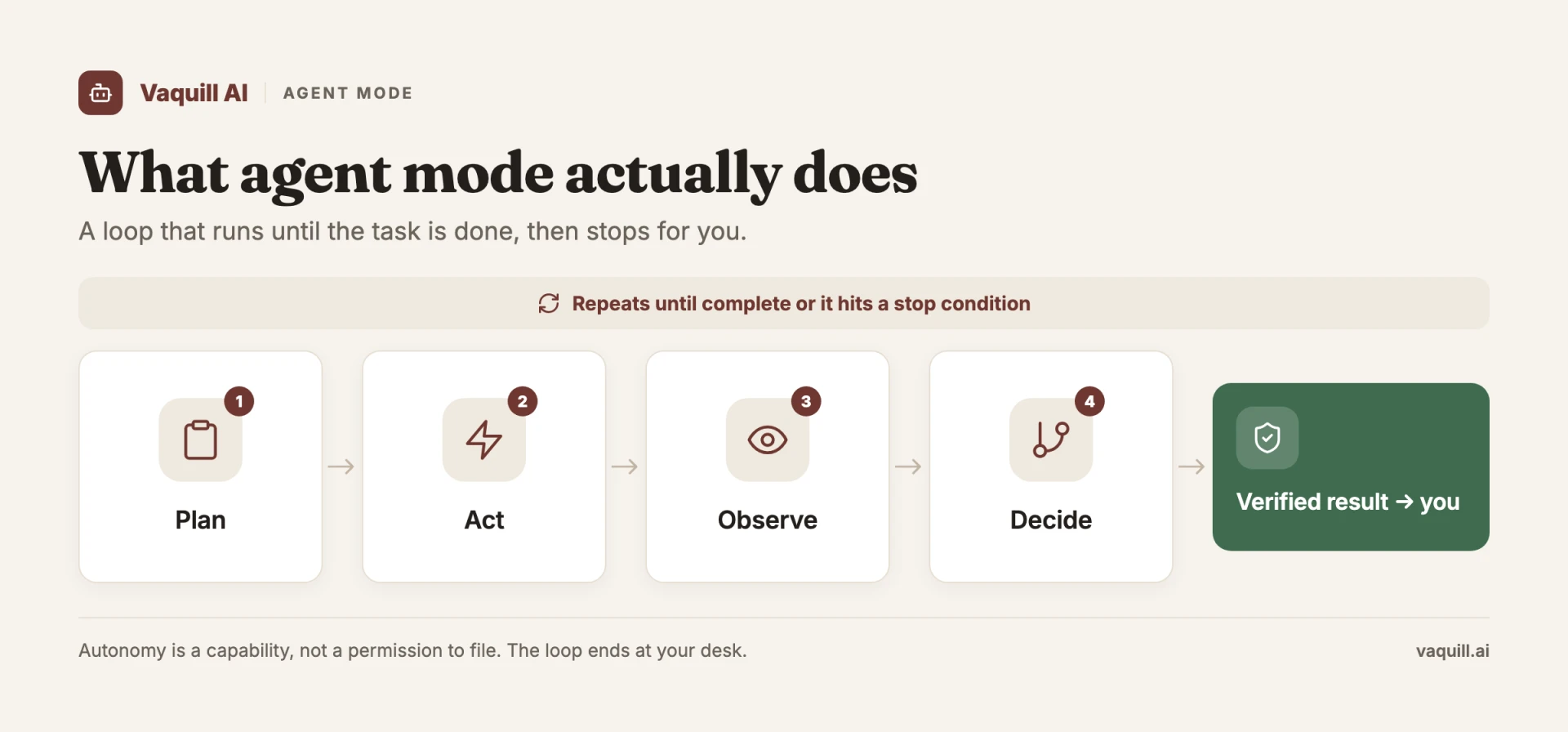
Agent mode is a loop that runs until the task is done, then returns a verified result for your approval.
What a legal research agent actually is, minus the magic
Strip away the branding and a legal research agent is a loop. The model reads your question, writes itself a plan ("find the controlling standard, pull the relevant statutes, check for recent reversals, summarize the split"), then executes each step by calling tools: a search, a fetch, an extraction, another search informed by what it just found.
It reads its own intermediate output, decides what to do next, and keeps going until it thinks it is done.
That is the part that is genuinely new and genuinely useful. A single-shot chat answers the question you asked. An agent decomposes a vague question into the five sub-questions a competent associate would have asked, then chases each one.
The clean way to see the difference is the number of steps. A single query is one retrieve-and-answer pass: it pulls whatever the first search returns and writes from that, with no way to notice a gap or try again. A legal research agent runs five distinct moves: plan, retrieve, read, synthesize, verify. It interleaves reasoning with tool calls, judges whether what it pulled is enough, and loops back to search again when it is not. Harvey describes its own agentic search in roughly these phases, from query planning to a completeness check to a citation-backed response (How Agentic Search Unlocks Legal Research Intelligence, Harvey, 2026). The verify step is where the honest products stop short of full autonomy, and the rest of this piece is about why.
If you have ever handed a second-year a fuzzy "figure out our exposure on the non-compete" and gotten back a structured memo, you understand the appeal. The agent does the legwork of the boring middle: the planning, the parallel retrieval, the pulling of forty documents into one place.
Where this shines is structured extraction. Point an agent at a folder of fifty contracts and ask for governing law, assignment clauses, and change-of-control triggers, and it will give you a grid. That is the work that used to eat a Saturday.
It is also, not coincidentally, the work that fails loudly rather than silently: if a cell is blank, you see the blank. We wrote about exactly this kind of bounded task in our NDA triage evaluation, and it is the clearest example of agents earning their keep. The task is narrow, the output is verifiable at a glance, and a miss is visible.
The trouble starts when the task stops being narrow.
Why legal work breaks the partial-credit assumption
Most AI benchmarks are graded like a school exam. Get 90 of 100 questions right and you score 90 percent, which sounds like an A.
The Vals AI and Legaltech Hub study from early 2025 reported numbers in exactly this register: Harvey's assistant around 94.8 percent on document question-answering, CoCounsel around 89.6 percent, chronology generation in the high seventies. Those are real, careful numbers, and they are encouraging. They are also measuring the wrong thing for the work people most want to automate.
Notice what that same study did with legal research: it deferred it to a separate report. The single most-hyped use case, the one every demo opens with, was the one they would not yet score. That is not an accident. Research is long-horizon and open-ended, and the grading model that works for question-answering falls apart.
Here is the core problem. Legal deliverables are graded all-pass. A brief that cites nine good cases and one case that was overruled last term is not a strong brief with a minor flaw. It is a brief that can get you sanctioned.
A due-diligence memo that surfaces every material risk except the one that actually kills the deal is worse than useless, because it manufactures false confidence. The cost function is not linear. It is closer to a step function where one bad item can zero out the value of everything else.
This is why Harvey shipped LAB without a leaderboard and why Bob Ambrogi noted at LawNext that the benchmark might "complicate" the agentic narrative by revealing how far agents still are from autonomous practice. When you grade legal agents the way legal work is actually graded, all-pass against expert rubrics, the cheerful 90-percent numbers do not survive contact.
The failure mode nobody puts in the demo
Every agent demo shows the happy path. Question goes in, the little status lines tick by ("Searching... Reading... Synthesizing..."), a clean answer comes out, the room nods. What the demo never shows is the run where step three made a wrong assumption.
Long-horizon agents compound errors. Microsoft's own taxonomy of failure modes in agentic systems makes the point in dry engineering language, and practitioners say it more bluntly: design your agents around how they fail, not how they succeed.
If an agent misreads the controlling jurisdiction at step three, every subsequent step inherits that error. It searches the wrong state's code, it weighs the wrong precedents, it builds a chronology around the wrong statute of limitations.
By step two hundred it produces a beautifully formatted, internally consistent, completely wrong memo. And it does this with no visible distress signal. The progress bar fills. The citations are formatted correctly. Nothing flashes red.
That is the thing to internalize. The danger is not the obvious hallucination. We already learned that lesson the hard way in 2023, when lawyers in Mata v. Avianca filed a brief full of cases ChatGPT invented and got sanctioned for it.
That was a single-shot failure, easy to understand in hindsight, and it became the canonical cautionary tale (we walk through it and the sanctions risk in detail elsewhere). Agentic research introduces a subtler version: not a fabricated case, but a real case applied to the wrong question because an upstream step drifted. Silent partial completeness. The output is plausible, grounded, and wrong in a way you only catch if you redo the reasoning yourself.
If you have to redo the reasoning yourself to trust it, you have to ask what the autonomy actually bought you.
"Autonomous" is a capability, not a permission
This is where I think the industry quietly conflates two different things: autonomy and reliability. They are not the same. Autonomy is the agent's ability to take many steps without asking. Reliability is whether those steps are correct.
You can have a highly autonomous agent that is unreliable, and that combination is the worst of both worlds, because it produces the most polished wrong answer with the least human friction.
ABA Formal Opinion 512, issued in July 2024, settled the professional-responsibility question before the agents even arrived. The duty of competence and the duty to verify sit with the lawyer, full stop.
It does not matter how many steps the tool took or how confident it sounds. You cannot delegate the verification gate to the thing that produced the work, any more than you would let an associate grade their own memo and file it unread.
So the honest framing is not "how autonomous can we make the agent." It is "where do we put the human gate so the autonomy is bounded." The most reliable pattern I have seen in practice looks like this:
- The agent owns the plan. Let it decompose the question and propose the research steps. This is genuinely where it adds value, and a wrong plan is cheap to catch because you can read it in thirty seconds.
- The agent owns retrieval, but only grounded retrieval. Every source it pulls should carry a citation you can open. Generation that summarizes real opinions and statutes via retrieval, not a model reciting from training memory, is the difference between a checkable claim and a confident guess. This is the RAG mechanism underneath good legal AI.
- The lawyer owns the verification gate. Not "spot check." Verify the load-bearing claims, the controlling authority, the procedural posture. The agent saved you the gathering; it did not save you the judgment. Our checklist for verifying AI legal citations before filing walks through what that pass actually involves.
That is bounded autonomy. It is less sexy than "fire and forget," and it is the only version that survives a malpractice carrier's questions.
What grounding looks like in practice
Let me make the grounding point concrete, because it is the whole ballgame. The difference between a useful agent and a dangerous one is whether every claim resolves to a source you can click.
A grounded statute lookup returns the actual section, with its citation and a link to the official source. Ask a properly wired system for 42 U.S.C. § 1983 and you should get back "Civil action for deprivation of rights," the section text, and a govinfo.gov source URL, not a paraphrase the model is confident about.
That is the bar. When you see the citation and the link, you can verify in seconds. When you see only a fluent paragraph, you have to take the model's word for it, and taking a model's word for it is precisely how the Mata lawyers ended up in front of a judge.
This is the design principle behind the better in-product research surfaces on the market: every claim resolves to a real opinion or statute section, surfaced through features like an agent mode, a document matrix for multi-doc extraction, a chronology builder, and multi-step workflows.
Case-law grounding lives inside those product features; public APIs in this category, where they exist, are typically scoped to statutes and regulations. The design philosophy matters more than the brand: if the agent cannot show you the source, the autonomy is a liability, not a feature.
The named tools running agent mode today
Every serious legal-AI vendor now ships some version of an agentic research mode. The labels differ; the loop underneath is the same.
- CoCounsel (Thomson Reuters). CoCounsel Legal launched its multi-agent Deep Research in August 2025, grounded in Westlaw and Practical Law, chaining specialized agents (case law, statutes, synthesis) and returning a citation-backed report with a visible plan (Legal IT Insider, August 2025).
- Harvey. Harvey ships Agentic Search plus Deep Analysis, its mode for multi-source reports across large internal corpora. Deep Analysis launched November 4, 2025 and plans a strategy, runs iterative searches, and returns a citation-backed report in minutes (Introducing Harvey's New Reasoning Capabilities, Harvey, November 2025).
- Legora. Competes in the same agentic tier, leaning on a collaborative drafting and review workspace rather than a single research engine.
- Lexis+ AI / Protege (LexisNexis). A pre-built agentic toolkit grounded in the Lexis corpus, aimed at firms that want guardrails over a build-your-own platform.
- Claude-plus-MCP stacks. Leaner setups wire a general model to legal sources through tools (the Model Context Protocol), trading a polished suite for control over which sources the agent can reach.
The capabilities are converging. The real decision is not whose agent is smartest. It is whose agent shows you the plan, grounds every claim in a source you can open, and makes the verification step feel natural instead of optional. We compare these suites head to head in Which Legal AI Is Best in 2026?
The part that has nothing to do with the model
Here is the finding that surprised me most, and it is not technical. Thomson Reuters ran a "premortem" exercise on agentic pilots in 2026, and their conclusion was that pilots fail less on the technology than on organizational readiness. Two lines stuck with me: "GenAI success is not a proxy for agentic AI readiness," and "misaligned incentives kill more pilots than bad technology."
Think about what that means. A firm can have a fantastic agent and still fail, because the associates are measured on billable hours and an agent that compresses ten hours of research into one threatens the very metric people are paid on.
Or because nobody defined who owns the verification gate, so everyone assumes someone else checked. Or because the partner who championed the pilot leaves and the muscle memory never formed. The model was never the bottleneck. The workflow around the model was.
This squares with the broader cost and capability reality of the AI-native incumbents. The vendors competing here, Harvey, Legora, CoCounsel, and the leaner Claude-plus-MCP stacks, are all converging on similar agent capabilities. The differentiation is increasingly not "whose agent is smarter" but "whose workflow makes verification natural and whose incentives let the firm actually adopt it."
Where this is heading
I do not think "autonomous legal research" is hype. I think it is mislabeled. What is actually arriving, and arriving fast, is agentic assistance: tools that take the planning and gathering off your plate so your judgment goes further. That is a real productivity gain, and on bounded, verifiable tasks like clause extraction or chronology assembly it is already worth the money.
What is not arriving, and the serious vendors now admit this by their actions, is hands-off delegation of all-pass legal work. Harvey building the toughest benchmark in the category and then declining to declare a winner is the tell.
They know the scores are not where the marketing implies, and they had the integrity to measure it honestly rather than ship another inflated demo.
So when you evaluate an agent, do not ask "how autonomous is it." Ask three sharper questions. Can I see the plan before it runs? Does every claim resolve to a source I can open? And who, on my side, owns the gate that says this is good enough to file?
Get those three right and agent mode earns its place in your stack. Get them wrong and you have automated your way to a faster, more confident mistake.
The agents are good. They are not associates.
Treat the difference as a feature of how you work, not a flaw to wait out.
FAQ
What is a legal research agent?
A legal research agent is an AI that handles a research question as a multi-step workflow instead of a single answer. It plans the question into sub-questions, retrieves statutes and cases through tools, reads what it finds, synthesizes the result, and checks itself before handing the work to a lawyer. The lawyer still verifies the load-bearing claims.
How is agentic legal research different from a normal AI search?
A normal AI search is one retrieve-and-answer pass: it writes from whatever the first search returns. Agentic legal research interleaves reasoning with tool calls across five moves (plan, retrieve, read, synthesize, verify), judges whether what it pulled is enough, and loops back to search again when it is not. That iteration is what lets it chase a vague question down to the sub-questions a competent associate would have asked.
What does AI legal research agent mode actually do?
Agent mode runs the gathering: it decomposes the question, pulls sources in parallel, extracts structured data across many documents, and drafts a citation-backed memo. It is strong on bounded, verifiable tasks like clause extraction across a folder of contracts. It does not replace the lawyer's verification of controlling authority and procedural posture.
Which tools offer a legal research agent?
CoCounsel (Deep Research, August 2025), Harvey (Agentic Search and Deep Analysis, November 2025), Legora, and Lexis+ Protege all ship an agentic research mode, along with leaner Claude-plus-MCP setups. The capabilities are converging; they differ mostly on which legal corpus they search and how naturally they surface the verification step.
Can a legal research agent replace a lawyer?
No. ABA Formal Opinion 512 (July 2024) places the duty of competence and the duty to verify on the lawyer, regardless of how many steps the tool took or how confident it sounds. The agent saves you the gathering; the judgment stays yours. Hands-off delegation of all-pass legal work carries real malpractice exposure.
Why do legal research agents still need human verification?
Long-horizon agents compound errors silently. If an early step misreads the controlling jurisdiction, every later step inherits the mistake and the run still looks clean: the progress bar fills, the citations are formatted, nothing flashes red. The output can be plausible, grounded, and wrong in a way you only catch by redoing the reasoning, so a human stays at the gate.
Is autonomous legal research just hype?
Mislabeled is closer than hype. What is arriving is agentic assistance that takes planning and gathering off your plate, which is a real productivity gain on bounded tasks. What is not arriving is hands-off delegation. Harvey building the toughest benchmark in the category (LAB) and then declining to rank anyone is the tell.
A closing takeaway
Agent mode earns its place when the plan is visible, every source is citable, and a human still owns the gate.
New legal AI guides, weekly.
Further Reading
What Is a Document Matrix? Extract the Same Fields Across Dozens of Docs
Read postHow to Draft a PI Demand Letter and Build the Chronology With AI
Read postCan AI Analyze Legal Documents? Extraction Across 50 Contracts at Once
Read postDocument Matrix vs Document Comparison: Grid vs Redline
Read postWhat Is NDA Triage? How Lawyers Sort Inbound NDAs in Minutes With AI
Read postNDA Triage AI: How AI NDA Review Works and How to Evaluate a Tool (2026)
Read post
Product & Content
The US primary law data API: statutes, regulations, constitutions, court rules, executive orders and agency guidance across 53 US jurisdictions, each section cited and linked to its official source, via REST, MCP or SQL.