Ask ten plaintiff lawyers what the hard part of a demand letter is, and almost none of them will say "the writing." The prose is the easy 20 percent. The hard part is the part nobody sees in the finished package: reconstructing a defensible factual record out of 1,400 pages of records from five providers, getting the specials to add up to the penny, and finding case law that actually supports your valuation instead of just sounding like it does.
That is where an AI personal injury demand letter workflow either earns its keep or quietly sets you up for a malpractice problem. Used well, AI is a verification-accelerator on the facts and the citations. Used badly, it is a one-prompt letter mill that invents a treatment date here, a fake appellate case there, and a settlement number out of thin air.
The difference between the two is not the model. It is where you put the human gates.
This is a narrow, operational how-to: one end-to-end demand build, the chronology and specials underneath it, and the three points where a human has to stop and check before anything moves forward.
If you want the wider survey of what PI AI touches across the whole practice, the Personal Injury AI in 2026 guide is the zoom-out companion. This post assumes you already know AI helps and want to know exactly how to run the play without getting burned.
TL;DR
- The deliverable is not the letter. It is the chronology and the itemized specials. Get those right and verified, and the letter is mechanical.
- Build the workflow with three non-negotiable human gates: (1) the chronology against source pages, (2) every legal citation, (3) the demand number.
- AI is great at extraction across dozens of records and at assembling timelines. It is dangerous at producing citations and numbers, because those are exactly the outputs that look authoritative and are wrong.
- A realistic time budget: roughly 180 minutes manual versus around 75 minutes AI-assisted on a straightforward file, per Quilia's 2026 breakdown. The savings come from extraction, not from skipping verification.
- The PI-specific vendor field is crowded (ProPlaintiff, Tavrn, AI Demand Pro). The real differentiator is extraction across records plus auto-chronology in one suite, not a point tool that drafts prose.
Where does this workflow tell you to put the three non-negotiable human gates?
Part of our document tools, redline, and matrix guide series.
For related document-tools coverage, see Search Your Matter Files Conversationally: What Good Per-Matter Retrieval Looks Like and Autonomous Legal Research: What Agent Mode Actually Does (and Where It Breaks), and how to build a litigation chronology from documents with AI.
Stop thinking of the letter as the deliverable
Here is the reframe that changes the whole workflow. The demand letter is downstream. It is the readable wrapper around two artifacts that do the actual work:
- The medical chronology. Dated treatment events, providers, diagnoses, procedures, in order, with no gaps you can't explain.
- The itemized specials. Every billed amount, tied to a provider and a date, summed to a total an adjuster can't pick apart.
Once those two are correct and verified, the prose almost writes itself. The liability narrative, the general-damages argument, the closing demand: those are templated paragraphs you adapt per case.
The reason demands take 8 to 20 hours by hand is not the writing. It is reconstructing and reconciling those two artifacts from a stack of records that arrived in five different EHR formats with handwriting in the margins.
So the AI question is not "can it write a demand?" Of course it can. The question is "can it build a defensible chronology and a clean damages grid faster than I can, while leaving me able to verify every line against the source?"
That is a completely different bar, and most one-prompt demand generators fail it because they optimize for a finished-looking letter, not for a checkable record.
Where the hours actually go
Quilia, a PI vendor, published a 2026 breakdown of an AI-assisted demand that is worth grounding the workflow in, because it puts numbers on the intuition.
Their manual baseline is roughly 180 minutes on a straightforward case. The AI-assisted version comes in around 75 minutes, allocated something like this:
- Chronology: 15 minutes
- Treatment extraction: 25 minutes
- Damages: 15 minutes
- Liability: 30 minutes
- Review: 15 minutes
They frame it as 45 to 90 minutes saved per demand on straightforward files. Two things jump out.
First, the single biggest block in the assisted version is liability narrative, the part that is genuinely yours and that AI helps with least. Second, review never goes to zero. It stays at 15 minutes because it is the gate, not a formality you trim when you're busy.
AI compresses the reading and the transcription. It does not compress the judgment, and the moment you let it try, you're back to the letter-mill failure mode.
The workflow, step by step
Run it in this order. Each step produces an artifact the next one depends on, which is also why the gates land where they do.
Step 1: Extract across all the records at once
Upload the full record set, not one PDF at a time. The single-document-chat trap is real: asking one file a question is fine for a contract, but a PI injury narrative is spread across five providers, and you need to see all of it together.
The output you want is a grid, not a chat transcript. Same fields pulled from every record: treatment date, provider, diagnosis, procedure, billed amount.
This tabular, multi-document extraction is the thing a Document Matrix does that a chatbot cannot. You get one table where each row is an event and each column is a field, with a citation back to the exact source page.
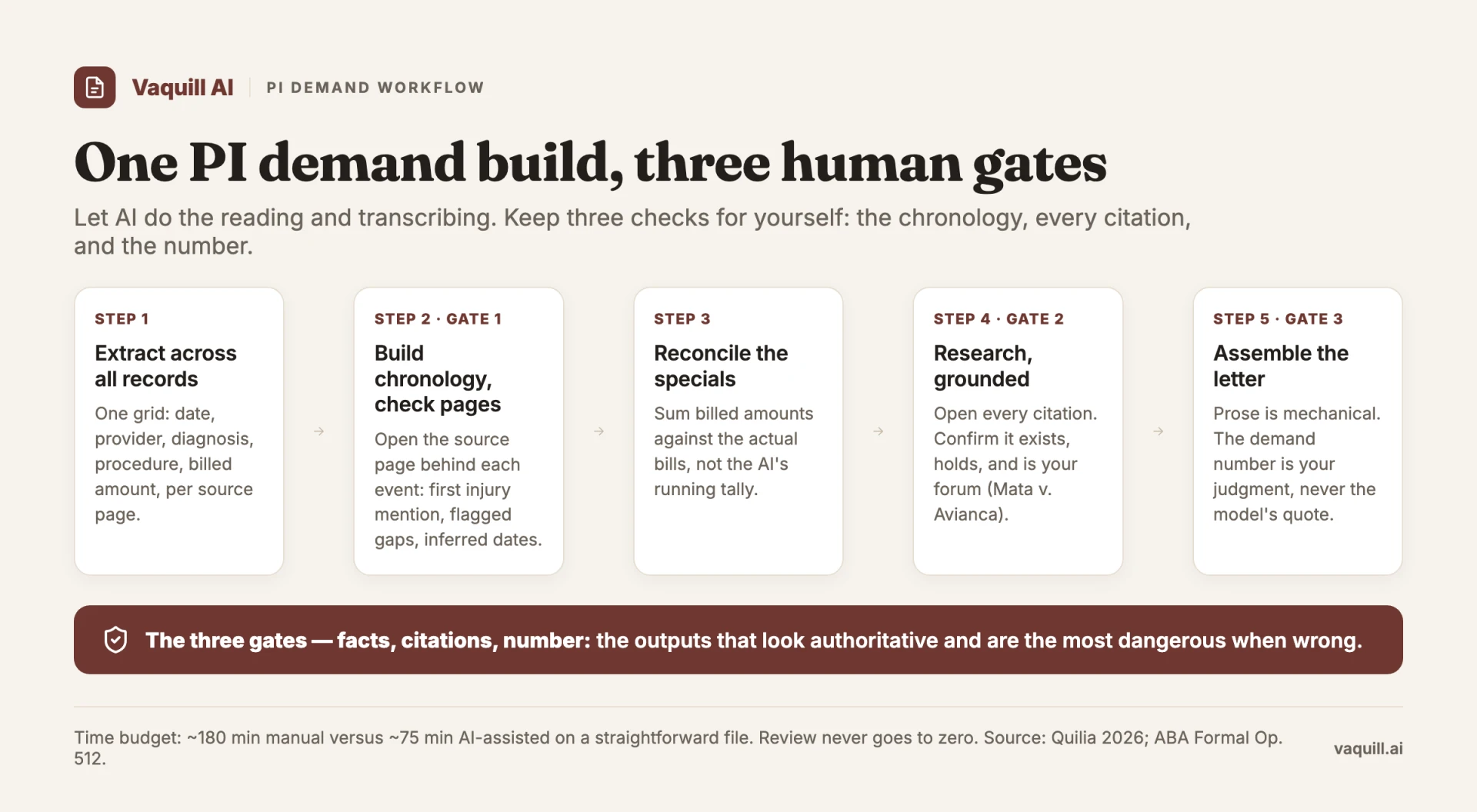
The five-step demand build, with the three human gates that catch the outputs AI gets confidently wrong: the facts, the citations, and the number.
That source-page link is what makes the next two steps verifiable instead of faith-based.
Step 2: Auto-build the medical chronology, then check it against the pages
Feed the extracted events into a timeline. Medical chronology AI is the part of the workflow that turns hundreds of unsorted pages into a dated treatment history. A Chronology Builder assembles the dated events into an ordered sequence, flags gaps longer than your threshold, and shows the provider-by-provider order. You review and correct rather than transcribe from scratch.
A finished chronology row carries five fields: the date, the provider, the diagnosis or finding, the procedure or treatment, and a citation back to the source page. Here is what a few real-shaped rows look like (facts illustrative, not from a real file):
| Date | Provider | Diagnosis / finding | Treatment | Source |
|---|---|---|---|---|
| 04/03/2025 | County ER | Cervical strain; lumbar contusion | X-ray, discharge with NSAIDs | ER001, p. 4 |
| 04/11/2025 | Orthopedic clinic | Disc protrusion C5-C6 | Exam, MRI ordered | Ortho007, p. 2 |
| 04/24/2025 | Imaging center | C5-C6 herniation confirmed | MRI cervical spine | Img003, p. 1 |
| 05/02 to 08/15/2025 | PT center | Cervical radiculopathy | 22 PT sessions | PT012, pp. 1-9 |
The source column is what makes the row checkable. Without it you have a clean-looking timeline that nobody can verify, which is the same trap as a one-prompt letter.
This is human gate #1. Do not accept the chronology as drafted. Open the source page behind each event the tool generated, especially:
- The first mention of the injury (your causation anchor)
- Any treatment gap the tool flagged (the defense's favorite argument)
- Any date the model "rounded" or inferred from a partial record
A wrong date in the chronology is not a typo. It is a factual misrepresentation in a demand letter, and it is the kind of thing that surfaces in a deposition six months later when you least want it.
Step 3: Reconcile the specials
Sum the billed amounts from the grid. Cross-check the total against the actual bills, not against the AI's running tally.
Models are confident at arithmetic and occasionally wrong at it, and a specials number that doesn't reconcile to the source bills is the fastest way to lose an adjuster's trust on the whole package.
The specials grid pulls straight from the same extraction. Every line ties to a provider and a date, so the adjuster can audit it without reading the full record set (figures illustrative):
| Provider | Service | Billed |
|---|---|---|
| County ER | Emergency visit and imaging | $8,400 |
| Orthopedic clinic | 6 visits | $4,800 |
| Imaging center | MRI cervical spine | $2,300 |
| PT center | 22 sessions | $5,500 |
| Total specials | $21,000 |
The total has to match the bills to the dollar. If the chronology says PT ran May through August, the specials must show the matching PT billing for that window. A narrative and a damages grid that disagree is the first thing a sharp adjuster pulls on.
Step 4: Research the valuation, grounded
Now the law. You want appellate opinions and reported outcomes involving similar injuries, liability facts, and your jurisdiction.
The hard rule: the research tool surfaces real opinions and verifiable citations. It does not conjure a settlement number. A grounded in-app legal research feature runs over millions of real US court opinions (retrieval over actual case law, not generated from a model's memory), so every case it cites is one you can open and read.
This is human gate #2. Every citation gets opened. Not skimmed in the AI's summary: opened, the holding read, the jurisdiction confirmed. More on why below.
Step 5: Assemble the letter
Only now do you draft prose. The chronology drops in. The itemized specials drop in. The liability narrative is yours. The valuation paragraph cites cases you have personally opened. The letter is mechanical because everything load-bearing is already verified.
The treatment section of the letter is just the chronology rendered as prose, with each sentence tied to a record. A demand excerpt built from the table above reads like this (illustrative facts):
On April 3, 2025, our client presented to the County ER with cervical strain and a lumbar contusion (ER001, p. 4). An orthopedic exam on April 11 found a C5-C6 disc protrusion (Ortho007, p. 2), confirmed as a herniation by MRI on April 24 (Img003, p. 1). She completed 22 sessions of physical therapy from May 2 through August 15 (PT012, pp. 1-9). Past medical specials total $21,000, itemized above and supported by the attached bills.
Every clause points to a page. The adjuster can verify the whole narrative without your help, which is exactly the credibility you want before you state a number.
This is human gate #3: the demand number. AI can hand you a figure. Treat it as a prompt to do your own valuation, never as a quote to type into the letter.
Quilia, a vendor that sells this software, says the quiet part out loud: AI "produce[s] a number, not the right number." The number is your professional judgment, full stop.
Why three gates, and why these three
It would be cleaner to say "just check the AI's work." But "check everything" collapses into "check nothing" when you're behind on a Friday.
Naming the three specific outputs that are both high-stakes and high-hallucination-risk is what makes the discipline survivable.
Gate 1: the chronology against source pages
Because a fabricated or misdated event is invisible in a polished letter. It reads perfectly. It just isn't true, and it's load-bearing for causation and damages.
Gate 2: every citation
This is the one with a sanctions trail. In Mata v. Avianca (1:22-cv-01461, S.D.N.Y., 2023), a personal injury case, lawyers filed a brief with six cases ChatGPT invented and drew a $5,000 sanction plus a national reputation hit.
Quilia's own guide warns that AI demand drafts include cases that "don't exist" or are "from the wrong jurisdiction." And ABA Formal Opinion 512 (July 2024) put verification squarely in the duty of competence: it is not optional diligence, it is the rule. We wrote up the full sanctions pattern and how to gate against it in AI hallucinations and legal research sanctions.
The wrong-jurisdiction failure is sneakier than the fake-case one. A real California opinion cited in a New York demand looks completely legitimate until opposing counsel notices. Open every citation. Confirm it exists, confirm it stands for what you're claiming, confirm it's your forum.
Gate 3: the number
Because the demand figure is the one output where being confidently wrong costs your client money directly, either by anchoring too low or by torching credibility too high. No model knows your adjuster, your venue, or the soft-tissue-versus-surgery reality of this specific plaintiff. You do.
This is a documented design pattern
If the human-gate model sounds like vendor hand-waving, look at who else builds it that way. Stanford's Justice Innovation program, working with the Legal Aid Society of San Bernardino, built an AI demand-letter assistant whose success criterion was output "indistinguishable from a competent housing attorney."
Their lawyers specifically reviewed for hallucinated facts and case law and checked that statutory quotes were "precisely correct."
That is the same three-gate discipline applied to a different practice area by a research institution with no product to sell. The pattern is real practice. The verification step is the design, not a disclaimer bolted onto the bottom of a sales page.
What most people get wrong
Two errors, and they're the expensive ones.
First, they treat the letter as the deliverable and prompt for prose. They type "draft a demand letter for a rear-end collision with $42,000 in specials" and edit what comes back.
The output reads well and is built on nothing checkable. There's no grid, no source-page links, no chronology you can verify. You've outsourced the wrong 80 percent and kept the easy 20.
Second, they trust the AI's citations and its number. These are precisely the outputs engineered to look authoritative.
A hallucinated case is formatted exactly like a real one. A made-up settlement value carries the same confident tone as a defensible one. The polish is the hazard.
On the vendor field, honestly
PI lawyers have options in 2026, and they should know them. ProPlaintiff AI, Tavrn, and AI Demand Pro all market AI demand-letter and chronology drafting. They are real tools and some firms get value from them.
The honest critique is that most of them are single-slice point tools: one does chronologies, another does demand drafts. The PI reality is that the artifacts feed each other.
Extraction feeds the chronology, the chronology feeds the specials, the specials and the research feed the letter. When those live in separate apps, you spend your savings re-uploading and reconciling across tools, and every handoff is a new place for a date to drift.
That is the case for doing it in one suite rather than stitching point tools: the document matrix grid, the chronology builder, grounded legal research, and the drafting step chained as one workflow, so the verified chronology that you signed off on is the same object the letter draws from.
For the broader PI tooling picture beyond the demand, see seven concrete uses of AI for personal injury lawyers and our comparison of AI software for plaintiff law firms, which ranks the chronology and demand tools side by side.
The one rule
If you remember nothing else: the chronology and the damages grid are the load-bearing artifacts, and the letter is downstream of them. Put your human gates on the facts, the citations, and the number.
Let AI do the reading and the transcribing, which is most of the hours, and keep the judgment for yourself, which is the part that has your name on it.
If you want to run this whole sequence in one place, the Chronology Builder, Document Matrix, grounded legal research, and drafting live as one Vaquill AI workflow, so the chronology you signed off on is the same object the letter draws from. No re-uploading between point tools, no date drifting at a handoff.
FAQ
How do you write a personal injury demand letter with AI? Run five steps. Extract every treatment event from the full record set into a grid, auto-build the medical chronology and check it against source pages, reconcile the itemized specials against the bills, research the valuation over real case law, then draft the letter last. The chronology and the specials are the deliverable. The letter is the wrapper around them.
What is medical chronology AI? It is software that ingests unsorted medical records (PDFs, faxes, scans, handwritten notes) and uses OCR and natural-language processing to extract dates, providers, diagnoses, and procedures, then orders them into a dated treatment timeline. Each row should cite the source page so you can verify it. It replaces the hours of reading and transcribing, not the attorney review.
Can AI write the whole demand letter for me? It can produce a finished-looking draft, but the two outputs you must never accept as-is are the legal citations and the demand number. AI hallucinates cases and cites wrong-jurisdiction opinions, and it produces a number, not the right number. Open every citation and set the figure yourself.
How long does an AI demand letter take versus doing it by hand? On a straightforward file, roughly 180 minutes manual versus around 75 minutes AI-assisted, per Quilia's 2026 breakdown. The savings come from extraction and chronology assembly. Liability narrative and review stay roughly the same because that is the judgment AI does not replace.
What fields go in a medical chronology? Date, provider, diagnosis or finding, procedure or treatment, and a citation to the source page. The source citation is the field that matters most: it is what lets you, and the adjuster, verify each event against the actual record instead of trusting a clean-looking timeline.
Why do AI legal citations get lawyers sanctioned? Because a hallucinated case is formatted exactly like a real one. In Mata v. Avianca (S.D.N.Y., 2023), lawyers filed a brief with six cases ChatGPT invented and drew a $5,000 sanction. ABA Formal Opinion 512 (July 2024) makes verifying AI output part of the duty of competence. The fix is opening every cite and confirming it exists, says what you claim, and is in your forum.
Should AI set the demand number? No. Treat any figure the model hands you as a prompt to do your own valuation. No model knows your adjuster, your venue, or the soft-tissue-versus-surgery reality of this plaintiff. Anchoring too low costs your client money; too high torches credibility.
What is the difference between a medical chronology and a medical summary? A summary describes the treatment in narrative form. A chronology orders every event by date with the provider, diagnosis, and a source citation, which is what makes it usable in a demand and checkable by the defense. The chronology is the structure adjusters and opposing counsel actually audit.
New legal AI guides, weekly.
Further Reading
What Is NDA Triage? How Lawyers Sort Inbound NDAs in Minutes With AI
Read postNDA Triage AI: How AI NDA Review Works and How to Evaluate a Tool (2026)
Read postTop 12 Legal Redline Software Tools (2026)
Read postHow to Build an NDA Playbook Your AI Can Actually Enforce
Read postLegal AI Workflows: How Law Firms Chain Multi-Step AI Tasks in 2026
Read postLegal Research Agent: What Agentic AI Agent Mode Actually Does (and Where It Breaks)
Read post
Co-Founder & CEO · Attorney
Arshita leads product and strategy at Vaquill AI, the US primary law data API. As an attorney, she decides which law we carry, how each section is sourced and cited, and what legal AI and compliance teams need from the data.