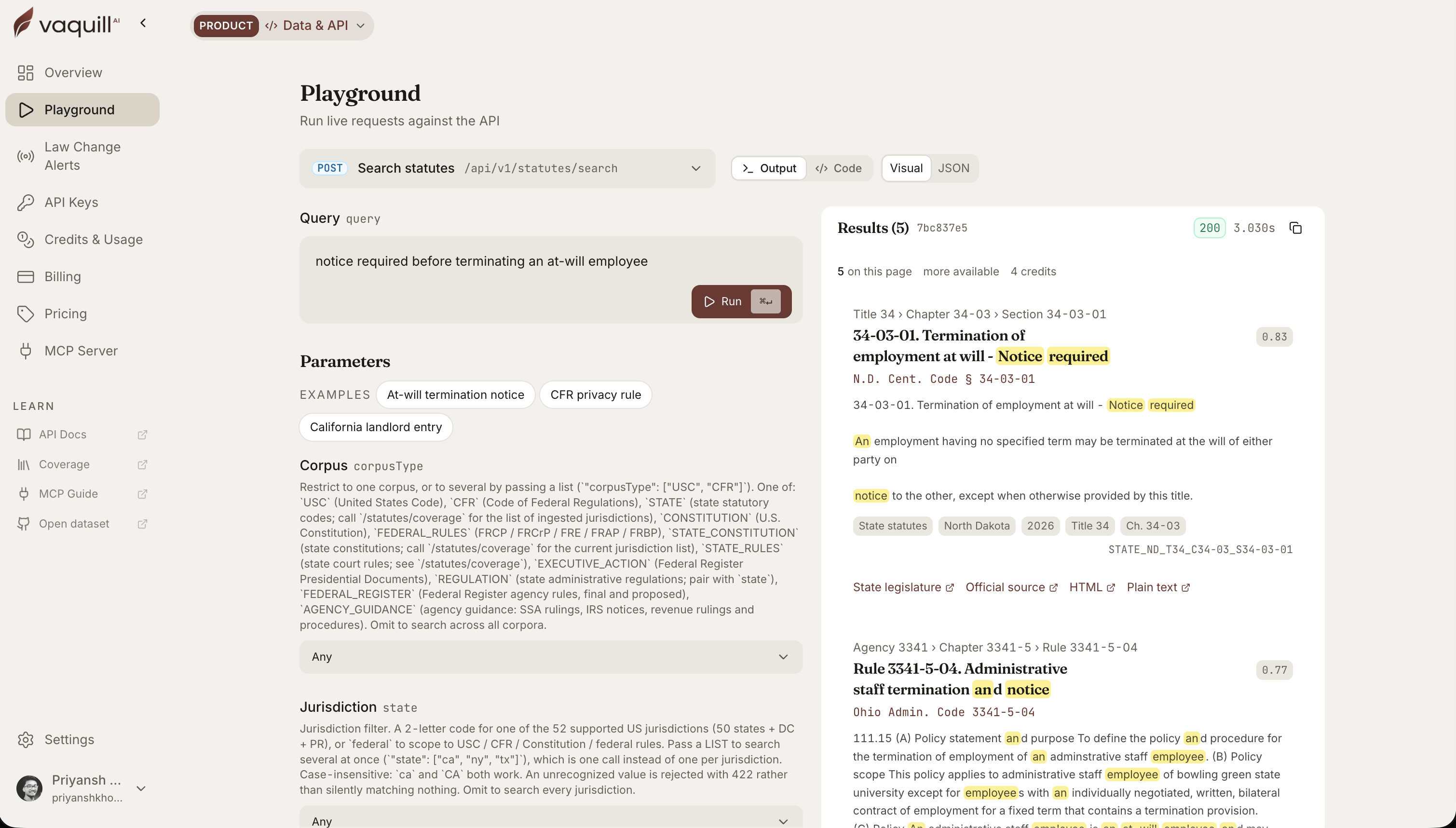
 The same corpus behind this article, queried live. Every result carries its citation and a link to the official source.
Legal AI workflows are short, inspectable chains of AI steps (retrieve, extract, compare, draft, verify) that complete a real legal task end to end, with a lawyer approving at each seam. They are how firms automate legal tasks with AI beyond a single prompt: legal workflow automation turns the copy-paste shuffle between systems into one grounded pipeline you can audit. The rest of this guide shows four real chains, where the human gates go, and when to build versus buy.
The week "legal AI is dead" trended
At the end of April, Legora's CEO Max Junestrand stood up and said legal AI was dead, then in the same breath launched what the company called an agentic operating system for legal work. TechCrunch covered it on April 30.
A few weeks earlier, in March, Harvey had raised $200 million at an $11 billion valuation and Legora $550 million at $5.55 billion. Legora crossed $100 million in ARR. The headlines made it sound like a model breakthrough. It was not.
What actually changed is the unit of work. The 2026 frontier in legal AI workflows is not a smarter model answering a single question. It is connectivity and orchestration: chaining retrieval, extraction, comparison, and drafting into auditable multi-step pipelines, with a human approving at the seams.
The model got good enough two years ago. The bottleneck moved to plumbing, and most firms have not noticed because they are still typing one prompt at a time into a four-figure-per-seat chat box and treating it like a fancy search engine.
This post is the layer above the buy decision. If you want the build, the Claude + MCP stack walkthrough covers one concrete pattern, and what the incumbent suites actually cost covers the cost side. This one is about why workflows beat single prompts at all, and what a real chain looks like when a partner has to sign their name to the output.
TL;DR
- Single-prompt legal AI has plateaued. The next gain comes from orchestration, not a bigger model.
- A real firm workflow is a short, inspectable chain: retrieve, extract to a grid, compare, build a timeline, draft, then cite-check, with grounding at every step.
- The constraint in 2026 is the "context gap" and "action gap," not model IQ. If a human has to manually bridge every system, the time saved on the task gets eaten by setup.
- Full autonomy is the marketing. Supervised chaining with a human gate before anything leaves the building is the practice.
- Chaining ungrounded steps multiplies hallucination risk. A confident fake citation in step four is worse than no answer at all.
- You do not need a four-figure-per-seat suite to build this. You need the right architecture and grounding at each node.
If each step in a five-step chain is 95 percent reliable, roughly how reliable is the chain end to end?
Part of our document tools, redline, and matrix guide series.
For related document-tools coverage, see Autonomous Legal Research: What Agent Mode Actually Does (and Where It Breaks) and Which Legal AI Is Best in 2026? A Capability Comparison of Agentic Suites, and a legal AI agent running one in-house task end to end.
Where single prompts stop working
Try this in any chat tool. Paste a question: "Does our use of these images qualify as fair use?" You get back a tidy paragraph about the four factors under 17 U.S.C. 107, maybe a citation to a famous case, and a confident tone.
It reads like an answer. It is not one. It has not seen your images, your licenses, the twelve agreements in the matter folder, or the actual holdings of the cases it name-dropped.
Single prompts are good at one thing: producing fluent text about a closed question with all the context already in the window. Legal work is almost never that. It is open, it spans dozens of documents, and the answer depends on facts that live in systems the chat box cannot see.
So lawyers do what they have always done: they become the integration layer. They copy a clause out of one PDF, paste it into the chat, copy the response into a memo, go back for the next clause, and repeat. The model is fast. The human shuttling context between systems is not.
Artificial Lawyer put a name to this on June 2, in a piece framing MCP (the Model Context Protocol) as the equivalent of HTTP for AI-to-system integration. They describe two gaps. The "context gap" is the model not knowing what it needs to know about your matter. The "action gap" is the model not being able to do anything in the systems where work actually happens.
Their line is the one worth taping to your monitor: when every AI interaction requires a human to act as the bridge between systems, the time saved on the task is partly or wholly consumed by the time spent on context-setting.
That is the real ceiling. Not "the model is not smart enough." The model is plenty smart. It is sealed in a jar.
What most people get wrong about legal AI workflows
Two failure modes dominate, and they are opposites.
The first is treating "workflow" as a synonym for "better prompt." People attend a CLE, learn to write a 600-word mega-prompt with role-playing and step-by-step instructions, and call it a workflow. It is not. It is one inference call with a longer input.
Everything still happens in a single opaque pass, you cannot inspect the intermediate reasoning, and if step three is wrong you cannot see it, you just get a wrong final answer that sounds right.
The second failure mode is the fantasy of one long autonomous agent run. Point an agent at a matter, let it churn for twenty minutes, come back to a finished brief. This is what the funding-round headlines sell.
In practice, an unsupervised chain compounds errors. If each step is 95 percent reliable, a five-step chain is around 77 percent reliable end to end, and you have no idea which link broke. Worse, an autonomous run that hits a dead end will confabulate its way past it rather than stop, because stopping is not what these systems are trained to do.
Real firm workflows live between those extremes. They are short chains of discrete, inspectable steps, each one grounded, with a human gate before anything consequential leaves the building. Supervised chaining, not full autonomy, is the working practice in 2026.
The vendors who understand this build seams into the product on purpose. The ones who do not ship a magic button and hope.
A concrete pipeline: the fair-use memo
Let me make this real with a chain a litigation or IP associate actually runs. Take the fair-use question from earlier and break it into nodes.
Step 1: Ground the law. Pull the actual text of 17 U.S.C. 107 and the leading opinions, with retrieval-augmented generation so the model reasons over real statutory and case text rather than its training memory. This is the difference between a model that recites the four fair-use factors from pattern memory and one that quotes the section and cites opinions you can open.
The statute side is what a public statutes-and-regulations API exposes: U.S. Code, CFR, and 50-state codes you can fetch programmatically. The case grounding is in-app product, not a public endpoint, and the distinction matters because grounding on opinions is exactly where the hallucination risk concentrates.
Step 2: Extract to a grid. Now bring in the matter documents: licenses, prior agreements, takedown correspondence. Instead of pasting one at a time, run them through a document matrix that extracts the same fields across every document into a table. Which agreements grant image rights. Which are silent. Which carve out editorial use.
This is the single biggest leap past single-prompt chat, because chat reads one document at a time and a matrix reads thirty into tabular form you can scan in seconds.
Step 3: Build the timeline. Feed the extracted dates into a chronology builder. When was each license signed, when did use begin, when did the demand letter arrive. Fair use turns on facts, and facts have an order.
Step 4: Compare and check. Run a compliance check against the grid, and where you are revising a license, use document comparison to produce a clean redline rather than eyeballing two versions.
Step 5: Draft, then verify the cites. Only now does the model draft the memo, grounded in the outputs of every prior step. And the last node is non-negotiable: every citation gets verified against the source before a human reads it, because a chain that ends in an unverified citation is a chain that ends in a sanction.
Notice the shape. Five discrete steps, each one inspectable, each one grounded, with the associate able to stop and correct at any seam. That is a workflow.
The mega-prompt version does all of this in one invisible pass and hands you a memo you have to reverse-engineer to trust.
Three more workflows lawyers actually run
The fair-use memo is one shape. Here are three more chains that show up in almost every legal team, each broken into steps with the human gate marked. Read these as templates: the nodes change, the discipline (ground each step, gate before it advances) does not.
NDA intake to signature
The highest-volume contract most teams touch. A single prompt can summarize one NDA. A workflow runs the whole intake-to-signature path.
- Intake. A request lands by email, a form, or a shared inbox, with the counterparty paper attached. The chain extracts party names, effective date, and term into structured fields.
- Triage against the playbook. The draft is scored against your standard positions: mutual vs one-way, term length, governing law, carve-outs. This is the NDA triage node, and it flags only the clauses that deviate.
- Human gate. A lawyer reviews the flagged deviations. Standard NDAs route to fast approval; anything off-playbook stops here.
- **Redline.
- Human gate, then route to signature. Counsel signs off on the redline before it leaves the building.
The win is not "AI read the NDA." It is that a third-year stops hand-checking 40 routine NDAs a week and reviews only the handful that actually deviate.
Contract review to risk matrix
Due diligence and portfolio review, where the unit of work is dozens of contracts at once.
- Load the set. Point the chain at a data room or contract folder.
- Extract to a grid. A document matrix pulls the same fields out of every agreement: assignment, change of control, termination, liability cap, auto-renewal. Thirty contracts become one scannable table instead of thirty separate reads.
- Score and rank. Each row gets a risk flag against your standard, so the worst paper surfaces first. See the bulk contract review walkthrough for the populated-grid version.
- Human gate. A lawyer spot-checks the extractions on the high-risk rows before any of it feeds a report. Garbage in step two becomes a garbage memo in step five, so this gate is not optional.
- Draft the summary. The reviewed grid feeds a diligence memo or a redline plan, grounded in the cells a human already verified.
Research to memo
The classic associate task, and the one most exposed to hallucination if you skip grounding.
- Frame the question and ground the law. Pull the controlling statute and the leading opinions with retrieval-augmented generation so the model reasons over real statutory and case text instead of training memory.
- Synthesize. The chain drafts the analysis section by section, each tied to a retrieved source.
- Human gate. Counsel reads the synthesis and confirms the framing before drafting goes further. This is where agent mode earns or loses trust: an unsupervised run will confabulate past a gap rather than stop.
- Cite-check. Every citation is verified against its source. A memo that ends in an unverified cite is a memo that ends in a sanction.
- Human gate. A person signs before it reaches a client or a court.
Why every node needs grounding, not just the last one
Here is the part the autonomy crowd glosses over. In a chain, errors do not just persist, they propagate. If step two extracts a clause wrong, step four compares against garbage, and step five drafts a confident memo built on it.
The further down the chain a fake fact travels, the more authoritative it looks, because by the time it reaches the draft it has been "confirmed" by three prior steps that never actually checked anything.
The legal field already learned this lesson the expensive way. In 2023, lawyers in Mata v. Avianca filed a brief with six cases that did not exist, hallucinated by ChatGPT and never verified. The screenshot of the sanctions order is still in CLE decks.
It keeps happening. As recently as this spring, Fortune reported on May 12 that Sullivan & Cromwell submitted a bankruptcy filing with fictitious citations and apologized for the hallucinations. Eve's CEO Jay Madheswaran put it cleanly in that piece: in litigation, an authoritative-sounding hallucination is worse than no answer.
ABA Formal Opinion 512, from July 2024, makes the duty explicit. Competence and candor do not get suspended because a machine drafted the thing.
And note who is going all in anyway. The same Fortune reporting had Freshfields, Quinn Emanuel, and Holland and Knight building on Claude, more than 20,000 people registered for Anthropic's legal webinar, and Claude Opus 4.7 scoring 90.9 percent on Harvey's BigLaw Bench.
The frontier firms are not betting against AI. They are betting that grounding and verification, the unglamorous parts, are what make it filable. We wrote a whole piece on how hallucinations turn into sanctions and why a verification node belongs at the end of every chain.
The short version: a workflow without grounding at each step is not faster, it is faster at being wrong.
This is a procurement and architecture decision
The mental model that wins in 2026 is treating legal AI as an architecture choice, not a chatbot subscription. Ask the questions you would ask of any system that touches client work. Where does grounding happen, and on what corpus. Can I see the intermediate steps. Where are the human gates. What happens to a citation between the model generating it and a person reading it. Does the tool connect to the systems where my work lives, or am I still the integration layer.
Cost makes the stakes concrete. Across our costs and pricing-reality coverage, Harvey runs $1,200 to $2,000+ per user per month and Legora $300 to $800 per user per month, both for unlimited AI usage, both bundled products with per-feature add-ons that set the per-user price, and both now offering a pay-as-you-go, credit-metered plan.
The top-voted contrarian take in the r/legaltech threads is blunt: a thin wrapper over retrieval and a foundation model, and paying four figures per user per month for it is comedy. That is overstated, the good suites do real orchestration. But the underlying point holds.
What you are paying for is the workflow architecture, the grounding, and the seams, not the model, because the model is the same family everyone licenses. If a vendor cannot show you the chain, you are paying premium prices for a search box.
Build vs buy
Once you see workflows as architecture, the next question is whether to assemble your own or pay for a suite. The honest answer depends on how much your work deviates from the templates above.
Buy a suite when your workflows are common (NDA triage, contract review, research memos), you have no engineering help, and you want grounding and audit trails out of the box. The tradeoff is price (Harvey runs $1,200 to $2,000+ per user per month, Legora $300 to $800, per our pricing-reality coverage) and workflows shaped to the vendor's idea of your job.
Build (or assemble) when your matter types are unusual, you already have a developer or a willing ops lead, and you want to own the corpus the AI grounds on. The build-vs-buy breakdown for in-house teams and the internal legal copilot guide cover the assemble path: open protocols like MCP let you wire your own document store, statute API, and review steps into a chain you control, without writing a model from scratch.
Most teams land in the middle: buy for the high-volume common chains, assemble the one or two workflows that are specific to how your firm actually works. Gartner projects over 40% of agentic AI projects will be canceled by the end of 2027 (Gartner press release, June 2025), and the ones that survive are the scoped, gated, grounded ones, not the "point it at everything" bets.
A single well-built node still beats a single prompt. Our writeups on NDA triage and contract review are each one node in a larger chain, and even alone they save real hours.
But the compounding value shows up when nodes connect: retrieval feeds extraction, extraction feeds comparison, comparison feeds the draft, and a human signs at the end. For most law firms, that connected chain, not a bigger model, is the entire 2026 opportunity.
Where this is heading
The funding rounds and the "operating system for legal work" language all point one direction. The next two years are about closing the context and action gaps: tools that can see your matter and act in your systems without a human copy-pasting between them, MCP and its successors doing for legal AI what HTTP did for the web.
The model wars are mostly over. The orchestration wars are just starting.
The firms that win will not be the ones who bought the most expensive seat. They will be the ones who treated their workflow as a designed system: grounded at every node, inspectable at every step, and gated by a human before anything goes out the door.
The chatbot was the demo. The chain is the product.
FAQ
What are legal AI workflows?
Legal AI workflows are multi-step chains where AI handles discrete tasks (retrieve law, extract fields, compare documents, draft, verify citations) in sequence, with a lawyer reviewing at each seam. They differ from a single prompt because each step is grounded on real text and inspectable, so an error fails loudly instead of arriving hidden in the final draft.
What is legal workflow automation?
Legal workflow automation is using software to run the repeatable process steps between a lawyer and their billable work: intake, routing, approvals, document assembly, and review. Older versions follow fixed rules. Newer ones add AI that reads context and chains several steps, but the reliable ones still gate a human before anything consequential goes out.
Which legal tasks can you automate with AI?
The first wins are high-volume and repeatable: NDA triage, contract review across a data room, deadline extraction from court documents, first-draft research memos, and template-based document generation. Strategy, client advice, and anything filed with a court stay human decisions; AI prepares the draft, a lawyer signs it.
Is automating legal work with AI safe?
It is safe when each step is grounded on real source text and a person reviews before the chain advances. It goes wrong when an ungrounded step invents a fact that later steps treat as confirmed. The 2023 Mata v. Avianca sanctions and a 2025 Sullivan and Cromwell filing with fictitious citations (Fortune, May 2025) both came from skipping the verification step.
What is the difference between agentic AI and a legal AI workflow?
Agentic AI describes a system that plans and executes steps with some autonomy. A legal AI workflow is the disciplined version: the same step-chaining, but with grounding at every node and a human gate before consequential output. Full autonomy is the marketing; supervised chaining is the working practice in 2026.
Should a legal team build or buy legal AI workflows?
Buy a suite for common chains (NDA triage, contract review, research) if you want grounding and audit trails out of the box and can absorb four-figure-per-seat pricing. Build or assemble (using open protocols like MCP) when your matter types are unusual and you want to own the corpus the AI grounds on. Most teams buy for the common chains and assemble the one or two that are specific to their firm.
Do legal AI workflows replace lawyers?
No. They remove the copy-paste shuffle between systems and the routine first pass, so a lawyer reviews the handful of items that actually need judgment instead of hand-checking every one. Every chain still ends with a person signing their name.
New legal AI guides, weekly.
Further Reading
Top 13 Legal Redline Software Tools (2026)
Read postHow to Build an NDA Playbook Your AI Can Actually Enforce
Read postHow to Build a Document Matrix to Compare Contracts, Leases, and Filings
Read postHow to Compare Documents and Export Clean Redlines (Step-by-Step)
Read postBulk Contract Review: How to Review Many Contracts at Once With a Document Matrix
Read postLegal Document Version Control: Which Platforms Track Versions
Read post
Product & Content
Legal AI suite for US working lawyers: research, drafting, document comparison, document matrix, matters, and citation-verified answers, in one tool.