Ask a legal-tech founder whether AI can analyze legal documents and you will get a confident yes. Ask a litigator who got sanctioned and you will get a longer answer. The honest version sits between them, and the honest version is the whole story.
Can AI analyze legal documents? Yes. But the useful answer is narrower than the marketing one, and the narrowness is exactly where the value lives.
AI is not impressive because it can read a single contract and tell you what the indemnity clause says. A second-year associate can do that, and so could a decent keyword search.
AI gets genuinely valuable when you point it at fifty near-identical contracts and ask the same set of questions across all of them at once, with every answer traced back to the clause it came from, and a human spot-checking a subset before anyone relies on it.
That last part is not a disclaimer you scroll past. As of 2024 it is a stated professional-conduct standard.
So the real answer to "can AI analyze legal documents" is: yes, at scale, if every cell is traceable and you verify a sample. Here is why the scale matters more than the comprehension, and why the verification step is the thing that makes the rest legitimate.
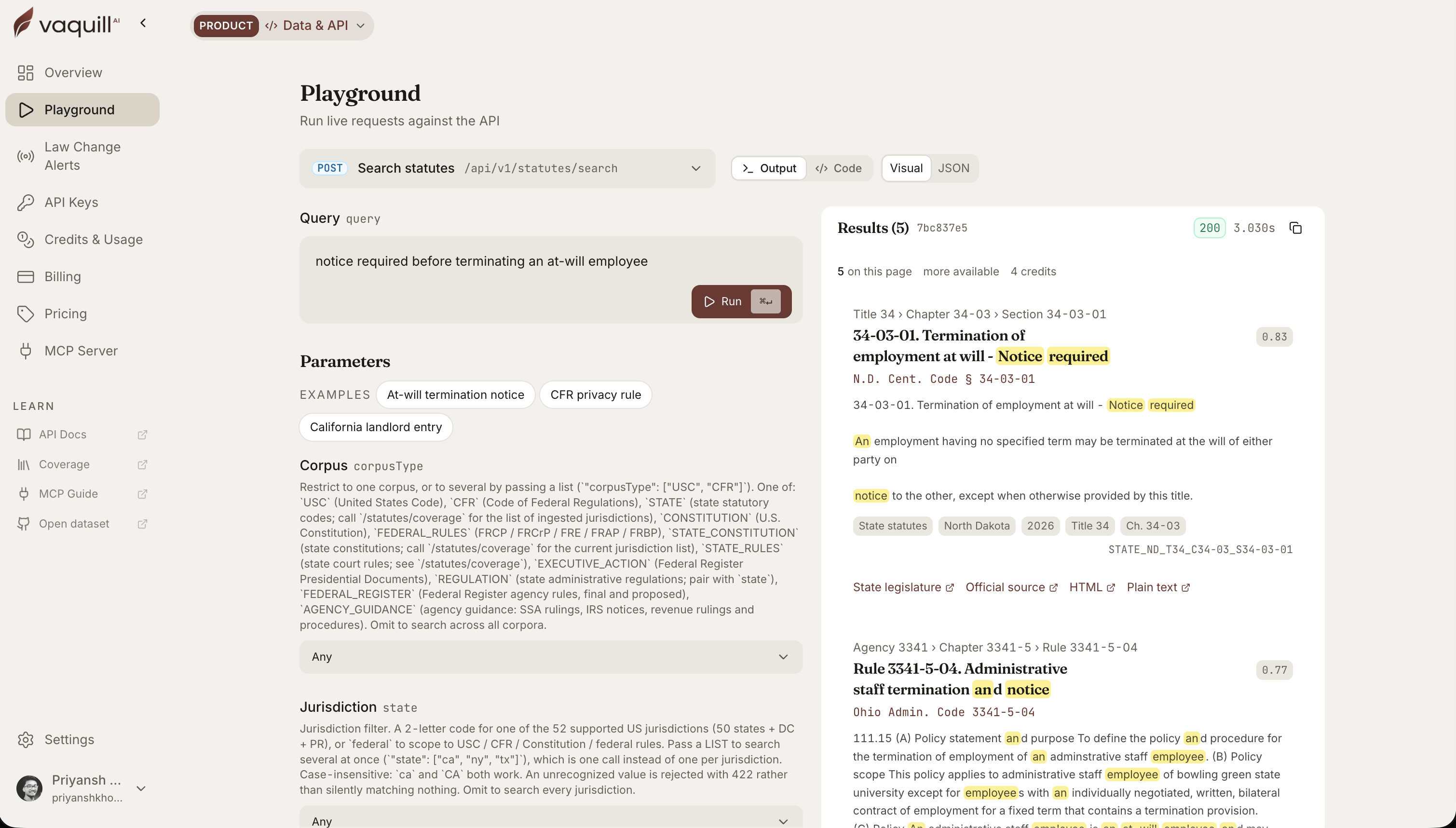 The same corpus behind this article, queried live. Every result carries its citation and a link to the official source.
TL;DR
- Yes, AI can analyze legal documents. The honest version is "yes, at scale, with verification," and both halves matter.
- The 2023 to 2024 hype sold a single-document chat window. The work that actually drains legal teams is comparison across dozens of similar documents, not comprehension of one.
- The real unlock is collapsing the integration step: holding your questions constant and running them down a whole stack, with per-cell citations.
- Verification is not optional. Stanford found leading legal-AI tools returned incorrect information 17 percent to 34 percent of the time, and ABA Formal Opinion 512 makes spot-checking a subset a competence obligation.
- A live example: U.S. auto-renewal compliance is a fragmented fifty-state patchwork, not one rule. Matching your contracts against the actual statutes is exactly the job a matrix plus a current statute lookup solves.
In the Stanford RegLab and HAI benchmark cited here, how often did leading legal research tools return incorrect information?
Part of our document tools, redline, and matrix guide series.
For related document-tools coverage, see Reviewing 50 Contracts at Once: Bulk Clause Extraction With a Document Matrix and What Is a Document Matrix? Extract the Same Fields Across Dozens of Docs.
The question is wrong, slightly
"Can AI analyze legal documents" usually smuggles in an assumption: that "analyze" means "chat with one PDF." Upload a contract, ask it questions, read the answers.
That is the picture the first wave of products sold, and it is a real capability. For the one bespoke agreement you are negotiating clause by clause, a focused conversation is the right interface. Nobody should drop a unique joint-venture agreement into a grid and walk away.
But that is not where the hours go. The hours go to volume. A mid-size company running 500 vendor agreements a year burns roughly 1,250 lawyer hours on review alone, a number we walked through in our guide to AI contract review.
The expensive part of that work is almost never understanding any single document. It is the repetition: reading the forty-third NDA and asking, for the forty-third time, what the survival period is and whether the carve-out language is standard.
Single-document chat does nothing for that. It makes each of the forty-three conversations slightly faster while leaving you to run forty-three conversations and hand-transcribe each answer into a spreadsheet. The interface fights the task.
So when someone asks whether AI can analyze legal documents, the honest reframing is: the question that matters is whether AI can analyze a set of documents, consistently, in one pass. That is a different and harder capability, and it is the one worth buying.
Multi-doc extraction, not single-doc chat
Flip the axis. Instead of holding one document constant and asking it a hundred questions, hold the questions constant and run them across the whole stack.
Documents become rows. Questions become permanent columns: governing law, liability cap, auto-renewal notice window, indemnity scope. The output is not a conversation. It is a grid you can sort, filter, and scan for the three rows that deviate.
That structure is the point, because structure is sortable. Three rows into a comparison grid, the contract with uncapped liability and no renewal-notice clause already jumps out of the column.
Run the same grid across fifty rows and the workflow holds: the deviations are visually obvious, and everything that conforms clears in a single pass. This is what tools like the Document Matrix are built for, and it is where AI stops being a faster typewriter and starts replacing the most expensive line item in legal operations, which is bulk human review.
If you want the mechanics of how that grid is actually built, what makes a column definition hold across heterogeneous documents, how absence is distinguished from error, the difference between a real matrix and a demo, we wrote a dedicated deep-dive on what a document matrix is and how it works.
This post is about the broader question, whether AI can do this work at all and what makes the "yes" defensible. The short version of the mechanism: every cell points back to the source clause, and the system tells you when a field is genuinely missing rather than guessing. Hold onto that, because it is the bridge to the part most people skip.
It is worth saying that this is not a novel invention. The serious tools converged on the grid because the grid matches the work.
CoCounsel ships review tables. Legora built its whole differentiation around a spreadsheet view of a contract stack. We compared what they charge for it in our breakdown of Harvey, Legora, and CoCounsel pricing. The category agrees on the interface. The disagreement, and the thing worth scrutinizing, is whether the cells hold up.
The "with verification" half is not a caveat
Here is where the honest answer earns its keep.
In May 2024, Stanford's RegLab and HAI ran a benchmark against the leading legal research tools that claimed to be "hallucination-free." The results, later peer-reviewed in the Journal of Empirical Legal Studies, were not kind.
Lexis+ AI and Thomson Reuters' Ask Practical Law AI returned incorrect information more than 17 percent of the time. Westlaw's AI-Assisted Research did worse, more than 34 percent. The researchers concluded the vendors' accuracy claims were "overstated." You can read the Stanford HAI writeup directly.
Sit with those numbers in the context of a fifty-row grid. If a tool is wrong one cell in six, a fifty-document, four-column extraction has 200 cells and, on average, more than thirty of them are wrong.
Volume does not dilute error. It multiplies it. The instinct that "more documents means more confidence" is exactly backward when the cells are not traceable.
This is why per-cell, clickable provenance is not a nice-to-have feature. It is the entire ballgame. A cell you cannot click back to source is a cell you cannot trust, and at scale you have hundreds of them.
Then there is the professional dimension. In 2023, two lawyers in Mata v. Avianca filed a brief full of cases ChatGPT had invented, and a federal judge sanctioned them.
It is the permanent reminder that unverifiable model output is worse than no output, because it carries false confidence. We unpacked the pattern and the sanctions that followed in our piece on AI hallucinations and legal-research sanctions.
The bar association drew the line explicitly. ABA Formal Opinion 512, issued in July 2024, says that uncritical reliance on generative AI without an "appropriate degree of independent verification" can breach a lawyer's duty of competence.
And, crucially for the matrix workflow, it goes the other way too: for reviewing or summarizing long contracts, a lawyer need not re-review every document by hand if the lawyer tested the tool's accuracy by manually reviewing a smaller subset. We broke down what that opinion means for daily practice in our guide to ABA Opinion 512.
Read that carefully, because it is the most useful sentence in the entire legal-AI ethics conversation. The ABA did not ban the at-scale workflow. It blessed it, on one condition: spot-check a column.
Pull ten of your fifty rows, verify them against the source clauses, and if the tool holds up on the sample, you do not have to manually re-read the other forty. That is not a limitation on the technology. That is the operating manual for using it competently.
The verification step is what converts "the AI looked at fifty contracts" into "a lawyer competently reviewed fifty contracts." If you want a practical routine for it, we wrote one on how to verify AI legal citations before filing.
So when the brief from your vendor says "hallucination-free," treat it as marketing until someone shows you the audit.
The defensible posture is not blind trust and it is not blanket refusal. It is traceable extraction plus a human sample. That is the whole answer.
A fresh example: the fifty-state auto-renewal patchwork
Abstractions are easy to nod at. Here is a concrete one that shows why multi-doc extraction and a current statute lookup belong in the same workflow.
Auto-renewal clauses are everywhere in vendor and subscription contracts, and the law governing them is not one rule. It is a fragmented, state-by-state patchwork that has been shifting fast, with each state imposing its own notice requirements before an evergreen clause is enforceable against the customer. A few that we verified against current statutory text:
- New York (General Business Law § 527-A) sets its own notice regime for automatic renewals.
- Maine (10 M.R.S. § 1210-C, enacted 2025) adds notice obligations that took effect in 2025.
- Maryland (Commercial Law § 14-1329) takes effect June 1, 2026, so a sweep run today has to account for a rule that is not yet live.
- Connecticut (Conn. Gen. Stat. § 42-158ff) and New Jersey (N.J. Stat. § 56:12-95.5, with a 30-to-60-day notice window) each set different windows again.
Now picture the actual task. Counsel for a company with vendors and customers across multiple states wants to know, across the full contract stack, every agreement that auto-renews and whether its renewal mechanism could survive a challenge under the law of the relevant state.
In a chat tool, that is fifty separate sessions, fifty manually logged answers, fifty separate trips to look up which state's rule applies, and zero confidence you applied the same standard to contract fifty as to contract one.
In a matrix, it is a handful of columns. Here is what three real rows look like once the run finishes, using the statutes above:
| Contract | Auto-renews? | Governing-law state | Notice window in contract | Applicable statute | Compliance flag |
|---|---|---|---|---|---|
| Vendor MSA #12 | Yes | New York | 30 days | N.Y. Gen. Bus. Law § 527-A | Plausibly satisfies |
| SaaS Order #27 | Yes | Maryland | None stated | Md. Com. Law § 14-1329 (effective June 1, 2026) | Flag: no notice clause, rule goes live mid-term |
| Reseller Agt #41 | Yes | New Jersey | 15 days | N.J. Stat. § 56:12-95.5 (30 to 60 day window) | Flag: 15 days falls short of the window |
The first row clears. The other two surface for a lawyer because the grid put the deviation next to the rule it breaks. Run the same columns down all fifty rows, sort by the compliance flag, and the contracts that need a lawyer's eyes float to the top while the ones with a clean notice clause that matches their state's window drop out of scope.
Every cell above is a claim a lawyer can check: click the notice-window cell and land on the renewal clause, click the statute cell and land on the current code text. That is the difference between a grid you can file behind and a grid that just looks tidy.
This is where the two halves of the toolchain meet. The matrix tells you what your contracts say. But the "does this satisfy the rule" column depends on what the law currently requires, and that is a legislation lookup: the actual text of a state code section, current as of today, not a model's vague memory of a statute that may have changed last session.
That grounding is what a statutes and legislation API is built to provide across the U.S. Code, the CFR, and all fifty state codes. The Maryland example is the tell: a tool relying on stale training data would miss that § 14-1329 changes the analysis on June 1, 2026. A live lookup catches it. The flag is only as good as the statute behind it.
This example also makes the verification point land. Even with a clean grid and live statutes, you do not file on the flag alone.
You spot-check: pull the rows flagged as high-risk, click through to the actual contract clauses and the actual statute text, confirm the model read both correctly. That sample is your ABA 512 compliance, and it is the difference between "the AI thinks these twelve contracts are exposed" and "we have identified twelve contracts that need remediation."
What most people get wrong
They conflate "analyze" with "chat with one PDF." Real analysis at the scale that consumes legal teams is cross-document comparison and outlier detection. If your tool can only really tell you about one document at a time, you bought a summary with extra steps, not document analysis.
They treat verification as optional polish. It is the professional standard. ABA 512 makes the subset spot-check a competence obligation, not a nicety. A workflow without a verification pass is not a faster version of the competent workflow. It is a different, riskier thing.
They trust uncited cells. The Stanford numbers are the reason this is fatal at scale. When one cell in six can be wrong, the only thing standing between you and a Mata v. Avianca moment is the ability to click a cell and land on the source. Provenance is not a feature you compare on a checklist. It is the load-bearing wall.
They assume more documents means more accuracy. Volume amplifies error without traceability. Fifty documents through an untraceable tool is not fifty times the insight. It is fifty times the surface area for a hallucination to hide in a cell nobody checks.
So, can AI analyze legal documents?
Yes. With two conditions that are not really conditions so much as the definition of doing it right.
First, the value is in the scale, not the comprehension. Pointing AI at one document is a parlor trick that a junior associate or a good search can match.
Pointing it at fifty and collapsing the integration step, running the same questions down the whole stack and surfacing the deviations, is the thing that actually moves the hours. The interface that does this is the grid, not the chat window, and the broader agentic workflows that chain extraction into multi-step review are the layer being built on top of it now.
Second, the "yes" is only defensible if every cell is traceable and you verify a sample. The Stanford data tells you why uncited output cannot be trusted.
ABA 512 tells you that a subset spot-check is both the floor and, helpfully, the ceiling: do it, and you are practicing competently at scale. Skip it, and you are one hallucinated cell away from the kind of headline no firm wants.
The industry spent two years selling the conversation. The work was always the comparison, and the comparison was always going to need a human reading the receipts on a sample. Get both right and the answer to "can AI analyze legal documents" stops being a debate and becomes a Tuesday afternoon.
FAQ
Can AI analyze legal documents? Yes. AI reads and extracts terms from contracts, briefs, and filings, and it is strongest at bulk document review: running the same questions across many similar documents at once. The output worth buying is a sortable grid where every cell links back to the source clause, plus a human spot-check of a sample before anyone relies on it.
What types of legal documents can AI analyze? Contracts and NDAs, vendor and SaaS agreements, leases, policies, and filings in eDiscovery. It works best on volume sets of similar documents where you ask a fixed set of questions, such as governing law, liability cap, or auto-renewal notice window, across the whole stack. One-off bespoke agreements are better handled clause by clause.
How accurate is AI at reviewing legal documents? Less accurate than the marketing implies. A Stanford RegLab and HAI benchmark (May 2024, later peer-reviewed in the Journal of Empirical Legal Studies) found leading legal research tools returned incorrect information 17 percent to 34 percent of the time. Accuracy is usable only when every answer is traceable to its source and a human verifies a sample.
Can AI do bulk document review at scale? Yes, and that is where it earns its place. Instead of one chat per document, you hold the questions constant and run them down dozens or hundreds of documents in one pass, then sort for the rows that deviate. A 50-document, 4-column run is 200 cells, so traceability matters more, not less, as volume grows.
Can AI replace lawyers in document review? No. AI handles the repetitive extraction and surfaces outliers, but a lawyer still defines the questions, verifies a sample, and makes the judgment calls. ABA Formal Opinion 512 (July 2024) says uncritical reliance without an appropriate degree of independent verification can breach the duty of competence.
Is AI document review accepted in court? Technology-assisted review has been accepted in eDiscovery for over a decade. Generative-AI extraction is newer, and courts have sanctioned lawyers who filed unverified AI output, as in Mata v. Avianca (2023). The accepted posture is AI plus documented human verification, not AI alone.
Do I have to re-read every document the AI reviewed? No, and this is the practical upside of ABA 512. For reviewing or summarizing long contracts, you do not have to manually re-read every document if you tested the tool's accuracy on a smaller subset. Pull a sample, verify it against the source clauses, and the rest clears under competence.
Keep going
- Reviewing 50 contracts at once with a document matrix
- What is a document matrix?
- A lawyer's guide to AI contract review
- How to verify AI legal citations before filing
- The Document Matrix feature
New legal AI guides, weekly.
Further Reading
What Is a Document Matrix? Extract the Same Fields Across Dozens of Docs
Read postDocument Matrix vs Document Comparison: Grid vs Redline
Read postTop 12 Legal Redline Software Tools (2026)
Read postHow to Build an NDA Playbook Your AI Can Actually Enforce
Read postLegal AI Workflows: How Law Firms Chain Multi-Step AI Tasks in 2026
Read postLegal Research Agent: What Agentic AI Agent Mode Actually Does (and Where It Breaks)
Read post
Product & Content
The US primary law data API: statutes, regulations, constitutions, court rules, executive orders and agency guidance across 53 US jurisdictions, each section cited and linked to its official source, via REST, MCP or SQL.